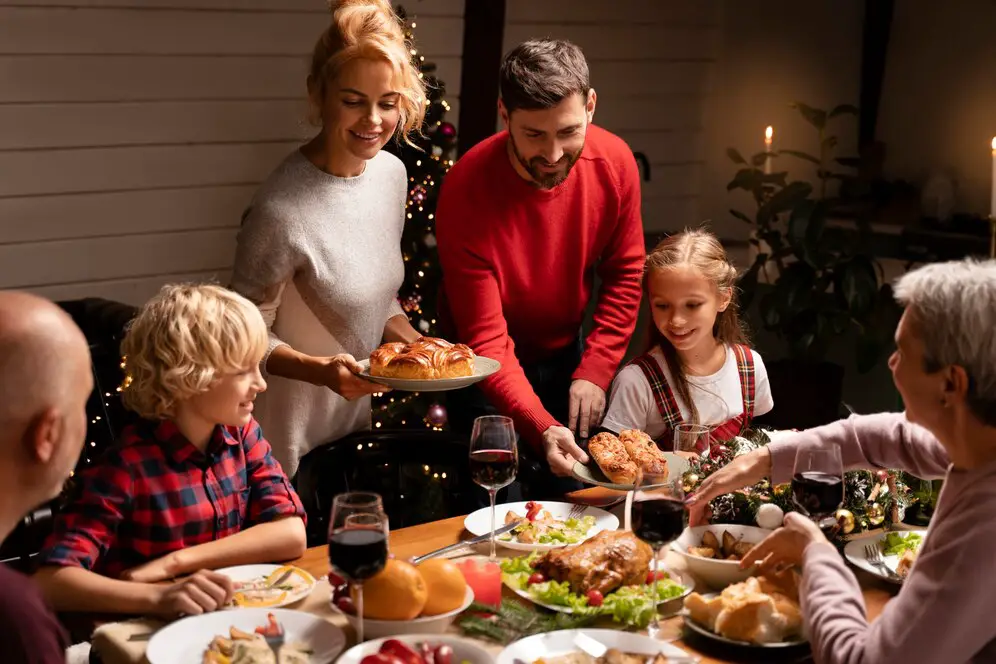
Gene’s dining room looked flawless in the way a room can look flawless when everyone inside is carefully holding their breath. Pine garlands framed the doorway. Cinnamon rolls were cooling beneath sheets of foil. The chandelier reflected off the silver napkin rings, while outside, a small American flag tapped softly against the porch railing in the winter wind.
Everyone knew Gene’s rules. Smile, remain polite, and never challenge her when she decided someone needed to be reminded of their place.
That Christmas, she chose my daughter.
My name is Marissa, and I’ve been married to Brandon for four years, together for six. Holly is my daughter from my first marriage, but Brandon had never treated that fact as though it made her less important. He packed her lunches, remembered that her stuffed rabbit had to face the bedroom door at night, and knew the difference between her genuine laugh and the careful little laugh she used around adults who made her uncomfortable. He’d been in her life since she was three years old, had gone to every parent-teacher conference her actual father skipped, had taught her to ride a bike in the parking lot of our old apartment complex on a Saturday morning when he probably should have been sleeping in after a double shift at the fire station.
Gene had never called Holly her granddaughter. Instead, she called her “Brandon’s girl,” “your child,” or “that sweet little visitor.” She was always almost family. But never quite family.
I want to explain, before I tell you what happened that Christmas, exactly how long this had been building, because the candle and the tag didn’t come out of nowhere. They came out of three years of small, precise cruelties that Gene had perfected the way some people perfect a golf swing — economical, deniable, and devastating in a way that never quite gave you enough to make a scene about.
The first Thanksgiving after Brandon and I married, Gene had set the kids’ table with paper plates featuring cartoon turkeys for every child except Holly, who got a plain white paper plate with no decoration at all. When I mentioned it, quietly, in the kitchen, Gene had laughed and said she must have simply run out, though there had been an unopened stack of the decorated ones sitting in the pantry not two feet from where we stood.
The second year, at Easter, Gene had organized an egg hunt in the backyard and handed each of the cousins a laminated card with clues written specifically for them, their names printed at the top in calligraphy. Holly got no card. When she asked where hers was, Gene had patted her head and said, “Oh, sweetheart, you can just follow the other children,” which meant Holly spent the entire hunt trailing behind kids who already knew where the eggs were, finding nothing, while the adults watched and said nothing.
By the third year, Brandon had started keeping a private log on his phone. Not to build a court case, he told me once, late at night, staring at the ceiling — just so he wouldn’t gaslight himself into thinking he was imagining the pattern. He needed proof, even if only for his own sanity, that his mother’s cruelty toward his stepdaughter was consistent rather than accidental. The log had forty-one entries by that third Christmas. Forty-one small, deniable moments that added up to something no single incident could prove on its own.
What none of us — not me, not Gene, not even Brandon’s own siblings — fully understood was that Brandon had also been quietly protecting his mother in ways she never once thanked him for. Six years earlier, when his father Walter died suddenly of a heart attack in the garage while replacing a car battery, Gene had been left with a modest but not insignificant mortgage on the house she’d lived in for thirty-one years, plus a second loan Walter had taken out against the property to cover a failed investment in his brother’s restaurant that nobody in the family liked to discuss. Gene, who had never worked outside the home and had no real understanding of finances, had been on the verge of losing the house within eighteen months of Walter’s death.
Brandon, who was the only one of Gene’s three children with any real savings — his siblings, Dana and Kyle, were both perpetually behind on their own bills — had quietly stepped in. He hadn’t told Gene the full extent of it. He’d structured it carefully with a lawyer friend from the department, buying the second, higher-interest loan outright from the private lender who held it, effectively becoming the person Gene owed money to instead of a stranger with far less patience. He’d told her only that he’d “worked something out” with the bank, letting her believe her modest widow’s pension and social security were somehow stretching further than they actually were. For six years, Brandon had quietly kept his mother in her house, expecting nothing back except, perhaps, some small measure of decency toward the family he’d built.
He got the opposite.
That morning, at 8:47 a.m. on December 25th, Gene began distributing presents as though she were conducting an elaborate ceremony. One cousin opened an iPad. Another received the same gift. The older children pulled thick envelopes of cash from shiny holiday cards, counting the bills with the casual confidence of kids who’d learned exactly how loud to gasp to make Grandma feel appreciated.
Holly sat beside me in the gold dress Brandon had steamed twice before we left home. She was seven years old, with her black Mary Janes tucked beneath the chair and both hands resting neatly in her lap. Before we entered the house, Brandon had noticed a scuff on one of her shoes, wiped it away with his thumb, and quietly said, “She deserves at least one holiday where she feels chosen.” I remember thinking, standing on Gene’s porch mat in the cold, that it was such a small hope to carry into a house, and still somehow too much to ask.
Then Gene turned toward Holly.
“Oh. Holly.”
She held out a thin drugstore gift bag decorated with a crooked bow, the kind you buy in a multi-pack at the register while checking out. “This is for you, sweetheart. I didn’t want you to feel completely left out.”
Holly accepted the bag with both hands. She carefully pulled away the tissue paper, the same careful way she does everything, like she’s always half-bracing for something to go wrong and doesn’t want to be the reason it does.
Inside was a cheap vanilla candle, the kind sold three-for-ten-dollars at the drugstore checkout line.
The candle itself wasn’t what hurt. It was the handwritten tag attached to it.
To Brandon’s Girl.
A fork froze halfway toward someone’s plate. One cousin suddenly became fascinated with the carpet. The little dog hiding beneath the table backed away from the chair legs, sensing, the way animals do, that the temperature of the room had changed. Beside me, Brandon crushed the side of his paper coffee cup without even seeming to realize he was doing it, the cardboard buckling under his fingers with a soft, papery crunch that felt very loud in that silent room.
Gene continued smiling, already acting as though the insult was far too insignificant for anyone with manners to mention.
I quietly said Brandon’s name.
He leaned toward me. “I told her to give Mom the red box if this happened again.”
“What red box?”
“The one in her overnight bag.”
I stared at him. “You planned this?”
“No,” he replied. “I prepared for it.”
I want to sit with that distinction for a moment, because it’s the thing I keep coming back to when I think about that day. Brandon hadn’t wanted this to happen. He hadn’t set a trap hoping his mother would walk into it. He’d simply understood, after three years of watching the pattern repeat, that hope alone wasn’t a plan, and that his daughter — because that’s what Holly was to him, in every way that mattered — deserved a father who had thought several steps ahead of the woman who kept hurting her.
We got through the rest of gift-opening somehow. Gene moved on to the next round of presents like nothing had happened, complimenting Dana’s new haircut, asking Kyle’s wife about her sister’s wedding, filling the room back up with noise the way she always did, burying the moment under enough small talk that anyone who wanted to pretend it hadn’t happened had plenty of material to work with.
Holly didn’t say anything for the rest of the morning. She held the candle in her lap through the entire gift exchange, her small fingers wrapped around the glass jar, and I watched her read that tag over and over — To Brandon’s Girl — like she was trying to work out some kind of math problem that refused to balance.
Later that evening, at 9:12 p.m., I found Holly sitting on the guest-room bed with the candle resting in her lap. Her gold dress was wrinkled, and she kept staring at the tag as though she believed the words might somehow change if she looked at them long enough.
“Mom,” she asked quietly, “am I only Dad’s girl?”
Before I could answer, Brandon knelt in front of her, his knees cracking slightly the way they’d started to since he turned forty, his face level with hers.
“You are my daughter,” he told her. “No tag gets to decide who you are.”
Then he reached into her overnight bag and placed a small red velvet box in her hands.
“If Grandma ever makes you feel invisible again, you get to decide whether she receives this. Not me. Not your mom. You.”
Holly turned the box over in her hands, her thumb running along the worn velvet seam. “Will she be mad?”
“Probably.”
“Will you still be my dad?”
For half a second, Brandon looked completely broken, like the question itself had cracked something open in his chest that he’d been holding steady all day for her sake.
“Always,” he said, and his voice caught on the word in a way I don’t think Holly noticed, but I did, standing in the doorway with my arms crossed, blinking hard against my own tears.
I asked him later, once Holly was asleep, what exactly was in that box. He wouldn’t tell me the specifics, only that it was something his mother needed to see for herself, in her own time, and that he wanted Holly to have the power to decide when — if ever — that time came. “She’s spent three years having no control over how Mom treats her,” he said. “I wanted her to have control over this one thing.”
I didn’t sleep much that night. I lay awake replaying the tag, the candle, the careful cruelty of it, and wondering what a seven-year-old was supposed to do with a small red box that her father wouldn’t explain, sitting somewhere in a drawer in a house that wasn’t quite home.
The following morning, Gene hosted brunch. The table had been arranged again with white dishes, silver napkin rings, and handwritten place cards, each one written in Gene’s looping, deliberate cursive, the kind she’d learned from nuns at a Catholic school in the fifties and never let anyone forget.
Everyone had a name.
Except Holly.
Her card simply read: Guest.
Holly noticed it at the exact same moment Brandon and I did. She didn’t cry. She didn’t ask either of us to fix it. I watched something settle over her face instead — not resignation, exactly, but a kind of quiet decision, the same look she gets when she’s working out a hard math problem and has finally found the right approach.
She reached into the tiny purse Brandon had given her for Christmas, a small gold clutch that matched her dress, and wrapped both hands around the red velvet box she’d carried in from the guest room without either of us noticing. Then she stood.
She walked across the dining room while every aunt, uncle, cousin, and in-law watched her, her Mary Janes clicking softly against Gene’s hardwood floor, her chin held level in a way that made my chest ache with pride and terror in equal measure.
“Grandma,” Holly said, loud and clearly enough for everyone at the far end of the table to hear, “Dad told me to give this to you if you ever ignored me again.”
Gene’s polished smile tightened. “Well, isn’t that dramatic.”
Brandon rose behind our daughter, his chair scraping back against the floor.
“Open it,” he said.
Gene lifted the lid while still wearing that smug expression, as though she already had a speech prepared about overly sensitive children and modern parenting, the kind of speech she’d delivered a dozen times over the years whenever anyone dared to suggest her behavior needed examining.
Then she screamed.
The cousin standing near the window flinched. Everyone leaned forward.
Inside the red velvet box was a single small brass key and a folded white card.
The first words on it read: This key belongs to the second lien on 1147 Maple Crest Lane, purchased in full six years ago. Effective today, that lien transfers into a trust in Holly Marie Whitfield’s name, to be administered by her mother until Holly turns twenty-five.
Gene’s hands were shaking so badly the card nearly slipped from her fingers. Dana grabbed it from her, reading it out loud in a voice that grew softer and more disbelieving with every word, until she reached the second paragraph, which explained, in plain legal language Brandon’s lawyer friend had drafted weeks earlier, that the loan Gene had believed was “worked out with the bank” had in fact been quietly purchased and held by her own son for six years, and that the monthly payments she’d been sending — payments she genuinely believed were going to a faceless financial institution — had been landing, every single month, in an account Brandon controlled.
“You’ve been paying me?” Gene said, her voice thin and disbelieving. “This whole time, I’ve been paying you?”
“You’ve been keeping your house,” Brandon said. His voice was steady, but I could hear the effort it took to keep it that way. “I made sure of that, six years ago, when Dad died and you had nowhere else to turn. I never told you the details because I didn’t want you to feel like you owed me something every time you looked at me. I wanted you to just be my mother, and I wanted to just take care of you the way a son should, without keeping score.”
“Then why,” Gene said, gesturing weakly at the card still trembling in Dana’s hands, “why would you do this? Why would you take it away from me and give it to a child?”
“I’m not taking your house,” Brandon said. “Read it again. The lien transfers into a trust that doesn’t come due, doesn’t get called, doesn’t change a single thing about your monthly payment or your right to live there, as long as one condition is met.”
“What condition?”
Brandon looked at his mother for a long moment, and I could see him deciding, right there at that table, whether to soften what he was about to say or let it land exactly as hard as it needed to.
“That Holly is treated like family,” he said. “Not a guest. Not ‘Brandon’s girl.’ Not almost. Every holiday, every gathering, every single time this family sits down together, she gets a place card with her actual name on it, same as every other grandchild in this house. If that ever stops being true again, the trust converts. The lien becomes immediately payable in full, administered by an attorney instead of by me, with no flexibility and no more quiet arrangements between family. You’ll be on the open market for that loan balance within thirty days, same as any other borrower who defaults, except this time there won’t be a son quietly protecting you from what that actually means.”
The room had gone entirely silent except for the soft tick of Gene’s grandfather clock in the front hall. Kyle’s wife had stopped even pretending to eat. Dana was still holding the card like it might catch fire.
“You would really do that?” Gene whispered. “To your own mother?”
“I already did the opposite for six years,” Brandon said. “I protected you when you had nothing and nobody else stepping up. All I ever asked in return, all I ever wanted, was for you to extend the same basic decency to my daughter that you extend to every other child in this family. You couldn’t manage even that much. So now the protection has a condition attached to it. That’s not cruelty, Mom. That’s just what happens when kindness gets taken advantage of long enough. Eventually somebody has to build a floor under it.”
Gene looked down at Holly, who was still standing very straight in her gold dress, her small hands now empty since Dana had taken the card, her chin still level, watching her grandmother with an expression that wasn’t triumphant, wasn’t cruel, was mostly just tired in the particular way a seven-year-old shouldn’t have to be tired.
“Holly,” Gene said, and her voice cracked on the name in a way I’d genuinely never heard before, not once in three years of careful, deniable slights. “I didn’t realize.”
“You knew,” Holly said quietly. Not shouting. Not crying. Just stating a fact the way she’d state that the sky was blue or that Tuesday came after Monday. “You knew, Grandma. Everybody at this table knew. That’s why nobody said anything when you gave me a candle with Dad’s name on it instead of mine.”
Nobody at that table had an answer for that, including me. I’ve thought about it many times since — the particular clarity children have before the world teaches them to soften hard truths for the comfort of adults who don’t deserve the softening.
Aunt Dana was the first to move. She stood up, walked around the table, and knelt down in front of Holly the way Brandon had the night before. “I’m your aunt,” she said. “I should have said something a long time ago. I’m sorry I didn’t.”
Kyle, who I’d always found to be the quietest and least confrontational of Brandon’s siblings, said something similar, though more haltingly, clearly working through his own guilt in real time. His wife squeezed Holly’s shoulder and told her, with tears actually running down her face, that she thought Holly was one of the sweetest kids in the family and always had.
Gene didn’t say much else that morning. She sat very still at the head of her table, the table she’d nearly lost six years earlier and had no idea her own son had quietly saved, staring at the brass key sitting beside her orange juice glass like it belonged to a door she’d never noticed before, in a house she’d lived in her entire adult life.
We left not long after that. Brandon didn’t gloat. He didn’t demand an apology on the spot or make a speech about vindication. He simply gathered our coats, helped Holly into hers, and said, quietly, to his mother on the way out the door, “The offer stands whenever you’re ready to actually mean it, Mom. Holly’s not going anywhere. Neither am I. The only question is whether you want to be part of that or not.”
The drive home was quiet. Holly fell asleep in the back seat somewhere around the highway exit for Millbrook, her head tilted against the window, the gold dress rumpled around her knees. Brandon reached over and took my hand at a red light, and I saw that his eyes were wet, though he didn’t say anything, and I didn’t push him to.
“You never told me the full story,” I said eventually. “About the loan. Six years, Brandon. You carried that alone for six years.”
“I didn’t want you worrying about money that wasn’t yours to worry about,” he said. “And I didn’t want Mom feeling like a charity case every time she looked at me. I just wanted to help. That’s all it was supposed to be.”
“And now?”
He was quiet for a long moment, watching the road. “Now I’ve realized that help without any expectation of decency in return isn’t generosity. It’s just letting yourself be used and calling it love because the alternative feels too harsh to admit. I’m not sorry I helped her. I’d do it again. But I should have set this condition six years ago, the very first time she called Holly ‘that sweet little visitor’ at Thanksgiving instead of her name.”
Three weeks passed with almost no contact from Gene’s side of the family beyond a stiff, formal thank-you text from Dana about the holiday and a longer, more apologetic message from Kyle’s wife that Brandon read twice before showing me. Then, on a Tuesday evening in mid-January, our doorbell rang.
Gene stood on our porch in her good wool coat, the one she usually saved for church, holding a small wrapped box that was clearly not from the drugstore. Her eyes were red-rimmed in a way I’d never once seen in four years of marriage into that family.
“May I come in?” she asked.
Brandon looked at me. I nodded. He stepped back from the door.
Gene sat stiffly on our couch, the wrapped box balanced on her knees, while Holly peered around the corner from the hallway, uncertain whether to come closer.
“Holly,” Gene said, and her voice was smaller than I’d ever heard it, all the polish scraped away. “Would you come sit with me for a minute?”
Holly looked at Brandon, who nodded, and then walked slowly into the living room and sat on the far end of the couch, leaving a careful, deliberate gap of space between herself and her grandmother.
Gene handed her the box. Holly opened it carefully, the same careful way she opens everything. Inside was a delicate gold necklace with a small pendant shaped like a holly leaf.
“Your great-grandmother’s name was Holly too,” Gene said quietly. “I never told you that. I never told you a lot of things, because I think some part of me was still angry that your mother remarried, still holding onto some idea of what our family was supposed to look like, and I let that anger land on a seven-year-old who never did anything except exist. That was never fair to you. It was cruel, and it was cowardly, because I dressed it up in candles and place cards instead of just saying what I actually felt, which would have at least given your father the chance to correct me sooner.”
Holly turned the pendant over in her small fingers. “Are you going to call me Holly now? Not ‘Brandon’s girl’?”
“Yes,” Gene said. “If you’ll let me. I know I don’t deserve to just walk back in here and have that be enough. I know actions matter more than one necklace and one apology. But I’d like the chance to prove it, over time, if you’re willing to give me that chance.”
Holly considered this with the same seriousness she considered everything, her small face thoughtful in the lamplight. “Okay,” she said finally. “But if you do the candle thing again, I’m telling Dad, and I don’t think there’s another red box, so you should probably just be nice the first time.”
Something in Gene’s face broke open at that, a laugh and a sob arriving at the same time, and she reached out, slowly, giving Holly every chance to pull away, and when Holly didn’t, she wrapped her arms around her granddaughter for what I later learned was the first real hug Gene had given her in three years.
Things didn’t become perfect overnight. Gene is still, by nature, a woman who likes control and likes being the center of every room she enters, and old habits occasionally flickered back — a slightly too-pointed comment about Holly’s manners, a moment at Easter where she almost, almost slipped back into old patterns before catching herself and course-correcting in real time, visibly working to remember the name on the place card she’d written herself. But the place cards always had Holly’s actual name on them now. The gifts were equal. The candles, when they appeared at all, came with tags that read simply, plainly, To Holly, With Love, Grandma, the same as every other grandchild’s tag.
Brandon never had to invoke the trust again. The key stayed in a small fireproof box in our home office, a quiet reminder rather than a weapon, though I know he kept the paperwork current every year with his lawyer friend, just in case. Some kinds of trust, once broken as thoroughly as Gene had broken it, need more than good intentions to rebuild. They need a floor that can’t be talked around, a structure that holds even on the days when someone’s oldest, ugliest instincts try to resurface.
Holly wears the holly-leaf pendant most days now, tucked under her collar at school, out where everyone can see it at family dinners. Last Christmas, a full year after the candle, Gene handed her a wrapped gift with a tag that read To Holly, and inside was a photo album filled with pictures of Brandon’s own childhood, including several of him at exactly Holly’s age, grinning gap-toothed in a backyard that looked remarkably like the one Holly plays in now. On the inside cover, in Gene’s looping cursive, she’d written: For the girl who taught an old woman that family isn’t a word you get to redefine to suit your own comfort. I’m sorry it took a locked box and a scared old lady’s pride to understand that. I love you, Holly. Truly. Grandma.
Holly read it twice, the same careful way she reads everything, and then looked up at her grandmother and said, simply, “Thank you, Grandma,” using the word without any hesitation at all, like it had always belonged there, like three years of candles and paper plates and “Brandon’s girl” had simply never happened.
I don’t think they’ll ever fully disappear, those years. Holly still, occasionally, out of nowhere, asks me some version of the question she asked Brandon that night on the guest-room bed — am I only Dad’s girl, am I only a visitor, am I really family or just tolerated family — and every time, we answer the same way Brandon did that Christmas night, without hesitation, without qualification.
You are our daughter. No tag, no place card, no candle from a drugstore rack ever got to decide that. And neither, in the end, did anyone else’s comfort get to matter more than hers.

Adrian Hawthorne is a celebrated author and dedicated archivist who finds inspiration in the hidden stories of the past. Educated at Oxford, he now works at the National Archives, where preserving history fuels his evocative writing. Balancing archival precision with creative storytelling, Adrian founded the Hawthorne Institute of Literary Arts to mentor emerging writers and honor the timeless art of narrative.