The Ink He Hid
Brad and I had a happy marriage and three wonderful children, and if you had asked me, on any ordinary morning of our fourteen years together, whether I truly knew my husband, I would have laughed at the question. Of course I knew him. I knew the way he took his coffee, the sound of his key in the door, the particular gentleness he brought to being a father. I knew that he never left the house without kissing me goodbye, not once, not in fourteen years, not even during the bad stretch when the roof needed replacing and money was tight and we were both too tired to be kind. He always kissed me goodbye.
But there was one thing about Brad I never understood, one locked room in the middle of my open, familiar house of a marriage, and it had to do with the tattoos.
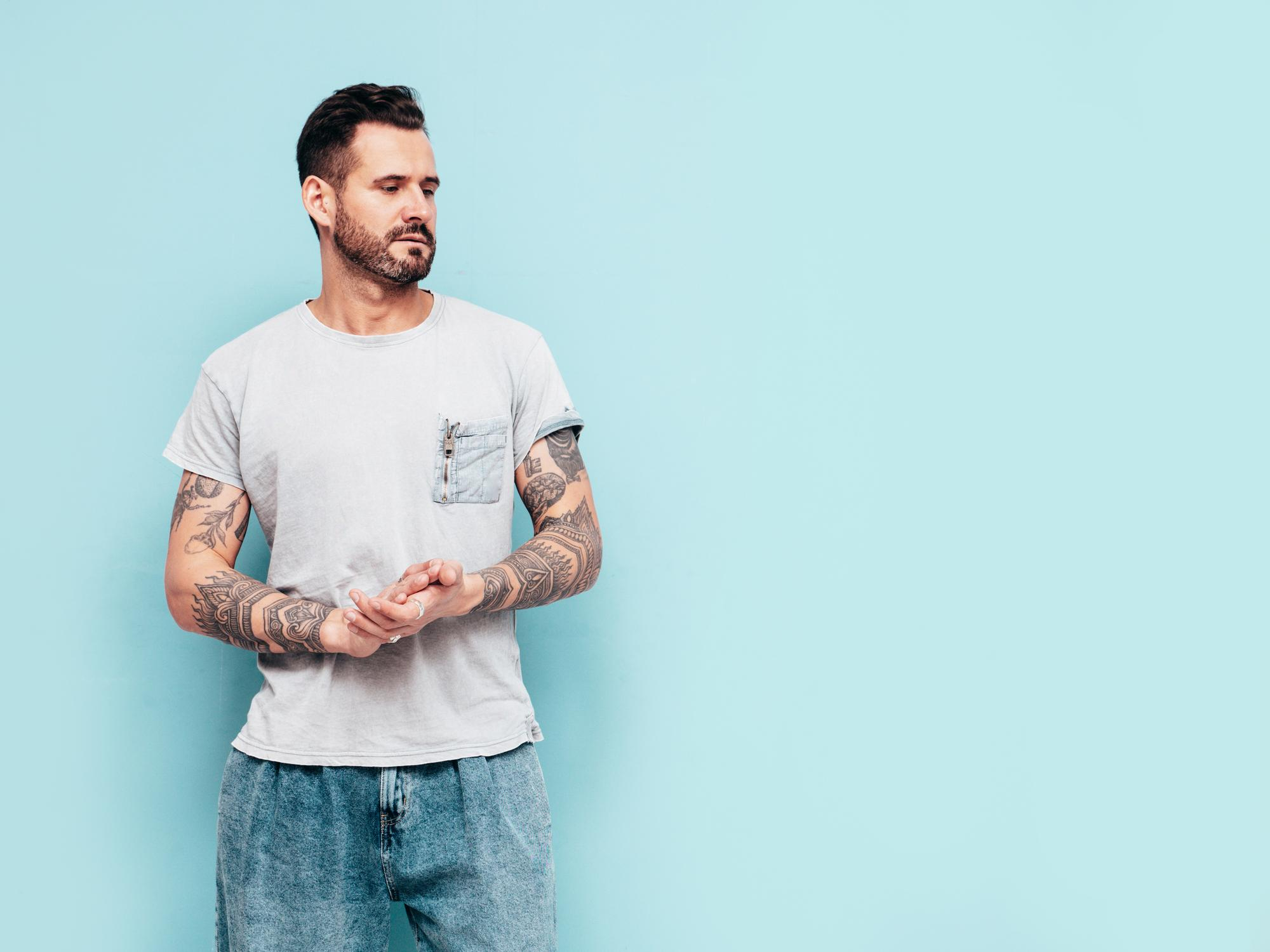
Brad’s body was covered in them. Beautiful ones, intricate and strange and clearly the work of real artists, running up both arms, across his back, down over his ribs, images and patterns and symbols that flowed into one another like a language I couldn’t read. At home, our children loved them. Our youngest, Molly, who was five that year, would sit in his lap and trace them with one small finger, following the lines, asking him what each one meant, and Brad would make up stories, gentle inventions, this one is a dragon who guards good dreams, this one is a river that flows to a secret ocean. The kids thought their dad was the coolest man alive, a walking storybook, and they were right.
Yet the moment Brad stepped outside our front door, every inch of that ink disappeared.
He covered all of it, always, without exception. Long sleeves in the dead of summer. Long pants when other men wore shorts. In the hottest months he wore thin lightweight gloves, the kind cyclists wear, so that not even the tattoos on the backs of his hands could show. He had a whole wardrobe organized around concealment, and he sweated through it uncomplaining, year after year, rather than let a single stranger glimpse what our children traced so freely every night.
I asked him about it, early on. “Why hide something so beautiful?” I said. We were young then, newly married, and I genuinely couldn’t understand it. The tattoos were gorgeous. Any artist would have been proud to wear them.
And Brad’s smile, the easy warm smile that was the first thing I ever loved about him, had disappeared. His face closed like a door.
“I got them when I was young,” he said. “And I regret it. That’s all. I’d rather people didn’t see.”
I respected that. We all have parts of our past we’d rather not carry into the present, and if my husband’s regret took the shape of long sleeves in July, that was a small enough eccentricity in a good man. So I let it go. I stopped asking.
But I never stopped noticing. Because it wasn’t quite regret, what I saw in his face when the subject came up. Regret is a soft, resigned thing. What crossed Brad’s face when someone got too close to the tattoos was sharper than regret. It looked, if I’m honest, like fear. And underneath the fear, sometimes, something that looked almost like grief. For fourteen years I filed that expression away, this small strange wrongness in the middle of a man I otherwise understood completely, and I told myself that everyone is allowed one locked room, and that love means not always demanding the key.
I got the key anyway. Not from Brad. From a stranger in a store, on a chilly afternoon, in the most ordinary moment of the most ordinary day, and it broke my heart and then, slowly, remade it into something larger than it had been.
It was autumn. We’d taken the three kids to the park, the good one across town with the big climbing structure, bundled up against the chill because Molly had begged and begged and it was the last decent weekend before the cold set in for good. Brad, of course, was covered head to toe, long sleeves, long pants, the whole armor, pushing Molly on the swings and refereeing the older two on the climbing frame, sweating a little even in the cool air but never once complaining, because he never did.
And then Molly, being five, being Molly, slipped near a muddy puddle at the edge of the playground and went down hard on her side, and came up howling and soaked, her little dress caked in cold mud and puddle water, shivering and furious and miserable.
And Brad, without a second’s hesitation, did the thing that changed everything.
He pulled off his own button-down shirt, the outer layer, the concealment, and he wrapped it around Molly to warm her and stop her crying, gathering her up, murmuring to her, it’s okay, baby, Daddy’s got you, let’s get you warm.
And for the first time in years, in public, out in the open where anyone could see, my husband stood in nothing but a short-sleeved T-shirt, his tattooed arms completely, fully exposed to the world.
I noticed it immediately, the way you notice something rare and precious, my husband’s beautiful hidden arms bare in the daylight, and I felt an unexpected pang, because he looked, in that moment, so free, so unguarded, a man simply holding his cold wet daughter without a thought for himself. I remember thinking, he doesn’t even realize. He’s so focused on Molly that he’s forgotten to be afraid. And I remember wishing, foolishly, that he could always be like this, unarmored, unhidden, that whatever he regretted could stop mattering enough to make him sweat through July.
We needed to get Molly into something dry. There was a store a few blocks from the park, one of those places that sells a bit of everything, and we drove over and went in, all of us, Molly wrapped in Brad’s shirt, still sniffling, the older two trailing behind, and Brad still, without thinking, in just his T-shirt, his arms still bare, because in the rush of a cold miserable child he simply hadn’t remembered to cover up.
We made our way to the children’s section, and Brad was reaching for a small sweater on a shelf, his tattooed arm extended, when I heard a sound behind us, a carton or a box hitting the floor, something dropped.
I turned. And there was a young woman standing frozen in the aisle a few feet away, and she was staring at Brad’s arm, at the tattoos, and her face had gone completely, bloodlessly white.
She was maybe thirty, plainly dressed, an ordinary-looking woman, and she was looking at my husband’s exposed ink like she was seeing a ghost. Her hand was still half-raised from where she’d dropped whatever she’d been holding.
“Bradley?” she whispered.
I felt Brad go rigid beside me. Nobody called him Bradley. He was Brad, always Brad, had been Brad the entire time I’d known him. But this woman said Bradley like it was a name she knew, a name from somewhere, and I watched my husband slowly, slowly lower his arm and turn toward her, and I saw on his face the fear I’d been cataloging for fourteen years, but larger now, full-grown, undisguised.
“I’m sorry,” Brad said, and his voice wasn’t quite steady. “You’ve mistaken me for someone else.”
“No,” the woman said. “No, I haven’t.” Her voice cracked, and she took a step closer, her eyes never leaving the tattoos on his arm. “That tattoo. I would know that tattoo anywhere. I never thought I’d see you again. I never thought I’d see you again in my whole life.”
“Please,” Brad murmured, and there was something desperate in it now, something pleading. “Not here. Not in front of my family.”
And the woman seemed to notice us for the first time, really notice us, me standing there confused, the three children, Molly wrapped in Brad’s shirt. Her eyes moved over us, and something in her face shifted, a kind of astonishment breaking through the shock.
“Your family?” she said. “This is your family? You have, you have children?” Her eyes filled with tears. And then she looked at me, directly at me, and she said, “So you never told them. You never told any of them. They really don’t know what your husband did?”
The floor seemed to move under me. What your husband did. Fourteen years of a locked room, and here was someone with the key, someone from the part of his life he covered up every single day, and she was standing in a discount store in the children’s section telling me there was a thing my husband did, a thing so large it had shaped his whole hidden life, a thing I had never once been told.
“What do you mean?” I asked. My voice came out strange and small, barely mine. “What did he do?”
Brad said, “Sarah, don’t,” but I didn’t know if he was talking to me or to her, and I realized I didn’t even know the woman’s name, and it turned out neither of us was named Sarah, that was just the roar in my own ears rearranging the world.
The woman looked at Brad, and she looked at me, and she seemed to make a decision, and she stepped close to me, close enough that I could see the tears running freely down her face now, and she said the one thing I had never in ten thousand imaginings expected to hear.
She said, “Your husband ran into a burning building and carried my little brother out. He saved my brother’s life. And then he disappeared before anyone could even thank him, and we’ve been looking for him for eleven years.”
The store tilted. My knees hit the cold tile floor, and I was down, kneeling in the children’s aisle of a discount store, and I began to sob, deep, heaving, uncontrollable sobs, because everything I thought I understood about my husband, the whole shape of the man I’d been married to for fourteen years, was coming apart and reassembling into something I could barely comprehend.
Brad was on the floor beside me instantly, his arms around me, saying my name, the real one, over and over, and Molly was crying again because Mommy was crying, and the older kids were frightened, and the woman was standing over us with her hands pressed to her mouth, and it was chaos, and through all of it I kept sobbing, because a stranger had just told me that the man I loved was a hero, and I hadn’t known, I hadn’t known, he had let me believe he was ashamed of those tattoos, and instead they were, they had to be, somehow connected to the bravest thing a person could do.
We ended up in the store’s little café area, all of us, the manager kindly waving off the disruption, the kids settled with hot chocolates, Molly finally dry in a new sweater, and Brad and the woman, whose name was Diane, sitting across from each other at a small table, and me beside my husband holding his tattooed hand in both of mine, and the whole story finally, after eleven years and fourteen years of marriage, came out.
Here is what my husband had never told me.
Before I knew him, before he was Brad the gentle father in the covered arms, he had been Bradley, a young man in his early twenties, a firefighter. Not a career one. A volunteer, in the small town where he’d grown up, a young man who’d signed up out of some mix of idealism and restlessness and the desire to be useful. And the tattoos, all of them, the beautiful intricate ones our children traced every night, were firefighter tattoos. Memorial tattoos. Brotherhood tattoos. The imagery I couldn’t read was the imagery of that world, the Maltese crosses and the flames and the names, the whole visual language of men who run toward the fires everyone else runs away from. He hadn’t gotten them when he was young and foolish and then regretted them. He’d earned them. Every single one meant something. They were a record of who he had been and what he had done and, I would learn, what he had lost.
Because there had been a fire. A terrible one, eleven years ago, an apartment building, at night, fully involved by the time the trucks arrived. And Bradley, twenty-three years old, had gone in. He’d gone in when the building was collapsing, when the incident commander was calling everyone out, when it was already past the point where anyone was supposed to still be inside. Because there was a child on the third floor. Diane’s little brother, Tyler, eight years old, trapped in a back bedroom, and his family screaming on the sidewalk that he was still in there, still in there, please, somebody, he’s still in there.
And Bradley went in against orders, up through the smoke and the heat and the failing structure, and he found the boy, and he wrapped him in his own coat and carried him out, and he got him to the paramedics, and the boy lived. Tyler lived. He grew up. He was nineteen now, Diane told us, in college, alive, whole, because of my husband.
But Bradley hadn’t come out unscathed. Because on his way out, with the boy in his arms, part of the ceiling had come down. And Bradley had turned his body to shield the child, taken the collapse across his own back and arms, and gotten the boy clear, and then, only then, had gone down himself.
Two other firefighters had gone in after him, his friends, his brothers, when he didn’t come out. They’d found him and dragged him clear. Bradley survived, badly burned across his back and arms, months in the hospital, skin grafts, the whole long agony of recovery.
The two firefighters who went in to save him did not survive. The building came down on them. They died pulling my husband out of the fire he’d entered to save a little boy.
And that, Diane explained gently, her own tears falling, was why Bradley had disappeared. Why he’d left town the moment he could travel, changed nothing about his name but let Bradley become Brad, moved away, started over, and covered his tattoos every day for the rest of his life. Because he could not live as a hero when two men had died saving him. Because every time someone saw the tattoos and asked about them, he would have to tell the story, and the story ended with two of his brothers dead and him alive, and he could not bear it, could not bear the gratitude, could not bear being called brave when the price of his bravery had been paid by two men who left behind their own wives and children.
The tattoos, the beautiful tattoos our children loved, included the names of those two men. Brad had them inked on his arms, over the burn scars, memorials to the friends who died pulling him out. That was why he covered them. Not shame. Grief. A grief so total and so private that he had built his entire adult life around never having to explain it, had let his own wife believe a small lie about youthful regret rather than open the door on the thing that had broken him.
I understood, finally, sitting in that café with my husband’s scarred and tattooed hand in mine, the expression I’d been cataloging for fourteen years. It wasn’t regret. It was survivor’s guilt, worn on his skin, hidden under long sleeves, carried silently every single day of our marriage. My gentle husband, who kissed me goodbye every morning and made up stories about dragons for our daughter, had run into a collapsing building to save a stranger’s child, and had spent eleven years punishing himself for surviving it.
“We looked for you for years,” Diane was saying, through her tears. “My whole family. My parents, Tyler, all of us. You saved my brother’s life and then you vanished. The department wouldn’t give us your information after you left, privacy rules, and you’d moved, changed how you went by, and we just, we never got to thank you. Do you understand? For eleven years we’ve carried this, that the man who saved Tyler never knew what it meant to us, never let us say thank you. My mother prays for you. She’s prayed for you every night for eleven years, a man whose full name she wasn’t even sure of. And I walked into a store to buy my niece a birthday present and I saw that tattoo on your arm and I thought I was going to faint.”
Brad was crying now too, my strong silent husband, tears running down his face in the middle of a discount store café. “I couldn’t stay,” he said, his voice breaking. “After Marcus and Dave. They went in for me. They died for me. Their kids grew up without fathers because of me, because I went in when I wasn’t supposed to, and everyone kept calling me a hero, and I couldn’t, I couldn’t be a hero, I got two men killed. So I left. I left and I covered them up.” He touched his own arm, the names inked there. “I kept them on me because I couldn’t not keep them on me, they’re my brothers, but I couldn’t let anyone see, because then I’d have to tell it, and telling it is, it’s—” He couldn’t finish.
And Diane reached across the table and took his other hand, the tattooed one, and she said something that I will remember for the rest of my life, something that started the slow work of healing a wound my husband had kept open and hidden for over a decade.
“Bradley,” she said. “Listen to me. I’ve thought about this for eleven years, about what I’d say to you if I ever found you. Marcus and Dave didn’t die because you went in. They died because that’s who they were, the same as you. They ran toward the fire, same as you did. They didn’t go in for a mistake. They went in for a brother. That’s not something you did to them. That’s something they chose, because they were the same kind of person you are, the kind who runs in. You’ve been carrying their deaths like you killed them. You didn’t. A fire killed them. And what you did, what all three of you did, is you saved an eight-year-old boy who is nineteen now and alive and about to become an engineer, and every single day of his life is a gift that the three of you gave him together. All three of you. You don’t get to take Marcus and Dave’s part of that away by hiding. Their names are on your arm. Don’t you understand? You’ve been hiding their names. You’ve been hiding the memorial to your own brothers because you’re too ashamed to be seen surviving. And that’s not honoring them. That’s not what they’d want. They’d want you to live. They’d want their names out in the sunlight where people can see them and ask, and you can say, these were the bravest men I ever knew, and they died saving my life, and I’ve spent every day since trying to be worth it.”
The café was silent. My children were watching, wide-eyed, uncomprehending and yet somehow understanding everything. And I watched something break open in my husband, some dam that had held for eleven years, and he put his face in his hands and he wept like I had never seen him weep, and Diane held one of his hands and I held the other, and my children came and wrapped their arms around their crying father, Molly climbing into his lap, and we held him while eleven years of hidden grief finally, finally came out.
Everything changed after that day. Not instantly. Grief that old and that deep doesn’t resolve in a café. But a door had been opened, and it could not be closed again, and Brad, for the first time since I’d known him, began to walk through it.
He met Tyler. Diane arranged it, a few weeks later, and my husband sat across from the nineteen-year-old man he’d carried out of a fire as an eight-year-old boy, and Tyler, who had grown up knowing that a firefighter had saved his life and given everything for it, could barely speak for crying, and neither could Brad, and the two of them just held onto each other, the man and the boy he’d saved, across eleven years and a lifetime that only existed because of what Brad had done.
He met Diane’s mother, the woman who’d prayed for him every night for eleven years without knowing his full name. She held his face in her hands and thanked him, finally, the thank you he’d run away from for over a decade, and she told him that he was an answer to prayer, that he’d given her back her son, and Brad let himself receive it, finally, the gratitude he’d believed he didn’t deserve.
And he sought out the families of Marcus and Dave. That was the hardest thing, the thing he’d been most afraid of for eleven years, facing the widows and the children of the men who’d died saving him. But he did it, because Diane’s words had lodged in him, that hiding their names dishonored them, that he owed it to his brothers to carry their memory in the light. And the families, it turned out, had not blamed him, had never blamed him, had spent eleven years wishing they could tell him so, that Marcus and Dave had died doing what they loved, saving lives, and that they’d have made the same choice again, and that Brad living a good life, being a good father, was the finest tribute their husbands and fathers could have. Brad had spent eleven years imagining their hatred. He found only love, and grief they could finally share, and a burden that got lighter the moment it stopped being carried alone.
He stopped covering his tattoos.
That was the outward sign of everything. One warm day the following summer, Brad walked out of our house in a short-sleeved shirt, his arms bare, the beautiful ink and the names of his brothers out in the sunlight for the whole world to see, and he never covered them again. And when people asked, and they did ask, strangers, all the time, because the tattoos were striking and beautiful, Brad would tell them. These are from when I was a firefighter. This one’s a memorial to two men I served with, Marcus and Dave. They died saving my life in a fire eleven years ago. Best men I ever knew. And he’d say their names out loud, in the sunlight, to strangers, and every time he did it, Diane’s promise came true, that speaking their names in the light honored them more than hiding ever could.
Our children learned the true stories behind the tattoos, age-appropriately, over time. The made-up dragons and secret oceans gave way to the real thing, which was better, which was that their father was a genuine hero who had run into a burning building to save a little boy, and that the marks on his arms were the names of brave men who had given their lives, and that this was a thing to be proud of, not to hide. Molly, who is older now, tells anyone who will listen that her dad is a hero, and she’s right, and Brad no longer flinches when she says it. He’s learned to let it be true.
I think about the locked room I lived beside for fourteen years, and about how close I came to never knowing what was in it. If Molly hadn’t slipped in that puddle. If Brad hadn’t given her his shirt. If Diane hadn’t walked into that store on that exact afternoon to buy her niece a birthday present. A whole hidden life, a whole hidden heroism, a whole hidden grief, revealed by a chain of the most ordinary accidents, a child’s fall and a father’s reflexive kindness and a stranger’s sharp eye.
And I think about what it means, the thing my husband taught me without ever meaning to. That the people we love carry things we cannot see. That a person can lie beside you for fourteen years and kiss you goodbye every morning and still be carrying, in silence, under his sleeves, a weight so heavy it has shaped his entire existence. Brad wasn’t hiding something shameful. He was hiding something sacred, and the shame was only that he’d survived when others didn’t, which is no shame at all, which is just grief wearing a mask.
We spend so much energy, all of us, hiding our deepest wounds, convinced that if people saw them they’d think less of us. Brad covered the bravest thing he ever did because he was ashamed of the price. And it took a stranger, a woman who’d carried her own eleven-year weight of ungiven gratitude, to walk into a discount store and tell him the truth he couldn’t tell himself. That his wound was not a mark of shame but a mark of love. That the names on his arm deserved the sunlight. That he had been running from a heroism he should have been living inside.
I fell to my knees and sobbed on the cold tile of that store not because I’d learned something terrible about my husband, but because I’d learned something magnificent, something he’d hidden from me out of a pain I’d never guessed at. I cried for the eleven years he’d carried it alone. I cried for Marcus and Dave. I cried for the little boy who lived and the two men who didn’t. And I cried, most of all, with a kind of overwhelming love for the man I’d married, who was even better and braver and more broken than I’d ever known, and who was, finally, in a discount store café with his children wrapped around him, beginning to set the weight down.
Brad still has the tattoos, of course. He’ll have them forever. But they mean something different now, or rather, they mean out loud what they always meant in secret. They’re not hidden anymore. When summer comes, his arms are bare, and Marcus and Dave’s names catch the sunlight, and when a stranger asks, my husband smiles, the easy warm smile I fell in love with, the one that used to disappear whenever the tattoos came up, and he tells the story. The whole story. The fire, the boy, the brothers he lost, the eleven years he spent hiding, and the woman who found him in a store and gave him permission, at last, to be seen.
Make sure your family knows what your husband did, Diane had said, more or less, that day.
Now they do. Now everyone does. And my husband walks in the sunlight with his brothers’ names on his arms and his children on his shoulders and nothing, anymore, hidden under his sleeves.

Specialty: Quiet Comebacks & Personal Justice
David Reynolds focuses on stories where underestimated individuals regain control of their lives. His writing centers on measured decisions rather than dramatic outbursts — emphasizing preparation, patience, and the long game. His characters don’t shout; they act.