You know that moment in a relationship, when everything has been going so well for so long that you actually start to get nervous, start waiting for the other shoe to drop, start wondering when and how something is finally going to go wrong?
Well. For my husband and me, the wrong turned out to be his mother.
Judy.
There were entire years where I was fairly certain that Judy was the devil’s right hand woman. On my darker days, I wasn’t sure she wasn’t the devil herself.
And don’t get me wrong. I tried. I genuinely, sincerely tried, for a long time, harder than anyone in my life would have given me credit for. I wanted to be the good daughter in law, the kind people talk about at family gatherings with a warm little smile, the kind other women envy. I came into my marriage fully prepared to love my husband’s mother, to build something with her, to be family in the real sense of the word.
I invited her shopping, early on, back when I still believed the problem was just that we didn’t know each other well enough. I thought that if we spent some real time together, just the two of us, she’d finally see me as an actual person, a real part of the family instead of the woman who’d taken her son. But every single time I made the effort, I came home regretting it, feeling smaller than when I’d left.
“Oh, dear,” she’d say, looking me over as we walked through the mall, “are you eating enough? You’re looking a little frail. A little washed out. You should really take better care of yourself now that you’ve got a husband to think about.”
And then, the very next outing, without any apparent memory of the first: “You’ve put on some weight, haven’t you? Around the middle, I mean. Nothing drastic. But maybe a little diet would do you some good. You want to keep him interested.”
It was as though she had a personal mission, a quiet dedicated project, to find and catalog every possible flaw in me. If I was too thin, she said so. If I gained three pounds, she noticed within the hour. If I cooked, the seasoning was off. If I ordered takeout, I was lazy and no wonder her son looked tired. There was no version of me that would have satisfied her, because the dissatisfaction was never really about me. It was about the fact that I existed at all, that I had married her son, that I stood between her and the one relationship in her life she had fully controlled.
I tried harder than I should have, for longer than I should have. I remembered her birthday and sent thoughtful gifts, which she’d acknowledge with a flat “how nice” that somehow contained an entire essay of disappointment. I asked her for her recipes, thinking she’d be flattered, and she gave them to me with the confidence of a woman who fully expected me to ruin them. I complimented her home, her clothes, her taste, and she accepted every compliment as her simple due while never once returning one. I was a woman throwing herself against a locked door, over and over, convinced that if I just knocked politely enough, kindly enough, it would eventually open.
After a while, I simply stopped trying to win her approval. It was like trying to fill a bucket with a hole in the bottom. Useless, and exhausting, and it left me feeling like a failure over things that weren’t failures at all. So I gave up the campaign, and I settled instead for the only strategy that preserved my sanity, which was to be unfailingly polite and to keep a careful, deliberate distance.
That worked, more or less, for a while.
And then, right before our wedding, Judy did the thing that ended any hope of a real relationship between us, forever.
I still have trouble saying it out loud without my jaw tightening. In the weeks before the wedding, Judy hired a woman. A woman of, let’s say, questionable morals and very clear intentions, and she pointed her at my husband, Mark, like a loaded weapon. She arranged, it came out later, for this woman to happen to be at a bar Mark and his friends were at during his bachelor weekend, to strike up a conversation, to make herself very available, to test him and, ideally, to give Judy something to hold over the whole marriage before it had even begun.
“Just so he could remember,” Judy told me later, with a serenity that still makes my skin crawl, “that there are better women out there. Before he ties himself down. A mother has to look out for her son.”
The plan failed, for the record. Mark, confused and then suspicious of how forward this stranger was being, extracted himself and came home and told me about the whole strange encounter, and it was only later, through a slip Judy made, that we pieced together that she had arranged it. But the failure of the plan was almost beside the point. It was the intent that broke something. My husband’s own mother had actively tried to sabotage our marriage before it started, had spent money and effort trying to catch her son in a betrayal, all so she could keep him from fully becoming mine.
That was it. That was the final straw, the one that broke everything. When it all came out, Mark and I had a fight so enormous, so loud, that I genuinely wondered whether one of the neighbors might call the police. Not a fight with each other, thankfully. A fight about her, about what she’d done, about what we were going to do about it. Mark, to his eternal credit, was as horrified as I was. He confronted her. He defended me. And that was the moment I understood, fully, that whatever Judy believed about her precious son, he was not actually on her side against me.
After that, Judy and I stopped pretending. We dropped the act entirely. At family gatherings, we existed in the same room by treating each other like furniture. She’d talk over me. I’d talk around her. We were coldly, formally civil in the way of two people who have privately agreed to a ceasefire that is really just a permanent state of war conducted at a low simmer.
And honestly? It was a relief. I want to be clear about that, because people always assume this kind of thing must have torn my marriage apart. It didn’t. If anything, it strengthened it. Once Judy and I stopped pretending to like each other, an enormous weight lifted off Mark and me. We didn’t have to referee anymore. We didn’t have to perform harmony at holidays. Mark and I became a team, unified against the one external force that had ever really threatened us. We were solid. We were partners in the truest sense.
Judy, for her part, went around telling anyone who would listen that Mark was a mama’s boy, hopelessly devoted to her, that she could pull him back to her side any time she liked. But that was pure fiction. The truth was that Mark’s relationship with his mother was every bit as strained as mine, maybe more so, because his came layered with guilt and history and all the complicated wiring that only a mother can install in a child. He loved her the way you love a difficult parent, out of obligation and old habit and some buried memory of a time when things were simpler. But he did not trust her. And after the wedding stunt, he no longer pretended to.
For a long time, life was good. Better than good. Mark and I lived five hours away from Judy, which was, I’m convinced, one of the load bearing pillars of our happiness. Five hours is far enough that you can’t drop by. Far enough that visits require planning and warning. Far enough to breathe.
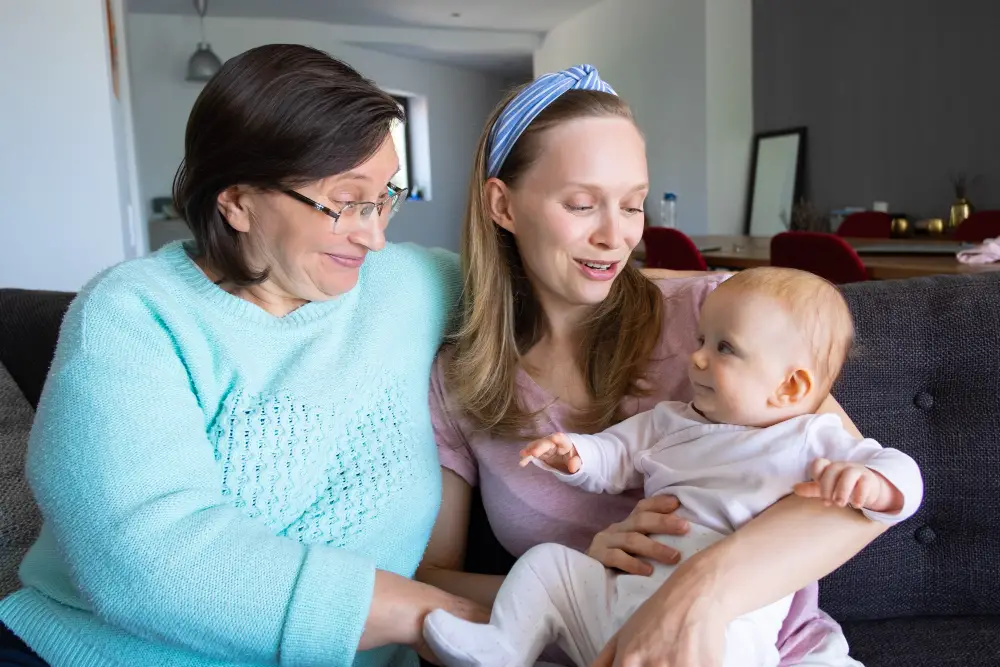
And then, about two months before this story really begins, our lives changed in the best possible way. I gave birth to our daughter, Riley.
Riley was, and is, everything. Those first two months were the exhausting, delirious, sleep deprived blur that everyone warns you about and no one can actually prepare you for. We were tired in a way I hadn’t known was possible. There were nights I fell asleep mid sentence. There were mornings I couldn’t remember which day of the week it was. But underneath all that exhaustion, Mark and I were happier than we had ever been in eight years together. We had made this tiny, perfect person, and every hard hour of it was worth it a hundred times over.
We had it all. And I should have known, given my history with the other shoe, that something was coming.
It came on an ordinary evening. I was in the nursery, in the glider by the window, rocking Riley in the soft last light of the day, and Mark walked in.
I knew immediately that something was wrong. I knew it before he said a word, because of the way he was moving. His hands were fidgeting. He drifted over to the crib and touched the rail. He reached in and straightened a stuffed rabbit that didn’t need straightening. He glanced at the stack of diapers on the changing table, then at the window, then at the floor. Anywhere but at me.
Stalling. My husband was stalling, and after eight years I could read him like a familiar book.
“What?” I said, shifting Riley up against my shoulder.
Mark stood by the crib, his fingers tapping a nervous little rhythm against the wooden rail. “What do you mean, what?” he said, in a tone that was trying very hard to sound like a man who had simply wandered in to admire his sleeping daughter.
I narrowed my eyes. “You want to tell me something. I can see it all over your face. So say it.”
He hesitated. His shoulders climbed up toward his ears. He reached back and scratched at the back of his neck, a tell I’d known since our second date. “You always know everything,” he muttered, almost resentfully.
I couldn’t help a small smirk, even through the growing dread. “We’ve been together for eight years, Mark. What did you expect? Say it.”
He took a deep breath, held it a moment, and then blurted the whole thing out in a single panicked rush, all the words slammed together into one long syllable.
“Momhadafiresheneedsaplacetostay.”
I blinked at him. “What? Say that in English.”
He exhaled, slower this time, forcing himself to slow down. “My mom. There was a fire. At her house. It’s damaged, she needs to renovate before she can live there again, and in the meantime she needs somewhere to stay. So.” He swallowed. “She’s going to be staying with us. For a little while.”
The room went completely silent. Even Riley, mercifully, stayed asleep. My arms tightened around her, and I felt something cold and heavy settle in my chest.
“You’re joking,” I said. “Tell me you’re joking.”
Mark shuffled his feet and said nothing, which was, of course, its own answer.
And then a second, uglier realization landed on me, and I felt my whole face go hot.
“Wait,” I said slowly. “Did you deliberately tell me this while I’m holding the baby? So I wouldn’t be able to scream at you? So I’d have to keep my voice down?”
His silence stretched out just a beat too long.
“…Maybe,” he finally admitted, wincing.
I closed my eyes and let out a long, slow breath, using every ounce of self control I had to keep my voice level and quiet for Riley’s sake. “Mark. Do you understand what you’re actually asking me to do here? I am home with Riley all day. Every day. Which means, if Judy moves in, I am home with Judy all day. Every day. Just the two of us and the baby, in this house, for hours and hours, with you at work.”
Mark attempted a weak, hopeful little smile. “But hey. At least you’ll have help with the baby, right?”
I let out a short, humorless laugh. “Help. You think Judy is going to help me? You mean I’ll have a nonstop live in commentator, telling me everything I’m doing wrong? Lecturing me about how I don’t know the first thing about being a mother? That kind of help?”
“Kate. Please.” He said it like a man who already knew he’d lost, but had to try anyway.
I stared at him for a long moment, my exhausted, well meaning husband, caught as always between the two women in his life. And I understood that he hadn’t actually said yes to her so much as failed to say no, which with Judy amounted to the same thing.
“Fine,” I said tightly. “Fine. How long is she staying?”
Mark hesitated. And that hesitation told me more than any number could have. “I… don’t know,” he admitted.
Before I could get another word out, before I could ask a single one of the dozen furious questions rising in my throat, he turned and practically bolted from the nursery, moving with the speed and guilt of a man fleeing the scene of a crime.
I sat there in the glider with my sleeping daughter, and I pinched the bridge of my nose, and I exhaled long and slow into the quiet room.
This, I thought. This is going to be a very interesting experience.
I had no idea.
Judy arrived two days later with three enormous suitcases, a garment bag, and a box of her own kitchen implements, because apparently my kitchen was not to be trusted. And within four days, four days, I was already at the absolute end of my rope.
Because Judy did not come to help. Judy came to correct.
Everything I did with Riley, in Judy’s expert opinion, was wrong. Fundamentally, dangerously wrong.
I was bathing her wrong. The water was too hot, then too cold, then I was holding her head at the wrong angle, then I was using too much soap, then not enough.
I was changing her diaper wrong. Too loose, too tight, the wrong brand, the wrong technique, and did I know that in her day they used cloth and it was better for the baby and I really should consider it.
I was feeding her wrong. On the wrong schedule, in the wrong position, for too long, for not long enough.
I was putting her to sleep wrong. Too much rocking, not enough rocking, the room too dark, the room too bright, the swaddle too tight, the swaddle unnecessary and old fashioned.
It didn’t matter that I had read every book. It didn’t matter that I had a folder of notes from Riley’s pediatrician, that I’d taken the classes, that I called the nurse line whenever I had a question. It didn’t matter that Riley was, by every measure that actually counted, a thriving, healthy, growing baby who was hitting all her milestones early. None of that registered with Judy. Because Judy had raised exactly one child, Mark, some thirty odd years ago, and in her mind that single data point made her the world’s foremost living authority on infant care, and me a bumbling amateur who was lucky the child had survived this long under my incompetent hands.
The days were long. God, they were long. Mark would leave for work in the morning and it would be just me, and Judy, and Riley, in a house that had suddenly become far too small, for nine or ten hours at a stretch. Nine or ten hours of that voice, that steady drip drip drip of correction, until I felt like I was slowly losing my mind.
I remember one afternoon in particular. Riley had been fussy all day, the way babies sometimes are for no discernible reason, and I’d finally, after an hour of walking and bouncing and singing, gotten her to settle into a light doze against my chest. I was exhausted, running on maybe three hours of broken sleep, and I sat down very carefully so as not to wake her, and for one blessed moment there was peace.
And Judy looked over from her armchair and said, “You’re holding her too much, you know. You’ll spoil her. In my day we let them cry it out. Put them down and let them learn. You carry that child around like she’s made of glass and you’ll have a clingy, needy little thing on your hands, mark my words. Mark never cried. I made sure of it.”
I did not respond. I had learned, by then, that responding only extended the lecture. I just sat there with my sleeping daughter and stared at the wall and counted, silently, the hours until Mark came home.
I called Mark on his lunch breaks and tried to explain what it was like, and he’d say something soothing and useless like she means well or just try to ignore it or it’s only temporary, and I would hang up feeling more alone than before. Because he wasn’t there for it. He didn’t hear the tone, didn’t feel the way every hour of it wore a little groove into you, didn’t understand that it wasn’t any single comment but the relentless accumulation of them, hundreds of tiny cuts, that was breaking me down.
I told myself I could survive it. It was temporary, right? A few weeks, a couple of months at the outside, while her house got fixed. I could grit my teeth and get through it.
And then, one evening, Judy said the thing that changed everything.
It was after dinner. I had just finished feeding Riley, and I had her up against my shoulder, patting her small warm back, waiting for the burp. Judy sat across the room in the good armchair, the one she’d claimed as hers within a day of arriving, with a cup of tea balanced on her knee. She’d been watching me for a while. I could feel it, that appraising, disapproving stare, but I’d learned to tune it out.
Then she set down her teacup, and she said it. Casually. Lightly. In the exact same tone she might have used to comment on the weather.
“You know,” she said, “maybe you should just let me take Riley. Let me raise her. She’d be so much better off with me, dear. Truly.”
I froze. My whole body went rigid. My hands tightened, instinctively, protectively, around my daughter’s tiny body.
“…I’m sorry,” I said, and I could hear my own voice come out sharper and colder than I’d intended. “Are you joking?”
Judy didn’t even blink. She looked at me with an expression of perfect, placid reasonableness, as though I were the one being unreasonable for not immediately agreeing.
“No,” she said. “I’m not joking at all. I raised Mark, and you married him, so you must think I did a decent job of it. And frankly, dear, I look at you, and I genuinely cannot imagine what kind of child you’re going to raise. It worries me. It keeps me up at night. So I’m offering. Let me take her. Let me do it right.”
I felt a wave of heat rise up through my entire body, from my chest to the roots of my hair. My ears were ringing.
“So let me make sure I understand you,” I said, very quietly, because Riley was still in my arms and I would not, would not raise my voice with her against my shoulder. “You want to take my daughter. From me. And raise her yourself. Because you don’t think I’m good enough.”
“Well,” Judy said, with a little sigh, as though the answer were obvious and I was being slow, “yes, dear. But it would be for the best. For everyone. Especially for her.” And she reached across the space between us and placed a hand on my shoulder, warm and heavy and utterly presumptuous, like she was comforting me, like this was a kindness.
I shoved her hand off my shoulder. My whole body was shaking now, a fine tremor of rage running through me. Without a word, because I did not trust myself to speak, I stood up and turned and marched straight into the nursery.
I laid Riley down in her crib for a moment, and with hands that would barely obey me, I started grabbing her things. Diapers, wipes, bottles, formula, onesies, the swaddles Judy hated. I stuffed all of it into the diaper bag and then into a second larger bag. Then I scooped Riley back up, held her against me, and walked into our bedroom.
Mark was sitting up in bed, reading, comfortable and oblivious. He didn’t register the storm that had walked into the room until I set Riley in the bassinet and yanked open my dresser drawer and started throwing my own clothes into a suitcase.
“Whoa. Hey. Where are you going?” he asked, sitting up straight, alarmed.
“To my mother’s,” I said, not looking at him, still packing. “I’m going to stay at my mom’s until Judy is gone. Out of this house.”
“What? Kate, what happened?” He swung his legs off the bed. “What’s going on?”
I spun around to face him, and I finally let some of it out, though I kept my voice down for the baby. “Do you know what your mother just said to me? Just now? In our living room? She said we should give Riley to her. To raise. Because she doesn’t trust the kind of mother I’ll be. She offered, Mark, like it was a favor, to take our daughter away from us.”
Mark’s face flickered with uncertainty. “I’m… I’m sure she didn’t mean it like that. You know how she talks, she—”
“Oh, she meant it,” I cut in. “Trust me. I was there. I saw her face. She meant every single word.”
Mark opened his mouth, and then closed it. He didn’t argue. That was the thing that told me he believed me, underneath his instinct to smooth it over. He knew his mother. He just sighed, a long, defeated sigh, and reached over to the nightstand and picked up his car keys.
He drove Riley and me to my mother’s house in complete silence. And I let the silence sit, because I had nothing left to say to him that wouldn’t come out as something I’d regret.
That was supposed to be a short term thing. A few days, maybe a week, to let things cool down, to force the issue, to make Mark finally deal with his mother.
It turned into almost three weeks.
Three weeks I lived at my mom’s house, in my childhood bedroom, with Riley in a borrowed bassinet beside me. And in some ways it was a relief. My mother was kind and helpful and, crucially, did not once tell me I was doing anything wrong. She held Riley so I could nap. She cooked. She let me cry when I needed to. It was the first real rest I’d had in months.
My mother, I should say, is everything Judy is not. Warm where Judy is sharp. She’d raised me and my two siblings mostly on her own after my father left, and she’d done it with a kind of easy grace that I only fully appreciated once I became a mother myself. When I’d arrived on her doorstep at eleven at night with a diaper bag and a baby and a face swollen from crying, she hadn’t asked a single question. She’d just opened the door wider and said, “Come in, sweetheart, I’ll put the kettle on,” and taken Riley from my arms so I could set down the bags. That was the difference between the two grandmothers, laid bare. One of them helped. The other corrected.
Those three weeks, I got to watch what it looked like to have a mother figure in the house who made things easier instead of harder. Riley thrived. She slept better, ate better. And I began, slowly, to feel like myself again, to remember that I was actually a competent and loving parent and not the fumbling incompetent Judy had spent a month convincing me I was.
But it was also a marriage slowly bending under a weight that wouldn’t lift.
Mark came to visit nearly every day. He’d show up after work, hold Riley, sit with me, and every time, the tension between us would be a little thicker than the day before. Because every time, I’d ask the same question, and every time, he’d give the same impossible answer.
One evening, about three weeks in, we were sitting in my mother’s living room after Riley had gone down for the night. The exhaustion between us hung in the air like humidity, heavy and hard to breathe through.
“Come home,” Mark said quietly. “Please. Just come home.”
I looked at him steadily. “Has Judy left?”
He shifted on the couch. He couldn’t hold my eyes. “No. She… she says the house is still under renovation. It’s not ready yet.”
I let out a sharp, disbelieving laugh. “Really. It’s still not ready. Mark, don’t you think that’s a little bit strange? It’s been a month. How bad was this fire, exactly, that a whole month later the house still isn’t livable? You’ve never even shown me a photo of the damage. Neither has she.”
Mark rubbed his temples with both hands. “I don’t know, okay? I don’t know how bad it was. I haven’t been down there. But Kate, I miss you. I miss Riley. I miss my family. I want you home.”
I shook my head slowly. “I’m not coming back to that house while she’s still in it. I’m sorry. I won’t. And it is not my fault that she has somehow become a bigger priority to you than your own wife and your own daughter.”
Mark’s expression, which had been pleading, suddenly hardened. “That’s not fair. That’s not fair, and you know it.”
I folded my arms across my chest. “Isn’t it, though? Am I wrong? Because from where I’m sitting, your wife and your baby have been gone for three weeks, and your mother is still comfortably installed in our home, and you haven’t done a single thing to change that. So tell me. Am I wrong?”
His jaw clenched tight. Something in him, some pressure that had been building for weeks, finally cracked.
“You know what? Maybe you should just file for divorce, then,” he snapped. “If that’s really how you feel. If I’m such a terrible husband. Maybe we should just end it.”
My stomach dropped straight through the floor. The word divorce landed in the room like a dropped glass.
“Maybe I will!” I fired back, before I could stop myself, before I could think.
And the instant the words left my mouth, I saw Mark’s face change. The anger drained out of it and was replaced, immediately, by a look of pure, stricken regret. We both heard it, that word, hanging in the air between us, and we both knew it was the worst thing either of us had ever said to the other.
But it was too late to take it back. Neither of us knew how. Mark stood up abruptly, and without another word, he stormed out of my mother’s house and slammed the door behind him hard enough that I heard my mother’s picture frames rattle in the next room.
I sank down onto the floor right where I stood, and I put my face in my hands, and I cried. Really cried, the kind of crying that comes from somewhere deep and old. I was drained. Completely, utterly drained. I felt like I was watching my marriage, the thing I’d been so sure was unbreakable, come apart over a lie I couldn’t even prove.
And that was the thought that stopped my tears.
A lie I couldn’t prove.
I sat up on my mother’s living room floor, wiping my face, and something cold and clear settled over me. For three weeks I’d been taking it on faith. The fire. The damage. The renovations that dragged on and on. Judy had said it, Mark had repeated it, and I had simply believed it, the way you believe a thing that’s too big and too strange to bother questioning.
But I had never seen it. Not once. No photos. No contractor’s estimates. No insurance paperwork. Nothing. Just Judy’s word, and Judy’s word had never once in eight years been worth anything to me.
I had to see it. I had to see this fire with my own two eyes.
The next morning, I made my decision. I kissed Riley’s soft head and left her with my mother, who took one look at my face and asked no questions, just nodded and held out her arms for the baby. And I got in my car and I started driving. Five hours, toward Judy’s house, my hands gripping the steering wheel far tighter than necessary, my thoughts running in furious circles the whole way.
I was going to see it for myself. The fire. The damage. The renovations that had somehow kept this woman living in my home, in my life, for over a month, that had somehow driven my husband and me to the edge of divorce.
I was so angry. Angry at Mark, for letting it drag on this long, for choosing the path of least resistance every single time, for saying that word last night. Angry at myself, for not driving down here weeks ago, for being so tired and so overwhelmed that I’d let it get this far without checking. And most of all, underneath everything, boiling, furious at Judy. She had turned our entire life upside down. She had come into our home and told me I wasn’t fit to raise my own child. She had somehow engineered a situation that had me sleeping in my childhood bedroom while she slept in my house.
I drove the whole five hours barely aware of the road, running through what I’d say, how I’d finally make Mark see. And as I got close, as I turned onto Judy’s familiar street, I braced myself for the sight of it. Charred black walls. Boarded up windows. A dumpster in the driveway full of ruined furniture. Construction crews and scaffolding and tarps. The visible, undeniable evidence of a house that had burned.
I pulled up to the curb in front of Judy’s house.
And I froze.
Because the house was perfectly, completely fine.
There was not a single burn mark anywhere. Not one. No smoke damage on the walls, no boarded windows, no construction crew, no dumpster, no scaffolding, no tarps, nothing. The windows were all intact and clean and gleaming in the afternoon sun. The lawn was neatly, freshly mowed. The flower beds along the walk were tended and blooming. The house looked exactly, precisely, identically as it had the last time I’d seen it, months ago. Untouched. Immaculate. Lived in and cared for.
There had been no fire. There had never been a fire.
My hands were shaking as I pulled out my phone. I got out of the car and I walked up and down the sidewalk, and I took pictures. Dozens of them. The intact windows, the clean walls, the trimmed lawn, the blooming flowers, the front door with its cheerful wreath. From every angle, in clear afternoon light. I needed proof. I needed evidence. I needed something concrete and undeniable that Mark could not explain away, could not smooth over, could not defend.
Because now I understood. It had all been a lie. A calculated, elaborate lie, told to force her way into my home, and I had almost lost my marriage over it.
I didn’t think. I didn’t stop to rest, didn’t get a hotel, didn’t even really plan. I got back in my car and I turned around and I drove the five hours straight home, my jaw set the entire way.
By the time I pulled into my own driveway, it was late, well past dark. The house lights were on. I didn’t care about the hour. I didn’t care about anything except walking through that door with the truth in my phone. My heart was pounding so hard I could feel it in my teeth.
I let myself in, and I stormed into the living room.
And there they were. Mark and Judy, sitting together on the couch, watching television, as comfortable and settled as if the last month had never happened, as if my daughter and I weren’t five hours away sleeping in my mother’s house because of a lie.
“Kate—” Mark started, standing up, surprised.
But I didn’t let him finish. I turned, and I looked straight at Judy, and my hands curled into fists at my sides.
“Tell me the truth,” I said. “Right now. There was no fire. Was there.”
Judy blinked up at me, arranging her face into an expression of perfect, wounded confusion. “What? Kate, dear, I don’t know what you’re talking about. Of course there was a—”
“Oh, don’t,” I snapped. “Don’t you dare. Don’t even try it with me. I just drove ten hours round trip, today, to your house. Your house is perfectly fine, Judy. It is immaculate. There’s not a mark on it. No fire, no smoke, no damage, no renovation, no construction, nothing. The lawn’s freshly mowed. There are flowers blooming in the beds.” I pulled out my phone and held it up, the photos ready on the screen. “I have pictures. All of it. So don’t sit there and lie to my face again. Why did you do it? Why did you lie?”
The room was silent. Mark was staring at his mother now, the color draining from his face as he began to understand.
And Judy, faced with the photographs, faced with being caught, deflated. All at once, the wounded confusion collapsed. Her shoulders sank. She looked down at her hands in her lap. And when she finally spoke, her voice was small, and for the first time since I’d known her, it was honest.
“I was lonely,” she said.
I stared at her. “You were… lonely.”
“I was lonely,” she said again, still not looking up. “Do you have any idea what it’s like? To live all alone, five hours away, in a quiet house, and know that your only son has a whole life you’re not part of? A wife. And now a baby. A grandbaby I’ve only held a handful of times.” Her voice wavered. “Kate, your mother lives twenty minutes from here. You see her all the time. She’s part of everything, every day. And I only ever get to see any of you at holidays, and only if I’m lucky, and only for an afternoon. I sit in that house by myself and I imagine all of you together and I…” She trailed off.
Mark’s brow was furrowed, his voice quiet and hurt. “Mom. If you were lonely, if you wanted to see us more, why didn’t you just tell us that? Why didn’t you just say it? Instead of… this?”
Judy finally looked up, and there was something almost pitiful in her face. “Because,” she said simply, “Kate never would have let me stay. And I knew it. If I had called and asked to come visit for a month, she’d have found a reason to say no, and I couldn’t have blamed her.” She looked at me. “So I made up a reason she couldn’t argue with.”
And you know what? She wasn’t entirely wrong about that, and we both knew it. If she had called and asked to stay with us for a month, I would absolutely have found a way to say no. After everything, after the wedding, after years of criticism, I’d have run a mile.
But that didn’t excuse it. Not even close.
I crossed my arms and took a breath, and when I spoke, the fury had drained out of me and left something steadier and sadder in its place.
“You did this to yourself, Judy,” I said. “Do you understand that? You did. Because here’s the thing. For years, I tried. I really tried. When I first married Mark, I wanted a relationship with you so badly. I invited you shopping. I invited you into our home. I tried to make you part of our lives, part of everything. And every single time, all I ever got back from you was criticism. You told me I was too thin, then too fat. You told me I couldn’t cook. You hired a woman to try to break up my wedding, Judy. And now you tell me I’m not fit to raise my own daughter and you want to take her from me. And you wonder why I keep my distance? You wonder why I wouldn’t have let you stay?”
Judy was quiet for a long moment. And then she did something I’d genuinely never seen her do in eight years. She lowered her eyes, and she said, softly, “I know. I know I did all that.” She swallowed. “The truth is, Kate, I… I always want the best. For Mark. For Riley. For everyone I love. I do. But I don’t know how to say it right. I never have. Everything comes out as a criticism because I don’t know any other way to say it. My own mother was that way with me, and I suppose I just… became her. And I’ve pushed everyone away doing it. Including you. Including my own son, sometimes.” Her voice cracked. “I’m lonely because of the way I am. And I know that. And I don’t know how to be different.”
Something shifted in the room when she said that. It was the first time, in all the years I’d known this woman, that Judy had ever admitted a single fault, ever spoken to me without a barb hidden in the words, ever sounded like a scared and lonely human being instead of my mortal enemy.
I let out a long breath, and the last of the anger went out of me with it, and I sat down.
I sat down across from her, and I felt the full weight of the whole long, exhausting month settle onto me at once. And then, without either of us quite deciding to, we started to talk. Really talk, for the first time ever.
At first it was awkward. Painfully so. Both of us hesitating, starting sentences and abandoning them, unsure of where to even begin after eight years of cold war. Mark hovered, and then, sensing something delicate happening, quietly slipped out of the room to check on the house and give us space.
But little by little, the words came. Judy admitted things. The shopping trips, the comments about my weight, all of it, she admitted she’d known even as she said them that they were cruel, and that she’d said them anyway because some jealous, frightened part of her couldn’t stand to watch her son build a life that didn’t revolve around her. She admitted the wedding stunt had been unforgivable and that she’d known it at the time and done it anyway, and that she’d never really apologized for it because apologizing felt like losing.
“When Mark was a boy,” she told me at one point, her voice going soft and far away, “it was just the two of us. His father wasn’t around much, and then not at all. And Mark was my whole world. Everything I did, I did for him. And I think somewhere along the way I decided that his world had to be me, the same way mine was him. And then you came along, and you were kind, and you were smart, and he looked at you the way he’d never looked at anyone, and instead of being happy for him, I was…” She stopped, and pressed her lips together. “I was terrified. That I was being replaced. That I’d made him the whole meaning of my life and now he was walking out of it into a life with you, and I’d have nothing. So I tried to spoil it. I tried to find fault with you so he’d see what I saw, except there wasn’t anything to see, so I had to invent it. I’m not proud of any of it. I’ve never said this to anyone.”
And I admitted things too. That I’d stopped trying long before I’d had to, that I’d written her off completely, that I’d taken a certain satisfaction in the distance between us, that I’d used her bad behavior as permission to shut her out entirely rather than ever try to understand where it came from. That I’d made Mark choose, over and over, between us, which wasn’t fair to him. That I’d been so busy defending myself from her that I’d never once stopped to wonder what she was so afraid of.
We dug down into years of it. Years of unspoken resentment and misread intentions and accumulated hurt, peeling it back layer by layer, and it was not easy, and it was not comfortable, and more than once one of us had to stop and collect herself. But it was real. For the first time in eight years, something real was happening between us instead of a performance of politeness stretched over a foundation of mutual dislike.
And then, without warning, without either of us seeing it coming, Judy reached across the space between us and pulled me into a hug.
I froze. My whole body went rigid, the reflex of eight years of keeping this woman at arm’s length. And then, slowly, something loosened in my chest, some knot I’d been carrying for so long I’d stopped noticing its weight, and I let it go. I hugged her back. Two women who had spent nearly a decade as enemies, holding onto each other on my living room couch, both of us crying a little, both of us tired of the war.
I want to be honest and say that it did not fix everything overnight. Judy did not transform into a perfect, gentle grandmother the next morning. There were still comments, old habits, things that slipped out before she could catch them. But there was a difference now, and it was this: when she said something that landed wrong, I could say so, and she would stop, and sometimes even apologize, and we would move past it. We had a way to talk to each other now. We had, underneath everything, decided we were on the same side.
She went home a week later, to her perfectly intact house, but she came back. Properly this time, invited, planned, welcome. She visits every couple of months, and she calls to ask before she comes, and she holds Riley and dotes on her, and when she catches herself starting to correct the way I do something, she stops, and she says, “Sorry. Old habit. You’re doing fine,” and she means it.
Mark and I never spoke that word again, the one we’d thrown at each other in my mother’s living room. We both understood that we’d said it out of exhaustion and pain and a situation that had backed us both into corners. We came out the other side of that month more careful with each other, more aware of how much we had to protect.
And the strangest part, the part I never could have predicted the night I stood in that living room with photos of an unburned house on my phone, is that I actually gained something out of all of it. Not just my home back, and not just my marriage, though I got those too.
I gained a mother in law. A real one. A flawed and difficult one who says the wrong thing more often than she’d like and who spent years being my enemy because she never learned any other way to be. But a real one. Someone who loves my daughter, and who is trying, genuinely trying, to be better. Which, in the end, turned out to be all I’d ever wanted from her in the first place.
She hadn’t started a fire. But she’d nearly burned everything down anyway, and somehow, out of the wreckage of a lie, we finally built something true.

Laura Bennett writes about complicated family dynamics, difficult conversations, and the quiet moments that change everything. Her stories focus on real-life tensions — inheritance disputes, strained marriages, loyalty tests — and the strength people find when they finally speak up. She believes the smallest decisions often carry the biggest consequences.