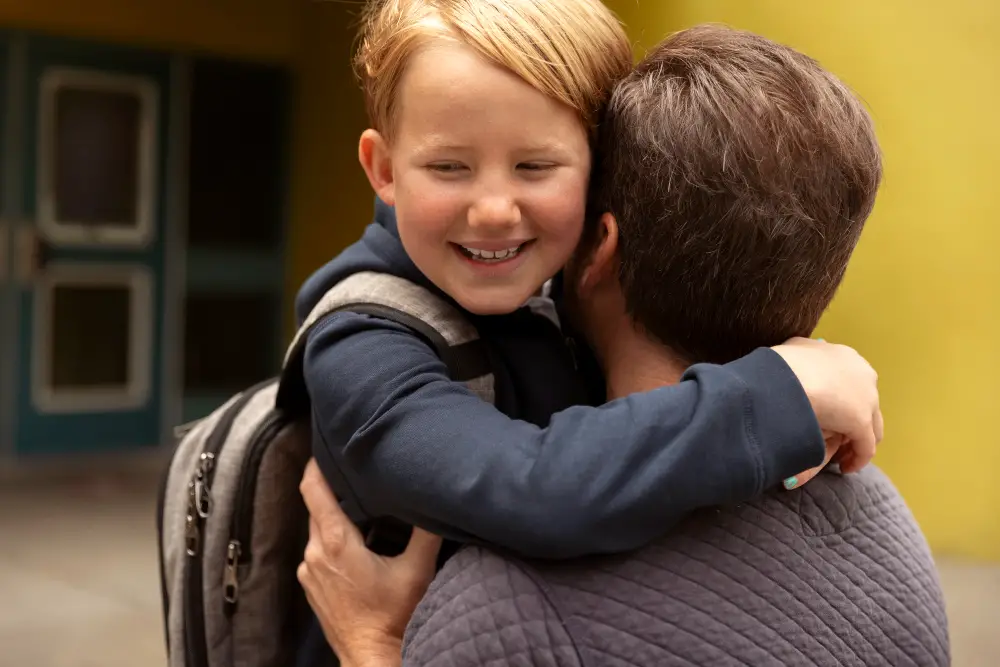
Everyone warned me not to adopt Luke.
“He’s sixteen,” my sister said over the phone, her voice tight with the particular worry of someone who loves you and thinks you’re about to make a mistake. “Do you know how many placements a kid like that has been through?”
I did know. Ten. I’d read the number in his file and it had sat in my chest like a stone.
“Caroline, teenagers who bounce around that much—they come with things. Things you can’t fix.”
“Everybody comes with things,” I said.
She sighed. It was the sigh she’d been sighing at me for three years.
But two weeks after the adoption became final—two weeks after I signed my name on the line that made Luke legally, permanently, undeniably my son—he sat across from me at dinner, and his hands started to shake, and he set down his fork, and he said the words that would crack my whole world open again.
“Mom, I need to tell you why.”
I didn’t know yet what he meant. I didn’t know that this quiet, careful boy had been carrying a secret heavy enough to bend him in half. I didn’t know that everything I thought I understood about his ten failed placements was wrong.
All I knew, in that moment, was that his eyes were full of tears, and he looked more frightened than I had ever seen him.
To understand what happened at that dinner table, you have to understand how I got there in the first place.
You have to understand about the silence.
Three years before Luke, I buried both of my children.
There’s no gentle way to write that sentence. I’ve tried. There isn’t one.
It was a Thursday. An ordinary, forgettable Thursday—the kind you never think will be the day that splits your life into a before and an after. Grace was fourteen. Noah was eleven. Their father had died two years earlier, so it had just been the three of us, learning how to be a smaller family, figuring out our new normal.
And then a car crossed a median on a wet road, and there was no more normal at all.
For months afterward, I kept their bedroom doors closed.
I couldn’t walk past them open. I couldn’t look inside. Every doorway was a mouth about to swallow me. So I shut them, and I told myself that was easier.
It wasn’t.
Because closed doors have their own weight. They sit in a hallway like tombstones. Every time I passed them, I felt the closing all over again—the deliberate, final act of shutting my children away.
So one day I opened them.
I don’t remember deciding to. I just remember standing in the hallway one morning with my hand on Grace’s doorknob, and turning it, and letting the door drift open.
Her sweatshirt was still hanging over the back of her desk chair. The gray one she wore constantly, the one with the frayed cuff she used to chew on when she was nervous.
I couldn’t move it.
Down the hall, in Noah’s room, three library books were still stacked beside his bed. Overdue by three years now. I imagined the fines climbing, absurd and endless, and I couldn’t make myself return them. Returning them would mean he wasn’t coming back to finish them.
I couldn’t move any of it.
People told me my grief would change. That it would soften. That someday it might even go away.
They were right, technically.
It did change. It changed from something that crushed me flat every single morning—that pinned me to the mattress and made breathing feel like lifting weights—into something quieter. Something I learned to fold up and carry inside my coat where no one could see it.
I got good at that. Frighteningly good. I could go to the grocery store and smile at the cashier. I could answer “How are you?” with “Good, thanks, and you?” I could sit through a work meeting and nod at the right moments.
Nobody knew I was carrying two coffins under my ribs.
But the house knew.
The house stayed silent.
I’d grown up believing a home was supposed to be loud. Kids arguing over the remote. Feet pounding down stairs. The refrigerator door opening forty times a day. Music leaking out from under bedroom doors that I’d have to knock on and say, “Turn it down, it’s a school night.”
Now there was nothing. Just the hum of the refrigerator and the tick of a clock and my own footsteps echoing in rooms built for more people than they held.
The silence got louder every day.
And eventually, it became unbearable.
That was why, one rainy Tuesday, I walked into a foster care agency and sat down across from a woman named Denise and told her I wanted to talk about becoming a parent again.
Denise did not smile at me right away.
I’d expected warmth—the kind of professional brightness people put on when they want you to feel welcome. Instead she studied me across her cluttered desk with dark, steady eyes, like she was reading something written on the inside of my skull.
“Before we go any further,” she said, “I’m going to ask you something difficult.”
“Okay.”
“Are you trying to replace your children?”
The question landed like a slap. Not because it was cruel—but because it was exactly the thing I’d been afraid to ask myself. The thing that had kept me awake, staring at the ceiling, wondering if I was allowed to do this. Whether wanting a child again meant I was trying to paper over the ones I’d lost.
“No,” I said.
She didn’t move. “Are you sure?”
I made myself hold her gaze. “No one could replace them. I don’t think anyone could. Grace and Noah were exactly who they were, and they’re gone, and no child on earth could step into those spaces.” My voice wobbled but held. “I’m not looking for a replacement. I’m looking for someone to love. Those aren’t the same thing.”
Something in Denise’s face shifted. The wariness loosened, just slightly.
“Good answer,” she said.
I let out a breath I hadn’t realized I was holding.
“I’ll be honest with you, Caroline,” she went on. “This process is going to be harder than you think. And I don’t mean the paperwork, though there’s a mountain of that too. I mean the parts that get inside you.”
She wasn’t wrong.
The process took months.
There was training—hours and hours of it. Classes about trauma and attachment and the ways a child’s brain rewires itself when the adults who were supposed to protect it don’t. There were interviews where strangers asked me the most intimate questions of my life and wrote my answers on clipboards. There were home visits, where a caseworker walked through my house checking smoke detectors and cabinet locks and, I was certain, silently judging the two closed-again bedroom doors I couldn’t bring myself to explain.
There were conversations about trauma that sometimes sent me out to my car afterward, where I’d sit in the parking lot with my hands on the steering wheel and cry until I was empty.
But I kept going back.
Because every time the silence at home threatened to close over my head, I remembered why I’d started.
And then, one afternoon, Denise called me.
“We’re having an event this weekend,” she said. “Prospective parents get to meet some of the kids. Informal. Low pressure. No expectations.” A pause. “I think you should come.”
The event was in a community center gymnasium with fluorescent lights and folding tables and a squeaky floor.
Most of the younger kids were playing—chasing each other, building precarious towers out of blocks, shrieking with the easy joy children can summon even in the strangest circumstances. Volunteers hovered at the edges. Prospective parents drifted through with careful smiles, trying not to look like they were shopping, which of course was exactly what everyone was doing, and everyone knew it, and nobody said it.
I felt sick. I almost turned around and left.
And then I saw him.
One teenage boy sat alone beside a window, a little apart from everything, a paperback open on his knees. While the room churned with noise around him, he read as though he were sitting in a quiet library instead of a gym full of chaos and hope and quiet desperation.
There was something in the stillness of him that caught me.
I was still watching when a little girl a few feet away knocked over a box of crayons. They scattered across the floor in a bright avalanche, rolling under tables and chairs.
The boy immediately put down his book.
He didn’t sigh. He didn’t look for an adult to handle it. He just got up, crouched down, and started gathering crayons, sorting them back into the box with quick, practiced hands. When one blue crayon rolled all the way under a table, he got down on his stomach and reached for it, stretching until he could pinch it between his fingers.
He handed the full box back to the little girl with a small nod. She beamed at him. He returned to his chair, opened his book, and disappeared back into it as though nothing had happened.
Something in my chest pulled tight.
“Who’s that?” I asked, nodding toward him.
Denise had appeared beside me. She followed my gaze, and when she saw who I was looking at, her whole expression changed.
“Luke,” she said.
There was something in the way she said the name. A weight.
“How old is he?”
“Sixteen.”
“Can I meet him?”
She hesitated—a real hesitation, the kind that means someone is choosing their words. “You should know something first. He’s had a lot of placements.”
“How many?”
“Ten.”
I stared at her. Ten. Ten families. Ten times a door had opened and then closed. Ten times a boy had unpacked a bag and packed it up again.
The number sat in my stomach like something cold.
“Was he violent?” I asked. The question everyone asks. The question I hated myself for asking.
“No.”
“Drugs?”
“No.”
“Did he hurt younger children?”
“No.” Denise shook her head firmly. “Nothing like that.”
“Then what happened?”
She was quiet for a moment. “Different things. Luke is…” She searched for the word. “Complicated.”
I felt something flare in my chest, sudden and fierce.
I hated that word.
Years ago, after my husband died, Noah stopped talking in class. He’d been a bright, chattering kid, and then his father was gone, and something in him went quiet. His teachers called him difficult. Complicated. As though an eleven-year-old drowning in grief were a customer service problem, an inconvenient case.
What they really meant was that my hurting son no longer made their jobs easy.
I’d spent years learning that when adults call a child complicated, it usually means the child has feelings that adults find inconvenient.
“I’d still like to meet him,” I said.
Luke stood up when I approached.
That surprised me. Sixteen-year-old boys don’t usually stand for anyone. But he rose to his feet, unfolding to a height that nearly matched mine, and there was something formal and old-fashioned in it.
“Hi,” I said. “I’m Caroline.”
He glanced at the only empty chair nearby and gestured toward it. “Please, ma’am. You can sit here.”
I almost laughed.
“I’m forty-seven,” I told him, sitting down. “Not ninety.”
His mouth twitched. The very beginning of a smile, quickly suppressed. “I wasn’t implying anything.”
“You absolutely were.”
And there it was—a real smile, breaking across his face before he could stop it. It transformed him completely. For a second he wasn’t a boy with a file and a number, he was just a kid with a good sense of humor and a paperback and a smile he clearly didn’t hand out to just anyone.
“What are you reading?” I asked.
He turned the book so I could see the cover. And that was all it took.
We talked about that book for nearly an hour.
I don’t remember everything we said. I remember that he was smart—sharp in a way that had clearly gotten him in trouble before, the kind of smart that adults sometimes find threatening in a kid. I remember that he was funny, dry and quick, the humor of someone who’d learned to make jokes as a shield. I remember that when he talked about the characters in his book, he talked about them like they were real people whose choices he’d thought hard about.
And I remember that when I stood up to leave, I didn’t want to.
Denise caught me by the door.
“One good conversation doesn’t guarantee a placement,” she said. Gently, but clearly. A warning. Don’t get attached. Don’t get your heart set. This is a boy who has left ten homes.
“I know,” I said.
But I already knew something else too.
I was going to come back.
So I did.
Again and again and again.
For four months, Luke and I met—first at the agency, in supervised rooms with a caseworker sitting quietly in the corner. Then at libraries, where we’d wander the aisles and I’d let him recommend books to me. At diners, where he always ordered the same thing and always insisted on stacking our plates neatly for the server. At parks. On careful, supervised outings that slowly, week by week, felt less like appointments and more like time I looked forward to all week.
I kept waiting.
I’ll admit that. I kept waiting for the difficult teenager everyone had warned me about—the one who racked up ten placements, the one Denise called complicated. I braced for the anger. The sabotage. The moment the mask would slip and I’d see whatever it was that made families give him back.
He never appeared.
Luke was guarded, yes. There was a wall around him you could feel, a wariness in the way he watched to see if I’d still show up the next week. But behind the wall he was kind. Genuinely, quietly kind, in the small ways that matter most.
And he remembered everything.
Every single thing I told him. Offhand comments I’d forgotten making. He filed them all away.
Once, weeks into knowing each other, I mentioned in passing that Grace used to hate raisins. I don’t even know why I said it. It just slipped out, the way the kids slipped out sometimes, and then I braced for the awkwardness that always followed when I accidentally mentioned them.
Luke just nodded and let it go.
Three weeks later, we were sitting in a café and he pushed a cookie across the table toward me.
I stared at it.
“Don’t worry,” he said, not looking up from his book. “I checked. No raisins.”
I stared at him. Something in my throat went thick and tight.
“What?” I managed.
“Nothing,” he said.
But it wasn’t nothing.
He’d remembered. Not even something about me—something about my dead daughter, a tiny detail I’d mentioned once, and he’d carried it three weeks and turned it into a kindness.
I had to look out the window for a moment. I’d learned, in the years since I lost my children, that grief could make small kindnesses dangerous. A stranger holding a door could undo me. And this—this boy checking a cookie for raisins because I’d mentioned a girl he’d never meet—this nearly broke me right there in the café.
But I didn’t let him see. I just took the cookie and said thank you and we went back to our books.
That was the day I knew.
Eventually, we started talking about adoption.
It came up carefully, both of us circling it like a fire we weren’t sure we could touch.
“You’d really want that?” Luke asked one afternoon. We were at the park. He was picking at the label of a water bottle, not looking at me.
“Yes,” I said.
“Permanent?”
“That’s generally how adoption works.”
He didn’t smile. He looked away, toward the trees. “What if I mess it up?”
“Then we’d deal with whatever you messed up,” I said.
“What if you regretted it?”
“Then I’d be an adult having a feeling,” I said. “And you’d still be my kid.”
His eyes stayed fixed on the table between us, on his own hands. “You make everything sound simple.”
“No,” I said. “I make commitment sound simple. Because it is. It’s the one thing that actually is.”
He was quiet for a long time after that.
I didn’t know it then, but I’d said something that mattered. Something that would come back to me later, when I finally understood what he’d been carrying.
When Luke finally moved into my house, he treated everything as though he were borrowing it.
That was the first thing I noticed. He didn’t spread out. He didn’t make a mess and leave it, the way teenagers do, the way my own kids used to leave trails of belongings through every room like they owned the place—which they did, because it was their home.
Luke made his bed before breakfast, corners tucked tight. He washed his plate the instant he finished eating and set it in the rack. He folded towels without being asked, folded them better than I did. He moved through the house like a guest afraid of leaving a mark. Like a boy who’d learned that the way to make people keep you was to take up as little space as possible.
It broke my heart a little every time.
The first Saturday he was there, I nearly went headfirst down the porch steps.
There was a loose board—there’d been a loose board for years, one of those things you mean to fix and never do—and my foot caught the edge of it and I stumbled and grabbed the railing just in time.
Before I’d even fully caught my balance, Luke appeared with a screwdriver.
I don’t know where he’d been keeping it. He just materialized, already crouching down to examine the board.
“How long has this been like this?” he asked.
“Couple years,” I admitted.
He looked up at me, genuinely startled. “You’ve been walking on this? For two years?”
“I enjoy danger.”
“You’re ridiculous,” he said, and there was something in his voice I hadn’t heard before. Something almost fond. Almost like a kid gently exasperated with a parent.
He fixed the step that afternoon. Fixed it right, sanded it smooth, made sure every board was solid. And when he was done he tested it himself, stepping on it hard a few times, before he’d let me walk on it.
I understood, later, that Luke fixed things because fixing things was the only way he knew to say I want to stay here. I want this to last.
A month later, he called me Mom by accident.
We were in the kitchen. It was an ordinary morning, and he came around the corner already half-distracted, and he said it without thinking.
“Mom, have you seen my charger?”
We both froze.
The word hung in the air between us, enormous.
Luke turned bright red, all the way to his ears. He looked like he wanted the floor to swallow him.
I turned away quickly, toward the counter, and pretended to search a drawer for absolutely nothing, because if he saw my face he’d see the tear that had already spilled over, and I didn’t want to make it a big thing. I didn’t want to scare him off it.
“Kitchen counter,” I said, keeping my voice light. “By the toaster.”
“Right,” he said. “Thanks.”
Neither of us mentioned it.
But he kept saying it.
Slowly at first. Then more. Mom, I’m home. Mom, what’s for dinner. Mom, can you sign this. Each one a small miracle. Each one a door opening in a house that had been silent for three years.
By the time the adoption was finalized, I had stopped waiting for him to turn into someone else. I’d stopped bracing for the difficult teenager who’d never shown up. He was just Luke. He was just my son.
I thought the hard part was over.
I thought we’d made it through the storm and out the other side.
I had no idea.
Then, exactly two weeks after the adoption became final, Luke came to dinner and barely touched his meatloaf.
That scared me more than it should have.
Because Luke loved meatloaf. It was the one meal he never held back on, the one time he’d actually go back for seconds without me having to insist. And that night he just pushed it around his plate, cutting it into smaller and smaller pieces, not eating any of it.
“Sweetheart?” I said.
“I’m fine.”
“Terrible lie.”
His fork scraped against the plate. The sound set my teeth on edge.
I reached across the table and put my hand over his.
He was trembling.
Not a little. His whole hand was shaking under mine, and when I looked up at his face, his eyes were filling with tears.
“Luke,” I said, my heart starting to pound. “What is it? What happened?”
He pulled his hand away.
“Mom,” he whispered. “I need to tell you something.”
“Okay,” I said, trying to keep my voice steady even as fear crawled up my spine. “Okay. I’m listening.”
“And you’ll probably wish you hadn’t adopted me.”
My fork slipped from my fingers and clattered against the plate.
My stomach dropped straight through the floor.
Every terrible possibility rushed through my mind at once. Every warning I’d been given. He looked so terrified, so certain that whatever he was about to say would end us, that for one awful second I braced myself to hear something unforgivable.
“Luke,” I said. “Whatever it is. Just tell me.”
He looked down at his plate. His whole body was rigid. And then, so quietly I almost didn’t hear it, he whispered:
“I have a sister.”
The words didn’t make sense at first.
“A sister?” I repeated.
“Half-sister.”
I searched his face. “Luke—your file said you didn’t have any siblings placed with you.”
“She’s not placed with me.” His voice cracked. “Not anymore.”
And then, slowly, in fragments, with long pauses where he had to stop and breathe, Luke told me the story he’d been carrying alone.
Her name was Emma.
She was nine years old now.
They’d entered foster care together, years earlier, when Emma was still tiny. Just the two of them against the world. And from the very beginning, Luke had taken care of her.
“I basically raised her,” he said, and there was no pride in it, just fact. “I made her breakfast. Got her ready for school. Did her hair, even though I was terrible at it. Helped her with homework.” He swallowed hard. “When she woke up at night scared, she didn’t go looking for whatever adult was around. She came looking for me. Every time.”
I could picture it so clearly it hurt. A little boy, barely more than a child himself, learning to braid hair and pack lunches and be the steady thing in a little girl’s chaotic world. Being a parent when he should have been getting parented.
“What happened?” I asked softly.
Luke’s jaw tightened.
“A family wanted to adopt her,” he said. “A good family. Stable. Nice house. Everything she deserved.” He stared at the table. “But they didn’t have room for me.”
“What do you mean, they didn’t have room?”
“They wanted a little girl. Not a teenage boy too.” He shrugged, but the shrug was a lie, a small brave lie covering something enormous. “I was fourteen. And everybody kept asking me what I thought was best. For her.”
Something cold began to gather in my chest.
“Who asked you that?”
“Everybody. The caseworkers. The family. They said Emma deserved stability. They said she deserved a real chance at a permanent home. And they’d look at me while they said it.” He laughed, a short bitter sound with no humor in it at all. “Like they were waiting for me to be the one to say it. So they wouldn’t have to.”
“And did you?” I could barely get the words out. “Did you agree?”
“I was fourteen,” he said again, and his voice broke on the number. “They kept asking me what was best for her. What kind of brother says no to his little sister getting a family?” His hands were shaking again. “So I said yes.”
I felt anger rising in me, hot and immediate. Not at Luke. Never at Luke.
At every single adult who had put that impossible choice on the shoulders of a fourteen-year-old boy and let him believe it was his to make.
“So they took her,” Luke said. “And I stayed in the system.”
“After that,” Luke went on, “I started messing up my placements. On purpose.”
“What do you mean?”
“Not—I never got violent. I never hurt anybody or broke anything or did anything like that.” He said it quickly, needing me to know. “I just learned how to make people give up on me.”
“How?”
“I’d stop talking.” He said it flatly. “Just go silent. For days. Weeks, sometimes.”
“On purpose?”
“Mostly.” He paused. “Sometimes I just didn’t feel like talking anymore. But mostly on purpose.”
“What else?”
“Refuse to go on outings. Stay in my room with the door shut. Skip meals.” His voice dropped. “And sometimes I’d say stuff. Stuff I knew would hurt them. Stuff I knew would make them stop trying.”
I thought of the boy who checked cookies for raisins. Who stood when I entered a room. Who fixed my porch step so I wouldn’t fall. The idea of him deliberately wounding people, making himself unlovable on purpose, was almost impossible to fit against the boy I knew.
“Why?” I asked. “Luke, why would you do that?”
His chin trembled.
“Because if I got adopted somewhere else,” he said, “Emma might think I chose another family over her.”
The kitchen went very still.
And suddenly, all at once, ten placements looked completely different.
I’d been carrying that number around as a warning. Ten failures. Ten families who’d tried and given up. But that wasn’t the story at all.
The story was a boy who’d loved his sister so much that he’d made himself impossible to keep. Who had burned down every chance at a family of his own, over and over, for four long years—because staying meant betraying her.
“Did every family reject you?” I asked. I had to know.
Luke shook his head.
“How many did you push away?” I asked. “How many actually wanted you?”
“I don’t know.”
“Luke.”
He closed his eyes. “Most of them,” he admitted. “Most of them wanted me to stay.”
I remembered something Denise had told me, weeks before. A story about a foster mother who’d started discussing permanent guardianship with Luke—and how he’d packed his bags before she could even finish the sentence.
“Why did you leave that one?” I asked. “The woman who wanted to keep you for good. You had your bags packed before she finished talking.”
“Because I wanted to leave first,” he said.
“Why?”
He looked up at me, and there were tears running freely down his face now, and he said the thing that broke me clean in half:
“Because leaving hurts less when you’re the one who decides when it happens.”
I couldn’t speak.
He’d spent four years teaching himself to be the one who walked away. Because being left—being chosen against, the way he believed he’d been chosen against when Emma got her family and he didn’t—was a pain he couldn’t survive again. So he’d decided he would always leave first. Always be the one holding the door.
And then he said something worse.
“I was going to do it to you,” he whispered.
I turned back to him.
“What?”
“When I moved in.” He couldn’t look at me. “I had a plan. Give it a couple months. Let everybody get comfortable. And then start acting different. Push you away. Make you give up, so I could leave before you could—” His voice cracked completely. “Before you could get rid of me.”
I should have been hurt. Maybe I should have been angry.
Instead, despite everything, despite the tears on my own face now, I almost laughed. Because I could see so clearly the boy who’d made that plan, and the boy who was sitting in front of me confessing it, and how far apart those two boys had grown.
“But you didn’t,” I said.
“I messed up,” he said, and the words came out wrecked. “I couldn’t do it.”
“How?”
“I liked being here.” He covered his face with both hands. “I liked you. I liked the stupid porch step and the meatloaf and the way you never made a big deal out of anything. And then—” His shoulders shook. “Then I started loving you. And I didn’t know how to stop.”
I was up and out of my chair now.
“And then the adoption happened,” he sobbed. “It was final. It was real. Everybody was so happy. And all I could think was—” He gasped for breath. “All I could think was that Emma would find out. That she’d hear I let a family adopt me. And she’d think I chose you over her. She’d think I gave up on her. After everything I told her—after all the letters where I promised—”
I sat down in the chair beside him and pulled him into me, and this boy who folded towels perfectly and stood when I entered rooms and made himself as small as he could—this boy fell apart against my shoulder, four years of held-back grief pouring out of him all at once.
“You should have told me,” I said into his hair.
“I know,” he wept. “I know.”
“But listen to me.” I pulled back so he could see my face. “Listen. You are not going anywhere. You’re my son. Do you understand? Adoption isn’t a trial period. There’s no acting different that could make me give up. There’s nothing you could do. You’re stuck with me, Luke. Forever. That’s what forever means.”
His whole body seemed to collapse, like a knot that had been pulled tight for years finally coming loose.
And in that moment, holding my sobbing son, I made myself a promise.
I was going to find Emma.
The next morning, the second Luke left for school, I called Denise.
I didn’t bother with pleasantries.
“Why wasn’t Emma discussed during Luke’s adoption?” I asked. “Why didn’t I know he had a sister?”
There was a long silence on the line.
“There were decisions made,” Denise said finally, “between the adults involved at the time.”
“What does that mean?”
“The history was in the older records. But direct contact had become restricted years ago, while Emma was adjusting to her placement.”
“Restricted by whom?”
Another silence, longer this time.
“By the adults,” Denise said carefully. “Letters were supposed to be routed through them. Contact was supposed to be revisited when things settled down.”
“Supposed to be,” I repeated. “So it wasn’t.”
“It wasn’t handled well, Caroline. I’ll say that much. There were a lot of good intentions and not a lot of follow-through.”
My grip tightened on the phone. “Did Luke ever have contact with her? After the separation?”
“He sent letters,” Denise said.
“Did she answer?”
A pause. “I don’t know.”
But Luke did.
When I asked him that evening, gently, whether he’d ever written to Emma, he went quiet for a long moment. Then he got up and disappeared into his room, and came back carrying an old shoebox, soft at the corners from being handled.
He set it on the table without a word.
Inside were copies. Dozens and dozens of them. Every letter he’d written to his sister over four years, and he’d kept a copy of each one.
Birthday letters. Christmas letters. Letters asking how school was going, whether she’d made friends, whether she was happy. Letters folded and refolded. Some with little drawings in the margins. Some clearly written by a fourteen-year-old, then fifteen, then sixteen—I could watch his handwriting grow up across the years.
And every single one of them ended with the same sentence.
I’m still your brother.
Over and over. Year after year. Letter after letter. A promise renewed dozens of times, sent out into silence.
“She never answered one,” Luke said quietly. “Not once. Four years. I figured she was mad at me. I figured she thought I abandoned her.” He touched the edge of the box. “I kept writing anyway. In case.”
Something wasn’t right. I knew it in my bones. A nine-year-old girl who’d been raised by her big brother, who’d come looking for him in the night when she was scared—that girl didn’t just stop caring. Children don’t work that way.
Somewhere between Luke’s pen and Emma’s hands, those letters had gone missing.
And I was going to find out where.
Denise made several calls.
A few days later, she came back with news. Emma’s parents—Rachel and David—were willing to talk. But they wanted to move slowly.
“Maybe,” Denise said, “we should wait before putting Luke and Emma in the same room. Let the adults work through the history first. Make sure everyone’s prepared.”
I stared at her across her desk.
“The adults,” I said slowly, “have been deciding what those two children can handle for years. And look where it got them. Four years of silence. A box full of letters that never got answered. A boy who set fire to ten homes because he thought his sister hated him.”
“Caroline—”
“I’m not asking you to throw them together with no support,” I said. “I’m not reckless. But I’m asking you not to turn ‘slowly’ into another few years. Because that’s what ‘slowly’ has meant so far, isn’t it? Every year, some adult deciding it wasn’t the right time yet. And those two kids paying for it.”
Denise was quiet.
“A supervised meeting,” I said. “Professionals in the room. Every safeguard you want. But it happens soon—if Luke wants it, and if Emma wants it. Let them decide something, for once. Let them have a say in their own lives.”
She held my gaze for a long moment.
Then she nodded.
“Let me make some calls,” she said.
Eventually, everyone agreed.
Luke almost didn’t go.
The morning of the meeting, he sat on the edge of his perfectly made bed, gray in the face, and told me he’d changed his mind.
“What if she doesn’t want me?” he said.
“Then we’ll respect that,” I said. “And we’ll go home, and you’ll still have me, and we’ll figure out the next thing together.”
“What if she hates me?”
“Then you’ll survive hearing the truth. Which is better than four more years of guessing.”
He looked up at me, and his voice went small. “What if she forgot me?”
I couldn’t answer that one. I didn’t have a good answer. So I just sat down beside him and took his hand, and after a while, he stood up, and we went.
Emma’s parents met us in their living room. Rachel and David.
Rachel looked nervous, wringing her hands in her lap. David looked—ashamed. He couldn’t quite meet Luke’s eyes. That told me a great deal before anyone had said a word.
The first ten minutes were agony. Strained small talk. Everyone stepping around the enormous thing in the center of the room. Luke sat rigid on the edge of the couch beside me, his whole body a held breath.
Then Rachel stood up abruptly and went upstairs.
She came back down carrying a plastic storage bin, the kind you’d keep in a closet, and she set it on the coffee table in front of Luke.
“What is this?” he asked.
“Letters,” Rachel said. Her voice was already breaking.
She lifted the lid.
The bin was full of envelopes. Full to the top. And every single one of them had Luke’s name on it—LUKE—written in a child’s careful, uneven handwriting, the letters getting steadier as the years went on.
Luke picked one up. His hand was shaking.
“She wrote back,” he said. It wasn’t quite a question.
“Yes,” Rachel whispered.
“All this time?” His voice cracked. “She wrote back this whole time?”
Rachel was crying openly now. “Your letters came through to us. All of them. And at first—at first everyone thought limiting the contact might help Emma settle in. That was the advice we got. And she kept writing replies anyway. Every one of yours, she’d answer the same day.”
“Then why didn’t I get them?” Luke’s voice was rising, breaking apart. “Why didn’t she get mine? I thought—I thought she never wrote back. I thought she hated me.”
Rachel wiped her eyes. “We kept thinking we’d send them once things felt more stable. Once she was more settled. And then—” She shook her head, helpless. “Then too much time passed. And admitting we’d waited so long, admitting we’d kept them from both of you—it just got harder and harder to face. So we didn’t. God forgive us, we just didn’t.”
David finally spoke, his voice thick. “We should have fixed it. Years ago. We told ourselves we were protecting her. But we were just protecting ourselves from a hard conversation.” He looked at Luke at last. “I’m sorry, son. There’s no excuse. We’re so sorry.”
Luke wasn’t listening anymore.
He’d opened one of the letters, and he was reading it, and his hands were shaking so hard the paper rattled.
And then, from upstairs, a door opened.
Footsteps on the staircase.
A girl appeared at the top of the stairs.
She was nine, small, with wide dark eyes, and she stopped halfway down and stared at Luke like she was seeing a ghost.
Luke got to his feet. The letter fell from his hand.
Neither of them said anything. The whole room held its breath.
Emma’s face crumpled—and she turned and ran back up the stairs, disappearing down the hallway.
Luke’s face fell apart.
“I knew it,” he whispered. “I knew it. She hates me. It’s been too long, she doesn’t even—”
But then there were footsteps again, thundering overhead, fast, and Emma came flying back down the stairs.
She was carrying something.
A battered, well-loved stuffed rabbit, gray with age, one ear hanging by a thread.
Luke stopped breathing.
Emma held it up in both hands, and her voice came out small and fierce and full of tears.
“You gave me Mr. Buttons,” she said. “You told me he’d keep me safe until you came back.”
Luke covered his mouth with his hand.
And then Emma ran—straight down the last of the stairs and across the living room and into her brother, full speed, and Luke dropped to his knees and caught her and wrapped both arms around her and held on like the world was ending, or maybe like it was finally beginning again.
He was sobbing. She was sobbing. The rabbit was crushed between them.
I looked away. I didn’t approach. I didn’t say anything.
The moment belonged to them.
Their relationship didn’t repair itself that afternoon.
I want to be honest about that. It wasn’t a fairy tale where one hug fixed four years of silence and stolen letters. There was too much lost time, too much hurt, too much that had been broken by the adults who were supposed to protect them.
But it started again.
There were supervised visits at first. Then phone calls—long ones, the two of them talking for hours about nothing and everything, Luke’s face lighting up whenever the phone rang. Then birthdays celebrated together. Then, eventually, whole weekends.
And I made one thing very clear, to Luke and to myself.
I was not replacing Emma. And Emma was not competing with me.
Because Luke had spent years believing that family meant choosing one person over another. That love was a thing in short supply, that to have a mother meant betraying a sister, that every door that opened meant another one had to close.
He needed to learn there could be room for both.
That love isn’t a pie that runs out. That you don’t have to choose. That a heart can hold a sister and a mother and a whole crowded, noisy life, all at once, with room left over.
It took time. But he learned.
Months later, I came out onto the porch to find Luke fixing that step again—it had come a little loose over the winter—and Emma sitting beside him, supervising his every move with the ruthless authority of a nine-year-old.
“You’re holding it wrong,” she informed him.
“You’ve never held a hammer in your life,” Luke said, not looking up.
“I’ve seen people do it.”
“On television?”
“Still counts.”
I came out with a tray of lemonade.
Emma reached for the hammer.
Luke pulled it out of her reach without even breaking stride. “Absolutely not.”
“Why?”
“Because I enjoy having all ten of your fingers attached to your hands.”
“I know how to use it!”
“No,” Luke said, “you don’t.”
Emma turned to me, appealing to a higher authority. “Tell him.”
“Mom,” Luke said, “please tell her she is not touching this hammer.”
And everything stopped.
Because he’d said it so easily. So naturally. Mom. Like it was nothing. Like it was the most ordinary word in the world.
For half a second, I saw the old panic flicker across his face—the old fear, the old wound, the boy who used to believe that loving one person meant losing another. He glanced at Emma, checking, bracing for her to be hurt that he’d called someone else Mom.
Emma just rolled her eyes.
“You’re both annoying,” she announced. “Fine. Ask your mom. See if I care.”
Your mom.
Not a betrayal. Not a competition. Just a fact, tossed off by a nine-year-old who wanted a turn with the hammer.
Luke blinked.
And then he laughed—a real laugh, surprised out of him, the laugh of someone realizing the thing they’d feared their whole life simply wasn’t going to happen.
A second later, the two of them were arguing about the hammer again, bickering like siblings who’d never spent a day apart, and I stood on the porch with my tray of lemonade and just watched them.
The house wasn’t silent anymore.
For three years, I’d carried two coffins under my ribs through rooms that echoed. I’d opened doors because closing them was worse. I’d learned to smile at cashiers with a grief no one could see.
And now my porch was full of noise—arguing and laughing and the tap of a hammer and a nine-year-old declaring that she’d learned carpentry from television.
Everyone had warned me not to adopt Luke.
They’d told me he was too old. Too broken. Too complicated. Ten placements. A kid who came with things you couldn’t fix.
What they’d never understood—what it took me this long to understand—was that Luke was never broken.
He was just a boy who loved his sister so much he’d been willing to burn down his own life rather than let her think he’d left her behind.
And now, at last, he didn’t have to choose.
Nobody had to leave to make room for anyone else.
There was room for all of us.

Laura Bennett writes about complicated family dynamics, difficult conversations, and the quiet moments that change everything. Her stories focus on real-life tensions — inheritance disputes, strained marriages, loyalty tests — and the strength people find when they finally speak up. She believes the smallest decisions often carry the biggest consequences.