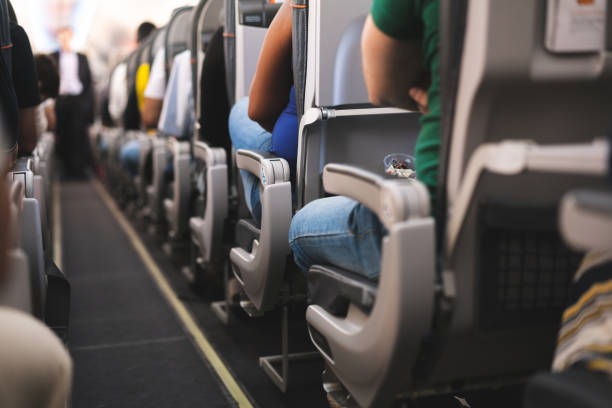
The moment my daughter stood up in that aisle, I knew nothing about that flight was going to end the way it started. She unbuckled her seatbelt without asking, without hesitating, and walked straight toward the woman who had taken her seat two hours earlier. I remember gripping the armrest so hard my knuckles went white, thinking, please, baby, don’t do this, and at the exact same time thinking, thank God, someone finally is.
But I need to back up, because none of that makes sense unless you understand what got us there.
Six weeks before that flight, I gave birth to my son Leo in a hospital room in Chicago while my husband David sat beside me between shifts on a construction job three states away. He’d flown home for the delivery, held our son for eleven hours, and then had to fly right back out because the project he was working couldn’t hold without him. That’s just how it was that year. He wasn’t running from us. He was building the life we needed, one paycheck at a time, and I understood that even when it was hard to sit with.
What I didn’t understand, not fully, was how hard it would be to manage a newborn and a ten-year-old by myself while my body was still healing and my nights were still broken into two-hour pieces. My sister Amy lived in Orlando, and after two weeks of watching me try to function on no sleep over video calls, she said the words I needed to hear.
“Pack a bag. Come stay with me for a few weeks. I’ll help you with the baby, I’ll get Maya to the pool every day, and you’re going to sleep for longer than ninety minutes at a stretch. That’s an order.”
I laughed at the time. I didn’t laugh at three in the morning when Leo wouldn’t settle and Maya had school in five hours and I was doing the math on how many more nights I could survive like this. So I booked the flight.
Flying alone with a six-week-old and a fourth grader is not something you do casually. I spent an entire evening on the airline’s website picking seats, because I knew exactly what I needed. Maya had to be right next to me. Not across the aisle, not a row back, right next to me, so if Leo needed to be changed or fed or walked up and down the aisle, she wasn’t alone and scared. I paid extra for 11A and 11B, a window and a middle with a little more legroom, because I needed space for the diaper bag, the bottles, the extra blanket, everything a baby needs just to survive a two-and-a-half-hour flight.
I checked those boarding passes four times before we even left the house. Once while packing. Once in the car. Once at security. Once at the gate. I know that probably sounds excessive, but when you’re doing something alone that used to take two people, you hold onto the details you can control, because there are so many you can’t.
At the gate, something else was happening that I only half-noticed at the time. An older man, maybe seventy, was patting down his jacket pockets over and over, then his pants pockets, then his jacket again. A gate agent was crouched near him, and I heard fragments as I walked Leo in slow circles to keep him asleep.
“I had it right here,” the man kept saying. “I know I had it right here.”
“Sir, when did you last see it?”
“In the security line. I had it in my hand for my ID and then I put my jacket back on and I just… I don’t know.”
The gate agent radioed someone and told him they’d keep an eye out and to check with lost and found if it didn’t turn up. He sat down heavily in a chair near the window, staring at his hands like they’d betrayed him. I remember feeling a pang of sympathy for him and then forgetting about it completely, because Leo started fussing and Maya needed help zipping her backpack and boarding announcements started and my whole world narrowed down to getting my kids on that plane.
We boarded with the early group because of the baby. Maya held my hand and pulled our small rolling suitcase, so proud of herself for being responsible, and I carried Leo against my chest in the wrap, one hand resting protectively on his back the way you do when your body just moves that way now, without thinking.
We found row eleven, and a woman was already sitting in seat A. My seat. My daughter’s seat.
She looked to be in her early fifties, dressed like she’d stepped out of a magazine ad for a woman who didn’t check her own bags. Designer sunglasses pushed up into her hair, a beige trench coat draped over the seat beside her, a large leather bag wedged against the wall of the plane. Her shoes were already off. She had a blanket from somewhere pulled over her lap. She looked like she’d been sitting there for an hour, even though we’d barely finished boarding.
“Excuse me,” I said, keeping my voice pleasant, because I always try pleasant first. “I think you might be in our seat. This is 11A.”
She didn’t look up. She had large headphones on, the noise-canceling kind, and either she genuinely didn’t hear me or she chose not to. I tapped her shoulder gently. She pulled one side of the headphones off, just enough to hear me, annoyance already written across her face before I’d even repeated myself.
“This is our seat,” I said again, and held up my phone with the boarding pass on the screen. “11A and 11B. I booked them together because my daughter needs to sit with me.”
She glanced at my phone for exactly one second, then looked back out the window.
“I’m already comfortable here,” she said.
I actually laughed a little, because I thought she was joking. She wasn’t.
“I understand, but this seat is assigned to us. If there’s been some mix-up, we can find a flight attendant to sort it out, but I do need this seat.”
That’s when she looked at Maya, then at Leo strapped to my chest, and something shifted in her expression, something colder.
“You know,” she said, loud enough that people in the rows around us could hear, “just because you have kids doesn’t mean the whole world has to rearrange itself for you.”
I felt my face go hot. Not because I was embarrassed for myself, but because Maya was standing right there, hearing a stranger talk about her like she was an inconvenience instead of a little girl who’d been so excited about this trip she’d packed her own bag three days early.
“I’m not asking the world to rearrange itself,” I said, and I kept my voice level even though my hands weren’t quite steady. “I’m asking you to sit in your assigned seat so my family can sit in ours.”
She put her headphones back over her ears like the conversation was over.
By then, people were stacking up behind us in the aisle, shuffling bags, that particular impatient energy that builds during boarding when something isn’t moving fast enough. A flight attendant made her way over, a woman in her thirties with a tight bun and a professional smile that looked a little strained at the edges.
“What’s going on here?” she asked.
I explained. I showed her the boarding passes. She checked something on a small handheld device and then looked at the seated woman.
“Ma’am, it looks like this seat is assigned to this family. Can I see your boarding pass?”
The woman sighed like she was doing everyone a great favor and pulled a boarding pass from her bag. The flight attendant looked at it, then back at seat 11A, then at me, and I could see her doing the math of a situation she didn’t want to deal with any more than I did.
“There is a seat available a few rows back,” the flight attendant said to me, not to the woman in 11A. “Would it be possible for you to move so we can get everyone boarded?”
I felt something drop in my stomach.
“A few rows back,” I repeated. “By myself? With the baby? And my daughter would stay here, alone, next to…” I didn’t finish the sentence, but I looked at the woman, and I think everyone understood what I meant.
“She’s ten,” the woman in 11A said, rolling her eyes. “She’s not a toddler. She can sit by herself for two hours. I don’t see the problem.”
I wanted to say so many things. I wanted to say that I had paid for these two seats specifically, together, for a reason. I wanted to say that a woman traveling alone with a newborn and a fourth grader deserved a little patience, not an audience of irritated strangers watching her hold up the line. I wanted to say that this wasn’t about whether Maya could technically survive sitting alone, it was about a promise I’d made to myself that I would not let my children feel unprotected while their father was three states away working to keep a roof over our heads.
But Leo stirred against my chest, and the aisle was packed, and Maya was looking up at me with those eyes she gets when she’s trying to be brave for me instead of the other way around, and I understood in that moment that I was not going to win this argument standing in a crowded aisle with an audience of impatient strangers and a sleeping baby who could start crying at any second.
So I did the thing you do when you’re a mother and you’ve run out of easy options. I chose the version of the situation that got everyone moving and kept the peace, even though every part of me hated it.
“It’s okay,” Maya said quietly, before I could even ask her. She squeezed my arm. “I’ll be fine, Mom. Go sit down before Leo wakes up.”
Ten years old, and she was comforting me.
I helped her get settled into the window seat, made her promise to buzz the call button if she needed anything, told her I was just a few rows back and could see her, which wasn’t entirely true but felt true enough to say. Then I turned and walked toward the back of the plane with my sleeping son, past rows of strangers who had watched the whole thing and were now very interested in their phones or the seatback in front of them, the universal signal of people who saw something happen and didn’t want to get involved.
Before I turned away completely, Maya did something I didn’t think much of until later. She leaned slightly toward the woman’s seat and said something too quiet for me to hear over the cabin noise, gesturing subtly toward the floor near the woman’s leg.
The woman didn’t even glance down.
“Mind your own business,” she snapped, loud enough that I caught it from several feet away, and pulled her blanket tighter over her lap.
I almost turned back. I almost said something. But a flight attendant was gesturing me forward, saying we needed to keep the aisle clear for boarding, and Leo made a small unhappy sound against my chest that told me his patience for being jostled was running out, and so I kept walking.
I found my new seat, middle row, several back from Maya, wedged between an empty aisle seat and a window occupied by an older woman with silver hair pulled into a neat braid and kind eyes that found mine the second I sat down.
“Rough morning?” she asked, not unkindly.
I don’t know what my face looked like, but it must have said everything, because she reached over without asking and helped me get the diaper bag settled at my feet, then held out her arms.
“I raised four of my own and I’ve got six grandchildren. Let me hold him while you catch your breath.”
I almost said no. Something about strangers holding your six-week-old feels instinctively wrong. But I was exhausted, and shaking a little from the confrontation, and something about her voice made me trust her the way you sometimes just trust a person for no reason you can explain. I handed Leo over, and she settled him against her shoulder like she’d done it a thousand times, which she probably had.
“I’m Ruth,” she said. “That your daughter up there?”
“Maya,” I said. “She’s ten. This wasn’t supposed to happen. I bought those seats together specifically so she wouldn’t be alone.”
Ruth’s mouth pressed into a thin line as she looked up the aisle toward row eleven. “Some people,” she said, “think the world exists to accommodate them, and everyone else is just in the way.”
I nodded, throat tight, and looked past her out the window as the ground crew finished loading bags below us. I kept twisting in my seat trying to catch a glimpse of Maya through the gaps between headrests, and every time I saw the back of her head, still and small, I felt my chest tighten a little more.
The safety demonstration played. The doors closed. The plane pushed back from the gate, and there was no more time to argue, no more time to switch seats, no more time to do anything but sit there and trust that my daughter would be okay for the length of a domestic flight, sitting next to a woman who had already shown us exactly what kind of person she was.
During taxi, I watched what I could see of Maya. She sat very still, hands folded in her lap, not fidgeting the way she normally does, not looking out the window with the excitement she’d shown all week about this trip. She kept glancing down, toward the floor near the woman’s seat, quick little glances like she was checking on something.
I told myself I was imagining it. I told myself she was just nervous sitting next to a stranger, which was reasonable, understandable, and would pass.
The engines roared. The plane picked up speed down the runway, that particular pressure pressing us back into our seats, and then the wheels left the ground and Chicago dropped away beneath us, grey and sprawling and getting smaller.
Ruth kept Leo for the first part of the climb, murmuring something to him I couldn’t hear over the engine noise, and I sat there with my hands pressed flat against my thighs, trying to convince myself everything was fine. Maya was smart. She was careful. She’d survived worse discomforts than an awkward seatmate. In twenty minutes the seatbelt sign would go off, and I’d get up and check on her properly, maybe even ask the flight attendant if there was any way to move us back together once we reached cruising altitude.
That plan lasted about ten minutes.
I was watching the seatbelt sign, willing it to switch off, when I saw Maya’s head turn. She looked back down the aisle, and even from several rows away, even past all the other passengers, I recognized the look on her face. It wasn’t fear. It was the look she gets when she’s made up her mind about something and there’s no talking her out of it, the same look she had at six years old when she decided she was going to learn to ride her bike without training wheels that same afternoon, scraped knees be damned.
She unbuckled her seatbelt.
“Ruth,” I said, already trying to stand, hampered by the seatbelt I hadn’t unclicked yet and the baby not currently in my arms. “Ruth, she’s getting up.”
Maya stood in the aisle. The seatbelt sign was still on, technically, but nobody stopped her, because everyone within eyeshot was already watching, that instinctive human radar for something about to happen. A woman standing where a child should be sitting draws eyes.
I finally got my belt off and half-rose in my seat, straining to see over the headrests. A flight attendant started moving up the aisle toward her, probably to tell her to sit back down, but Maya wasn’t misbehaving. She wasn’t causing trouble. She turned to face the woman in 11A directly, and her voice, when she spoke, carried further than I expected from a ten-year-old, clear and steady in a way that silenced the murmur of cabin conversation around her.
“You have a wallet under your leg,” Maya said. “I saw you put it there when we were boarding. It’s brown, and it has initials on it, and it’s not yours.”
The cabin went quiet in that fast, rippling way that happens when everyone within earshot simultaneously stops what they’re doing to listen. I heard someone’s magazine stop rustling. I heard the low hum of the engines suddenly feel very loud in the silence.
The woman in 11A yanked her headphones off, face flushing. “Excuse me?”
“You told me to mind my own business,” Maya continued, and her voice didn’t waver, didn’t shake, even though I could see her hands trembling slightly at her sides. “But I saw you do it. When that man dropped it near the boarding line, you picked it up fast and you sat on it, and you didn’t give it to anybody.”
I was out of my seat by then, moving up the aisle as fast as I could without shoving past people, Ruth right behind me still holding Leo, the flight attendant reaching the row at almost the same moment I did.
“What is she talking about,” the woman said, too fast, too loud, the kind of denial that comes out before a person has even finished thinking it through. “This is absurd. I don’t know what this child thinks she saw, but I am not going to be accused of something by a ten-year-old.”
“Ma’am, I need to ask you to remain seated,” the flight attendant said, her tone shifting instantly from customer service pleasant to something firmer, more alert. “Can you please stand up for a moment.”
“This is ridiculous,” the woman said, but something in her face had changed. The confidence that had let her ignore boarding passes and personal space and basic decency for the last twenty minutes was cracking at the edges, replaced by something closer to panic.
“Ma’am.”
She stood, reluctantly, clutching her blanket like it might shield her, and there, tucked into the seat cushion exactly where she’d been sitting, was a slim brown leather wallet, worn soft at the corners the way wallets get after years of use, initials pressed faintly into the leather near the fold.
F.R.
I remembered the old man at the gate, patting his pockets, insisting he’d had it in his hand at security. Frank, I would learn his name was later, though at that moment all I knew was that the initials matched a man who had been sitting alone, staring at his empty hands like they’d failed him.
The flight attendant picked up the wallet carefully, opened it, and there was a driver’s license, credit cards, a folded photograph gone soft at the creases, the kind of photograph a person carries for decades. A woman smiling in the sun, younger, with the same eyes as the shaky, worried man from the gate area. His wife, I found out later. She’d passed two years earlier, and he carried her picture everywhere he went, because some habits you don’t stop even after someone’s gone.
“This isn’t mine,” the woman in 11A said, but nobody was listening to her anymore. The flight attendant had already turned and was speaking quietly into the small radio clipped to her uniform, her eyes flicking between the wallet and the woman still standing awkwardly in the aisle, shoeless, wrapped in a blanket that had suddenly stopped looking cozy and started looking like something to hide behind.
“You picked that up in the boarding line,” Maya said again, quieter now, but just as certain. “I saw you look around first. I saw you check if anyone was watching. Then you sat down and put it under your leg.”
I reached my daughter then, wrapped my arm around her shoulders, and felt her lean into me, the bravery she’d been holding so tightly finally letting go now that I was there. My hands were shaking too, adrenaline and fear and something fierce and proud all tangled together.
“You’re in so much trouble,” the woman hissed at Maya, some last attempt at authority, at control, at making the situation about anything other than what it actually was. “Making accusations like that, do you have any idea—”
“That’s enough,” I said, and I surprised myself with how steady my own voice came out. “My daughter is ten years old and she just did something a lot of adults on this plane were too afraid to do. She told the truth. If you have a problem with that, you can take it up with the flight crew, not with her.”
The senior flight attendant arrived then, a woman with more stripes on her uniform and the calm, unhurried authority of someone who had handled worse than this at thirty-five thousand feet. She looked at the wallet, looked at the woman, looked at Maya, and something in her expression told me she’d already pieced together enough to know exactly how seriously to take this.
“Ma’am, I’m going to need you to come with me to the back of the aircraft,” she said to the woman in 11A. “We’ll sort this out properly, and local authorities will meet us when we land.”
“This is insane,” the woman said, but her voice had lost all its earlier certainty, gone thin and brittle. “I want to speak to someone in charge.”
“I am someone in charge,” the flight attendant said simply, and gestured for her to gather her things.
The woman grabbed her trench coat, her sunglasses, her leather bag, movements jerky and humiliated now with every single passenger in earshot watching her walk the length of the cabin, no longer the person who’d claimed a seat that wasn’t hers with total confidence, but someone very small and very exposed, stripped of the armor that entitlement gives a person right up until the moment it doesn’t work anymore.
As she passed our row, she glanced at Maya one more time, opened her mouth like she might say something, then seemed to think better of it and kept walking, disappearing behind the curtain toward the back galley with the flight attendant close behind her.
The cabin didn’t go back to normal right away. There was a strange, charged quiet, then a low buzz of conversation as people turned to their neighbors, and then, unexpectedly, someone near the front started clapping. A few more joined in. Within seconds, half the cabin was applauding, not loudly, not for long, but enough that Maya’s cheeks went pink and she ducked her head against my side, suddenly shy in a way she hadn’t been thirty seconds earlier when she was facing down a grown woman in front of a hundred strangers.
“You did so good,” I whispered into her hair, my own eyes stinging. “I am so, so proud of you.”
“I didn’t know if anyone would believe me,” she admitted quietly. “You always say if I see something wrong I should say something, even if it’s scary. So I waited until I was sure. I didn’t want to be wrong.”
I thought about that for a long moment. I thought about how many adults on that plane, myself included, had let the situation slide because confrontation felt harder than swallowing the discomfort. I thought about how I had walked away from row eleven with my son against my chest and my pride tucked somewhere down deep, telling myself it wasn’t worth the fight. My daughter had watched me make that choice, and instead of learning to shrink the way I had in that moment, she’d found her own kind of courage, quieter than mine, but braver.
Ruth appeared at my elbow with Leo, who had slept through the entire thing, blissfully unaware that his sister had just handled herself better than most adults could have.
“Well,” Ruth said, smiling, “I don’t think I’ve ever seen anything like that on a flight before. That little girl has more nerve than half the boardrooms I sat through in my working years.”
A flight attendant, a different one, came by a few minutes later to formally move me and Leo back up to row eleven, since the seats were free now, and to apologize, repeatedly, for the whole situation, offering drink vouchers and an assurance that the airline would follow up regarding the seating issue. I barely heard most of it. I was too busy holding Maya’s hand, sitting beside her again in the seats I’d paid for in the first place, Leo settled in my lap, the three of us finally together the way the trip was supposed to start.
The rest of the flight passed in a strange, quiet aftermath. Every so often another passenger would lean across the aisle to tell Maya how impressed they were, how brave that was, how they wished they’d had that kind of courage at her age, let alone at ten. A man two rows up sent back a small bag of pretzels with a note that just said “good job, kid” scrawled on a napkin. Maya kept the napkin. She still has it, tucked into a drawer in her room, next to the plastic wings the captain gave her when we landed.
We found out more of the story once we were on the ground. Frank Reynolds, the elderly man from the gate, had indeed lost his wallet in the security line at O’Hare that morning, exactly the way Maya described. He’d been so distraught about it that the gate agents had helped him file a report before his own flight, a later one, since he’d had to sort through the chaos of missing identification and cancelled cards before he could even think about boarding anything. The photograph inside, the one of the woman smiling in the sun, was his wife Dorothy, who had passed away two years earlier from a long illness. He carried it with him everywhere, a habit he said he couldn’t break even if he wanted to, because looking at her face still felt like she was somewhere nearby.
When police officers boarded the aircraft after we landed in Orlando, they took a full statement from Maya, gentle and patient with her, praising her for paying such close attention and for waiting until she was certain before saying anything. The woman, whose full name we learned was Vivian Cross, was escorted off the plane in handcuffs, past a cabin full of passengers who watched in a silence that felt entirely different from the silence at the start of the flight. This wasn’t discomfort. This was witness.
It turned out later, according to the police report the airline eventually shared with us at our request, that Vivian Cross had a history of similar behavior at airports, small thefts of opportunity, items left unattended for just a few seconds too long, taken advantage of by someone who had convinced herself that other people’s carelessness was her good fortune. Frank’s wallet was returned to him within the week, wife’s photograph and all, along with a formal apology from the airline and a voucher that he told us, when we spoke to him briefly on the phone, he intended to use to finally take the trip to see his granddaughter in Seattle that Dorothy had always wanted them to make together.
As for us, the airline followed through on more than just an apology. They refunded the extra we’d paid for the seats, added a credit toward a future flight, and the same senior flight attendant who’d handled the situation so calmly made a point of finding us again before we deplaned, crouching down to Maya’s eye level near the jet bridge.
“You know,” she said, “in fifteen years of doing this job, I don’t think I’ve ever watched a passenger handle a situation as well as you did today. Most grown adults would have just let it go.”
Maya just shrugged, suddenly bashful again. “I didn’t want him to lose his wife’s picture forever,” she said. “That seemed really sad.”
That was the whole reason, as simple as that. Not a desire for attention, not some performance of justice. A ten-year-old girl had understood, more clearly than most of the adults around her, that a stranger’s grief mattered, that a small act of dishonesty could cause someone real pain, and that noticing something wrong came with a responsibility to say so, even when it was uncomfortable, even when the person doing wrong tried to make you feel small for speaking up.
My sister Amy was waiting at baggage claim, and the second she saw my face she knew something had happened. I told her the whole story while we waited for the bags to come around the carousel, Leo asleep again in his car seat, Maya sitting on our suitcase looking exhausted in the particular way kids do after an adrenaline spike finally wears off. Amy kept looking over at Maya throughout the story like she was seeing her niece for the first time, this quiet, careful kid who’d been sitting right there through the whole telling, kicking her feet against the suitcase, more interested in whether there’d be a pool at Amy’s apartment than in the fact that she’d just become, for one afternoon, thirty-five thousand feet in the air, the bravest person on that plane.
David called that night, once we were settled at Amy’s, and I put him on speaker so Maya could tell him herself. I listened to my daughter recount the entire thing to her father in her own words, matter-of-fact, almost businesslike, the way kids sometimes talk about things that were actually enormous to them but that they haven’t fully processed as enormous yet. David went quiet for a long moment after she finished, and when he spoke again his voice had gone thick.
“I wish I could’ve been there,” he said. “But Maya, baby, I am so proud of you I don’t even have the words.”
“It’s okay, Dad,” she said. “You would’ve done the same thing.”
I’m not sure that’s entirely true. I think about that flight a lot now, the way I handed over my seat because I didn’t want to cause a scene, the way I convinced myself that keeping the peace was worth more than standing my ground. I don’t regret prioritizing my children’s safety over an argument with a stranger, but I do think about how close we came to that wallet just staying hidden, to Frank Reynolds flying home without his wife’s photograph, to Vivian Cross walking off that plane with something that was never hers to take, simply because the rest of us decided the discomfort of confrontation wasn’t worth it.
My daughter decided differently. She waited until she was sure. She spoke clearly, without anger, without theatrics, just the plain truth laid out for everyone to see. And in doing that, she gave an old man back a piece of the wife he missed every single day, and she gave me something too, something I don’t think I fully understood until we were back on solid ground.
She gave me proof that the things I try to teach her actually take root. That paying attention matters. That kindness and courage aren’t opposites, they walk together. That sometimes the smallest person in the room is the one paying the closest attention, and the rest of us would do well to listen when she finally decides to speak.
We flew home three weeks later, rested, sunburned, Leo a little bigger, Maya a little taller it seemed, though that was probably just my imagination. We had different seats, an uneventful flight, nothing worth telling anyone about. But every time I fly now, I think about row eleven, about a woman who thought entitlement could take the place of decency, about a girl who watched quietly and waited for the right moment, and about how the truth, once someone finally has the courage to say it out loud, has a way of being impossible to ignore.

Specialty: Legal & Financial Drama
Michael Carter covers stories where money, power, and personal history collide. His writing often explores courtroom battles, business conflicts, and the subtle strategies people use when pushed into a corner. He focuses on grounded, realistic storytelling with attention to detail and believable motivations.