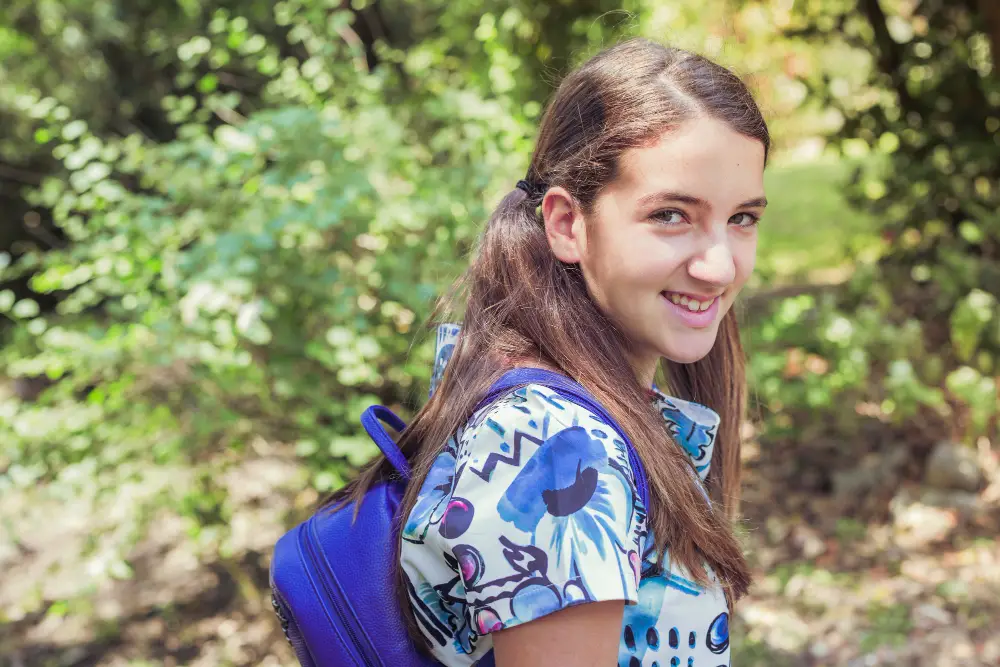
My daughter, Ava, is twelve, and until this summer, she’d given me almost no practice at being suspicious of her.
She was the kid who reminded me when I forgot to sign her school forms. She got straight As without anyone pushing her. If she accidentally took somebody else’s pencil home from school, she’d bring it back the very next morning, embarrassed, like she’d committed a crime.
So when she started begging me to let her spend a week at scout camp with her troop, getting into trouble wasn’t even on my list of worries. My only real concern was whether I could handle her being gone.
“Mom, I’m twelve,” she told me, for what felt like the hundredth time that week.
“I know exactly how old you are.”
“You keep acting like I’m six.”
“I’m not acting like you’re six.”
“You labeled my sunscreen. With my name. In marker.”
“Because you’ll lose it.”
She just stared at me. I stared right back, refusing to give ground.
Then, slowly, she reached into her backpack and pulled out the sunscreen to prove some point about her own responsibility.
The cap was already gone.
Neither of us said anything for a second. She looked at the capless bottle. I looked at her. The corner of my mouth twitched.
“Fine,” she muttered, shoving it back in her bag.
I laughed, and after a lot more back-and-forth over the following days, I finally agreed to let her go. It was her first time away from home for longer than a single night, and I don’t think she understood that the whole negotiation had been harder on me than the packing was on her.
The first two days were rougher on me than they were on her, I’m sure of it.
Phones were discouraged during activities, so I did my best not to bombard her with messages. I got one short text the first night.
Made it. Cabin is small. Food is weird. Love you.
I read it about nine times.
The second night, nothing at all. I told myself that was a good sign. It meant she was busy. It meant she was having fun and didn’t have time to miss me, which was the whole point, even if it stung a little.
Then, on the third day, my phone buzzed while I was eating lunch at my desk.
A photo from Ava.
She was standing near a cluster of picnic tables, grinning at the camera, girls from her troop scattered behind her. Sunlight, trees, the whole wholesome scene. At a glance it was the most ordinary photo in the world.
Underneath it, she’d written:
We just finished training and we’re heading to lunch. See? Everything’s fine. It’s so much fun here! Love you and miss you!
I smiled at my screen. I actually said it out loud, quietly, to my empty office. “See? She’s fine.”
And then I looked at the picture again, the way you do when you want to soak up every detail of your kid’s face because you miss them.
That’s when I noticed the girl sitting at the table behind Ava.
Loose, light brown hair. A pink shirt.
Maddie.
I knew Maddie. Her mom, Beth, and I had stood in the parking lot talking for a good twenty minutes the morning the girls left for camp, doing that nervous first-time-camp-parent chatter.
And I knew, for a fact, that Maddie was not at camp anymore.
Beth had called me the night before. Maddie had come down with something and her dad had driven out to pick her up and bring her home. She’d left camp the previous evening.
I zoomed in on the photo. There was no mistaking it. It was Maddie, clear as anything, sitting at a picnic table in the background of a photo my daughter had just sent me with the words we just finished training.
Present tense. Just finished. Heading to lunch.
But Maddie had gone home the night before.
I called Ava. It rang and rang and went to voicemail.
I called again. Nothing.
I tried to stay reasonable. I really did. Maybe she’d sent an old photo by accident, thumbing through her camera roll and grabbing the wrong one. Maybe the message had gotten stuck and only just now delivered, hours late. Maybe there was something obvious I wasn’t seeing, some innocent explanation that would make me feel silly for even wondering.
But she wasn’t picking up. And the more I sat there staring at Maddie’s pink shirt, the less the reasonable explanations held together.
So I called the camp office.
A woman answered with the calm, practiced voice of someone who talks to anxious parents all day long.
“Hi,” I said. “My daughter’s there with her troop. Her name is Ava.”
“Of course. Is everything okay?”
“I don’t know.”
Those three words changed the whole temperature of the call. I heard it in the pause before she spoke again. She said she’d transfer me to Ava’s group counselor, a young woman named Marissa.
When Marissa came on, I explained the photo. Then she gave me a number and I texted the picture over so she could see for herself.
There was a pause. A long one.
“Marissa?”
“I’m here.”
“Please tell me I’m imagining this.”
Another pause. And then her voice changed, went a shade more careful.
“Are you sure Ava sent you this today?”
My stomach dropped straight through the floor. “Yes. About twenty minutes ago. Why?”
“Okay…”
“What does ‘okay’ mean? What’s wrong?”
“That picture—it isn’t from today. Maddie left camp last night. Her father picked her up.”
“I know she left. That’s the whole reason I’m calling.” I was on my feet now, pushing back from my desk. “Where’s Ava? Right now, where is she?”
“She’s safe.”
“That’s not what I asked. Where is she?”
“She’s in the health cabin.”
I gripped the edge of the desk. “What? Why is she in the health cabin?”
“She reported an injury this morning. Nothing serious, don’t worry. She said she twisted her ankle and wasn’t able to participate in the day’s activities.”
I stared at the wall of my office. Ava’s cheerful message was still open on my phone. We just finished training.
“She just texted me that she finished training and was heading to lunch. Ten minutes ago.”
“I understand that, but—”
“No. I don’t think you do. My daughter does not lie to me. Ever. That’s not who she is.”
Marissa hesitated, and when she spoke again there was a smoothness to it that I didn’t like at all. “Kids sometimes act differently when they’re away from home. It’s very common—”
“Can I speak to her? Please. Put Ava on the phone.”
“Let me go check.”
Thirty seconds crawled by. When Marissa came back, her voice had gone flat and apologetic.
“Ava doesn’t want to come to the phone right now.”
Something cold and heavy settled into my chest.
“Why not? Why wouldn’t she want to talk to me?”
“I really can’t answer that.”
I told her I was coming, and I hung up before she could tell me not to.
I left work.
The camp was a little over an hour up into the hills, and I spent the entire drive talking myself down from every horrible thing my brain could invent. My imagination is very creative when my child won’t come to the phone. By the time I turned onto the long gravel road, I had mostly convinced myself that Ava was physically safe. Nobody hides a genuinely hurt child in a health cabin and refuses to let her mother talk to her.
But safe and fine are two different things, and I knew it.
Marissa met me outside the health cabin. She was younger than I’d pictured from her voice, maybe twenty-four, and she had the posture of someone who badly wished this parent had stayed home.
“Ava’s inside,” she said.
“How bad is the ankle?”
Marissa shifted her weight from one foot to the other. “The nurse didn’t find any swelling.”
I looked at her.
“Any bruising?” I asked.
“No.”
“So there’s no swelling and no bruising, but she’s been in the health cabin all day and won’t come to the phone.”
Marissa didn’t have an answer for that. I brushed past her and went inside.
Ava was sitting on a narrow cot with her backpack beside her, and her ankle wasn’t wrapped, wasn’t propped up, wasn’t iced. It looked exactly like a perfectly fine ankle.
When she saw me in the doorway, her whole face changed. It fell open with shock and then, right underneath the shock, something that looked a lot like relief.
“Mom? What are you doing here?”
I came in and sat on the edge of the cot across from her.
“Show me your ankle,” I said.
She froze.
I waited. I’ve learned that with Ava, the silence does more work than any question.
“Ava.”
Her eyes dropped to the floor. And that was the moment I knew for certain my daughter was lying to me—my honest, straight-A, returns-the-pencil daughter. What I couldn’t have guessed, not in a hundred years, was why.
“You weren’t hurt,” I said.
Nothing.
“Look at me, sweetheart.”
She did, and her eyes were already wet and shining.
“Fine,” she whispered. “I wasn’t hurt. But you can’t tell anyone. Please, Mom, you can’t tell anyone.”
I leaned back a little. “Okay.”
She blinked at me, thrown. “You’re—you’re not mad?”
“I’m confused,” I said honestly. “The mad part can wait until I understand what’s going on. Right now I just want to understand. Why would you fake an injury?”
She wiped her face with the back of her hand. “I didn’t want to do the challenge.”
“What challenge?”
“The final one. The big one.”
And then it started coming out.
Her troop had spent months, all year really, training for a camp-wide competition. Navigation, first aid, climbing, problem-solving—a whole series of events, with the highest-scoring troop taking the prize at the closing ceremony. Ava had been obsessed with it. It was half the reason she’d begged me so hard to let her come.
“You wanted to come here partly because of that competition,” I said. “You talked about it for months, Ava.”
“I know.”
“So why on earth would you sit out the most important event? This doesn’t make sense.”
Her mouth pressed into a thin, tight line, and she looked down at her hands twisting in her lap.
“Because,” she said, so quietly I almost missed it. “We’re cheating.”
For a second I genuinely thought I’d misheard her.
“What?”
She kept staring at her hands. “Not everybody. But enough of them. Enough that it matters.”
“Tell me,” I said. “From the beginning. All of it.”
“It started small,” she said. “Little stuff. I didn’t even really notice at first. I only started paying attention when we kept winning things I didn’t think we should be winning.” Her voice wobbled. “Like, we’d get scores that didn’t make sense, or somebody would already know the answers to a station, or they’d sneak looks at another troop’s map. And once I figured out what was happening, I said we should stop. I said it out loud, to everyone.”
“What did they say?”
Ava looked toward the little window of the cabin.
“Kayla said everybody bends the rules. She said it’s not a big deal, everybody does it, that’s just how you win.”
Kayla was one of Ava’s closest friends. Had been since second grade.
“What else?”
“She said nobody was getting hurt. And then—” Ava swallowed hard. “Then Brianna said we’d all worked for this the entire year, and if I made a big deal out of it, we’d all get in trouble and everybody would lose. Because of me. She said everybody losing would be my fault.”
I kept my voice as level as I could manage, which took effort. “And then what happened?”
Ava’s jaw tightened, and I could see her deciding whether to say the next part.
“Kayla asked if I was going to go call my mom about it. And then she said—” Ava’s cheeks went pink and blotchy, “—she said maybe my mom could come and, like, fix camp for me. Since I can’t handle anything by myself. And everybody laughed. So I said fine. I said I wouldn’t tell you.”
And suddenly the photograph made complete sense.
“So you sent me the old picture,” I said. “On purpose.”
She nodded miserably. “I wanted you to think I was having a great time so you wouldn’t worry and wouldn’t come. I just grabbed a happy picture from the other day and sent it. I didn’t even look close at it, I swear, I didn’t remember Maddie was in it.” Her face crumpled. “And then I saw you calling and calling, and I panicked, because I knew—I knew if I talked to you, you’d hear it in my voice. You always do.”
“So you told them you couldn’t come to the phone,” I said, “and then you faked an injury.”
“Because today was the biggest event,” she said. “The one worth the most points.”
And there it was. The whole impossible trap she’d built for herself, laid out on a cot in a health cabin. Her troop needed her score to have a real shot at winning. If she competed, she’d be helping them win by cheating. If she deliberately did badly to throw the event, everyone would know exactly what she was doing and why. And if she reported them, the whole troop would be disqualified and every last girl would blame her for it.
“So you tried to disappear,” I said softly.
She nodded, and a tear slid down. “I thought if I was hurt, then I wouldn’t have to do any of it. And it wouldn’t be my fault. An injury just happens to you. Nobody can be mad at you for getting hurt.”
I let out a slow breath. It was, honestly, a pretty clever plan for a scared twelve-year-old. Wrong, but clever.
“Did you tell an adult?” I asked. “About the cheating. Before you faked the ankle.”
Her whole expression shifted, closing up again, and that shift was all the answer I needed before she said a word.
“Who did you tell, Ava?”
“Mom.”
“Who did you tell?”
“Marissa,” she said. “I told Marissa.”
Something in me went very still and very focused. “And what did Marissa say?”
Ava looked away.
“What did she say, Ava?”
“She told me to be careful about accusing people. She said accusations are serious and you can’t take them back once you make them. She said maybe I’d misunderstood what I saw, and that we should all just finish out the week and talk about it later if I still felt that way.”
“Did you give her details? Did you tell her which girls, and what they did?”
“Yes. I told her everything. I gave her names.”
And that was the moment my anger changed direction entirely.
Up until then, I’d been upset in a manageable, familiar way—kids making bad choices, peer pressure, the ugly little politics of twelve-year-olds. That’s a hard thing but a normal thing. But a grown adult, a counselor, had been handed a specific report of cheating by a frightened child, complete with names, and had told that child to keep quiet and stop making trouble.
That was different. That was a whole different thing.
I found Marissa outside the cabin.
“We need to talk,” I said.
She glanced past me toward Ava in the doorway. “Rachel, I really think emotions are running very high right now, and maybe if we all just—”
“My daughter told you the troop was cheating. She gave you names.”
Marissa went still. “She raised some concerns, yes.”
“That’s a very careful phrase.”
“I didn’t have any proof,” she said. “I couldn’t just act on—”
“Did you investigate? Did you look into it at all?”
“I spoke with some of the girls.”
“Together, or separately?”
She didn’t answer that. And her not answering told me she’d done exactly what you should never do—gathered the accused girls together, where the loudest and most confident of them could set the story straight for everyone while the quiet one who told the truth sat there outnumbered.
I felt my voice go sharp and cold. “You told a twelve-year-old to be careful about making accusations she couldn’t take back. You told her to think about her teammates and how they’d feel. You put all of that on her.”
Marissa’s face went red. “I was trying to prevent a conflict before I had all the facts. That’s my job—to keep things calm.”
“You already had a conflict,” I said. “You just decided the quietest kid in it should be the one to swallow it and keep everyone else comfortable. That’s not preventing conflict. That’s picking who has to lose.”
I hadn’t exactly kept my voice down, and I wasn’t sorry. It got the attention of the program director.
Her name was Ms. Alvarez, and unlike Marissa, she did not spend one second trying to soothe me before she heard what had actually happened. She listened. She brought Ava into her office and asked her to tell it again, and she listened to that too, without once suggesting my daughter might have misunderstood.
Then she started making phone calls.
The girls were pulled and interviewed separately this time. And once that happened, the whole thing came apart almost immediately. It was messy and obvious the second an adult actually looked at it honestly. There was no detective work required, no hard-to-crack mystery. Marissa hadn’t needed proof or investigative genius. She’d needed to take a scared kid seriously the first time. That was the entire job, and she hadn’t done it.
That evening, Ms. Alvarez asked Ava whether she’d be willing to put it all in a written statement. An official one.
Ava asked if she could talk to me alone first. So the two of us went and sat on a bench behind the office, in the cooling evening air, and she looked absolutely exhausted, wrung out in a way I’d never seen on her before.
“If I write it down,” she said, “the whole troop gets disqualified. Right?”
“Probably. Yes.”
“And they’ll all hate me.”
“Some of them might,” I said. I wasn’t going to lie to her about it. She’d had enough lies for one week, including her own.
“Kayla definitely will.”
I nodded. There wasn’t much point pretending otherwise.
Ava picked at a loose thread on the hem of her shorts, winding it around her finger.
“What do you think I should do?” she asked.
And every single instinct I had wanted to just tell her. Wanted to make it easy, take the weight off her, give her the answer and let her off the hook. I’m her mother. Fixing it for her is practically a reflex.
I didn’t.
“I can’t make this choice for you,” I said.
She shot me an annoyed, watery look. “That’s super helpful, Mom. Thanks.”
“I can tell you one thing, though.”
“What?”
“Faking that injury didn’t actually get you out of it. Did it? You’re still sitting here having to choose. All the ankle did was delay it a few hours.”
Her eyes filled up.
“I wanted there to be another option,” she said. “I kept trying to find one. I wanted them to just stop, without anybody ever knowing I was the one who said something. I wanted us to still win. I wanted—” Her voice cracked wide open. “I wanted Kayla to still be my friend.”
That last one landed the hardest. That was the real thing underneath all of it.
I put my hand over hers on the bench.
“You were trying to find a version where nobody loses anything,” I said. “And there just isn’t one. Is there?”
“No,” she whispered.
She cried for a minute, and I let her, and I didn’t try to talk her out of it or hurry her through it. Then she wiped her face and sat up straight and stood.
“I’ll tell them,” she said.
Ava gave the statement. Her troop was disqualified from the competition.
Kayla found her outside afterward. I was standing close enough to hear the whole thing, and I made no move to pretend I wasn’t.
“You ruined everything,” Kayla said, her voice shaking with fury. “You know that? I thought you were my friend.”
Ava’s voice shook right back. “I am your friend.”
“No. You’re not.”
And Kayla turned and walked away. Ava didn’t chase after her. She just stood there and watched her best friend go, and it took everything in me not to step in, because this was hers to feel and mine to witness.
That evening, Ms. Alvarez gathered the whole troop together and spoke to them. She told them the competition was meant to measure their skills, sure—but that the program itself, the whole point of any of it, was supposed to teach them judgment and trust and responsibility.
“If you win by breaking the exact values you’re supposed to be here practicing,” she said, “then the trophy doesn’t mean a single thing. It’s just a piece of metal you lied to get.”
Then she looked directly at Ava.
“The hardest decision anyone made this entire week,” she said, “was made by the one person who knew that telling the truth would cost her own team the win. That’s not easy. Most adults can’t do that.”
Ava stared hard at the floor, her ears going pink, and I could see how badly she wanted to disappear and how much, underneath that, it meant to her.
Marissa was pulled from the competition program for the rest of the session, pending a formal review of how she’d handled it.
Once Ms. Alvarez agreed that Ava had been through more than enough for one day, I signed her out and took her home.
We drove in silence for a while, the dark trees sliding past. About halfway home, Ava spoke up from the passenger seat.
“Am I grounded?”
I glanced over at her. “Yes.”
Her head snapped toward me. “But I told the truth!” She crossed her arms hard over her chest. “I cannot believe this. I did the right thing and I’m getting grounded?”
“You told the truth at camp, and I’m proud of you for it,” I said. “But you also lied to me. You sent me a fake message on purpose so I wouldn’t worry. You faked an injury. Those things happened too, and they don’t just evaporate because the ending was good.”
“I was under pressure!”
“I know you were, sweetheart. And I understand why you did it. But understanding why doesn’t erase that you did it. Both of those things are true at the same time.”
She turned and stared out her window, and we drove on.
After a few more miles, in a much smaller voice, she asked, “Are you disappointed in me?”
And that question hurt more than anything else that whole long day. I thought carefully before I answered, because she’d remember whatever I said.
“I’m disappointed that you lied to me,” I said. “And I’m disappointed that you thought you had to handle all of this completely alone, that you couldn’t just call me and let me help you carry it.” I paused. “But I am proud—really proud—of what you did once you finally had to make the choice.”
Ava wiped at one eye. “Even though everybody lost?”
“Especially because you knew they would,” I said. “And you told the truth anyway. Anybody can be honest when it’s free. Being honest when it costs you everything—that’s the whole thing, Ava. That’s the entire ballgame.”
She was quiet for a bit.
Then: “I think Kayla hates me. What if she never talks to me again?”
I hated that I couldn’t fix that one. I hated it more than I can say.
“Then telling the truth cost you something real,” I said. “Something that actually mattered to you. And that’s part of why it counts as much as it does.”
She looked over at me. “You’re supposed to say something inspiring right now. That was your chance and you blew it.”
“I don’t have anything inspiring,” I admitted. “I wish I did. Sometimes the right thing just costs you and there’s no inspiring speech that makes the cost go away.”
That, finally, got a laugh out of her. Just one. Small and tired, but real.
When we got home, she handed me her phone without my even asking for it. Then she started up the stairs, and at the bottom step she stopped and turned around.
“Mom?”
“Yeah?”
“I really did have fun the first day. Like, genuinely. And the picture I sent you—it wasn’t completely fake.”
“No?”
“I was actually happy when we took it. That part was real.”
Then she went up to bed.
A few nights later, Kayla texted her.
I didn’t read over her shoulder, but Ava told me the gist. Kayla was still angry, and she said she didn’t know if they were even friends anymore. But somewhere in there, she also admitted that the cheating would have just kept going and going if nobody had ever stood up and stopped it.
It wasn’t an apology, exactly. It wasn’t the friendship stitched back together good as new. But it was something. It was a crack of light.
Ava told me she thought maybe she’d skip camp next year.
Then, a minute later, she shrugged, already halfway to changing her own mind. “Or maybe I will go. I don’t know. I still like camping.”
For now, that felt like enough.

Ethan Blake is a skilled Creative Content Specialist with a talent for crafting engaging and thought-provoking narratives. With a strong background in storytelling and digital content creation, Ethan brings a unique perspective to his role at TheArchivists, where he curates and produces captivating content for a global audience.
Ethan holds a degree in Communications from Zurich University, where he developed his expertise in storytelling, media strategy, and audience engagement. Known for his ability to blend creativity with analytical precision, he excels at creating content that not only entertains but also connects deeply with readers.
At TheArchivists, Ethan specializes in uncovering compelling stories that reflect a wide range of human experiences. His work is celebrated for its authenticity, creativity, and ability to spark meaningful conversations, earning him recognition among peers and readers alike.
Passionate about the art of storytelling, Ethan enjoys exploring themes of culture, history, and personal growth, aiming to inspire and inform with every piece he creates. Dedicated to making a lasting impact, Ethan continues to push boundaries in the ever-evolving world of digital content.