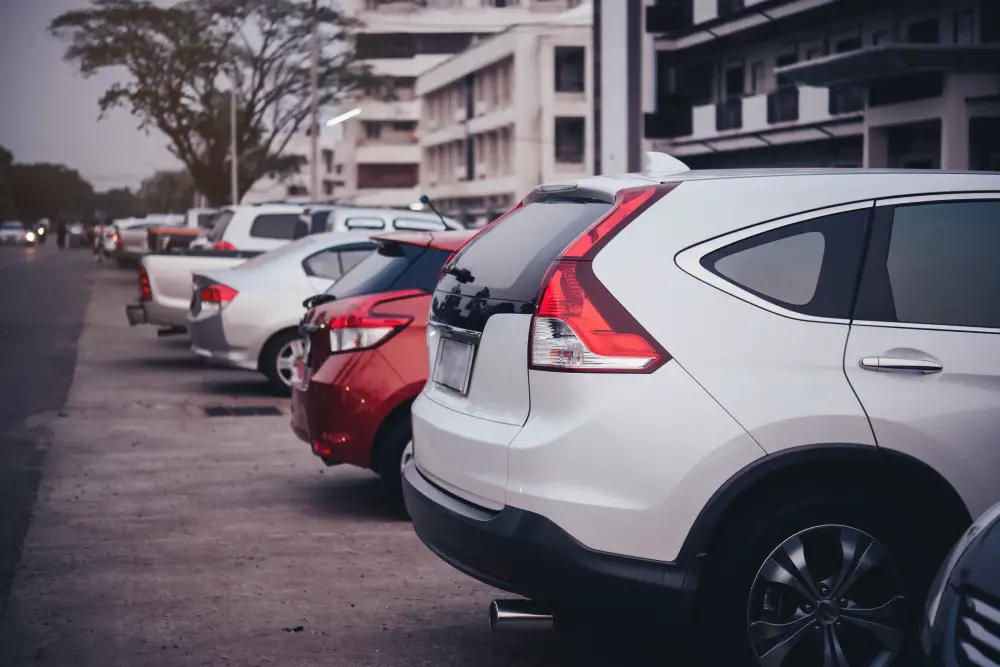
For six months, my neighbor Linda treated my driveway like it belonged to her.
It started innocently enough, the way these things always do. “Just ten minutes,” she’d say, leaving her big SUV parked there while she ran across the street to visit someone. And what was I going to say to ten minutes? I’m not a monster.
But ten minutes became two hours. Two hours became an afternoon. And before long, she was leaving that SUV in my driveway overnight, like it had grown roots there.
I asked her politely. Then I asked her firmly. I even went to the hardware store and bought a sign, a real one, white with bold red letters, PRIVATE DRIVEWAY, and I mounted it right where nobody could miss it.
Linda laughed at the sign.
“You barely use it anyway,” she said.
And she wasn’t entirely wrong. That was the maddening part. Since my husband Robert died two years earlier, I only had the one car. There was a lot of empty space out there most days.
But empty isn’t the same as free for the taking. Empty doesn’t mean it stopped being mine.
Before Robert died, our driveway was almost never empty.
Robert loved classic cars. And I don’t mean in the casual, “oh, that’s a nice Mustang” sort of way that most people mean it. My husband could hear an engine from half a block away and tell you exactly what was wrong with it before the car even came into view. It was a party trick and a genuine skill all at once, and I watched him do it a hundred times.
For more than twenty years, he belonged to a local classic-car club, and over time our house became one of their favorite places to gather. There was something about our corner lot, the wide driveway, the private gravel lane that ran along the back of the property. It fit a lot of cars, and it fit a lot of people, and Robert loved nothing more than filling it up with both.
Every September, the two of us hosted a breakfast in the backyard for the whole club. Cars would line the driveway bumper to bumper and spill out onto the gravel lane behind the house, and Robert would be out there before the sun was even up, directing traffic like a man working an airport runway.
“Move that Chevy another foot! Come on, you’ve got room!”
“Robert,” I’d holler out the kitchen window, “nobody can hear you over all these engines!”
“That’s exactly why I’m yelling, Carol!”
I can still hear him. Some mornings that’s a comfort and some mornings it’s the hardest thing in the world.
After he died, I stopped hosting. It wasn’t a decision, exactly. I just couldn’t. And then I stopped going to the club’s events too, because it turned out that seeing all those beautiful cars lined up without Robert somewhere in the middle of them, waving his arms, hurt so much more than I’d expected it to. It was like the cars were all there and the one thing that made them mean anything was missing.
So the driveway went quiet.
And Linda, apparently, looked at all that quiet and decided it was an invitation.
The first time she parked there, honestly, I didn’t care. The fifth time, I did.
“Linda, could you please use your own driveway?”
“Oh, I’m only running across the street.”
“That’s fine, but this is still my driveway.”
She moved the car. And then the next week she did it all over again, like the conversation had never happened.
Eventually I stopped asking nicely, because nice clearly wasn’t landing anywhere. One afternoon I came home from the grocery store, arms full of bags, and there was her SUV, right in my spot. I set the bags down on my own porch and walked next door.
“Linda. We’ve talked about this.”
She sighed, the sigh of a woman being terribly inconvenienced. “I’ll move it later.”
“I need you to move it now.”
“Why?”
“Because it’s my driveway.”
And she laughed. She actually laughed at me.
“Carol, you’ve got one car and enough space for six. You barely use it anyway.”
There it was again. That sentence. You barely use it anyway. As though ownership just expired if you weren’t using something hard enough to satisfy Linda.
I put up the sign the very next day.
That weekend, she parked directly beneath it.
I should have done something serious right then. I know that now. But I kept telling myself I didn’t want to start a war with a woman who lived thirty feet away, whose window looked into mine, who I’d have to see every single day for years. So I swallowed it. Again.
Then came the doctor’s appointment.
It was scheduled for 7:30 on a Thursday morning. And this wasn’t a routine thing, a checkup I could shrug off. I’d waited almost two months to get in. Two months of that low, quiet worry humming in the background of everything.
That morning I showered, got dressed, gathered my bag, and stepped outside at 6:50, plenty early.
Linda’s SUV was parked square behind my car, blocking me in completely.
I stood there for a second just staring at it, willing it not to be real. Then I marched next door and knocked. Nothing. I rang the bell. Nothing. I called her cell and it went straight to voicemail. I knocked again, harder.
“Linda!”
No answer. No lights. No movement. Nothing.
I stood on her porch for fifteen full minutes, knocking and calling and feeling the time slip away from me like water through my fingers. At 7:10 I finally called the doctor’s office and explained the situation, my voice doing that awful thing where it climbs and shakes at the same time.
They were kind about it, but they told me that if I got there more than fifteen minutes late, they couldn’t promise I’d be seen at all.
I tried Linda one more time. Voicemail.
I missed the appointment.
The soonest they could reschedule me was three weeks out.
I sat in my kitchen after that call and I didn’t cry, exactly, but I came close. Three weeks of that quiet worry, extended, because a grown woman couldn’t be bothered to park on her own property.
That afternoon I spotted Linda strolling out toward her SUV, unhurried, like it had been a perfectly normal day. I went outside.
“I’ve been trying to reach you all morning.”
“Oh.”
“You blocked my car in. Completely.”
“Sorry. I was sleeping.”
“You were sleeping. I missed a doctor’s appointment because of that, Linda. One I waited two months for.”
She looked mildly annoyed. Not sorry. Annoyed. The exact expression you’d make if someone told you their dog had barked too much.
“Well, couldn’t someone have driven you?”
“That is not the point.”
“I said I’m sorry.”
And then she smiled. Not an apologetic smile. A dismissive one, the kind that tells you the other person has already decided the whole conversation is beneath them and a little bit ridiculous.
“You really should’ve told me you needed the driveway this morning,” she said.
I just stared at her. “I have to tell you when I need to use my own driveway?”
She shrugged. “You barely use it anyway.”
That smile. That shrug. Something in me went very quiet and very clear.
I didn’t have the idea right away. I want to be honest about that. I went back inside more defeated than anything. But by that evening, sitting alone at my kitchen table, I knew exactly what I was going to do.
I got up and opened a drawer I hadn’t touched in months. Robert’s car-club directory was still in there, right where he’d always kept it, a little spiral-bound book full of names and numbers in his handwriting on the cover.
I ran my finger down the list until I found George. He’d been the club president for years, and one of Robert’s closest friends. When Robert died, George had told me, more than once, “Whenever you’re ready to have us back, Carol, you just say the word. The door’s always open.”
I’d never said the word. Two years, and I’d never once said it.
I dialed. He picked up on the fourth ring.
“Carol?” He sounded genuinely stunned to see my name.
“Hi, George.”
“Well. This is a surprise.”
“I have kind of a strange question for you.”
“Those,” he said warmly, “are usually the best kind.”
I looked out my kitchen window at the empty driveway, silver in the evening light.
“That offer to host everyone again. Is it still open?”
There was a pause on the line. Then, carefully, “Are you serious?”
“I think I am.”
“You just tell me when.”
“Monday.”
Another pause. “Monday morning?”
“Seven o’clock.”
George laughed, low and delighted. “Robert would’ve loved whatever it is you’re planning, Carol.”
“You don’t even know what I’m planning.”
“I knew your husband twenty-seven years,” he said. “I’m willing to take the gamble.”
I told him I wanted a breakfast in the backyard, nothing fancy. Coffee, pastries, eggs, whatever folks felt like bringing. Just like the old days.
And then, before I hung up, I added, “And George?”
“Yeah?”
“Bring everybody.”
He said he would.
That following Monday, Linda pulled into my driveway at 6:45 in the morning.
I was standing at my kitchen window with a cup of coffee, and I honestly could not believe my luck. She got out of the SUV, glanced at nothing, and walked back toward her own house. Later I’d learn a landscaping crew was coming to do her yard that morning and needed her driveway.
She didn’t knock to ask. She didn’t call. She didn’t so much as glance up at the PRIVATE DRIVEWAY sign.
She just left her car sitting there and went inside.
Perfect.
At 7:00 sharp, the first car turned onto my street. A red 1967 Mustang, gleaming, and behind the windshield George was grinning and waving at me like a kid. I stepped out and directed him in, right up close behind Linda’s SUV.
Then came another car. And another. And another.
A Corvette. A Camaro. Two old pickup trucks that rumbled the windows. A gorgeous deep-blue Cadillac that Robert would’ve walked around three times, whistling. Some folks brought their everyday cars because their classics weren’t running that week, and I didn’t care one bit. The point wasn’t the cars.
By 7:30 there were eighteen vehicles.
By 8:00 there were thirty, lined up nose to tail behind Linda’s SUV, filling my driveway and spilling all the way down the private gravel lane behind the house, exactly the way they used to.
And every single person got out carrying something. Coffee thermoses. Folding chairs. Breakfast casseroles wrapped in foil. Boxes of donuts. One man hauled out what looked like enough bacon to feed an army, and got a cheer for it.
Nobody was leaving. They were all walking, laughing and calling to each other, back toward my backyard.
I was out on the patio pouring coffee when I heard her.
“What the hell is this?!”
I stepped around to the front porch with my mug in my hand. Linda was standing beside her SUV in a bathrobe and slippers, staring at the sea of cars behind it.
“Morning,” I said.
“Move these cars! Move them right now!”
“I can’t.”
“What do you mean, you can’t?”
“People are eating.” I gestured toward the backyard with my mug. “Everyone’s having such a nice time. It’d be rude to interrupt them.”
“I have work!”
I took a slow sip of coffee.
“You barely use your car anyway.”
Her face went a deep, blotchy red. “Are you serious right now?”
“Very.”
“You did this on purpose!”
“I invited some friends over for breakfast.”
“Some friends? You invited thirty friends!”
“Robert was popular,” I said.
She looked past me at all of them, dozens of people milling around my backyard, not one of them heading for their car, and I watched the reality of it land on her.
“I’m blocked in!” she said, pointing at her SUV like I might not have noticed.
“Yes.”
“You need to tell them to move!”
“Yes, I do,” I agreed pleasantly. “I’ll tell them. Eventually.”
“Eventually? I have to leave now!”
“That’s unfortunate.”
“Carol!”
I know I shouldn’t have enjoyed it as much as I did. I’m not proud of exactly how much I enjoyed it. But after six months of that smile and that shrug and you barely use it anyway, I stood on my porch drinking coffee and I enjoyed every second.
And then Linda’s whole face changed.
She was looking past me, at the very last car pulling slowly into the gravel lane. An elderly man was climbing out of it, tall and thin, moving with great care, steadying himself with a wooden cane.
The instant she saw him, Linda froze. Her coffee mug slipped right out of her hand and hit the grass with a soft thud.
“No,” she said quietly. “No.”
I turned to look, and I recognized him immediately.
“Arthur!”
He raised one hand in greeting. “Morning, Carol.”
Arthur was eighty-two years old, and he had lived in this neighborhood long before Robert and I ever arrived. In fact, decades back, his family had owned much of the land along our whole side of the street. Arthur was the one who’d eventually divided part of it up into separate lots. And years after that, he was the one who sold the house next door to Linda.
He was also one of the oldest and most respected members of Robert’s car club.
Arthur made his slow way up to the edge of the driveway and stopped. He looked at Linda. Then at her SUV, blocking everyone. Then at the long line of cars behind it.
“Linda?” he said.
She didn’t answer.
Arthur lifted his cane and pointed at the SUV. “Don’t tell me that’s your vehicle.”
“It’s—complicated,” Linda managed.
He looked around at the whole scene, unhurried. “Not really.”
Linda crossed her arms over her robe. “I just parked here for a little while.”
Arthur frowned. “Why?”
“My driveway’s being used this morning.”
“So?”
She shot a look at me, then back at him. “It’s not like Carol needs all this space.”
And Arthur’s expression shifted. Something in it hardened.
“I showed you the property line myself,” he said.
The porch went silent.
I looked at her. “You knew?”
Linda wouldn’t meet my eyes. She looked everywhere but at me, at the grass, at the cars, at the sky.
Arthur kept going, calm and steady. “When you bought that house, you asked me specifically about overflow parking. Do you remember that? And I told you, plain as day, that this driveway and that gravel lane both belong to the property next door. To Carol’s property.”
Linda’s jaw tightened. “I know whose driveway it is.”
And there it was. Right out in the open.
Because for six solid months, some small part of me had genuinely wondered whether she just didn’t understand, whether she truly believed that gravel lane was some kind of shared neighborhood thing. Whether it was ignorance instead of malice.
It wasn’t ignorance. She had known the whole time. She just hadn’t cared.
Arthur shook his head slowly, and the disappointment on his face was somehow worse than any shouting could have been.
“Then why,” he said, “are we even having this conversation?”
“Because she blocked me in!” Linda snapped.
Arthur looked at her SUV again, then at all the cars stacked up behind it because of exactly where she’d chosen to leave it.
“Seems to me,” he said, “you blocked yourself in.”
I had to hide my smile behind my coffee mug.
Linda did not appreciate that at all. “I’m calling the police,” she announced.
“Okay,” I said.
That stopped her cold, clearly not the response she’d been expecting. “What?”
“Call them,” I said. “Go ahead.”
So she did. She stormed inside to make the call, and then to change out of her robe, and meanwhile, breakfast just carried on without her.
I walked back into my own backyard, and for the first time in two years, it sounded like one of Robert’s mornings.
People laughing. Car doors thunking shut. Somebody in a heated argument about carburetors. George was hunched over a portable griddle trying to cook eggs while three different men stood around telling him he was doing it completely wrong, and he was telling all three of them exactly where they could put their opinions.
And I laughed. Really laughed, from somewhere deep down, and it caught me completely by surprise. I’d forgotten the sound of my own laugh like that.
George looked over at me. “There she is.”
“What?”
“We’ve missed that,” he said. “That laugh.”
I knew exactly what he meant, and I couldn’t say anything back, so I just nodded.
One of the club members, a woman named Diane who’d known us for years, came over and pressed a warm cup into my hands.
“Robert’s coffee,” she said.
I looked down into it. Black, one sugar.
“He would’ve fussed at you,” I said, my throat tight. “For putting the sugar in before you handed it over. He liked to stir it himself.”
“I know he would’ve.” She smiled. Then she reached into her bag. “I brought you something.”
She handed me a photograph. It had been taken right here in this driveway, maybe eight years back. Robert was standing beside his old Pontiac with both hands thrown up in the air, mouth open, clearly caught mid-instruction, mid-yell, telling somebody to move another foot. There were cars everywhere around him. And he looked so happy, so completely himself, that it knocked the wind right out of me.
I touched the edge of the photo. “I’d forgotten this one.”
“We haven’t,” Diane said quietly. “None of us have.”
Arthur came up beside me then, having made his slow circuit of the yard. He looked around at the whole noisy, crowded, wonderful mess of it.
“Robert would be happy,” he said, “to see this driveway full again.”
“Yeah,” I said. “He would.”
Because here was the thing Linda never understood, with all her you barely use it anyway. The driveway hadn’t gone empty because it stopped mattering to me. It had gone empty because the man who used to fill it was gone, and I hadn’t been able to bear the sight of it full without him. That’s a different kind of empty entirely. That’s an empty that’s holding a whole life inside it, if you know how to look.
Around nine, a police car pulled up to the curb.
Linda came flying out of her house, dressed now, and got to the officer first. He listened to her for a while, nodding, and then he made his way across the yard to where I was standing.
“Are you the property owner, ma’am?”
“I am.”
“And all these folks are your guests?”
“They are.”
“Do you know the owner of that SUV?” He nodded toward it.
“My neighbor. Linda.”
“Did you give her permission to park there today?”
“No, I didn’t.”
He glanced over at the PRIVATE DRIVEWAY sign, still mounted right where I’d put it. “And have you asked her not to park there before?”
“Repeatedly,” I said. “For six months.”
Linda jumped in. “That’s not the issue. She’s deliberately blocking my vehicle in. On purpose.”
The officer turned to her. “Ma’am, is your vehicle parked on your own property right now?”
Linda hesitated. “No, but—”
“Did she give you permission to park where you are today?”
“No.”
He turned back to me. “Can these vehicles be moved enough to let her get her SUV out?”
“After breakfast,” I said, “absolutely. Happy to.”
Linda exploded. “After breakfast? I have work!”
The officer held up a hand to calm her down. “I’m just trying to resolve this without making it more complicated for everybody.”
And honestly, I wasn’t interested in dragging it out into some legal battle either. I’d made my point. Loudly, thoroughly, in about thirty classic cars. There was nothing left to prove.
So I found George and two others and asked them to move their cars. Within ten minutes there was a clear path, and Linda could back her SUV out.
Before she pulled away, the officer took her aside and spoke to her privately. I didn’t catch all of it, but I caught pieces, drifting across the yard.
“…been explicitly told not to park…”
“…private property, ma’am…”
“…work out future arrangements…”
Linda got in her car and drove off without a single glance in my direction. And that, more than anything, told me she’d finally understood something.
The breakfast lasted until almost noon. When the very last car finally rumbled away down the street, I stood out in my driveway by myself.
And for the first time in two years, it didn’t look empty to me.
It just looked like a driveway. Warm concrete, a few oil spots, the morning long behind it.
That felt like progress. It felt like the biggest kind of progress there is.
Three days later, Linda knocked on my door.
I opened it, and she didn’t even say hello.
“You made me look like an idiot,” she said.
“I didn’t park your car in my driveway, Linda.”
“You invited thirty people over knowing I was parked there.”
“Yes,” I said. “I did.”
“That is unbelievably childish.”
“Possibly,” I agreed.
“You could have just asked me to move.”
I looked at her for a long moment.
Her mouth was still open to keep going, and I said, “I did. For six months, Linda. I asked politely. Then I asked firmly. I put up a sign you parked underneath. You ignored every bit of it.”
She closed her mouth.
“I missed a doctor’s appointment because of you,” I said. “One I’d waited two months for.”
“I apologized for that.”
“You told me I should have warned you that I needed my own driveway.”
Her face pinched tight. “You didn’t need thirty cars to make your point.”
“Apparently,” I said, “one sign, six months of asking, and a missed doctor’s appointment weren’t enough. So I tried thirty cars.”
That finally shut her up.
And then I asked her the thing I’d been turning over in my mind ever since Arthur named it out loud on the porch.
“You knew it was private property. When you bought your house. Didn’t you.”
She looked away from me. “…Yes.”
“Then why?”
“Because you weren’t using it,” she said. And at least it was honest.
I shook my head slowly. “You don’t get to decide something belongs to you just because someone else isn’t using it enough to suit you. That’s not how it works. That was never how it works.”
“I know.”
“No,” I said. “I really don’t think you did. Not until this week.”
She glanced past me, toward the driveway. And after a second she said, “Fine. I do now.”
It wasn’t an apology. Not really. But I’d known Linda long enough by then to understand it was about as close as I was ever going to get.
Linda never parked in my driveway again. Not once, not for ten minutes, not ever.
A few months later, I hosted another car-club breakfast. A smaller one this time. Only about fourteen cars came out.
As the first few were pulling in, I saw Linda step out of her house, and I braced myself out of pure habit.
She looked at the cars. Then she looked at me.
And without a word, she got into her SUV and moved it farther up her own driveway, to give Arthur more room to swing his big Cadillac around near the street.
Arthur noticed. Of course he noticed; Arthur notices everything.
When he’d parked and climbed out, he looked over at Linda’s SUV, tucked neatly and considerately up her own drive. Then he looked at me, one eyebrow raised, and didn’t say a word.
“Progress?” I offered.
“Don’t jinx it,” I said, and he laughed.
A few minutes later, standing in the middle of all that friendly noise, he looked toward my driveway, full of gleaming cars and folding chairs and people carrying casseroles.
“Looks like you’re using it,” he said.
I smiled. “Turns out I am.”
But that wasn’t entirely true, and I knew it even as I said it. The truth was I’d always been using it. Even empty. Even silent. Especially then.
Because sometimes an empty space still belongs to someone. Sometimes it’s not empty at all, it’s just full of things that only one person can see. Memories nobody else knows are standing there. A man with his hands in the air, yelling at a Chevy, laughing in the early light.
And sometimes you don’t realize how much of your own life you’ve quietly folded up and set aside until somebody else’s disrespect finally shoves you into reaching for it again.
I thought those thirty cars would teach Linda a lesson. Maybe they did. But they taught me a far bigger one.
I had spent two whole years keeping a part of my life empty because Robert wasn’t here to fill it anymore. I’d told myself the emptiness was grief, was loyalty, was love. And maybe it was, a little. But mostly it was just me, standing at a window, looking at a space and seeing only what was gone.
That Monday morning, thirty cars pulled into my driveway. And for the first time since I lost him, I looked out at all that noise and all that chaos and all those people, and I didn’t think about what I’d lost.
I thought about everyone who was still willing to show up.

Laura Bennett writes about complicated family dynamics, difficult conversations, and the quiet moments that change everything. Her stories focus on real-life tensions — inheritance disputes, strained marriages, loyalty tests — and the strength people find when they finally speak up. She believes the smallest decisions often carry the biggest consequences.