When a couple walked out without paying for their dinner, I stood in the middle of the restaurant and cried, because I didn’t have the money to cover it. What I didn’t know yet was that it would turn out to be the luckiest four hundred dollars I ever spent.
Let me tell you what four hundred dollars was to me, so you understand.
It was two weeks of groceries in my house. It was the electric bill, with enough left over to put a little toward next semester’s tuition. It was the difference between calling home and saying everything’s fine and calling home and lying about it.
It was not dinner. At least, not to people like me.
I had moved a state away for college. Close enough to visit home when I could scrape together the gas money, far enough that every emergency felt like the end of the world because I couldn’t just drive over and fix it. For almost a year I’d been waitressing at a place called Bellamy’s, a nice restaurant near campus, the kind where the prices made me flinch even after seeing them a thousand times. I worked evening shifts around my classes, and I sent home whatever I could spare.
My mother and I had always been close, even though she wasn’t the type to say it out loud. Affection didn’t come naturally to Evelyn. She was stern and orderly and proper about everything. She planned her appointments weeks ahead. She kept every receipt in a labeled folder in a specific drawer. She called me at exactly eight o’clock every Sunday evening, never a minute past. Even her kitchen towels had assigned spots, and God help you if you hung the dish towel where the hand towel went.
I used to find it exhausting. Now I’d give anything to hear her scold me about a towel.
Because that’s the thing about who my mother was. It’s the reason her disappearance made no sense to anyone who knew her.
Four months before that night at the restaurant, she vanished. No suitcase packed. No note left behind. Her purse was still on the hook by the door. Her phone was on the charger. Her clothes were all in the closet, her medication still lined up in its weekly organizer on the counter, Monday through Sunday, each little compartment full past the day she was gone.
A woman who planned her life down to the towels does not walk out the front door with nothing and disappear. Everyone said the same thing. The neighbors, her coworkers, my aunt. That is the last thing Evelyn would ever do.
I’d come home when it happened and spent days at the police station, and days after that calling them, and days after that just sitting by the phone. They were kind enough, but they didn’t have much. She was an adult. There was no sign of a struggle in the house. No blood, no broken door, nothing forced. Every lead they mentioned seemed to dissolve before it went anywhere. An adult woman with no evidence of foul play, in a system with too many cases and not enough people, becomes a folder that sits in a drawer.
We looked into hiring a private detective. He was polite on the phone and told me honestly what it would cost, and it was a number that made two weeks of groceries look like pocket change. We didn’t have it. My aunt offered what she could, which wasn’t much, and I told her to keep it for herself.
So I did the only thing I could afford to do. I made posters.
I printed hundreds of them at the twenty-four-hour copy place, my mother’s face over the word MISSING, her description, the date, my phone number. I carried a stack everywhere I went. I taped them up in supermarkets and bus stations and laundromats and diners. I put them all over campus, on every bulletin board, every lamppost the campus police didn’t tear them off of. I kept folded copies in my bag so that if I met someone new, anyone, I could hand one over.
Before every single shift, I’d check my phone and pray. Maybe today one of those posters had reached the right pair of eyes. Maybe today somebody had seen her.
It never happened. Not once in four months.
And it was expensive, all of it. Not just the detective we couldn’t hire. The trips home. The printing. The bills at my mother’s house that didn’t stop coming just because she was gone. My aunt was staying there to keep the lights on, but she was on a fixed income, and so slowly, without ever really deciding to, I’d gone from sending home whatever I could spare to sending home almost everything. I lived on rice and shift meals and the free coffee at work. I told myself it was temporary. I told myself she’d be back and I’d laugh about how thin I got looking for her.
That was where my life stood the Friday the couple sat down in my section.
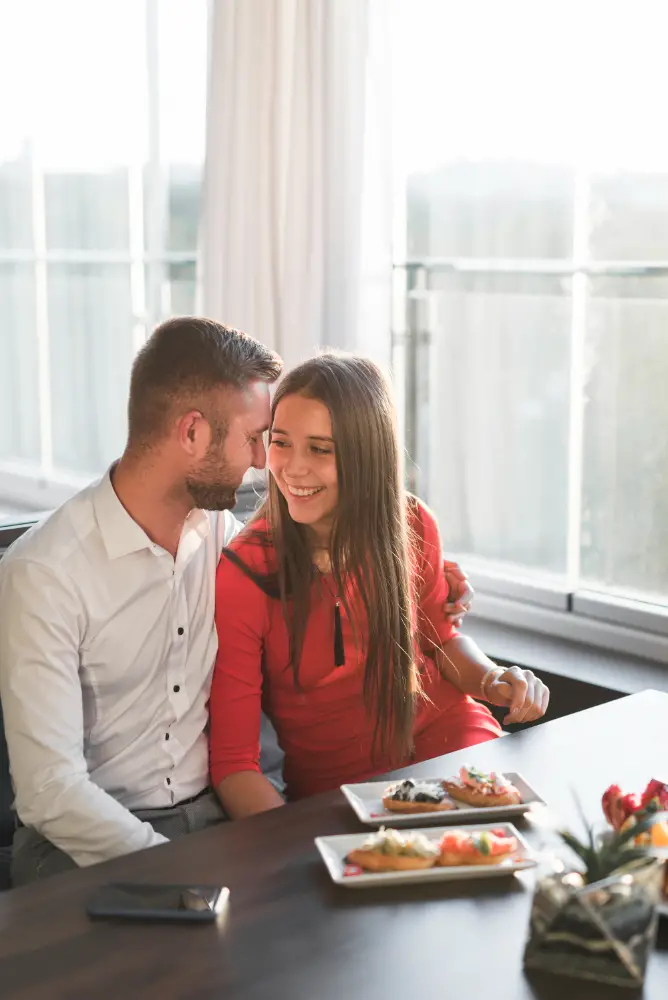
It was just after seven. They looked like they belonged at Bellamy’s in a way I never would, no matter how many shifts I worked there. Not flashy. Just comfortable. The kind of people for whom the prices on the menu were decorative suggestions rather than warnings.
“It’s our anniversary,” the woman told me, smiling, when I brought the water. She had on a green dress. Her husband had silver hair, neatly combed, and a nice watch.
They were polite. Kinder than a lot of our regulars, honestly, who could be sharp with the staff in the casual way of people used to being served. This couple said please. They looked me in the eye. But they were distracted, both of them, and it took me a few minutes to figure out the shape of the distraction.
The man kept checking his phone. He kept it low, under the edge of the table, like he was trying to be discreet about it. And every single time he looked at it, the woman stopped whatever she was saying and watched his face. Not annoyed. Not the way a wife gets annoyed when her husband won’t put the phone down at dinner. She watched him like she was waiting for something. Like they both were.
I remember thinking it was a strange way to celebrate an anniversary. I remember thinking, and I’m ashamed of it now, that rich people had their own private miseries and it wasn’t my business.
Still, they ordered like people who’d decided the night mattered. Oysters to start. Then the filet mignon for him, lobster for her. Three cocktails between them. And a bottle of Bordeaux from the locked cabinet, the good one, the one Jett kept the key to himself. I brought it all. I refilled their water. I cleared the shells. And when I asked about dessert, the man glanced at his phone again and said, no, no thank you, just the check.
Their bill came to four hundred and seven dollars and sixty-three cents.
“Could we have the check?” he asked again, and there was something tight in his voice now, a strain I clocked but didn’t understand.
I set the leather folder down beside him, told them I’d be right back, and went to run drinks to another table that had been flagging me down. I want to be precise about this, because I’ve gone over it so many times in my head. I was gone three minutes. Maybe less. I dropped two drinks, said something about the specials, turned around.
The booth was empty.
At first my brain just refused it. People don’t leave. I looked at the empty booth and thought, they must be in the restroom, both of them, at the same time, which made no sense, but neither did the empty booth. I picked up the leather folder.
The payment tray was gone. No card. No cash. Nothing.
I checked the men’s room and the women’s room, knocking, feeling insane. I hurried to the front, out past the host stand, onto the sidewalk. The valet stand was quiet. No green dress. No silver hair. Just the street and the cold and my own breath in front of my face.
I went straight to Jett’s office.
Jett was the manager. He was maybe thirty-five, always half-stressed, the kind of boss who wasn’t cruel exactly but who had long ago stopped seeing the servers as people with lives. He barely looked up from his computer when I came in.
“Table twelve,” I said. “The couple. They walked out. They didn’t pay.”
He exhaled slowly through his nose, the way he did when you were being a problem. “Maybe they stepped out for a smoke. Maybe they’re in the bathroom.”
“They’re not. I checked everywhere. They’re gone, Jett. Their car’s gone. Can you pull the cameras? You’ll see them leave, you’ll see when—”
“I’m not digging through four hours of footage in the middle of dinner service.” He finally looked at me, and there was no give in his face at all. “You know the policy, Laura. Walkouts come out of the server’s pocket. That’s the rule. It’s the same for everybody.”
“That’s four hundred dollars.”
“Then take it as a lesson. Watch your tables closer next time.”
A lesson.
Like I’d walked them to the door. Like I’d wished them a good night and told them not to worry about the bill. I stood there and I felt something break loose in my chest, something that had been holding tight for four months, and I knew if I opened my mouth again I’d cry in front of him, so I didn’t.
I finished my shift. I don’t know how. I paid the four hundred and seven dollars out of my tips and the little cushion in my checking account that wasn’t a cushion at all, it was next month, it was groceries, it was the electric bill. My hands shook when I handed it over. Jett counted it and nodded like it was nothing, because to him it was nothing.
I made it out to the parking lot before the tears came. I sat in my car and didn’t turn the key. I just sat there in the dark with my hands in my lap and cried, ugly and gasping, the kind of crying you save up for when nobody’s watching. Four hundred dollars gone. My mother still gone. And no way on earth to explain either one to my aunt, who was waiting at home, who still asked me every Sunday if there was any news.
I finally drove back to my apartment, lay down in my clothes, and slept maybe three hours.
Jett called me at eight the next morning.
“Can you come in?” he said.
My eyes were swollen almost shut. My throat hurt. “My shift doesn’t start until five.”
“I know.” Something was off in his voice. Not the usual busy impatience. Something quieter. “Just, please. Come in as soon as you can. It’s important.”
I almost didn’t. I lay there for a minute genuinely considering telling him no, considering quitting, considering never walking back into that restaurant. But he’d said please, which he never did, and there was that strange note in his voice, so I put on yesterday’s jeans and I went.
I expected another lecture. Some new policy. Some form to sign about the walkout.
Instead I found Jett standing beside table twelve, and he looked nothing like the man who’d taken my money the night before. He was pale. He kept rubbing the back of his neck, up under his hairline, over and over.
“What is it?” I asked.
“The cleaners found something this morning. It was wedged down behind the booth, in the gap between the cushion and the wall. They almost missed it.” He was holding a small clear plastic bag, the kind you’d put a sandwich in. “Laura, I pulled the cameras. After they found this, I pulled the cameras.”
He held the bag up.
Inside was a ring.
I stopped breathing. I actually stopped, mid-inhale, and the world went very small and very loud at the same time.
Because I knew that ring.
A thin gold band, scratched near the setting where twenty-three years of a life had worn it down. Three tiny diamonds around a pale blue stone, an aquamarine, her birthstone. And one of the gold prongs holding the stone bent very slightly inward, from the time she caught it on the car door and never got it fixed because she said it still held, so what was the point.
I knew every flaw on that ring because I’d been staring at the photograph of it for four months. It was on the poster. It was the one identifying detail I had that was truly hers, unmistakable, and I’d shown that photo to every coworker at Bellamy’s and begged them, if you ever see this ring, on anyone, you call me.
“You recognize it,” Jett said quietly. It wasn’t a question.
I nodded. I couldn’t speak.
My mother had worn that ring every single day for twenty-three years. She slept in it. She showered in it. She kneaded bread with it on and just washed the flour off after. When she vanished, we found everything else at the house. Her purse. Her clothes. Every other piece of jewelry she owned, right there in the little dish on her dresser.
The only thing missing was the ring on her hand.
Which meant she’d been wearing it when she disappeared. Which meant that couple, the polite couple in the green dress and the silver hair who’d walked out on a four-hundred-dollar bill, had somehow ended up with the one thing my mother still had on her body when she vanished off the face of the earth.
My hand closed around the bag.
“I’m so sorry about last night,” Jett said, and he sounded like he meant it. “I should have checked the footage the second you asked. And after I saw this, I—” He swallowed. “You need to see the video. Come to the office.”
He pulled it up without a word. The camera over table twelve had a clear angle down onto the booth. I watched the couple eat. I watched the man check his phone under the table, again and again, and the woman watch his face each time. Everything I’d seen from the floor, but from above.
Then, about halfway through the meal, the woman reached into her purse on the seat beside her, digging for something. And as she pulled her hand back out, something small caught on the metal clasp of the purse, tumbled loose, and dropped onto the seat cushion.
The ring.
It rolled. It rolled across the cushion in a slow curve and vanished into the narrow gap between the seat and the wall, gone, and she never saw it. She was looking at her husband. She never even glanced down.
“She didn’t notice,” Jett murmured. “She had no idea she dropped it.”
I kept watching. A few minutes later, the man’s phone lit up again, and this time he answered it. I watched him lift it to his ear. I watched him go completely still. Whatever he was hearing drained the color out of his face in real time, and he turned the screen or maybe just his expression toward his wife, and her hand flew up to cover her mouth.
They stood up so fast the woman knocked her chair sideways. He grabbed her coat, grabbed her purse, and the two of them rushed toward the front of the restaurant without a backward glance. Not at the table. Not at the folder with the check in it. Not at anything.
“They weren’t running from the bill,” Jett said slowly. “Look at them. They forgot the bill even existed.”
I was already on my feet.
Something had happened. Some phone call in the middle of an anniversary dinner had made two people forget four hundred dollars like it was nothing, forget it so completely they left it sitting on the table. And they were connected to my mother’s ring. Whatever they knew, wherever they were going, it led back to her.
The valet from the night before was off, but the morning guy was in the employee lounge, and Jett went and got him.
“The couple last night,” I said. “Green dress, older man, silver hair. Did they say anything? When they got their car? Anything about where they were going?”
He thought about it, frowning. “Yeah, actually. The guy was real anxious. Told me to hurry with the car. And while he was waiting he was on the phone, and I heard him say—” He paused, getting it right. “He said, ‘Call the hospital. Tell them we’re on our way.'”
The hospital.
Jett grabbed his keys off the hook. “Which one? There are two. I’ll drive you.”
“I don’t know which one. I’ll figure it out.”
“Laura.” He caught my arm, gently. “You don’t know who these people are. You don’t know what this is. Let me come with you.”
“No.”
“You just watched them run out of here after a phone call about somebody in a hospital, and they had your missing mother’s ring. That could be anything. That could be dangerous.”
“That’s exactly why I have to go,” I said. “And why it has to be me.”
Because here is what four months had done to me. For four months I had waited. I’d waited for the police to call. I’d waited for a stranger to look up at one of my posters and recognize her face. I’d waited for someone else, anyone else, to find the thread and pull it and bring my mother home to me. And all that waiting had given me was sleepless nights and an empty phone and a hole in my chest where she used to be.
I was done waiting for other people.
I slipped the plastic bag into my jacket pocket, closed my hand around it through the fabric, and walked out. I picked the bigger hospital first, the one closer to the road out of town, and I drove there in twelve minutes without remembering a single one of them.
I ran from the parking lot to the doors with the ring in my fist.
There was a woman in blue scrubs at the reception desk. She looked up as I came skidding to a stop in front of her, out of breath, wild-eyed, in yesterday’s clothes.
“I’m looking for my mother,” I said. I pulled a folded poster out of my bag and spread it flat on the counter in front of her, smoothing the creases with a shaking hand. “Her name is Evelyn. Evelyn Mercer. She’s been missing four months. I think she might be here. I think she might be a patient here.”
The receptionist looked at the poster, and her face did the thing I’d seen a hundred times. The apologetic softening. “I’m so sorry, but I really can’t give out any information about our patients. Privacy laws. I wish I could help.”
“Please.” I fumbled the plastic bag out of my pocket and set it on the counter beside the poster. “This is her ring. She was wearing it when she disappeared. Last night, two people dropped this ring at the restaurant where I work, and then they came here, to this hospital, right after. Please. Just look.”
Something in her face changed. She looked at the ring, then at the poster again, at my mother’s photo, and then she pulled her keyboard closer and started typing.
Seconds went by. Each one felt like a year.
“I’m not finding anyone admitted under the name Evelyn Mercer,” she said. “Or Evelyn anything, recently.”
The floor dropped out from under me. I gripped the edge of the counter.
Then she frowned at her screen. “Wait.”
Her fingers moved again, faster.
“We do have—” She hesitated, choosing her words carefully. “Several weeks ago, an unidentified woman was brought in. No ID, no purse, nothing. She was confused, couldn’t tell anyone her name or where she lived. She was transferred to our neurological unit for evaluation. She’s still here.”
My heart was slamming against my ribs. “Does she look like her? Like the photo?”
“I can’t pull up her picture from this desk, and I couldn’t tell you if I could. But—” Her voice dropped, kind now. “The age is right. The general description matches. I’m not saying it’s her. But it’s not not possible.”
“That’s her,” I said. “It has to be her. Please, I need to see her.”
The receptionist hesitated again, and this time there was something careful in it. “I should tell you. The patient had a seizure yesterday evening. She’s stable now, but she’s not in great condition, and she really shouldn’t have a lot of visitors right now. In fact—” She checked the screen. “She already has two people with her. A couple. They’ve been listed as her regular visitors for weeks.”
The couple.
And every awful thing I’d been holding at bay came rushing in at once. They had her ring. They’d been coming here for weeks. They were up there right now, at her bedside, two strangers with my mother who couldn’t remember her own name, who couldn’t protect herself, who couldn’t tell anyone if something was wrong.
“You don’t understand,” I said. “Those people. I think they may have hurt her. I think they may have had something to do with her going missing. Please, you can’t leave her alone with—” My voice cracked and gave out.
The receptionist’s eyes flicked toward the security desk across the lobby. I saw her weighing it.
“Please,” I said, quieter now, forcing myself steady, because I could see that losing control would get me thrown out and calm might get me upstairs. “Just let me see her. If it’s not my mother, I swear I’ll turn around and leave and you’ll never see me again. But if it is her, if she’s been up there for weeks while I’ve been putting her face on every lamppost in two states—please. She’s my mother.”
For a long moment she just looked at me. Then she picked up the phone and spoke to someone quietly, her back half-turned. When she hung up, she printed a visitor badge and slid it across the counter to me.
“Third floor. Room 318. A nurse will meet you at the desk and take you in.”
I grabbed it.
“And, honey?” she called as I turned toward the elevators. There was real gentleness in it, and a warning too. “Prepare yourself. If it is her, after everything, she may not know who you are.”
The elevator was the slowest machine ever built by human hands. I watched the numbers climb. One. Two. Three. When the doors finally opened, a nurse was waiting, and she walked me down a hallway so quiet I could hear my own pulse, and she stopped outside a door with 318 beside it.
There was a narrow window in the door. Through it I could see the couple.
The woman still had on the green dress from the night before, wrinkled now, slept-in. The man’s silver hair was a mess, standing up on one side like he’d been dragging his hand through it for hours. In the restaurant they’d looked polished, wealthy, untouchable. Now they just looked like two exhausted people who hadn’t been home. They were standing on either side of the bed, and they were looking down at whoever was in it with an expression I couldn’t reconcile with anything I’d built in my head.
I pushed the door open.
The woman turned. Her eyes went straight to my hand, to the plastic bag, and they went wide.
“That ring,” she whispered.
I stepped forward, putting myself between the two of them and the bed without even deciding to. “Where did you get this? Where did you get my mother’s ring?”
“Please,” the man said, lifting both hands, palms out. “Please, keep your voice down. The patient needs quiet, she’s very—”
“You stole this from my mother.”
The woman just stared at me. “Your—your mother?”
And that’s when I finally let myself look down at the bed.
For four months I had imagined finding her. I’d pictured it a thousand ways, in a thousand places. In none of them had she looked like this. My mother, Evelyn, who ironed her sheets and stood so straight and kept every towel in its place, lay under a thin white hospital blanket looking impossibly small. Her face was pale and had gone gaunt. There was an IV taped to the back of one hand, the hand that should have had the ring on it. Her hair, always so carefully set, was loose and gray against the pillow.
But it was her. It was her.
“Mom?” The word came out of me broken.
Her eyelids fluttered. They didn’t open.
My knees went. I caught the metal bedrail and held on, and I turned back to the couple with everything I had left. “Who are you? What did you do to her? Tell me right now.”
“Nothing,” the woman said, and to my complete confusion her eyes filled with tears. “We didn’t do anything to her. We found her.”
Her name was Margaret. Her husband was Thomas. And standing there in that room, I listened to the whole story come apart from the shape I’d given it, piece by piece.
Several weeks earlier, they’d been driving home in the evening on the county road that runs outside town. And in the last of the light they’d seen a woman walking along the shoulder. Barefoot. No coat. Wandering, unsteady, drifting toward the traffic lane and back. They’d pulled over.
“She didn’t know where she was,” Margaret said. “She couldn’t tell us her name. She couldn’t tell us her address, or how she got out there, or where she’d come from. She had no purse, no phone, no ID, nothing at all. Just—” Margaret gestured helplessly at the bed. “Just her. And she was so frightened. We couldn’t leave her out there. It was getting dark, and cars come around those bends fast.”
They’d called an ambulance. And when it came, my mother had grabbed Margaret’s hand and wouldn’t let go.
“She held onto me the whole way,” Margaret said, and her voice wobbled. “Every time I tried to step back so the paramedics could work, she’d panic. So I rode with her. And after that we just—we kept coming back. Every day, nearly. Because she’d get so scared when there was no familiar face. And ours were the only faces she had.”
The doctors, they told me, believed my mother had suffered some kind of injury or medical event that damaged her memory. A fall, maybe. Something that had wiped out who she was and how to get home. The hospital had done what they were supposed to do, registered her as an unidentified patient, but she’d been found in one jurisdiction and gone missing in another, and my desperate poster campaign in a different county, my police report in a different town, had never connected to a nameless woman in this bed. Two systems that never spoke to each other, and my mother had fallen straight down the gap between them, the same way her ring had rolled into the gap behind the booth.
“The ring,” I said. “How did you get the ring?”
Thomas answered, gently. “When they examined her, the nurses took it off. It was loose on her finger, she’d lost so much weight, and it kept sliding around. She kept trying to put it back on, and it would nearly fall off, and she’d get so upset about it. So Margaret offered to hold onto it. To keep it safe.”
“There are so many people in and out of these rooms,” Margaret said. “Cleaners, nurses, aides, other visitors. I was terrified it would get lost or taken. It clearly meant everything to her. So I kept it in my purse. I meant to keep it safe until—” She stopped, and pressed her lips together, and looked at me. “Until someone came. We kept hoping someone would come.”
They’d been living for weeks between their home and this hospital room, sitting with a stranger, holding her hand, keeping her ring safe. And last night, their anniversary, after weeks of it, they’d finally let themselves go out. Put on the green dress and the good watch and gone to Bellamy’s to have one nice evening.
And they’d spent the whole meal watching Thomas’s phone. Because that was the habit now. That was what weeks of waiting for news about a woman with no name had done to them. Every buzz might be the hospital.
And then it was.
“They called to tell us she’d had a seizure,” Thomas said. “That she was stable but it had been serious. And we just—” He shook his head. “We didn’t think about the check. I don’t think either of us remembered there was a check. We didn’t even really think about the car. We just had to get here. She didn’t have anyone else. We thought she didn’t have anyone else.”
I stood there, and all the fury I’d carried up three floors in my fist had nowhere to go. It just drained out of me and left something worse behind, which was shame. I had spent the whole drive certain these two people had hurt her. And the truth was they were the only reason she’d been warm and safe and held for weeks while I plastered her face on lampposts a county away.
“You stayed with her,” I said. “All this time. You didn’t even know her.”
Margaret looked at the bed, at my mother’s still face. “We kept hoping her family was out there somewhere. Looking for her. We couldn’t stand the thought of her being alone if they were.”
“I was looking,” I whispered. “I never stopped. Not for one single day.”
And then a small sound came from the bed.
My mother’s fingers moved against the blanket. Her eyelids lifted, slowly, and her eyes were unfocused at first, cloudy, searching the ceiling. Then they drifted down, and they found my face, and they stopped.
I didn’t breathe. I couldn’t. Her brow drew together like she was reaching for something through a heavy fog, straining toward it, and I watched her try, and I would have given the last four months of my life, the four hundred dollars, everything I had, for her to make it through.
“Laura?” she said.
That one word took every last thing holding me upright and knocked it away.
I bent over the bed and got my arms around her, careful of the IV, laughing and sobbing at the same time in a way that must have sounded like I’d lost my mind. “Yes. Yes, Mom, it’s me, it’s Laura, I’m here.”
Her hand came up, weak and slow, and rested against my cheek, and her thumb moved once, the way she used to do when I was small and crying about something that seemed like the end of the world.
“I knew you were somewhere,” she said, so quietly I felt it more than heard it. “I could feel it. I just couldn’t remember the way back to you.”
I took the ring out of the little plastic bag. I slid it onto her finger where it belonged. It hung loose, too big for her thin hand now, and she felt it slipping and curled her fingers closed around mine, holding it in place, holding my hand, holding on the way Margaret said she’d held on that first night by the road.
“Take me home, Laura,” she said.
“I will,” I told her. “I promise. I’m going to take you home.”
Behind me, Margaret had started to cry in earnest, and Thomas put his arm around her, and I finally understood the whole shape of it. These strangers hadn’t taken my mother from me. They’d stood in the gap where the whole world had let her fall, and they’d kept her safe, and they’d waited with her until I could get there.
The four hundred dollars, it turned out, was never a loss at all. It was the thread. If they’d paid that bill and left quietly like any other table, that ring would have stayed jammed behind the booth, and my mother would have stayed a nameless woman on the third floor, and I would have kept driving past hospitals with posters in my bag, never knowing she was inside one of them.
I paid four hundred and seven dollars and cried in a parking lot over it, certain it was the worst night of a very bad year.
It was the luckiest money I ever spent in my life.
My mother came home three weeks later. Her memory came back slowly, in pieces, some days better than others, and the doctors said parts of it might never return all the way. She still can’t tell me exactly what happened the day she walked out of the house with nothing but her ring. Maybe she never will.
But she calls me every Sunday at eight o’clock. Never a minute past. And Margaret and Thomas come for dinner once a month, and my mother sets the table herself now, slowly, carefully, every fork in its place, every towel where it belongs. And she always seats Margaret right beside her.
They’re family. They earned it in a hospital room, holding the hand of a woman who couldn’t remember her own name, refusing to let go until somebody came.
Specialty: Emotional Turning Points
Rachel Monroe writes character-driven stories about betrayal, second chances, and unexpected resilience. Her work highlights the emotional side of family conflict — the silences, the misunderstandings, and the moments when someone quietly decides they’ve had enough.