I switched off the lights in my home office, picked up my leather briefcase, and kissed my two daughters goodbye as though I were really about to leave for Canada.
“It’s only four days,” I told them while I fastened my jacket. “Be good for Marisol. I’ll be back Friday.”
Valeria, my nine-year-old, wrapped both arms around my waist and held on so tight that the guilt landed in my chest before I even reached the door.
Sofia, who was six, grabbed my hand.
“Do you really have to leave again, Daddy?”
I made myself smile.
“It’s an important business meeting in Toronto, sweetheart.”
That was a lie.
There was no meeting. My private jet was never going to leave the ground. I hadn’t booked a hotel. I wasn’t going anywhere.
Forty-five minutes after my SUV rolled through the iron gates of our Bel-Air estate, I came back in quietly through a service entrance with Hector, the head of my private security team.
Nobody inside the house knew I was back.
Especially not Chloe.
My fiancée. The woman I was supposed to marry in three months.
The whole plan had started because of one sentence she said over dinner the night before.
“You trust Marisol far too much, Alexander.”
That single line kept me up for hours.
Marisol had worked for me for almost five years. She was hired as a housekeeper. But after my wife died, Marisol slowly became one of the people my daughters trusted most. She never tried to replace their mother. She was just there. She knew their routines. She helped when they were upset. She listened when they needed someone.
Until Chloe put doubt in my head, I had always thought that closeness was a good thing.
Let me back up, because you need to understand how I got here. How a man with everything ends up hiding in a room behind his own garage, spying on the people he loves.
My name is Alexander Vance. I build companies. That’s the short version. The longer version is that I’ve spent the last fifteen years buying failing businesses, fixing them, and selling them for more than anyone thought they were worth. I’m good at it. I’m good at reading numbers, reading rooms, reading the moment a man across a negotiating table decides he’s going to lie to me.
But I couldn’t read what was happening in my own house.
My wife, Elena, died three years ago. Cancer. It moved fast, faster than any of the specialists promised, and by the time I understood we were losing her, we had maybe six weeks left. I remember standing in a hospital hallway telling myself that money would fix it. That if I just found the right doctor, the right trial, the right hospital in the right country, I could buy her more time.
I couldn’t.
She died on a Tuesday morning while I was on the phone with a clinic in Switzerland.
I didn’t get to say goodbye. I was arguing about wire transfers when the machine beside her bed went quiet.
I’ve never told anyone that. Not even Chloe.
After Elena was gone, I did the only thing I knew how to do. I worked. I threw myself into deals I didn’t need, meetings I could have skipped, trips that kept me out of the house for weeks at a time. Because the house was full of her. Her handwriting on the grocery list stuck to the fridge. Her perfume still in the bathroom. Her voice in my daughters’ laughter.
And Marisol held it all together while I ran.
She learned that Sofia liked her eggs scrambled soft, almost runny, the way Elena used to make them. She learned that Valeria couldn’t sleep without the hall light on. She learned which songs made the girls cry and which ones made them dance in the kitchen in their socks.
I paid her a salary. What she gave my daughters, I could never have paid for.
Then, eighteen months ago, I met Chloe.
It was at a charity gala, one of those events where everyone pretends the auction matters more than the networking. She was standing near the bar in a green dress, laughing at something, and she looked over at me like she already knew me.
She was smart. She was beautiful. She said all the right things about grief, about how a man shouldn’t carry it alone, about how my daughters deserved a woman in the house who could love them.
I believed her.
God, I wanted to believe her.
Because being alone with my grief was heavier than any deal I’d ever closed.
We got engaged eight months later. My friends thought it was fast. My lawyer thought it was reckless and pushed for a prenup, which I signed without reading closely, because I trusted her.
I trusted her right up until the night she leaned across my dinner table and told me the woman raising my children was a thief.
“What exactly are you trying to say?” I asked her that night.
Chloe leaned toward me and lowered her voice, even though we were the only two people in the room.
“Things have disappeared from the house.”
I frowned.
“What things?”
“My diamond earrings. Some cash I left in my vanity drawer. Expensive perfume.”
I stared at her.
“Are you saying Marisol stole them?”
“I’m not accusing anyone.”
Her answer came out smooth, rehearsed almost, though I didn’t think of it that way at the time.
“I’m only telling you that you need to start paying attention.”
Then she added something else, and this was the part that got under my skin.
“She’s also turning the girls against you.”
A cold feeling moved through me.
“What do you mean?”
“They’re far too attached to her,” Chloe whispered. “When you walk into a room, they get quiet. But when Marisol appears, they run to her.”
She touched my hand.
“That woman knows everything about this family. Our schedules. Our habits. Private conversations.”
Then she said the line that stuck.
“It’s always the quiet ones you should watch.”
I didn’t want to believe her.
But suspicion is a strange thing. Once someone gives you a reason to doubt, every ordinary detail starts to look different.
I remember standing in the kitchen the next morning, watching Marisol pour orange juice for Sofia, and thinking, for the first time in five years, does she stand too close to my daughters?
I hated that thought. But I couldn’t shake it.
Over the next few days, I watched Marisol more carefully.
She knew exactly how Sofia liked her breakfast. Valeria often waited by the window for Marisol to finish working so they could read together. Whenever Marisol entered a room, both girls seemed to relax.
Those were things I had once seen as proof that she genuinely cared about them.
Now I found myself wondering if Chloe was right.
There was one moment that pushed me over the edge. Two nights before the fake trip, I came downstairs late for a glass of water and heard voices in the den. Valeria and Marisol. They stopped talking the second I walked in. Valeria looked at me, then at Marisol, and something passed between them that I didn’t understand.
“What are you two doing up?” I asked.
“Just talking, Mr. Vance,” Marisol said. “She had a bad dream.”
Valeria nodded quickly. Too quickly.
They were hiding something. I was sure of it.
I didn’t know yet that they were hiding it from Chloe, not from me.
That was why I invented the Toronto trip.
Three months earlier, I had upgraded the whole estate’s security system. More than thirty concealed high-definition cameras covered the hallways, living spaces, kitchen, garden, entrances, and other common areas. There were no cameras in bedrooms or bathrooms. But the system covered enough of the property to show me what happened inside my home when everyone thought I was thousands of miles away.
I told myself it was to catch Marisol.
I know now that some part of me, some quiet part I wasn’t ready to listen to, wanted to catch someone else.
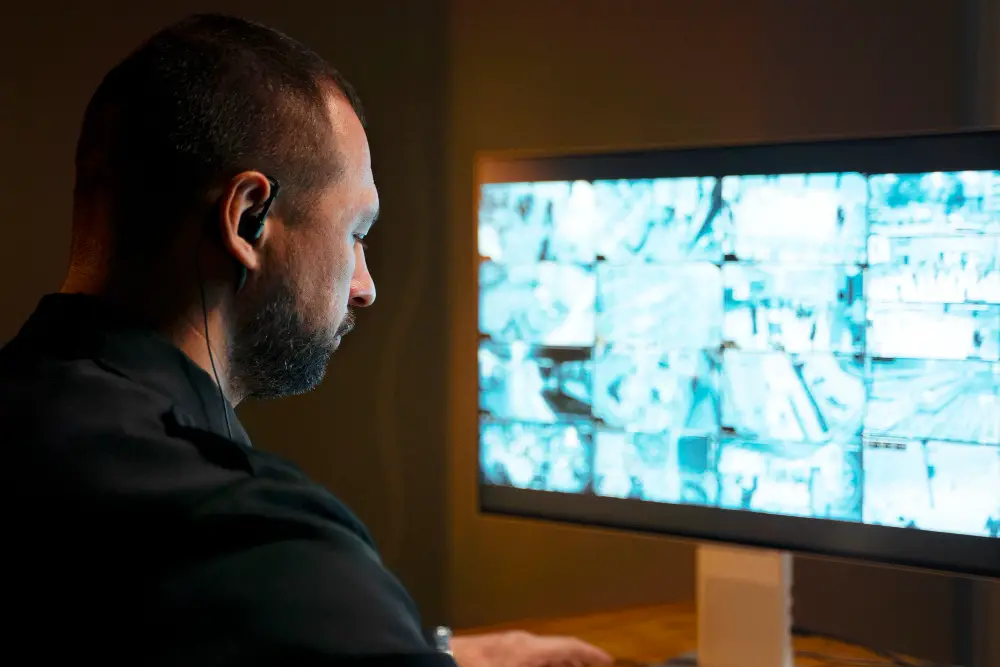
Hector and I entered the secure monitoring room hidden behind the garage. He locked the heavy door behind us.
A wall of monitors glowed in front of me.
“Audio is active in every common area, Mr. Vance,” Hector said quietly.
Hector had worked for me for six years. He was ex-military, said maybe forty words a day, and I trusted his judgment more than most of the men in my boardroom. He didn’t ask why I was hiding in my own house. He just did his job.
I sat down.
“I want to see what happens in this house when everyone believes I’m gone.”
For the first fifteen minutes, I felt ridiculous.
Marisol cleaned the marble kitchen counters. My daughters sat at the dining table finishing breakfast. Outside, the landscaper worked near the pool.
Nothing suspicious happened.
Nothing even close to unusual.
I started to think Chloe’s warnings had just gotten inside my head. I watched Marisol wipe down a counter she’d already wiped, humming to herself, and I felt like a fool. A paranoid, grieving fool who’d let his fiancée turn him against a woman who’d done nothing but love his children.
I almost stood up and ended the whole thing.
I actually put my hand on the arm of the chair to push myself up.
“You want me to shut it down, sir?” Hector asked.
“Give it a few more minutes,” I said. I don’t know why. Maybe it was the same instinct that made me good at deals. The feeling that the important thing hadn’t been said yet.
Then Chloe walked into the main living room.
And within seconds, I realized I’d been watching the wrong person the entire time.
The woman on the screen barely looked like the elegant, soft-spoken fiancée I thought I knew.
Her posture changed. Her pleasant expression vanished. Her face went hard.
Valeria was sitting quietly on the rug beside the fireplace, reading a book. Sofia sat nearby holding an old stuffed rabbit.
That rabbit mattered. It was one of the last gifts Elena had given Sofia before she passed away. Sofia had named it Mr. Buttons. She’d slept with it every night for three years. It had been washed so many times it had gone gray, and one ear had been sewn back on twice.
Chloe marched toward them, her heels striking sharply against the hardwood floor.
“How many times do I have to tell you two that I don’t want you sitting around in the main living room?”
Both girls reacted instantly.
And that reaction was the first thing that scared me.
They didn’t look surprised.
They looked used to it.
Valeria closed her book right away. Sofia lowered her head.
There was no confusion in either of their faces. Only recognition. Like they already knew exactly what happened when Chloe used that voice.
I leaned closer to the monitor.
“Turn the audio up,” I said.
Hector adjusted a dial. Chloe’s voice came through clearer now, cold and clipped.
Then Chloe reached down and took the stuffed rabbit out of Sofia’s hands.
She placed it on a shelf far above my daughter’s reach.
“I’m tired of repeating myself,” she said. “When your father isn’t home, I make the rules here.”
I stared at the screen.
Sofia’s lower lip started trembling.
Valeria moved closer to her sister. Almost on instinct, she put herself slightly in front of Sofia.
Then Marisol came into the room.
She didn’t yell. She didn’t confront Chloe aggressively. She just walked over and stood between Chloe and my daughters.
“Miss Chloe,” she said calmly, “the girls were only reading while they waited for their tutor.”
Chloe turned toward her.
“Did I ask for your opinion?”
“No, ma’am.”
“Then remember your place.”
Chloe stepped closer.
“You work here.”
Her voice went colder.
“You are not family. You are not their mother. You are nobody in this house.”
My hands tightened into fists.
On another camera angle, I watched Valeria reach back and take Sofia’s hand.
Neither girl looked at the other. They didn’t need to. It was automatic. Practiced.
That was the moment the truth hit me in the chest like a fist.
This had happened before.
Maybe many times.
My daughters weren’t reacting to one bad morning. They had learned how to protect each other when Chloe was like this.
And while it had been happening, I had been traveling. Working. Negotiating acquisitions. Attending meetings. Building companies.
I had been so focused on protecting their future that I hadn’t seen what was happening in their own home.
Chloe leaned toward them.
“Go upstairs. Now. I don’t want to see either of you down here.”
Sofia looked toward the shelf.
“Please,” she whispered. “I just want my bunny.”
Chloe laughed.
Not warmly. Not playfully. Coldly.
“Then maybe you should learn to listen to me.”
I stared at the monitor.
And suddenly everything Chloe had told me the night before looked completely different.
The missing jewelry. The money. The perfume. The accusations against Marisol. The warnings that my daughters were getting “too attached” to her.
Marisol wasn’t turning my daughters against anyone.
She had been protecting them.
And Chloe wanted her gone.
What I still didn’t understand was why.
“Mr. Vance.” Hector’s voice was low. “Do you want me to go up there?”
“No,” I said. My own voice sounded strange to me. “Keep watching. I need to see all of it.”
Because I wasn’t going anywhere. Not until I found out exactly what Chloe had been doing when she thought I would never see it.
On the screen, the girls went upstairs. Marisol stood there a moment longer, and I saw her look up at the shelf where the rabbit sat. She waited until Chloe walked out of the room, into the hallway, toward the kitchen. Then Marisol pulled a chair over, climbed up, and took Mr. Buttons down.
She held it against her chest for a second. Then she carried it upstairs after the girls.
I watched her on a second camera, the one in the upstairs hallway, knock softly on the girls’ door and go in. There was no camera inside the bedroom, so the feed cut there. But I’d seen enough to understand what kind of woman I’d almost fired.
I sat back in the chair and pressed my hands against my face.
“How long has this been going on,” I said. It wasn’t really a question. But Hector answered anyway.
“The system’s been recording for three months, sir. Everything’s stored.”
I looked at him.
“Everything?”
“Every camera. Every day. You can go back.”
I don’t know how to describe the feeling that went through me then. It was fear and shame and a kind of terrible hope all at once. Fear of what I’d find. Shame that it took a hidden room and thirty cameras to see it. And hope, because for the first time in months, I understood who the enemy actually was.
“Pull it up,” I said. “Start from three months ago. I want to see the days I was gone.”
Hector hesitated. “Sir, that’s a lot of footage. It could take—”
“Then we’d better start now.”
He nodded and started typing.
What I watched over the next two hours, I will never forget as long as I live.
It wasn’t every day. Chloe was careful. When I was home, she was perfect. She read to the girls. She brushed Valeria’s hair. She kissed Sofia on the forehead and called her sweetheart. I’d seen those moments myself and thought I was watching a woman fall in love with my children.
But the days I was gone told a different story.
There was a morning in April. Sofia had spilled juice on the kitchen floor. An accident. Any six-year-old would have done it. Chloe grabbed her by the arm, hard enough that Sofia cried out, and made her clean it up while standing over her, saying things I could barely stand to hear.
“You’re just like your mother. Sloppy. Careless. No wonder your father can’t stand to be in this house.”
I had to stop the footage. I actually stood up and walked to the corner of the room and stood there with my back to the monitors, breathing like I’d run a mile.
“Sir,” Hector said quietly. “You don’t have to watch all of it.”
“Yes I do,” I said. “I do have to.”
Because I hadn’t been there. And the least I owed my daughters was to see what they had lived through while I was gone.
There was a scene from May. Valeria had brought home a drawing from school. A picture of our family. She’d drawn me, and the two of them, and Marisol, and even Elena up in the corner with wings. There was no Chloe in the picture.
Chloe found it on the refrigerator.
She waited until the girls were in the room. Then she took the drawing down, looked at it, and tore it in half. Then in half again. She dropped the pieces in the trash without a word and walked out.
Valeria didn’t cry. That was the worst part. She just walked over to the trash, looked down at the pieces, and closed the lid. Like she’d expected it.
Later, Marisol came in, saw Valeria sitting alone at the table, and figured out what happened somehow. She fished the pieces of paper out of the trash, taped them back together at the kitchen table, and hid the drawing somewhere. In the footage I watched her fold it carefully and tuck it into the pocket of her apron.
I thought about the night I’d walked in on them in the den. The night I’d been so sure they were hiding something from me.
They were hiding it from Chloe. They were hiding the drawing, the rabbit, the small pieces of their own lives that Chloe kept taking away.
And I’d almost fired the one person keeping those pieces safe.
I made Hector keep going.
There was footage of Chloe on the phone. Dozens of calls, always when she thought she was alone, always in the same corner of the garden where she must have believed there were no cameras. The audio out there was faint, picked up by a camera mounted near the pool house. But we could hear enough.
“He signs everything without reading it,” she said in one call. “That’s how easy this is going to be.”
In another: “The prenup’s got a clause. If we’re married two years, I get the Malibu house outright. Plus support. But that’s nothing. The real money’s in the trust.”
And then the one that made my blood run cold.
“The kids are the problem. He’d give up anything for them. As long as they’re around, he’s never going to fully trust me over them. But there are ways to handle kids. Boarding school. Custody stuff. His late wife’s got a sister who’s been sniffing around wanting visitation. I could make that a real headache for him. Make him choose between the fight and me.”
I sat very still.
For fifteen years, I had made my living reading people. Figuring out what they wanted and what they were willing to do to get it. And I had missed this. Completely. She’d walked into my grief and found the exact soft place to put the knife.
“Who is she talking to?” I asked.
Hector was already working on it. “The number’s saved in the system logs. Give me a few minutes.”
While he worked, I kept watching. I couldn’t stop now.
The calls painted a picture. Chloe wasn’t working alone. There was a man on the other end of most of them. Someone named Derek. From the way they talked, he was more than a friend. In one call she got tender, dropped the businesslike voice completely.
“Just a little longer, baby. Once the ring’s on and the two years are up, we’re set for life. Then it’s you and me and we never have to think about that man or his brats again.”
That was the word she used. Brats.
I turned to Hector.
“I want everything on Derek. Full name, address, history, how they met, all of it.”
“Already on it, sir.”
I looked back at the monitors. On the live feed, the afternoon had gone quiet. The girls were still upstairs. Marisol was in the kitchen, prepping dinner. Chloe was in the master bedroom, doing something on her laptop.
I thought about walking into that house right then and dragging her out by the arm.
But fifteen years of deals had taught me one thing. You don’t move until you have everything. You don’t tip your hand. The moment Chloe knew I was onto her, she’d start covering tracks, calling lawyers, spinning a story. And I couldn’t risk it. Not with my daughters in the middle.
So I made myself sit back down.
“Hector,” I said. “How long can I stay in here without anyone knowing?”
“As long as you need. Nobody comes back here. I control the only key.”
“Good.”
I pulled out my phone and did something I should have done years ago.
I called my late wife’s sister.
Her name was Diana. Elena’s older sister. After Elena died, things had gotten strained between us. I’d pulled away from everyone connected to that loss, and Diana most of all, because she looked like Elena and sounded like her, and every conversation felt like touching a bruise. She’d asked to see the girls more than once. I’d always found a reason to say not now. Later. When things settle.
The phone rang twice.
“Alexander?” She sounded surprised. Of course she was. I hadn’t called her in over a year.
“Diana. I need to ask you something, and I need you to be honest with me.”
A pause. “Okay.”
“Chloe told me you’ve been trying to get involved with the girls. Trying to get visitation. Causing problems.”
Silence on the line. Then: “Is that what she told you?”
“Yes.”
Diana let out a breath. “Alexander, I called your house one time. In February. I wanted to take the girls to the aquarium for Sofia’s birthday. Chloe answered. She told me you didn’t want me around them. That you blamed me somehow for Elena. That I should stop calling or you’d get a restraining order.”
I closed my eyes.
“I never said any of that.”
“I know. Or, I hoped. But you never called back, so what was I supposed to think?” Her voice cracked a little. “I’ve been sending the girls birthday cards through the mail because I didn’t know what else to do. Did they even get them?”
I thought about the mail that came through the house. Chloe handled a lot of it. Sorted it. Threw out what she called junk.
“No,” I said quietly. “I don’t think they did.”
There was a long silence.
“Alexander, what’s going on?”
“I found out some things about Chloe today. I can’t explain all of it right now. But I need you to know that everything she told you was a lie. And I need to ask you a favor.”
“Anything. For those girls, anything.”
“I might need you soon. On short notice. Can you be ready?”
“I can be there in an hour if you need me.”
Something loosened in my chest that had been tight for a very long time.
“Thank you, Diana. I mean it.”
After I hung up, Hector spoke without looking up from his screen.
“Got Derek.”
He turned the monitor toward me. A driver’s license photo. A record. The man had two prior arrests for fraud. One dismissed, one that ended in a plea deal. There was a civil suit from three years back, a woman in Arizona who claimed he’d emptied a joint account and disappeared.
“They’ve been together at least two years,” Hector said. “Before you ever met her. There’s a lease with both their names on it. She kept the apartment. Been paying rent on it this whole time, sir. Even after she moved in here.”
I stared at that. She’d kept a second home. A place to run to. A place for Derek.
I had proposed to a woman who was already, in every way that mattered, married to someone else.
I should have felt like a fool. And part of me did. But mostly I felt something clearer and colder than that. I felt like a man who had finally, after fumbling in the dark for months, put his hand on the light switch.
“What do you want to do?” Hector asked.
I looked at the monitors. At my two daughters coming back downstairs, careful and quiet. At Marisol setting the table for them. At the woman in the master bedroom who thought she’d already won.
“I’m going to give her a chance to hang herself,” I said. “And I’m going to make sure my girls never have to be scared in this house again.”
I spent the rest of that first day in the room, watching, thinking, planning. I ate a sandwich Hector brought from a place off the property. I didn’t sleep. I couldn’t. Every time I closed my eyes I saw Sofia reaching for her rabbit, and Chloe laughing that cold laugh.
By the second morning, I had a plan.
But first, there was something I needed to see with my own eyes. Something the cameras couldn’t give me.
I needed to hear my daughters tell the truth. And I needed them to be able to do it without being afraid.
I called Marisol’s cell phone from a blocked number.
She answered on the third ring, cautious. “Hello?”
“Marisol. It’s Mr. Vance. Don’t react. Don’t say my name. Keep your face normal.”
There was a pause, and I watched on the monitor as she turned slightly away from the room, her expression steady even though I knew her heart must have jumped.
“Yes, of course,” she said, in a voice that sounded like she was talking to a delivery service.
“I never went to Toronto. I’m in the house. I’ve been watching the cameras. I’ve seen everything Chloe has done to the girls. I know it wasn’t you. I know you’ve been protecting them.”
I heard her breathe out slowly.
“I understand,” she said carefully.
“I need your help. But I can’t have Chloe suspecting anything. Can you get the girls alone this afternoon? Take them out to the garden. To the far corner by the old oak tree. There’s a camera there but no one else can see it or hear you. Tell them the truth, that their dad is home and everything is going to be okay. But don’t let Chloe see.”
“That sounds fine,” Marisol said in her flat delivery-service voice. “I can do that.”
“Marisol.” My voice caught. “Thank you. For all of it. For everything I didn’t see.”
She was quiet for a second. Then, still careful, she said, “It was never a job to me, sir. Those girls are my heart.”
She hung up.
I sat there and pressed the back of my hand against my mouth, because a grown man crying in a security room is not something Hector needed to deal with.
That afternoon, I watched on the garden camera as Marisol walked the girls out to the old oak tree, the one Elena had planted the year Valeria was born. She knelt down in front of them and talked for a long time. I couldn’t hear all of it, the wind kept eating the audio, but I saw the moment she told them.
I saw Valeria’s whole body go still. Then Sofia’s mouth opened, and she said something, and Marisol nodded, and pointed vaguely toward the house, and both girls looked toward it with an expression I’ll never forget. It was hope, but scared hope. The hope of children who’d learned not to trust good news.
Then Sofia started to cry, and it wasn’t the crying I’d been watching for two days, the small silent crying of a kid trying not to be noticed. It was loud, and messy, and it was the sound of a little girl who suddenly didn’t have to hold it in anymore.
Valeria hugged Marisol. Then Sofia climbed into the hug too. The three of them stayed like that under the oak tree for a long time.
I decided then that I would not wait another day.
That evening, I put the last piece of the plan in place. I called my lawyer, Gerald. I’d woken him up, and he was cranky, until I told him what I’d found.
Gerald had never liked Chloe. He’d pushed the prenup on me hard, and I’d resented him for it at the time. Now I could have kissed him.
“Send me everything,” he said, all traces of sleep gone. “The footage, the call logs, the lease, the man’s record, all of it. And Alexander, listen to me. Do not confront her alone. Do not say anything you can’t take back. Let me and the authorities handle the parts that need handling. You focus on the girls.”
“There’s a part I have to do myself, Gerald.”
“Alexander—”
“I have to look her in the face. I need her to know that I know. I’ve earned that. And so have my daughters.”
He sighed. “Then at least have Hector in the room. And record it.”
“I intend to.”
That night, I slept for a few hours on the cot Hector set up in the corner. In the morning, I showered in the pool house, put on fresh clothes Hector had brought me, and walked around to the front of my own house like a man arriving home.
I texted Chloe from the driveway.
Meeting ended early. Flying back tonight. Home by nine. Missed you all.
I watched on the monitor, standing just outside the front door, as she read it. I watched her smile. A warm, pleased, private smile, the kind you’d give if you loved someone. She typed back.
We missed you too. The girls will be so happy. I’ll have dinner ready.
Then, the second she set the phone down, the smile dropped off her face like a mask coming loose. She walked into the living room, where the girls were, and I heard her say, “Your father’s coming home tonight. You will be on your best behavior. You will smile. You will tell him what a wonderful few days we had. Do you understand me? If either of you says one word to upset him, you’ll be very, very sorry.”
I put my phone away.
I opened my front door.
“I’m home,” I called out.
What happened next I’ve replayed a thousand times.
Sofia came running first, the way she always did, but this time she stopped a few feet away and glanced back over her shoulder at Chloe before she reached me. That glance. My six-year-old checking to make sure it was safe to hug her own father. That’s the image that stays with me.
I knelt down and opened my arms.
“Come here, baby.”
She ran into me and held on. Valeria came more slowly, watching, always watching, and I pulled her in too.
Chloe appeared in the hallway, and there she was, the woman I’d almost married, in a soft cream sweater, her hair down, her face lit up with a smile so convincing that for one dizzy second I doubted everything I’d seen.
“You’re home early,” she said, coming toward me. “The girls have been asking about you every day.”
“Have they,” I said.
Something in my voice made her slow down. Just for a fraction of a second. She recovered fast, though. She always did.
“Let me take your bag. Marisol made dinner. Well, I supervised.” A little laugh. “How was Toronto?”
“Cold,” I said. “Very cold.”
Marisol had come to the kitchen doorway. Our eyes met across the room. I gave her the smallest nod.
“Girls,” I said, still holding them. “Why don’t you go upstairs with Marisol for a few minutes. I need to talk to Chloe about something. Grown-up stuff.”
Valeria looked at me. There was a question in her eyes, and a fear, and I tried to put everything I felt into my face so she would understand.
You’re safe, I tried to tell her without words. It’s over.
I think she understood. She took Sofia’s hand, the way she always did, and she let Marisol lead them upstairs.
Then it was just me and Chloe. And Hector, standing quietly by the door, a fact Chloe hadn’t clocked yet.
“Is everything all right?” Chloe asked. “You seem tense. Was it the deal? Did something go wrong in Toronto?”
I walked over to the fireplace. To the shelf. The one where she’d put the rabbit up out of Sofia’s reach three days before.
“There was no deal,” I said.
She tilted her head. “What?”
“There was no Toronto trip. There was no meeting. My plane never left.”
I watched it happen. I watched the calculation start behind her eyes. She was fast, I’ll give her that. Most people, caught out, freeze. Chloe was already several moves ahead, already choosing a story.
“I don’t understand,” she said slowly. “Where have you been?”
“Here,” I said. “I’ve been here the whole time. In the room behind the garage. Watching the cameras.”
The color went out of her face. It’s a thing people say, but I actually saw it. She went pale, and then she did something that told me everything. She glanced, very quickly, toward the garden. Toward the corner where she’d made her phone calls.
“There are thirty-one cameras in this house, Chloe,” I said. “There’s one by the pool house that picks up the far corner of the garden. The place you thought was private.”
“Alexander—”
“I know about Derek.”
Her mouth opened. Closed.
“I know about the apartment you kept. I know about the calls. I heard you call my daughters brats. I heard you talk about sending them to boarding school. About using Diana against me. I heard you say I’d give up anything for them, and you were right. I would. Including you.”
She switched tactics so fast it was almost impressive. Her eyes filled with tears, real-looking ones.
“Alexander, you don’t understand. Derek is, he’s an old friend, he’s been going through a hard time, I’ve been trying to help him and he takes advantage, he twists things—”
“Stop.”
“—and the girls, I love the girls, I’ve been trying so hard, but they don’t listen, and I get frustrated, and maybe I’ve been too strict but it comes from a good place, I promise you—”
“I said stop.”
Something in my voice did it. She stopped.
I walked over and took the stuffed rabbit down off the shelf. Mr. Buttons. Gray and worn and one ear sewn on crooked. I held it up.
“Do you remember this?” I asked. “You put it up here so a six-year-old couldn’t reach it. You took it out of her hands and you laughed at her. My wife gave her this rabbit before she died. It’s one of the last things Elena ever gave her.”
Chloe said nothing.
“You tore up Valeria’s drawing. You made Sofia clean the floor while you told her she was just like her mother. Sloppy. Careless. You said no wonder her father can’t stand to be in this house.” My voice was shaking now, and I let it. “You told a grieving child that her father didn’t love her, so you could have the money in his trust.”
“Alexander, please, if you’d just let me explain—”
“There’s nothing to explain. I have all of it. Every day. Three months of it. It’s already with my lawyer. It’s already with people who need to see it.”
Now the tears stopped. Just like that. The soft cream sweater and the trembling lip couldn’t help her anymore, so she dropped them. And I saw, finally, in the open, the woman who’d been living in the footage.
“You signed a prenup,” she said, cold now. “You’ll owe me—”
“I signed a prenup with a fidelity clause and a clause about conduct in the home. Gerald made sure of both. You’ve been living with Derek. You’ve got a lease with his name on it. You’ve been abusing my children on thirty cameras. You’re not going to owe me anything. You’re going to be lucky if the only thing you lose is the money.”
For the first time, she looked genuinely afraid.
“What does that mean,” she said.
“It means the police have questions about a woman in Arizona and a joint account. It means the DA looks at footage of an adult grabbing a six-year-old hard enough to leave a mark. It means Derek’s record and your lease and two years of calls are all in one place now.”
Hector stepped forward from the doorway. Chloe jumped. She hadn’t known he was there the entire time.
“Miss Chloe,” he said, in that flat, forty-words-a-day voice. “I’ve packed your things. They’re by the front door. A car’s waiting to take you to the apartment on Vermont. The one you already pay rent on.”
She looked from him to me, and I watched the last of the act fall away.
“You’ll regret this,” she said. “You have no idea who Derek—”
“I know exactly who Derek is,” I said. “I know more about him than you do, probably. And if either of you comes near my daughters, or Diana, or Marisol, or me, ever again, you’ll find out exactly what a man with my resources does when he’s angry. I’ve spent three days being sad, Chloe. Don’t make me spend the rest of my life being your problem.”
She stared at me. Then she turned, grabbed her coat off the hook, and walked to the door. She stopped there, her hand on the frame, and for a second I thought she might say something human. An apology. Anything.
“They were annoying children,” she said instead. “You’ll see. Someday you’ll wish you’d let me handle them.”
Then she was gone.
I stood in the living room, holding a gray stuffed rabbit, and I listened to the car pull out of the driveway and through the iron gates.
I didn’t feel triumphant. People always think you’ll feel triumphant in a moment like that. I mostly felt sick, and tired, and hollowed out.
“Sir,” Hector said quietly. “You did right.”
“I let it happen, Hector. For months.”
“You didn’t know.”
“I should have.”
He didn’t argue with me. There wasn’t anything to say.
I went upstairs.
Marisol was sitting on the floor of the girls’ room with her back against the bed, and Valeria and Sofia were on either side of her. They looked up when I came in. Three faces, waiting.
I got down on the floor with them. My knees popped. I’m not as young as I used to be.
“She’s gone,” I said. “She’s not coming back. Ever. I promise you that.”
Sofia looked at the rabbit in my hands. “You got Mr. Buttons.”
“I did.” I held him out to her. “He’s yours. He’s always going to be yours. Nobody is ever going to take him away from you again.”
She took him and held him against her chest and buried her face in his crooked ear.
Valeria was looking at me with those serious eyes of hers. My little watcher. Always watching, because she’d had to.
“Daddy,” she said. “Are you mad at us?”
That broke something in me.
“No, sweetheart. God, no. Why would I be mad at you?”
“Because we didn’t tell you. About Chloe. We wanted to but she said, she said you’d send us away if we caused trouble. She said you were tired of us. She said Mommy died because we made her sad and you didn’t want us to make you sad too.”
I couldn’t speak for a second.
I’d known Chloe was cruel. I hadn’t understood the shape of it until then. She hadn’t just been hurting them. She’d taken the worst fear a child who’d lost her mother could have, that somehow it was her fault, that love could run out, and she’d used it as a leash.
I pulled Valeria into my lap even though she was nine and thought she was too big for that.
“Listen to me,” I said. “Both of you. Look at me.”
They looked at me.
“Your mother did not die because of you. She got sick. It wasn’t anybody’s fault, and it definitely wasn’t yours. And I am not tired of you. I have never been tired of you. I’ve been sad, and I’ve been away too much, and that was wrong of me, and I’m going to fix it. But I am never, ever going to send you away. There is nothing you could do that would make me stop loving you. Nothing. Do you understand me?”
Valeria nodded against my shoulder. I felt her tears through my shirt.
“I understand,” she whispered.
I looked over at Marisol. She was wiping her own eyes with the back of her hand.
“Marisol,” I said. “I owe you an apology that I don’t have words big enough for. I almost let her convince me you were the problem. I doubted you. After everything you’ve done for this family, I doubted you, and I’m ashamed of it.”
She shook her head. “You were grieving, Mr. Vance. Grief makes fog. She knew how to use the fog. That’s what people like her do.”
“That’s generous. More generous than I deserve.”
“No,” she said simply. “You came home. When it mattered, you came home. That’s what a father does.”
We stayed on that floor for a long time, the four of us, until Sofia fell asleep against me with Mr. Buttons tucked under her chin, and Valeria’s breathing went slow and even, and the house was quiet in a way it hadn’t been in months.
That was six months ago.
A lot has changed since then.
Chloe never went to trial, in the end. Her lawyer took one look at the footage and the phone records and the lease, and one look at what a jury would think of a woman who terrorized two motherless children, and advised her to disappear quietly. She signed away every claim under the prenup. The last I heard, she and Derek had left California. Gerald keeps an eye on things. If she ever comes back this direction, we’ll know.
I don’t waste much thought on her anymore. She taught me an expensive lesson, and I paid it, and the tuition was almost my daughters. That’s enough attention for one person to have from me for a lifetime.
Diana is back in our lives. She comes every Sunday now. She looks so much like Elena that the first time she walked in, Sofia went quiet and stared, and then said, “You look like the pictures of Mommy,” and Diana knelt down and said, “That’s because she was my little sister, and I loved her very much, and I’ve missed you both so much it hurts.” They spent that whole afternoon looking through old photo albums. I heard my daughters laughing at stories about their mother as a girl, and it was the best sound I’d heard in three years.
I’ve cut back on the travel. Radically. I turned over the day-to-day of two of my companies to people I trust, and I sold a third outright. My accountant thinks I’ve lost my mind. I’ve never felt more sane. I do the school drop-off now. I know Sofia’s teacher’s name. I know that Valeria has a best friend named Priya and a crush on a boy named Marcus that she’ll deny to her grave. I know these things because I’m here now, and being here turns out to be the only part of the job that was ever irreplaceable.
Marisol still runs the house. But I sat her down a month after everything happened and told her that “housekeeper” was the wrong word and had always been the wrong word, and I doubled her salary and gave her a title she waved off as unnecessary and a room downstairs that’s properly hers, with a door that locks and a window that looks out on Elena’s oak tree. The girls call her their Titi now. When I asked her once, quietly, why she’d stayed all those years, through the grief and the fog and a fiancée who tried to get her fired, she thought about it and said, “Because somebody had to make sure those girls knew they were loved on the days their father couldn’t. And because I promised your wife I would.”
I didn’t know she’d ever spoken to Elena about it. She had, apparently. Near the end. Elena had asked her to stay and look after the girls, and Marisol had given her word.
She’d been keeping a promise to a dying woman for three years, and I’d almost fired her for it.
Sofia sleeps with Mr. Buttons every night. The rabbit lives on her pillow now, in plain sight, where no one will ever move it again.
Valeria doesn’t watch rooms the way she used to. It took a while. For the first month, she still flinched at raised voices, still positioned herself between Sofia and any adult she wasn’t sure about, still asked me a little too often if I was leaving. But slowly she’s learned that the answer is no, that home is safe, that she doesn’t have to be the little soldier standing guard over her sister anymore. A few weeks ago I found her sprawled on the living room rug, right in the middle of the main room, reading a book, completely relaxed, taking up space like she had every right to it.
Because she does. It’s her house. It always was.
I framed that drawing, by the way. The one Chloe tore up and Marisol taped back together and hid in her apron pocket. The picture of our family, with me and the girls and Marisol and Elena with wings in the corner. It hangs in my office now, over my desk, where I see it every single day. You can still see the tape lines running through it if you look. I’ve thought about having it professionally restored, the lines removed, made to look whole.
I never will.
Because those lines are the whole point. Something can be torn apart by someone who wanted to destroy it, and picked up piece by piece by someone who refused to let it be lost, and taped back together, and it can still be the most precious thing in the house. The cracks don’t ruin it. The cracks are the proof that it was fought for.
I pretended to leave the country for four days.
Instead I hid in a room behind my garage and finally, three years too late, saw my own family clearly.
Forty-five minutes changed everything.
I only wish it hadn’t taken me so long to look.

Adrian Hawthorne is a celebrated author and dedicated archivist who finds inspiration in the hidden stories of the past. Educated at Oxford, he now works at the National Archives, where preserving history fuels his evocative writing. Balancing archival precision with creative storytelling, Adrian founded the Hawthorne Institute of Literary Arts to mentor emerging writers and honor the timeless art of narrative.