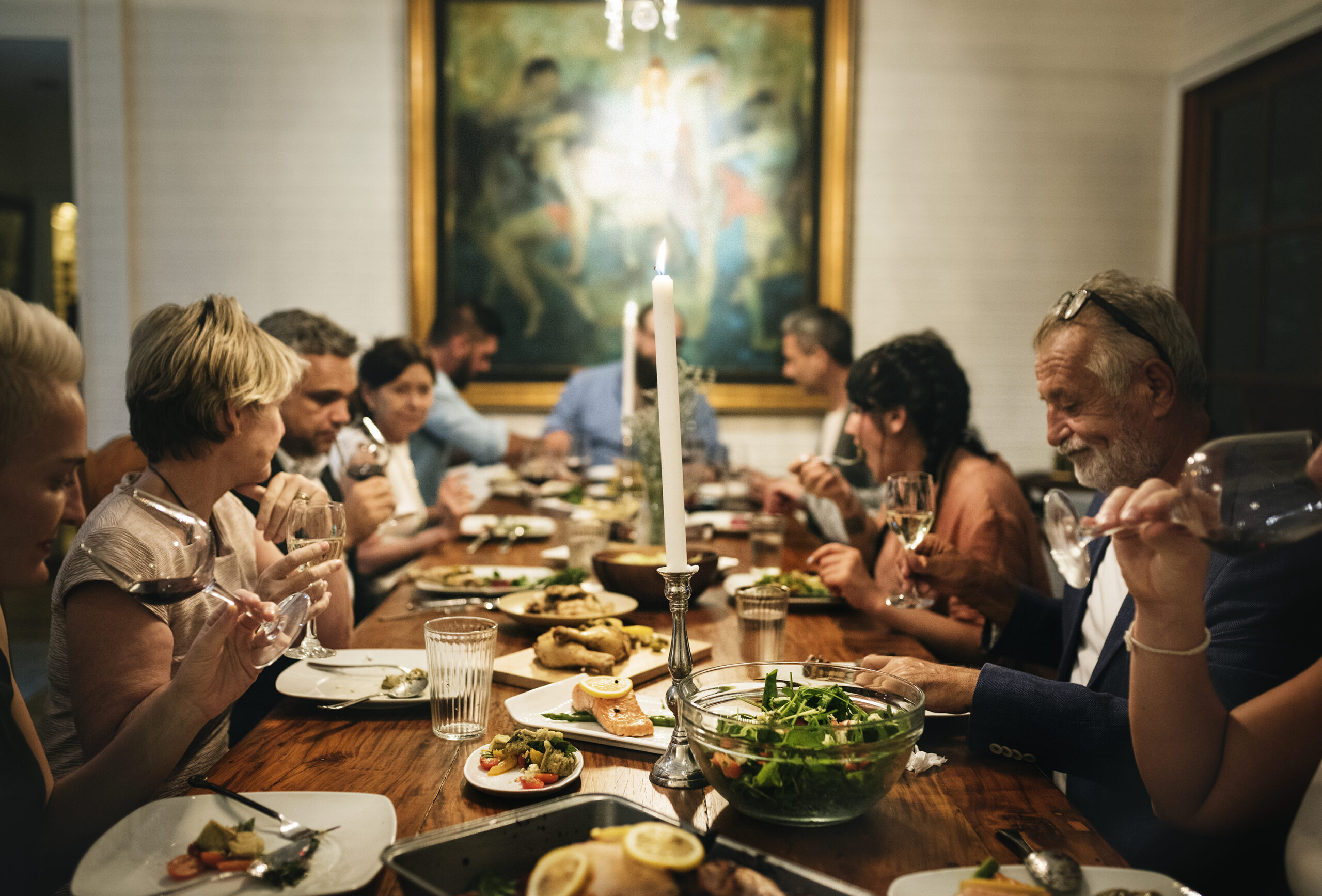
My father humiliated me at his dinner table in front of my five-year-old son, and it took me the whole drive home to stop shaking.
It happened on a Sunday evening in October, at my parents’ house just outside Columbus. My husband Daniel was covering an emergency shift at the auto shop he worked at, so I loaded Noah into his booster seat by himself and drove the twenty minutes to my childhood home the way I had a hundred Sundays before, telling myself this time would be easier than the last.
It never was. I just kept hoping.
My parents’ house always smelled the same when you walked in, roast chicken or pot roast depending on the week, my mother’s candles burning on the mantel, the low murmur of whatever news program my father had on in the background before dinner. It was a beautiful house, the kind with a circular driveway and a chandelier in the entryway that Dad liked to mention had come from an estate sale in Cincinnati, like the story of where it came from made it worth more.
Noah loved visiting. He didn’t understand yet what these dinners cost me. He just knew there’d be dessert, and that Grandma kept a drawer of toy cars in the den for him, and that if he behaved himself he might get to stay up late enough to watch part of a movie before we left. He held my hand walking up the front steps, swinging our arms a little, five years old and completely unaware that he was about to watch his grandfather tear his mother apart at the dinner table.
We sat down around six. My sister Vanessa was already there with her husband Eric and their daughter Chloe, and within the first five minutes of us all settling into our seats, Vanessa was talking about the new SUV Eric had bought her.
“Seventy-two thousand,” she said, running her hand along the edge of the table like she was still admiring the leather seats in her head. “It’s the fully loaded package. Heated everything.”
My father lifted his wineglass in her direction, the kind of small approving toast he liked to give when someone in the family did something that fit his idea of success.
“That’s what happens when you marry a man with ambition,” he said.
Then he looked at me. I felt it before I even turned my head, that particular weight of my father’s attention landing on me like it always did right before he said something designed to put me in my place.
“You married a poor man,” he said.
The table went quiet in that fast, awful way. I heard Noah’s fork stop scraping against his plate. I felt his small knee press against mine under the table, the way kids do when they sense tension they don’t have words for yet.
Vanessa laughed. Not a nervous laugh, not an oh-Dad laugh. A real one, easy and amused, like he’d made a joke she genuinely enjoyed.
“Dad’s not wrong,” she said, reaching for her wine. “Daniel still fixes cars for a living. Emily used to have standards.”
I looked at my mother. I always did, in these moments, some old instinct that never quite died no matter how many times it let me down. She was looking at her plate, cutting her chicken into smaller and smaller pieces, saying nothing.
“Daniel owns half that repair shop now,” I said, keeping my voice level.
My father shrugged, unimpressed. “Half of something small is still small.”
“Dad.”
“What?” His voice rose, that particular register he used when he felt challenged in his own house. “I spent money putting you through college. You had opportunities. Real ones. And you married a mechanic and moved into a house the size of my garage.”
That was when Noah looked up at me, his small face open and confused in the way children’s faces are when the adults around them are saying things that don’t match the world they thought they understood.
“Mommy,” he said, “is Daddy poor?”
I have replayed that question more times than I can count. Not because it was cruel, Noah didn’t mean it that way, he was five, he was just trying to understand what his grandfather had said. It hurt because of what it meant that he’d had to ask it at all. Because somewhere between the roast chicken and the wine, my father had made my son wonder if his own home, his own family, was something to be embarrassed about.
I put my fork down.
“Children should understand reality,” my father said, like this was a reasonable thing to say to a table with a five-year-old at it.
“No,” I said. “Children should understand respect.”
His face changed the way it always did when I disagreed with him in his own house. My father had never learned the difference between being contradicted and being disrespected. In his mind they were the same thing, and both required the same response.
“If you’re going to lecture me in my own house,” he said, pointing toward the hallway like he was directing traffic, “get out.”
Vanessa smirked into her wineglass. My mother still hadn’t looked up.
Then he added the sentence that would sit in my chest for weeks afterward.
“And don’t come back for Thanksgiving. We’re happier without you.”
Noah’s eyes filled with tears. He didn’t cry, not yet, he just sat there with his chin trembling, looking between his grandfather and me like he was waiting for someone to explain that this was a misunderstanding, that it would be fixed in a minute, that this wasn’t really happening.
I stood up. I helped him into his coat with hands that weren’t quite steady, and even though he was getting too heavy to carry comfortably, I picked him up anyway, because I needed to hold him more than he needed to walk to the car on his own.
At the doorway, my father said one more thing.
“Maybe someday you’ll understand what you threw away.”
I turned around. Vanessa was watching, waiting for tears. My mother was watching too, waiting, I think, for an apology that would let everyone pretend this hadn’t happened. My father was watching, certain, the way he was always certain, that I would eventually fold the way I always had before.
Instead I looked at him and said five words.
“You’ll regret saying that, Dad.”
Then I carried my son out to the car and drove home.
What none of them knew, not my father, not my mother, not even Vanessa, was that Daniel and I had been keeping something private for almost three years. And by the time Thanksgiving arrived, my father would understand exactly how wrong he had been about the poor man I married.
Noah was unusually quiet for most of the drive. He’s a talker normally, narrating whatever’s out the window, asking questions about things we pass, but that night he just sat in his booster seat looking out at the dark, and I let him have the silence because I didn’t trust my own voice yet.
About ten minutes from my parents’ house, he finally spoke.
“Mommy, does Grandpa hate Daddy?”
I tightened my hands on the steering wheel. “No, sweetheart.”
“Then why did he say Daddy was poor?”
I chose my words carefully, the way you do when you know a five-year-old is going to remember whatever you say for the rest of his life. “Grandpa thinks money tells him how important somebody is.”
“Does it?”
“No.”
That part was easy. The rest, explaining thirty years of my father’s particular cruelty, explaining why I kept going back to that table year after year, explaining why I hadn’t stood up for Daniel sooner, that part I didn’t have words for, not for a five-year-old, and honestly not fully for myself either.
Daniel and I had been married eight years by then. When we met, he was twenty-eight, working six days a week at Miller Automotive, coming home every night with grease under his fingernails that never quite washed out all the way. I had just graduated from Ohio State with a business degree and was working for an insurance company downtown, wearing blazers to an office that had nothing to do with anything I actually cared about.
I remember the first time I brought Daniel to meet my parents. My father shook his hand, looked him over once, and asked what he did for a living. When Daniel said he was a mechanic, my father’s whole face did something small and dismissive, a flicker that lasted less than a second but that I noticed immediately, because I’d spent my whole life learning to read that exact expression.
Daniel had been raised by a single mother in Dayton who worked two jobs to keep the lights on. He didn’t have a college degree, or an inheritance, or family connections that opened doors. What he had was patience, real mechanical skill that bordered on artistry, and an almost irritating talent for saving money, stretching every dollar further than anyone I’d ever met.
My father only ever saw the grease. He never once asked Daniel what he was building.
Three years before that October dinner, the owner of Miller Automotive decided to retire. Instead of selling to one of the regional chains that kept circling the shop with offers, he gave Daniel and another longtime mechanic, a quiet, steady man named Marcus Reed, the chance to buy the business themselves.
Daniel had been saving since he was in his early twenties, long before he even met me. I’d been saving too, quietly, the kind of saving that doesn’t look like anything from the outside because you’re not buying things, you’re just not buying things. We put almost everything we had into that deal.
The first year was brutal in a way I don’t think either of us fully talked about at the time, because talking about it would have meant admitting how scared we were. Daniel worked twelve-hour days, sometimes longer. I handled the bookkeeping and payroll at our kitchen table after Noah went to sleep, squinting at spreadsheets at eleven at night with a cup of coffee gone cold beside me. We skipped vacations. We bought secondhand furniture. We kept driving our old cars long after they should have been replaced, because every spare dollar went back into the shop.
My family saw all of that and read it as struggle. As proof that Daniel had dragged me down into a smaller life than the one I was supposed to have. What they didn’t see, what I never told them, was that revenue nearly doubled in those two years. That the small, sacrificing, unglamorous life we were living was actually the foundation of something real.
Then Marcus decided he wanted out, ready to retire himself, and Daniel and I bought his share of the business too. By the night my father threw me out of his house, Daniel owned Miller Automotive outright.
But that wasn’t even the biggest thing we’d been keeping quiet.
When I got home that night, Daniel was sitting at our kitchen table surrounded by paperwork, reading glasses pushed up on his forehead, a legal pad covered in his cramped handwriting beside a stack of documents I didn’t recognize. He looked up the second I walked in, and whatever was on my face told him everything before I said a word.
“What happened?” he asked, already standing.
I told him. All of it. The SUV, the wineglass toast, the poor man comment, Noah’s question, the five words I’d said on my way out the door. I watched Daniel’s jaw tighten with every sentence, watched him go very still in the particular way he does when he’s furious but working hard not to show it in front of me.
“He said that in front of Noah?” he asked, voice low.
“Yes.”
He glanced toward the hallway, toward Noah’s room, where our son had gone straight to bed without even asking for a snack, which told me more about how the evening had landed on him than anything he’d said in the car.
“That changes things,” Daniel said.
I sat down across from him, still in my coat. “What are these papers?”
His whole expression shifted then, something careful and hopeful breaking through the anger. For the first time that night, he smiled.
“Remember the property on Westerville Road?”
I did. For six months, Daniel had been quietly negotiating to buy a struggling auto service center from a businessman who was retiring and wanted out fast. He’d mentioned it a handful of times, always careful not to get my hopes up, always saying we’ll see, always saying it’s not a done deal yet.
“The bank approved it?”
“This afternoon.”
I stared down at the paperwork spread across our table. The deal included the building, the equipment, existing customer contracts, and the empty lot next door. It would give Daniel two locations and enough capacity to hire a dozen more people.
My hands started shaking, and it had nothing to do with my father anymore.
“Daniel.”
“We did it,” he said, reaching across the table for my hand. “We actually did it.”
I sat there in my coat in our small kitchen, my son asleep down the hall, my father’s words still ringing in my ears, and I felt something crack open in my chest that was half grief and half something close to joy, because I understood in that moment that everything my family thought they knew about our life was about to be proven completely, spectacularly wrong.
We closed on the Westerville property three weeks later. We told almost no one. Not because we were hiding it out of shame, but because for years I had learned that giving my father information about our life only gave him more material to use against us. Every time we shared good news, he found a way to make it small. So eventually, without really deciding to, I just stopped sharing.
Then, seven days before Thanksgiving, my mother called.
Her voice sounded hesitant in a way I wasn’t used to hearing from her. “Your father wants you to come Thursday.”
I almost laughed. “He told us not to.”
“I know.”
“So what changed?”
Silence stretched long enough that I checked to see if the call had dropped.
Then she said, “Vanessa’s husband lost his job.”
I leaned back against the counter. That explained everything.
Eric had been a regional sales director for years, the kind of title my father liked to bring up at dinner as evidence that Vanessa had made the right choice. His company had gone through a restructuring, and his entire division had been eliminated. Suddenly that seventy-two-thousand-dollar SUV looked a lot less impressive, and I imagine my father’s dinner table had gotten considerably more uncomfortable without me there to absorb the worst of his commentary.
“Your father thinks everyone should be together for the holiday,” my mother said.
“No.”
“Emily—”
“He told me I wasn’t welcome. He told me you were happier without us. I’m respecting his wishes.”
“He was angry. He didn’t mean—”
“He was cruel, Mom. And you sat there and said nothing while he did it in front of my son.”
She went quiet. I could hear her breathing on the other end of the line, and for a second I almost felt guilty, which was exactly the trap my family had always set for me, making me feel responsible for their comfort even when they’d been the ones causing the damage.
“Please,” she finally said, barely above a whisper.
For one second, I almost gave in. That’s the truth. Some old, deep part of me still wanted my father’s approval, still wanted to be the daughter who kept the peace, who smoothed things over, who made everyone comfortable at her own expense.
Then Daniel walked into the room with Noah riding on his shoulders, both of them laughing about something, Noah’s small hands gripping Daniel’s hair like reins, and I remembered my son’s question in the car. Does Grandpa hate Daddy.
“No, Mom,” I said, and I meant it in a way that went beyond just declining an invitation. “We’re not coming.”
I ended the call.
What happened after that made my father’s Thanksgiving far more uncomfortable than my absence ever could have.
Thanksgiving morning at our house was peaceful in a way that surprised me. For most of my adult life, holidays had been performances built entirely around my father’s moods, everyone arriving at the exact time he demanded, dinner running on his schedule, conversation gradually curving toward whatever topic let him explain why his opinion mattered most. Daniel had tolerated years of that because I asked him to, because I hadn’t yet found the courage to ask for anything different.
That year we stayed home, and it felt like exhaling after holding my breath for a decade.
Daniel put the turkey in before sunrise, moving through our small kitchen in sweatpants and an old T-shirt, using what seemed like every pan we owned in the process. Noah camped out in front of the television in his dinosaur pajamas, transfixed by the Macy’s parade, occasionally shouting updates to us from the living room like we couldn’t hear the broadcast ourselves. I made sweet potatoes and burned the marshmallow topping slightly, and nobody cared.
Around eleven, Daniel’s mother Patricia arrived carrying two pies and enough side dishes for twenty people, hugging Noah so hard he squealed, settling into our kitchen like she’d been part of it her whole life, which in every way that mattered, she had.
At noon, one of Daniel’s newest employees, a man named Luis Mendoza, showed up with his wife and teenage daughter. Luis had moved to Columbus a few months earlier after his previous shop closed down, and Daniel had hired him within two days of the interview, no hesitation, because that’s who Daniel was, the kind of boss who saw talent and gave it a place to land. Two more of Daniel’s employees, both without family nearby for the holiday, arrived a little after that.
Our little house filled up fast. Mismatched chairs got pulled from every room in the house and crowded around a table that was clearly built for fewer people than we now had sitting at it. Someone knocked over the cranberry sauce. Noah spilled an entire glass of milk across the tablecloth and looked so mortified that six different adults immediately told him it was fine, don’t worry about it, accidents happen, and I watched his face relax in a way that made my chest ache, because that was exactly the kind of grace my own childhood dinner table had never offered anyone.
Around two, my phone started buzzing. Vanessa.
I let it ring out. She called again almost immediately. Then a third time.
Daniel glanced at me across the kitchen, drying his hands on a dish towel. “You should probably answer that.”
I stepped into our bedroom and closed the door partway.
“What?” I said, without a hello.
Vanessa skipped past pleasantries entirely. “Dad’s furious.”
“That tracks.”
“Mom told him you weren’t coming.”
“I know. I told her that myself.”
“He thought you’d change your mind.”
“I didn’t.”
She exhaled sharply into the phone. “Emily, can you please stop making everything so dramatic?”
I almost laughed out loud at the irony of that sentence coming from the woman who’d laughed in my face a month earlier while our father humiliated my husband in front of my son. “I’m having Thanksgiving with my family,” I said instead.
“We are your family.”
“So is Daniel.”
“That’s not what I meant.”
“I know exactly what you meant.”
There was noise in the background on her end, plates, someone’s voice, the particular tense hum of a house trying to pretend everything is fine. Then her voice dropped lower.
“Eric lost his job.”
“Mom told me.”
“He’s been unemployed almost a month now. We haven’t told anyone. Dad only found out because he asked Eric point-blank at dinner last week why he wasn’t at the office.”
I closed my eyes. “I’m sorry, Vanessa. That’s genuinely hard.”
“And Dad keeps making comments.”
There it was. The first real crack I’d heard in my sister’s voice in years.
“What kind of comments?”
“You know how he is.”
“Yes,” I said. “I do. I’ve known for a long time. You just never had to find out for yourself before.”
“He keeps asking Eric when he’s getting another job. Yesterday he told him a man should be able to provide for his family. In front of Chloe.”
I sat down on the edge of our bed. For the first time in my adult life, my sister was standing exactly where I had stood for years, on the wrong side of my father’s approval, and I felt something complicated about that. Not satisfaction, not exactly. More like recognition.
“I’m sorry he did that,” I said, and I meant it.
“Could you just come over? Please. Mom’s crying in the kitchen. Dad’s furious. Eric wants to leave and I don’t know what to do.”
“No.”
“Emily.”
“I’m not bringing my husband and my son over there to be decorations so Dad can feel like his family is still intact after everything he said to me.”
Silence. Then, quietly, something I never expected to hear from my sister.
“I shouldn’t have laughed,” she said. “That night, at dinner. When he said that about Daniel. I shouldn’t have laughed.”
It was the first apology anyone from that house had offered me in weeks.
“You shouldn’t have,” I agreed.
“I was trying to—” She stopped herself.
“Trying to what?”
“Stay on Dad’s good side.”
I understood that more than she probably realized. That had always been the unspoken rule in our family, that someone needed to sit beneath Dad’s criticism so everyone else could feel temporarily safe from it. For most of my life, that person had been me. Sometimes it had been Daniel, by extension. Now, apparently, it was Eric.
“I’m not coming to Dad’s house,” I told her. “But if you want to leave, you’re welcome here.”
She let out a short, disbelieving laugh. “In your tiny house?”
The words hung there for a second, an old reflex from a family that measured everything in square footage, and I heard her catch herself immediately.
“Sorry,” she added quickly. “That came out wrong.”
I found myself smiling despite everything. “We’ll find you a chair.”
Twenty-five minutes later, Vanessa’s SUV pulled into our driveway. Eric climbed out first, looking hollowed out in a way I’d never seen on him before, the confident sales director posture gone, replaced by something tired and uncertain. Their daughter Chloe followed, eight years old, clutching a stuffed rabbit against her chest like she needed the comfort of it. Vanessa came last, carrying a casserole dish she’d clearly grabbed on her way out the door, still wearing the earrings she’d put on for our parents’ table.
Nobody rushed to talk about what had happened. Daniel handed Eric a beer without a word, the kind of gesture that says more than any speech could. Patricia found Chloe a seat next to Noah at the crowded table and had her laughing within five minutes over some story about her own grandchildren. Vanessa hovered awkwardly near the kitchen doorway until I handed her a knife and asked her to slice the bread, giving her something to do with her hands, which I think she needed more than she would have admitted.
For almost an hour, everything felt nearly normal. Then someone knocked at the door.
I assumed it was another one of Daniel’s employees, running late, and I opened it already smiling.
My mother stood on the porch. My father stood behind her.
Richard Coleman looked past me into our crowded living room, taking in the mismatched chairs, the folding table Daniel had borrowed from the shop, and then, slowly, Vanessa’s car in the driveway, Eric’s coat on our hook, Chloe’s shoes lined up by the door.
His expression hardened into something I recognized immediately.
“So this is where everyone went,” he said.
Nobody answered right away. My mother looked mortified, twisting her hands together. “I told him we should call first,” she said quietly.
“Apparently nobody answers my calls anymore,” my father said.
I crossed my arms in the doorway. “What are you doing here?”
His eyebrows lifted like the answer should have been obvious. “I came to bring my family home.”
Behind me, I heard a chair scrape back. Daniel appeared at my side, calm, not aggressive, though I could feel the tension radiating off him like heat.
“This is our home,” Daniel said.
My father gave him the same dismissive look he’d been giving him for eight years. “I wasn’t talking to you.”
“Then you can leave,” Daniel said.
My father stared at him, and I watched something shift in his face, the particular shock of a man realizing the quiet, patient person he’d spent years underestimating had run out of patience entirely. Daniel had never once spoken to my father that way before, not because he was afraid of him, but because for years he had respected me enough not to escalate a fight I hadn’t asked him to fight. That restraint, I could see plainly, was gone.
My father turned to me instead. “You’re allowing this?”
“Allowing my husband to speak in his own house?” I said. “Yes, Dad. I am.”
“This whole situation is ridiculous.”
“No. You told me to leave. You told me not to come back for Thanksgiving. I listened.”
“You knew I didn’t mean it.”
“I knew exactly what you meant. You’ve never said anything you didn’t mean, Dad, not once in my whole life.”
My mother reached over and touched his arm. “Richard. Just apologize.”
His jaw tightened so hard I could see the muscle jump. The word apologize seemed to physically cost him something every time it got anywhere near his mouth.
Before he could answer, Eric stood up from the table behind us.
“Actually,” he said, “I’d like to hear it too.”
My father looked genuinely startled, like he’d forgotten Eric was even in the house. “Excuse me?”
“You spent last week’s dinner telling me I was failing my family because I got laid off,” Eric said, walking toward the door, Vanessa rising behind him.
“I told you the truth.”
“You called me useless in front of my daughter.”
Vanessa set down the bread knife. “And you told Chloe she should never marry a man who can’t keep a job.”
My father’s expression flickered, and for the first time I saw something like uncertainty cross his face. He hadn’t expected everyone to compare notes. He’d spent years managing us separately, one conversation at a time, each of us thinking we were the only one absorbing the worst of him.
“You’re all too sensitive,” he said.
Daniel folded his arms. “That’s convenient.”
My father rounded on him. “And what exactly are you so proud of? You fix cars.”
“I do.”
“At least Eric had a real career.”
“Richard, stop,” Eric said, but my father couldn’t. Even standing in a doorway with almost everyone he loved pulling away from him at once, he still needed to rank people, still needed someone beneath him to make the hierarchy feel stable.
Daniel glanced at me. I knew that look. He was asking permission, not to defend himself, but to finally stop hiding what we’d been carrying quietly for three years.
I nodded.
Daniel turned back to my father. “You’re right. I fix cars.”
My father gave a small, satisfied shrug, like he’d won something.
“I also own Miller Automotive,” Daniel continued.
“I know. Half of it.”
“All of it.”
My father blinked.
“Marcus sold me his share back in September,” Daniel said. “And last week we closed on a second location out on Westerville Road.”
Nobody spoke. Vanessa turned to look at me, eyes wide. “Second location?”
I nodded.
“Fourteen service bays,” Daniel said. “Two commercial contracts already in place. The building and the lot next to it.”
My father’s eyes narrowed. “You bought the building?”
“Yes.”
“With what money?”
Daniel’s mouth curved into something that wasn’t quite a smile. “Ours.”
That was the exact moment I watched my father’s entire understanding of us begin to collapse. Daniel still drove a ten-year-old pickup truck. We still lived in a modest three-bedroom house with a kitchen too small for the crowd currently filling it. I bought clothes because I needed them, not because a season had changed and a catalog told me to. My father had spent years reading all of that as evidence of failure, when really it had just been evidence of where we’d chosen to put our money instead. While he measured success in leased SUVs and expensive dinners, Daniel and I had been quietly buying equipment, buying equity, buying an entire second location, building something real instead of something that merely looked real.
Eric let out a short, disbelieving laugh. “You know what’s funny?”
My father glared at him. “What?”
“Daniel offered me a job yesterday.”
I turned to Daniel, surprised. “You did?”
He looked almost sheepish. “I was going to tell you tonight.”
Eric explained, some of the color coming back into his face for the first time since he’d walked in the door. “The Westerville location needs someone to manage commercial accounts. Daniel knew I spent twelve years in regional sales. He called me himself.”
Vanessa stared at her husband. “You didn’t tell me.”
“I didn’t know if I was going to accept.”
My father scoffed, some last reflex of his old certainty flaring up. “You’re considering working at a garage?”
Eric looked straight at him, steadier than I’d seen him all night. “No. I’m considering working for a growing company that offered me a position while you spent Thanksgiving telling me I was worthless.”
That ended it. I watched my father look around the room, at Vanessa, at Eric, at me, at Daniel, and for the first time in my entire life, nobody rushed in to soften the moment for him, nobody stepped between him and the consequences of what he’d said.
Even my mother stepped back.
“Richard,” she said quietly, “you need to go home.”
He turned to her, incredulous. “You’re taking their side?”
“I’m not taking anybody’s side,” she said, and her voice shook in a way I had genuinely never heard before. “I’m tired.”
Those two words seemed to land harder on him than anything Daniel or Eric had said.
“I’m tired of every dinner becoming a test,” my mother continued. “I’m tired of watching you compare the girls against each other. I’m tired of pretending your insults are just advice you’re too blunt to soften.”
“Susan.”
“No.” It might have been the first time in my life I ever heard her interrupt him. “You told Emily we were happier without her. Look around this house, Richard. Does this look like people who are happier without her?”
He had no answer. I watched him search for one and come up with nothing, and for a man who always had something to say, that silence was its own kind of collapse.
My mother took off her coat. “I’m staying for dessert.”
He stared at her, then at me, and then, without another word, he turned and walked back down our front steps to his car.
Nobody cheered when the door closed behind him. Nobody laughed. The room stayed tense and quiet until Noah, completely unaware of the weight of what had just happened, tugged on my sleeve and asked, “Can we eat pie now?”
The whole room burst out laughing at once, and the tension broke like something physical, like a held breath finally released.
My mother stayed. She sat beside Patricia and ate a slice of pecan pie off a paper plate, and for the first time in years, I watched her talk about something other than my father. She asked Daniel about the new business, not how much money it made, not whether it was impressive, but how he’d actually built it. Daniel told her about the years of saving, about the risks, about the nights we’d nearly given up, about Marcus and Luis and his first real profitable month. She listened to every word.
Then she looked at me. “I had no idea.”
“I know.”
“Why didn’t you tell us?”
I thought about that for a moment. “Because every time we shared something good, Dad found a way to turn it into a competition. Eventually I just stopped giving him information he could use against us.”
She nodded slowly, something heavy moving behind her eyes. “I should have stopped him. All those years. I should have said something.”
“Yes,” I said. “You should have.”
There were no dramatic tears. But the apology mattered anyway, more than I expected it to.
Things changed after that Thanksgiving, though not instantly, and not completely. My father didn’t wake up the next morning a different person. For a while he blamed everyone but himself, telling relatives at church that I had turned the family against him, that I’d always been the difficult one. My mother, for the first time in my memory, stopped agreeing with him. So did Vanessa.
Eric accepted Daniel’s offer and became director of commercial accounts at the Westerville location. He turned out to be remarkably good at the job, better than any of us expected, and within a year he’d helped secure contracts with three local delivery companies that doubled that location’s revenue on their own.
Six months after that Thanksgiving, Vanessa sold the SUV. Not because they needed the money desperately, but because, as she told me over coffee one afternoon, she’d finally admitted to herself that she hated the payment, hated what it represented, hated that she’d bought it partly to impress a man who would have found something to criticize about it eventually anyway.
“I spent years trying to make sure Dad criticized you instead of me,” she told me that day, staring into her mug.
“I knew,” I said.
She winced. “That almost makes it worse.”
“It does,” I said, but I said it gently, because I could see how much it cost her to admit it out loud.
She apologized properly that afternoon, not the quick, defensive almost-apology from the phone call on Thanksgiving, but a real one, and I accepted it, because holding onto it wasn’t going to change what had already happened, and because I could see she meant it.
My father remained harder to forgive. We didn’t speak for nearly four months after that Thanksgiving. Then, on Noah’s sixth birthday, he showed up at our door holding a wrapped present, standing on the porch with an expression I’d never seen on him before, something almost uncertain.
I stepped outside before letting him in.
“You cannot insult Daniel in this house,” I told him.
“I know.”
“You cannot talk about money in front of Noah.”
“I know.”
“And if you disrespect either of them, you leave. Immediately. No warnings.”
His jaw tightened, and for a second I saw the old response gathering behind his eyes, the instinct to argue, to remind me whose house rules used to matter more. Then, to my genuine surprise, he nodded.
“Understood,” he said.
He handed me the package. “I brought him a train set.”
“He likes dinosaurs now.”
My father looked almost hurt by that, in a small, human way that caught me off guard. “I thought he liked trains.”
“He did. When he was four.”
That, I realized standing on my own porch, was the real cost of who my father had chosen to be for so many years. He had missed things. Small things. The kind of things you only know about a child if you’re actually paying attention to their life instead of measuring everyone around you against some scorecard only you could see.
He stood there a moment longer, present in the wrapping paper going soft in his hands. “Can I still give it to him?”
“Yes,” I said.
He came inside. Daniel greeted him politely, nothing warm, nothing cold, just the bare minimum of civility two men extend to each other for the sake of everyone else in the room. My father sat down on the living room floor while Noah tore into the wrapping paper, and Noah, being five and endlessly generous in the way small children are, was thrilled with the train set anyway, completely unaware of everything it represented.
A few months after that, my father visited Daniel’s Westerville shop for the first time. He walked slowly through the service bays, watching the mechanics move between lifts and diagnostic equipment with the kind of quiet efficiency that only comes from people who genuinely know what they’re doing. Daniel showed him the customer lounge, the parts room, the small office where I still did the books some evenings, though we’d hired an accountant to handle most of it by then.
I could see my father was impressed, in the stiff, reluctant way he allowed himself to be impressed by anything. But Daniel didn’t need it anymore. Neither did I.
Outside, standing in the parking lot beside his car, my father said something I never expected to hear from him.
“I misjudged you,” he told Daniel.
Daniel wiped his hands on a shop towel, unhurried. “Yes, you did.”
My father paused, waiting, maybe, for some kind of reassurance, some easy forgiveness to smooth the moment over the way I used to offer him automatically.
Daniel didn’t give him one.
“You’ve done well,” my father finally said.
Daniel looked over at me, then back at him. “We did well.”
That distinction mattered more than my father probably understood. This had never been Daniel’s success alone, or mine alone. It belonged to both of us, built one twelve-hour day at a time, one spreadsheet at a time, one risk at a time, together.
That night, after my father left, Noah climbed into my lap while I was reading on the couch.
“Grandpa likes Daddy now?” he asked.
I smiled and smoothed his hair back. “I think Grandpa is learning.”
“Was Daddy ever poor?”
I looked across the room at Daniel, sitting at our kitchen table in an old gray T-shirt with a smear of grease on one sleeve, reviewing invoices with his reading glasses pushed up into his hair, the same man my father had once looked at and seen nothing worth respecting.
“No,” I said. “Your dad was never poor.”
Daniel glanced up and grinned at me from across the room.
I kissed the top of Noah’s head. “He just always knew the difference between looking rich and building something real.”
That was the lesson my father accidentally taught all of us, though it took him years longer than everyone else to learn it himself. It didn’t start the day Daniel bought his second location, or the day Eric accepted a job from the mechanic he used to quietly look down on, or even the day my mother finally found her voice in our crowded living room. It started at that dinner table in October, when my father told me I wasn’t welcome and expected me to beg my way back in.
Instead, I walked out.
The five words I gave him on my way out the door weren’t a threat. They were a prediction.
You’ll regret saying that, Dad.
He did. But by the time he understood why, I no longer needed his regret to feel whole. I had Daniel. I had Noah. I had a home where nobody had to prove they were richer or smarter or more successful just to earn a seat at the table.
The following Thanksgiving, we hosted again. My mother arrived early, before anyone else, and helped me set the table without being asked. Vanessa brought bread, the same as before, but this time she stayed in the kitchen with me the whole afternoon instead of hovering near the door. Eric brought wine and spent twenty minutes talking shop with Daniel about the Westerville contracts, easy and comfortable in a way that would have seemed impossible a year earlier. Patricia, predictably, brought too many pies.
My father came last, standing in the doorway holding a casserole dish, and for once he didn’t walk in like the room already belonged to him.
He looked at me. “Is there still room?”
I glanced past him at the crowded table, then over at Daniel, then down at Noah, who was already tugging at my father’s sleeve, eager to show him something he’d built out of Legos.
“There is,” I said. “As long as you remember whose house you’re in.”
He nodded, and I believed him. “I remember.”
And when we finally sat down to eat that year, nobody mocked my husband. Nobody asked what anyone’s car had cost. Nobody ranked careers around that table like it was a competition with a single winner. Nobody was ordered to leave.
It wasn’t perfect. Real families rarely are, no matter how many years pass or how many hard conversations get had in doorways and parking lots. But it was different. And after everything, different was enough.

Sophia Rivers is an experienced News Content Editor with a sharp eye for detail and a passion for delivering accurate and engaging news stories. At TheArchivists, she specializes in curating, editing, and presenting news content that informs and resonates with a global audience.
Sophia holds a degree in Journalism from the University of Toronto, where she developed her skills in news reporting, media ethics, and digital journalism. Her expertise lies in identifying key stories, crafting compelling narratives, and ensuring journalistic integrity in every piece she edits.
Known for her precision and dedication to the truth, Sophia thrives in the fast-paced world of news editing. At TheArchivists, she focuses on producing high-quality news content that keeps readers informed while maintaining a balanced and insightful perspective.
With a commitment to delivering impactful journalism, Sophia is passionate about bringing clarity to complex issues and amplifying voices that matter. Her work reflects her belief in the power of news to shape conversations and inspire change.