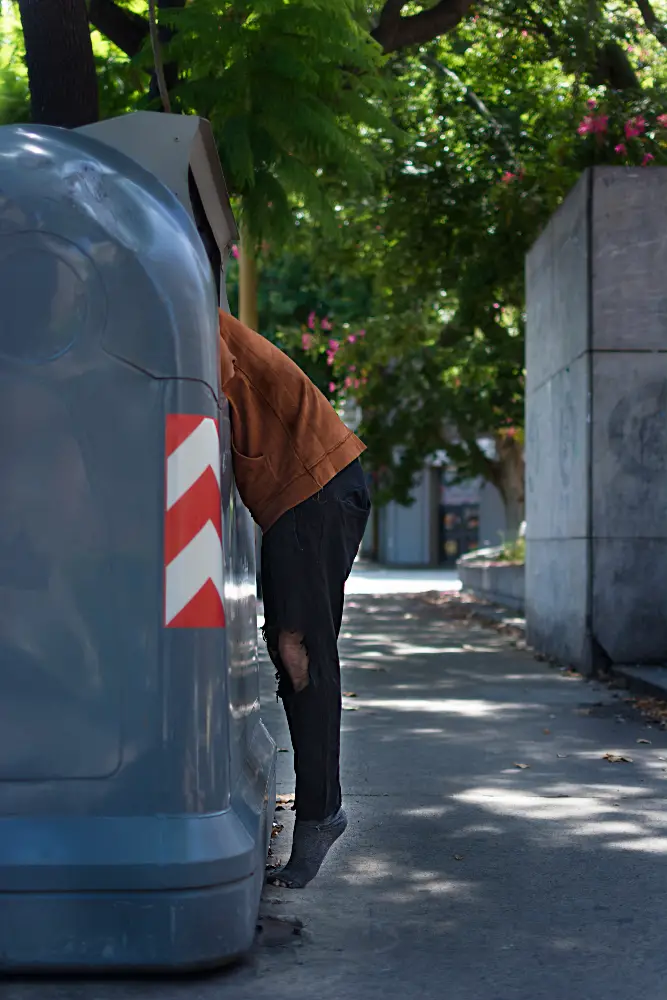
Robert had always treated taking out the trash like it was a personal insult, so when he started volunteering for it night after night, I knew something was wrong. What I found in the alley made me think the worst. Then one sentence changed everything.
For twenty-nine years, taking out the trash was my job.
It wasn’t that we’d ever sat down and split up the chores that way. Robert just hated doing it. And I mean he really hated it, in a way that never made any sense to me. This was a man who would rinse every dish after dinner without being asked. He’d scrub a bathroom top to bottom. He once spent an entire Saturday out on a ladder cleaning the gutters in the cold, whistling the whole time, happy as could be.
But carrying a plastic bag twenty feet to the bins in the driveway? That, apparently, was beneath him.
I’d caught him more than once balancing an empty cereal box on top of an already overflowing can, pressing it down like a game of Jenga, rather than just tying the bag and walking it outside. I used to tease him about it. “One day that whole tower’s going to come down on you,” I’d say, and he’d shrug and say he’d deal with it then.
So when he stood up after dinner that Monday, walked to the kitchen, and grabbed the trash bag without a word, I actually laughed out loud.
“Who are you,” I said, “and what have you done with my husband?”
Robert didn’t laugh. He just said, “I’ve got it,” and tied off the bag and carried it out the back door.
I didn’t think much of it. People have off days, or on days, I supposed. Maybe he was finally turning over a new leaf at fifty-eight. Stranger things had happened.
But then came Tuesday.
At exactly nine-thirty, right in the middle of the show we were watching, Robert stood up off the couch. “I’ll take the trash out,” he said.
I looked toward the kitchen. I’d barely cooked that day. “There’s hardly anything in there, Rob. Wait till it’s full.”
“I’ll do it anyway.”
And he did. Except this time he was gone almost fifteen minutes. For a chore that takes ninety seconds. I sat there watching the clock more than the television, and when he finally came back in, I asked him what on earth had taken so long.
“The lid on the bin was stuck,” he said, and sat back down like it was nothing.
Our bin lid had never stuck a day in its life.
I want to explain who I am, and who Robert was to me, so you understand why I did what I did next instead of just letting it go. My name is Diane. I’d been married to Robert for twenty-nine years, and in all that time he had never once given me a real reason to doubt him. He wasn’t a secretive man. He wasn’t a liar. He was steady, almost boringly so, the kind of husband who told you every small thing about his day whether you wanted to hear it or not. If he stopped at the hardware store, I heard about the conversation he had with the guy at the register. That was Robert.
Which is exactly why the stuck-lid excuse sat so wrong with me. It wasn’t just that it was a lie. It was that Robert didn’t lie. And a man who doesn’t lie suddenly telling you small, easy lies, that’s a man carrying something.
So on Wednesday night, I watched him.
At nine-thirty on the dot, he got up, went to the kitchen, and pulled a half-full bag out of the can even though it didn’t need to go out. I made some excuse about being tired and went upstairs. But instead of getting ready for bed, I went to the bedroom window that looks out over the back of the house, and I pulled the curtain aside just enough, and I watched.
Robert came out the back door with the bag. He headed toward the bins.
And then he walked right past them.
He kept going. Past the garage. Past the hedge that separates our yard from the neighbors’. He went all the way to the narrow alley that runs behind the row of houses on our street, the one nobody uses except to drag their cans out on collection day.
I stood there gripping the curtain so tightly my knuckles ached.
Twelve minutes later, he came back. Walking slowly, hands in his pockets.
Without the bag.
I let go of the curtain and got into bed and picked up a book and pretended to read. When he came upstairs a few minutes later, he pretended nothing had happened. He said goodnight. He kissed my forehead. He went to sleep.
I lay awake most of that night, and I’m not proud of the places my mind went. Twenty-nine years of trust, and it took about three nights of stuck-lid lies to have me imagining the worst. An affair. That was the obvious one, the one that kept circling back no matter how many times I pushed it away. A man doesn’t sneak out to a dark alley every night at the same time carrying something he won’t let his wife see and come back empty-handed for an innocent reason. That’s not what innocent looks like.
By Thursday, I was done pretending.
At nine-thirty, Robert grabbed the trash bag, same as always, and headed for the back door. I waited until I heard it close. I counted to thirty. Then I slipped my shoes on, grabbed my coat off the hook, and went out the front so he wouldn’t see me, and I came around the side of the house into the dark.
He didn’t go anywhere near our bins. I knew he wouldn’t by then. He walked down the alley, two houses down, and stopped beside an old detached garage that belongs to a couple who spend half the year in Florida. And then he did something that made my heart stop.
He opened the trash bag. He reached inside it. And he pulled out a small brown paper package.
I knew that wrapping. I had a whole stack of that brown paper in the hall closet upstairs, the kind you use for wrapping fragile things to mail. But I’d never seen that particular package before in my life.
And then a woman stepped out from behind the garage.
She had blue hair, bright blue, even in the dark I could see it under the one streetlight at the end of the alley, and she was wearing a long coat. Young. Younger than us by decades.
Robert handed her the package.
I stood frozen in the shadows, my whole body cold, and I watched my husband of twenty-nine years hand a strange young woman a secret package in the dark, and every terrible thing I’d been imagining seemed to snap into focus all at once.
Then the woman spoke, and her voice carried down the quiet alley.
“She still doesn’t know?”
Robert shook his head. “Not yet.”
“How long are you going to keep doing this?”
“Until Saturday.”
I took a step backward, and my heel came down square on an empty plastic bottle somebody had tossed by the garage. The crack of it under my foot sounded like a gunshot in the silence.
Robert spun around. The woman’s face went white. And for half a second, the three of us just stood there in the dark, nobody breathing, nobody saying a word.
Then Robert said my name. “Diane.”
I looked at the woman. I looked at my husband. My voice came out flat and hard, a voice I barely recognized.
“What’s going on.”
Robert took one step toward me, his hands coming up. “Please. Let me explain.”
“That’s usually what people say,” I said, “right before they explain something they know they shouldn’t have been doing.”
The woman glanced between us, uncertain, and up close, in the light from the end of the alley, she looked even younger than I’d thought. Late twenties, maybe. Thirty at the very most.
Robert lowered his voice, gentle, the tone he used when he was trying to calm me down. “Can we go home? Please? Let’s just go home and talk about this.”
“No,” I said. “Let’s do it right here. In front of whoever this is.”
“Diane, please—”
“I followed you into a dark alley,” I said, and I could hear my own voice starting to shake, “and I watched you pull a secret package out of our trash bag and hand it to a woman I have never seen before in my life. And then I heard the two of you talking about how long you can keep something from me. So no, Robert. We are not going home. Not until somebody tells me exactly what is happening here.”
He looked pained. He opened his mouth and closed it again, like he didn’t know where to start, and the woman was staring at me with an expression I couldn’t read, something between fear and heartbreak, and I braced myself for whatever awful thing was coming.
And then she said, “I’m Claire’s daughter.”
I thought I’d misheard her. The name landed and then just floated there, refusing to mean anything.
“What?”
“My mom,” she said, softer now. “My mom was Claire.”
The alley seemed to tilt under my feet.
Claire was my younger sister. My only sibling.
She’d been dead for twenty-three years.
I stared at the woman. I really looked at her now, past the blue hair, which had been the only thing I’d let myself see before. And underneath it I saw everything else. The narrow chin. The particular way the outer corners of her eyes tilted up, just slightly. I knew that face. I’d grown up across the breakfast table from a version of that face.
She had Claire’s eyes.
“Oh my God,” I whispered.
The woman swallowed hard. “My name is Amelia.”
And of course I knew that name. How could I not know that name.
The last time I had seen Amelia, she had been seven years old. She’d been standing in her father’s driveway with a stuffed rabbit tucked under one arm, watching my car back out. I had rolled down the window and waved to her. She hadn’t waved back. She’d just stood there holding that rabbit, watching me go.
At the time I’d thought she was just a confused, grieving little girl who’d lost her mother a few months before. I’d figured I’d see her again soon, the next weekend, or the one after. I had no idea, none at all, that it would be the last time I’d lay eyes on her for more than twenty years.
I looked at Robert, and my voice came out thin. “You found her.”
“I found her,” he said quietly. “I was looking through some old records online, trying to track down some of Claire’s things, and I came across her name. And I took a chance. I sent her a message.”
“When, Robert?”
He hesitated. That was answer enough, honestly, but I made him say it.
“About six weeks ago.”
Six weeks. My husband had known where my dead sister’s daughter was, the girl I’d lost and mourned and wondered about for two decades, for six weeks, and he’d said nothing. The shock in me curdled into anger so fast it frightened me.
“You’ve known where she was for six weeks,” I said, “and you didn’t tell me.”
Amelia stepped forward quickly. “Please. Please don’t blame him for all of it. It wasn’t all his idea.”
“All of what?”
She looked down at the brown paper package still in her hands.
And only then did I remember it. The package. The thing I’d watched him smuggle out in the trash.
My mouth went dry. “What is in there?”
Amelia looked at me for a long moment. Then she carefully opened the paper.
She pulled out a photograph, and I knew it before she’d even turned it all the way toward me.
It was a picture of Claire and me at the lake, when we were teenagers. Claire was wearing that ridiculous bright yellow swimsuit she’d loved and worn until it was practically transparent. I had my arm slung around her shoulders and we were both squinting into the sun and laughing at something, I couldn’t even remember what.
I had kept that photograph, and dozens like it, in a storage box on the top shelf of my closet for years.
Amelia pulled out another. Claire on our mother’s front porch, in the rocking chair, with a baby in her lap. Her only child. Amelia herself.
Then came an old birthday card. A yellowed envelope. A little silver picture frame I recognized.
I turned to Robert and my voice cracked. “You’ve been taking these. Out of my closet. Out of Claire’s box.”
“One batch at a time,” he admitted.
“In garbage bags.”
He actually looked embarrassed, this grown man of fifty-eight, caught out. “I needed a way to carry them out of the house without you asking me what I had. If I’d walked out the front door with a package, you’d have wanted to know what it was.”
“So you volunteered to take out the trash,” I said. “The one chore you have flat-out refused to do since 1997.”
Amelia made a small sound, a strangled little noise that might have been a laugh, and then clapped her hand over her mouth, mortified.
And under any other circumstances in the world, I think I might have laughed too. It was absurd. My trash-hating husband, sneaking family heirlooms out to a dark alley in Hefty bags, night after night, so I wouldn’t catch on. It was ridiculous.
But I wasn’t ready to laugh. There was a question pounding in my head that was louder than everything else, and I asked it.
“Why? Why would you keep this from me? Robert, this is my sister’s daughter. You know what this would mean to me. Why in God’s name would you hide it?”
Amelia’s expression changed. She looked down at the photograph of Claire holding her as a baby, and when she spoke, her voice was very quiet.
“Because I didn’t believe him.”
“Believe what?”
“That my mother’s family loved me. That you’d wanted me. Any of it.”
I stared at her. I didn’t understand. “Amelia. What are you talking about?”
She kept her eyes on the photo. “My dad always told me that Mom’s family didn’t want anything to do with us after she died. That’s what I grew up believing. That’s what I knew.”
For a second I genuinely could not make the words fit together in my head.
“Your father told you what?”
“That you didn’t want any contact. That you thought I belonged with him, and that you didn’t want to interfere or confuse things. That it was better for everyone if we just, moved on separately.” She glanced up at me, then away. “Later, when I got older and started asking more questions, the story would change a little. Sometimes he’d say there had been arguments after Mom died. That you blamed him for things. That there was bad blood. It depended on when I asked, kind of. But the bottom line was always the same. Mom’s side didn’t want us. Didn’t want me.”
“This is absurd,” I said, and it came out sharper than I meant it, so sharp that Amelia flinched.
I made myself soften. I lowered my voice.
“No. Amelia, listen to me. That is not what happened. That is not even close to what happened.”
She nodded slowly, and there was something so tired in the gesture, the resignation of someone who’s heard a thing contradicted before. “That’s what your husband said too. Word for word, almost.”
And then the memories came rushing back, all of them at once, twenty-three years of them.
The phone calls to Claire’s husband that rang and rang and were never returned. The birthday cards I mailed to Amelia every single year, care of her father’s address, that I never heard a word about. The Christmas package that came back to me marked with a stamp that said they’d moved, no forwarding address. The afternoon I finally drove out to their old house, worried sick, and knocked on the door and found total strangers living there, a young couple who’d bought the place months before and had no idea where the previous family had gone.
I remembered calling every relative we had, asking if anyone knew where Claire’s husband had taken Amelia. Cousins. Our aunt. Old friends of Claire’s. Nobody knew. Or if they knew, they wouldn’t say. Eventually I stopped asking, because asking just meant hearing “I don’t know” over and over until it hollowed me out.
But I never stopped wondering. Not for one single year of the twenty-three.
“I thought he wanted us gone,” I said, and my throat was tight. “Your father. I thought he blamed us for something, or that seeing us was too painful for him, that we reminded him too much of Claire. I thought he cut us off on purpose, and I never understood why, and I spent years thinking maybe I’d done something wrong, said something wrong, at the funeral or after. I thought maybe it was my fault somehow.”
Amelia pressed her lips together, and her eyes were shining now. “I thought you forgot about me,” she said.
That hurt worse than anything else she’d said. Worse than finding her in an alley, worse than the six weeks Robert had hidden it, worse than all of it.
“I never forgot you,” I said. “Amelia, I never, ever forgot you. Not for one day.”
Her eyes spilled over. Robert looked away, down at the ground, giving us the moment.
And I stood there in that dark alley feeling about six things at once. I wanted to pull that young woman into my arms and never let go. I wanted to shake my husband until his teeth rattled. I wanted to get in my car and drive to wherever Claire’s husband was living now and demand he explain himself, twenty-three years too late.
Instead I said, “Come home with us. Right now. Please. Come home.”
And Amelia stepped back.
It was a small movement, barely anything, but I saw it, and I understood it. It wasn’t fear of me exactly. It was fear of the whole enormous thing this was, the weight of it, all at once, in the dark, with no warning.
“I was supposed to come on Saturday,” she said.
I turned to Robert. “That’s what you meant. In the alley. ‘Until Saturday.’ That’s what you were counting down to.”
He nodded. And suddenly the conversation I’d overheard, the one that had my mind spinning out the worst possible stories, made complete sense. He wasn’t planning to end an affair on Saturday. He was planning a reunion.
“She asked me not to tell you until then,” Robert said, rubbing a hand down his face. “That was the deal. I wanted to tell you weeks ago, Diane, I swear I did, but she asked me not to and I—”
“Why?” I asked, turning back to Amelia. “Why Saturday? Why the secret at all?”
“Because I wasn’t sure I could go through with it,” Amelia said. She hugged the package of photographs against her coat like a shield. “When Robert first messaged me, I thought it was some kind of scam. Or a mistake. Somebody had the wrong person. Because everything he was telling me was the exact opposite of everything I’d been told my whole life.”
“She didn’t believe I was who I said I was,” Robert said. “And when she finally believed that part, she didn’t believe the rest. That you’d loved Claire. That you talked about her all the time. That you still had boxes of her things up in the closet.”
“He told me you kept all of it,” Amelia said. “Photos, letters, her old things. And I just, I couldn’t square it with what I knew. If you cared that much, why did you disappear? That’s what I couldn’t get past.”
“So I started bringing her proof,” Robert said quietly. “I thought, if she can just see it with her own eyes, before she ever has to walk into this house and face you, then maybe she’ll believe it. Maybe she’ll feel safe enough to come.”
Amelia nodded. “The first night, he brought photographs. Then he brought some cards. Yesterday—” Her voice caught. “Yesterday he brought letters. Letters my mom wrote to you, when I was a baby.”
I remembered those letters. My chest ached with remembering them. Claire had been a great one for writing letters even when we lived twenty minutes apart, long rambling pages about nothing, about everything. She’d tease me about my terrible cooking, she’d fill half a page describing how Amelia had just learned to clap her hands and now wouldn’t stop, clapping at dinner, clapping in the bath, clapping herself to sleep. I’d forgotten those letters even existed. They’d been down at the bottom of the box for two decades.
“My dad told me nobody on my mom’s side ever cared what happened to us,” Amelia said. “For twenty-three years, that’s what I believed. And then I sat in a hotel room and read letters my mother wrote, in her own handwriting, and she wrote about you like—” Her voice broke apart. “Like you were part of everything. Like you were in every day of her life. Like there was no version of her family that didn’t have you right in the middle of it.”
I couldn’t speak. I couldn’t get a single word out.
“I thought if she could see enough of it first,” Robert said, very gently, “if she could hold it in her hands and know it was real before she ever met you, then Saturday she’d feel safe enough to come through our front door. That was the whole plan. That was all it was.”
And I understood it. I did. I understood what he’d been trying to do, and part of me even loved him for it. But another part of me was still standing in a cold alley at ten o’clock at night, three days into thinking my marriage was ending.
I turned on him. “And you thought the best way to do all this was to keep me completely in the dark? To let me sit in that house night after night watching you sneak out and lie about stuck bin lids?”
“Amelia asked me not to tell you,” he said.
“I understand why she asked.” I did. She was terrified, and she’d built her whole self around a lie, and she needed to test the ground before she stood on it. “I’m not angry at her, Robert.” I pointed back toward our house. “I’m angry at you. You knew. You of all people knew what losing contact with Claire’s daughter did to me. You held me through some of those nights. And you let me think—”
“I know,” he said.
“For years I wondered if I’d done something to Claire before she died, some fight I didn’t remember, something that made her husband hate me enough to erase us. I wondered if I pushed too hard afterward, called too many times, scared him off. I wondered if Amelia grew up thinking her aunt just, dropped her. Threw her away.” I was crying now, openly, the words coming out of me in a rush. “And you knew you had the answer to all of that in your pocket, for six weeks, and you carried it out to the trash instead of giving it to me.”
Robert’s face was tight with everything he was feeling. “I was trying to make Saturday perfect,” he said. “I wanted to give you a perfect reunion. Something you’d remember for the rest of your life. I wanted to open the door and there she’d be, and it would be—”
“Why on earth would I want it perfect?” I said. “I wanted it true. I would have wanted it true and messy and right now, six weeks ago, the second you found her.”
He didn’t have an answer for that.
“And while you were busy planning your perfect surprise,” I went on, “I was lying awake every night convinced my husband of twenty-nine years was having an affair.”
Amelia’s head came up sharply. “Oh,” she said, and her face went stricken.
I looked at her. “What?”
She turned to Robert. “You didn’t tell me she was getting suspicious. You said she had no idea.”
“I didn’t think she did,” Robert said, a little helplessly. “I didn’t know she’d noticed anything, and I sure didn’t think she’d follow me out here.”
And despite absolutely everything, a short laugh escaped me. It wasn’t a happy laugh. It was more like something breaking loose.
Robert gave me a weary look. “That came out worse than I meant it.”
“Everything about this came out worse than you meant it,” I said. “That’s rather the whole problem, Robert.”
For a few seconds the three of us just stood there in the alley, none of us knowing what came next.
Then Amelia said, “I confronted my dad. After Robert first reached out to me and I started to wonder. I called him and I asked him straight out, and he—” She stopped. “He was scared, Diane. I could hear it. He was so scared.”
“Of what?” I asked, though I think I already knew.
“Of losing me.”
She told me the rest of it standing right there, the streetlight buzzing at the end of the alley. She told me how Claire had been the whole center of her childhood. How when Amelia scraped her knee, it was Claire she ran to. How when she woke up screaming from a nightmare, it was Claire’s name she called. Her father had loved her, she said, but he’d worked long hours and traveled, and he’d never been the one she reached for first. Claire was.
And then Claire died, all at once, no warning, and overnight this man became a grieving widower alone with a seven-year-old who cried every single night for a mother who was never coming back.
“He thought I’d choose you,” Amelia said. “He was sure of it.”
“Choose me? Over her own father?”
She nodded. “He told me, years later, that after Mom died I kept asking when I could see you. Every day. When can we go to Aunt Diane’s. When is Aunt Diane coming. Because you were the closest thing left to Mom, I think. You looked like her. You sounded like her.”
I had doted on that little girl from the day she was born. Even before Claire died, half of Amelia’s weekends were spent at our house. Of course she’d asked for me. Of course she had.
“He said he thought if I stayed close to Mom’s family, I’d never let her go. That I’d never accept she was really gone if I kept getting to see the people who reminded me of her most. He convinced himself it was for my own good. That a clean break would help me heal.”
“I don’t think that was the whole reason,” I said quietly.
Amelia looked at me. “Neither do I.”
“He was afraid of losing you too,” I said. “He’d just lost his wife. And there you were, crying for another family, her family. And he panicked.”
“He panicked,” Amelia agreed. “And then he moved us, and he changed the story, and he kept changing it, and one lie needed the next one to hold it up, and by the time I was old enough to really question any of it, it had been the truth for so long that questioning it felt like betraying him.” She wiped her eyes. “He isolated me from everybody. Not just you. Everyone on Mom’s side. It was easier for him if there was nobody around to contradict what he’d told me.”
I understood his fear. I did. Grief makes people do things they’d never do otherwise. It makes people grab and clutch and wall themselves off. I understood it.
But understanding it is not the same as forgiving it, and I want to be honest that I have not fully done the second thing, even now.
Because nothing could give me back those twenty-three years. Nothing could hand me back the seven-year-old with the stuffed rabbit who vanished out of my life. Nothing could give Amelia back the aunt she’d been raised to distrust, or the grandmother she never knew, or the whole extended family she’d been quietly stolen from.
But standing in that alley, I understood something I never had before, in all my years of wondering what I’d done wrong.
Claire’s husband hadn’t cut us off because we meant nothing to that little girl.
He’d cut us off because we meant too much.
We walked home together, the three of us. Amelia hesitated at the front door, one foot on the step, and I could see the war in her, the twenty-three years of a story telling her not to go in, right up against everything she’d read in her mother’s own handwriting.
I didn’t push her. I’d learned that much just in the last hour.
“You’ve always been welcome here,” I told her. “Long before tonight. Long before you ever knew it. There’s always been a place for you in this house.”
She looked at me for a long moment. “Thank you,” she said. And she stepped inside.
Robert, wisely, stayed quiet and hung back and let me lead.
I took Amelia straight upstairs to the hall closet. On the top shelf sat the cardboard box I’d carried through three moves over two decades, the one I could never bring myself to unpack and could never bring myself to throw away. I lifted it down and carried it to the bed and set it there and took off the lid.
Robert had taken some of it, the photos and the letters and the little frame. But most of it was still there. All the pieces of my sister I’d been keeping safe with nobody to give them to.
Claire’s old college sweatshirt, faded gray, the cuffs worn soft. A recipe book with flour ground permanently into the crease of the pages. A scarf she’d bought on a trip somewhere and insisted made her look sophisticated. A little wooden jewelry box.
Amelia reached in and picked up the scarf, and her breath caught. “I’ve seen this.”
“You have?”
“There’s a picture of Mom wearing it. My dad didn’t take everything when he—” She stopped. “There were a few pictures he kept. She’s wearing this in one of them.”
I smiled, and it surprised me, that I could smile. “She wore that thing constantly for about six months. Draped it over everything. And then one day she decided she hated it and said it made her look like a fortune teller and never touched it again.”
Amelia laughed, a real laugh this time, wet and surprised, and I laughed too, and something in the room loosened.
Inside the little wooden box was a thin silver bracelet. I lifted it out. I’d kept it all these years because of something Claire said to me once, offhand, over coffee, back when Amelia was still a baby. She’d said she wanted Amelia to have it someday, when she was grown. A grown-up thing for a grown woman.
I’d never gotten the chance to keep that promise for her.
Until now.
I held it out. “This was your mother’s. She told me, years ago, that she wanted you to have it when you were older. I’ve been holding onto it for you ever since. I just didn’t know where you were to give it to you.”
Amelia didn’t take it right away. She stared at it in my palm. “You’re sure,” she said. “You’re sure I can have it?”
“I’ve been sure for twenty-three years.”
Her whole face crumpled. And I moved toward her and then stopped myself, not wanting to push, and she closed the last of the distance herself and put her arms around me.
It was the strangest thing, holding her. She was family, my own blood, my sister’s child. And she was also very nearly a stranger, a grown woman I’d met an hour before in an alley. Both things at once. I cried into her blue hair and she cried into my shoulder and I held on the way I’d wanted to hold on to a seven-year-old in a driveway a lifetime ago.
We sat at the kitchen table until well past midnight. Amelia had a thousand questions, and I had twenty-three years of answers saved up with nowhere to put them.
What was Mom like as a teenager?
Stubborn. Gloriously, impossibly stubborn.
Did she really hate mushrooms?
She would pick a single mushroom out of a casserole and hold it up like she’d found evidence of a crime.
Could she sing?
Only if you were feeling very generous with the word “sing.”
Amelia laughed so hard at that one she had to wipe tears off her cheeks, and I realized, watching her, that every question she asked gave me something back I’d thought was gone for good. A place to set my memories down. For twenty-three years I’d carried all of it alone, every story about Claire locked up in a box in my head with the box in my closet, because there was no one left who wanted them. And now here was someone who wanted every single one.
Robert mostly sat quietly at the end of the table, and I was grateful to him for that. He knew this wasn’t his to fill.
Amelia went back to her hotel that night. She wasn’t ready to stay, and I didn’t ask her to.
Two days later, Saturday came, without the perfect surprise Robert had spent six weeks building. And Amelia came anyway. This time she used the front door, and she knocked, and I opened it, and there she was.
I won’t tell you it all became easy and normal overnight, because that would be a lie, and I’ve had my fill of those. There were awkward silences that neither of us knew how to fill. There were questions with no good answers. There were moments when I’d look up at her across the room and see Claire so clearly, in the tilt of her head or the shape of her laugh, that I’d have to look away and blink hard.
But she kept coming back. That was the thing. She kept coming back.
A few weeks in, she called me, out of the blue, just to ask if I still had Claire’s pie recipe, the one with the flour stains all over it. I read it out to her over the phone, and after we hung up I sat in my kitchen and cried, because it was such an ordinary thing, a niece calling her aunt for a family recipe, and I’d been denied it for twenty-three years and never thought I’d get it.
As for Robert, I stayed angry at him longer than he expected me to. He thought a good motive should have earned a fast pardon. It didn’t work that way, and I made sure he understood why.
One evening, weeks later, I told him, “If you ever find another missing member of my family, you will tell me before you start smuggling their photographs out of my closet in Hefty bags. Are we clear?”
He smiled, cautiously. “That seems more than fair.”
And then I stopped smiling, because I needed him to really hear it. “I mean it, Robert. No more secrets like that. Not ever. Not the big ones.”
“I won’t.”
“Even when your intentions are good. Especially then. Good intentions were exactly the problem this time.”
“Agreed,” he said. “You have my word.”
Eventually, I forgave him. I did. I hated the secrecy, hated the nights he stole from me, and I told him so more than once. But I came to understand why he’d made the mistake he made. He was trying to give a frightened young woman enough courage to walk through our door. He was trying to hand me back something he’d watched me grieve for our entire marriage. His heart was in the right place the whole time.
He just forgot that loving someone doesn’t give you the right to make their most important decisions for them. That even a gift, if you keep it in the dark long enough, starts to feel like a theft.
For a few days there, I’d genuinely wondered whether Robert’s secret meant I didn’t know my own husband after twenty-nine years. Whether the man I’d built my life with was someone else entirely.
Instead, his secret led me straight to someone I’d been missing for almost as long as I’d known him.
I still grieve those twenty-three years. So does Amelia. For more than two decades she believed I had looked at her and chosen not to know her. For more than two decades I believed she’d been carried off somewhere I wasn’t wanted. Neither of us had abandoned the other. Not once. We’d simply spent twenty-three years standing on opposite sides of the very same lie, each of us mourning the other.
These days, whenever Amelia visits, she almost always leaves with something from Claire’s box. A photograph one time. The pie recipe, copied out in her own hand. One of the letters. That ridiculous scarf, which she took home one afternoon and which, she tells me, she wears constantly now, draped over everything, exactly the way her mother did before she decided she hated it.
The box on my closet shelf is getting emptier all the time.
And for the first time in twenty-three years, that makes me glad. Those things were never meant to sit hidden in the dark forever, waiting for someone who might never come.
And neither was she.

Lila Hart is a dedicated Digital Archivist and Research Specialist with a keen eye for preserving and curating meaningful content. At TheArchivists, she specializes in organizing and managing digital archives, ensuring that valuable stories and historical moments are accessible for generations to come.
Lila earned her degree in History and Archival Studies from the University of Edinburgh, where she cultivated her passion for documenting the past and preserving cultural heritage. Her expertise lies in combining traditional archival techniques with modern digital tools, allowing her to create comprehensive and engaging collections that resonate with audiences worldwide.
At TheArchivists, Lila is known for her meticulous attention to detail and her ability to uncover hidden gems within extensive archives. Her work is praised for its depth, authenticity, and contribution to the preservation of knowledge in the digital age.
Driven by a commitment to preserving stories that matter, Lila is passionate about exploring the intersection of history and technology. Her goal is to ensure that every piece of content she handles reflects the richness of human experiences and remains a source of inspiration for years to come.