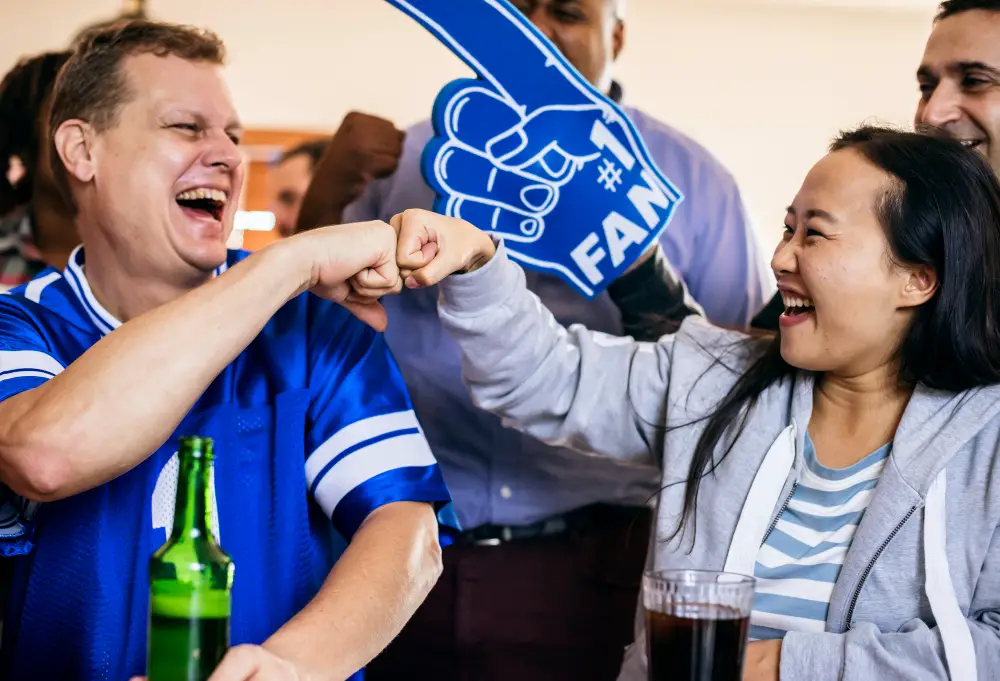
My eight-year-old daughter, Kelly, learned football sitting right beside her dad on our living room couch.
I never cared much for the sport myself. But Austin cared enough for all three of us, and then some. By the time Kelly was seven, she knew positions, penalties, coaches, and half the players in the whole league. Our living room turned into his classroom every Sunday afternoon, and she was the most dedicated student he ever had.
“Okay,” he’d say, pointing at the screen with the remote. “Tell me. What does the safety do?”
Six-year-old Kelly would squint at the TV, thinking hard. “Stops people from being safe?”
Austin would throw his head back and laugh. “Close enough for today.”
That was how it went, week after week. And it wasn’t long before she learned she could work her father like a fiddle.
“Dad, the game isn’t over yet.”
“It’s bedtime, kiddo.”
“But you said fourth quarters build character.”
He’d pause, caught. “I absolutely did not say that.”
“You said it last week. I heard you.”
Then he’d look down the couch at me, honestly unsure. “Did I say that?”
“You probably did,” I’d tell him, not looking up from my book.
Kelly would grin like she’d won the lottery, and she’d get another twenty minutes out of him every single time. Sometimes she’d start correcting him before he’d even finished explaining a play, this little kid telling a grown man he had the coverage wrong, and half the time she was right.
Football was their thing. It belonged to the two of them. I sat at the other end of the couch and pretended to follow what they were shouting about, and honestly I didn’t mind not understanding, because watching the two of them was better than any game on the screen.
Then last year, Austin died.
It was a car accident. An ordinary Tuesday. One morning he kissed me goodbye at the door and reminded Kelly to finish her spelling homework before school, and that afternoon a police officer was standing on my porch with his hat in his hands, and just like that the whole shape of our lives was gone.
For months afterward, the house went quiet in a way I didn’t know a house could be quiet.
Kelly stopped asking to watch football. She just stopped. The season kept going without us, and she never once mentioned it. Austin’s team jersey stayed folded over the back of his chair, exactly where he’d left it, and neither of us touched it. I kept catching myself waiting for noise, the sound of the two of them yelling at a referee, and it never came, and every time I remembered why, it knocked the wind out of me all over again.
Every Sunday, Kelly still came and sat beside me on the couch. But she didn’t watch the game. She stared at the empty cushion at the other end. The one where her dad used to sit. She’d just look at it, this quiet little girl in a too-quiet house, and I never knew what to say, so mostly I said nothing and put my arm around her and we sat there together in all that silence.
I didn’t move the jersey. Neither did she. It became a thing in our house we both walked around, this soft gray reminder draped over an empty chair.
Then, about six months after the accident, Kelly came into the kitchen while I was making lunch.
“Mom?”
“Yeah, baby?”
“Do you know what time the game starts?”
I turned around from the counter, not sure I’d heard right. “What game?”
She rolled her eyes at me, and the way she did it looked so exactly like Austin that my chest physically hurt. “Dad’s team, Mom. They’re playing today.”
“Oh.” I had to take a second. I picked up my phone and checked. “Four thirty.”
“Can we watch?”
I tried very hard not to make a big deal of it. If I made it into a moment, I was afraid she’d close back up. “Sure,” I said, like it was nothing. “Course we can.”
She nodded, satisfied, and walked into the living room. And then she picked up Austin’s jersey off the back of the chair, and she pulled it on over her head.
It hung down almost to her knees. The sleeves swallowed her arms. She had to push them up just to see her hands. She climbed onto the couch in it and folded her legs up under her and waited for kickoff.
I stood in the kitchen doorway and pressed my hand over my mouth so she wouldn’t hear the sound I made.
That was the first Sunday football came back into our house. And after that, she watched every week. Even when the team played badly, even when they lost in the last minute and it clearly stung, she watched, in that jersey, on that couch, cheering the way he’d taught her.
For Kelly’s eighth birthday, I wanted to do something that would matter. Something real.
Money had been tight since Austin died. Tighter than I let on. Going from two incomes to one, with everything else that comes crashing down when you lose someone, it had been a hard year in more ways than the obvious one. But I’d been quietly setting aside a little bit whenever I could manage it. Ten dollars here. Twenty there. Skipping things I told myself I didn’t need. It took months. And finally, I had enough.
Two tickets to see Austin’s team. Her team now. Not amazing seats, but not terrible ones either, close enough to actually feel like you were there.
When I showed her, she screamed. An actual scream, the kind that makes you check that nothing’s on fire.
“Are these REAL?!”
“No,” I said, deadpan. “I printed fake tickets just to mess with you on your birthday.”
She stared at me, uncertain for one heartbeat, and I couldn’t keep it up.
“Yes. They’re real. We’re going.”
She threw herself into my arms so hard she nearly knocked me over. And then, muffled against my shoulder, she said something that undid me completely.
“Dad always said we’d go. He promised we’d all go someday.”
I held her tighter and shut my eyes. “I know, baby,” I said. “I know he did.”
She slept with those tickets on her nightstand that night. I checked on her before I went to bed and there they were, propped up against her lamp where she could see them, and she was asleep facing them.
The night before the game, Kelly disappeared into her room with a stack of markers and a piece of poster board I hadn’t even known she had. I heard her working in there for the better part of an hour, the squeak of markers, the crinkle of the board.
Then she came out and held it up for me to see.
The letters were crooked and blue and getting bigger toward the bottom the way kids’ handwriting does when they run out of room.
MY DADDY LOVED THIS TEAM.
HE’S IN HEAVEN NOW,
SO I’M CHEERING FOR BOTH OF US.
I had to look away for a second. I looked at the wall, at the window, anywhere.
“You’re crying,” Kelly said, and her face fell. “Is it bad? I can make a different one.”
“No,” I said quickly. “No, sweetheart. It’s not bad at all.”
“Then why are you crying?”
“Because it’s good. Because it’s really, really good.”
She smiled, relieved, and looked back down at her sign like she was proud of it, which she should have been.
“I’m bringing it tomorrow,” she said.
“Absolutely you are.” I took it from her, gently, and folded it along a careful line so the letters wouldn’t crack, and I set it by the door so we wouldn’t forget it.
The next afternoon, Kelly carried that sign through the stadium like it was made of glass. Held it flat against her chest with both arms wrapped around it, weaving through the crowd, protecting it from everyone who passed.
And people noticed. That’s the thing about a sign like that, written in a child’s hand. A man by the concession stand read it over her shoulder and gave her a thumbs-up and a sad little smile. A woman going the other way slowed down, read it, and said, quietly, “Sorry about your dad, kiddo.”
And Kelly answered every single one of them the same way, this small, steady, matter-of-fact answer that broke my heart a little more each time.
“Thanks. He would’ve loved this.”
Our seats turned out to be close enough to the field that we could see the players clearly during warmups, and Kelly was in heaven. She narrated the entire thing to me, whether I wanted it or not.
“That’s Marcus,” she said, pointing at a player jogging along the sideline.
“Okay.”
“Mom. He’s Dad’s favorite player.”
“I know.”
“No, you don’t.”
“I’ve heard the name, Kelly. I promise I’ve heard the name.”
“He’s a receiver. A veteran. That means he’s been playing a long time. Dad had his jersey. Dad used to yell at the TV whenever people said Marcus was too old, and he’d say, ‘You watch, you just watch,’ and then Marcus would catch something amazing and Dad would go nuts.”
“I knew that part,” I lied.
She gave me a look that said she knew I was lying and forgave me for it.
She knew every warmup drill they ran. She knew what each one was for. She stood up at the railing at the front of our section, holding her sign up over the edge, watching Marcus run routes with a focus I’d only ever seen on her father’s face.
And then Marcus jogged past our section, close to the wall, and Kelly went absolutely still.
He glanced up, the way players do, scanning the crowd. And his eyes landed on her sign. He slowed. He read it. And then he read it again, I saw him do it, his eyes going back to the top and moving down a second time.
He looked at Kelly. And he pointed. Right at her.
“Mom.” Kelly’s voice had gone very small.
“I see him, baby.”
“He’s pointing at me.”
“I see that too.”
Marcus turned and jogged back a few steps to where a bunch of footballs sat in a mesh bag near the sideline. He bent down and picked one up. He looked back up at Kelly, at her sign, and he gestured toward her, like, this one’s for you.
And then he tossed it up into the stands.
Several adults around us reached up on instinct, hands going for the ball the way hands always do at a game. But a man somewhere behind us shouted, “FOR THE KID! LET THE KID HAVE IT!”
And the ball came down and dropped straight into Kelly’s arms.
She caught it against her chest, both arms clamping around it, the sign momentarily forgotten and pressed under one elbow. And for one full second, she didn’t make a sound. She just stood there, frozen, staring down at the football like she couldn’t believe it was solid.
Then she screamed.
“MOM!”
She was laughing and crying at the same time, spinning to face me, the ball squeezed so tight against her.
“Mom, LOOK! He gave it to ME!”
“I see it, sweetheart, I see it!”
“Daddy would’ve gone CRAZY!”
I laughed through my own tears, because it was true, he would have. “He would’ve told everyone in this whole stadium that he caught it himself,” I said.
“He would’ve!” She hugged the ball to her chest and buried her face against it for a second, and I thought, this. This is what I saved for. This exact moment. This is worth every skipped lunch and every twenty dollars. I would have paid a hundred times what those tickets cost for the look on her face right then.
And then a hand came across me from the side.
It happened so fast I didn’t understand it at first. The woman sitting next to us, a woman I hadn’t paid any attention to, reached over and pulled the football right out of Kelly’s arms.
Kelly gasped.
The woman turned and handed the ball to the teenage boy sitting on the other side of her. Then she settled back into her seat and adjusted her coat, calm as anything, like she’d just picked up something she’d dropped.
I stared at her. “What are you doing?”
“My son should have it,” she said. “He’s been playing football for three years.”
I genuinely thought I’d misheard her. “I’m sorry, what?”
“He’s been playing for three years. He’ll actually appreciate it.”
The boy, who was maybe fourteen, was holding the ball now and looking like he wanted the earth to open up and swallow him. He would not look at Kelly. He stared at his own knees.
I stood up. My legs did it before my brain fully caught up.
“That player threw that ball to my daughter. He pointed at her. Directly at her. The whole section saw it.”
The woman rolled her eyes at me. “He threw it into the crowd. Once it’s in the crowd, it’s anybody’s. Ethan here has as much right to it as she does.”
“He pointed at her first.”
“So?”
And that little word, so, said with a shrug, in front of my grieving eight-year-old, on her birthday, did something to me. I felt something go very cold and very steady in my chest.
“Mom,” Kelly whispered. She had hold of my sleeve. When I looked down at her, her eyes were welling up, and her lip was starting to go, and she was looking at me like she needed me to fix this and was afraid I couldn’t.
That look changed everything. I stopped being upset and started being something else.
I held out my hand to the woman. “Give it back. Please.”
The woman actually laughed. One short, disbelieving laugh. “No.”
“Give my daughter her football.”
“Girls don’t even understand football,” she said. “My son deserves it more. He’s a player.”
“Why does that matter?”
And then she said the thing I still, to this day, cannot believe a grown adult said out loud to a child who’d just lost her father.
She glanced at Kelly’s sign, the blue crooked letters and all, and she said, “It’s not like this really matters to her. She’ll have forgotten all about it by tomorrow. Buy her a doll or something.”
I heard a man behind us say, “Lady. Seriously?”
Her son had gone red to the tips of his ears. He looked physically ill.
But the woman just waved a hand at Kelly like she was shooing a fly and said again, “He actually plays. That’s the difference.”
The people around us had started to catch on to what was happening, and I could feel it, the mood in our little section shifting. These were strangers, every one of them, but suddenly they didn’t feel like background. They felt like they were on our side. Somebody muttered something angry. Somebody else leaned in. A man two rows back was half out of his seat.
“Give it back,” I said again, holding my hand out, my voice shaking now but not backing down. “That is my daughter’s ball.”
And that was when the shouting started behind us. But it wasn’t aimed at the woman. It was aimed at the field.
I turned around to look.
Marcus was standing near the sideline, and he was looking directly up at our section. He wasn’t smiling anymore. He was pointing, first at Kelly, then at the football in the teenage boy’s hands, then back at Kelly. And a team staffer standing near him followed the line of his arm, up into the stands, right to us.
Marcus said something to the staffer. And then he walked over and reached for a sideline microphone, the kind they use for announcements.
The stadium noise dipped, the way a crowd does when it senses something’s happening.
“I threw that ball to the little girl holding the sign,” Marcus said. His voice came booming out over the whole section, clear as day.
Kelly grabbed my hand and squeezed my fingers so hard my knuckles actually cracked.
“The young man holding it,” Marcus went on, “knows exactly who it belongs to.”
And then the giant screen up above the field changed.
Suddenly there we all were, forty feet tall. Kelly, in her dad’s jersey, tear tracks down her face, clutching her sign. Me, standing with my hand out. The woman beside us. And her son, Ethan, standing there holding a football that the entire stadium had just been told wasn’t his.
The woman’s mouth snapped shut. “Ethan,” she whispered.
Ethan looked up at the screen, at himself, forty feet tall, holding a stolen ball in front of tens of thousands of people. Then he looked down at Kelly.
A man behind us laughed in pure disbelief.
Then an usher and a security officer appeared at the end of our row, making their way toward us.
The woman pointed at me immediately. “Officer, this woman has been harassing me and my son. She’s been—”
“Lady,” the man behind us cut in, “the whole stadium just heard the player say it. Give it up.”
The security officer wasn’t even looking at me. He was looking at Ethan. “Son?”
Ethan stared down at the football in his hands.
His mother started, fast, “It went into the crowd, it’s a free ball, anyone could have—”
“Mom.” Ethan’s voice was quiet but it stopped her cold. “Stop.”
She stared at him. “Ethan, don’t. It’s yours now, I got it for you, just—”
“You took it from her.” He finally looked at his mother full on. “I didn’t ask you to do that. I never asked you to take it.”
“You told me you wanted a game ball! You’ve been saying it all season!”
“Not hers.” He shook his head. “Not like this.”
And then he turned, and he stepped past his mother, and he walked the couple of feet over to Kelly, and he held the football out to her.
“I’m sorry,” he said.
Kelly looked up at him. She hesitated, glancing at me first, and I gave her the smallest nod. Then she reached out and took it.
“It’s okay,” she said.
Ethan shook his head. “No, it isn’t.” He said it low, just for her. “It really isn’t.”
His mother had gone a deep, furious red. But it didn’t matter, because down on the field, Marcus gave Ethan a small nod, one guy to another, and then the giant screen switched back to the warmup feed, and the stadium’s attention moved on, and it was over.
The usher leaned down toward me.
“Ma’am, would you and your daughter mind staying right here for a few minutes? Don’t go anywhere just yet.”
I frowned. “Why?”
He glanced back toward the field, and there was a little smile at the corner of his mouth. “Someone asked to see her. After warmups. If that’s all right with you.”
Kelly’s eyes went enormous. “Mom.”
“I heard him, baby.”
A few minutes later, the usher came back and waved for us to follow him. He led us out of our section and down a ramp and into a concrete hallway under the stands, the kind of place regular fans never get to go. Kelly held that football against her chest the entire way, both arms locked around it like she was never letting anyone touch it again.
“Am I in trouble?” she whispered as we walked.
“No, sweetheart. Not even a little.”
“Are you sure?”
“Mostly.”
“Mom!”
“I’m kidding. You’re not in trouble. I promise.”
A door opened up ahead, near the mouth of the tunnel that led out to the field. And Marcus was standing there, in full uniform, waiting.
Kelly stopped walking completely. “Oh my God,” she breathed, and half hid herself behind my leg.
Marcus smiled and crouched down, getting himself lower, closer to her eye level. “Hey,” he said. “You’re Kelly, right?”
She nodded, still half behind me, her fingers tightening around my hand.
“I saw your sign,” he said. “Out there. I read it twice.” He paused. “What was your dad’s name?”
Kelly’s voice came out tiny. “Austin.”
Marcus nodded slowly, like the name meant something to him. “My dad taught me football too,” he said. “When I was about your age. Everything I knew as a kid, he’s the one who taught me.”
Kelly looked up at him properly for the first time. “He did?”
“Everything. Sounds like your Austin knew what he was doing.”
“He taught me all of it,” Kelly said, coming out from behind my leg a little. “He explained penalties to me because my mom doesn’t understand them.”
I looked down at her. “Wow. Thanks.”
Marcus laughed, a real, warm laugh. “Hey, somebody’s gotta learn ’em.” He pointed at the ball in her arms. “Can I see that for a second?”
Kelly handed it over carefully.
Marcus pulled a marker out of somewhere in his uniform. “Usually,” he said, uncapping it, “I just sign my name and hand it back.” Then he looked up at me. “How do you spell Austin? A-U-S-T-I-N?”
My throat closed up. I had to work to get it out. “Yes. A-U-S-T-I-N.”
He wrote something beneath his signature, slow and careful, then handed the ball back to Kelly.
She read it. And then she read it again, her lips moving.
For Kelly and Austin — keep cheering together.
She traced her father’s name with one finger. Once. Then again. Then she pulled the football back into her chest and hugged it, and her lips started to tremble, and then she just cried. Full, wide-open, eight-year-old crying, the kind that shakes the whole body.
Marcus looked briefly alarmed, glancing up at me like he might have done something wrong.
“Good tears,” I told him. “Those are good tears.”
“Good tears?” he asked Kelly.
She nodded hard, gasping, hugging the ball. “Good tears,” she managed.
I was crying too, by then. “Thank you,” I said to him. “You have no idea. Thank you.”
Marcus smiled and stood back up. “Actually,” he said, “if it’s okay with Mom, I’ve got one more question.”
Kelly wiped her face with the back of her hand. “What?”
“You want to stand by the tunnel when the team runs out for introductions?”
Her mouth dropped open. She turned and looked up at me, and she couldn’t even get the words out.
“Mom.”
“Yes,” I said, laughing.
“Mom!”
“I already said yes, baby. Go.”
When the team came thundering out of that tunnel a little while later, Kelly screamed so loud right beside me that I thought she’d lose her voice for a week. She stood there at the edge of it all with the signed football clamped against her chest, jumping up and down in her dad’s giant jersey, screaming her lungs out.
And for a little while, standing there, she wasn’t crying because she missed her father. She was crying because something good had happened. There’s a difference, and I hadn’t seen the second kind of tears from her in a long, long time.
After the game, walking out through the concourse in the slow river of people, we passed Ethan. He was standing a few feet apart from his mother, who had her arms crossed and was staring off in another direction. When he saw us, he lifted one hand.
“Hey.”
Kelly stopped and hugged her football a little tighter.
“I’m sorry again,” he said.
“You already said that.”
“I know. I should’ve given it back right away. The second she grabbed it. I shouldn’t have just stood there holding it.”
Kelly considered this with total seriousness, the way kids do. “Probably,” she said. “But I would’ve hesitated too. Marcus is really famous.”
Ethan cracked a small smile despite himself. I almost laughed out loud.
“I hope the rest of your day goes better,” he said.
“Thanks.”
And we kept walking. His mother never said a word to us. But Ethan had, and honestly, that was enough. He was fourteen. He’d been handed something by a parent who should have known better, and in front of an entire stadium, he’d found it in himself to do the right thing anyway. That counts for something. That counts for a lot, actually.
That night, back home, Kelly set the football down in the middle of the coffee table like it was on display in a museum. Then she went and got Austin’s jersey and draped it over the back of his old chair, smoothing it out. And then she just sat on the couch, looking at both of them, the jersey and the ball.
“You okay?” I asked, sitting down next to her.
She nodded. “Dad would’ve been jealous.”
“Extremely,” I agreed.
She smiled at that. Then she looked back down at the writing on the ball. “He would’ve touched it too much,” she said. “He would’ve picked it up like a hundred times a day.”
“Definitely. He’d have carried it around the house.”
She laughed, quietly. And then she got quiet in a different way, and she said, “Mom?”
“Yeah?”
“Do you think Dad saw?”
I knew exactly what she meant. The game. The sign. Marcus reading it. The ball dropping into her arms. All of it.
I put my arm around her and pulled her in against my side and I thought about how to answer, because I wanted to tell her the truth, whatever the truth was, and I didn’t know.
“I don’t know, baby,” I said finally. “But I hope so. I really hope so.”
She nodded against me. “I hope so too.”
A few weeks later, Kelly sat down at the kitchen table and wrote Marcus a thank-you letter. I sat with her while she did it, helping with a couple of the harder words. She thanked him for the ball, and for signing her dad’s name, and for letting her stand at the tunnel. And at the very bottom, all on her own, she added one last line.
The ball is beside my dad’s jersey now. I think he’d like that.
Then life just kept going, the way it does. There’s no other choice, really. It keeps going and you go with it.
Sunday football still feels different in our house. It probably always will. Austin’s chair is still there in its spot. Kelly still drapes his jersey over the back of it before every kickoff, a little ritual she never explains and I never ask about. The signed football lives on the coffee table, and it’s the first thing anyone sees when they walk in.
Last Sunday, I was sitting at my usual end of the couch, the far end, while Kelly watched a replay of an old game. She let out a big, dramatic sigh, the kind she’s perfected.
“Mom.”
“What?”
“Sit closer.”
“I’m comfortable where I am.”
She patted the cushion right beside her. The empty one. His.
“Dad would’ve explained this whole play to you already,” she said.
So I moved over. I slid down the couch and sat right beside her.
“Fine,” I said. “Explain it to me, then.”
She pointed at the television, all business. “Okay. Watch the safety.”
I smiled. “The person who stops people from being safe?”
Kelly turned and stared at me, dead serious. “That was when I was six, Mom.”
“I remember important things.”
“That is not even close to what a safety does.”
“Then educate me.”
And she did. She launched into it, coverage and routes and zones, pointing at the screen, correcting me when I got confused, exactly the way her father used to do. I understood maybe half of what she said. Maybe less. But I wasn’t really watching the play.
I was watching her face. She was lit up, animated, completely in her element, teaching her clueless mother the game her dad taught her. She was smiling.
I looked once at Austin’s empty chair, with the jersey over it and the ball sitting nearby.
Then I looked back at Kelly, still talking, still pointing, still smiling.
And for the first time since he died, that empty place beside us wasn’t the only thing I could see.

Specialty: Quiet Comebacks & Personal Justice
David Reynolds focuses on stories where underestimated individuals regain control of their lives. His writing centers on measured decisions rather than dramatic outbursts — emphasizing preparation, patience, and the long game. His characters don’t shout; they act.