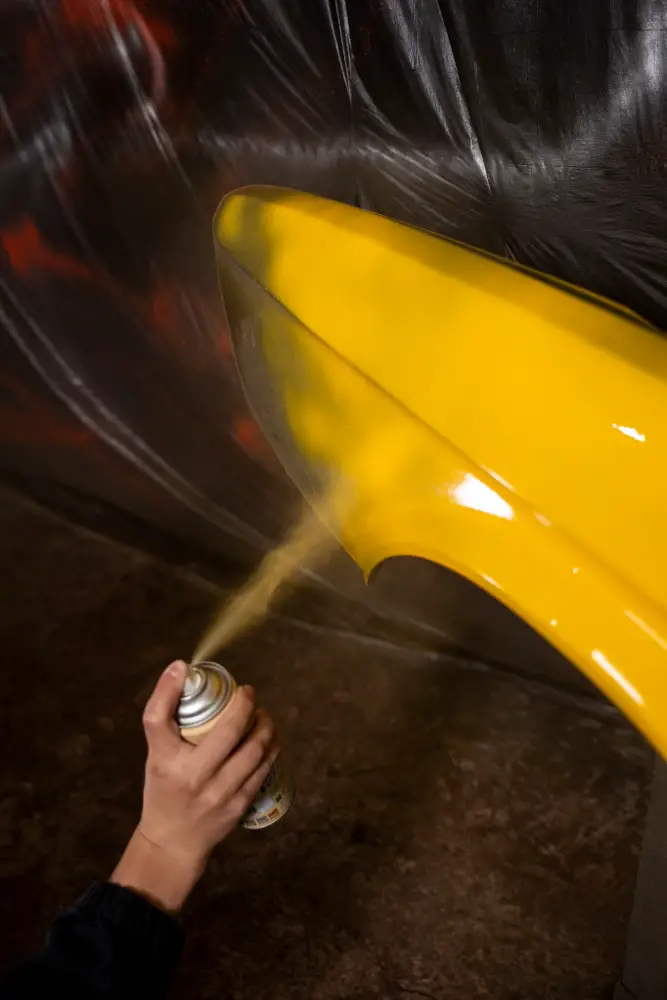
The first thing I noticed was the color. Bright yellow. The kind of yellow that looked almost fake against the white paint of my SUV, like someone had spilled a cartoon across my driveway.
At 2:13 that morning, I’d woken to a metallic clang outside my window. I remember checking the clock, and I remember that I was annoyed before I was scared, because that’s the order those things come in when you’re half asleep and someone’s making noise in your driveway in the middle of the night. Then I got up and looked out the bedroom window.
Linda was running across my lawn.
She was gone, disappearing toward her own house, before my brain had even caught up to what my eyes were doing. I stood at the window a second longer, waiting for it to make sense, and it didn’t, so I threw on my robe and went downstairs.
There was an empty bucket lying on its side beside my car. And yellow paint. Everywhere. Across the hood, down the windshield, over the driver’s side door, splattered onto part of the rear panel.
For a few seconds I just stood there in my slippers on the cold concrete, staring at it. And then, God help me, I started laughing. Not because anything was funny. Because the whole thing was so completely absurd that my brain didn’t have another setting to switch to. A grown woman had poured a bucket of paint over my car in the dark like a teenager in a bad movie, and I was standing there at two in the morning looking at it, and laughing was all I had.
Let me back up, because none of this makes any sense without the driveway, and the driveway is where it all started.
Linda and I had been fighting over a strip of my driveway for six months. There’s a narrow space beside my garage, just wide enough to park a vehicle, and it’s mine. Not “sort of” mine. Not “technically” mine. It’s clearly, unambiguously on my property, and I used it whenever I wanted to leave the SUV outside instead of pulling it into the garage.
Linda had decided, at some point, for reasons that lived entirely inside her own head, that this strip was “basically shared.” I still don’t know where she got that. She’d park there when she had people over. She’d let her grown son, Tyler, leave his big work truck there for days at a time. Once I came home from work to find a landscaper she’d hired using my space to unload a trailer full of mulch, wheelbarrow and all, like it was a public loading zone.
The first few times, I was polite about it. I really was.
“Linda, would you mind moving your car? That’s my side.”
She’d let out this long, put-upon sigh, like I was the unreasonable one. “You’re not even using the garage side.”
“That’s not really the point.”
“Then what is the point, exactly?”
“The point is that it’s my driveway.”
That answer never once satisfied her. It was like the concept just bounced off her. In her mind, if the space wasn’t actively occupied by my car in that exact moment, it was fair game, and my objecting to it was some kind of character flaw.
After the fourth or fifth time, I bought a little sign at the hardware store and staked it into the ground right near the property line. PRIVATE DRIVEWAY, in plain black letters.
She actually laughed out loud when she saw it. Stood in her yard with her hands on her hips and laughed. “You are unbelievable, you know that?”
“I’ve asked you six times, Linda.”
“You’ve got plenty of room over there.”
“So do you.” And that was the part that made me crazy. Her driveway was bigger than mine. Noticeably bigger. She had more room than I did. This was never about space. It never had been. It was about Linda having decided that she was entitled to do a thing, simply because nobody had made her stop yet, and my sign, my requests, my property line, none of it was a real obstacle to her. It was just noise she had to talk over.
So last week, I finally stopped asking.
I came home from work and there was her SUV, parked beside my garage, right where the sign was, blocking my space. Linda’s car, but Linda herself was nowhere to be seen. Gone somewhere, left it there like she owned the spot.
I stood there for a minute. And then I went inside, looked up a towing company, and called them.
Forty minutes later, her SUV was gone.
I won’t pretend I didn’t feel a little jolt of satisfaction watching that truck haul it away. Six months of being sighed at and laughed at and stepped over, and finally, finally, a consequence. I thought that would be the end of it. I thought she’d be furious, and she’d yell, and then maybe, just maybe, she’d finally leave my driveway alone.
She came back about an hour later. I heard her before I saw her.
“WHAT DID YOU DO?”
I opened the front door and stepped out onto the porch. “I had it towed.”
Her face went red, that deep, blotchy red of real anger. “You had my car TOWED?”
“It was parked on my property. Again.”
“You could have called me!”
“Linda, I have called you. I’ve called you and asked you and put up a sign, for six months.”
“I mean today. You could have called me today.”
“I didn’t know where you were. Your car was here, you weren’t.”
She jabbed a finger at me across the yard. “You’re going to regret this.”
I remember thinking how silly that sounded. You’ll regret this. Like a line from a soap opera. This was a woman in her late fifties threatening me over a parking spot. I honestly almost laughed then too. I went back inside and figured that was the worst of it.
Six nights later, I woke up to the clang, and looked out the window, and there she was, running away from my ruined car.
Standing in the driveway at two in the morning, staring at all that yellow, I did the only sensible things I could think of. I took pictures. A lot of them. The hood, the door, the windshield, the rear panel, every angle I could get. I photographed the bucket lying on its side. I even photographed the trail of drips leading back toward the direction she’d run.
I had no camera pointed at the driveway. I hadn’t gotten around to it, one of those things you always mean to do. I had no witness. All I had was what I’d seen from the bedroom window, a woman in the dark that I was certain was Linda, and a driveway full of paint.
I decided not to call the police right then. It was two-thirty in the morning, and I figured a vandalism report at that hour, with nobody still on the scene and no immediate danger, wasn’t going to get anybody out of bed. Better to call first thing in the morning, in daylight, when I could show them everything properly. So I went back inside, made myself a cup of tea I didn’t drink, and waited for the sun to come up.
By 7:20, I didn’t have to call anyone.
Someone was pounding on my front door, hard, urgent. My first thought was that it was Linda, come to scream at me in person, to deny it to my face before I could accuse her. I braced myself for a fight and opened the door.
Instead, there were three police cars parked outside her house.
Two officers were walking in and out of her open garage. And Linda was standing barefoot on her own lawn, in pink pajamas, arms flailing, yelling at the top of her lungs.
“I didn’t do anything! You have no right! I didn’t do ANYTHING!”
I stepped out onto my porch, completely bewildered. The officer who’d knocked on my door turned and saw me, and then his eyes went to my driveway, to the SUV.
He walked over toward it. “Ma’am, is this your vehicle? The damaged one?”
“Yes. Yes, it’s mine. I was actually about to call you people. My neighbor—” I gestured at Linda. “She did this. Last night.”
He stared at the yellow paint for a long moment. Then he said, “Don’t wash it.”
“I wasn’t planning to.”
“Good.”
I looked past him at all the commotion. “Why are the police at Linda’s house? Is this about my car?”
He glanced back toward her garage. “That’s a separate matter, ma’am.”
Before I could ask him what that meant, another officer came out of Linda’s garage carrying a paint can, half empty, held carefully by the rim. And even from my porch I could see the color.
Bright yellow. The exact same yellow that was all over my car.
I almost laughed again. “Well,” I said. “There’s my proof, I guess. That’s the paint.”
Neither officer smiled. That was the first moment the morning started to feel wrong, in a way I couldn’t name. One of them looked back at my SUV, then at the paint can, then at my SUV again, slower this time.
“This isn’t about your car,” he said.
I frowned. “What isn’t about my car?”
He didn’t answer me. He was still looking at the SUV.
The older of the two, a serious-looking man with gray at his temples, walked around toward the back of my car, studying it. “When did you buy this vehicle?” he asked.
“About three years ago.”
“New?”
“No, used.”
“Where’d you buy it?”
“A dealership out on Route 8.” I was answering on autopilot, but my stomach was starting to knot up. These were not the questions you ask about a vandalism. “Why does that matter? She poured paint on it, you’ve got the can right there.”
He didn’t respond. He kept moving around the vehicle, and I followed him, and that’s when I saw it too. Near the rear bumper, where the paint had pooled and run, something had happened to the finish. The yellow paint, whatever was in it, had eaten through the white. Not down to bare metal. Down to another layer. Older white paint underneath the newer white, a different shade, slightly. I’d never noticed it before, never had a reason to.
The officer crouched down in front of the rear quarter panel. Then he leaned in closer, until his face was almost against the car.
“What is it?” I asked.
He didn’t answer.
There were markings under there. Faint, ghostly, revealed where the paint had stripped back the top coat. Letters and numbers. At first glance they looked random, like scratches, like nothing. The officer pulled a small cloth out of his pocket and, very gently, wiped at one edge of the exposed area.
More of it came into view. Two letters, then a number. And beside them, near what looked like an old seam where a repair had been done, part of another marking.
I watched the man’s whole body change. His shoulders went stiff. He stopped wiping. And then he reached up and touched the radio clipped to his shoulder.
“Get her away from the vehicle.”
My stomach dropped straight through the ground. “What? Away from my own car? Why?”
The younger officer put a hand out toward me. “Ma’am, I need you to step back, please.”
“Why? What is going on?”
The older one straightened up and turned to me, and his voice was calm in a way that scared me more than yelling would have. “Just step away from the car, please.”
I did. I backed up onto the grass. And I watched him speak quietly into his radio, a few words I couldn’t make out, and a number. And then a phrase I did catch, that made no sense to me at all in that moment.
Cold case.
I felt lightheaded. “Please. What is happening? Somebody tell me what is happening.”
The detective looked at me. “What’s your name, ma’am?”
“Claire.”
“Claire. Did you ever have any body work done on this vehicle? Since you owned it?”
“No. Nothing.”
“Any repainting? Any part of it?”
“No. Never. I’ve never had anything done to it except oil changes and tires.”
“You said you bought it used.”
“Yes.”
“Do you still have the paperwork from the sale?”
“I, yes, I think so, in the house.”
“Don’t touch the car. Don’t move it. Don’t let anyone near it.” He hesitated, and I could see him deciding how much to tell me. “Claire, this vehicle may be connected to an old investigation.”
“An investigation into what?” My voice was shaking now. “Into what?”
He glanced at the SUV, at the markings under the paint, and back at me.
“Possibly a fatal hit-and-run. One I’ve worked on.”
Everything inside me went cold and still. “What?”
He asked me, gently but firmly, to go inside and find the purchase documents. My legs barely worked as I went back in. My hands were shaking so hard that I could hardly get the filing cabinet drawer open. I dug through folders, dropping things, until I found it all, the bill of sale, the dealership paperwork, the financing documents, a copy of the title. I stuffed it all into one folder and went back outside.
There were more officers now. And Linda had stopped yelling. She was standing near her porch with her arms folded across her chest, no longer indignant. She looked scared. She was watching the cluster of police around my car, not her own garage, and there was something in her face I’d never seen there before. Confusion. Fear. The look of a person who has thrown a rock and realized, too late, that she can’t see where it’s going to land.
I handed the folder over. The older officer introduced himself properly this time. Detective Harris. He flipped through the pages, reading fast.
“Is this dealership still in business? On Route 8?”
“Yes. As far as I know.”
He nodded and closed the folder. “I’m going to tell you what I can, Claire. You deserve that much.” He took a breath. “Six years ago, a nine-year-old boy named Caleb was hit and killed crossing a residential street. About fifteen miles from here.”
I put my hand over my mouth.
“The driver didn’t stop,” Harris said. “It was a hit-and-run. We had traffic-camera footage from two intersections away, but it was poor quality, and it was nighttime, so there wasn’t much to go on.” He looked back at my car. “But we could make out a white SUV. This general model. Same make. And there was a partial marking on the back quarter panel. Looked like part of a commercial fleet decal. A company vehicle, maybe.”
I felt sick. “You’re telling me this is that car. My car.”
“I’m telling you it may be.”
“How? How can you tell from a few scratches?”
Harris pointed at the exposed area near the rear bumper. “After a collision like that one, the vehicle would have had damage right about here. On the right rear side. Consistent with the impact. And in the footage there was that partial fleet marking, in this same spot.” He crouched again, careful not to touch. “Those letters coming through under the white. That’s what we could never find. Because the car vanished.”
I stared at the faint letters. “The car vanished?”
“We enhanced every frame of that footage we could. We sent images to every repair shop, every dealership, every salvage yard in three counties. For years.” He shook his head slowly. “Nothing. It was like the vehicle drove off that camera and off the face of the earth.”
He stood up, and I looked at him, and I understood then why his face looked the way it did. It wasn’t excitement. There was no triumph in him at all. He looked haunted. Like a man staring at a ghost he’d been chasing for six years and never expected to actually catch.
“You worked that case,” I said. It wasn’t a question.
“I worked that case,” he said quietly. “From the first night.”
He explained the rest to me in pieces, while the other officers photographed my car from every angle. If someone had repainted the vehicle quickly after the collision, he said, covering that fleet marking, patching the damage, and then run it through a dealership that wasn’t too careful about paperwork, that would explain why they’d never found it. It could have been given a clean-looking history and sold on to someone who had no idea. Someone like me.
I stood in my own driveway and I thought about all the ordinary things I’d done in that car. I’d driven it to work every single day for three years. I’d taken it to the grocery store, to the mountains on vacation, to the dentist, to my mother’s house. I’d washed it in the driveway on summer afternoons. I’d vacuumed cereal out of the seats. I’d complained, more than once, about its lousy gas mileage.
And the whole time, it might have been the car that killed a little boy.
I thought I might actually be sick. “Am I in trouble?” I asked. “Detective, am I in trouble?”
He turned to me immediately, and his answer came fast and firm, which I was grateful for. “Not based on anything you’ve told us. No.”
“I bought it from a dealership. In good faith. I had no idea, I swear to God I had no—”
“I believe you. We’ll verify everything, and it’ll check out, and that’ll be that. Okay? You bought a used car. You didn’t do anything wrong.”
“Please verify it,” I said. “Please.”
“We will.”
I looked over at Linda’s house then, at the officers still moving through her garage, and I remembered that all of this had started with her. “Wait. What is all this at her house? What did she do, besides my car?”
Harris followed my gaze. “Her son was arrested last night.”
“Tyler?”
“Yes.”
“For what?”
He hesitated, then decided it would be public soon enough anyway. “Stolen property.”
Honestly, that surprised me less than it probably should have. Tyler worked at one of the big commercial construction sites over on the other side of town. According to Harris, that company had been reporting materials going missing for months. Expensive stuff. Copper. Specialty wiring. Metal fittings. Thousands of dollars’ worth over time. Investigators had been quietly watching Tyler for a while, and they’d finally caught him trying to sell off a load of it. He’d been arrested, and then he’d confessed, and he’d told them the rest of the stolen material was stashed in his mother’s garage.
That was why the police were already there at seven in the morning. It had nothing to do with my paint at all. They’d shown up at dawn with a search warrant for the stolen construction materials. And while they were in Linda’s garage, searching, they’d found the stolen goods, exactly where Tyler said they’d be.
And they’d found a half-used can of bright yellow paint.
The same yellow that was, at that very moment, dripping down the side of my SUV.
“So she really did throw the paint on my car,” I said. It came out almost dazed.
Harris glanced at the can, now bagged as evidence. “We’ll test it to be sure. But yes. It appears very likely.”
Linda was arrested later that morning, on the vandalism charge. She was already standing in her own front yard when they put the cuffs on her, and she looked so small and so bewildered, this woman who six days earlier had jabbed her finger at me and promised I’d regret it.
My SUV was towed away too, that same afternoon. Not because I’d done anything wrong. Because it was evidence now, in a six-year-old case about a dead child, and it needed to go somewhere it could be properly examined.
That was the strangest part of a very strange day. By lunchtime, my driveway was completely empty. The thing Linda and I had fought over for six months, the whole reason any of this had happened, was just bare concrete in the afternoon sun. Her house had gone silent. And I sat at my kitchen table with a cold cup of tea and tried to understand how a stupid, petty feud over a parking space had turned into this.
The weeks that followed were exhausting. Detectives interviewed me twice, going over every detail of how and when I’d bought the car. They contacted the dealership on Route 8.
The dealership owner, at first, insisted there had been nothing unusual about my SUV at all. Just a normal used car, he said. But then investigators pulled his old sales records, going back years, and the story fell apart. The vehicle had come into that dealership just a few weeks after the hit-and-run, years before I ever bought it. Whoever sold it to the dealership had taken far less than it was worth, in exchange for a fast, quiet cash sale. And on the paperwork, the dealership had listed the car as having only “cosmetic body damage.”
That “cosmetic” damage, it turned out, had included structural repairs to the rear and a full repaint of part of the rear quarter panel. The exact spot where a child had been struck.
Harris called me one afternoon a few weeks in. I could tell from the first word that something had broken open.
“We found the previous owner, Claire.”
I sat down slowly at my kitchen table. “And?”
“We’re bringing him in for questioning.”
His name was Darren. He’d owned the SUV six years earlier, right at the time of the crash. And here was the piece that made it all click into place: he had ties to a contracting company, one that put fleet decals on its work vehicles. The partial letters hidden under my paint matched that company’s markings. The repair on the rear panel lined up exactly with the part of the vehicle that investigators had always believed struck Caleb.
And then came the part that six years of investigation had never been able to produce. After a long, hard interrogation, Darren confessed.
He’d been the one driving that night. He told them Caleb had run out into the road, that it happened fast, that he hit him before he could even react. And then he panicked. He didn’t stop. He drove away. He told himself, he said, that he would call the police later, once he’d calmed down, once he’d figured out what to say.
He never called.
Instead, he hid the SUV at a friend’s property, out of sight, for several weeks while the search was on. And then, when the immediate heat died down, he took it to a dealer he knew wouldn’t ask too many questions. The dealer did a quick, cheap repair on the damage, repainted the panel to cover the fleet marking, and cleaned up the paperwork just enough to make the car look like any other used vehicle with a minor dent in its past.
And years later, not knowing any of it, I walked onto that lot and bought it.
When Harris told me all of this, I cried. I sat at my kitchen table with the phone against my ear and I cried, and I couldn’t fully explain why, even to myself. I’d never met Caleb. I didn’t know his family. But something about the whole thing just broke me open. A nine-year-old boy had died on a residential street. His parents had spent six years not knowing who had done it, not knowing who to be angry at, not knowing anything. And the answer, the actual physical answer, had been sitting in my driveway the entire time. I’d been leaning on it while I dug for my keys. I’d been arguing with my neighbor over the right to park it.
Harris told me that Caleb’s parents had been notified before the arrest went public. “They finally know,” he said.
“Does it help them?” I asked. “Knowing?”
He was quiet for a while. “Not enough,” he said. “It never does. But not knowing was its own kind of cruelty. At least now there’s a name. There’ll be charges. There’ll be a courtroom. There’ll be something.”
The dealership on Route 8 became its own separate investigation. Their records were a disaster, and the owner swore up and down that he’d had no idea Darren had been involved in a fatal collision. Maybe that was true. Maybe it wasn’t. But investigators found enough problems with how that car’s title and repair history had been handled, and enough other irregularities besides, that the dealership ended up facing serious consequences of its own.
Because I’d bought the car in good faith, and because there were such clear problems with how it had been sold to me, my lawyer helped me pursue compensation from the dealership. It took a long time. These things always do. But eventually, once the case against the dealership had worked its way through the system, I was awarded a settlement.
The SUV itself never came back to me. It stayed in evidence for months, and was handled as part of the case, and honestly, I never wanted it back. I couldn’t have sat behind that wheel again. I couldn’t have turned the key. Every time I’d have looked at the rear panel I’d have seen those letters coming through the paint.
As for Linda, the paint match came back exactly the way everyone expected. The yellow on my car was the yellow from the can in her garage. She pleaded guilty to the vandalism and got fines, restitution to cover the damage, and community service.
And the irony of it was almost too much to hold in my head.
She poured that paint over my car because she was furious that I’d had her SUV towed. She meant to ruin my week, to teach me a lesson, to get even. Instead, the chemicals in that cheap paint ate through the newer white finish. That exposed the older paint underneath. That revealed the fleet markings that had been hidden for six years. Those markings gave Detective Harris the lead he’d been chasing since the first night. And that lead led to a confession, and a name, and a family that finally, after six years, learned who had killed their child.
Linda, trying to hurt me, had accidentally cracked open a case that professional investigators hadn’t been able to solve in six years of trying.
Tyler had it worse than his mother. The stolen construction materials added up to a lot of money, and he ended up taking a plea and serving real time. Linda blamed everybody for that. The police. His employer. His “bad friends.” At one point, from what I heard, she even found a way to blame me, though I’ve never been able to work out how I fit into her son stealing copper wire. But that was Linda. It was always someone else’s fault. That was the whole reason we’d ever ended up here.
She never parked in my driveway again. Mostly because after all of it, she barely spoke to me at all, which suited me fine.
About eight months later, I ran into Detective Harris at the grocery store, of all places. He recognized me first.
“Claire.”
“Detective.”
We stood there awkwardly beside a big display of canned soup, two people connected by the strangest thing either of us had probably ever been part of. And I asked him the question I’d been carrying around for months, half afraid of the answer.
“How is Caleb’s family? Do you know?”
He nodded slowly. “They’re doing about as well as people in their situation can. Which isn’t a lot. But it’s something.”
“Was there a conviction?”
“Yes.” He told me Darren had accepted responsibility as part of a plea deal. There’d been a sentencing hearing. Caleb’s parents had spoken at it, both of them.
I swallowed hard. “I hope it helped. A little.”
Harris looked at me for a moment, considering something. “His mother said something afterward,” he said. “To me, in the hallway.”
“What did she say?”
“She said she could finally stop looking at every white SUV on the road.”
That sentence has stayed with me ever since. I went home from that grocery store and I cried again, thinking about it. Six years. Six years of that woman driving down the highway, sitting at red lights, walking through parking lots, and scanning every single white SUV that passed, wondering, is that the one, is that the one that killed my son. Six years of searching every vehicle on the road for some clue, some sign, some scrap of an answer nobody could give her. And now she could stop. Now she could just drive.
Eventually I bought myself another car. Nothing fancy. A plain gray sedan with good gas mileage. Reliable, boring, ordinary. The salesman kept trying to talk me up into something nicer, leather seats, a bigger engine, the premium package, all of it. And I kept saying, no thank you, no thank you, this one is fine.
I wanted ordinary. After everything, ordinary felt like a gift.
I still live in the same house. Linda still lives next door. These days our whole relationship is a nod, if we happen to be outside at the same time, and often not even that. My driveway is entirely, unquestionably mine, and has been ever since, though it turns out that was never really the important thing about any of it.
Sometimes, late at night, I still think about how absurd the whole chain of it was. If Linda hadn’t parked in my driveway, I’d never have called the tow truck. If I hadn’t called the tow truck, she’d never have gotten angry enough to come out in the dark with a bucket. And if she’d used any other paint, any normal paint, the old layer underneath might have stayed hidden forever. The fleet marking would still be buried under two coats of white. Darren would still be out there somewhere, driving around, thinking he’d gotten away with it. And a mother would still be scanning the highway for a white SUV that no longer even existed in the form she was looking for.
None of that makes what Linda did okay. It was petty and destructive and against the law, and she did it purely to hurt me. I want to be clear about that. She wasn’t trying to help anyone. She was trying to ruin my week.
But consequences have a way of not stopping where people expect them to.
Linda thought she was destroying my car. What she actually did was expose her own family’s crimes, draw the police straight to a piece of evidence they’d hunted for six years, and hand a grieving mother and father the answer they should have had all along.
I lost a car. The dealership had to pay me back for it. Linda got community service. Tyler went to prison. Darren finally had to stand in a courtroom and answer for the little boy he left in the road. And Caleb’s parents got to stop looking at every white SUV on the highway.
All of it, every last piece, because of a bucket of yellow paint poured over my car at two in the morning by a woman who was angry about a parking spot.
I still can’t quite believe it. I don’t think I ever will.

Lila Hart is a dedicated Digital Archivist and Research Specialist with a keen eye for preserving and curating meaningful content. At TheArchivists, she specializes in organizing and managing digital archives, ensuring that valuable stories and historical moments are accessible for generations to come.
Lila earned her degree in History and Archival Studies from the University of Edinburgh, where she cultivated her passion for documenting the past and preserving cultural heritage. Her expertise lies in combining traditional archival techniques with modern digital tools, allowing her to create comprehensive and engaging collections that resonate with audiences worldwide.
At TheArchivists, Lila is known for her meticulous attention to detail and her ability to uncover hidden gems within extensive archives. Her work is praised for its depth, authenticity, and contribution to the preservation of knowledge in the digital age.
Driven by a commitment to preserving stories that matter, Lila is passionate about exploring the intersection of history and technology. Her goal is to ensure that every piece of content she handles reflects the richness of human experiences and remains a source of inspiration for years to come.