Larry’s letter came six days after we buried him.
I found it wedged between a phone bill and a grocery flyer, in a thick white envelope with my name written across the front in his handwriting. I knew that handwriting. I’d watched him fill out hospice forms with it, his hand shaking so badly the nurses offered to write for him.
He always said no.
“My hand still works,” he’d tell them. “Mostly.”
I smiled when I saw the envelope. I thought Larry had written me a goodbye. The man couldn’t take a cup of coffee from me without thanking me three separate times. Of course he’d written a goodbye. He probably thanked me in it twice.
I made tea. I sat at my kitchen table. I opened the envelope carefully, because it felt like the last thing I’d ever get from him and I didn’t want to tear it.
The first line read:
“Sarah, I need to apologize before I thank you.”
I read it twice.
An apology was strange. Larry never had anything to apologize for. He was the one sleeping outside a subway station in January. I was the one who got to go home to a warm apartment every night and feel good about buying him socks.
Then I read the next line.
“Nobody was going to bury me as a John Doe.”
The blood drained out of my face. I don’t know how else to describe it. I felt cold from the top of my head down, the way you feel when a doctor pauses too long before saying something.
I set the letter down.
“No,” I said, to nobody. My apartment was empty. The heater ticked. My tea went cold in front of me.
Because I already understood what he was about to tell me. I understood it before I read the rest. And the understanding sat in my chest like a stone.
Larry had lied to me.
The whole thing had been a lie.
Let me back up, because you need to know how it started, or none of the rest will make sense.
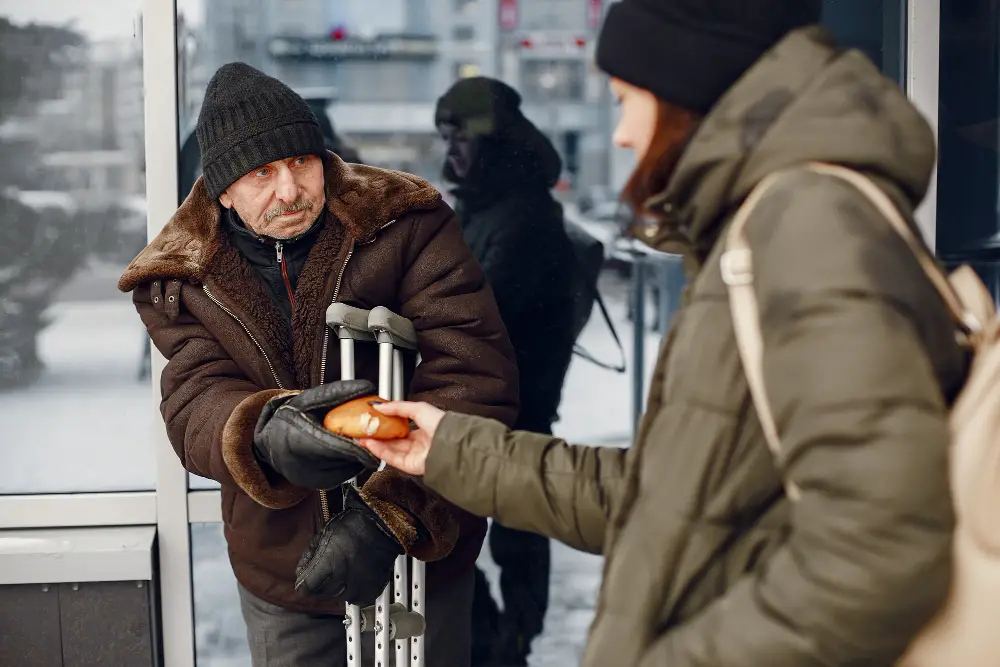
I met Larry two years before he died, though “met” isn’t the right word. You don’t meet the man who sits outside your subway station. He’s just there one day, part of the scenery, like the newspaper box and the broken parking meter.
The first winter, I walked past him the way everyone walks past. Eyes forward. Fast pace. I told myself I was busy, which was true, and I told myself somebody else would help him, which was a lie people tell themselves every single day.
Then one morning I bought two coffees by accident.
I’d been on the phone with my sister, half paying attention, and I ordered on autopilot. One with cream. One black. My sister always drank hers black and I must have been thinking about her. By the time I hung up, I was standing there holding a coffee I didn’t want, and Larry was six feet away, blowing on his hands.
I don’t know why I gave it to him. It was easier than throwing it out, maybe. It was easier than carrying it.
“You take it black?” I asked.
He looked up at me like I’d said something suspicious.
“That the only kind you got?”
“It’s the only kind I’ve got extra.”
He took it. He wrapped both hands around the cup and closed his eyes for a second, just feeling the heat.
“Black’s fine,” he said. “Black’s how I take it anyway.”
That was it. That was the whole thing. I went to work. I didn’t think about it.
But the next morning, without deciding to, I ordered two.
And then it was just what I did.
Every weekday for two years, I bought two coffees at the kiosk beside the station. Mine with cream. His black. I’d hand him his cup and we’d talk for five minutes, and then I’d rush off to my office and my spreadsheets and my life.
Larry never begged me for anything. That’s the thing people don’t believe when I tell them. In two years, he never once asked me for money. He never asked me for anything at all. If I brought him something, he took it and thanked me. If I didn’t, he never mentioned it.
But he talked.
God, could that man talk.
Some mornings we discussed the weather like two farmers. Other mornings he complained about the pigeons, which he claimed had a personal grudge against him.
“That gray one,” he said once, pointing. “That one’s been casing me for a week. He’s planning something.”
“He’s a pigeon, Larry.”
“That’s what he wants you to think.”
One morning he looked down at my shoes and shook his head slowly, like a doctor delivering bad news.
“Who designed those?”
“They’re work shoes.”
“They were designed by somebody who hated feet, Sarah. Somebody who woke up one morning full of hate, looked down at his own feet, and thought, I’ll make everyone suffer like I suffer.”
I laughed so hard I nearly spilled my coffee. A man in a suit stared at me like I was crazy, a woman in heels laughing with a homeless man outside the F train.
That was Larry. I never knew his last name for the longest time. I never asked where he’d come from or how he’d ended up on that patch of concrete. It seemed rude, somehow, and he never offered. We just had our five minutes. Mine with cream. His black.
I want to be honest about something. I thought I was a good person for those five minutes.
I really did. I’d walk into my office feeling warm, feeling like I’d done my small kind thing for the day. I bought him socks in the winter. I once spent half my lunch break calling shelters when the temperature dropped below zero, going down a list, getting hung up on, getting put on hold, until I found him a bed for two nights.
I brought him the address written on a napkin.
“You’ll go?” I asked. “Promise me you’ll go.”
“I’ll go.”
“Larry.”
“I’ll go, Sarah. Cross my heart.”
He thanked me for that napkin like I’d handed him the deed to a house.
I felt wonderful.
It never once occurred to me, in two whole years, that Larry might be learning something too. That every time I solved a problem for him, I was teaching him exactly how I worked. What I responded to. How to reach me.
I thought I was studying him.
He was studying me.
The freezing Tuesday came at the end of January.
I remember it was cold enough that the coffee steam looked like smoke, and my breath hung in the air in front of me. I bought the two coffees and walked over to Larry’s spot, and I stopped.
Because Larry looked terrible.
His skin had gone a strange yellowish color, like an old photograph. His lips were pale. His hands, when I gave him his cup, trembled so badly the lid rattled.
And across his knees he held a piece of cardboard. On it, in thick black marker, he’d written:
MARRY ME. I HAVE ONE MONTH LEFT TO LIVE.
I stood there. The traffic noise seemed to fade out, the way it does in movies, except this was real and it was happening to me.
“What is this?” I said, pointing at the sign.
He looked at the cardboard like he’d forgotten it was there.
“The clinic gave me about a month.”
I don’t remember deciding to sit. I just found myself on the cold concrete beside him, my nice work coat pressed against the dirty wall.
“What?” I said. “A month for what?”
“Liver failure.” He said it plainly, the way you’d report the score of a game. “It’s been coming a while. Went to the clinic when I couldn’t keep anything down. They ran their tests. Gave me the number.”
“Larry.” My throat closed up. “Larry, I’m so sorry.”
“Don’t.”
“Don’t what?”
“Don’t make that face.”
“What face?”
“The one people make when they’re already standing at your funeral.” He took a sip of his black coffee. “You’re doing it right now. Cut it out.”
Even then, dying, he could make me laugh. A wet, terrible laugh, but a laugh.
But the sign wasn’t funny. The sign was still sitting there on his knees.
“Why marriage?” I asked. “Of everything. Why that?”
His eyes dropped to his coffee. For the first time in two years, Larry looked like he didn’t want to talk.
“I don’t want to die belonging to nobody,” he said finally.
“You don’t belong to nobody. You’ve got—” I stopped, because I realized I didn’t actually know who he had. “You’ve got people who care about you.”
“That’s a nice thing to say, Sarah. It’s a different thing on a form.”
He explained it to me then, in that quiet voice. He told me that a man with no legal family, no wife, no children on record, doesn’t get buried by someone who loved him. He gets processed. Some county clerk, some overworked stranger, signs him over to a city plot. No name that means anything. No one to say the words.
“I just want somebody who can walk in and say, ‘He’s mine. I’ll take him.'” He looked at me. “That’s all. That’s the whole thing.”
And here is where I have to tell you the truth about myself, because it matters.
I was single. I’d been single for a long time. I was thirty-eight years old and I lived alone and I was very, very good at solving other people’s problems, mostly because I’d never learned how to sit with my own.
Larry was dying. He’d handed me a problem. A clean, solvable problem, with a form at the end of it.
And I had always been better at solving problems than walking away from them.
“Okay,” I said.
He blinked. “Okay?”
“Okay. Yes. I’ll do it.”
He looked at me for a long moment. Something moved across his face that I didn’t understand at the time. I thought it was relief. Later I’d wonder if it was something closer to guilt.
“You don’t have to decide right now,” he said.
“I just did.”
He nodded slowly. He folded up the cardboard sign and set it aside, and he never held it up again.
“Thank you,” he said. And then, because he was Larry: “Thank you.”
“That’s twice.”
“Thank you,” he said a third time, and grinned, and I punched him lightly in the arm, and that was how I agreed to marry a homeless man outside a subway station on a freezing Tuesday morning.
I told my friend Dana that night. Dana and I had worked together for six years and she was the only person I told anything to.
We were at the wine bar near the office, the one with the sticky tables, and I said it as casually as I could.
“So I’m getting married.”
Dana had her glass halfway to her mouth. She set it back down.
“You’re—what? To who? Sarah, are you seeing somebody? Since when?”
“You know Larry. Coffee Larry. The guy at my station.”
She stared at me.
“The homeless guy.”
“Don’t say it like that.”
“How am I supposed to say it? Sarah.” She lowered her voice, leaned across the table. “You’re marrying the homeless man who lives at your subway stop.”
“He’s dying, Dana. Liver failure. He’s got a month, maybe less. He doesn’t want to be buried as a nobody. If I marry him, I can claim him. I can make sure he gets—” I heard my own voice crack and hated it. “I can make sure somebody buries him with his name.”
Dana was quiet for a second. She reached over and put her hand on mine.
“Honey,” she said. “This is a lot. Even for you.”
“What does that mean, even for me?”
“You know what it means.” She wasn’t being cruel. Dana was never cruel. “You collect people. You always have. The intern nobody would train, you trained him. Your neighbor with the leg, you did her grocery runs for four months. You are the person who fixes things. And I love that about you. But you can’t fix dying, Sarah.”
“I’m not trying to fix dying,” I said. “I’m trying to fix the paperwork.”
She looked at me for a long time.
“And after?” she said. “When it’s done. When he’s gone. What then?”
I didn’t have an answer. I hadn’t thought about after. I’d only thought about the problem in front of me, the clean solvable problem, the way I always did.
“Then I’ll have done a good thing,” I said.
Dana squeezed my hand and let it go.
“You’re a good person,” she said. “I just hope this is for him and not for you.”
I didn’t understand what she meant.
Now, thinking back, I think she saw it before I did. She saw that I needed to be needed the way some people need to be loved. That I’d built a whole life out of showing up for other people so I’d never have to sit still long enough to notice how alone I was.
Larry saw it too.
He saw it better than anyone.
Two days later, we went to the courthouse.
Larry wore a clean blue button-down shirt. Someone at the shelter had given it to him, he said, though it hung loose on his shoulders because he’d lost so much weight. He’d washed his face and combed his hair and he looked, for one afternoon, like a regular man dressed up for something.
I wore my navy work dress. The nice one. I’m not sure why I bothered. Some part of me must have felt it mattered.
The courthouse waiting room was full of couples. A woman in a white jumpsuit was fixing her lipstick in a compact while her fiancé held her little bouquet like it might explode. A toddler was crawling under the plastic chairs, and his father kept diving after him and coming up empty-handed. Everyone looked nervous and happy, the way people look before they promise something big.
Larry and I sat in a row near the back.
He kept rubbing his palms against his pants. Back and forth. Back and forth.
“You’re shaking,” I said.
He looked down at his own hands like they belonged to someone else.
“I’m dying,” he said. “I’m allowed to shake.”
I accepted that. Of course I accepted that. What else would it be? The man was in liver failure. His hands were supposed to shake.
I didn’t think about it again for a long time.
When they called our names, we went into a small room with a wooden arch against one wall. A clerk read us the words. Larry answered when he was supposed to answer, his voice steady even though his hands weren’t.
When the clerk got to the part about rings, Larry patted his shirt pocket.
“Knew I forgot something.”
The clerk smiled. She’d clearly heard it before.
I laughed. A few of the people waiting glanced over.
Then the clerk had us sign. Larry asked twice where his signature went. Twice. A man who, it turned out, had spent twenty-eight years working in that exact building, asking a junior clerk where to sign his own marriage license.
I teased him.
“You’re acting like this is a real wedding.”
He went quiet for a second. Just a second. Then he smiled at me, and there was something underneath the smile I didn’t read at the time.
“First marriage,” he said. “Let me have my nerves.”
I laughed again.
Eleven minutes after we walked in, I was Larry’s wife.
Outside, on the courthouse steps, I bought us celebratory hot dogs from a cart because it felt like we should do something. Larry ate his slowly. He folded up his copy of the marriage certificate and tucked it into his shirt pocket, and he pressed his hand flat over it for a second, like he was making sure it was still there.
“You okay?” I asked.
“Never better,” he said.
And I believed him, because believing him was easier than asking what else might be true.
The three weeks we had after that went fast and slow at the same time, the way the last part of anything always does.
Larry moved into the state hospice facility. I’d arranged it, of course. I’d made the calls and filled out the forms and argued with an intake coordinator until she found him a bed. It was clean and quiet and smelled like disinfectant and something floral underneath, and Larry had a bed by a window that looked out at a parking lot.
“Room with a view,” he said the first day.
I visited every evening after work.
And every single visit started the same way.
I’d walk in carrying something. Better socks, because his old ones had holes. A phone charger, so he could reach me. A new blanket, because I decided the hospital one was too thin. A whole bag of toiletries once, enough for six months, which was a strange thing to buy a man who had three weeks.
I’d come through the door already talking, already unpacking, already looking for a nurse to flag down about something.
And Larry would say, from the bed: “Sit down, Sarah.”
And I’d say, “In a minute.”
There was always another minute of something to do. Another form at the front desk. Another nurse to ask about his pain medication. Another problem I could put my hands on. I’d fluff his pillow and organize his side table and refill his water cup and check the schedule and do everything except the one thing he actually asked me to do.
“You bought me socks again,” he said one evening, holding up the new pack.
“Your feet were cold.”
“My feet are always cold. I’m dying. That’s a feature, not a bug.” He set the socks down. “Sit down, Sarah.”
“I want to talk to that nurse about your—”
“Sarah.”
“—medication, because you said last night it wasn’t lasting—”
“Sarah.” His voice was soft but it stopped me. “The socks are great. Thank you. Sit down.”
I sat. On the very edge of the chair, ready to spring up again. He watched me do it and shook his head a little, but he was smiling.
“You know what you are?” he said.
“What am I?”
“You’re a hummingbird. You never land. You just hover over a thing and drink from it and zip off to the next thing.”
“That’s not true.”
“You’ve been here nine minutes and you’ve stood up four times.”
I opened my mouth to argue and then closed it, because I realized I was, at that very moment, half out of my seat.
I sat back down.
“See,” he said. “You can do it. Now don’t move.”
We talked. About nothing, mostly, the way we always had. The pigeons. My terrible shoes, which he continued to insult from his deathbed. A game show playing on the little wall-mounted TV. He told me a story about a coworker from some job he’d once had, a man who ate a hard-boiled egg at his desk every single day at exactly ten in the morning, and how the whole office could set their watches by the smell.
“Where’d you work?” I asked. “You’ve never told me. What did you do, before?”
Larry looked at the ceiling.
“Little bit of this,” he said. “Little bit of that.”
“That’s not an answer.”
“It’s the answer you’re getting.” But he said it gently. “Ask me something else.”
I let it go. I let a lot of things go with Larry, because it was easier, and because I thought we had more time to get to the hard questions.
We didn’t.
Our last Tuesday, I brought coffee.
Not from the kiosk. He couldn’t really drink it by then. But I brought a cup anyway and set it on his side table, black, just so the room would smell right. Just so it would feel like one of our mornings.
He was smaller by then. The yellow had gone deeper. His voice came out thin.
“You staying?” he asked when I sat down.
“Five minutes,” I said. Old habit.
He smiled, and it took effort.
“Big spender.”
I stayed twelve.
I didn’t mean to. I meant to check on his chart and refill his water and flag down a nurse and do all my usual things, but for some reason that evening I just sat. I held his hand, which was cold, and I didn’t get up, and I didn’t fix anything, and we didn’t even talk much. The TV murmured. The parking lot lights came on outside the window.
At one point he turned his head and looked at me.
“This is nice,” he said.
“What is?”
“This.” He moved his fingers a little in mine. “You. Sitting. Not running around.”
“I run around because I care about you, you know.”
“I know.” He closed his eyes. “But this is better.”
Twelve minutes. Then I told him I’d see him tomorrow, and I kissed his forehead, and I left.
He died that night, sometime after two in the morning. The nurse who called me said it was peaceful. She said he wasn’t alone, that she’d been in the room. I’ve held onto that. I don’t know if it’s true, exactly the way she said it, but I’ve held onto it.
Those twelve minutes were the last time I saw him awake.
I keep thinking about that. About how I almost only gave him five.
The funeral was small.
I paid for it, which felt right, and I picked a plot in a quiet cemetery under a tree, because Larry had once mentioned he liked trees more than people, “and they don’t ask you for anything.”
Dana came, and stood next to me, and held my arm. A few people from the shelter came. And two older folks I didn’t recognize, a man and a woman, stood at the back the whole time and left before I could ask who they were. I assumed they were shelter volunteers. I found out later I was wrong.
The minister I’d hired hadn’t known Larry, so he read the generic words, the ones about ashes and dust, and I stood there in the cold and felt like a fraud. Because I realized, standing at his grave, that I’d married the man and buried the man and I didn’t know where he was from, or if he had a family somewhere, or what he’d done for twenty-eight years, or a single true thing about his life before the day he sat down on that concrete.
I thought I knew Larry.
I knew his coffee order.
We lowered him into the ground, and I put a hand on the casket, and I said the only thing I could think of.
“He’s mine,” I said, quietly, so only I could hear it. “I took him.”
I thought that was the end of it.
Then his letter came.
I’ve told you the beginning of the letter. Let me tell you the rest, because I read it in pieces over that whole terrible day, and each piece knocked something loose in me.
After the first two lines, the ones that turned me cold, I made myself keep reading at the kitchen table.
“The liver failure was real. The month was real. The lie was why I asked you to marry me.”
I read that three times.
“My arrangements were already handled,” he wrote. “Long before I ever met you. I knew somebody from hospice or the county would deal with the paperwork when the time came. I was never going to disappear without a name. That part, the John Doe part, I made it up. I made it sound worse than it was because I knew if I handed you a problem, a clean one you could solve, you’d solve it. You always did. If I gave you a problem you could solve, I knew you’d solve it.”
I stood up so fast my chair scraped back and nearly tipped over.
“What did you do, Larry?” I said out loud, to my empty kitchen.
But there was nowhere for the anger to go. That was the worst part. He was dead. I couldn’t call him. I couldn’t storm into the hospice and demand an explanation. I couldn’t even make him sit through the look on my face, the way he’d made me sit in that chair.
He’d figured out how to get the last word by dying with it in his pocket.
I paced my apartment. I got angry, then confused, then angry again. Because he was right. That was the thing that hurt the most. He’d read me exactly right. If he’d walked up to me two years in and simply said, “Sarah, I’m lonely, will you marry me so I’m not alone,” I don’t know what I would have said. It would have been messy. It would have been a feeling, not a task.
But turn it into a form? A burial? A problem with a clear solution?
I’d said yes in about four seconds flat.
I sat back down and forced myself to read the last line on that first page.
“Before you decide what kind of jerk I was,” he’d written, “go back to the courthouse where we got married. Ask for Margaret. Tell her you’re my wife.”
I almost threw the whole letter in the trash. I got as far as standing over the garbage can with it in my hand.
But I didn’t.
An hour later, I was on the train.
The courthouse looked exactly the way it had three weeks earlier. The same plastic chairs, the same nervous couples, the same fluorescent buzz. A woman was fixing her lipstick. A different toddler was crawling under a different set of chairs.
I stood in the lobby and remembered sitting there with Larry, watching him rub his palms on his pants.
“You’re shaking,” I’d told him.
“I’m dying. I’m allowed to shake.”
And I’d accepted it. Because it was easier than asking another question.
Standing there now, I wondered how many things I’d accepted in my life simply because the harder answer would have cost me something.
I went to the records counter. A young clerk looked up.
“I’m looking for Margaret?” I said.
He pointed toward an older woman a few desks down, gray hair, red reading glasses pushed up on her head. I walked over. My heart was going hard for no reason I could name.
“Margaret?”
She looked up. “Yes?”
“I’m Sarah,” I said. “I’m—I was—Larry’s wife.”
Her hands, which had been resting on her keyboard, went completely still.
“Larry?” she said.
I nodded.
Her chair rolled back an inch. Her face did something complicated.
“Oh, honey,” she said.
She got up, came around the counter, and hugged me. I stood there stiff as a board, arms at my sides, not knowing what to do with any of it. I hadn’t come for a hug. I’d come for an explanation.
When she let go, her eyes were wet behind the red glasses.
“When did he pass?” she asked.
“A week ago.”
She looked down at the floor. “I knew he was sick. I didn’t realize it was that close.”
“You knew Larry?” I said.
She looked at me like I’d asked something obvious.
“Of course I knew Larry.”
“How?”
She glanced around the busy office, all the couples, all the noise. She lowered her voice.
“He worked here,” she said.
I stared at her.
“Here?”
“Twenty-eight years.”
For a second the whole room tilted. Twenty-eight years. Little bit of this, little bit of that. Ask me something else.
“Then how did he end up outside my subway station holding a piece of cardboard?” I said. My voice came out sharper than I meant it to.
Margaret took off her glasses and folded them slowly.
“His health went after he retired,” she said. “It came on fast. The medical bills ate his savings, and then some. When he lost the apartment, he was too proud to call any of us. We didn’t even know until it was too late. I looked for him. A few of us did. He didn’t want to be found.”
I thought of the two people at the back of the funeral, the ones who left before I could ask their names.
“What did he do here?” I asked. “For twenty-eight years.”
Margaret smiled, but it was a sad smile.
“Marriage licenses, mostly,” she said. “This department. Right here.” She put her glasses back on. “He never told you, did he.”
“No.”
“That sounds like Larry.”
“What does that mean,” I said, “that sounds like Larry? Everyone keeps saying things like they knew him and I’m starting to feel like I married a stranger.”
Margaret studied me for a moment. Then she came to a decision.
“Come with me,” she said.
She led me down a hallway I’d never noticed, past offices and storage rooms, and stopped at a door. She opened it. Inside was a small ceremony room, plain, with rows of folding chairs and a wooden arch against the far wall.
I knew that arch.
“This is where we got married,” I said.
“I know.”
“You were here?” I turned to her. “At our wedding?”
“No.” She stepped into the room. “But Larry was. The afternoon before.”
“The afternoon before what?”
“Before your wedding. He came in the day before. Sat right there.” She pointed to a single chair beside the wooden arch. “For almost an hour.”
“Why?”
Margaret walked to a cabinet in the corner and crouched down, working a key into the bottom drawer.
“I asked him the same thing,” she said. “I came in to lock up and there he was, sitting in that chair, just looking at the arch. I said, Larry, what on earth are you doing. And you know what he told me?”
“What?”
“He said he was nervous.”
I almost laughed. It came out as more of a cough.
“A man who worked around weddings for twenty-eight years,” I said. “Nervous.”
“That’s exactly what I told him.” Margaret pulled a thick black binder out of the drawer and stood, holding it against her chest. “And he looked at that arch, and he said to me, ‘Tomorrow I’m standing on the other side of the desk.'”
I felt the floor go soft under me again.
The other side of the desk. All those years he’d stood behind the counter, handing licenses to other people. And the next morning it was going to be him, in the chair, saying the words.
I thought about his shaking hands in the waiting room.
“I’m dying,” he’d said. “I’m allowed to shake.”
I’d blamed the illness. I’d blamed the thing that let me stop asking.
But maybe I’d been watching something else the whole time.
Maybe he’d been nervous.
Maybe he’d been nervous the way any man is nervous on the day he gets married for the first time in his life, at the very end of it, to someone he wasn’t sure had chosen him or just chosen the problem.
Margaret set the binder on a table and opened it.
“Look,” she said.
Under a clear plastic sleeve was an old marriage record. Yellowed at the edges, the date going back decades. Two names at the top, a man and a woman, strangers to me.
And near the bottom, in handwriting I knew as well as my own by then, one signature.
Larry.
Beside it, one word.
Witness.
Margaret turned the page. Another record. Different couple. Different year.
Larry.
Witness.
She turned another. And another. The dates jumped forward through the decades. Different people. Different handwriting for the couples. But the same narrow, careful L. The same crooked little y that trailed off at the end. The same word beside it, over and over.
Witness. Witness. Witness.
“What is this?” I whispered.
“Sometimes people came in to get married with nobody,” Margaret said. “No family. No friends. Just the two of them, or sometimes—” she paused. “Sometimes just one, waiting for someone who never showed. The law used to want a witness. And Larry couldn’t stand it. He couldn’t stand the idea of somebody getting married with an empty room behind them.”
She turned another page.
“So he’d step out from behind that counter, walk in here, and stand up for them. Strangers. He’d sign the line. He’d say congratulations. Half the time he’d stay and take a picture on their little camera so they’d have one. Then he’d go back to his desk and finish his afternoon.”
I put my finger on one of the signatures. It was strange, seeing his handwriting from years before I ever knew him. Before the coffee. Before the concrete. A younger Larry, healthier, stepping out from behind a desk so a stranger wouldn’t have to marry into an empty room.
“How many?” I asked.
Margaret shrugged.
“Hundreds,” she said. “Over the years. Nobody counted.” She smiled, and this one had some warmth in it. “He used to joke that he’d been to more weddings than anyone alive in this building and never once had to remember an anniversary.”
A laugh escaped me. A real one.
And then it died in my throat, because the obvious question arrived, the one I should have asked weeks ago.
“Was he ever married?” I said. “Himself. In all those years. Was Larry ever married?”
Margaret closed the binder slowly.
She didn’t answer.
“Margaret?”
“Once,” she said.
I searched her face. “To who?”
She looked me right in the eyes.
“You.”
I sat down in the folding chair. The one by the arch. The one he’d sat in the day before, being nervous.
“Twenty-eight years,” Margaret said quietly, “he watched other people walk in as two strangers and walk out belonging to each other. And when they had nobody, he stood up for them. His name is in that book hundreds of times. But it never once appears next to the word spouse.”
She let that sit.
“Not until you.”
I don’t know how long I sat in that chair. Margaret didn’t rush me. She just stood there with her hand on the binder, the way you stand with someone at a graveside.
Finally she went back to the cabinet and opened a different drawer.
“There’s one more thing,” she said. “He asked me to pull this after the marriage was recorded. Just in case you ever came looking for me. He said, ‘If she comes, she’ll be angry, and she’ll deserve to be. Give her this.'”
She took out a clear plastic sleeve and set it in front of me.
Inside was a copy of our marriage certificate.
My name. Larry’s name.
And beside his, that word.
SPOUSE.
I remembered how carefully he’d folded his copy on the courthouse steps. How he’d pressed his hand flat over his shirt pocket to make sure it was still there. How he’d asked the clerk twice where to sign, a man who had shown a thousand other people where to sign that exact line.
I’d teased him.
“You’re acting like this is a real wedding.”
He’d gone quiet. Then he’d smiled.
“First marriage. Let me have my nerves.”
First marriage. He hadn’t been joking. He’d been telling me the truest thing he ever told me, and I’d laughed at it.
“He set all this up,” I said. “The letter. Sending me here. You having this ready. He planned the whole thing.”
“He did.” Margaret sat down in the chair next to mine. “He wanted you to understand something. Did he tell you why he asked you to marry him? In the letter?”
I told her. About the John Doe story. The burial. The confession that he’d made it sound worse than it was, that he’d handed me a problem because he knew I’d solve a problem when I might not answer a feeling.
I waited for Margaret to defend him.
She didn’t.
“That wasn’t fair to you,” she said. “You should know that. What he did wasn’t fair. He knew it too. That’s why he apologized.”
“Then why did he do it?”
Margaret looked at the certificate.
“Because Larry was always better at asking for practical help than at asking anybody to choose him,” she said. “He’d spend his life stepping into empty rooms for strangers. But when it came to his own empty room—” She shook her head. “He didn’t know how to just ask. So he found a way you wouldn’t be able to say no to.”
I looked at his signature. Spouse.
“What was I really saying yes to?” I said. “That’s what I want to know. When I said yes. What did I actually agree to?”
Margaret stood up. She squeezed my shoulder.
“That’s not my story to tell, dear,” she said. “I think he left you the rest of it.”
She was right. There were still pages in my purse I hadn’t read. He’d told me to come here first. He’d wanted me to see the binder, the certificate, the word, before I read the end.
I thanked Margaret. I don’t think I said it very well. She hugged me again, and this time I hugged her back, and she told me that if I ever wanted to hear stories about him, the real him, from before, I knew where to find her.
“He talked about you,” she said, at the door. “The last time I saw him, before he got so sick. He came by to say hello and he told me about the woman who brought him coffee. Two coffees. Every day for two years.” She smiled. “He said, ‘She thinks she’s just being nice, Margaret. She has no idea.'”
“No idea about what?”
But Margaret just patted my arm and went back to her desk, and I walked out into the cold with the rest of the letter waiting in my purse.
I took the subway toward home. But when the train pulled into Larry’s old stop, I got off. I don’t fully know why. My feet just carried me up the stairs and out into the evening.
The kiosk was still there. The woman behind the counter recognized me.
“Two?” she said. Old habit. She’d been ringing me up for two coffees for two years.
I almost said yes. My mouth almost formed the word. Then I looked over at the empty patch of concrete beside the station entrance, the spot where Larry used to sit, and something in my chest folded over.
“Yeah,” I said. “Two.”
She handed me both. Mine with cream. His black.
I carried them over to his spot, and for the first time in two years, I sat down there. Really sat. Not for five minutes on my way to somewhere else. I set his black coffee on the ground beside me, in the spot where he would have been, and I took out the letter.
He’d written only one line at the top of the next page.
“I didn’t need a wife to make my life matter, Sarah.”
And under it:
“But I did want to know what it felt like, once, to have somebody choose that word with me.”
I had to stop and breathe.
The black coffee beside me sent up its little curl of steam into the cold air. The trains rumbled underneath the pavement. People streamed past, not looking at me, the way they’d never looked at Larry.
I read the next line.
“I knew if I’d told you the truth, you might still have said yes.”
“So why didn’t you?” I said out loud.
His answer was right there, waiting under the question, the way it always was.
“Because then I’d have had to hear you decide whether being lonely was a good enough reason. And I didn’t think I could stand it if the answer was no. So I made it easier for you to say yes by turning loneliness into paperwork. You had the right to know. I’m sorry.”
I sat with that for a long time.
Because suddenly two years of coffee mornings rearranged themselves in front of me. Two years of me thinking I was the one giving. Me with my socks and my shelter phone numbers and my warm smug feeling walking into work. And Larry the whole time, lonely, watching me, learning the one language I could always hear.
Problems. Tasks. Things to fix.
He couldn’t say, “I’m lonely, choose me.” He didn’t have the words for it, or he had them and they scared him. So he wrapped his loneliness in a form and handed it to me, because a form I could take.
“You should have told me,” I whispered.
A train rumbled under my feet.
The letter went on.
“You always wanted to fix things for me. I liked that about you, even when you drove me crazy. But I have to tell you something, and I need you to actually hear it.”
I turned the page.
“I didn’t need better socks as much as you thought I did.”
I laughed. It came out wet and broken. A woman walking past gave me a look and hurried on.
“You’re welcome, Larry,” I said to the empty spot. “You ungrateful—”
I read the next line.
“I needed you to sit down.”
I looked at the black coffee on the ground next to me. At the empty concrete.
I needed you to sit down.
All those evenings at the hospice. Sit down, Sarah. In a minute. Sit down, Sarah. There’s a nurse I need to find. All that time I thought I was loving him by staying busy, by fixing, by hovering like the hummingbird he called me. And the whole time, the one gift he actually wanted was for me to stop moving and just be there.
Twelve minutes, our last Tuesday.
“This is nice,” he’d said. “You. Sitting. Not running around.”
Maybe those twelve minutes had been the only real gift I ever gave him. Maybe everything else, the socks and the blankets and the toiletries for six months, maybe that had been for me all along. So I wouldn’t have to sit still. So I wouldn’t have to feel anything.
The final part of the letter began, and my hands were shaking now the way his used to.
“There’s one more thing, and it’s the most important thing, so pay attention.”
“Don’t turn me into one more person you failed to save.”
My fingers stopped on the page.
Because I had been doing exactly that. Every day since the funeral, I’d been running the tape backward, looking for the exit I missed. If I’d noticed the yellow in his skin sooner. If I’d found him better doctors. If I’d gotten him into housing two winters ago. If I’d done more, tried harder, moved faster. I’d been adding Larry to the long, quiet list I carried around inside me, the list of people I couldn’t fix.
Under that line, he’d written:
“You were not my failed rescue, Sarah. You were my wife for three weeks. I liked it. I liked it more than almost anything in my whole life, and I had a pretty full life, whatever it looked like from that piece of concrete. Don’t let your guilt take that away from me. It’s mine. I earned it.”
A laugh broke out of me, big and awful, the kind that’s really crying wearing a costume.
“Idiot,” I said, to the empty spot, to the black coffee, to the trains under the ground. “You absolute idiot.”
There was one line left.
“Next time you start fixing somebody’s life, ask them what they actually want first. That’s my whole marriage advice. Take it or leave it. I love you. Thank you. Thank you. Thank you.”
Three thank-yous. Of course. Three, right to the end.
I folded the letter carefully around the copy of our certificate, the way he’d folded his on the courthouse steps, and I pressed my hand flat over it for a second the way he had, and I sat there in his spot as the sky went dark.
For decades, his name had appeared beside one word. Witness.
For three weeks, it had appeared beside another. Spouse.
He’d stood up for hundreds of strangers so they wouldn’t have to marry into an empty room.
And at the very end, he’d found one person to stand up for him.
I just wish I’d understood, while he was alive, that standing up for someone and sitting down with them were two different things, and he’d only ever needed the second one.
I stayed on that concrete a long time.
Long enough that the black coffee beside me went cold, its steam gone. Long enough that the evening rush thinned out and the station got quiet.
At some point a shadow fell across the sidewalk in front of me.
“Excuse me,” a voice said. “Is this seat taken?”
I looked up. A man stood there, maybe fifty, with a worn backpack over one shoulder and a face that had spent too many nights outdoors. He was nodding at the empty space beside me. Larry’s space. Where the cold coffee sat.
And my hand moved. Automatically. Toward my purse. Toward my wallet. Toward the reflex I’d had my whole life, the fix, the solve, the buy-him-something, the warm smug feeling.
Then I stopped.
Next time you start fixing somebody’s life, ask them what they actually want first.
I moved the coffee. I gestured to the spot.
“No,” I said. “It’s not taken. Go ahead.”
He sat down, a careful arm’s length away, and let out a long breath, the way you do when your feet finally stop.
I almost asked if he was hungry. I almost asked if he needed a coffee, a phone number, a shelter bed, if he had somewhere to sleep tonight, all the questions that were the old me, the hummingbird, already lifting off toward the next thing to fix.
Instead, I just sat there with him. For a minute we didn’t say anything at all. We watched people hurry down into the station, coats pulled tight, eyes forward, the way people do.
Then I held out my hand.
“I’m Sarah,” I said.
He looked surprised. Like it had been a while since anyone offered him a hand instead of change.
“Jeremy,” he said, and shook it.
“Nice to meet you, Jeremy.”
We sat a while longer. I didn’t fix anything. I didn’t solve anything. I didn’t hover. I just sat next to a person, which turned out to be one of the hardest things I know how to do, and one Larry had spent three weeks trying to teach me.
After a bit, I picked up the second coffee. The black one. His.
I took a sip.
I made a face. It was cold and bitter and awful. I don’t know how he drank it that way for two years.
Jeremy glanced over.
“Bad?” he asked.
“No,” I said. I looked at Larry’s empty spot. “Just not mine.”
I got up and walked back to the kiosk. The woman behind the counter was closing up, but she saw me coming and waited.
“Another black?” she asked.
I shook my head.
“Actually,” I said, “could I get one with cream?”
She smiled and made it.
When I came back, Jeremy was still there, and I sat back down next to him, and this time I had a coffee that was actually mine. Larry’s letter and our marriage certificate rested against my leg, folded together, the witness and the spouse, all the empty rooms he’d filled and the one person who’d finally filled his.
I wasn’t rushing anywhere.
For the first time in as long as I could remember, I had nowhere I needed to be and nothing I needed to fix, and I let myself just sit there in the cold with a stranger and a coffee, and be still, the way he’d asked me to.
The coffee in my hands was warm and sweet.
It finally tasted like mine.

Laura Bennett writes about complicated family dynamics, difficult conversations, and the quiet moments that change everything. Her stories focus on real-life tensions — inheritance disputes, strained marriages, loyalty tests — and the strength people find when they finally speak up. She believes the smallest decisions often carry the biggest consequences.