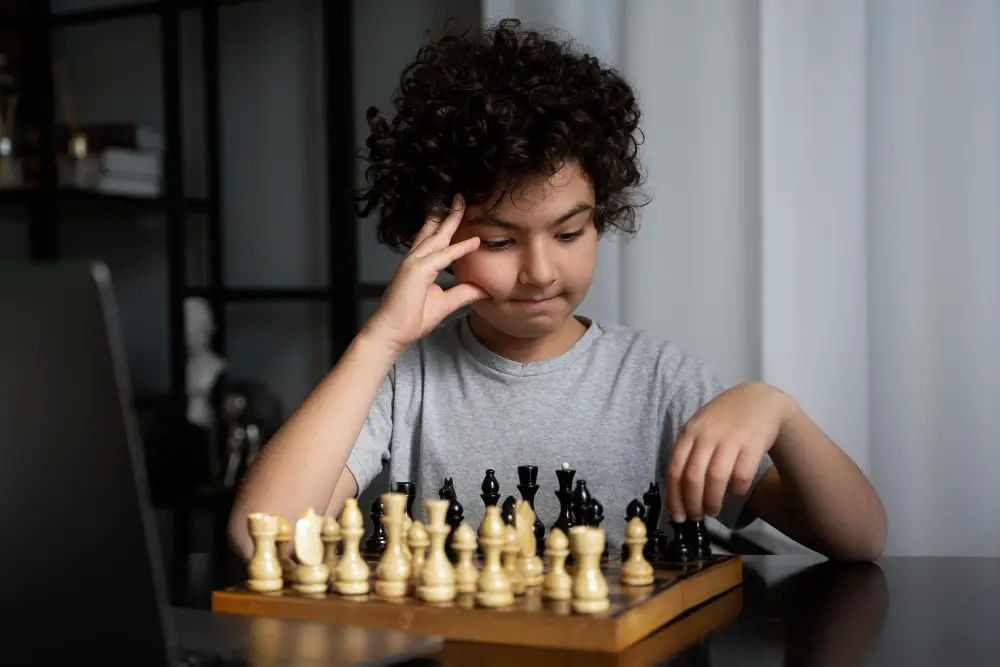
“Nobody cares about pawns.”
Miles said it with the absolute confidence only a seven-year-old can bring to something completely wrong.
Arthur reached across the concrete chess table, slow the way he did everything, and lifted the white pawn he’d just captured.
“That’s why you keep losing them, Soldier.”
Miles’s whole face scrunched up like he’d bitten a lemon.
“Don’t call me Soldier.”
Arthur turned the pawn between his fingers, studying it like it was worth something. “Why not?”
“Because soldiers are pawns.”
“And?”
“They’re the weakest.”
Arthur nodded, slow and serious, like Miles had just delivered expert testimony in a courtroom.
“Only if they stay where they started, dear.”
Miles rolled his eyes so hard I could see it from my bench ten feet away.
“That doesn’t even make sense, Artie.”
“It will.”
“You’re old.”
“I’ve been informed.”
“You make everything into a lesson.”
Arthur smiled, and set the captured pawn down beside the board with all the others. “Your move, Soldier.”
Miles groaned like the world was ending.
I covered a laugh with my coffee cup and turned back to my laptop, and I didn’t think anything of it. That was the mistake I’d spend months not knowing I was making. I thought I was watching a nice old man teach my kid a board game. I thought I was ten feet away, keeping an eye on things.
I had no idea what was actually happening across that table.
Miles had been obsessed with chess since he was five.
I still don’t totally know where it came from. His father was long gone by then, off to a new city and a new life and a new phone number he didn’t give us, so it wasn’t that. It wasn’t me. I can barely remember how the horse-shaped one moves. It was just something inside Miles, some little gear that turned differently than other kids’ gears.
Every day after school, the other children went sprinting for the playground. The swings, the slide, the screaming, all of it. And Miles walked right past every bit of it and headed for the concrete chess tables near the back of the park like a retired accountant showing up for a standing appointment.
I’m a single mom and I work from home, so I built my whole schedule around that walk. School pickup, park, an hour and a half at the table while I answered emails on my laptop, then home for dinner. It wasn’t glamorous. But it worked, and Miles was happy, and a happy quiet kid is not something you go poking at just because it’s a little unusual.
The trouble was, at first, nobody would play with him.
The other kids thought chess was boring. The occasional grown-up would sit down and let him win in about four moves and then say “wow, you’re really good!” in that fake bright voice adults use, and Miles hated that more than anything. He could smell it. He’d come back to my bench furious.
“He let me win, Mom.”
“How do you know?”
“Because I did a bad move and he didn’t take it.”
So mostly he played himself. He’d set up both sides and play against nobody, moving around to the other side of the table to make the opponent’s move, arguing quietly with himself. It broke my heart a little, if I’m honest. But he seemed content, and I told myself content was enough.
Then Arthur showed up.
The first time I noticed him, he was sitting alone at one of the far tables, and he wasn’t playing.
He was just looking at the empty board painted into the concrete. Both hands folded on top of his cane. A paper coffee cup steaming next to him. He had the stillness of a man who had nowhere in particular he needed to be and had made peace with it a long time ago.
Miles noticed him too. Miles noticed him the way a shark notices a swimmer.
He stared at the old man for a solid thirty seconds, which is a long time for a seven-year-old to hold still. Then he picked up his chess box and started walking over.
I closed my laptop halfway. “Miles?”
He ignored me completely.
He marched up to the old man’s table and set his box down with a thunk, and I got ready to apologize, to scoop him up, to explain that we don’t just impose ourselves on strangers.
The old man looked up.
“Do you know how to play?” Miles asked.
The old man looked at the chess box. Then at my son’s face, which was set in that fierce little scowl he gets.
“A little,” he said.
Miles narrowed his eyes to slits. “That means yes.”
The old man’s mouth twitched. “Does it?”
“Adults say ‘a little’ when they’re good and don’t want kids to know.”
I put my face in my hands. “I’m so sorry,” I called over.
The old man glanced toward me, and there was something warm underneath all those wrinkles.
“Don’t be,” he said.
Then he reached out and moved one of Miles’s white pawns forward two squares, opening the game himself.
“Your son has already insulted my integrity,” he said. “We might as well play.”
That was the first game. Miles lost in about twenty minutes, and it was the happiest I’d seen him lose anything in his whole life, because for once the person across from him had actually been trying.
By the end of that week, “Mr. Arthur” had become “Artie.” Arthur pretended to hate it. He’d sigh every time, “It’s Arthur, thank you,” and Miles would say “okay, Artie,” and Arthur would sigh again. Somewhere in there Arthur started calling him “Soldier,” which Miles genuinely, deeply hated, which of course guaranteed Arthur would never once stop for as long as he lived.
Their games became the shape of our afternoons.
Arthur was always there first. Same table, the one by the big oak. Same coffee. Sometimes a folded newspaper he never seemed to actually read. He’d have the board halfway set up before we even came down the path, and Miles would run the last stretch to get to it.
Mostly what they did was argue.
“You can’t do that.”
“I just did.”
“That’s cheating, Artie!”
“It’s called castling.”
“You didn’t tell me that rule.”
“You didn’t ask.”
“ARTIE.”
But here’s the thing I noticed even back when I wasn’t really paying attention, the thing that made me trust him without ever quite deciding to. Arthur never rushed my son. Not once. Miles would sit and stare at the board for four, five, six minutes, his chin in his hands, working it out. And most adults can’t handle that. Most adults start filling the silence. “Take your time!” “No pressure!” “Do you see a good move?” All of it just noise, all of it pressure dressed up as patience.
Arthur just sat. He’d sip his coffee and watch a bird and wait, completely comfortable inside the quiet, like the silence was a room he lived in and was glad to have company in.
I’ve thought about that a lot since. How rare it is. Somebody who can just be quiet with you and not need anything from it.
One afternoon Miles threw away three pawns in ten moves. Just chucked them into battle to get captured, one after another, like he was trying to get rid of them.
Arthur leaned back and folded his arms. “Do you have a personal grudge against the infantry?”
“They’re useless.”
“Interesting.”
“They only move one square.” Miles shoved one across the table for emphasis.
“Usually.”
“And they can’t even go backward.”
“Correct.”
“They’re terrible, Artie.”
Arthur reached over and picked up one of the captured pawns Miles had thrown away. He held it up between them.
“What happens,” he said, “if this terrible little fellow makes it all the way to the other side of the board?”
Miles shrugged. “He gets stuck?”
Arthur looked so offended I laughed out loud from my bench.
And then, for the first time, he taught Miles about promotion. He lined up the queen and the rook and the bishop and the knight across the middle of the board, and he explained that a pawn who crosses the whole board, who survives all the way to the last rank, gets to become any one of them.
Miles’s eyes went huge. “Wait. A pawn can turn into a queen?”
“Yes.”
“That’s stupid.”
Arthur laughed, a real laugh, the kind that turned into a little cough at the end. “Why is it stupid?”
“Then why doesn’t everybody just use pawns?”
“Ah.” Arthur set the pawn down in the middle of the board. “Because getting to the other side is the hard part, Soldier. Anyone can start a pawn moving. Almost none of them make it all the way across. That’s the whole game, really. Deciding which ones are worth walking all that way.”
Miles stared at the little piece for a long time. Then he muttered, “Still don’t call me Soldier.”
Arthur smiled and moved his bishop. “Get to the other side, Soldier.”
From my bench I watched Miles try to hide a grin behind his hand, and fail.
The pawn thing became a whole ritual, and it took me an embarrassingly long time to understand any of it.
It started with Miles coming home mad.
“Artie stole another one.”
“He stole your chess piece?” I looked up from the stove.
“Not stole stole, Mom.” He said it with enormous disdain, like I was the dumbest woman alive. “Not like a robber.”
“That’s an important distinction.”
“He kept it.”
“Kept which one?”
“My pawn. The one that got to the other side.” Miles crossed his arms. “I promoted it and made it a queen and then he took the old pawn and put it in his pocket.”
“Why would he do that?”
“He said it was evidence.”
“Evidence of what?”
Miles scowled. “That I’m teachable.”
I laughed so hard I had to sit down, and Miles got so offended he refused to talk to me through most of dinner.
The next afternoon I walked over during a water-bottle break and asked Arthur if he was stealing chess pieces from small children now.
He put one hand flat over his heart, wounded to the core. “Maisy. I am preserving history.”
“Uh huh.”
“He’s being annoying,” Miles called from the water fountain.
“That too,” Arthur agreed, without missing a beat.
I went back to my bench. I thought it was a cute bit. A running joke between an old man and a little boy. I genuinely did not understand, not for months, that every single one of those pawns meant something. That he was keeping a record of every time my son learned to walk something small and weak all the way across a hard distance and turn it into something that mattered.
I was ten feet away. I’ve had to make my peace with how much you can miss from ten feet away.
The park had a little coffee kiosk near the entrance, and one afternoon Miles came sprinting back from it holding two white paper sugar packets like they were treasure.
He slapped them down in front of Arthur. “These are for you.”
Arthur looked at them. “For what?”
“Your coffee.”
“I know what sugar is, Soldier.”
Miles sighed, the long-suffering sigh of a boy dealing with a truly hopeless adult. “Old people like sweet coffee, Artie. Everybody knows that.”
I nearly choked on my drink. “Miles!”
“What? They do.”
Arthur was quiet for a second. Then he reached out and took the two little packets, careful, like they might tear.
“Thank you, Soldier,” he said.
He didn’t put them in his coffee. I noticed that even then, and I filed it away as one more small strange thing about Arthur that I’d never think about again.
I was wrong about that, too.
Then Arthur started missing days.
Not many, at first. One Tuesday. Then a Friday two weeks later. The first time, we got to the park and his table was empty and Miles refused to sit anywhere else, refused to play anyone else, just stood there with his box under his arm scanning the path until it got dark and we had to go home.
When Arthur came back the next day, Miles was furious with him.
“You weren’t here.”
“I noticed I wasn’t, yes.”
“I waited, Artie.”
Arthur studied the board a moment. “You could have played somebody else, you know.”
Miles looked genuinely insulted by the suggestion. “They play weird.”
“A compelling endorsement of my company.”
But I saw something pass over Arthur’s face when Miles said I waited. Something that wasn’t quite a smile.
A few afternoons later, Arthur seemed tired in a way I hadn’t seen before. Grayer. He rubbed the flat of his hand against his chest, slow circles, and then he caught me watching him and immediately reached for his coffee cup like nothing had happened.
I waited until Miles ran off to refill his water bottle, and then I came and sat down across from Arthur, in Miles’s chair.
“You okay?”
“Perfectly.”
“That’s not an answer, Arthur.”
“It’s technically an answer.”
“Arthur.”
He looked at me then, and the joking dropped out of his face for just a second, and he gave me a small, tired smile. “Just getting old, Maisy. That’s all. It happens to the best of us. Even to Soldiers, eventually, though don’t tell him that.”
I didn’t like it. There was something underneath the words I couldn’t get at. But before I could push, Miles came trotting back with his water, and Arthur turned to him instantly and said “Your move, Soldier,” and the whole thing folded shut like it had never been open.
I told myself I’d ask again. I told myself there’d be time.
About a week after that, I heard Arthur say something that stuck in me like a splinter.
Miles was deep in thought over the board, and Arthur was watching him, and out of nowhere he said, quiet:
“Soldier. Someday I might not be sitting here.”
Miles didn’t even look up from the board. “Then I’ll wait.”
Arthur’s hand stopped in the air over his bishop.
I looked up from my laptop. Arthur glanced over at me, just for a second, and then he moved his piece and said nothing else, and neither did I.
But I remembered it. God, did I remember it.
Especially the day it came true.
We got to the park at 3:30, same as always.
Arthur’s table was empty.
Miles stopped dead on the path. “He’ll come,” he whispered, almost to himself.
“Maybe he’s just running late, sweetie.”
“Artie doesn’t run, Mom.”
I smiled despite myself. “You know what I mean.”
We walked the rest of the way to the table, and Miles opened his chess box, and then he stopped, because the board was already set up. Not fresh, not ready for a new game. Set up in the middle of one. Pieces scattered across it in a pattern, most of them already gone, only a handful left standing.
“Did Artie leave these?” Miles asked.
“Maybe. Don’t touch them yet, okay?”
He kept looking down the path. So did I.
At 4:10, when the light was starting to slant long and gold through the trees, I finally closed my laptop.
“Miles. I think maybe we should head home.”
“No.”
“Honey.” I crouched down next to him. “Remember what Arthur said? That someday he might not be sitting here?”
Miles looked toward the park entrance, his jaw set hard.
“But he didn’t say today,” he said.
And right then, like it had been waiting for the words, a park ranger’s golf cart came humming around the bend in the path.
The ranger slowed when he saw us. Then stopped. He climbed out holding a plain white envelope, and something about the careful way he held it made my stomach drop before he’d said a single word.
“Excuse me,” he said. “Are you the lady whose boy plays chess with the older gentleman? Arthur?”
I was on my feet before the cart had fully stopped. “Yes. What happened? Is he—”
The ranger held the envelope out to me. “He came by first thing this morning. Asked me to make sure you got this. Made me promise, actually.”
Miles was suddenly pressed against my side. “Where’s Artie?”
The ranger’s face went soft in a way that scared me more than anything. He looked at Miles, and then at me, and he just said, gently, “He asked me to make sure your mom got the letter, buddy.”
Which wasn’t an answer. Which was the kind of non-answer that means the worst thing.
My hands were shaking as I took the envelope. The ranger gave me a small nod, got back in his cart, and drove away, and I understood he was leaving because he didn’t want to be there for whatever came next.
Arthur had written my name across the front. Just:
MAISY
Nothing else. In careful, shaky capital letters.
I tore open the flap. Inside was a single small sheet of paper, folded once. Four handwritten lines.
Maisy,
I won’t be at the table anymore.
Please don’t take Miles home yet.
Ask him to finish today’s game. He knows which one.
I forgot how to breathe. I read it three times and the words wouldn’t stay still.
“Miles,” I started, and my voice came out wrong.
He snatched the note out of my hands before I could stop him. His eyes flew across it, fast, the way he read everything.
“What game?” he whispered. “What does he mean, which one?”
And then he looked up, past me, toward Arthur’s table. Toward the board that had been sitting there set up and waiting since the moment we arrived.
And he went very, very still.
I turned to look.
There were only a handful of pieces left on the board, arranged in the middle of some game I couldn’t read. But it wasn’t the board that had stopped him.
Beside the board, lined up in a perfect, careful row, were seven white pawns.
Miles walked toward them slowly, like they might disappear if he moved too fast. He reached out and picked up the first one. Turned it over in his fingers, looking at the bottom.
There was a tiny blue dot drawn underneath it in ink.
His eyebrows scrunched together hard. “Mom.”
“Yes, baby?”
He set it down and picked up the next one. Turned it over. A red dot. Then the next. A green one.
His voice dropped to almost nothing. “These are mine.”
I came and knelt beside him. “What do you mean, yours?”
“These are my Soldiers.” He looked up at me, and his eyes were huge and wet and confused. “The ones I promoted. He marked them. He’s been keeping all of them. Every single one.”
And I stood there in the gold afternoon light and finally, finally understood that something enormous had been happening at that chessboard every single day for months, right in front of me, and I had never once seen the whole of it.
Seven pawns. Seven times my quiet, difficult, lonely little boy had walked something small all the way across a hard distance and made it into something more.
And Arthur had kept every one.
But it still didn’t tell me where he’d gone. Or why there was one last pawn sitting all by itself in the middle of the unfinished board, apart from the row of seven.
Miles saw it the same moment I did. He reached out and lifted the lone pawn.
Underneath it was a second folded slip of paper.
He stared at the pawn in his hand, then at the row of seven beside the board, then down at the slip. His fingers were trembling a little. He unfolded it.
Arthur’s handwriting, three short lines.
You finished the first part.
Now come finish the game. The address is on the back.
They’re expecting you. — Artie
I turned the slip over. On the back, in the same shaky hand, was the address of an assisted living facility fifteen minutes across town.
Miles looked up at me. “He moved?”
“It looks like it, baby.”
“Without telling me?”
The hurt in those three words went through me like a knife. Because I heard, underneath them, everything he wasn’t saying. Everybody leaves. His dad had left without telling him too. And now the one person who’d sat across a table from him every day and treated him like he was worth trying against had packed up and gone somewhere else, and Miles had found out from a stranger in a golf cart.
Miles grabbed his chess box off the table and started shoving the seven pawns into it, and then the lone one, careful, into his pocket.
“Mom—”
“Get in the car,” I said. “We’re going right now.”
Arthur was sitting beside a window when we found him, in a room that smelled like clean linen and floor cleaner, with a view of a little courtyard. He looked smaller than he did at the park. Every line in his face seemed to have gotten deeper overnight, and there was a cannula under his nose, thin clear tubing looping up to something behind the bed.
Miles marched straight across the room and stopped in front of him, fists clenched, and I braced for the storm.
Arthur looked up, and his whole tired face lifted.
“Soldier!”
“I hate when you call me that!”
“I know.” Arthur’s smile was weak, but it was real. “I know you do.”
“You left.”
The smile faded. “Yes. I did.”
“You didn’t finish, Artie.” Miles’s voice cracked right down the middle. He dropped the chess box onto the little table between them, hard, and a bishop went rolling off the edge and onto the floor.
Without even thinking, Arthur started to lean down after it.
Miles got there first, snatched it up off the carpet, and pointed a stern finger at the old man.
“Don’t. You’re old, Artie.”
Arthur blinked, surprised. And then something eased in his face, and his eyes went bright. “I’m delighted you’ve come all this way to comfort me, Soldier.”
Miles set the bishop back on the table with great care. “Mom drove.”
As if that explained the entire universe. As if there could be no other reason a person did anything.
Arthur looked over Miles’s head at me, and the humor drained out of his eyes. “I’m sorry,” he said.
“For leaving?” I asked. I sat down in the chair beside him.
“For making a seven-year-old deliver my goodbye for me.” He shook his head slowly. “That was a coward’s way to do it. I knew it while I was writing the note and I did it anyway.”
“You could have just told him, Arthur.”
“I tried, Maisy. You heard me try.”
“When?”
He watched Miles, who had opened the box and was already, on instinct, starting to set up the pieces on the little table.
“I told him someday I might not be at the table,” Arthur said quietly. “And do you remember what he said to me?”
I did. My throat closed up.
“He said, ‘Then I’ll wait,'” Arthur said. “How do you tell a boy like that that you’re not coming back? He’d have waited at that table every single day. I couldn’t leave him waiting on an empty chair, not knowing. So I did it this way instead. I gave him something to finish. Something to do with his hands so it wouldn’t just be a hole.” He looked at me, almost pleading. “Was that wrong? I couldn’t decide if it was wrong.”
I didn’t answer, because I couldn’t, because if I opened my mouth I was going to lose it completely. And that’s when I noticed the clear plastic container sitting beside his bag on the windowsill.
It was full of sugar packets. Stuffed with them. Dozens and dozens of little white paper packets, packed in tight.
“Arthur,” I said.
He followed my eyes and immediately his face went stiff and defensive.
“Don’t start.”
But I was already starting to laugh, the helpless kind that comes out sideways when you’re trying not to cry. “You drink your coffee black. I’ve watched you drink your coffee black for months. I never once saw you use one of those.”
“What?” Miles’s head came up from the board.
Arthur pointed an accusing finger at me. “Your mother is spreading vicious and malicious lies, son. Pay her no mind.”
Miles looked at the container, then at Arthur, deeply betrayed. “You don’t use the sugar?”
Arthur sighed, long and defeated. “No, Soldier. I don’t.”
“Then why’d you keep it? You kept all of it. That’s a hundred of them.”
Arthur looked at the container for a long moment, and all the bluster went out of him, and his face went soft and open in a way I’d never seen it.
“Because you gave it to me,” he said.
Miles went quiet.
So did I.
Because there it was. There was the whole thing, the thing I’d been ten feet from for months and never let myself see all the way. I’d thought I was watching a kind old man be generous with my lonely little boy. I’d thought Arthur was the one giving. The patient teacher, the good deed, the nice thing that had wandered into our lives.
I reached out and touched the plastic container full of sugar he would never use.
“I thought you were keeping him company,” I said.
Arthur looked at Miles, bent over the chessboard, tongue between his teeth, setting up the pieces exactly the way Arthur had taught him.
“He was keeping mine,” Arthur said softly.
He told me the rest quietly, while Miles finished setting up the board.
His wife had died four years ago. His kids loved him, he was quick to say that, he said it twice, they loved him and they called and they visited when their busy lives let them, which wasn’t often, and he didn’t blame them for it, that was just how the world worked now. But his days had blurred into one long gray smear. Breakfast in the same chair. A slow walk. Television he didn’t watch. Dinner. Sleep. Then all of it again. Days that were indistinguishable from each other, weeks he couldn’t tell apart.
And then one afternoon a fierce little boy had dropped a chess box on his table and accused him of lying about being good at chess.
And suddenly Arthur had somewhere to be at 3:30.
He started checking the weather the night before, to know if they’d get to play. He started saving chess puzzles from the newspaper to bring. He started keeping cookies in his coat pocket, the plain kind without raisins, because Miles had once declared that raisins were “fruit pretending to be candy” and Arthur had decided, privately, that he agreed.
“I couldn’t very well let a seven-year-old beat me because I’d gotten lazy,” he grumbled.
Miles’s head shot up. “I beat you twice.”
“Once.”
“Twice, Artie.”
“Highly disputed.”
And there they were again, exactly the same, like the whole park had just picked itself up and moved into this little room by the window. Same two voices. Same argument. Same everything, except now I was listening to every word of it like my life depended on it.
Miles had the board ready. It wasn’t a full game, just the endgame Arthur had left waiting on the park table, carried over piece by piece. One white pawn, deep in enemy territory, one square from the far side. A clear path in front of it.
One pawn that had to make it across.
Miles tried the flashy stuff first, the way he always did. Big showy moves, trying to win with something dramatic. Arthur just waited, the way he always did, quiet, patient, not saying a word.
Eventually Miles sighed the way you sigh when you finally admit the boring answer is the right one.
“Fine.”
He moved the pawn one square. Then, next turn, he moved a piece to guard it. Then another square forward. Protecting it the whole way. Walking it, careful and slow, all the way across the board.
Arthur said nothing. He just watched, and I saw his eyes shining.
Finally the pawn reached the last rank. The other side. All the way across.
Arthur leaned back in his chair. “What do you want, Soldier?”
Miles’s hand went toward the queen. The strongest piece. The obvious choice, the one everybody picks.
Then he stopped.
His fingers moved sideways, and picked up the knight instead.
Arthur raised one eyebrow. “Not the queen?”
“No.”
“Why not the queen? The queen’s the strongest.”
Miles shrugged, setting the knight down where the pawn had been. “Knights move weird.”
“And?”
“And they get places the other ones can’t.” He looked at the little horse-shaped piece. “Sometimes weird is better.”
Arthur smiled, and it was the biggest smile I’d seen on him in all these months.
Then he reached for the old pawn, the one Miles had just swapped out for the knight, to add it to the row of seven others, to make it eight. Evidence. His whole collection, complete.
Miles’s hand shot out and stopped him.
“No, Artie.”
Arthur frowned. “What are you doing, Soldier?”
Miles gathered up all seven of the saved pawns, and the one from today’s game, and very deliberately dropped all eight of them into the plastic container. In with the sugar packets. All of it together.
“What are you doing?” Arthur asked again, softer.
“Keeping evidence,” Miles said.
“Evidence of what?”
Miles looked at him like it was the most obvious thing in the entire world.
“That you’re not done teaching me, Artie.”
Arthur’s eyes filled up and spilled over. He didn’t wipe them. He just let them run down into all those deep new lines in his face.
Mine did the same. I looked away first, out the window at the little courtyard, and gave them both a minute.
“Do they have a chess table here?” I finally managed.
A staff member found us one, near a big window down the hall, in a common room where the afternoon light came in soft and warm.
Arthur sat on one side. Miles sat on the other. I took a chair off to the side, a few feet away.
The same arrangement we’d had for months.
Except this time my laptop stayed zipped inside my bag, and I watched. I watched all of it. The long silences while Miles thought. The little smirks Arthur tried to hide behind his hand when Miles walked into a trap. The way Miles bit his lower lip right before he committed to a move, every single time.
I had been ten feet away for months and months. And I finally understood that ten feet away with your eyes on a screen is not the same thing as seeing. Not even close.
I saw it all now. I made myself see all of it, because I understood, the way you suddenly understand things you’d rather not, that there weren’t going to be very many more of these.
When it was time for us to go, Arthur started slowly packing the pieces back into the box, his hands not quite steady.
“Tomorrow, Soldier.”
Miles groaned, right on cue. “Fine.”
He got halfway to the door. Then he stopped.
He ran back, quick, and grabbed one white pawn off the table and shoved it deep into his pocket.
Arthur raised an eyebrow. “Stealing now, are we?”
“Borrowing.”
“Borrowing. I see. And why is that?”
Miles closed his fist tight around it inside his pocket.
“Because he hasn’t reached the other side yet,” he said.
Arthur went quiet. Then he nodded, slow and grave, like a judge accepting a verdict.
“Fair enough,” he said.
Miles came back to me and took my hand, and we started down the hall.
Behind us, Arthur’s voice called out, thinner than it used to be but still his.
“See you tomorrow, Soldier.”
And here is the thing I keep coming back to. Every single time for months, that sentence had gotten the same answer out of my son. Stop calling me that. Every time, without fail, at top volume.
This time, Miles didn’t say it.
He just slipped his free hand into his pocket, and wrapped his fingers around that little pawn, and held on to it, and kept walking.
And he smiled.
We went back the next day. And the day after that. We went back every day that Arthur had left, and there were more of them than the doctors first thought, which Arthur took enormous personal pride in, as though he’d beaten them at a game they didn’t know they were playing.
Miles carried that borrowed pawn in his pocket the whole time. He’d take it out sometimes and set it on the table between them at the start of a game, standing it up at the edge like a little witness, and then put it back in his pocket when we left.
Walking it, I finally understood. A square at a time. All the way to the other side.

Laura Bennett writes about complicated family dynamics, difficult conversations, and the quiet moments that change everything. Her stories focus on real-life tensions — inheritance disputes, strained marriages, loyalty tests — and the strength people find when they finally speak up. She believes the smallest decisions often carry the biggest consequences.