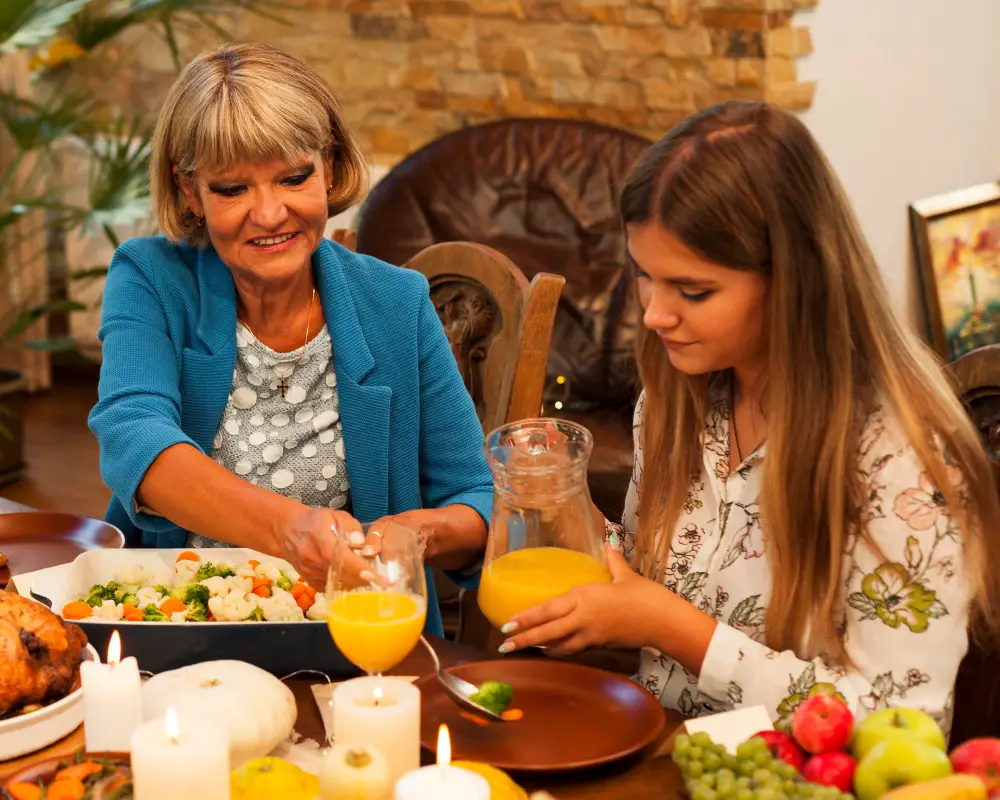
The moment my daughter asked her husband for permission to eat cake at my own table, something inside me went cold.
I was standing at the head of my table with a knife in my hand, ready to cut into the lemon cake I’d baked that morning, when it happened.
Hannah raised her hand for a slice. Then she stopped, halfway up, like she’d hit an invisible wall.
She looked across the table at Craig.
“Is it okay if I have a bit?”
Craig didn’t even look up from his plate.
“You’ve had two rolls already.”
“I know. I just really want some.”
“Honey, no.”
And that was it. Hannah’s hand came back down. She set it in her lap.
“Okay,” she said.
She even moved her plate a little to one side, like she was making room for the slice of cake she now wasn’t going to get.
I stood there and stared at my thirty-one-year-old daughter.
It was my kitchen. It was my table. It was the lemon cake she’d asked me to make on her birthday every single year since she was nine years old, back when she couldn’t say lemon without it coming out “lemel.”
And she’d just asked her husband for permission to eat it. And he’d said no. And she’d accepted it like it was the most normal thing in the world.
Nobody else seemed to notice.
My husband, Dave, reached over and cut himself a slice like nothing had happened. My son, Michael, started talking about the construction on the highway and how it had added twenty minutes to his drive over. The conversation just closed right over the top of what I’d seen, the way water closes over a stone you drop in a pond.
I wish I could tell you I put the knife down and demanded to know what on earth was going on.
I didn’t.
Instead I smiled. Too brightly. I heard my own voice come out chirpy and strange.
“There’s plenty, you know. Plenty of cake.”
Craig finally glanced up at me. He had a small, polite smile on his face.
“She’s fine, thanks, Rebecca.”
She’s fine, thanks, Rebecca.
Those four words went straight under my ribs and stuck there like a splinter.
I sat down at the end of my own table. I picked up my fork. And I stopped hearing anything anyone said for the rest of the meal, because I was too busy counting.
I was counting all the little things I had spent the whole summer refusing to count.
Let me start with the wine.
Hannah had stopped drinking at our house. She hadn’t made a thing of it. There’d been no announcement, no “I’m doing a cleanse,” no “Craig and I are cutting back.” Nothing. It had just quietly started sometime back in May. Every Sunday dinner, when I came around with the bottle and tipped it toward her glass, she’d put her hand flat over the top.
“No, thanks.”
The first time, I honestly didn’t think anything of it. People skip a glass of wine. It’s not a mystery.
But it was every time. Week after week. Hand over the glass. No, thanks. And I’d told myself she was just being sensible, that she’d probably had a big week at work, that it was nothing.
Then there was the dress.
The gray dress. Hannah had worn it to the last four Sunday dinners in a row. The exact same dress. And that, if you knew my daughter, was strange all on its own. Hannah has always cared about clothes. Not in a snobby way, but she likes things that fit her, that look like they were made for her. She’ll return something if the sleeves are a quarter-inch too long.
The gray dress didn’t fit her. It hung off her like a bedsheet. It swallowed her whole.
The second Sunday she wore it, I’d complimented it, mostly to be nice, and she’d touched the fabric at her waist and said, “It’s comfortable.”
And here’s the part I’d shoved down deep. Right before she answered me, she’d looked at Craig. Just a quick flick of the eyes. And he’d looked back at her.
I’d noticed it. I’d filed it away. And then I’d told myself I was being a paranoid old woman who watched too many true-crime shows, and I’d let it go.
And then July.
The beach weekend. We’d been planning it for months. And you have to understand, Hannah is the beach person in our family. She’s the one who loves it more than any of us. When we plan a beach trip, she’s the one texting the group at six in the morning to make sure everyone’s actually getting in the car. She’s led every beach trip we’ve taken since she was a teenager.
Two days before we were supposed to leave, she called and canceled.
“It’s going to be too hot,” she said.
“Hannah,” I said, half laughing, “you once sat on that beach through an actual heat advisory. They had signs up telling people to stay inside and you brought a second cooler.”
“I know. I just don’t feel like it this year.”
I don’t feel like it this year. From the girl who once got sunburned so badly she couldn’t sleep on her back for a week and called it “worth it.”
And when she’d said it to me, she’d been standing in her doorway, and Craig had been right behind her in the hall. I remembered that too.
Again, I’d noticed. Again, I’d done nothing.
Now I sat at my table and watched my daughter carefully fold her napkin and lay it down beside a plate with no cake on it, and every single one of those little moments came loose from wherever I’d buried it and lined itself up in a neat, terrible row.
The wine. The dress. The beach. The cake.
He’d been making her decisions for her all summer. And I’d sat here and watched it happen and told myself I was imagining things.
I felt sick.
After dinner, everyone drifted off toward the living room the way they always do. Dave turned on the television to check a score. Michael sprawled out in the good chair. Craig’s phone buzzed and he stepped out the front door onto the driveway to take the call, one hand pressed over his other ear.
I volunteered to clear the table.
I needed something to do with my hands. And more than that, I needed a reason to be in the kitchen, alone, where I could think.
I stacked the plates by the sink and turned the water on hot, and I stood there rehearsing the questions I was afraid to ask. Not the little questions. The big ones.
Are you safe?
Do you want to come home with us tonight?
Is he hurting you?
Every version I came up with sounded too dramatic, too much, like something out of a movie. And then I’d picture her hand stopping halfway to the cake, and I’d picture her asking permission, and suddenly none of the questions sounded dramatic enough.
I was rinsing a plate when I heard the kitchen door swing open behind me.
I turned the faucet off.
“Han?”
She was standing in the middle of the kitchen. Just standing there, her arms down at her sides, and her face was pale. Really pale. Paler than I’d ever seen it.
“Are you alright?” I said. I kept my voice low and steady, even though my heart was starting to go. “Whatever it is, you can tell me. Do you need help?”
Her eyes moved past me. Over my shoulder, to the window above the sink. Through it, out in the driveway, we could both see Craig with his back to the house, phone against his ear, pacing a little the way he does.
“Mom,” she said. “Not here.”
And before I could say another word, she reached out and grabbed my wrist.
She pulled me. Right out of the kitchen, down the hallway, past the bathroom, into the little back room we use as an office and where nobody ever goes.
She shut the door behind us.
Then she turned the little lock on the handle.
The click of it went straight through me.
Hannah leaned back against the door like she needed it to hold her up. And I looked at my daughter’s face, and I saw something I hadn’t seen since she was seven years old and she’d knocked a glass ornament off the shelf, the one she was convinced had belonged to my grandmother, and it had shattered on the floor.
It was fear. Not embarrassment. Not nervousness. Real fear.
“Sit down,” she said.
“Hannah, you’re frightening me.”
“Please, Mom. Just sit down.”
I sat on the edge of the old loveseat we keep shoved in the corner under a pile of Dave’s magazines. Hannah stayed by the door.
For a long moment, neither of us said anything. I could hear the television going faintly through the wall. I could hear my own pulse.
Then I said it. The question I’d been building up to at the sink.
“Is Craig hurting you?”
Her eyes went wide. “What? No.”
“Is he controlling your money?”
“No.”
“Your phone? Does he go through your phone?”
“No, Mom, God—”
“Where you go? Who you see? Does he tell you who you’re allowed to talk to?”
“Mom.”
“You asked him if you could eat cake, Hannah.”
“I know.”
“You raised your hand and then you asked your husband if you were allowed to eat a piece of cake at my table. And he said no. And you just—” My voice cracked. “You just put your hand down.”
She closed her eyes.
I stood up. I couldn’t sit anymore. “Hannah, I need you to really hear me right now. You are thirty-one years old. You are a grown woman. You do not need anybody’s permission to eat something at my table. Not his. Not anyone’s.”
“I know that.”
“Do you? Because from where I was standing, it didn’t look like you know that.”
“I do know it.”
“Then why did you ask?”
She pressed both hands flat over her face and dragged them down slowly.
And now the anger came. Hot and clean, rising up from somewhere underneath the fear. Because I was scared and I didn’t know what I was scared of, and anger is so much easier to hold than that.
“Why haven’t you had a drink in this house since May?” I said.
Her hands dropped away from her face.
“Why do you keep wearing that dress? Four Sundays in a row, the same dress, and you’ve never in your life worn the same thing twice if you could help it.”
“Mom, stop.”
“Why did you cancel the beach? You. You canceled the beach.”
“I said stop.”
“No.” I was shaking now. “No, I’m not going to stop, because I should have asked you all of this weeks ago. I should have asked the first time I noticed something was off and I told myself I was being crazy. That’s on me. I should have said something in May.”
Something shifted in her expression. Something I couldn’t read.
“Nothing is wrong,” she said.
“Then look me in the eye and tell me what is happening. Because a woman who has nothing wrong doesn’t lock the office door at her mother’s house.”
She looked toward the door. It was quick, but I caught it. Her eyes went to that locked handle like she was checking it.
And that scared me more than anything else in the whole night. More than the cake. More than the wine. So I made myself lower my voice.
“Hannah. Listen to me. If you want to leave him, you can. Tonight. Right now. You don’t need to pack a bag. You don’t need a plan or a lawyer or any of it. You get in the car with your father and me and you come home and you stay as long as you want. As long as you need. Do you understand me?”
She stared at me.
And then, of all the things I could have imagined, she almost laughed. It wasn’t a happy sound. It was worse than crying, in a way.
“Oh, Mom.”
“What? What is it?”
“You think Craig is doing this to me.”
“What am I supposed to think, Hannah? Tell me what else I’m supposed to think, because I’ve been trying all summer to think of something else and I can’t.”
She sank down into the desk chair. She rolled it back an inch, then forward, the way she used to spin in that chair when she was little and Dave was working and she wanted his attention.
I waited.
She opened her mouth. Then she shut it again.
Out in the hallway, footsteps. We both went absolutely still. I held my breath. The footsteps came closer, passed the door, and kept going toward the living room. Michael’s voice, saying something about the score. Dave laughing.
Hannah let out a long breath.
“Craig doesn’t know I’m telling you tonight,” she said.
Every hair on my arms stood straight up.
“Telling me what?”
She looked at me for a long, long time. Like she was deciding something. Like she was standing on the edge of something and trying to make herself jump.
Then she reached down for the hem of that gray dress.
“Just promise me one thing first,” she said.
“What? Anything.”
“Don’t be angry with him until I finish. Please. Whatever you’re feeling right now, hold onto it until I’ve said the whole thing.”
I stared at her. I could not for the life of me imagine what she could possibly tell me that would make me less angry at that man. But I nodded.
And right then, out in the hall, I heard the front door open. Craig, coming back inside from his call.
Hannah heard it too. Her eyes went to the door.
For a second I honestly thought she was going to change her mind. Stand up, unlock the door, tell me it was nothing, we’ll talk another time.
“Whatever this is,” I said quickly, quietly, “you don’t have to protect him from me. You know that, right? You don’t owe him that.”
“I’m not protecting him.”
“Then who are you protecting?”
She reached out and took my hand. Her fingers were cold, and they tightened around mine.
“Me,” she whispered. “I’m protecting me.”
And then a soft knock landed on the door.
“Hannah?”
It was Craig.
She went completely still, my hand still in hers.
His voice came again, quieter this time, careful. “Everything okay in there?”
Hannah looked at me. And whatever was coming, I understood in that moment that it was so much bigger than a slice of cake. I could feel it. Whatever my daughter was about to tell me was going to rearrange the whole night, maybe more than the night.
“Hannah?” Craig called again.
She squeezed my hand once, then raised her voice toward the door.
“We’re fine. Give us a minute. Please.”
There was a pause on the other side. I could picture him standing there, not sure what to do with himself.
“Okay,” he said finally.
His footsteps moved away down the hall.
I turned back to my daughter. “Now,” I said. “Tell me. Right now, before I lose my nerve or you lose yours.”
Hannah drew in a shaky breath. And then, with both hands, she gathered up all that loose gray fabric and pulled it in tight against her stomach.
The dress had hung so straight and loose all summer that you’d never have seen it. But now, with the fabric pulled snug, there was no missing it.
The curve of it.
I stared. My mouth opened, but nothing came out for a second.
“No,” I finally said.
Her eyes filled up. “Yes.”
I looked from her face down to the small, unmistakable swell beneath her hands and back up to her face again.
“You’re—” I couldn’t even say it. “Hannah. You’re pregnant?”
She nodded. And the tears spilled over.
I couldn’t speak. Every single thing I’d been carrying around all summer, all those terrible pictures in my head, came crashing down and rearranged themselves in one instant. The wine she wouldn’t drink. The dress that swallowed her. The beach she wouldn’t go to. The cake she asked permission for.
Not a prison. Not a cage. A pregnancy.
“How—” I sat down hard on the loveseat. “How far along are you?”
“Nineteen weeks.”
“Nineteen?” It came out almost as a shout, and I clapped a hand over my own mouth and dropped my voice. “Nineteen weeks?”
“I know.”
“That’s—Hannah, that’s almost five months. You’ve been pregnant almost five months?”
“Since May,” she said. “Yes.”
“You’ve known since May. All summer. Every Sunday you sat at my table and you’ve known.”
My eyes were burning now too.
“Hannah.”
“I’m sorry,” she said. “I’m so sorry, Mom.”
“No. No, don’t you dare apologize.” I reached out and pulled her off the desk chair and down onto the loveseat next to me. “Don’t apologize. I just—” I pressed my fingers against my lips, trying to steady myself. “Why? Why wouldn’t you tell us? Why wouldn’t you tell me? I’m your mother.”
She looked down at her stomach. Her hands were still resting on it, and now I understood the gesture completely, the way she’d been touching that spot all summer and I’d thought she was just fidgeting with the dress.
“Because it’s complicated,” she said. “It’s a complicated pregnancy.”
And just like that, the happiness that had been flooding in caught on something and stopped cold.
“What does that mean?” I said. “Complicated how?”
“At the first appointment, there were some concerns. Nothing huge, but enough that they wanted to keep an eye on things. And then my bloodwork came back and it wasn’t right. My blood sugar was high. Way higher than they’d normally expect to see this early. Most women don’t get tested for it until later, but mine was already off.”
I felt my whole body tense. “Is the baby okay?”
“Right now, yes.”
“Are you okay?”
“Right now, yes.”
Those two little words, right now, did not comfort me even slightly, no matter how gently she said them.
She turned toward me on the loveseat and took both my hands in hers.
“They diagnosed me with gestational diabetes. Early. Really early. So I’ve been testing my blood sugar four, five times a day. I’ve got a meal plan. Carb limits for every meal. Numbers I have to hit and numbers I have to stay under. It’s a whole thing, Mom. It’s been a whole thing all summer, quietly, in the background of everything.”
And Craig’s voice came floating back into my head, cold and flat across the dinner table.
You’ve had two rolls already.
I turned to look at her.
“The cake,” I said slowly.
She nodded. “The cake.”
“He wasn’t—” I had to work it out as I said it. “He wasn’t telling you what you were allowed to eat. He was—”
“Well. Technically he was.” A small, watery smile. “But only because I asked him to. Because I begged him to, honestly.”
I just looked at her.
“Mom, I am so bad around your lemon cake. You have no idea. I have zero self-control with that cake. I never have. And my doctor sat me down and told me I have to be strict, especially after a meal where I’ve already had bread, because that’s exactly when the numbers spike. And I know myself. I knew that if it came down to me sitting in front of that cake and having to be the one to say no to myself, I’d cave. Every time.”
“So Craig—”
“I told Craig. I said, if I start bargaining with myself at the table, if I start going ‘just one bite, just a little slice,’ you have to be the one who says no. Because I can’t. I can’t be the person who tells myself no every single time all day long. It’s exhausting. I needed someone else to be the bad guy sometimes.”
I sat with that for a second.
“So when you asked him,” I said. “Tonight. At the table. ‘Is it okay if I have a bit.'”
“I already knew the answer,” she said. “I knew he was going to say no. I asked him to say no. I set it up that way myself.”
“Then why on earth ask like that? In front of everyone? Making him look like—like some awful little dictator?”
Her face twisted up, half laughing and half crying.
“Because I wanted the cake,” she said. “I really, really wanted the cake, Mom. And some stupid part of me thought maybe if I asked out loud, in front of everyone, he’d feel too embarrassed to say no and I’d get to have it.”
I laughed. I couldn’t help it. It burst out of me in disbelief. But then it died in my throat just as fast.
“Hannah. You scared me half to death tonight. Do you understand that? Half to death.”
“I know.”
“I thought—I sat at that table and I genuinely thought that man was controlling you. I had a whole speech ready. I was going to get you out of that house tonight.”
“I know. I know that now.”
“You looked at him. All summer. Every time I asked you something, you’d look at him first before you answered.”
“Because we were trying so hard not to tell anyone yet.” She wiped her eyes with the heel of her hand. “Every single time you came around with that wine bottle, my heart would stop, because I thought, this is it, this is the moment she figures it out. Every time you asked why I was wearing this dress again, I was sure you already knew and you were just waiting for me to say it.”
“And the beach,” I said. “In July. You canceled the beach.”
“Doctor’s orders.”
I frowned. “Because of the heat? You told me it was because of the heat, and I didn’t believe you for one second, because you love that beach.”
“It was partly the heat. But it was more than that. I’d had a couple of dizzy spells that week. And my blood pressure had been doing strange things, spiking and dropping. My doctor didn’t want me spending a whole weekend out in extreme heat, two hours away from my hospital, with no easy way to get back if something went wrong.”
And there it was. That July phone call, the one that had made me so suspicious, the one I’d chewed on for months, suddenly turned into the most reasonable thing in the world.
I put my hand over my mouth again and just breathed for a second.
“And the dress?” I said finally. “Please tell me the dress isn’t doctor’s orders too.”
“The dress is not doctor’s orders.”
“Oh, thank God.”
She actually smiled at that. “The dress is just me. Hiding this.” Her palm pressed flat against the curve of her belly. “I wasn’t ready for everyone to know yet. The dress was the only thing I owned that hid it well enough.”
“But why?” I said, and I heard how small my voice had gone. “Why weren’t you ready? A baby, Hannah. This is—this is wonderful news. Why did you have to hide from us that you were having a baby?”
Her eyes dropped to her lap.
“Because we lost one last year,” she said.
The whole room went silent. Even the television seemed to go quiet.
I sat there and stared at her. I knew Hannah and Craig had talked, in a vague someday sort of way, about having kids. But I never knew they’d already been trying. I never knew there’d been anything to lose.
“You never told me that,” I said.
“I couldn’t.”
“Oh, honey. Oh, Hannah.”
The thought of it. The thought of my daughter carrying that grief around, going through something like that, and me not knowing. Me offering her wine and asking about the beach and going on with my little Sunday dinners while she quietly hurt. It hurt worse than anything else she’d said all night.
“It was early,” she said. “Really early. We hadn’t told a single soul that I was pregnant, so when it ended, it just felt—easier, somehow, to keep it private. Not to have to tell everyone that it had happened and then have to tell them all over again that it was gone. It felt like it would just be twice the pain. So we kept it to ourselves.”
I reached over and took her hand again. She leaned into me and put her head on my shoulder, the way she used to when she was small and something had gone wrong at school.
“This time,” she said, and her voice wobbled, “when I got pregnant again, I was so happy. And then almost right away the doctor started talking about blood sugar and blood pressure and appointments and monitoring, and I just—I panicked, Mom. I kept thinking, here we go again. Here we go again. Something’s going to go wrong again.”
“And Craig? How’s he been through all this?”
She let out a shaky little laugh. “He panicked too. In his own way.”
I thought about how fast, how completely, I’d cast that man as the villain. How I’d built a whole story about him in my head over the course of one dinner and been ready to burn his life down over a piece of cake.
Hannah must have read something in my face, because she squeezed my hand.
“He’s been driving me absolutely crazy,” she said. “But not the way you think.”
“What way, then?”
“He reads every single label. Every one. He knows the carb count of foods before I do. He’s got alarms set on his phone for all my glucose checks so I don’t forget. He keeps a sleeve of crackers in the glove box in case I get nauseous when we’re out driving.” Her eyes went soft. “The night I told him I couldn’t stand being the person who has to say no to myself all day long, every day, he didn’t even hesitate. He just said, ‘Then I’ll do it. I’ll be the one who says no. You don’t have to carry that part.'”
I looked toward the door, toward where Craig had been standing a few minutes ago.
“Even if it made him look like a monster to everyone at the table?” I said.
“I don’t think he realized how bad it would look,” she admitted. “I don’t think either of us thought about how it would come across from the outside.”
“He said, ‘She’s fine, thanks, Rebecca.’ To me. Across my own table.”
Hannah put both hands over her face.
“Okay, that one,” she said, her voice muffled. “That one does make him look really, really bad.”
And then she started laughing into her hands, and the laugh shook her whole body, and it was such a relief to see, after all that fear, that I started laughing too. The two of us sat on that dusty old loveseat surrounded by Dave’s magazines and laughed until my eyes ran over again, though I couldn’t have told you anymore whether it was from laughing or from everything else.
When we finally settled, I remembered something.
“Why all the secrecy just now, though? The locked door, the whispering. You said Craig doesn’t even know you’re telling me tonight.”
She wiped her eyes. “Because we agreed. We agreed we’d tell everybody together, all at once, after my scan next week. If everything looks good at the scan, we tell the whole family at Sunday dinner. That was the plan.”
“Then why tell me now? Why break the plan?”
She looked at me. And her face got serious again, but soft.
“Because I saw your face at dinner tonight.”
I didn’t say anything.
“I saw the way you looked at Craig after the cake. Mom, you looked like you were about to come around that table and bury him under the back patio.”
“That,” I admitted, “did cross my mind.”
“And I realized how the whole thing must have looked to you. The wine and the dress and the beach and then the cake, all lined up. I realized what you’d been building in your head all summer. And I couldn’t stand the idea of you going home tonight and spending another whole week thinking my husband was some kind of controlling monster who was doing something terrible to me. I couldn’t let you sit with that for another seven days. It wasn’t fair to you. And it wasn’t fair to him.”
I pulled her into a hug and held on.
A minute later, there was another soft knock at the door.
This time Hannah called out, “Come in.”
Craig opened it slowly, cautiously, like he wasn’t sure what he was walking into. He looked at Hannah first. Then at me. And whatever he saw on our faces, our red eyes and our wet cheeks, his own face changed and understood.
“You told her,” he said.
“I had to,” Hannah said. “I saw her face at dinner.”
He nodded slowly. Then he turned and looked at me, and I watched him brace himself.
I folded my arms across my chest.
“You,” I said.
Craig stopped where he was. “I can explain.”
“I’ve had the explanation, thank you.”
“Oh. Okay. Good.”
“You told my thirty-one-year-old daughter that she could not have a piece of her own birthday cake at my table.”
His mouth opened.
“Mom,” Hannah started.
“I know why now,” I said, holding up a hand. “I do. I understand it. She asked you to. You were doing what she needed you to do, and I get it.”
Craig’s shoulders dropped an inch in relief.
“But,” I said, and he tensed right back up, “next time, maybe don’t make it sound like you’ve got her on a bread-and-water prison diet. In front of her whole family. On her birthday.”
Hannah snorted.
Craig rubbed the back of his neck and looked at the carpet. “Yeah. Fair. That’s fair.”
“And you could have let her answer for herself. Even if the answer was still no. You could have said, ‘That’s up to Hannah,’ and let her be the one to decide.”
“Also fair,” he said.
Hannah nudged my knee with hers. “In fairness to him, I really did ask him to keep me on the plan. I really did make him promise to be the one to say no.”
“I heard you,” I said. “I heard all of it. And I understand.”
Then I pointed a finger at Craig.
“But if that girl ever asks you for permission to breathe, you and I are going to have a serious problem. Are we clear?”
And that broke it. All three of us started laughing, and Craig came the rest of the way into the room and Hannah stood up and he put his arm around her, and I saw the way she leaned into him, easy and comfortable, and I thought, how did I miss that? How did I look at the two of them all summer and see a cage instead of this?
But then, that’s the thing about fear. It only lets you see what you’re already afraid of.
A few minutes later, we all went back out to the kitchen. Dave looked up from the couch and said, “Everything alright?” and I said, “We’ll tell you in a minute,” and he went back to his score, because after thirty-five years the man knows when to wait.
The lemon cake was still sitting there on the counter, half of it gone, the other half glistening under the kitchen light.
Hannah looked at it. She looked at it the way you look at an old friend you’re not allowed to hug.
I looked at Craig.
He immediately raised both hands in the air, palms out. “I’m not saying a word. Not one word. I’ve learned my lesson.”
Hannah laughed and shook her head. “It’s fine. I’m still not having any.”
“You sure?”
“I’m sure. Numbers were already high after dinner. It’s not worth it. I’ve got a baby to think about.” She said it lightly, but I saw how much it cost her, and I saw the little flash of pride underneath it too.
So I got out a plate and a knife, and I cut a thin slice of that lemon cake, and I wrapped it up carefully in plastic wrap, and I wrote her name on it in marker, and I put it in the very back of the freezer.
“For after the baby comes,” I told her. “The very first thing. Before you even leave the hospital, if you want.”
Hannah looked at it, and then at me, and her eyes went shiny again. “Mom, that cake is going to be a fossil by then.”
“Then I’ll make a fresh one,” I said. “The day you come home. A whole new lemon cake, just for you, and nobody at that table gets to tell you no. Not even Craig. Especially not Craig.”
“Hey,” Craig said, but he was smiling.
“Deal,” Hannah said softly.
I hugged her then, and this time she wrapped both arms all the way around me and held on tight, and I could feel the little curve of her between us, my grandchild, and I had to bite down hard to keep from completely falling apart in my own kitchen.
We told everyone the next week, after the scan. The scan went well. The baby was healthy, measuring right on track, and the doctors said if Hannah kept doing what she was doing with the diet and the monitoring, there was every reason to expect things would be just fine.
She came to Sunday dinner in a dress that fit. A blue one, that showed the curve of her clearly, proudly. And when she told them, the whole table erupted. Dave cried. Michael whooped and knocked over his water glass. And I stood at the head of the table and watched my daughter glow, and I thought about how close I’d come, one week earlier, to setting fire to the best news our family had gotten in years.
Craig, for the record, turned out to be exactly the husband I’d have picked for her if she’d let me pick. Over the following months I watched him fuss over her, watched him carry the crackers and set the alarms and read the labels and, yes, gently say no when she needed him to and gently say yes when she deserved it. I stopped seeing a warden. I started seeing a man who was scared out of his mind of losing something precious and was pouring every ounce of that fear into taking care of it.
My granddaughter was born in the winter. She came out screaming and pink and perfectly healthy, seven pounds exactly, with a full head of dark hair like Hannah had when she was born.
I made the cake. I made it the morning Hannah came home from the hospital, a fresh lemon cake, still warm, and I set it down on the table in front of her and I said, “Nobody tells you no today.”
She laughed and she cried and she ate two slices, and Craig didn’t say a single word. He just sat there holding the baby, grinning like a fool.
That whole terrible, wonderful night in the locked office stayed with me, though. It stays with me still.
Because here’s the thing I keep turning over. I was wrong about Craig. Completely, embarrassingly wrong. I built a monster out of a good man over the course of one dinner, and I very nearly acted on it. If I’d said what I wanted to say at that table, in front of everyone, I might have done real damage to my daughter’s marriage over a slice of cake.
And yet.
I’m not sorry I asked. I’m not sorry I followed her into that office. I’m not sorry I locked eyes with her and asked if she was safe, if he was hurting her, if she wanted to come home.
Because if the answer had been different, if it really had been a cage and not a pregnancy, if my daughter really had been shrinking away under someone else’s thumb all summer while I told myself I was imagining things, then she would have needed exactly one thing in the whole world.
She would have needed someone willing to notice. Someone willing to lock the door and ask the ugly question out loud.
Sometimes loving someone means respecting their privacy and giving them room to keep their own secrets and come to you when they’re ready.
And sometimes loving someone means asking the uncomfortable question anyway, risking being completely wrong, risking looking paranoid and dramatic and foolish, because the one time you’re right might be the only time that matters.
That night I learned just how hard it can be to tell the two apart in the moment, when you’re standing at your own sink with a plate in your hand and your heart in your throat.
But here’s the real question, the one I still ask myself. When someone you love starts behaving in ways that worry you, do you respect their privacy and stay quiet and hope you’re wrong? Or do you risk being wrong out loud, and ask the uncomfortable question that just might uncover what’s really going on?

Ethan Blake is a skilled Creative Content Specialist with a talent for crafting engaging and thought-provoking narratives. With a strong background in storytelling and digital content creation, Ethan brings a unique perspective to his role at TheArchivists, where he curates and produces captivating content for a global audience.
Ethan holds a degree in Communications from Zurich University, where he developed his expertise in storytelling, media strategy, and audience engagement. Known for his ability to blend creativity with analytical precision, he excels at creating content that not only entertains but also connects deeply with readers.
At TheArchivists, Ethan specializes in uncovering compelling stories that reflect a wide range of human experiences. His work is celebrated for its authenticity, creativity, and ability to spark meaningful conversations, earning him recognition among peers and readers alike.
Passionate about the art of storytelling, Ethan enjoys exploring themes of culture, history, and personal growth, aiming to inspire and inform with every piece he creates. Dedicated to making a lasting impact, Ethan continues to push boundaries in the ever-evolving world of digital content.