The Apple Tree
A Story About Neighbors, Children, and the Quiet Ways You Teach Someone What Kind of Person They Are
There are people who will tell you that you should never let things with neighbors go unaddressed.
There are other people who will tell you that neighbor conflicts are the ones most worth avoiding, because you cannot choose your neighbors the way you choose your friends, and you have to see them every day, and the cost of a bad relationship with the person next door is paid in small, daily increments for as long as you both live there.
Both of these pieces of advice are correct.
This story is about what happens when you hold both of them at the same time and find the narrow path between them — the one that requires you to be smarter than you want to be when someone has hurt your children and your instinct is to stand on your deck and say every true thing you know about them at full volume.
It is also, at its heart, a story about an apple tree.
And what it means to know the difference between what is technically yours and what is actually right.
Dale Mercer moved in next door eleven years ago.
I know this because we moved in twelve years ago, which means I was still in the honeymoon phase of the house — the phase where everything about the neighborhood feels like possibility, where you learn which neighbors wave back and which ones don’t, where you figure out the unspoken rules of how your particular street works.
Dale was already there when we arrived. He had been there for years, apparently. He knew the drainage pattern of the block and where the property lines technically fell and which utility company owned which pole. He was the kind of neighbor who possessed a great deal of technical information about shared spaces and was not shy about deploying it.
He was not warm.
He wasn’t cruel, exactly, not at first — just closed in the way that some people are closed, armored with the specific self-sufficiency of someone who has decided that other people are primarily a source of problems. He maintained his property carefully. He kept to himself. He nodded when you passed him on the street and did not initiate conversation.
We coexisted.
For the first few years, coexistence was enough.
The apple tree predated all of us.
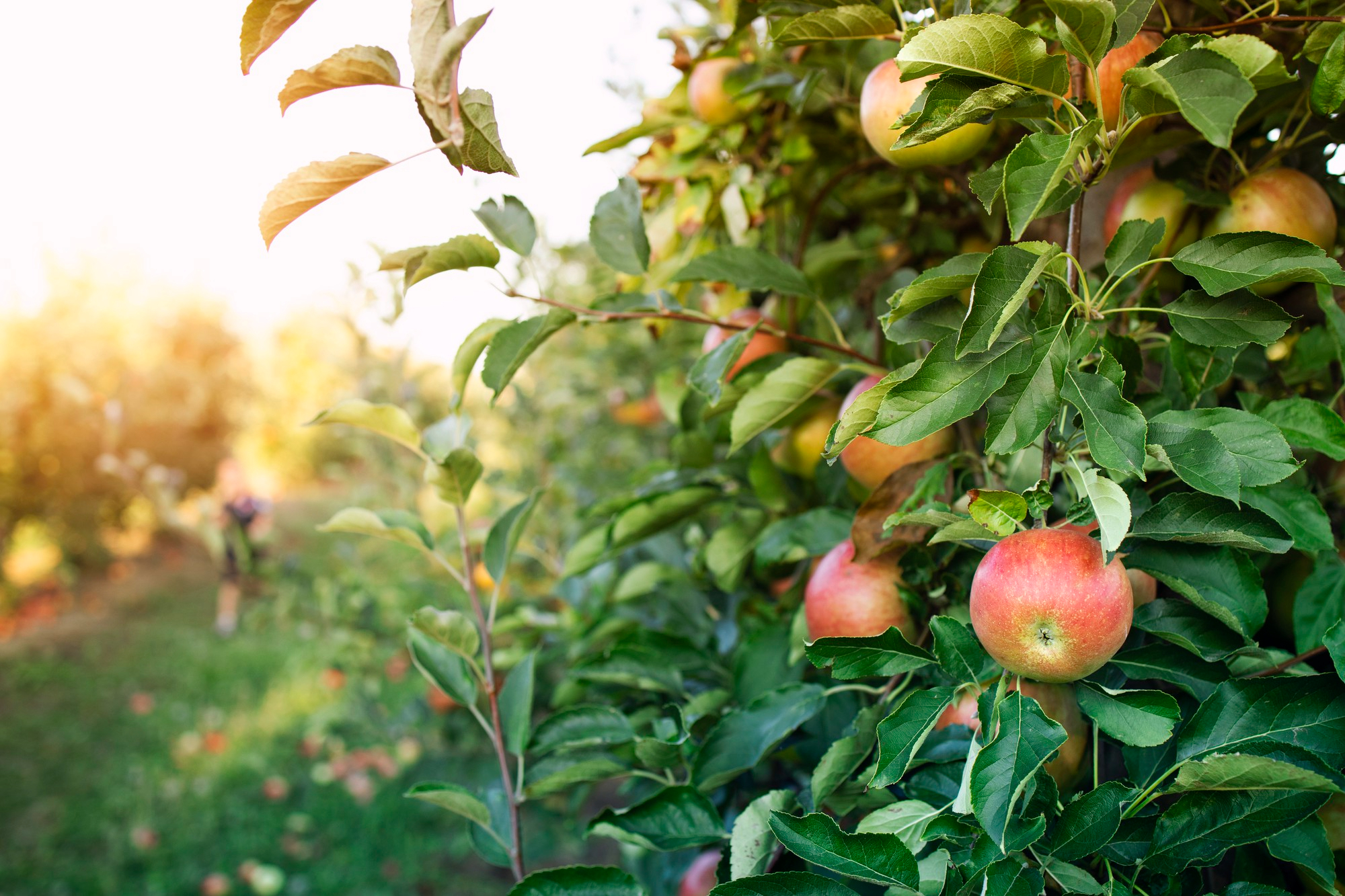
It was an old tree, the kind that had been growing long enough to have real presence — gnarled, substantial, its canopy spread wide in the way of trees that have been allowed to develop without interference. It sat near the property line, but not on it. It was Dale’s tree, unambiguously, by deed and by common sense. No one had ever disputed this.
What the tree did not respect was the property line.
A full third of its canopy extended over our yard. This is not unusual with old trees — they grow toward light, they spread indifferently, they do not consult property surveys before putting out new branches. What this meant, practically, was that every August, a significant portion of Dale’s apple harvest landed in our grass.
Not a few apples.
Buckets of apples.
I don’t know what variety the tree was. Tart, small, the kind that make excellent sauce if you’re in the mood to make apple sauce, which I learned in the second year when I had so many that I had to do something. They came down in waves — first the early windfalls, the ones that gave up before they were ready, and then the main drop in late August, when the grass under our swing set and through our flower bed and across half the back lawn was carpeted in them.
I had raked apples for nine years.
Rob had raked apples for nine years.
The apple that rotted into the paint on our shed was not an anomaly — it was the logical consequence of a hundred apples coming down faster than we could clear them, one of them landing at the base of the wall and staying there through rain and heat until it became part of the surface it had rested against.
The mark was still there.
Dale had never helped with any of this. Not a word of acknowledgment that his tree was creating labor on our side of the fence. Not an offer to split the fruit, or to send his grandson over to help with the clearing, or even a thank-you for the years of maintenance we had absorbed without complaint.
This was the context.
Nine years of context, stacked up like apples in a bucket, waiting.
My daughter Maya turned six in April.
She has Rob’s patience and my grandmother’s red hair and a way of approaching the physical world with her whole body that is exhausting to watch and magnificent at the same time. She does not do things halfway. When she was learning to ride her bike, she practiced until she either had it or fell off, no middle ground, no cautious halfway measures. When she decided she wanted to plant a garden last spring, she planted it with the conviction of someone who has studied the project and committed to the result.
She is, in other words, a person who sees something that needs doing and does it.
Leo is nine, and he is the more analytical of the two — the one who needs to understand why before he will commit to the how. He asks questions before he acts, which has saved him from several of Maya’s more ambitious schemes over the years. He has a quality of stillness that Maya does not, the ability to watch a situation before deciding what it means.
On Sunday afternoon, after lunch, they went into the backyard.
I was on the deck with my coffee, not paying close attention, doing the particular Sunday unfocusing that the afternoon allows. I watched them peripherally. Maya was carrying something. Then she was carrying something again. It took me three or four of these trips before I understood what I was watching.
She had found the old bucket in the garage — the big blue one we used for gardening — and she and Leo were picking up apples.
Not to bring inside. To bring to the fence.
They were clearing the yard without being asked, which was already remarkable, and they were taking the apples to the property line, which in their minds was obviously the right destination. The tree belonged to Dale. The apples came from the tree. Where else would you take them?
Children’s logic.
Pure, simple, correct.
I was watching this with the warmth of a mother who has just seen her children do something generous and unprompted when Dale came out.
He was at the fence before they reached it with the first load.
“Those are mine,” he said.
Leo stopped. “What?”
“All of them. Every one that came off my tree. Bring them to the fence.”
“They fell on our side.”
“Doesn’t matter where they land. It’s my tree.”
I stood up from my chair.
Leo and Maya looked at each other.
And then they did it.
Because they were children who had been raised to respect adults, even adults who were not being respectful back, they began picking up the apples. Not just the ones they had already gathered. The ones in the flower bed. The ones under the swing set. The ones in the far corner of the yard that had bounced and rolled into the shadow of the fence.
Maya couldn’t hold more than three at a time.
She was six. She had small arms and the apples were uneven and awkward.
Four trips. She made four trips.
She kept looking up at the deck.
I said his name. Once. Dale.
He didn’t turn his head.
He stood at the fence and took the apples one load at a time, dropping them into a bag, and he did not look at the children or at me, and when the last apple had been delivered and the bag was closed, he looked up and he saw me.
“Nice,” he said. “Raising thieves young, are we?”
Maya started crying.
Leo didn’t.
Leo stood in the middle of the yard with his hands dirty and his ears red, looking at the ground, and I have thought about that image many times since because the thing about a child who doesn’t cry when they have been hurt is that the not-crying is often more heartbreaking than the crying. It means they have swallowed it. It means they have already begun the process of deciding what kind of person they are going to be in response to the kind of person they have encountered.
I wanted to decide that for him.
I wanted to march to that fence and teach him a different lesson.
I photographed it instead.
Not dramatically. I took two photographs through the deck railing — Maya wiping her face, Leo in the yard with his hands at his sides — and I sent them to Rob with one line: He stood at the fence and made them hand over every apple in our yard.
He called in forty seconds.
“I’m coming home,” he said.
“Don’t. You’re not going over there.”
“Rob, he called our children thieves.”
“I know. And if you go over there, the whole street sees two adults screaming, and we end up being the problem.” A pause. I could hear him thinking. “I’ve got a better idea.”
“What idea?”
“I think I know how to teach the old man a lesson. And nobody has to say one rude word to anybody.”
“Rob.”
“Save those photos. Don’t delete them. Send them to my personal email.”
“What are you going to do?”
“I’ll tell you when I get home. First, go be with the kids.”
I went inside.
Maya had moved from crying to the particular post-cry state of a six-year-old who has been upset and is now hungry for something sweet and looking for comfort without knowing exactly how to ask. I made her hot chocolate, which is the solution to a remarkable range of problems when you are six. I sat her at the table and Leo came in on his own and I made him hot chocolate too, without him asking.
He sat across from his sister.
“Dale is not a nice person,” Leo said.
“No,” I said.
“Why did we have to give him the apples?”
I thought about this.
“Because right now, technically, he was right that the apples came from his tree,” I said. “But being technically right and being a good neighbor are different things.”
“What’s the difference?”
“Being technically right means you can point to the rule and say the rule is on your side. Being a good neighbor means you think about the other people too, and what’s fair, not just what you can claim.”
Leo was quiet for a moment.
“He wasn’t being a good neighbor,” he said.
“No,” I said.
“So what do we do?”
“We wait for Dad,” I said. “He has an idea.”
Leo looked at his hot chocolate.
“Is it a good idea?”
“It is,” I said. “I think it might be a really good idea.”
I wasn’t entirely sure of this. I was giving Rob’s idea more confidence than I had evidence for, because what I actually wanted to do was a different idea entirely and the children needed to believe that the adult response to injustice was something other than yelling.
Rob came home an hour later with a laptop bag and a plan.
He sat down at the kitchen table across from both kids.
He had stopped at the store on the way home, which I didn’t know until he unloaded the bag: four gallon-size zip-lock bags, a box of canning jars, and a large bag of sugar.
Leo looked at the sugar.
“What’s that for?”
“Applesauce,” Rob said. “And apple butter. And maybe, if we have enough apples, some cider.”
“We don’t have any apples,” Leo said. “We gave them all to Dale.”
“We gave Dale the windfalls,” Rob said. “The apples that had already fallen. The ones still on the tree—” he nodded toward the backyard “—those come down in waves. More every day. And I happen to know, because I’ve lived here for nine years and watched this tree, that the big drop happens in the next two weeks.”
Maya looked up from her hot chocolate.
“More apples are coming?” she said.
“A lot more,” Rob said. “The question is what we do with them.”
He looked at Leo.
“Here’s what I know about property law,” he said, and I watched Leo straighten slightly, because Leo was nine and property law was the kind of thing he found interesting in the way some boys find dinosaurs or space interesting. “A tree belongs to the person who owns the land it grows on. But the fruit that falls off the tree onto someone else’s property — that’s a gray area. Courts have gone different ways on it. Some say the fruit follows the tree. Some say what lands on your property is yours.”
“Dale said it was his,” Leo said.
“Dale said what he believed,” Rob said. “But what Dale believes isn’t automatically the law. And more importantly, Dale has a choice. He could have been a neighbor about this. He could have said thank you for gathering them up, and split them with you, or just said take whatever you want. Instead he chose something else.”
“He chose to make Maya cry,” Leo said.
“He chose,” Rob said, “to teach me what kind of neighbor he is. And that’s useful information.”
Maya was following this with the concentration of someone who is not catching every word but understands the general direction.
“Are we going to get the apples?” she said.
“We’re going to get the apples that land in our yard,” Rob said. “Every single one. Starting tomorrow morning. And we’re going to do something useful with them.”
“What about Dale?” Leo asked.
Rob smiled.
“Dale,” he said, “is going to do his part without knowing he’s doing his part.”
I need to tell you about Rob.
He is not a dramatic person. He has never, in fifteen years of marriage, raised his voice in a conflict in a way that I thought was out of proportion to the situation. This is not because he is passive — it is because he has a quality that I have come to understand is actually a form of confidence: the knowledge that the right response to most situations is the slow one. The thought-out one. The one that costs you something in patience but pays you back in outcome.
He had been a community organizer before he became a project manager, and before that he had grown up in a neighborhood where he had learned early that the people who lasted were the people who played a longer game. He had learned to read situations for what was actually happening underneath the surface of what was said.
He read Dale in about thirty seconds from the photograph I sent him.
He knew what kind of person stood at a fence and made two small children give back every apple in a yard.
He knew what that person would respond to, and what that person would not respond to, and he knew that the response that would feel most satisfying to me in the short term was also the one least likely to produce any actual change in Dale’s behavior or any actual benefit to us.
He also knew, which I did not yet know, that the situation was about to become more useful than I realized.
The second drop started on Tuesday.
It was a heavy one — Rob had been right about the timing. I came out in the morning to find the grass under the overhang thick with apples, more than I had ever seen in a single day, the branches above having released what seemed like the entire summer’s accumulation overnight.
The kids were at school.
I stood on the deck with my coffee and looked at it.
Then I went inside and got the bucket.
I spent forty minutes picking up apples. Not grudgingly — this is important. With the specific intention that Rob and I had discussed the night before. Every apple that had come down on our side of the fence went into the bucket and then into the big cooler we had brought up from the basement.
When the kids came home, they helped.
Leo in particular approached it with the methodical focus he brought to any task that had been explained to him properly — he understood the goal now, and the goal gave the activity meaning. He moved through the flower bed and under the swing set and along the fence line and he picked up every apple he could find.
Maya made trips to the cooler.
Four trips. Same as Sunday.
She counted them.
“Four trips again,” she said, the second time she came back.
“Is that okay?” I asked.
She thought about it.
“It’s more fun this time,” she said.
Rob’s plan had three parts.
He explained them to me that evening, after the kids were in bed, at the kitchen table with the photographs open on his laptop.
The first part was the apples.
Every apple that landed in our yard for the rest of the season was going to be processed. Rob had researched the varieties coming off old apple trees in our region, and the tart, dense kind our tree produced was exactly right for preservation. Applesauce, apple butter, dried apple rings, and if we had enough volume, pressed cider. He had found a local press that did custom batches.
“How much do you think we’ll have?” I asked.
“Based on past years? Probably three to four hundred pounds,” he said. “Maybe more, with the early ones we missed and the big drop this week.”
I stared at him.
“Three hundred pounds of apples.”
“It’s a big tree,” he said. “And a third of it is over our yard.”
“What are we going to do with three hundred pounds of applesauce?”
“We’re not going to keep it,” he said. “That’s the second part.”
He turned the laptop to show me a website.
It was the local food bank’s volunteer portal. He had already registered us. They had a program where community members brought preserved food — commercially acceptable quantities in proper canning jars, processed according to food safety guidelines — and they distributed it through their network of partner pantries.
“We’re going to donate the applesauce,” he said.
I looked at the screen.
“Okay,” I said.
“All of it. Everything we make. The apple butter, the dried rings, the cider if we get enough. We make it, we jar it, we bring it to them.”
“That’s — Rob, that’s a lot of work.”
“Yes,” he said. “It is. And I think it’s going to be worth it.”
“What’s the third part?” I asked.
He turned the laptop back and opened a different window.
It was a draft letter.
Addressed to Dale.
“You’re going to write him a letter?” I said.
“We are,” he said. “After we’re done.”
We spent the next two weekends processing apples.
There is no elegant way to describe this. It is not a romantic activity. It is a production operation that takes over your kitchen — the peeling, the coring, the cooking down, the canning, the precise temperature management of a hot water bath canning setup that Rob had learned from a YouTube series and approached with the seriousness of someone who has decided that if they’re going to do something they’re going to do it correctly.
The kids were involved at every stage they were able to be.
Maya peeled. She was not efficient at peeling, but she was committed, and the commitment mattered more than the efficiency. Leo quartered and cored, which he found satisfying in the methodical way he found most things satisfying when they had a clear method.
Rob cooked.
I managed the canning operation, which is the part that requires the most attention to the details that matter for safety — the headspace, the seal, the processing time, the cooling period. I had done some canning before, in a casual way, a few jars here and there. This was not casual. This was systematic.
By the end of the second weekend, we had seventy-eight jars of applesauce, twenty-two jars of apple butter, four pounds of dried apple rings, and three one-gallon jugs of fresh-pressed cider that Rob had taken to the press on Saturday morning while the kids and I worked on the final batch of sauce.
The cooler had been emptied four times.
The kitchen smelled, for two weeks, like the inside of a particularly excellent autumn.
Leo stood at the counter looking at the finished jars, lined up on the table before we boxed them.
“That’s a lot,” he said.
“Dale’s tree is very productive,” Rob said.
Maya looked at the jars.
“Those are from the apples in our yard?” she said.
“Every one,” Rob said.
“And we’re giving them away?”
“To the food bank,” he said. “So families who need food can have them.”
Maya was quiet for a moment. She was six and she was processing something.
“Dale didn’t want us to have the apples,” she said.
“No,” Rob said. “He didn’t.”
“But we made them into something and now other people can have them.”
“Yes,” Rob said.
She thought about this.
“That’s better than him having them,” she said.
“I think so,” Rob said. “I think that’s a lot better.”
We brought the boxes to the food bank on a Sunday morning.
The three of us — Rob and I and both kids. The food bank coordinator, a woman named Helen who had the specific quality of tireless cheerfulness that people develop when they work for a long time in service of something they believe in, met us at the loading dock.
She looked at the boxes.
“What have we got?” she said.
“Applesauce,” Rob said. “Apple butter. Dried apple rings. Cider.”
“All of it?”
“All of it.”
She opened a box and looked at the jars.
“Did you process these yourself?” she said.
“Hot water bath,” Rob said. “Followed the extension service guidelines.”
Helen looked at the labels Maya had made — construction paper labels, slightly uneven, with drawings of apples and the words APPLE SAUCE in Maya’s careful six-year-old printing.
“Your daughter made the labels,” Helen said.
“She did,” Rob said.
Helen looked at Maya.
“These are beautiful,” she said.
Maya stood up slightly straighter.
“I did them myself,” Maya said.
“I can tell,” Helen said. “Can I ask you something?”
Maya nodded.
“Where did all these apples come from?”
Maya looked at Rob. Rob nodded slightly.
“Our neighbor’s tree,” Maya said. “Part of it hangs over our yard. The apples fall in our grass.”
“And you made them into food for people?”
“Dad did most of the cooking,” Maya said, with the honesty of a person for whom credit accuracy is important. “But I helped peel.”
“You helped peel,” Helen said gravely. “That’s real work. Apple peeling is real work.”
Maya nodded.
“It is,” she said.
We wrote the letter that evening.
I need to tell you what was in it, because the letter is the heart of the third part, and the third part is the part that matters most.
Rob had been composing it in his head for two weeks. He had started and deleted and restarted several times, because getting the tone right required patience of a particular kind — not coldness, which would have been easy, but clarity. The clarity of someone who is not performing anger or performing forgiveness, but simply telling the truth of what had happened and what they had done with it.
This is what we wrote.
Dear Dale,
Two weeks ago, our children Maya and Leo gathered apples that had fallen from your tree into our yard. They were bringing them to the fence to return them to you when you came out and asked them to hand over every one — including those from the flower beds and from under the swing set. They did so, though Maya needed four trips because she could only carry three at a time.
Afterwards, you called them thieves.
Maya cried. Leo did not, which in some ways was harder to watch.
We want you to know what happened after that.
The apples continued to fall, as they do every year. We collected them — every one that landed on our side, which is approximately a third of your tree’s annual yield. We processed them into applesauce, apple butter, dried apple rings, and cider. We followed food safety guidelines and canned everything properly.
Last Sunday, we donated all of it to the Riverside Food Bank. Seventy-eight jars of applesauce, twenty-two jars of apple butter, dried apple rings, and several gallons of cider. The children helped make the labels.
We wanted you to know this because we thought you should understand what kind of family you live next to.
Our children are not thieves. They are children who saw a mess in their yard and started cleaning it up, and who gave back every apple you asked for, and who were then called thieves for it.
We have not involved anyone else in this. We have not spoken to other neighbors or posted anything online or contacted anyone in any official capacity. We simply did what seemed right with what we had.
We hope you have a good fall.
Rob and Claire, Leo and Maya
We printed it on plain paper.
Rob walked it to Dale’s mailbox on a Monday morning.
He did not knock. He did not wait. He put the letter in the box and walked back.
He did not tell me what he thought would happen.
I did not ask.
What happened was this.
Three days later, there was a knock at the front door.
It was Dale.
I almost didn’t open it. I stood at the door for a moment and thought about the options, and then I opened it because whatever I thought about Dale, I had also spent two weeks making applesauce and writing a careful letter and the point of a careful letter is that you are the person who does the careful thing, which means you also open the door.
He was holding something.
A bag. A reusable grocery bag, the kind from the market two streets over, and inside it were apples. His apples, from his tree, from the side of it that hung entirely over his own yard.
He looked at the bag.
He looked at me.
He did not look comfortable. He looked like a man who has read something that reorganized his understanding of a situation and is now standing at a door without entirely knowing what to do next, which is a specific and not entirely undeserved discomfort.
“The kids,” he said. “They still like apples?”
I looked at the bag.
I looked at him.
“They do,” I said.
He held out the bag.
I took it.
He did not apologize. I want to be honest about that — there was no explicit acknowledgment of the word thieves or the four trips or Maya’s red face. He was not a man who had come to the door prepared for a full accounting.
But he had come to the door.
With apples.
“I hear you gave it all away,” he said.
“We did,” I said.
He looked at the yard.
“Tree makes a lot,” he said.
“It does,” I said.
“I can’t use half of what it produces,” he said. “Haven’t been able to for years.” He was quiet for a moment. “I used to have help with it. I don’t anymore.”
I didn’t ask what that meant.
I had an idea.
“If you want,” I said, “we’ll keep collecting from our side. And we’ll keep donating whatever we can process.”
He looked at me.
“You’d do that.”
“If you’d let us,” I said.
He thought about it.
He was not a man who found agreement easy. I could see it — the effort of the position adjustment, the shift required to move from the stance of a man who had been right to the stance of a man who had read a letter and understood something different.
“Yeah,” he said. “All right.”
He left.
I stood in the doorway for a moment.
Then I went inside and put his apples on the counter and called Rob.
“He brought apples,” I said.
A pause.
“Okay,” Rob said.
“He didn’t apologize.”
“No,” Rob said. “He probably won’t.”
“Is that enough?” I said.
Rob was quiet for a moment.
“It’s something,” he said. “It’s more than it was.”
I need to tell you what I think the letter actually did.
Not to Dale — I mean, yes, to Dale, but that is the smaller thing.
What the letter did, primarily, was exist. It was the documentation of what had happened and what we had chosen to do with it. It was the record of how we had behaved when someone behaved badly, which is a record that matters because the children were watching.
Leo and Maya were watching everything.
They saw the apples come down. They saw what happened at the fence. They saw us come inside and make hot chocolate and sit down and have a conversation about what to do next that did not involve shouting or retaliation or the ambient fury of adults who have decided the only thing to do is match cruelty with cruelty.
They saw us spend two weekends making food.
They saw us bring it to the food bank.
They saw Helen read the labels Maya had made and tell her that peeling apples is real work.
They saw Rob write the letter and they asked to read it and he read it to them.
Leo said: “You told him what we did.”
“Yes,” Rob said.
“Why?”
“Because I wanted him to know what kind of family he’s dealing with. Sometimes the most important thing you can do when someone treats you badly is to show them, very clearly, the difference between who they are and who you are. Not by saying it — by doing something.”
Leo thought about this.
“And the letter shows him?”
“The letter tells him,” Rob said. “The donations show him. The letter just makes sure he knows.”
Leo looked at the letter.
“He called us thieves,” he said. “But we gave all the apples to people who needed them.”
“Yes.”
“So we’re the opposite of thieves.”
“Yes,” Rob said. “That’s exactly right.”
Fall turned into winter.
Dale was not transformed. I want to be honest about this the way I have been trying to be honest about everything — he did not become the warm neighbor he had never been, he did not start waving from the porch or dropping by for coffee. He was still closed. He was still the person he had always been.
But he was different in a specific way.
He acknowledged us.
Not the nod of before — the nod of a man who is technically being polite while registering your existence as a minor inconvenience. A different kind of acknowledgment, the kind that contains the memory of a letter.
In October, he left a bag of apples on our porch without ringing the doorbell.
In November, Leo saw him working on a gutter and asked if he needed help and Dale said no, then changed his mind and said actually yes, and Leo spent thirty minutes on the ground handing him things and they did not have a warm conversation but they had a functional one, and Leo came home and said: “He’s not mean. He’s just — I don’t know. Lonely, maybe.”
This was nine-year-old analysis.
It was not wrong.
The following August, the apples came down again.
Maya was seven now. Leo was ten. They went out on a Sunday afternoon and started picking up apples, same as before, putting them in the blue bucket, starting to carry them toward the fence.
Dale came out.
He stood at the fence.
Leo stopped.
Maya stopped.
There was a moment.
“You’re going to do the applesauce again?” Dale said.
“If we have enough,” Leo said.
Dale was quiet.
“I’ve got a bushel on my side I was going to bag up,” he said. “You want them too?”
Leo looked at Maya.
Maya looked at Leo.
“Yeah,” Leo said. “We’d take them.”
Dale lifted a heavy bag over the fence and set it on our side.
“Surplus,” he said. “Can’t use it.”
He went inside.
Maya looked at the bag. She looked at the fence. She looked at Leo.
“He gave us apples,” she said.
“He did,” Leo said.
“So we can make more applesauce for the food bank.”
“We can make more applesauce for the food bank,” Leo agreed.
Maya picked up the bucket.
She made four trips.
She always makes four trips — it’s the number that fits her arms, the number her body has found for this particular task, and she does not rush it or try to make it three. She has learned, at seven, that four trips is her number and four trips is enough.
I watched from the deck.
I did not call Rob this time.
I just watched.
There are things you understand about children when you have them that you do not understand until you do.
One of them is this: they are watching everything.
Not sometimes. Always. They are taking the temperature of every room, reading the behavior of the adults around them, filing away information about how the world works and what kind of people the people around them are. They are learning, constantly, not from the lessons you sit down and explain but from the things you do when you don’t think you’re teaching.
What did Maya and Leo learn from the apple tree?
Not from the Sunday afternoon when Dale called them thieves. From everything that came after.
They learned that the answer to someone treating you badly is not to match them.
They learned that there is usually something useful you can do with a bad situation, something that serves a purpose other than your own anger.
They learned that a letter written calmly with the facts laid out clearly is more powerful than a confrontation at a fence.
They learned that making food and giving it away feels better than staying angry.
They learned that nine-year-old analysis of lonely old men is sometimes accurate.
They learned that some people come to the door with apples without apologizing, and that this is not everything you wanted but it is something, and something is worth accepting.
They learned that four trips is sometimes the right number, and you do not have to be ashamed of your four trips.
The mark is still on the shed.
I repainted around it once, but the stain went deep enough that it came through the new paint, and eventually I stopped trying. It is just there now, a faint discoloration on the lower left corner, the evidence of an apple that landed in a bad place and stayed too long.
My kids know what it is.
Leo told a friend about it last spring.
“A rotten apple got through the paint,” he said. “Like, damaged it permanently.”
“How?” the friend asked.
“It just sat there too long,” Leo said. “If someone had moved it right away, it would’ve been fine. But it sat there.”
He was describing an apple.
He was also describing other things.
Rob and I listened from inside and said nothing.
Leo knows what he knows.
The tree is still there.
It will outlast all of us, probably. Trees like that, old and established and rooted, tend to outlast the specific human dramas that play out under them. The apples will keep coming down in August. The grass will keep needing clearing. The blue bucket will keep being filled.
This is fine with us.
Dale’s surplus bag sits beside the cooler now when the season is on.
We make the applesauce.
Maya still does the labels. They have gotten more elaborate as she has gotten older — last year she added a drawing of the tree to each one, the tree with its branches crossing the fence line, the apples falling in two directions. She showed it to me and I said I loved it, which I did.
She said: “I drew the fence too. Can you see it?”
I looked.
There was a faint line between the trees. Easy to miss. Just a line.
“I see it,” I said.
“The apples don’t care about the fence,” she said.
“No,” I said. “They don’t.”
“But we do,” she said. “We know where the fence is. We just decided to make food instead of fighting about it.”
Seven years old.
Seven years old and she had it.
I thought about the Sunday afternoon, the four trips, the red face, Leo’s dirty hands. I thought about Rob at the kitchen table with the sugar and the canning jars and the gentle explanation of property law. I thought about Helen and the labels and the food bank loading dock.
I thought about the letter.
We wanted you to know this because we thought you should understand what kind of family you live next to.
This is what kind of family we live next to.
I hope we always are.
The food bank received our donation again this year.
Eighty-three jars.
Maya’s best year yet for labels.
Leo pressed the cider himself.
Dale’s bag was on our side of the fence on a Thursday morning.
No note.
He never leaves a note.
We know anyway.
Specialty: Emotional Turning Points
Rachel Monroe writes character-driven stories about betrayal, second chances, and unexpected resilience. Her work highlights the emotional side of family conflict — the silences, the misunderstandings, and the moments when someone quietly decides they’ve had enough.