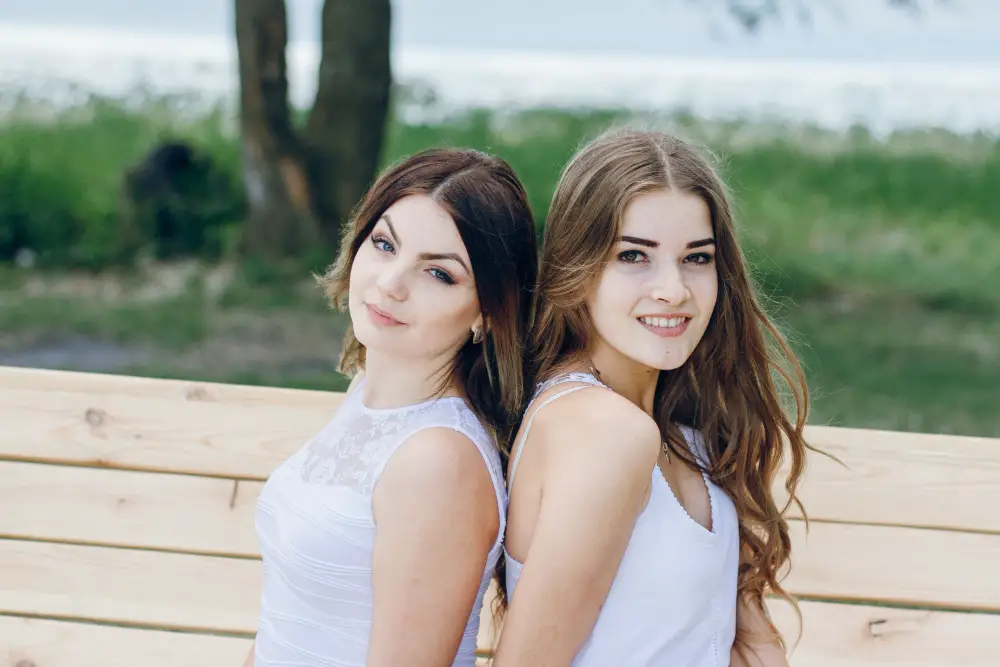
Ten years after my twin sister died, a dentist’s office called and asked me to come pick her up.
Then they put Clara on the phone.
“Sarah? Please come get me.”
I knew that voice before she finished saying my name. I would have known it anywhere, at any age, in any condition. It was my own voice, more or less. It was the voice I’d heard in my head for twenty years and then spent ten years trying to stop hearing.
Let me back up, because I need you to understand where I was when that call came, so you understand what it did to me.
I was thirty years old, sitting at my kitchen island on an ordinary Tuesday with my laptop open and a half-finished coffee going cold beside me. I was answering a work email. That’s it. That’s the whole scene. The most ordinary morning of the most ordinary week.
And then a receptionist said my dead sister wanted me to come get her, and put her on the phone, and my whole quiet, carefully rebuilt life just cracked straight down the middle.
By the time Clara’s voice came through the line, I was gripping the edge of the counter hard enough that my fingers ached.
“I’m sorry,” I said, when the receptionist came back on. “I need you to tell me again. Who exactly is sitting there in your office?”
“Your sister? Clara?” The woman sounded confused now, like maybe she’d dialed wrong. “She came in for a filling this morning, and she’s still a bit groggy from the medication we gave her. Her phone died in the waiting room, but she remembered your number by heart. She said you’d come.”
“My sister died ten years ago,” I said.
The words came out flat. I’d said that sentence hundreds of times over the years, to new coworkers, to a doctor filling out family history forms, to a man on a second date who’d asked if I had siblings. My sister died ten years ago. I had a whole calm delivery ready for it, built to keep other people from feeling too awkward.
It did not work that way this time.
The line went silent. A long, awful silence.
“I… I’m so sorry,” the receptionist said finally, and I could hear her scrambling, could hear how the ground had shifted under her too. “I don’t… Would you like to speak to her? To the woman who’s here? Would that help?”
“Yes,” I said.
A rustle. A muffled sound of the phone changing hands. And then:
“Sarah?”
My chest went so tight I couldn’t get a full breath.
“Where are you?” I said.
She gave me the address. A dental office maybe fifteen minutes from my house. She read it off carefully, like she was reading it from a sign on the wall, her voice going soft and uncertain at the end.
“Don’t leave,” I said. “Whatever you do, do not leave that office.”
“I won’t,” she said. So quietly I almost didn’t hear it. “I promise, Sarah. I won’t.”
I grabbed my keys off the hook and I was out the door before I’d even decided to move.
I should tell you about the crash.
Clara and I were twenty. It was a night in early spring, cold and wet, and she was driving home alone on a dark stretch of highway that curved along the edge of a ravine. Her car went off the road and down the embankment. They told us it flipped, that it caught fire before anyone could reach it, that by the time help arrived there was almost nothing left to recover.
Almost nothing. That’s the phrase that lived in my head for years. They gave us almost nothing to bury.
We had a closed casket. My mother, Alita, picked out the dress that went inside it, a dress that would never be worn, and I remember thinking that was the cruelest part, choosing an outfit for a box. My father, Jack, didn’t speak for most of that week. He just sat.
And then I had to learn how to be a person who used to be a twin.
Do you know what it is to be an identical twin, and then, suddenly, not? For twenty years there had been two of us. Two faces, two names people mixed up, two of everything. And then there was one, and the one was me, and every mirror in the world showed me a face that was supposed to belong to two people.
Therapy helped. It really did, I won’t pretend it didn’t. Over the years I rebuilt. I moved about twenty minutes from my parents so I could see them but still have my own life. I found a quiet job I liked, nothing dramatic, just steady and mine. I bought a small house. I learned, slowly, painfully, how to make plans that only had one name in them.
But you never fully unlearn being a twin. I’d catch myself at the bakery buying two pastries when I lived alone. I still had two blue coffee mugs in my kitchen cabinet, one that I used and one I called the “spare,” even though there had never once in ten years been anyone to use the spare.
That was the life I drove away from that morning. A quiet, one-person life I had built out of an absence I thought I understood completely.
I pushed through the door of the dental office and into the waiting room, and I stopped dead.
A woman stood up in the corner.
She was older. Of course she was. We both were, ten years older than the last time I’d seen my sister’s face. Her hair was shorter than Clara had ever worn it, cut blunt at the jaw. And there was a pale scar running along the line of her jaw, thin and old and faded, that had never been there before.
For a second, I thought, that’s not her. That’s a stranger. Some kind of terrible mistake.
And then she reached up, without seeming to know she was doing it, and started twisting a silver ring around and around her right finger.
And I knew.
Because Clara did that. When we were kids she’d twist her bracelets like that when she was nervous, round and round, a little motion she made without ever noticing she was making it. Twenty years I’d watched her do it. A stranger could copy a face. A stranger could not know to do that.
“Hi,” she said.
Something in me snapped taut.
“Don’t,” I said. “Don’t just say hi. Don’t you dare stand there and say hi to me like this is nothing.”
Her small, hopeful smile fell right off her face.
“Okay,” she said. “You’re right. Okay.”
I couldn’t make myself go to her. I couldn’t make myself close that distance and touch her, even though every cell in my body was screaming at me to. My feet stayed exactly where they were. My arms stayed at my sides.
“What did we call the dent in my bedroom wall?” I said. “When we were little.”
Her eyes filled up instantly.
“The moon,” she said. “We called it the moon. Because you said it looked like a crater and we could visit it before bed.”
My throat closed.
“Who broke Mom’s vase during the blizzard?”
“I did.” She said it without hesitating. “I knocked it off the hall table. And you took the blame for it so Dad wouldn’t ground me, because Maisie’s birthday party was that weekend and you knew how much I wanted to go.”
I stood there in that waiting room with a receptionist pretending not to watch us and I could not make my body move.
Clara took a step toward me.
I stepped back. Automatically. Like she was something hot.
“It’s really me, Sarah,” she said. “I promise. It’s really me.”
“You don’t get to tell me what’s real right now,” I said. “You don’t get to tell me anything right now.”
She stopped where she was. Nodded.
“You’re right,” she said again.
And I looked at her, really looked, and it was all there. The same eyes as mine. The same small vertical line that appeared between her eyebrows when she was frightened, the exact one I saw in the mirror when I was frightened, because we had the same face and the same fears written on it.
“How are you alive?” I said.
“Can we please leave here first? People are—”
“No. Tell me how you’re alive.”
She lowered her voice, glancing at the receptionist.
“I survived the crash, Sarah.”
“We buried you,” I said. “We had a funeral. There was a casket.”
“It was empty,” she said quietly. “There was nothing to put in it because I wasn’t in the car when it burned. It was an empty casket.”
“Mom still puts flowers on your grave. Every month. Fresh flowers on an empty box, for ten years.”
Clara closed her eyes.
“Dad wouldn’t drive that highway for five years,” I said. “Five years, Clara. He’d add forty minutes to a trip to avoid that one stretch of road because he couldn’t stand to look at the place where he thought you died.”
“I know,” she said.
And my stomach dropped through the floor, because of the way she said it. Not I can imagine. Not I’m so sorry to hear that. She said I know, the way you say it about something you already knew.
“How do you know that?” I said. “How could you possibly know that?”
She opened her eyes and looked at me, and something moved across her face, something careful and guilty and afraid.
And that was the moment, standing in a dentist’s waiting room with fluorescent lights humming overhead, that I understood my sister being alive might not actually be the worst thing waiting for me that day.
Outside, in the parking lot, she asked me to take her home.
And for one stupid, hopeful second, my heart leapt, because I thought she meant Mom and Dad’s house. I thought, we’re going home, all of us, this is the miracle, this is the story where the dead come back and everyone weeps in the driveway.
I already had my phone out. “I’ll call them,” I said. “I’ll call Mom right now, we can be there in—”
“No,” Clara said.
I looked up from the phone. “What?”
“Please. Take me to my apartment first.”
I stared at her. “Your apartment.”
“Sarah.”
“I’m sorry.” I heard my own voice climbing. “You supposedly died ten years ago, and you’ve been alive this whole time, and you have an apartment, and I’m just trying very hard to keep up here, Clara.”
She gave me an address instead of answering. I looked at it. It was two towns over. A good forty-five minute drive.
“That’s two towns away,” I said.
“I know.”
“Then why are you at a dentist fifteen minutes from my house?”
She rubbed the ring again, round and round. “I cracked a filling last night. It was bad. This was the only office anywhere that could fit me in today. It was a coincidence, Sarah. I didn’t plan any of this. I didn’t even know they’d—” She stopped.
“So you don’t live near here,” I said slowly.
“No. I don’t. I haven’t lived anywhere near you.”
“For how long? How long have you been living two towns over?”
She hesitated. “A few years.”
I got in the car. She got in beside me. I pulled away from the curb because I didn’t know what else to do with myself, and for the first several minutes, neither of us said a word.
I want you to understand something about me. When I get scared, I make lists. I always have. Groceries, tasks, pros and cons, anything I can put in a row and count. Order is how I survive fear. And driving my dead sister to her secret apartment that morning, my brain was trying frantically to make a list, and every single item on it was a question.
Clara broke the silence first.
“I need to tell you something. About the call. About how they got your number.”
I glanced over at her. “What about it?”
“I didn’t know I’d given it to them. I want you to know that. I was so out of it from the medication, and they asked me who they could call to come get me, and apparently I just… said your number. I don’t even remember doing it.”
“Clara,” I said. “That number is more than ten years old. That’s the number I had when we were twenty.”
“I know.”
“You remembered a phone number you haven’t used in a decade. Under sedation. Without even trying.”
“Apparently,” she said softly. “It just came out of me.”
And I didn’t say anything to that, because I didn’t know what to do with it. Somewhere inside my sister, buried under ten years of a whole life I knew nothing about, my phone number had been sitting there the entire time. Waiting. Some part of her had kept it.
After a while, quietly, she asked, “Are Mom and Dad okay?”
“They’re alive,” I said.
“That’s not what I meant. I meant emotionally. Are they okay.”
“I know what you meant.”
And I thought about them. About my mother, Alita, who called me every single Sunday for ten years and never once asked if I was “better” or “over it,” because she understood you don’t get over it, you just get further from it. About my father, Jack, who went quiet after the crash and stayed a little quiet forever after, but who showed up. Who sat beside me in every waiting room and at every dinner and simply existed next to me when there were no words left. They had spent ten years helping me survive losing my sister. And my sister had been alive the whole time.
“You knew my phone number,” I said.
“Apparently my brain did, yeah.”
“But you don’t know if Mom and Dad are okay.”
She turned and looked out the passenger window.
“That’s harder to explain,” she said.
“Then you’d better start explaining soon.”
When we got to her apartment, I understood, all at once and completely, just how thoroughly she had built an entire life without any of us in it.
It was a real home. Not a hideout, not a temporary place, a home. There were plants thriving in every window, the kind of plants that take years of steady care. There were framed photographs on the walls. There was a cheerful yellow mug sitting upside down in the dish rack by the sink.
Clara had a favorite mug. It was yellow. And I felt something twist in me, because our whole lives our favorite color had been blue. Both of us. Matching blue everything.
I walked around her living room, touching nothing, taking it all in. I picked up a book off her coffee table. A thick gardening manual, well-worn, with little colored tabs sticking out of the pages.
“You hate dirt,” I said.
“I did,” she said. “Before.”
“You killed a cactus, Clara. You killed the one plant that’s supposed to be unkillable. You forgot it existed for a month and it died of thirst.”
Her mouth twitched, almost a smile.
Then I saw the photographs on the wall, and the almost-smile went right out of me.
There was Clara, laughing at a dinner table crowded with people I’d never seen. Clara kneeling in the dirt beside a raised garden bed, sunburned and grinning, holding up a tomato like a trophy. Clara with her arm around a woman I didn’t know. Clara at what looked like a birthday, surrounded by strangers, mid-laugh, happy, so clearly and completely happy.
I looked at every single photograph on that wall.
There wasn’t one picture of me. Not one. Not of Mom, not of Dad. Ten years of a full, rich, happy life documented on that wall, and not one frame held anyone she’d been born to.
“How long have you lived here?” I asked. My voice came out strange.
“Three years.”
“And before that?”
“Farther away. A couple of different places.”
I set the gardening book down. “Okay,” I said. “Start from the crash. All of it. Now.”
She sat down on the arm of her couch and folded her hands.
“I was thrown clear of the car,” she said. “Before it went up. I don’t remember it, any of it, but that’s what they pieced together. I must have gotten up and walked, because a driver found me hours later, miles away, near a completely different road. I had a bad head injury. And I had nothing on me. No purse, no phone, no ID. Nothing that could tell anyone who I was.”
“And your memory?”
“Gone. At the start, completely gone.” She looked down at her ring. “I knew how to use a spoon before I knew my own last name. I could talk, I could walk, I could do all the automatic things, but I had no idea who I was or where I’d come from. My first name came back before anything else did. Clara. I knew I was Clara.” She paused. “But knowing you’re Clara isn’t the same as knowing where Clara belongs. Who Clara belongs to. That took so much longer.”
“What came back?” I asked. “When it started coming back. What did you remember?”
“Pieces. Out of order. Mom’s yellow kitchen. The way she’d hum while she cooked.” A faint smile. “You, singing terribly in the shower every morning.”
“That was you,” I said. “The terrible singing was you.”
“It was absolutely you, Sarah.”
“It was not.”
And I almost smiled, we almost had a moment, the old rhythm of us clicking into place for half a second. Then I remembered where we were and why, and it fell apart.
“When did you remember me?” I asked.
Her face changed. “Sarah.”
“When did I come back to you? When did you remember you had a twin sister?”
“Please, can we not—”
“How long, Clara?”
Her eyes filled, and she looked at the floor, and she wouldn’t answer.
“How long?”
“Six years,” she whispered.
The number didn’t make sense at first. I did the math out loud, stupidly. “Six. So four years after the crash.”
She nodded.
“You’ve known you were alive, and known who I was, and known I existed, for six years.”
“Yes.”
“You knew, for six years, that I believed you were dead. That I was walking around this earth thinking my twin sister burned to death on a highway. And you knew you were alive and you knew I was grieving you and you did nothing.”
“Yes,” she said. Barely audible.
I picked up her yellow mug off the counter. I don’t know why. I just needed something in my hands. I held it for a moment, feeling how light it was, this little ordinary object from her secret life. Then I set it back down, very carefully, so I wouldn’t throw it.
“Did you call?” I asked. “In six years. Did you ever once try to call?”
“I tried once.”
“Once.”
“I found Mom and Dad’s old landline number in my memory. When it finally came back to me, I called it. But it had been disconnected.” She’d been off it for years by then, everyone had gone to cell phones. “It just rang to nothing. A message saying the number was no longer in service.”
“So that was it? One disconnected number and you gave up?”
“No.”
“Then what? What did you do?”
She looked down at her hands. “I wrote letters.”
Something flickered in my chest, some awful hope. Letters. “Did you send them?”
She was quiet.
“Clara. Did you send them?”
“No,” she said.
The hope went out like a snuffed candle.
“Then you didn’t write them for us,” I said. “You wrote them for yourself. So you could feel like you’d tried without actually risking anything. Letters you never sent aren’t for the person they’re addressed to, Clara. They’re for you.”
She flinched like I’d hit her.
I grabbed my purse off her counter.
“Sarah, wait—”
I was already at the door.
“Please, let me explain, there’s more, I can explain all of it—”
I turned around with my hand on the doorknob and looked at her, at that unfamiliar scar on her familiar face, at all those photographs of a life that had no room in it for me.
“You had six years,” I said.
And I left.
I didn’t call Mom and Dad that night.
I sat in my own kitchen in the dark and I made that decision on purpose, and I want to be honest about it: part of it was mercy, wanting to figure out what to even say before I detonated their whole world. But part of it was something colder. Clara had spent six years controlling who got to know the truth and when. For one night, I wanted to be the one who decided. I wanted the truth to be mine for a few hours before I handed it over.
At some point I opened the cabinet for a glass of water and there they were. My two blue mugs. One I used every day. One “spare.”
I’d been buying spares for ten years. Two mugs. Two pastries. Two of everything, always, some reflex I’d never managed to kill, buying doubles of things that felt wrong alone. I’d told myself it was just habit. Standing there that night I understood it had never been habit. It had been hope. Some animal part of me setting a place for a person I consciously believed was gone.
And she wasn’t gone. She’d just left.
The next morning I called my mother.
“Are you sitting down?” I said.
“Sarah, you know I hate when you start a call like that. My heart can’t—”
“Please, Mom. Just sit down for me.”
Her voice changed. Went careful and small. “Okay. I’m sitting. What is it.”
“Clara’s alive.”
Silence. A long, terrible silence, the kind where you can hear someone’s whole world tilting.
“Sweetheart,” she said finally, gently, in the voice you use with someone who’s confused grief for reality. “Oh, sweetheart, have you been—”
“I saw her, Mom. In person. Yesterday. I sat in a car with her for forty-five minutes.”
Another silence.
“She knew about the moon,” I said. “The dent in my wall. She knew she broke your vase in the blizzard and I took the blame. She has the little line between her eyebrows. She twists her ring like she used to twist her bracelets. It’s her. I checked, I checked everything, and it’s her.”
I heard my mother start to cry, and then I heard the phone move, and then my father’s voice came on, low and steady.
“Sarah,” he said. “What do you need from us?”
Not where is she. Not how is this possible. Not are you sure. Just: what do you need from us. That was my dad, all the way down.
“I don’t know,” I admitted. My voice broke on it. “Dad, I don’t know what to do. I don’t know what I need.”
“Then we’ll start there, sweetheart,” he said. “We’ll start with not knowing, and we’ll figure the rest out together. Okay? You’re not doing this alone.”
Two days later, I drove them to Clara.
I’d called ahead this time. Clara had agreed, her voice tight with nerves on the phone. I brought my parents to her apartment and I watched my mother walk through that door and stop dead at the sight of her.
Clara stood by the window, rigid, her hands clenched in front of her.
For a long moment nobody moved. Then my mother crossed the room in about four steps.
“My baby,” she said. “Oh, my baby, my baby.”
And Clara stiffened, went stiff as a board for a second, and then just collapsed against our mother, folded into her and started to shake.
My father hung back by the door, one hand pressed over his mouth, tears running freely down into his beard. When Clara finally lifted her face from Mom’s shoulder and saw him, he managed one thing.
“Hey, kiddo,” he said, and his voice cracked right in half.
I looked away. I had to. Because I loved her, watching that, I loved her so much it hurt. And I was so furious with her I could barely breathe. And the thing nobody tells you is that both of those things fit inside you at the exact same time, at full size, neither one making room for the other.
After a while, when the crying had settled some, Mom pulled back and started talking. Too fast. Way too fast, the words tumbling out of her.
“I still make the cherry pie. The one you loved, I still make it every fall. And your old room, it’s not blue anymore, we painted it, but we could paint it right back, it would be nothing to paint it back. Oh, and do you remember that song, the one you girls used to sing in the back of the car on road trips, remember, you’d do the harmony and Sarah would—”
Clara’s hand slipped.
The yellow mug she’d been holding hit the counter and rolled onto its side with a hard clatter.
“Stop,” Clara said.
Mom froze mid-sentence.
Clara pressed both hands flat over her face.
“Please. Please just stop.”
“Clara?” Mom whispered. “Sweetheart, what—”
“I can’t do this anymore!”
The room went dead silent. My father took a small step toward my mother, but I stayed exactly where I was, by the wall, watching.
Clara dropped her hands. She was breathing hard, looking at the three of us like we were closing in on her.
“This,” she said. “This is exactly why I didn’t want to come back.”
My mother’s face crumpled. “Because… because I mentioned pie?”
“No, Mom. Because it’s been five minutes. Five minutes since you walked in that door, and you’re already rebuilding me. The pie, the room, the song. You’re already reassembling the exact person I was at twenty, piece by piece, right in front of me.”
“I just—” Mom’s voice wavered. “I thought you’d want something familiar. Something from home.”
“I don’t even like cherry pie anymore,” Clara said.
Mom stared at her like she’d spoken in another language. Cherry pie. Ten years, and cherry pie was still, in her mind, load-bearing. A fact about her daughter as fixed as her name.
Then Mom glanced over at me, reaching, trying to fix it. “But Sarah always loved it too. You both did. You girls always liked the same things.”
Clara laughed. One short, sharp, humorless sound.
“There,” she said. “That. Right there.”
Something cold slid down through me.
“You girls always liked the same things,” Clara repeated. “You have no idea, do you. No idea what that sentence did to me my whole life.”
“What are you saying?” Mom asked, bewildered.
Clara turned and looked directly at me. Only at me.
“Growing up,” she said, “it was always Sarah and Clara. One breath. One word, practically. And it was fine, until it wasn’t. You’d get the better grade. You’d make the team I got cut from. You’d win the thing. And people would look at me, this face that was identical to yours, and you could see them thinking it. She’s the other one. She’s the version that didn’t quite.”
“I never asked anyone to do that,” I said. “Clara, I never once—”
“I know you didn’t.” Her voice was raw. “That’s not what I’m saying.”
“Then why are you looking at me like I did this to you?”
“Because you never had to think about it!” The words tore out of her. “Not for one single day. You got to just walk into a room and be Sarah. Fully Sarah. And I walked into the same room and became the other one. The comparison. Every time. That was my whole life and you never even had to notice it was happening, because you were the one everything got measured against.”
Mom had started to cry again, quietly. “I never knew you felt that way. Clara, I swear I never knew.”
“Neither did I,” Clara said. “Not fully. Not until after the crash.”
She gripped the edge of the counter with both hands.
“At first, when I woke up and nobody knew who I was, when I didn’t even know who I was, it was the most terrifying thing you can imagine. To be no one. To have no past. But then, later, when the pieces started coming back, when I started to remember being Clara… something else happened. Something I wasn’t ready for.”
“What?” I asked. I had to know. “What happened?”
Clara looked at me through her tears.
“For the first time in my entire life,” she said, “there was no one to compare me to. Nobody in that whole new world had ever heard of Sarah. Nobody looked at me and saw half of a matched set. I was just a woman named Clara who was learning who she was from scratch.”
I felt the floor drop away from me.
“I found out I liked gardening,” she said. “Not because you liked it, not instead of you, just because I liked getting my hands in the dirt and watching things grow. I found out I liked cooking spicy food and staying up late and a hundred other things, and every single one of them was mine. Only mine. People met me and they never, not once, asked where my sister was.”
“So when you remembered us,” I said slowly, “when you remembered you had a whole family grieving you… you stayed gone. On purpose.”
“At first I was just scared and confused.”
“And after that? After the fear? When you knew exactly what you were doing?”
Her mouth trembled.
“After that,” she whispered, “I chose it. I chose myself.”
I stepped back from her.
“You chose yourself,” I said, “by letting us bury you. By letting Mom put flowers on an empty grave every month for ten years. By letting me grieve my own twin. That was the self you chose.”
“I know how that sounds.”
“It sounds monstrous because it was monstrous, Clara.”
She nodded, tears streaming now. “I know. I do know.”
Mom reached out toward her again, and Clara pulled away from the hand, gently but clearly.
“I loved you,” Clara said. “All of you. I never stopped loving you, I need you to believe that. But I was so scared that if I came back here, I’d stop being Clara again. That the second I walked back into this family, I’d dissolve right back into being one half of Sarah-and-Clara. And I couldn’t. I couldn’t lose myself again after I’d finally, finally found out who I was alone.”
I looked at her for a long moment.
“You looked us up,” I said. It wasn’t a question. I’d figured it out. “You knew about the flowers on the grave. You knew Dad wouldn’t drive that highway. You didn’t get that from your memory. You’ve been watching.”
Clara wiped her face. “I looked you up. Four years ago.”
“You found me.”
“Yes.”
“What did you see?”
“Your house,” she said quietly. “Your job. Your friends, in photos. You looked… you’d built a whole life, Sarah. A good one. You looked happy.”
“And that made it easier to stay away.”
“I was curious about you,” she said. “So curious. I’d sit there and look at your pictures for hours.”
“Curious enough to search for me and stare at my photos for hours,” I said. “But not curious enough to pick up a phone and tell me you were breathing.”
She looked down at her hands. “No.”
“Why?” I asked. “Just tell me why. Really why.”
She sat down slowly on the edge of the couch, like her legs had given out.
“Once I was well enough to make my own choices,” she said, “nobody could make me contact anybody. That’s the truth of it, ugly as it is. In rehab, they gave me routines before they gave me memories. I learned how to live a whole day, how to be a functioning person, before I ever remembered I had a family. And by the time enough came back to piece together my old life, I’d already started building a new one. And the new one didn’t hurt.”
“But eventually you remembered all of us. Clearly. Enough to find us.”
“Yes.”
“So why not come home? When you had the memories back and the choice was fully yours. Why not come home, Clara?”
She looked up at me, and her voice was steady for the first time.
“Because for the first time in my life, I was just Clara. No twin questions. No ‘oh, you’re one of the twins, which one are you.’ No ‘Sarah did this’ or ‘Sarah’s better at that.’ Nobody handing me a life that came pre-attached to yours. I could decide what I liked without wondering, even for a second, whether I only liked it because you did, or whether I was just being the other one again.”
“You could have told us that,” I said. “Any of that. You could have shown up on my doorstep and said, Sarah, I’m alive, and I love you, but I need to be my own person and I need you all to let me. I would have listened. We would have found a way.”
“I know.”
“You could have looked me in the face and told me the truth and let us grieve the twin thing instead of grieving you.”
“I know.”
“Instead you let me grieve a dead sister who was alive and gardening two towns over.”
Her eyes overflowed. “That’s the part I can’t defend. I know that’s the part there’s no excuse for.”
“Good,” I said. “Then don’t. Don’t you dare try to make that part okay.”
She nodded. “I won’t. I was selfish. I wanted my freedom more than I wanted to spare you pain, and that’s the truth. And then every year I stayed away made the coming back harder, because how do you undo one year of a lie, let alone six? So I told myself stories. That you were all fine. That you’d moved on. That coming back would just tear everyone open again for nothing.”
“And seeing me happy online made those stories easy to believe.”
Her face crumpled all over again. “Yes.”
I turned away. Looked at her wall of photographs, all those strangers, all that joy I hadn’t been in. Then I turned back and faced her.
“Listen to me,” I said. “I can understand wanting to be your own person. I can. I spent ten years learning how to be a whole person instead of half of a pair, so believe me, I understand that hunger better than almost anyone alive.”
Clara watched me, very still.
“I can understand hating the comparisons. I hated them too, sometimes, from the inside. I can even understand being terrified that coming home would swallow you back up. All of that, I can hold. I can find room for all of that.”
She swallowed.
“But I will never understand,” I said, “why my grief had to be the price of your freedom. Why the way you got to be yourself was by letting the people who loved you mourn you. There was another way, Clara. There were a hundred other ways. And you picked the one that cost me the most.”
Clara started to cry in earnest.
“I know,” she said. “I know.”
“No. Look at me. I need you to actually hear this one.”
She lifted her head and looked at me.
“You don’t get to disappear again,” I said. “You don’t get to vanish a second time the minute being my sister feels complicated or hard, because it is going to be complicated and hard, probably for a long time. That door is closed. You don’t get to walk out of it again.”
She nodded.
“And,” I said, and this part surprised me even as I said it, “I don’t get to drag you back into being the girl you were at twenty. I don’t get to do to you what Mom just did with the pie and the song. You’re not that person anymore. Neither am I. I’m not going to spend the next ten years trying to resurrect someone who doesn’t exist, and you’re not going to disappear to escape her. Those are both off the table now.”
Clara wiped her face with the back of her hand. “So what happens now?” she asked.
“Now,” I said, “for once, I decide. Not you. You’ve decided for all of us for six years. It’s my turn.”
She waited.
“We start small,” I said. “Very small. Here are the rules. You don’t disappear. Ever again. You don’t get to decide, from the outside, what I can and can’t handle, and then hide the truth to protect me from it. And you don’t make me chase you across the state for answers I have a right to. If I ask you something, you tell me. That’s the deal.”
“Okay,” she said. “Okay. That’s fair.”
“Mom and Dad get their own time with you. On their own terms. And they’re going to be angry, Clara, once the shock wears off. Really angry. Especially Dad, once he stops crying long enough to feel it. And I am not going to answer for you. When that anger comes, it’s yours to face. I won’t stand between you and it.”
Clara nodded slowly. “That’s fair too.”
“Stop saying it’s fair,” I said. “I’m not trying to be fair to you. I’m trying to figure out how to have a sister who’s alive, after spending ten years learning how to live without one. That’s a different thing than fair. It might be harder than fair.”
She almost smiled through the tears. “So what do you want from me? Right now?”
I picked up my purse from her counter.
“For right now?” I said. “Lunch. Thursday. Just the two of us. You pick the place. Somewhere I’ve never been. Somewhere that’s yours.”
Something moved across her face, something careful and disbelieving and grateful all at once.
“Okay,” she said. “Thursday.”
Three weeks later, I stopped at a bakery on my way to meet Clara for one of our lunches. We’d had two by then. They were awkward and stilted and occasionally, for a flash, exactly like being twenty again, and I never knew which it was going to be from one minute to the next.
I stood at the counter and pointed at what I wanted, and the cashier reached for a bag.
“Two blueberry scones?” she asked. Because I’d pointed, and old habit had almost made me hold up two fingers without thinking.
For ten years, I had bought things in twos without noticing I was doing it. Two mugs. Two pastries. Two of anything that felt too lonely as just one. Setting a place, over and over, for a ghost.
I looked through the glass case for a long moment.
“No,” I said. “One blueberry scone.”
Then I pointed to a chocolate croissant, the exact thing Clara had ordered at our lunch the week before, the thing I would never in a hundred years have picked for myself, a thing that was entirely and only hers.
“And one of those, please. Separately. Different bag, if you don’t mind.”
The cashier packed them up in two separate bags, and handed them across, and it felt right in a way I couldn’t have explained to her.
Because Clara and I were not picking up where we’d left off. I understood that fully now. There was no old, perfect, matched-set version of us waiting in storage somewhere to be dusted off and restored. That version had died on the highway just as surely as I’d always believed, even if the girl herself hadn’t. She had spent ten years becoming a whole person I was only now beginning to meet, a woman who grew tomatoes and liked her food too spicy and had a scar on her jaw and a wall full of a life I’d never seen.
And I had spent those same ten years becoming a whole person without her. Someone steady and careful and quiet, someone who’d learned to live with an absence and had, without meaning to, kept buying two of everything just in case.
One blueberry scone that was mine. One chocolate croissant that was hers. Two different things, in two different bags, for two different people who happened to share a face.
For the first time in twenty years, neither of us had to shrink down into half of something for the other one to exist. She didn’t have to disappear to be Clara. I didn’t have to resurrect anyone to have my sister back.
I picked up the two bags, one in each hand, both of them full, neither of them a spare.
And I went to go have lunch with Clara.

Specialty: Legal & Financial Drama
Michael Carter covers stories where money, power, and personal history collide. His writing often explores courtroom battles, business conflicts, and the subtle strategies people use when pushed into a corner. He focuses on grounded, realistic storytelling with attention to detail and believable motivations.