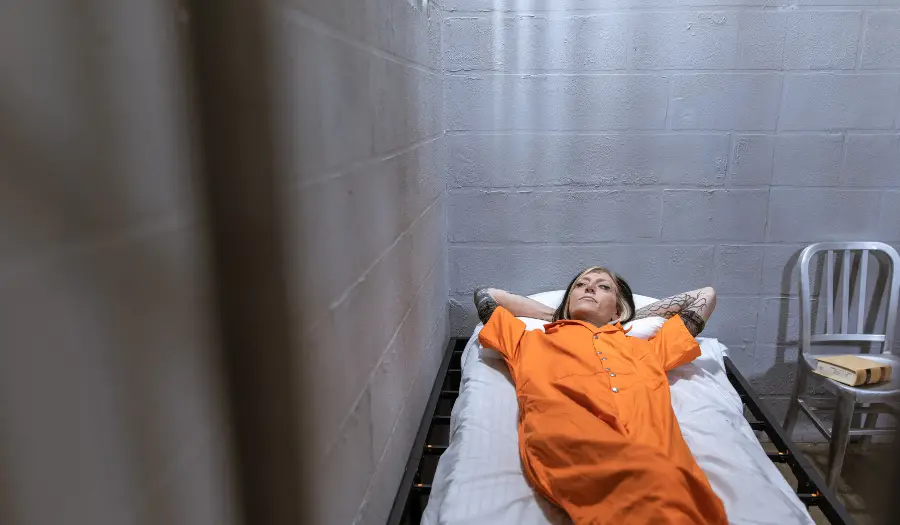
The corporal locked me inside a holding cell on the Marine base I was about to command, and my brother Glenn smiled at me through the bars.
“I told you they’d figure you out,” he said.
I didn’t answer him.
A few minutes later, the officer of the day walked into the hallway carrying a folder of paperwork, glanced through the bars out of routine, and stopped so suddenly that even Glenn noticed the change in him.
That moment had actually started hours earlier, with a decision that had seemed simple enough at the time.
I’d arrived at the installation in civilian clothes on purpose, because I wanted to see the place before anyone had a chance to polish it for my benefit. No escort waited beside my car when I pulled up outside the main gate. There was no convoy, no formal reception line, no carefully rehearsed row of officers standing by ready to tell an incoming commander exactly what they thought she wanted to hear. I wanted the ordinary version of the base — the version that existed on a Tuesday when nobody important was supposed to be watching. I wanted to see how the gate actually ran on a regular morning, hear how Marines spoke to each other when they didn’t think a general was listening, get a real feel for the place before ceremony and pressed uniforms changed the whole atmosphere of it.
So I drove my own car, an old gray sedan I’d owned for eleven years and had no intention of trading in just because I’d been selected for a star. My official orders sat in a folder on the passenger seat, along with the newly reissued credential I expected to use to get through the gate without any trouble at all.
Glenn sat beside me the whole drive down.
Bringing him had been my second decision that morning, and it turned out to be the one I would spend a long time thinking about afterward. He’d been making jokes about my career since I was eighteen years old, sitting across from me at our parents’ dinner table the night I first announced I wanted to earn a Marine Corps commission. I remember my father laughing before I’d even finished the sentence — not a cruel laugh, exactly, more the kind of laugh you give a child who’s just announced she wants to be an astronaut, fond and dismissive all at once. Glenn laughed right along with him, sixteen years old at the time, delighted to have a fresh joke handed to him on a silver platter.
“Playing dress-up for the government,” he called it. That exact phrase. It survived every single year that followed, dusted off at holidays, at graduations, at family gatherings where somebody’s second cousin would ask what I did for a living and Glenn would answer for me before I could open my mouth.
I remember how quickly everyone else at that table had joined in that first night, laughing along like my plan wasn’t something I’d spent months quietly researching and thinking through, but rather a joke I’d accidentally told without meaning to. At eighteen, I genuinely believed that achievement would eventually settle the argument on its own. I believed that if I worked hard enough, stayed long enough, carried enough responsibility, and earned enough trust from the people around me, the people closest to me — my own family — would eventually have to reconsider the version of me they’d built when I was young and easy to laugh at.
That belief followed me a lot longer than I like admitting out loud.
When I made captain, Glenn said I mostly pushed paperwork around a desk while real Marines did the actual work. When I pinned on lieutenant colonel, he said I’d simply gotten better at wearing the costume, more convincing in the role, but a role all the same. Every single promotion handed him another fresh opportunity to take something difficult and turn it into something small enough to fit inside half a sentence. He had a real gift for that, if I’m honest. He could reduce years of deployments, years of decisions that kept people alive, years of nights I couldn’t talk about even if I’d wanted to, down into one clever line that made everyone at the table laugh and moved on to the next topic before I could say a word in response.
I learned, somewhere along the way, not to argue with him in front of other people. But privately, quietly, I kept expecting some future accomplishment to finally be the one he couldn’t dismiss. The next star on my collar. The next command. The next milestone that would force him, once and for all, to look at what I’d actually built and admit he’d been wrong about me since I was eighteen years old.
Then I was selected for my first star, and even after that, some stubborn, hopeful piece of me still wanted my younger brother standing beside me when I arrived at the installation I was about to command. I wanted him to see, in person, exactly where thirty years of service had actually led. More than that, if I’m being completely honest with myself, I wanted one single moment where he looked around at what surrounded me and had absolutely nothing clever left to say.
That’s the real reason he was sitting in the passenger seat when we reached the gate that morning.
I handed my credential to the young Marine standing post, expecting nothing more dramatic than the routine inconvenience of entering a new installation with paperwork that hadn’t fully caught up in the system yet. The scanner rejected it.
Corporal Jared Brandt looked down at the card, tried it a second time, and frowned. He was twenty-two years old, I would later learn, and had been standing that particular gate alone for only two weeks, newly assigned after his predecessor rotated out. I didn’t know any of that when I first rolled down my window. I would learn enough during the encounter that followed to understand he was inexperienced, understandably cautious, and suddenly confronted with something that didn’t fit neatly into any of the simple categories his training had prepared him for.
“Ma’am, this card is invalid,” he said.
I asked him to check the orders I’d brought along in the folder. Then I asked him, calmly, to make a phone call — the command duty office or the protocol staff could clear up a credentialing glitch in a matter of minutes, the kind of routine hiccup that happens more often than most people realize whenever a new system rolls out a batch of reissued cards. Nothing about the situation required any kind of confrontation at all. A card had failed to scan. There was a simple, obvious way to confirm who I was and why I belonged there without anyone losing face over it.
Brandt didn’t take that path.
He looked at me, then down at the documents in his hand, and his expression hardened with the particular confidence of someone who believed he’d already solved the puzzle sitting in front of him.
“You are not entering my base with a fake story,” he said.
The words landed harder than the scanner’s rejection had. I kept my voice level and told him again, patiently, that a single phone call would settle the entire matter in under five minutes. He refused.
“Until someone tells me different, you’re going to wait right here.”
Behind me, I could feel Glenn smiling before I’d even turned to look. I could see it in my peripheral vision, that particular half-smile he’d been using for decades, the one that appeared whenever something happened that seemed, to him, to confirm every opinion he’d ever held about my career. That expression, somehow, hurt worse than Brandt’s suspicion did.
Because Brandt didn’t know me. He was looking at a civilian woman with a credential that wouldn’t scan, an unusual claim about her identity, and paperwork he hadn’t yet had a reason to trust. His caution, however clumsy, at least made a kind of logical sense.
Glenn knew thirty years of the actual story. And he still, apparently, preferred the joke.
The situation moved from the gate to a small holding area near the provost marshal’s office, Brandt escorting us there with a young Marine’s careful, by-the-book formality, radioing ahead to report an individual attempting to gain access with what he described, verbatim, as “a possible false identity claim.” And then the door closed behind me, and I heard the lock settle into place with a heavy, mechanical click.
The cell itself was cold, brightly lit, and almost offensively ordinary. Fluorescent lights buzzed faintly overhead. A steel bench ran along one wall, bolted down, the paint on it worn thin in the middle where countless people before me had sat waiting for someone else to decide what happened next. There was no dramatic sense of danger in the room, nothing cinematic about it at all, which somehow made the whole experience sharper rather than duller. It was simply a place built to contain someone until the people outside got around to sorting things out.
I sat down on that bench and listened to the lock settle fully into place.
Thirty years of service had handed me harder days than that one, by any honest measure. I’d sat through longer nights. I’d carried heavier responsibilities, made decisions involving Marines who needed me to stay steady whether I actually felt steady inside or not. I’d learned, over decades, to control my expression in moments when anger would only make a bad situation worse. I’d learned that leadership often meant absorbing the emotional weight of an entire room without letting your own feelings drive the next decision you made.
And yet sitting in that particular holding cell felt personal in a way none of those harder days ever had.
The reason for that was standing on the other side of the bars.
Glenn walked closer, his hands in his jacket pockets, unhurried. He didn’t look worried for me. He didn’t look confused about how a simple credentialing problem had somehow escalated into his sister sitting behind a locked door. He looked, if anything, satisfied.
“Thirty years of dress-up,” he whispered, leaning in slightly like he wanted to make sure I heard every word clearly. “And this is where it ends.”
For most of my life, a remark like that would have triggered an immediate, automatic defense somewhere in the back of my mind. I could have listed deployments for him right there — two tours through some of the worst years of two different wars, months at a time in places I still don’t talk about at family dinners. I could have listed commands, battalions and then a regiment, hundreds and then thousands of Marines whose training and readiness had, at various points, rested directly on decisions I made. I could have talked about nights away from home that Glenn had never once asked about, responsibilities he’d never seen up close, people who had trusted me with their lives when the consequences of getting something wrong were about as real as consequences get. I could have reminded him, calmly, that a career doesn’t last thirty years because everyone involved in it is simply pretending well.
There had always been another fact available to me. Always another accomplishment I could hold up in front of him and say, quietly, see? Does this one finally count?
Sitting on that steel bench, though, I felt something shift that I hadn’t expected. I realized, all at once, how genuinely exhausted I was by that particular question, by the whole lifelong project of gathering evidence for a case Glenn had never actually agreed to consider fairly in the first place.
My hands rested together in my lap. For the first time in longer than I could easily calculate, I felt no urgent need to convince him of anything at all.
That surprised me more than the locked door had.
I’d spent years, decades really, quietly imagining that respect would eventually arrive after the next milestone. The next promotion would finally settle it. The next command would be the one that made the difference. The next visible, undeniable proof would force the people who’d laughed at me across a dinner table when I was eighteen to finally admit they’d been wrong.
But Glenn had never actually lacked information. He’d watched enough of my life, from a distance, to know full well that the old joke no longer matched the reality of who I’d become. What he lacked wasn’t knowledge. What he lacked was the willingness to give the joke up.
Those are two very different problems, and understanding the difference, sitting there on that bench, changed something in me permanently.
A person can correct a misunderstanding the moment new information reaches them. That’s a simple, mechanical process. It’s a great deal harder to correct a story someone has deliberately chosen to keep telling, because that story gives them something they don’t actually want to lose. For Glenn, I understood then, dismissing my career had become woven into the way he understood both of us, together, as siblings. If I was merely playing dress-up, as he’d always insisted, then he never had to reconsider all those years of laughing along at our parents’ table. He never had to ask himself whether the judgments passed down on me at eighteen had been unfair. He never had to admit that the sister he’d spent decades reducing to a punch line had actually built a life of genuine, weighty responsibility that he had simply refused to look at clearly.
That refusal, I finally understood, was his burden to carry. Not mine.
The realization didn’t arrive as some kind of internal speech. I didn’t stand up in that cell and announce to Glenn everything I’d just worked out in my own head. I simply, quietly, stopped preparing a defense.
Glenn waited for one anyway. He’d spent thirty years learning exactly which comments reliably pulled me into explaining myself, justifying myself, proving myself all over again. This time, standing at those bars with his half-smile still in place, I gave him nothing at all.
The silence changed his expression slightly. Not dramatically — he was still amused, still apparently confident that the scene at the gate had proven something important about the two of us. But now he had to stand there without the familiar argument that usually followed one of his insults, and I watched something like uncertainty flicker briefly across his face, there and then gone.
I looked past him, toward the hallway beyond the bars. There was still, obviously, an administrative problem that needed solving. My credential had failed. The corporal had refused to verify my identity through the obvious available channels. And I was now sitting behind a locked door on the exact installation that had spent the last several weeks preparing for my arrival as its new commanding general.
Those facts would eventually have to meet each other. I didn’t know precisely how long that would take. I only knew, with a strange, settled clarity, that I no longer needed Glenn to understand any of it first.
Then I heard footsteps coming down the hallway. Not hurried. Someone walking with the purposeful, unremarkable pace of a person carrying out an ordinary task on an ordinary morning.
Corporal Brandt, stationed nearby, shifted his attention toward the sound. Glenn glanced back over his shoulder. I stayed exactly where I was.
The officer of the day entered the hallway carrying a folder of paperwork, and at first, nothing about the way he moved suggested he expected anything unusual. He glanced down at the page in his hand, then toward the holding area out of routine habit. His eyes found my face.
Then they went back down to the paperwork.
He checked the name printed there. Looked back up at me.
His posture changed immediately, a small physical shift, but one that everyone standing in that narrow hallway could clearly see happen in real time.
He didn’t need any kind of speech from me. He didn’t need Glenn’s opinion on the matter. He didn’t need to debate internally whether I looked like the person he’d been expecting to arrive on base sometime that week. The paperwork in his hand and the woman sitting behind that locked door belonged, unmistakably, to the exact same story.
The installation had spent weeks preparing for the arrival of its incoming commanding general. That general was now sitting in a holding cell because a newly reissued credential had failed to scan properly at the gate.
For the first time since we’d arrived that morning, the situation was finally being seen by someone who already understood its full context.
The officer’s attention moved from me to Corporal Brandt. Brandt straightened, almost involuntarily, and I could see, even from inside the cell, the exact moment the young corporal began quietly reconsidering the certainty that had brought all three of us to this hallway in the first place. The problem in front of him was no longer a stranger telling an improbable story at a checkpoint. Now the officer of the day was looking at that same stranger and reacting as though he recognized precisely what had gone wrong, and how badly.
Glenn noticed the shift too. His half-smile didn’t vanish all at once. First he looked at the officer. Then at me. Then down at the folder of paperwork the man was holding. He’d spent the last several minutes treating that holding cell as the final, satisfying proof that his thirty-year joke had been right all along. But the meaning of the room was changing right in front of him, faster than he seemed prepared for.
I still said nothing. That, more than anything else about that entire morning, is the part I remember most clearly even now. Not the scanner failing. Not the fluorescent lights buzzing overhead. Not even Glenn’s whispered line through the bars. I remember sitting perfectly still while the truth finally walked into that room on its own, without needing me to drag it in behind some argument I’d have to make on my own behalf.
For years, I’d believed that defending myself was simply part of earning respect. If someone diminished the work, I explained the work. If someone mocked the rank, I laid out the responsibility that came attached to it. If someone suggested that thirty years amounted to nothing more than a costume, I mentally assembled thirty years of evidence to prove otherwise. In that hallway, though, the evidence wasn’t mine to present at all. It was simply, already, there.
“Ma’am,” the officer said, stepping closer to the bars, his voice carrying the particular formal steadiness officers use when they’ve suddenly realized a situation is a great deal more serious than they’d been told. “General Merrick?”
“That’s correct,” I said.
He turned to Brandt, and his expression, which had softened somewhat toward me, hardened considerably in the corporal’s direction. “Get this door open. Now.”
Brandt fumbled slightly with the keys, his hands not quite steady, and I watched the full weight of what he’d done settle onto his face in real time, the color draining out of it the same way it had flooded into Glenn’s just minutes earlier for entirely different reasons.
“Sir, she couldn’t verify—” Brandt started.
“I’m well aware of what she couldn’t verify with the equipment at your post,” the officer said, cutting him off, not unkindly but firmly. “You had a phone in front of you. The command duty office has been standing by for this exact contingency since yesterday afternoon, because credential reissues fail at the gate more often than anyone likes to admit. Did you call it?”
Brandt’s silence answered the question more completely than any words could have.
The cell door swung open. I stood, straightened my civilian jacket, and stepped out into the hallway, and for a moment nobody said anything at all — not the officer, not Brandt, not Glenn, who stood off to one side now, uncharacteristically quiet, his hands no longer in his pockets.
“General, I owe you a formal apology on behalf of this command,” the officer said. “This should never have happened, and it will be reviewed thoroughly. I’ll have someone bring your vehicle around to the front entrance immediately, and I can have you escorted directly to the command suite if you’d like to bypass the rest of the gate process entirely.”
“I’d like that,” I said. “But first, Corporal Brandt and I are going to have a conversation.”
I watched something close to dread pass across the young Marine’s face.
I want to tell you honestly what I said to him in that hallway, because I’ve thought about it many times since, and I still believe it was the right approach, even if it surprised the officer standing beside me.
“Corporal,” I said, “look at me.”
He did, though it clearly cost him something to hold my gaze.
“You made an error today,” I told him. “A serious one. You had a resource available to you — a phone, a chain of command, a straightforward verification process — and instead of using it, you decided you already had the situation figured out. That decision put you at real risk of committing a genuinely serious mistake, and it happened to land on someone who has the rank and the patience to handle it calmly. It won’t always land that way. The next person you’re this certain about might not have either.”
“Yes, ma’am,” he said quietly.
“But I also want you to understand something else,” I continued. “You didn’t fold under pressure when a stranger with an unusual story pushed back on you. You held your post. You followed a process, even if it was the wrong process for this particular situation. That instinct — the refusal to simply wave someone through because they sounded confident — that instinct is worth something. It’s worth a great deal, actually, in a Marine standing post alone. You need better judgment about when to use it. You do not need less of it.”
Brandt looked at me for a long moment, clearly working to reconcile the reprimand with what had followed it.
“I expect a full review of gate verification procedures on this installation within the week,” I said, turning to the officer of the day. “Not to punish Corporal Brandt specifically, but because if a legitimate credential failure can escalate this quickly with a general officer standing right in front of him, it can escalate just as badly with anyone else standing at that gate on any other Tuesday. I’d rather fix the process than simply blame the Marine standing inside it.”
“Understood, ma’am,” the officer said, and I could see, in his expression, something shifting from simple alarm into something closer to respect.
Glenn stood off to the side through all of this, watching, and I want to be honest about what I saw in his face during those few minutes, because it wasn’t dramatic. It wasn’t a single cinematic moment of revelation. It was smaller than that, and in some ways more convincing for exactly that reason. I watched him watch me handle Brandt’s mistake with something other than fury, something other than the kind of vindictive satisfaction he might have expected from a woman he’d just spent an hour mocking through the bars of a holding cell. I watched him watch the officer of the day address me with a level of formal respect that had absolutely nothing to do with anything I’d said in my own defense, because I hadn’t said anything in my own defense at all.
We walked out of that building together, the three of us, into the gray morning light, and Glenn didn’t say a single word during the entire walk to the car. That silence, from a man who had never in his life let a silence sit unfilled when there was a clever remark available, told me more than anything he could have actually said.
I want to back up now and tell you a little more about how I got to that gate in the first place, because I think the years leading up to that morning matter as much as the morning itself.
I commissioned at twenty-two, straight out of college, over my father’s quiet disapproval and Glenn’s much louder amusement. My mother, for what it’s worth, never joined in the jokes — she’d simply nod when I talked about training, ask practical questions about logistics and timelines, and leave the mockery to the two men in the family, which I’ve come to understand, looking back, might have been its own quiet form of support even if she never said so directly.
The early years were exactly as hard as you’d expect. I spent my twenties earning the trust of Marines who had, at first, more than a little skepticism of their own about a young female officer giving them orders. I spent long stretches away from home during two different combat deployments, years I still don’t discuss in detail at family gatherings, not because the details are classified but because I’ve learned, through hard experience, that some stories don’t survive being told across a dinner table to people who weren’t there and don’t actually want to understand what they’re asking about. I made captain in my late twenties, then major, then lieutenant colonel by my late thirties, each promotion arriving alongside another one of Glenn’s jokes, delivered with the easy confidence of a man who had never once had to prove himself against a room full of Marines who assumed he didn’t belong there.
I never married. That’s not a detail I usually offer up freely, but it matters here, because it was one more thing Glenn found ways to work into his running commentary over the years — the sister who’d chosen a career over a family, who’d sacrificed the “normal” life the rest of us apparently understood better than she did. I’d stopped explaining, by my forties, that I’d made my peace with that choice a long time before it became a talking point at holiday dinners. The Marine Corps had, in its own imperfect way, given me a kind of family too, one built out of shared hardship and mutual trust rather than blood, and I never once regretted the trade, whatever Glenn assumed about it.
I made colonel at forty-four. I took command of a regiment at forty-seven, nearly four thousand Marines under my authority at the peak of it, responsible for their training, their readiness, their lives in a very real and immediate sense whenever we deployed. I spent two years in the Pentagon after that, in a policy role that involved more twelve-hour days than I could easily count, work that mattered enormously and that almost nobody outside a small circle would ever know I’d done.
And then, at fifty-three, I got the call every officer of my generation had quietly hoped for and rarely allowed themselves to fully expect. Selected for brigadier general. My first star.
I called my parents that evening, my father in his eighties by then, his hearing mostly gone, my mother relaying the news to him loudly across their kitchen. There was a long pause on the line, and then my father said, in a voice that had gone thinner with age but hadn’t lost its capacity to land exactly where it always had, “Well. I suppose you really did stick with the dress-up long enough to make it convincing.”
I laughed, because at that point, laughing was easier than explaining, again, for what felt like the thousandth time, exactly what the last thirty-one years had actually involved. My mother, in the background, told him to hush, but I could hear, even through that, that some part of him meant it as praise, filtered through the only language he’d ever really had for talking about my life.
Glenn’s reaction, when I told him separately a few days later, was almost exactly what you’d expect by now. A pause on the phone. Then, “So what, they just run out of colonels eventually?”
I didn’t laugh at that one. I’d stopped, somewhere in my late forties, finding that particular brand of humor especially funny.
The installation I’d be commanding sat in a part of the country neither of us had spent much time in, and when I mentioned, almost as an afterthought during a family dinner two weeks before my arrival date, that I planned to drive down and see the place informally before the formal change of command ceremony, Glenn had surprised me by asking if he could come along. I still don’t fully know why I said yes. Some old, stubborn hope, I think, that had never quite finished dying no matter how many times it should have.
That’s how we ended up at that gate together.
The change of command ceremony took place eleven days later, on a bright, cold morning on the installation’s main parade field, several hundred Marines standing in formation in their dress uniforms, a band playing, the outgoing commander and I exchanging the formal remarks and the traditional passing of the colors that mark the moment when responsibility for thousands of lives transfers from one set of shoulders to another.
Glenn came to that ceremony too, at my invitation, though I’ll admit I extended it with less hope than I had the first time and more simple, practical family obligation. He stood near the back of the guest section, in a suit rather than his usual casual clothes, and I remember catching sight of him during the ceremony itself, standing very still, watching several hundred Marines snap to attention in my honor, watching the base commander’s flag rise with my new rank displayed on it, watching a formal military ceremony built entirely around the fact that the woman he’d been calling a costume-wearer since she was eighteen years old was now legally, formally, undeniably responsible for the entire installation stretched out around him.
I didn’t watch his face for very long during the ceremony itself — I had a great deal else to focus on, several hundred Marines’ worth of attention required elsewhere. But afterward, during the reception in the officers’ club, he found me near the edge of the room, away from the crowd of well-wishers and fellow officers offering congratulations.
“That corporal,” he said, without preamble. “The one from the gate. Is he in trouble?”
“He’s in a review process,” I said. “It’s not the same thing, though I understand why it might look similar from the outside.”
Glenn nodded slowly, looking down at the drink in his hand rather than at me. “You didn’t rip into him. Back at the gate. I kept waiting for you to.”
“I noticed you waiting,” I said.
He was quiet for a moment. “I think I wanted you to, actually. I think some part of me wanted to watch you lose your temper at somebody, because it would have made the whole morning make more sense to me.”
“Make more sense how?”
“I don’t know,” he said, and for the first time in longer than I could remember, he sounded genuinely uncertain rather than performing certainty for an audience. “I think I’ve spent thirty years telling myself a story where none of this was real. Where you were basically playing a very elaborate, very long game of dress-up, like I always said, and eventually the costume would slip and everyone would see what I’d apparently seen all along. And then we’re standing at that gate, and the costume does slip, sort of — your credential doesn’t work, you get thrown in an actual holding cell — and for about ten minutes I thought, there it is, I was right the whole time.”
“And then the officer walked in,” I said.
“And then the officer walked in,” he agreed. “And he wasn’t looking at a costume. He was looking at paperwork that had your name on it, connected to something a lot bigger than either of us, and he changed everything about how he was standing the second he recognized it. That wasn’t performance, Elena. That wasn’t you convincing anybody of anything. That was just — what’s actually true, whether or not I ever decided to believe it.”
I didn’t say anything right away. I’d waited a long time to hear something close to that sentence, and now that it had actually arrived, I found I didn’t need to respond to it the way I once would have.
“I’ve been telling that joke since I was sixteen,” Glenn continued, still not quite looking at me directly. “I think somewhere along the way I stopped even really believing it and just kept saying it because I didn’t know how to stop without admitting I’d been wrong about my own sister for three decades. That’s a hard thing to admit to yourself, let alone out loud at a family dinner.”
“I know,” I said, and I meant it, more than I expected to.
“I’m not going to stand here and pretend this fixes thirty years in one conversation,” he said. “But I watched you today. All of it — the ceremony, the way those Marines look at you, the way that officer looked at you the second he understood who you actually were. I don’t have a joke for any of that. I genuinely don’t.”
“You don’t have to have one,” I said.
He looked at me then, finally, directly, and there was something in his expression I hadn’t seen from him since we were children, something unguarded and a little unsure of itself. “For what it’s worth,” he said, “I’m sorry. Not just for today. For a long time before today.”
I want to tell you that I felt some enormous wave of relief in that moment, some sense that thirty years of old wounds had simply resolved themselves in a hotel ballroom over drinks. That wouldn’t be honest. What I actually felt was smaller and, in its own way, more real — a kind of cautious, careful acknowledgment that something had genuinely shifted, without any promise attached to how far that shift would carry or how long it would last.
“Thank you for saying that,” I told him.
We didn’t hug. We didn’t cry. Glenn and I have never really been people who process things that way, and pretending otherwise for the sake of a tidier ending wouldn’t serve either of us. But he stayed at that reception for another two hours, longer than I expected, and I watched him talk with several of my staff officers, ask real questions about what the installation actually did, what my responsibilities as commanding general actually involved day to day. Genuine curiosity, not performance. It was a small thing. But after thirty years, small things had started to feel like a great deal.
Corporal Brandt’s review concluded about three weeks later. I read the final report carefully before it crossed my desk for approval. The gate’s verification protocol had, in fact, contained a genuine gap — new credentials issued through the recently updated system had a documented failure rate the installation hadn’t adequately briefed its gate personnel on, and Brandt, alone on a post he’d only been standing for two weeks, had never been given clear guidance on the escalation process for exactly this kind of situation. He received additional training rather than punitive action, and the installation’s gate procedures were formally revised within the month, a change that, as far as I know, has held up without incident ever since.
I saw him again about six months into my command, during a routine walk-through of the main gate one morning. He recognized me immediately, came to attention, and I stopped to talk with him for a few minutes, the way I try to do with junior Marines whenever the opportunity presents itself.
“How’s the post treating you, Corporal?”
“Better, ma’am. We got the new verification protocol installed last month. Runs a secondary check automatically now if the first scan fails.”
“Good,” I said. “I read about that. Good change.”
He hesitated for a moment before adding, “I think about that morning a lot, ma’am. I want you to know I don’t regret holding my ground the way I did. I just regret not using the resources I had available to check it properly first.”
“That’s exactly the right lesson to take from it,” I told him, and I meant it.
I think about that morning often too, if I’m honest, though for different reasons than Brandt probably does. I think about the particular stillness that settled over me on that steel bench, the strange, unexpected relief of finally setting down an argument I’d been carrying, unconsciously, for thirty straight years. I think about the exact moment the officer of the day’s posture changed, the truth entering that hallway entirely on its own, without needing me to drag it in behind some speech about deployments and commands and everything else I could have listed but chose not to.
And I think about Glenn, standing at the back of a parade field in a suit, watching several hundred Marines come to attention for a sister he’d spent three decades reducing to a punchline, finally understanding, in a way no argument of mine had ever managed to make him understand, exactly what those thirty years had actually built.
I don’t know if I ever needed that particular morning to happen exactly the way it did. Some days I think I could have reached the same quiet understanding without a locked door and a holding cell involved at all. But I also know this: for thirty years, I believed that respect from my brother was something I had to earn one accomplishment at a time, stacking proof upon proof until the weight of it finally became undeniable. Sitting on that steel bench, I finally understood that I’d been asking the wrong question the entire time.
The real question was never how much more I needed to accomplish before Glenn respected the life I’d built. It was how much longer I was willing to keep treating his refusal to see it clearly as a problem that belonged to me to solve.
I stopped carrying that particular weight somewhere in that holding cell, on a cold steel bench, under a set of buzzing fluorescent lights, in the exact moment I realized I no longer had anything left to prove to a man who had simply never wanted the proof in the first place.
Everything that came after that — the officer’s recognition, Brandt’s apology, Glenn’s quiet admission months later that he’d been wrong — all of it mattered. But none of it was ever really the point. The point was simpler than that, and it took me thirty years and one locked door to finally understand it completely: some people will only ever see what they’ve already decided to see, until the moment reality simply walks into the room and refuses to leave. My job was never to drag that reality in by force. It was only ever to keep building the life I actually wanted, steadily, honestly, whether or not anyone standing on the other side of the bars was ready yet to look at it clearly.

Specialty: Quiet Comebacks & Personal Justice
David Reynolds focuses on stories where underestimated individuals regain control of their lives. His writing centers on measured decisions rather than dramatic outbursts — emphasizing preparation, patience, and the long game. His characters don’t shout; they act.