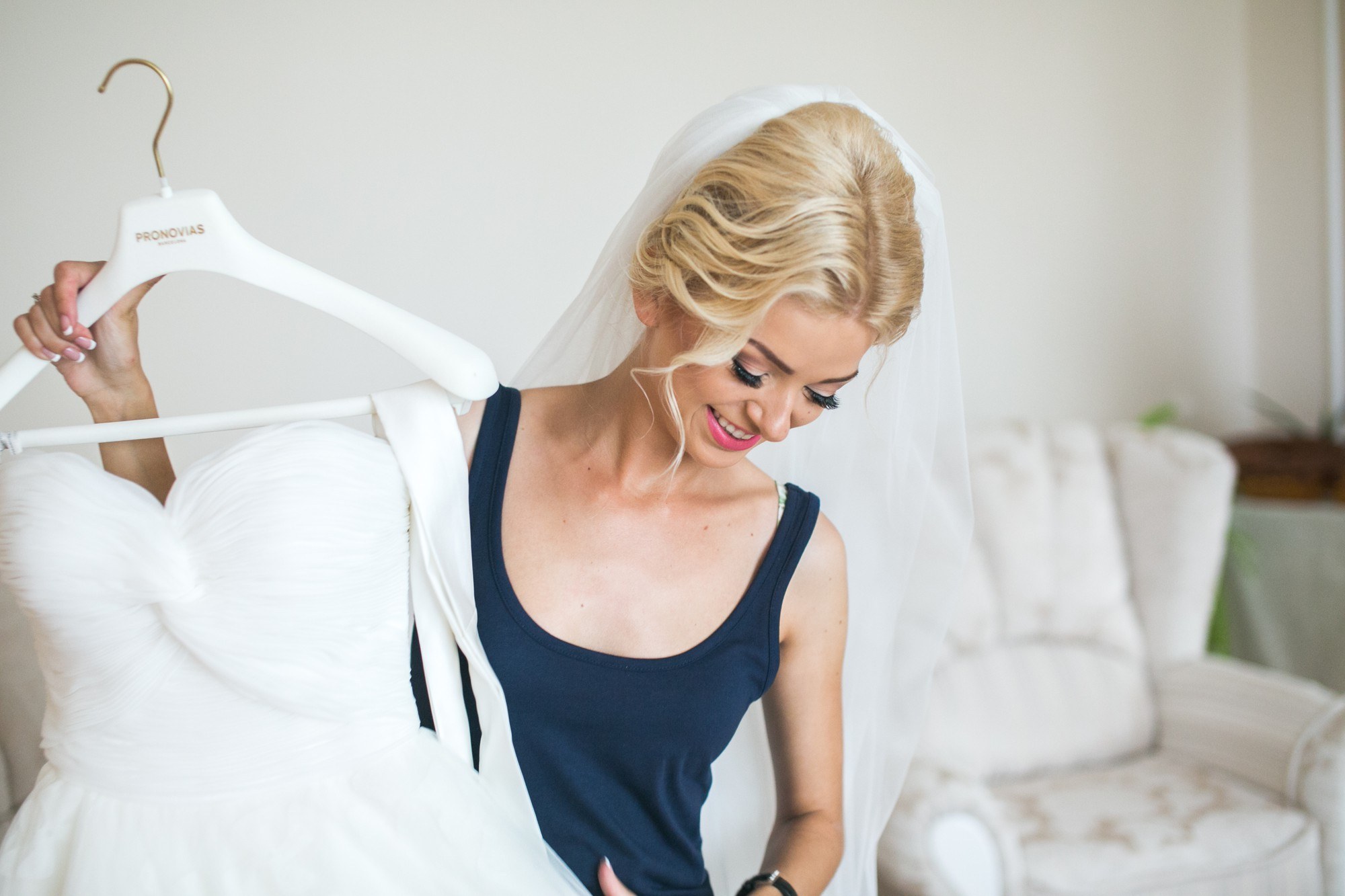
The woman at the bridal shop said it was the first dress she’d ever seen make a mother cry before the daughter did.
I didn’t believe her. I thought she said that to everybody. That’s how they sell dresses.
But then Emily stepped out from behind the curtain, and I stopped thinking about anything at all.
It was ivory. Not white. Emily said white made her look like a ghost. Ivory silk, with long lace sleeves that came down to her wrists, and a row of tiny covered buttons all the way down the back. The skirt was soft and simple, no big poof, no sparkles. It moved when she moved, like water.
She stood on the little round platform in front of the three mirrors and looked at herself.
She didn’t say anything. She just looked.
Then she turned around and looked at me, sitting on the velvet couch with my purse in my lap.
“Mom?” she said.
I had my hand over my mouth. I couldn’t say anything. My eyes were full.
“Is it okay?” she asked. Her voice was small. Like she was five years old again, showing me a drawing.
“Your father would have—” I started. Then I couldn’t finish.
Emily’s face crumpled. She came down off the platform in the dress, holding up the skirt with both hands, and sat down next to me on the velvet couch, and put her head on my shoulder.
We sat there like that for a long time. The saleswoman, a nice older lady named Rosa, quietly went to get a box of tissues.
“He’d have said I looked like a princess,” Emily said finally.
“He’d have said you looked like your grandmother,” I said. “On her wedding day. In the picture on the piano.”
“Is that good?”
“Your grandmother was the most beautiful woman in Schuylkill County,” I said. “Your father said so every Christmas.”
Emily laughed. Her laugh came out wet and shaky.
“This is the one,” she said. “Isn’t it?”
“This is the one.”
Then I looked at the price tag hanging from the sleeve. Two thousand, eight hundred and ninety dollars. Plus alterations.
It was more money than I’d ever spent on a piece of clothing in my life. More than I’d spent on all my clothes put together in the last five years.
I didn’t hesitate.
“We’ll take it,” I told Rosa.
Emily lifted her head. “Mom. No. That’s too much. I’ll pay for half. I’ll pay for some of it.”
“You’ll do no such thing,” I said. “I’ve been saving for this since you were born. Your father and I started an account. A little every month. For your wedding.” I squeezed her hand. “He’d want you to have the dress. He’d want me to pay for it.”
She looked at me for a long time.
“Okay,” she whispered. “Okay.”
My name is Nancy Kowalski. I’m fifty-eight years old. I worked as a bank teller at the First National on Main Street in Pottsville, Pennsylvania, for thirty-one years. I know exactly how much every dollar is worth. I’ve counted millions of them.
My husband’s name was Mike. He was a mail carrier. He was big and loud and funny, with a mustache and a laugh you could hear from the end of the block. He used to sing on his route. Old Frank Sinatra songs. People would open their windows when they heard him coming.
Emily was his whole world.
He taught her to ride a bike in the church parking lot. He taught her to fish at the reservoir. He taught her to throw a baseball “like a girl,” which in Mike’s opinion meant better than any boy on the street. He went to every school play, every softball game, every piano recital, even the one where she forgot the whole second half of “Für Elise” and just sat there on the bench and cried.
He was the first one on his feet clapping at the end.
When Emily was thirteen, Mike started getting tired. Just tired, at first. Then he started losing weight. Then his stomach started hurting. By the time the doctors figured out what it was, it was too late.
Colon cancer. Stage four. It had spread to his liver.
They gave him six months. He lived for eleven.
I’m not going to tell you everything about those eleven months. I can’t. Even now. I’ll just tell you that I watched my big, loud, singing husband get smaller and quieter every single day, until he was a gray shape in a hospital bed in our living room, and then until he was nothing.
He died on a Thursday in March. Emily was fourteen.
And then I fell apart.
I’m not proud of it. I’d like to tell you I was strong for my daughter. That I held her and took care of her and got her through it.
I didn’t.
I went to bed after the funeral and I didn’t get up for a long time. Weeks. Months, almost. I stopped going to work. The bank gave me leave. I stopped cooking. I stopped cleaning. I stopped answering the phone. I lay in bed with Mike’s pillow and his old flannel shirt and I just… stopped.
Emily was the one who got up.
She was fourteen. She got herself up for school every morning. She made her own breakfast. She made mine and brought it to me on a tray and left it on the nightstand and took it away later, untouched. She did the laundry. She paid the bills, writing out the checks for me to sign. She called the bank and told them I’d be back soon. She went to the grocery store on her bike with a list and a backpack.
She did all of that for almost a year.
One night, about six months after Mike died, she came into my room. It was late. I was lying in the dark. She sat down on the edge of the bed.
“Mom,” she said. “I need you to come back.”
I didn’t say anything.
“I lost Dad,” she said. “I can’t lose you too. Please. Please come back.”
I turned my head and looked at her. My fourteen-year-old daughter. Thin and tired, with dark circles under her eyes. She’d been carrying both of us for six months.
I got up the next morning.
It took a long time after that. Counseling. Medication for a while. Learning how to live in a house that was too quiet. But I came back. Because she asked me to.
I’ve never forgotten that. I’ve never forgotten that she had to ask.
Emily met Daniel when she was twenty-seven.
She was a physical therapist. He was a high school history teacher. They met at a 5K race to raise money for the children’s hospital. He tripped over his own shoelace at the starting line and fell right into her. She helped him up. He spent the whole race running next to her, apologizing.
“He apologized for four miles, Mom,” she told me on the phone that night. Laughing. “Four miles. I finally told him if he said sorry one more time, I’d trip him myself.”
“Did he stop?”
“He asked me to dinner instead.”
Daniel was good to her. I want to say that clearly. He was a good man. Tall and skinny, with glasses and a goofy smile and too many sweaters with elbow patches. He was patient. He listened. He made her laugh. He came to Sunday dinner at my house every week and always brought a dessert from the Polish bakery on Centre Street and always offered to do the dishes, and always actually did them.
He reminded me of Mike, a little. Not the loud part. The kind part.
He proposed after two years, on the bridge over the reservoir where Mike used to take Emily fishing. He’d asked me first. He came to my house on a Tuesday night and sat at my kitchen table and asked if I’d give him my blessing.
“Her father would want to be asked,” he said. “So I thought I should ask you.”
I gave him my blessing. I gave him a hug too. Then I went into the bathroom and cried, because Mike should have been there to say yes.
The wedding was planned for October 14th.
We booked the reception hall at the Schuylkill Country Club. A hundred and fifty people. A sit-down dinner. A band. Flowers. The church. A photographer. A cake from the Polish bakery, four tiers.
I paid for most of it. From the account Mike and I started when Emily was born. It wasn’t enough to cover everything. I took out some of my retirement savings for the rest. About eleven thousand dollars total. Plus the dress.
I didn’t mind. That’s what the money was for.
The dress went to a seamstress for alterations. Mrs. Kaminski, on Second Street. She’s been sewing wedding dresses in Pottsville for forty years. She did mine, in 1989. She’s eighty now and still has the steadiest hands I’ve ever seen.
Emily went to three fittings. I went with her to the first two.
I didn’t go to the third. It was in September, about five weeks before the wedding. I had to work. Emily said it was fine. She said she’d go alone. Just one last fitting. Just to check the hem.
I didn’t think anything of it.
The last few weeks before the wedding, Emily was different.
I noticed. Of course I noticed. I’m her mother.
She was tired. All the time. She came to Sunday dinner and fell asleep on my couch at seven o’clock. She lost weight. Not a lot. But I could see it in her face. In her wrists.
“Wedding stress,” she said, when I asked. “Everybody loses weight before the wedding. It’s normal.”
She missed two Sunday dinners in a row. Daniel came alone both times. He said she wasn’t feeling well. He said it was a cold. He didn’t look at me when he said it.
She stopped answering her phone sometimes. When she called me back, hours later, she sounded far away.
Once, in late September, I called her at work. At the physical therapy clinic. The receptionist said she was out. A medical appointment.
“Is she okay?” I asked.
“I’m sure she’s fine, Mrs. Kowalski,” the receptionist said. “It’s just an appointment.”
When I asked Emily about it that night, she said it was her annual checkup. Routine. Nothing.
She was lying. I could hear it. I’d heard her lie when she was eight about eating the last of the Oreos. I’d heard her lie when she was sixteen about where she was on a Friday night. I knew what it sounded like.
But I told myself it was wedding stuff. Bridesmaids drama. Maybe something with Daniel’s family. She’d tell me when she was ready.
I didn’t push.
I’ve thought about that a lot since. About how I didn’t push.
Four days before the wedding, on a Tuesday night, Emily came to my house to try on the dress one last time.
Mrs. Kaminski had finished the alterations. Emily picked it up that afternoon. She wanted to put it on in my house, in my bedroom, in front of my big mirror. The same mirror she used to stand in front of as a little girl, wearing my high heels and my pearls.
She went into my bedroom with the garment bag. She closed the door.
I waited in the hallway. I was smiling. I had my phone out to take a picture.
After a long time, she opened the door.
She was wearing the dress. The ivory silk. The lace sleeves. The tiny covered buttons down the back. Mrs. Kaminski had done perfect work. It fit her like it was made for her body and nobody else’s.
She looked beautiful.
But her face was gray. And her eyes were red. Like she’d been crying in there for a long time.
“Em?” I said. “Honey? What’s wrong?”
She stood in the doorway of my bedroom in her wedding dress. She looked at me.
“I can’t do it, Mom,” she said.
I just stared at her.
“What do you mean, you can’t do it?”
“I can’t marry Daniel.”
That was all she would give me.
I stood there with my phone in my hand. I couldn’t understand what she was saying. The words didn’t make sense.
“Did something happen?” I asked. “Did Daniel do something?”
“No.”
“Did he cheat on you? Did he hurt you?”
“No, Mom. No. Daniel didn’t do anything.”
“Then what happened?”
Emily looked away. At the wall. At the floor.
“I can’t explain it,” she said.
That made no sense to me. None. My daughter was four days from her wedding to a good man who loved her. And she was standing in a three-thousand-dollar dress telling me she couldn’t do it, and she couldn’t say why.
I felt something rise up in me. Something hot and sharp.
I’m not proud of what I said next. I want to be honest about that. I’ve replayed it a thousand times. I’d give anything to take it back.
“Do you have any idea how much money we’re going to lose?” I said.
Emily flinched.
“I know,” she said.
“The venue. The flowers. The catering. The band. The cake. Your dress.” My voice was getting louder. “I paid for all of it, Emily. Eleven thousand dollars. Out of your father’s savings. Out of my retirement. Do you know how long it took me to save that?”
“I said I know!”
“Then tell me what happened!”
“I don’t want to talk about it.”
That made me even angrier.
“You’re canceling a wedding I spent thousands of dollars on,” I said, “four days before it happens, with a hundred and fifty people invited, and you don’t want to talk about it?”
Emily’s eyes filled with tears.
“I’m sorry,” she whispered.
“Sorry doesn’t get any of that money back,” I said.
The words hung there in the hallway between us.
I saw them hit her. I saw her face change. Something in it closed. Like a door.
She reached behind herself and started unzipping the dress. Pulling at the little covered buttons with her shaking fingers.
“Fine,” she said.
“What are you doing?”
She didn’t answer. She got the dress open. She pulled it off her shoulders and stepped out of it right there in the hallway, in her slip, and she went back into my bedroom and grabbed her jeans and her sweatshirt off my bed and pulled them on as fast as she could.
Then she came back out. She picked up the wedding dress off the hallway floor. She bunched it up in her arms, all that ivory silk and lace, and she shoved it into my arms.
“You paid for it, right?” she said. Her voice was shaking. “Then keep it.”
“Emily—”
“Keep all of it. I don’t care.”
She walked past me toward the front door.
“Emily,” I said. My voice was hard. “If you walk out of here without explaining any of this, don’t expect me to pretend everything is fine tomorrow.”
She stopped. At the door. With her hand on the knob.
For one second, I thought she was going to turn around. I thought she was going to come back and tell me.
She didn’t turn around.
“I’m not asking you to,” she said.
Then she walked out.
I stood in my hallway holding my daughter’s wedding dress. I heard her car start in the driveway. I heard it pull away.
I stood there for a very long time.
We barely spoke after that.
I called the country club the next morning. They kept the deposit. Four thousand dollars. I called the florist. She kept half. I called the band. They kept all of it. I called the caterer. They were nice about it, but they kept the deposit too. I called the photographer. The church. The bakery.
The woman at the Polish bakery, Mrs. Nowak, was the only one who gave me my money back. All of it.
“Cakes I can sell to someone else,” she said. “Heartbreak I can’t.” She paused. “Is Emily all right, Nancy?”
“I don’t know,” I said. “She won’t tell me.”
“Then you’ll have to wait,” Mrs. Nowak said. “Daughters always tell their mothers. Eventually. Usually when it’s too late to do anything but hold them.”
Emily called me once, the next week. To ask if I’d sent the cancellation cards. I had. A hundred and fifty of them. The wedding of Emily Kowalski and Daniel Brennan will not take place. I wrote every address by hand.
She thanked me. Her voice was flat. Polite.
“Emily,” I said. “Please. Just tell me.”
“I can’t, Mom.”
“Why not?”
There was a long silence on the phone.
“Because I’m not ready,” she said. “And you’re still angry about the money.”
I opened my mouth to say that wasn’t true. That I wasn’t angry about the money.
But I was. A little. She was right.
“I’ll call you when I can,” she said. And hung up.
She didn’t call.
Daniel didn’t call either. I thought about calling him. Asking him what happened. But I was afraid of what he’d say. Afraid he’d tell me something I didn’t want to hear. Afraid he’d tell me nothing at all.
Thanksgiving came. Emily said she was going to a friend’s. I ate a turkey sandwich alone at my kitchen table.
Christmas came. She came over for two hours. She brought me a scarf. She was polite and quiet and thin. Thinner than before. She wore a knit hat the whole time, even inside. When I asked why, she said her ears were cold.
She left early.
I sat at the kitchen table after she left and cried into the scarf.
The wedding dress hung in a garment bag on the back of the door in my spare bedroom. Every time I walked past, I saw it. White plastic bag. A little paper tag from Mrs. Kaminski’s shop pinned to the hanger.
I thought about selling it. Women sell wedding dresses online. I could have gotten maybe a thousand dollars for it. Maybe more.
I never did.
I couldn’t. Every time I thought about it, I remembered Emily standing on that little platform in the bridal shop. Turning around and looking at me. Is it okay?
So it hung there. For three months.
Then one Saturday morning in January, someone knocked on my door.
It was early. Eight-thirty. I was still in my bathrobe, drinking coffee at the kitchen table and doing the crossword.
I opened the door.
Daniel was standing on my porch.
I hadn’t seen him since Emily canceled the wedding. He looked terrible. Thinner. Pale. There were dark circles under his eyes, like he hadn’t slept in weeks. He was wearing one of his sweaters with the elbow patches, and it hung on him like it was two sizes too big.
“Daniel,” I said. “What are you doing here?”
“Hi, Mrs. Kowalski.” He tried to smile. It didn’t work. “I need to get something.”
I folded my arms across my bathrobe.
“What?”
He hesitated. He looked down at his shoes.
“Emily’s wedding dress,” he said.
I actually laughed. I couldn’t help it. It came out of me sharp and surprised.
“You came here three months later,” I said, “for her wedding dress?”
“Yes.”
“Why?”
“I just need it.”
“Daniel.”
“Please,” he said. He looked up at me. His eyes were wet. “I don’t want to argue with you, Mrs. Kowalski.”
“Then don’t,” I said. “The answer is no.”
“Can you please just give it to me?”
“Why on earth would you want your ex-fiancée’s wedding dress?”
He didn’t answer.
I started to close the door.
He put his hand flat against it. Not hard. Just enough to stop it.
“Wait,” he said.
“What?”
“I really need that dress.”
There was something in his voice. Something I’d never heard from him before. Desperation. Like a man asking for a glass of water in the desert.
It made me stop.
I looked at him. At his thin face and his tired eyes and his too-big sweater.
“You want it that badly?” I said. “Fine.”
I turned around and walked down the hallway to the spare bedroom. I heard him come in behind me and close the front door. He followed me down the hall.
I pulled the garment bag off the back of the door. It was heavy. All that silk and lace.
I turned around and held it up between us.
“Here it is,” I said. “Now tell me why you need it.”
He immediately reached for it.
I pulled it back.
“Not until you answer me,” I said.
Instead of answering, he grabbed the garment bag. Both hands. He pulled.
“Daniel. Let go.”
“Mrs. Kowalski, please. I don’t want to fight with you.”
“Then tell me what’s going on!”
I yanked the zipper down. I pulled the dress out of the bag before he could take it. I held it against my chest. The ivory silk. The lace sleeves.
Daniel grabbed one side of the skirt. I grabbed the other.
And for a few ridiculous seconds, the two of us were literally standing in my hallway, pulling my daughter’s wedding dress back and forth. Like two kids fighting over a toy. Me in my bathrobe and slippers. Him in his elbow-patch sweater.
Then I heard a voice behind us.
“What the hell are you two doing?”
I froze.
Emily was standing in my front doorway.
She’d come in without knocking. The front door was open behind her. Cold January air was coming in.
She was wearing a long winter coat and a knit hat. Pulled down low. She looked thinner than at Christmas. Much thinner. Her face was pale.
She looked at Daniel.
“I told you I’d wait in the car,” she said.
I looked from her to him. Back to her.
“You came here together?” I said.
“Mom—”
“You two are still together?”
“Mom. Just give Daniel the dress.”
“Why?”
“Mom, please.”
And suddenly I knew. They were hiding something. Both of them. Something big.
I tightened my grip on the dress.
Emily came down the hallway. She grabbed one of the lace sleeves.
“Mom, stop.”
“Then tell me what’s going on!”
Daniel pulled the other side of the skirt. Not hard. But enough.
And I heard it. A small ripping sound. Fabric tearing.
“Stop!” Emily shouted.
We all let go at once. The dress dropped into my arms.
Part of the inner lining had torn loose. A long tear, about four inches, along the inside seam, near the waist on the left side. Right over where her heart would be.
And underneath the torn lining, there was a small pocket. Sewn into the dress. A little rectangle of ivory silk, carefully stitched, so neat you’d never know it was there unless the lining tore.
I’d never seen it before. It wasn’t there at the first two fittings. I was sure of it.
There was something inside it. I could see the edge. Paper. White paper.
I reached toward the pocket.
“Mom, don’t!” Emily said.
I looked up at her.
“So that’s why you sent him for the dress,” I said.
Emily didn’t answer.
She stood in my hallway with her hand over her mouth. Her eyes were full of tears.
Daniel was standing next to her. He put his arm around her. Gently. Like she might break.
I looked down at the pocket.
I should have stopped. I know that. My daughter told me not to. She said don’t.
But I’d been shut out for three months. I’d been lied to. I’d been called at the bank and told she was at a “medical appointment.” I’d watched her get thinner and thinner. I’d watched her wear a hat inside at Christmas and tell me her ears were cold.
I reached into the pocket.
There were two envelopes inside.
The first one was old. Yellowed. The paper was soft from being handled. It had been opened and resealed, very carefully, with a piece of clear tape.
On the front, in black ink, in big, loopy, sloppy handwriting, it said:
For Em. On your wedding day.
My heart stopped.
I knew that handwriting. I’d seen it on grocery lists and birthday cards and the back of envelopes for twenty-two years. I’d seen it on every Valentine’s Day card I ever got.
It was Mike’s.
“Where,” I whispered. “Where did you get this?”
Emily’s chin was trembling.
“Dad gave it to me,” she said. “In the hospital. Two weeks before he died. He made me promise not to open it until my wedding day. He made me promise not to tell you.” She wiped her eyes. “He said you’d cry too much. He said you’d want to read it first.”
“You never told me.”
“He made me promise, Mom.”
I held my dead husband’s letter in my hand. I hadn’t seen his handwriting in fifteen years. I didn’t know there was any left. I thought I’d found everything. Every note, every card, every scrap.
“I had Mrs. Kaminski sew the pocket,” Emily said. “At the third fitting. The one you didn’t come to. I wanted him to be with me. When I walked down the aisle. Right there.” She touched the place over her heart. “Since he couldn’t walk me himself.”
I couldn’t speak.
Then I looked at the second envelope.
It was new. White. Clean. Sealed shut.
On the front, in Emily’s neat handwriting, it said one word.
MOM.
And under it, smaller:
Only if.
I looked up at my daughter.
“Only if what?” I asked.
Emily didn’t answer. She was crying too hard.
Daniel answered for her.
“Only if she doesn’t make it,” he said quietly.
The hallway went very still.
“What?” I said.
Emily took off her hat.
She just reached up and pulled it off. The knit hat she’d worn all through Christmas, the one she said was for her cold ears.
Underneath, her head was almost bare. Just a little soft fuzz of brown hair, like a baby’s. Thin and patchy.
All of her beautiful long brown hair, the hair I used to braid every morning before school, the hair she’d been growing out for two years for the wedding, was gone.
I dropped the dress.
It fell on the hallway floor in a pile of ivory silk.
“No,” I said. “No. No, no, no.”
“Breast cancer,” Emily said. Her voice was very calm. Very quiet. Like she’d practiced saying it a hundred times. “Stage two. They found it in September. A lump. I thought it was nothing. I almost didn’t get it checked.” She swallowed. “The biopsy came back four days before the wedding. That’s why I came to try on the dress that night. I got the phone call in the parking lot of Mrs. Kaminski’s shop. I was holding the garment bag.”
I put my hand against the wall to keep from falling.
“I’ve been doing chemo since November,” she said. “Every other week. At the cancer center in Allentown. I’ve got two more rounds. Then surgery. Then radiation.”
“Chemo,” I repeated. “Since November.”
“That’s why I was thin at Christmas. That’s why I wore the hat.” She almost laughed. “My ears really were cold, though. That part was true.”
I couldn’t breathe.
“Why,” I whispered. “Why didn’t you tell me?”
Emily looked at me for a long time.
“Because I watched you disappear, Mom,” she said.
We sat on the floor of my hallway.
I don’t know who sat down first. I think it was me. My legs just stopped working. Emily sat down next to me. Daniel sat down across from us, with his back against the spare bedroom door. The wedding dress was in a heap between us.
“When Dad died,” Emily said, “you went to bed. And you didn’t get up. For almost a year.” Her voice wasn’t angry. It was just sad. “I was fourteen. I brought you breakfast every morning and took it away every afternoon. I paid the bills. I called the bank. I went to the grocery store on my bike.”
“I know,” I whispered. “I know, honey. I’m so sorry.”
“I’m not saying it to make you feel bad,” she said. “I’m saying it so you understand. When the doctor called and said cancer, all I could think about was you. In that bed. With Dad’s shirt. Not getting up. And I thought, I can’t do that to her again. Not before I know how bad it is. Not before I have a plan. Not until I know if I’m going to live.”
I put my face in my hands.
“I was going to tell you,” she said. “I swear. After the first scan. When I knew if the chemo was working. I thought, if it’s working, I’ll tell her, and it won’t be so scary. And if it’s not…” She stopped.
“Then there’s the letter,” Daniel said quietly. “In the dress.”
Emily nodded.
“I wrote it the night after the biopsy,” she said. “The night I canceled the wedding. I knew you’d keep the dress. I knew you’d never sell it. I knew you’d hang it in the spare room and look at it every day and be mad at me.” She almost smiled. “So I put the letter in the pocket next to Dad’s. So if something happened to me, someday you’d go through the dress, and you’d find it. And you’d know why.”
“And the wedding?” I asked. “Why cancel? You could have still gotten married.”
Emily looked over at Daniel. He looked back at her.
“Because I tried to break up with him,” she said.
Daniel told this part.
“She called me from Mrs. Kaminski’s parking lot,” he said. “After the biopsy. She told me. And then she told me she was calling off the wedding. And she told me I should go. Find someone else. Someone healthy. She said I was thirty-one. She said I didn’t sign up for chemo and surgery and maybe watching her die. She said I deserved a normal life.”
He shook his head.
“I told her that was the dumbest thing anybody’s ever said to me,” he said. “And I teach tenth graders.”
Emily laughed. It came out wet and broken.
“She wouldn’t listen,” Daniel said. “She canceled the wedding anyway. She said she couldn’t stand up in front of a hundred and fifty people and promise in sickness and in health when she already knew which one it was going to be. She said it wasn’t fair to me. She gave me back the ring.”
He reached into the pocket of his sweater. He took out a small velvet box. He opened it. The engagement ring was inside. A small diamond on a thin gold band.
“I’ve been carrying it around for three months,” he said. “Every day. In this pocket. Waiting for her to stop being stubborn.”
“I’m not stubborn,” Emily said.
“You’re the most stubborn person I’ve ever met,” Daniel said. “You get it from your mother.”
I laughed. I didn’t mean to. It just came out.
“I moved into her apartment the week after the biopsy,” Daniel said. “She told me to leave. I didn’t leave. I drove her to every chemo appointment. I held her hair when she threw up, back when she had hair. I shaved her head in the bathroom when it started falling out, because she said she wanted to do it on her own terms.” His voice cracked. “She cried. I cried. Then she looked in the mirror and said she looked like a baby bird, and we couldn’t stop laughing for twenty minutes.”
Emily was crying again.
“Two weeks ago,” Daniel said, “she finally said yes. Again. She said she’d marry me. But not in a church. Not with a hundred and fifty people. Not in October.” He looked at Emily. “Next Thursday. At the courthouse in Pottsville. Before her surgery on Monday.”
“Next Thursday,” I repeated.
“Her surgery’s on the twenty-second,” Daniel said. “A double mastectomy. She’ll be in the hospital for a few days. And I want to be her husband when she wakes up. I want to be the one they let into the recovery room. Not her boyfriend. Not her ex-fiancé. Her husband.”
He looked down at the dress on the floor between us.
“And she wanted to wear the dress,” he said. “She wanted to wear it so badly. She wanted her father’s letter over her heart. So she could open it on her wedding day. Like she promised him.”
“Then why didn’t you just ask me?” I said. My voice broke. “Why send Daniel? Why not just come and ask?”
Emily looked at the floor.
“Because I knew if I came,” she said, “you’d see me. Without the hat. And you’d know. And I wasn’t ready yet. I wanted to tell you after. After the wedding. After the surgery. When I was okay.” She wiped her face with her sleeve. “So I sent Daniel. I told him to just get the dress and leave. Don’t say anything. I’d wait in the car.”
“And then you heard us fighting,” I said.
“And then I heard you fighting,” she said. She almost smiled. “I could hear you from the driveway, Mom. The whole street could hear you.”
I looked down at the dress on the floor. At the torn lining. At the little pocket Mrs. Kaminski had sewn so carefully. At the two envelopes.
For Em. On your wedding day.
MOM. Only if.
I picked up the second envelope. The one with my name on it.
Emily reached out. She put her hand on mine.
“Please don’t read it,” she said. “Not now. I don’t want you to need it.”
I looked at my daughter. Her bare head. Her thin face. Her eyes, the same color as Mike’s.
I thought about the night she sat on the edge of my bed in the dark, fourteen years old, and said, I need you to come back.
I thought about the words I’d said in this same hallway three months ago. Sorry doesn’t get any of that money back.
She’d been holding her biopsy results in her pocket when I said that. She’d just found out she had cancer. She’d come to try on the dress one last time because she didn’t know if she’d ever wear it. And I’d stood in this hallway and yelled at her about the florist and the band and the caterer.
Do you have any idea how much money we’re going to lose?
I gave her the envelope back. Unopened.
“I won’t need it,” I said. “Because you’re not going anywhere. And neither am I.”
Then I pulled my daughter into my arms on the floor of my hallway, and I held her. I held her bare head against my chest. I held her the way I should have held her the night Mike died. The way I should have held her three months ago, in this same spot, when she stood in front of me in a wedding dress and said I can’t.
“I’m sorry,” I said into her fuzzy hair. “I’m so sorry, Emily. About the money. About what I said. About all of it.”
“It’s okay, Mom.”
“It’s not okay. I made you carry it alone. Again. Just like when Dad died.” I was sobbing now. “I made my daughter go through chemo alone because she was afraid I’d fall apart.”
“I wasn’t alone,” she said. “I had Daniel.”
“You should have had me too.”
She pulled back. She looked at me.
“I have you now,” she said.
Mrs. Kaminski fixed the tear that afternoon.
I called her at home. It was a Saturday. Her shop was closed. She’s eighty years old. I told her everything. Emily. The cancer. The courthouse on Thursday. The torn lining.
She was quiet on the phone for a long time.
“Bring it now,” she said. “I’ll open the shop.”
We drove over together. Emily and Daniel and me. Mrs. Kaminski was waiting at the door of her little shop on Second Street. She was wearing her glasses on a chain and a sweater with a pincushion strapped to her wrist.
She took one look at Emily, with her hat in her hand and her bare head, and she put her arms around her.
“Oh, kochanie,” she said. That’s Polish for sweetheart. “Oh, my darling girl.”
She took the dress. She laid it out on her big worktable under the bright lamp. She looked at the torn lining for a long time through her glasses.
Then she looked at the little pocket. The one she’d sewn at the third fitting.
“She asked me to make this,” Mrs. Kaminski said to me. “In September. She brought me the letter from her father. She asked me to sew a pocket right here. Over her heart.” She shook her head. “She made me promise not to tell you. I’ve kept a lot of secrets in forty years of wedding dresses, Nancy. That one was the hardest.”
“I’m glad you kept it,” I said. “I’m glad she had somebody.”
Mrs. Kaminski threaded a needle. Her hands were perfectly steady. She stitched the torn lining back together with tiny, invisible stitches. It took her twenty minutes. When she was done, you couldn’t even tell it had ever been torn.
Then she did one more thing.
She took a small piece of ivory silk from a drawer. A scrap. And she sewed a second little pocket. Right next to the first one. Over Emily’s heart.
“What’s that for?” Emily asked.
“For the other letter,” Mrs. Kaminski said. “The one for your mother.” She looked at Emily over her glasses. “You’ll keep it with you. Right there. On Thursday. And on Monday, when you go into surgery, you’ll keep it with you then too. Pinned inside your gown.” She tied off the thread. “And someday, when you’re old and gray and your mother is very, very old, you’ll take it out and burn it. Because you never needed it.”
Emily stared at her.
“That’s how it works,” Mrs. Kaminski said. “I’ve been doing this forty years. The letters you write only if are the ones you never have to give.”
They got married on Thursday at the Schuylkill County courthouse.
It wasn’t a church. There were no flowers except the ones Daniel bought at the grocery store that morning, a bunch of white daisies wrapped in plastic. There were no bridesmaids. No band. No four-tier cake.
There were eleven people.
Me. Daniel’s parents, who drove in from Harrisburg. Daniel’s brother. Emily’s two best friends from college. Mrs. Kaminski, in her best church dress, with her pincushion still on her wrist because she forgot to take it off. Mrs. Nowak from the Polish bakery, who brought a small two-layer cake in a white box, which she’d made that morning and refused to let me pay for.
And Emily’s physical therapy coworkers. Three of them. Who’d been covering her shifts since November without being asked.
Emily wore the dress.
She came out of the little room at the courthouse where she’d changed. The ivory silk. The lace sleeves. The tiny covered buttons down the back. She was thinner than when Mrs. Kaminski fitted it in September. Mrs. Kaminski had taken it in again on Tuesday night, staying up until midnight.
She wasn’t wearing a wig. She wasn’t wearing a hat. She’d thought about it. She’d tried on three wigs at the cancer center. She said they all made her look like a substitute teacher.
Instead, she was wearing a veil. A short one, just to her shoulders. And under it, a little crown of white daisies that Mrs. Kaminski had wired together from Daniel’s grocery store bouquet.
She looked like a baby bird. She looked like a princess. She looked like her grandmother in the picture on the piano.
She looked more beautiful than I have ever seen anyone look in my whole life.
Daniel saw her come out of that little room, and he started crying so hard the judge had to hand him a tissue.
Before the ceremony, Emily asked everyone to wait.
She stood in front of the judge’s bench in her wedding dress. She reached into the little pocket over her heart. The first one. And she took out the old, yellowed envelope.
For Em. On your wedding day.
“My dad wrote this,” she told everyone. “Fifteen years ago. In the hospital. Two weeks before he died. He made me promise not to open it until today.” She looked at me. “I’ve opened it before. Once. When I was nineteen and I was really sad. I read it and then I put it back. But I’ve never read it out loud. And I’ve never read it to my mom.”
She unfolded the letter. Her hands were shaking.
She read it out loud.
Em,
If you’re reading this, it’s your wedding day, and I’m not there. I’m sorry. I’m so sorry, Peanut. I wanted to walk you down the aisle more than I’ve ever wanted anything. I wanted to sing Sinatra at your reception and embarrass you in front of all your friends. I wanted to dance with you to “The Way You Look Tonight.” I’ve been practicing in the hospital bed. The nurses think I’m crazy.
I want you to know some things.
First, whoever he is, I hope he’s kind. I don’t care if he’s rich or handsome or smart. I hope he’s kind. I hope he’s the kind of man who will hold your hand in a hospital when things get bad. Because things get bad, Em. That’s life. And the only thing that matters is who’s holding your hand when they do.
Emily stopped. She looked at Daniel. He was crying so hard he couldn’t see.
She kept reading.
Second, take care of your mother. She’s going to have a hard time without me. She’s stronger than she knows. But she doesn’t believe it. She thinks she has to be strong all by herself. She doesn’t. Neither do you. Don’t let each other be strong alone. Promise me. That’s the only thing I’m asking. Don’t ever let each other be strong alone.
I put my hand over my mouth.
Emily looked up at me. Her eyes were full. Her voice cracked.
“I broke that promise, Mom,” she said. “These last three months. I let you be alone. And I tried to be strong alone. I’m sorry.”
“I broke it first,” I said. “Fifteen years ago. When I went to bed and made you carry me.”
She smiled through her tears. She read the last part.
Third. I love you. I’ve loved you since the second I saw you, all red and screaming and mad at the world. I’ll love you every second of your life. Even the ones I’m not there for. Especially those.
Go get married, Peanut. Go be happy. And tonight, when the band plays “The Way You Look Tonight,” close your eyes. I’ll be there. I’ll be the one stepping on your feet.
All my love, forever,
Dad
Emily folded the letter. She held it against her chest for a long moment. Then she put it back in the pocket over her heart. Next to the other one. The one that said MOM. Only if.
She turned to the judge.
“Okay,” she said. “I’m ready.”
There was no band at the courthouse. Of course there wasn’t.
But after the vows, after the judge said you may kiss the bride and Daniel kissed her so carefully, like she was made of glass, Daniel’s brother took out his phone.
He pressed play.
Frank Sinatra. “The Way You Look Tonight.”
Emily heard the first notes and burst into tears.
Daniel held out his hand to her. She shook her head. She looked across the room.
At me.
“Mom,” she said. “Will you dance with me? For Dad?”
I walked across the courthouse floor in my best blue dress. I took my daughter in my arms. In her wedding dress, with her daisy crown, with her father’s letter over her heart.
We danced. In the middle of the Schuylkill County courthouse, under the fluorescent lights, while a security guard and a man waiting to pay a parking ticket watched from the doorway.
I stepped on her feet. Twice.
“You’re stepping on my feet,” she whispered.
“Your father would have stepped on them worse,” I said.
She laughed. She put her head on my shoulder.
“I’m scared, Mom,” she whispered. “About Monday.”
“I know,” I said. “Me too.”
“Will you be there? When I wake up?”
“I’ll be in the chair next to your bed,” I said. “I’ll be there before you open your eyes. I’ll bring you breakfast on a tray every single morning. And this time, I’ll make sure you eat it.”
She laughed again. Then she cried. Then she laughed.
We danced until the song ended.
Her surgery was on Monday. It took seven hours.
I sat in the waiting room with Daniel. He held my hand the whole time. We didn’t talk much. Once, around hour five, he fell asleep with his head on my shoulder, and I didn’t move until he woke up.
When the surgeon came out, she was smiling.
“It went very well,” she said. “The margins are clear. The lymph nodes look good. She’s going to need radiation, but this is about the best news I could have given you.”
Daniel put his face in his hands and cried.
I didn’t cry. I just sat there.
Then I reached into my purse and took out a small folded piece of paper. A note Emily had given me on Sunday night, before the surgery. She’d written it on the back of an old grocery list.
Mom,
The other letter is pinned inside my gown. Right over my heart. Like Mrs. Kaminski said.
If the surgeon comes out smiling, I want you to know that I’m going to burn it when I’m old and gray.
I’m going to keep it until then, though. Because it’s the only time I ever told you everything.
Love you. See you when I wake up. Bring breakfast.
— Em
They let us into the recovery room an hour later. Daniel first. Because he was her husband.
Then me.
She was groggy. Pale. Tubes everywhere. Her bare head on the white hospital pillow. She opened her eyes and saw me in the chair next to her bed.
“You’re here,” she said. Her voice was thick from the anesthesia.
“I’m here.”
“Before I opened my eyes?”
“Before you opened your eyes.”
She smiled. Weakly. Then she looked at the little bedside table.
There was a tray on it. With a cup of apple juice, a container of vanilla pudding, and a plastic spoon.
“Breakfast,” I said. “It’s four in the afternoon. But it’s breakfast.”
She laughed. It hurt. She winced. She laughed anyway.
“Eat it,” I said. “I’m not leaving until you do.”
She ate three spoonfuls of pudding. It was the best thing I’ve ever watched anyone do.
That was a year ago.
Emily finished radiation in May. Her last scan was in December. Clear. Her oncologist says the next five years are the important ones. She’ll have scans every six months. She’ll take a pill every day for a long time.
But right now, today, she’s okay.
Her hair grew back. Curly. It was always straight before. Now it’s a mess of short brown curls all over her head. She says she looks like a poodle. Daniel says she looks like Annie. I say she looks exactly like her father did in his high school yearbook, which makes her furious, which makes Daniel laugh.
She went back to work in June. She has a new patient now. A girl named Hailey, sixteen, recovering from surgery after a car accident. Emily told me Hailey cries in every session. Hailey’s mother never comes.
“I sit with her,” Emily told me. “After the session. I just sit with her for a while. I don’t say anything. I just sit there.”
“That’s good,” I said.
“Dad said don’t let each other be strong alone,” she said. “I figure that goes for strangers too.”
I want to tell you about the money.
Because it still matters. It shouldn’t. But it does. I’m a bank teller. I spent thirty-one years counting other people’s dollars. I can’t help it.
I lost about eleven thousand dollars on that wedding. Deposits. Cancellations. Non-refundable fees. Money Mike and I saved, a little every month, for twenty-eight years.
At first, after I found out about the cancer, I felt so ashamed of being angry about it. About yelling do you have any idea how much money we’re going to lose at my daughter while she stood in front of me with a diagnosis in her pocket.
But I’ve thought about it a lot this year. And I’ve figured something out.
I wasn’t really angry about the money.
I was angry because I knew something was wrong. I’d known for weeks. The tiredness. The weight loss. The medical appointment she lied about. The missed Sunday dinners. I knew. A mother always knows.
And I didn’t ask. I didn’t push. Because I was scared of what she’d say.
So when she stood in my hallway and said I can’t, all that fear came out of me as anger. And the anger grabbed on to the first thing it could find. The money. The florist. The band. The cake. Because money is easy to be angry about. Money is safe. Money doesn’t have cancer.
I told Emily that a few months ago. We were sitting on my back porch. She was eating a popsicle. It was July.
She was quiet for a long time after I said it.
“I knew, Mom,” she said finally. “When you yelled about the money. I knew it wasn’t really about the money. I could see it in your face. You were scared.”
“Then why did you leave?”
“Because I was scared too,” she said. “And it was easier to let you think I was a spoiled brat who canceled her wedding for no reason than to tell you the truth.” She looked at her popsicle. “We’re kind of the same that way. We’d both rather be angry than scared.”
“Your father wasn’t like that.”
“No,” she said. “Dad just sang Sinatra at the mailboxes.”
We laughed.
Last month, on the anniversary of the courthouse wedding, Emily and Daniel came over for dinner. Sunday dinner, like always. Daniel brought a cake from the Polish bakery. A small two-layer one. Mrs. Nowak wrote HAPPY 1ST ANNIVERSARY on the top in pink frosting.
After dinner, Emily went into the spare bedroom.
When she came out, she was carrying the garment bag. The white plastic one, with Mrs. Kaminski’s little paper tag still pinned to the hanger.
She laid it on the kitchen table. She unzipped it.
The ivory silk. The lace sleeves. The tiny covered buttons. The two little pockets, sewn side by side over the heart.
“I want you to keep it,” she said. “Here. In the spare room. On the back of the door. Like before.”
“Em, it’s yours.”
“I know,” she said. “But I want it here. With you. I want it to be the thing you see every day when you walk past that room.” She smiled. “Not to make you mad this time. To remind you.”
“Remind me of what?”
She reached into the first pocket. She took out Mike’s letter. The old, yellowed envelope. For Em. On your wedding day.
She handed it to me.
“I want you to keep this too,” she said. “I’ve read it enough. I know it by heart. I want you to have it.” She paused. “He wrote it for me. But I think a lot of it was really for you.”
I held my husband’s letter in my hands.
Don’t ever let each other be strong alone.
Then Emily reached into the second pocket. The one Mrs. Kaminski sewed on that Saturday afternoon in January.
She took out the other envelope.
White. Still sealed. A little wrinkled now. Pinned inside a hospital gown for seven hours of surgery. Kept in a dresser drawer for a year.
MOM. Only if.
She looked at it for a long moment.
Then she put it back in the pocket.
“Not yet,” she said. “Mrs. Kaminski said I burn it when I’m old and gray.” She touched her short brown curls. “I’m not gray yet.”
“No,” I said. “You’re definitely not gray yet.”
She zipped up the garment bag. She carried it back into the spare bedroom. She hung it on the back of the door.
Then she came back into the kitchen, and she put her arms around me from behind while I was cutting the cake.
“Love you, Mom,” she said into my shoulder.
“Love you too, Peanut,” I said.
She went very still.
Mike was the only one who ever called her that. Nobody had said it in fifteen years.
“Is that okay?” I asked. “If I say it?”
“Yeah,” she whispered. “Yeah, Mom. That’s okay.”
The dress is still hanging on the back of the door in my spare bedroom.
I walk past it every day. I used to look at it and see eleven thousand dollars. Florists and bands and caterers. A wedding that didn’t happen.
I don’t see that anymore.
Now when I look at it, I see a twenty-nine-year-old girl standing in my hallway, holding a biopsy result in her pocket, saying I can’t, while her mother yelled about money. And I see that same girl, three months later, bald and brave and beautiful, in a crown of grocery-store daisies, dancing with me in a county courthouse while a man waiting to pay a parking ticket watched from the door.
I see two little pockets, side by side, over her heart.
One holds a letter from a father who couldn’t stay.
The other holds a letter from a daughter who was afraid she couldn’t either.
And I see the stitches. Mrs. Kaminski’s tiny, invisible stitches, where the lining tore that Saturday morning in January when I wouldn’t let go.
I’m glad I didn’t let go.
That’s the thing I keep coming back to. If I’d just handed Daniel the dress at the door, the way he asked, I’d have never found the pocket. I’d have never known. Emily would have gone through her surgery without her mother in the chair next to her bed. She’d have carried it alone. Again.
Sometimes you have to hold on to something so hard that it tears. Just a little. Just enough to see what’s underneath.
And then you have to find somebody with very steady hands to help you sew it back together.
Mike was right. Things get bad. That’s life.
The only thing that matters is who’s holding your hand when they do.
And who refuses to let go.

Lila Hart is a dedicated Digital Archivist and Research Specialist with a keen eye for preserving and curating meaningful content. At TheArchivists, she specializes in organizing and managing digital archives, ensuring that valuable stories and historical moments are accessible for generations to come.
Lila earned her degree in History and Archival Studies from the University of Edinburgh, where she cultivated her passion for documenting the past and preserving cultural heritage. Her expertise lies in combining traditional archival techniques with modern digital tools, allowing her to create comprehensive and engaging collections that resonate with audiences worldwide.
At TheArchivists, Lila is known for her meticulous attention to detail and her ability to uncover hidden gems within extensive archives. Her work is praised for its depth, authenticity, and contribution to the preservation of knowledge in the digital age.
Driven by a commitment to preserving stories that matter, Lila is passionate about exploring the intersection of history and technology. Her goal is to ensure that every piece of content she handles reflects the richness of human experiences and remains a source of inspiration for years to come.