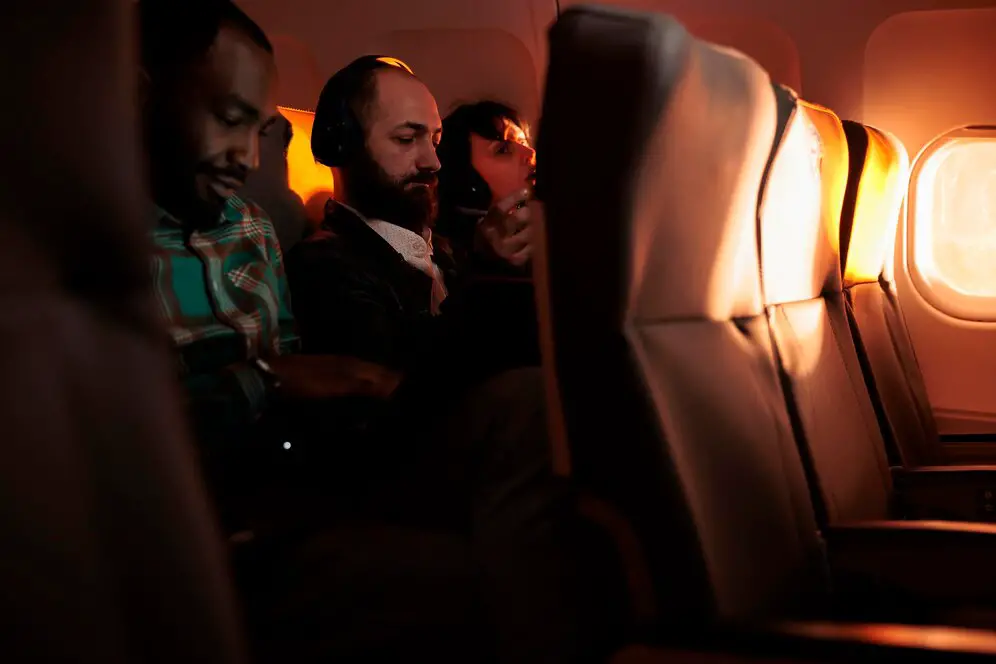
The wheels hit the runway with a violent shudder, and Lily startled awake in my arms.
For one suspended second, no one moved. Then the cabin filled with the ordinary sounds of arrival—seat belts clicking, overhead bins opening, phones chiming back to life, strangers stretching their arms as if the last few hours had not quietly split my life in two.
Beside me, Noah Whitman held his phone in one hand, his jaw tight.
Someone has been asking airport security where to find you.
The sentence echoed inside my skull.
“Who?” I whispered.
Noah didn’t answer right away. His eyes lifted toward the aisle, where passengers had already begun craning their necks to see him. A man two rows ahead pretended to adjust his coat while aiming his camera directly at us.
Noah leaned closer, his voice low enough that only I could hear. “Do you trust your ex-husband?”
A cold, humorless laugh nearly escaped me. “No.”
“Then we’re not walking through the main terminal.”
My grip tightened around Lily. “I can’t just disappear with you. I don’t even know you.”
His gaze softened, but the urgency didn’t leave his face. “You’re right. You don’t. But whoever is looking for you knew your flight, your name, and that you were traveling with a baby. That’s not casual.”
The line of passengers started moving. Noah stood, reached for my diaper bag, then stopped and waited for permission.
That pause—small, respectful, unnecessary for a man who probably owned half the city below us—made something inside me loosen.
I nodded. He took the bag.
As we stepped into the aisle, the flight attendant who had called him Mr. Whitman blocked two impatient passengers with a practiced smile. “Please remain seated for just a moment.”
A tall woman in a black suit appeared at the front of the plane. Her hair was pulled into a severe bun, and her eyes swept the cabin like she had already memorized every face.
“Noah,” she said.
“Mara,” he replied. “This is Emily and her daughter, Lily.”
Mara’s eyes moved to me, not unkindly, but sharply. “Ma’am, a man at arrivals has been asking for you. He claimed there was a custody emergency.”
My stomach dropped. “Ryan,” I breathed.
“Is that your husband?” Noah asked.
“Ex-husband. Almost.” My voice cracked. “He changed the locks on me. He froze my account. He hasn’t asked to see Lily in three weeks.”
Mara’s expression didn’t change, but something flickered in her eyes. “Then we move now.”
She led us through the front galley and into a narrow service corridor before the other passengers could exit. Somewhere behind us, people were complaining. Ahead, two more security men waited near an employee elevator.
I should have felt relieved. Instead, all I could think was that Ryan had found me.
In Austin, I had packed while Lily slept in her crib and rain tapped at the window. I had left behind wedding photos, chipped coffee mugs, the blue couch we bought when we still believed love could survive bills and bad days. I had taken only what I could carry.
And still, somehow, he had followed.
The elevator doors closed around us. Noah stood close, not touching me, while Lily clung to the collar of my shirt. Her little fingers curled there, warm and trusting. I kissed the top of her head and tried not to fall apart in front of strangers.
“Emily,” Noah said gently, “did Ryan know you were going to Chicago?”
“No. I told one person. My aunt Claire. She’s letting us stay with her.”
Mara glanced at one of the men beside her. “Get eyes on the aunt’s address.”
“No,” I said quickly. “Please don’t scare her.”
Mara looked back at me. “If he found your flight, he may already know where you’re going.”
The elevator descended into a restricted hallway beneath the terminal. The air smelled like concrete, fuel, and cold metal. Far away, luggage carts rattled like thunder.
Noah’s phone buzzed again. He read the message and cursed under his breath.
“What?” I asked.
“The man is still at arrivals,” Mara answered for him. “But now he has two airport officers with him.”
My knees nearly gave out. “Can he take Lily?”
“Not without paperwork,” Noah said.
“You don’t know Ryan.” My voice rose despite me. “He lies like breathing. He’ll tell them I’m unstable. He’ll say I kidnapped her. He’ll say anything if it makes him look like the wounded father.”
Mara held out her hand. “Do you have custody documents? Divorce filings? Anything showing you’re allowed to travel?”
My face went hot. Everything important was in a folder in my suitcase. My suitcase was somewhere in baggage claim.
Mara understood before I said it. “We’ll retrieve it.”
“No,” I said. “I need to get it. My documents are in there.”
“Emily,” Noah said, “walking into baggage claim is exactly what he wants.”
The calm in his voice should have steadied me, but instead it made me angry.
“You don’t understand,” I said. “Men like you can make phone calls and doors open. Men like Ryan close doors and tell everyone the woman trapped behind them is hysterical. Those papers are the only proof I have that I’m not whatever he says I am.”
Noah went still. For the first time, I saw something wounded beneath the polished surface. Not pity. Recognition.
“You’re right,” he said quietly. “I don’t understand all of it. But I understand being hunted by a story someone else wrote about you.”
Before I could ask what he meant, Mara’s earpiece crackled. She listened, then looked at Noah. “Problem.”
The word seemed too small for the dread that followed.
“What problem?” he asked.
“Someone took one of Ms. Collins’s suitcases off the carousel before our team reached it.”
My breath stopped. “Which one?”
Mara’s eyes lowered to the tablet in her hand. “Gray hard-shell case. Pink ribbon on the handle.”
The folder. My custody papers, Lily’s birth certificate, my emergency cash, the printed emails from Ryan’s attorney, the photos of the bruises on my wrist from the night he grabbed me too hard and then cried because I had “made him become that person.”
All of it. Gone.
I pressed my hand over my mouth.
Noah’s expression changed. His tired gentleness hardened into something colder, sharper. For a moment, I remembered that this was not just a kind stranger who made napkin puppets for babies.
This was Noah Whitman. And someone had just made him angry.
“Lock the terminal feeds,” he told Mara.
“Already requested.”
“Not requested. Locked.”
Mara nodded once and stepped away, speaking rapidly into her phone.
I stared at him. “Can you do that?”
“No,” he said. “But people who owe me favors can.”
We were taken into a private waiting room hidden behind an unmarked door near the lower level of the airport. It had beige walls, leather chairs, a coffee machine, and no windows. Lily began to fuss again, overwhelmed by the strange faces and my shaking hands.
Noah crouched in front of us. “May I?” he asked, holding up the stuffed rabbit.
Lily blinked at him. He made the rabbit sneeze. She stared. He made it sneeze again, louder. A reluctant giggle bubbled out of her.
I should have been thinking about the suitcase, Ryan, the man upstairs searching for me. Instead, I watched my daughter laugh at a billionaire kneeling on an airport carpet with a stuffed bunny in his hand, and the absurd tenderness of it nearly broke me.
My phone rang. Aunt Claire.
I answered with trembling fingers. “Claire?”
“Emily?” Her voice was strained. “Where are you?”
“At the airport. Why?”
A pause. Then she whispered, “Don’t come to my apartment.”
My blood turned cold. “What happened?”
“A man was here. Tall, dark hair, expensive coat. He said he was Ryan’s attorney. He knew my address, knew your flight number, knew Lily’s name. He said if I helped you hide, I could be charged.”
I closed my eyes. Ryan had not come himself. Of course he hadn’t. Ryan preferred clean hands.
“What did you tell him?” I asked.
“Nothing. I swear. I said I hadn’t heard from you. But, Emily, he left a card. And then a black car parked across the street.”
Noah stood slowly. Mara returned just as Claire began crying.
“I’m sorry,” Claire said. “I’m so sorry, honey. I’m scared.”
“It’s okay,” I lied. “Lock your door. Don’t answer for anyone.”
I hung up because if I listened to her cry one second longer, I would lose the last thread holding me together.
I looked at Noah. “I have nowhere to go.”
He didn’t hesitate. “Yes, you do.”
“No.” I shook my head. “I know what this looks like. Poor abandoned woman rescued by rich man. I can’t become another thing people whisper about around you.”
His mouth tightened faintly, as if the words landed somewhere bruised.
“They already whisper,” he said. “Let them be accurate for once.”
Mara cleared her throat. “We have a secure residence twenty minutes from here.”
“No mansion,” I said immediately. The words surprised even me.
Noah almost smiled. “Not a mansion. A hotel suite under a company account. Separate rooms. Cameras in the hallway. Security downstairs. You’ll have your own lock, your own phone, and a lawyer before dinner.”
“A lawyer?”
“Yes.”
“I can’t afford—”
“I didn’t ask.”
That should have annoyed me. It did annoy me. But beneath the annoyance was relief so powerful I hated myself for feeling it.
On the ride from the airport, Chicago passed outside the tinted windows in gray streaks of rain and steel. Lily slept in her car seat, her lashes resting on round cheeks, unaware that her whole world had tilted again.
Noah sat across from me, silent, one hand curled loosely around his phone. I studied him when he wasn’t looking. On the plane, he had seemed tired. Now he seemed haunted.
“Why were people recording you?” I asked.
He glanced up. For a moment, I thought he wouldn’t answer. Then he looked out at the rain.
“Three years ago, my wife died.”
The air left the car.
“I’m sorry,” I said softly.
“Her name was Caroline. She was brilliant and stubborn and hated every room full of rich people she ever walked into.” His smile flickered and vanished. “The tabloids decided grief wasn’t interesting unless they could make it ugly. They said I drove her to it. Then they said I staged it. Then they said I moved on too quickly because a woman from a charity board hugged me at a fundraiser.”
“That’s awful.”
“That’s business,” he said, but there was no bitterness in it. Only exhaustion. “This week is the anniversary. The cameras get worse every year.”
I remembered his request on the plane. Pretend you’ve fallen asleep on my shoulder. He hadn’t wanted romance. He had wanted a moment of peace.
“I didn’t know,” I said.
“That’s why I trusted you.”
The words settled between us, quiet and dangerous.
At the hotel, we were taken through a private entrance and up a service elevator to a suite bigger than my entire apartment in Austin. There was a crib already being assembled in the bedroom by a housekeeping supervisor, diapers stacked near the bathroom sink, baby food on the counter, and a soft yellow blanket folded on the sofa.
I stared at everything. “Noah.”
He stood near the door, careful not to cross too far into the room. “Too much?”
“Yes.”
“I know.” But he didn’t apologize for it.
Mara entered with a laptop and a grim expression. “We found the suitcase.”
Hope flared. “Where?”
“Abandoned in a restroom near Terminal Three.”
“And the folder?”
Mara’s silence answered.
I sat down hard on the sofa.
Noah’s phone rang before I could speak. He answered. “Tell me.”
I watched his face as he listened. Whatever the person said made him turn away from me.
“No,” he said. “Send it.”
A second later, his phone chimed. He looked at the screen for a long time. Then he handed it to me.
It was a copy of an emergency petition filed in Travis County family court that morning. Ryan Collins v. Emily Collins. My eyes stumbled over the words. Unstable. Erratic. Flight risk. Infant daughter removed from state without paternal consent. Mother believed to be experiencing severe emotional distress.
Attached was a letter from a doctor I had never met, claiming I had missed postpartum appointments and shown signs of dangerous paranoia.
My hands went numb.
“This is fake,” I whispered.
Noah knelt in front of me. “Emily.”
“This is fake.” My voice rose. “I never saw this doctor. I never said those things. Ryan barely changed Lily’s diapers, and now he’s pretending to be father of the year?”
Lily stirred in the car seat. I pressed my fists against my mouth and forced myself silent.
Mara’s voice was careful. “There’s more.”
Of course there was. There was always more.
“The petition includes a sworn statement from a witness,” Mara said. “A neighbor who claims she heard you threaten to disappear with the child.”
I laughed once, sharp and broken. “Mrs. Alvarez? She brought me soup last week.”
“No,” Mara said. “Not Mrs. Alvarez.”
She turned the laptop toward me. The name on the affidavit made the room tilt.
Heather Lane. Ryan’s new girlfriend. The woman in the smiling photos. The woman wearing my husband’s old college sweatshirt in a kitchen I had painted yellow.
“She doesn’t even know me,” I said.
Noah’s voice was low. “She knows enough to lie.”
Something inside me hardened. For weeks, I had been running on fear. Fear of Ryan’s anger. Fear of being alone. Fear that every wrong choice would become proof that I was the problem.
But seeing Heather’s name on that paper changed something. Ryan had not just abandoned me. He was trying to erase me. And he had recruited someone to help.
“I want to fight,” I said.
Noah looked at me as though he had been waiting for those exact words. “Then we fight.”
The lawyer arrived after sunset. Her name was Vivian Hart, and she looked like she had been born unimpressed. She wore a charcoal suit, silver-rimmed glasses, and carried a leather folder thicker than Lily’s baby book.
She listened without interrupting as I told her everything. The changed locks. The frozen account. The missing suitcase. The fake doctor letter. The girlfriend’s affidavit.
When I finished, Vivian removed her glasses.
“Your husband moved quickly,” she said.
“Ex-husband,” I corrected.
“Not yet,” she replied. “Legally, that matters.”
My stomach twisted.
Vivian continued, “The emergency petition is designed to make you look reckless before you have a chance to respond. But there are problems. Several. First, Texas does not automatically prevent you from traveling with your child unless there is a custody order stating otherwise. Second, a forged medical statement is a serious risk for whoever submitted it. Third, the stolen documents at the airport create a pattern.”
“So what happens now?”
“I file a response tonight. We request an emergency hearing. We also notify the court that someone impersonating legal authority attempted to intercept you at O’Hare.”
Mara’s phone buzzed. She checked it, then went very still.
Noah noticed. “What?”
Mara looked at Vivian, then at me. “The man at the airport wasn’t Ryan’s attorney.”
A chill slid down my spine.
Vivian frowned. “Who was he?”
Mara placed a tablet on the coffee table. The screen showed a security image from arrivals. A man in a dark coat stood near a pillar, speaking to two airport officers. His face was angled slightly upward, caught clear enough by the camera.
I had never seen him before. But Noah had.
All the color drained from his face.
“No,” he said softly.
Mara’s voice lowered. “His name is Graham Vale.”
Vivian inhaled sharply.
I looked between them. “Who is Graham Vale?”
Noah did not answer immediately. His eyes stayed fixed on the image, and for the first time since I met him, he looked afraid.
“He was my father’s closest advisor,” Noah said. “And the man my board fired last year for stealing from Whitman Group.”
My pulse pounded in my ears. “What does he want with me?”
Noah finally looked at me. “I don’t know.”
But he did know something. I could see it in the way he avoided Vivian’s eyes.
Vivian closed her folder slowly. “Noah.”
His jaw tightened.
Mara spoke before he could. “Graham has been trying to get back into the company for months. Lawsuits, threats, media leaks. Nothing worked.”
“And now he’s chasing me?” I said. “I don’t even know him.”
Noah turned away, walked to the window, and stared down at the rain shining on the city streets.
“My father built Whitman Group with three people,” he said. “One of them was Graham Vale. Another was a woman named Margaret Sloane.”
I froze. Sloane was my mother’s maiden name.
Noah turned back. “Emily,” he said carefully, “what was your mother’s full name?”
My throat tightened. “Anna Sloane Collins.”
The room went silent.
Vivian’s expression changed first. Not shock exactly. Calculation.
Noah closed his eyes briefly, as though some terrible puzzle piece had finally slid into place.
“What?” I demanded. “Why does that matter?”
Noah crossed the room and sat opposite me. “Margaret Sloane disappeared twenty-eight years ago,” he said. “Before she vanished, she transferred something out of Whitman Group’s founding trust. My father spent the rest of his life trying to find it.”
“My mother was Anna, not Margaret.”
“Anna may have been her daughter.”
“No.” I shook my head. “My mother grew up in San Antonio. She was a school librarian. She died when I was sixteen.”
“Did she ever talk about her parents?”
I opened my mouth. No words came.
My mother had always said family was complicated. She kept no photos of her childhood. No cousins visited. No grandparents called. When I asked, she kissed my forehead and said some doors stayed closed because they had wolves behind them.
I had thought it was one of her dramatic sayings. Now Noah was watching me like I might be standing in front of one of those doors.
Vivian leaned forward. “Emily, did your mother leave you anything? Documents? Jewelry? A safe deposit key?”
A memory surfaced so suddenly that I felt it in my body. My mother in a hospital bed, thin hands closing mine around a tiny brass key.
For someday, Em. Not for now. Someday.
I had kept it on my key ring for years, never knowing what it opened. Then Ryan had taken my keys during our last fight and returned them the next morning. The brass key was gone.
I stood too fast. “Ryan.”
Noah rose with me. “What?”
“He took it. He took my mother’s key.”
Mara was already typing into her phone.
Vivian’s voice sharpened. “What kind of key?”
“Small. Brass. No label. My mother gave it to me before she died.”
Noah looked at Mara. Mara nodded grimly. “That may explain Ryan.”
I turned toward her. “Explain him how?”
She placed another image on the screen. This one was from three weeks earlier. Ryan stood outside a glass office building in Austin. Beside him was Graham Vale.
The floor seemed to drop beneath me.
“No,” I whispered.
Noah’s voice was controlled, but barely. “Ryan isn’t working alone.”
Lily woke then and began to cry. The sound pulled me back from the edge. I lifted her from the car seat, held her close, and felt her little heartbeat flutter against mine.
Everything I had believed about my life rearranged itself in cruel new shapes. Ryan hadn’t just wanted the apartment. He hadn’t just wanted the money. He wanted something I had never understood I possessed. My mother’s past. Whitman’s secret. And maybe Lily.
A phone rang. Not Noah’s. Not mine. It came from the diaper bag.
I stared at it. Mara crossed the room and opened the bag carefully. Beneath Lily’s blanket, tucked inside a side pocket I never used, was a black phone. A burner. It lit up again in Mara’s hand.
Unknown caller.
Noah looked at me. “That isn’t yours?”
I shook my head, unable to speak. Mara answered and put it on speaker.
For a moment, there was only static. Then Ryan’s voice filled the room, smooth and familiar and poisonous.
“Emily,” he said. “You should have stayed on the plane.”
My blood went cold. Noah stepped closer, but I lifted a hand to stop him.
Ryan laughed softly. “I know Whitman is with you. That’s cute. Very heroic. But he can’t protect you from a story that started before either of you were born.”
I held Lily tighter. “What do you want?” I asked.
“The key,” Ryan said. “And my daughter.”
“She is not a bargaining chip.”
“No,” he replied. “She’s insurance.”
Noah’s face darkened.
Ryan continued, “Tell Noah to ask himself why his father really searched for Margaret Sloane. Then ask him why his wife died on the same road your mother used to visit every summer.”
Noah went utterly still. Even Mara looked shaken.
“What are you talking about?” I whispered.
Ryan’s voice lowered. “There’s a vault in Chicago, Emily. Your mother opened it once. Caroline Whitman opened it next. Neither of them lived long afterward.”
The line crackled. Then he said the words that made Noah stagger back as if struck.
“Lily has the last signature they need.”
The call ended.
No one moved. Rain slid down the windows like black veins. In my arms, Lily stopped crying and stared over my shoulder at Noah, her eyes wide and innocent.
Noah’s face had turned ashen.
“What signature?” I asked.
Vivian answered, but her voice sounded far away. “A bloodline trust.”
Mara looked at the dead phone in her hand.
And Noah whispered, almost to himself, “Caroline wasn’t driving alone that night.”
I turned toward him. The room seemed to shrink around us. “What?”
He looked at me with devastation in his eyes.
“My wife was pregnant when she died.”
Before I could breathe, before I could understand, every light in the hotel suite went out.
In the darkness, Lily began to scream.
Then, from the hallway outside our locked door, someone gently knocked three times.
The moment the plane door opened, I had felt the past step into the cabin before I did, though I wouldn’t understand that for hours yet. Now, standing in the dark of the hotel suite with my daughter screaming against my shoulder, the memory of that first terrible unraveling kept surfacing in fragments, as though my mind couldn’t hold the present moment and the morning’s revelations at the same time.
Noah rose from the floor where the darkness had dropped him, blocking the space between the door and us with a calmness that somehow felt like armor even in pitch black. “Mara.”
“Here.” Her voice came from somewhere near the window, steady despite the chaos. “Emergency power should kick in within thirty seconds. Stay where you are.”
The knock came again. Three slow raps, deliberate, almost gentle.
“Noah.” The voice through the door was old and tired. “It’s Elias Mercer. I’m alone. I’m not armed. I need five minutes.”
Noah’s jaw worked in the dim emergency glow beginning to filter up from the hallway strip lighting. “The man from the surveillance photo,” he said quietly. “The investigator.”
“He has my suitcase,” I said, Lily still crying against my shoulder, her small fists twisted in my shirt.
Mara moved to the door, checked the peephole, then looked back at us. “He’s alone. No weapon visible.”
Vivian stood slowly, smoothing her skirt with hands that weren’t quite as unimpressed as they’d been an hour earlier. “Let him in. But Callum stays between him and the baby.”
The lights flickered fully back on as the door opened. Standing in the hallway was an older man in a soaked gray coat, silver hair plastered to his forehead, hollow cheeks catching the overhead light in deep shadow. He looked less like a threat and more like a man who had been carrying something heavy for a very long time and had finally set it down.
At his feet sat my gray hard-shell suitcase, the pink ribbon still tied to the handle.
“I kept it from Hale,” he said, before anyone could speak. “I didn’t take it to hurt you. I took it to protect it.”
“Who are you?” I demanded, though some part of me, looking at his face, already suspected the answer connected to everything Noah had just told me about his father’s missing advisor.
“Elias Mercer,” he said again. “I worked for Thomas Whitman for eleven years. Before that, I worked for a woman named Margaret Sloane, who I believe was your grandmother.”
The word grandmother landed in the room like a dropped glass.
Noah stepped forward. “You knew about this the whole time?”
“I knew pieces,” Mercer said. “Margaret trusted very few people with the whole picture. I wasn’t one of them. I was given instructions, not explanations.” He looked at me, something unbearably sad in his expression. “Margaret called me the night before she died. She said Hale had found her. She said if anything happened, I was to watch from a distance, Emily, until your thirty-first birthday. No closer than that. She was very specific.”
“My birthday was three months ago,” I whispered.
“I know,” he said. “I’ve been watching you board flights and leave apartments and push strollers through grocery stores for three months, waiting for the right moment, and I kept telling myself there wasn’t one. Then Hale moved first. He always moves first when he thinks someone else might get there before him.”
Noah’s hand tightened at his side. “Why didn’t you come to me?”
Mercer’s laugh was bitter, dry as paper. “Because Whitman Group was full of Hale’s people. Some still are. I didn’t know who to trust inside those walls, so I trusted no one, which I understand now was its own kind of failure.”
He opened the suitcase on the floor. Inside were my custody papers, Lily’s birth certificate, and beneath them, a stack of documents I had never seen before — older, the paper slightly yellowed, bound with a rubber band gone brittle with age.
At the top lay an envelope addressed in handwriting I didn’t recognize but that made something ancient and unspoken tighten in my chest anyway.
My dearest Emily, the letter began, when I finally unfolded it with trembling fingers. I was never brave enough to tell you the truth while I was alive. I told myself secrecy kept you safe, but secrecy also made you lonely. For that, forgive me.
I pressed the letter to my chest as tears blurred the ink before I’d even finished the first paragraph.
Mercer placed another file on top of the suitcase. “Hale is moving tonight,” he said. “He called an emergency board vote. He plans to declare the Aurora Trust fraudulent before Emily can appear. Once that happens, Ryan files for emergency custody and claims she’s unstable.”
Emily felt sick. “He can do that?”
“With enough lies and enough money,” Mercer said, “men like Hale do anything.”
A voice echoed from somewhere down the corridor outside, cold and amused. “Careful, Elias. You’re starting to sound noble.”
The air in the suite changed instantly. Victor Hale stepped through the open doorway in a black overcoat, flanked by two men, the rain still beading on his shoulders from the street below.
Ryan stood just behind him.
My heart slammed against my ribs so hard I thought everyone in the room must be able to hear it.
Ryan smiled at me like he still owned the room, the same easy, practiced smile I’d fallen for seven years earlier over coffee at a diner on Guadalupe Street. “Emily,” he said. “You always did make things harder than they needed to be.”
I clutched Lily’s blanket in one fist, my body moving as if shielding her even though she was safe in my arms, already quieting now that the worst of the darkness had passed.
“You used me,” I said.
Ryan shrugged, almost bored. “I married a waitress with no money because Victor told me she was worth billions. Don’t look so wounded.”
The cruelty of it should have broken me. Instead, it burned away the last soft place I had kept for him, the small, stubborn corner of my heart that had still been quietly grieving the man I thought I’d married rather than the one standing in front of me now.
Noah moved toward Ryan, fury darkening his features, but I caught his sleeve.
“No,” I said.
Then I faced my ex-husband directly, my voice steadier than I had any right to expect.
“You changed the locks on your own daughter.”
Ryan’s smirk faltered, just slightly, just enough that I saw it.
I kept going, my voice rising, clear and cold in that overpriced hotel suite. “You froze the account I used to buy her formula. You made me believe I had nothing. But I had the one thing you never understood.”
I stepped closer, past Mara, past the suitcase, until there was nothing between us but air.
“I had her. And that made me impossible to scare forever.”
Hale’s eyes narrowed, impatient now. “Touching speech,” he said. “But sentiment does not beat signatures.” He lifted a document from inside his coat. “Emily signs away any claim to Aurora tonight. Ryan receives a settlement. Noah avoids a scandal. Everyone walks away.”
Noah gave a humorless laugh. “You still think this is about money.”
Hale smiled, thin and certain. “No, Noah. It’s about power. It always was.”
Then Mercer did something no one expected. He opened his coat, revealing a small recorder pinned beneath the lapel, the red light blinking steadily.
Hale’s smile vanished.
Callum stepped from the shadows of the hallway with two federal agents behind him, moving fast enough that neither Hale’s men nor Ryan had time to do more than flinch.
I looked at Noah. His face was calm. But his eyes shone.
“You didn’t come here to negotiate,” I whispered.
“No,” he said. “We came here to let him confess.”
Chaos erupted in seconds after that. Ryan bolted first, knocking into one of Hale’s men and slipping on the carpet near the door. Callum caught him before he reached the elevator bank.
Hale did not run. Men like Victor Hale rarely believed the ground could open beneath them, even when it visibly already had.
“You have nothing admissible,” he snapped at the agents closing in around him. “A frightened woman. A disgraced investigator. A sentimental billionaire desperate for family.”
I walked to the suitcase and removed Margaret’s final envelope from beneath the stack of older documents. There was one more item tucked inside — a small plastic tube, the kind used for preserving biological samples.
Mercer spoke quietly, almost reverently. “Margaret kept a lock of Thomas Whitman’s hair from the night he signed the guardianship papers. She told me one day it would matter.”
Noah stared at the tube, visibly stunned. Callum handed me a sealed document from somewhere in his jacket, already printed, already waiting.
“Preliminary comparison,” he said. “The DNA marker profile from Thomas Whitman’s preserved medical records confirms paternal probability above legal threshold.”
Hale’s face changed. For the first time since he’d walked through that door, I saw fear in him, real and unguarded.
Noah turned toward me slowly. The truth stood between us, too enormous for words.
I was not a stranger. I was not a coincidence. I was his sister.
Noah took one step toward me, then stopped, as if afraid the moment might break if he moved too fast. “I spent my whole life thinking my father left me only a company,” he said.
I looked at him through tears I’d stopped trying to hold back. “He left you a problem,” I said, laughing once through the ache of it.
Noah’s smile trembled. “He left me you.”
For a moment, the terminal of that morning, the suite of tonight, the rain, the agents, the man who had tried to erase me — all of it blurred behind the impossible warmth of being seen.
Then Hale lunged for the suitcase, a last desperate grab at whatever leverage he thought still remained.
I reacted without thinking, kicking it backward with my heel, and Mercer intercepted Hale before he reached it, old and tired as he looked, with a speed that surprised everyone in the room.
Federal agents seized him. Ryan shouted my name as they cuffed him near the elevator. “Emily, wait! I can explain!”
I turned. For years, I had waited for Ryan to sound sorry. Now that his voice finally shook, it meant nothing at all.
“You can explain it to a judge,” I said.
His face twisted with something between rage and panic. “You think he cares about you?” He jerked his chin toward Noah. “You’re just another asset.”
Noah stepped forward, fury darkening his features again. But I spoke first.
“No,” I said. “I know what being treated like an asset feels like. It sounds like you.”
Ryan went silent.
By dawn, news vans crowded outside Whitman Tower. Reporters shouted questions about fraud, secret heirs, corporate betrayal, and the woman who had appeared out of nowhere with a baby and a locket. I stood inside the lobby, still wearing the same wrinkled clothes I had boarded the plane in nearly twenty-four hours earlier. Lily rested on my hip, chewing happily on the ear of her stuffed rabbit, blissfully unaware that she had slept through the night her whole world had been explained.
Noah stood beside me.
“You don’t have to face them today,” he said.
I looked through the glass at the cameras. All my life, people had spoken for me. Margaret. Ryan. Lawyers. Men with money. Men with secrets.
Not anymore.
I adjusted Lily’s blanket. “Yes,” I said. “I do.”
When the doors opened, the reporters surged. I did not flinch.
“My name is Emily Mara Whitman,” I said into the storm of microphones, the name still strange and new in my own mouth. “But for thirty-one years, I was Emily Hayes, raised by a woman named Margaret who gave up everything to keep me alive.”
The crowd quieted.
“I did not come here for a fortune,” I continued. “I came here with a baby, two suitcases, and nowhere safe to sleep.”
My eyes found Noah’s.
“Then a stranger on a plane asked me to pretend I was his family.”
A faint smile touched my mouth.
“It turns out, I was.”
Six months later, I returned to an airport without fear. Not Austin. Not Chicago. A small private terminal in Texas, where sunlight poured over polished floors and Lily toddled unsteadily between Noah and me, one small hand gripping each of ours.
The custody case had ended quickly after Ryan’s arrest. His messages, the bank transfers from Hale, the attempt to coerce me into signing away the Aurora Trust — all of it destroyed him in court far more thoroughly than anything I could have said on my own. I received full custody without a single hearing dragging past a second date.
Victor Hale’s empire of lies collapsed in public and in the kind of prison-bound silence that no amount of money could buy its way out of. Whitman Group survived, but it changed, quietly and completely, in the months that followed.
I did not want a corner office with glass walls and men whispering outside the door. I did not want revenge. I did not even want the kind of wealth that made people stare before knowing your name.
So I made one demand. The Aurora Trust would become The Margaret House Foundation, funding emergency housing and legal aid for mothers fleeing financial abuse, custody threats, and homes where love had turned into a locked door.
At the dedication ceremony, Noah had stood beside me in the rain.
“What would Margaret think?” he asked.
I looked at the building’s warm windows, where women and children would sleep safely that night.
“She would say I finally learned what the locket was for.”
Noah smiled. “What was it for?”
I held Lily closer. “Not hiding,” I said. “Finding my way back.”
Now, in the Texas terminal, Mercer waited near the exit holding a weathered box.
“I found one last thing,” he said.
I opened it. Inside was a cassette tape labeled in Margaret’s handwriting. For Emily, when she knows everything.
Noah found an old player in one of the airport offices, dusty but functional. The tape hissed, then Margaret’s voice filled the room. Older. Softer. Alive in memory.
“Emily, my brave girl. If you’re hearing this, then the truth has finally caught up with you. I hope it was gentle, but knowing our family, it probably arrived like thunder.”
I laughed through instant tears.
Margaret continued. “I want you to know something no document can say. Thomas loved both his children. Noah was his pride. You were his miracle. He wanted you together one day, not because of money, but because loneliness runs in powerful families like a sickness.”
Noah bowed his head.
“And Lily,” Margaret’s voice said, breaking slightly, “if my granddaughter is there, tell her I loved her before I knew her name.”
I covered my mouth. Lily, too young to understand any of it, leaned against my knee and smiled up at the crackling voice as though she somehow recognized it anyway.
Then Margaret’s tone shifted.
“One more secret, my darling. The day you boarded that flight to Chicago, it was not luck that put you beside Noah.”
I froze. Noah looked up sharply.
Margaret’s recorded voice trembled with what I could tell, even through decades of tape hiss, was a smile. “Years ago, I left instructions with Elias. If you ever ran with your child, if Ryan ever turned cruel, if Hale ever found you — he was to make sure you got on the safest flight available. And if possible, he was to place you near the one person I believed would protect you without knowing why.”
I turned slowly toward Mercer. The old investigator’s eyes were wet.
“You changed my seat?” I whispered.
Mercer nodded. “I bribed an airline supervisor with a donation to her son’s surgery fund. Not my proudest legal moment.”
Noah let out a stunned laugh. I stared at him, remembering his tired eyes, the napkin puppet, the strange request, the steady shoulder beneath my cheek somewhere over Missouri.
“So the whole time—”
Noah finished softly, “You weren’t falling asleep on a stranger.”
My tears spilled freely now. I looked at Lily, then at Noah, then down at the locket still resting against my heart, the one I’d worn since I was fourteen without ever once understanding what it actually was.
For thirty-one years, I had believed my life was a series of abandonments. A father I never knew. A mother who died too soon. A husband who chose betrayal. A city I ran to because I had nowhere else.
But the truth had been hidden beneath all of it like a heartbeat.
I had been loved. Not loudly. Not safely. Not in the way I deserved. But fiercely enough that a dying woman built a path through decades of danger, all the way to one airplane seat beside a brother I had never known existed.
Noah reached for my hand. “Come home,” he said.
I looked toward the runway, where a plane lifted into the bright Texas sky. For once, I was not running. For once, the future did not feel like a locked door.
I squeezed Noah’s hand and smiled.
“I already did.”
And Lily, as if understanding the ending better than anyone, leaned her head against Noah’s shoulder and fell asleep.
This time, nobody had to pretend.

Sophia Rivers is an experienced News Content Editor with a sharp eye for detail and a passion for delivering accurate and engaging news stories. At TheArchivists, she specializes in curating, editing, and presenting news content that informs and resonates with a global audience.
Sophia holds a degree in Journalism from the University of Toronto, where she developed her skills in news reporting, media ethics, and digital journalism. Her expertise lies in identifying key stories, crafting compelling narratives, and ensuring journalistic integrity in every piece she edits.
Known for her precision and dedication to the truth, Sophia thrives in the fast-paced world of news editing. At TheArchivists, she focuses on producing high-quality news content that keeps readers informed while maintaining a balanced and insightful perspective.
With a commitment to delivering impactful journalism, Sophia is passionate about bringing clarity to complex issues and amplifying voices that matter. Her work reflects her belief in the power of news to shape conversations and inspire change.