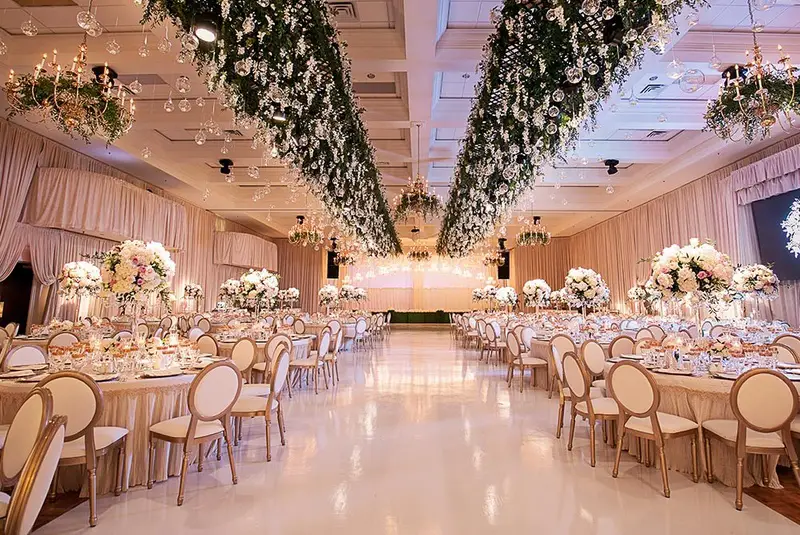
My grandmother’s face filled the ballroom screens just as the quartet stopped playing.
For one suspended second, no one moved. She had recorded the video in the library at Maple Hill. I recognized the carved walnut shelves behind her and the green lamp that had always cast a warm circle across her desk. She wore a navy blouse, her silver hair pinned neatly away from her face, and she looked directly into the camera with the steady expression she used whenever someone tried to intimidate her.
My father stared at the screen as though he were seeing a ghost. My mother gripped the back of a chair.
I want to back up for a moment, before I tell you what happened in that ballroom, because none of it makes sense without understanding the eighteen years that led up to it.
I had arrived at Maple Hill that morning the same way I’d arrived every other time in the past twelve years — through the service entrance, in my own car, carrying nothing but a small overnight bag and the deed folder Marcus had couriered to my apartment two days earlier. I’d stood in the gravel lot behind the kitchen for a long moment before going in, looking up at the house the way you look at something enormous you’ve decided, finally, to stop being afraid of.
Maple Hill had been built by my great-grandfather in the 1920s, a sprawling stone and timber estate with sixty acres of gardens, orchards, and woodland trails that my grandmother had spent the better part of her adult life restoring after decades of neglect under my great-grandfather’s more careless heirs. She had been the one who replanted the rose gardens along the south terrace, who restored the ballroom’s original oak flooring board by board, who turned the carriage house into a working studio where she painted watercolors nobody outside the family ever saw. Maple Hill was hers in every sense that mattered, long before any lawyer’s language made it official.
I had spent exactly four years of my childhood there, between the ages of ten and fourteen, during the stretch when my father’s construction business was struggling and Grandmother had insisted we move into the east wing rent-free while he rebuilt his finances. Those four years were, strangely, some of the only genuinely happy ones I remembered from my childhood. Grandmother taught me to identify birds by their calls from the library window. She let me help her prune the rose beds, showing me exactly where to cut so the plant would come back stronger the following spring. She never once, in all that time, made me feel like an inconvenience, which was more than I could say for either of my parents on their best days.
Then, the summer I turned fourteen, we took the trip.
I still don’t fully understand why my father decided a cross-country drive to visit his cousins in Colorado was necessary that particular summer, when his business was barely stable and tensions in our house had been running high for months. What I do remember, with the specific clarity trauma sometimes burns into memory, is the argument that started somewhere in western Kansas, over something so small I genuinely can’t reconstruct it anymore — I think I’d asked to stop for a bathroom break he didn’t want to make, or complained about Tyler kicking the back of my seat, something trivial enough that under any normal circumstances it would have dissolved into nothing within a few miles.
Instead, my father’s temper, which had always run hot and unpredictable, found a target in me that afternoon and simply would not let go. By the time we pulled into that gas station eighty miles outside the small town where he’d apparently decided he’d had enough, the argument had built into something neither of us, I think, fully understood the shape of until it was already happening.
“Get out,” he said, pulling the car to a stop beside the pumps.
I thought, genuinely, that he meant for me to use the bathroom. I unbuckled my seatbelt and opened the door, and it was only once I was standing on the pavement, my backpack still inside the car, that I understood something different was happening. He reached across the seat, grabbed my backpack, and threw it out onto the pavement beside me.
“Figure it out,” he said.
Then he put the car in reverse.
I remember my mother’s face through the window, turned forward, not looking at me. I remember Tyler, seventeen at the time, staring straight ahead with an expression I would spend years trying to interpret — not shock exactly, more like the practiced blankness of someone who had learned, long before that moment, that the safest response to our father’s rages was to simply disappear into yourself until they passed.
I remember standing there as the car pulled out of the lot and onto the highway, watching the taillights shrink and merge into the traffic until I genuinely could not tell which ones belonged to our car anymore.
I had fourteen dollars and change in my pocket, a backpack with a change of clothes and a water bottle, and no phone, because my father had taken it away two days earlier as punishment for some other minor infraction I can no longer remember the details of.
Denise found me a few hours later, after dark, when I’d finally worked up the nerve to come out from behind the dumpster where I’d been hiding, too frightened to approach any of the adults filling their cars at the pumps. She was closing out the register for the night shift change, and she told me, years later, that what struck her first wasn’t my clothes or my obvious fear, but how quietly I was crying — not sobbing, not making a scene, just tears running down my face while I stood very still, as though I’d already learned that drawing attention to my own pain rarely helped anything.
She called the police. She gave a statement. She stayed with me in the station’s little break room until an officer arrived, and she came back the next morning, on her own time, before her shift even started, just to check that someone had actually come for me.
Someone had. Not my parents. My great-aunt Laura, who lived ninety minutes from that gas station and who my grandmother called the moment the county office reached her, frantic and bewildered, asking what on earth was happening.
Grandmother drove down herself two days later, the moment she’d untangled enough of the story to understand what had actually occurred. I remember the exact look on her face when she walked into that county office and saw me — not pity, which I think I might have struggled to tolerate at that age, but something harder and more useful. Fury, carefully controlled, aimed entirely at the people who deserved it.
She took me home with her. Not back to my parents, not for even one night, despite my father’s protests on the phone that first evening, protests I could hear clearly even through the receiver pressed against her ear, demanding she return his daughter immediately, insisting the whole thing had been a simple misunderstanding that had gotten out of hand.
“A misunderstanding,” Grandmother had said into the phone, her voice flat and dangerous in a way I’d never heard from her before, “does not involve a fourteen-year-old child spending a night behind a dumpster.”
I lived with her, full time, for the next four years, until I left for college. My parents never formally lost custody — Grandmother made the deliberate decision not to pursue that route, not wanting to drag me through a protracted legal battle that would have required me to testify repeatedly about what had happened. Instead, she simply made it clear to my father that if he wanted to maintain any relationship with his own mother, I would be staying with her, full stop, no further negotiation available. He grumbled, periodically, over the following years, about how she’d turned me against the family, about how indulgent she was being, but he never seriously tried to force the issue, because he understood, I think, exactly how badly he’d look if the full story ever became public.
Those four years with Grandmother rebuilt something in me that I genuinely hadn’t realized was broken until I watched it slowly repair itself. She enrolled me in the local high school. She sat with me most evenings while I did homework at the same kitchen table where she did her own correspondence, answering letters from the historical society and the garden club and half a dozen charitable boards she sat on. She never once made me feel like a burden she’d taken on out of obligation.
“You are not a project, Ava,” she told me once, when I’d apologized, unprompted, for some minor inconvenience — needing a ride to a friend’s house, I think, on a night she’d already had other plans. “You are my granddaughter. There is a difference, and I need you to learn it.”
I went to college on a partial scholarship, supplemented by Grandmother’s help, and I studied finance, in part because the clean, logical precision of numbers appealed to something in me that had grown deeply suspicious of narratives that could be bent and reshaped depending on who was telling them. I built a career in corporate risk management over the following decade, work that required exactly the kind of careful, methodical attention to documentation and pattern-recognition that would later serve me so precisely in that ballroom.
I saw my parents occasionally over those years, at holidays Grandmother insisted on hosting for the sake of some fragile unity she still believed might be worth preserving, though I never fully understood why she kept extending that particular grace to my father. The visits were always strained. My father never apologized, not once, not even obliquely. My mother alternated between pretending nothing had happened and occasionally, in quieter moments, hinting that I’d somehow exaggerated the whole incident in my own memory. Tyler mostly avoided me entirely, which I came to understand, much later, as its own particular kind of guilt dressed up as indifference.
Grandmother died twelve years after that night at the gas station, when I was twenty-six. I inherited nothing outright at that point — the trust she’d established, the one that would eventually name me successor trustee, was structured to take effect only after her passing, with specific conditions and timelines Marcus Chen had spent years helping her refine. For the following six years, Maple Hill continued operating under the terms of her will, with my father managing day-to-day operations as he had for years, collecting his salary, living rent-free in the east wing, while I built my own separate life in the city, rarely visiting, never quite able to walk those halls again without feeling fourteen years old and abandoned all over again.
Which brings me back to that morning, standing in the gravel lot behind the kitchen, finally ready to stop being afraid of a house that had never actually belonged to the people who’d hurt me.
Marcus had called me three weeks earlier with news that changed everything. A routine audit, triggered by an unrelated banking inquiry, had flagged irregular activity in Maple Hill’s operating accounts. He’d spent the following weeks quietly building a complete financial picture, one that revealed exactly how thoroughly my father had been treating trust funds as his own personal resource for years. When Marcus discovered Tyler’s upcoming wedding was being funded, almost entirely, through those same misappropriated accounts, he’d called me immediately.
“You have a decision to make,” he’d told me over the phone. “We can handle this quietly, through legal channels, before the wedding. Or you can let it happen, and decide what you want to do afterward.”
I’d thought about it for exactly one night. Then I’d called him back and told him I wanted to be there in person, with every document properly prepared, the moment the trust’s true ownership became impossible for my father to spin into another convenient lie.
“Your grandmother left something else,” Marcus had added, almost as an afterthought, though I could hear in his voice that it was anything but. “A video statement. She made it the same week she amended the trust, twelve years ago, specifically in case this exact situation ever arose. She wanted you to have the choice of whether or when to use it.”
I had chosen the wedding.
Not out of cruelty, whatever my father would later claim to the handful of relatives still willing to listen to him. I chose it because I understood, with the particular clarity of someone who had spent eighteen years watching a family carefully construct and maintain a false version of events, that quiet legal correspondence would simply become one more private matter my parents could reframe to suit themselves afterward. A ballroom full of witnesses could not be reframed nearly so easily.
So there I stood, beside Marcus and Samuel, as the quartet finished their final warm-up notes and the first guests began filtering out onto the terrace for the ceremony, and I gave Marcus a small nod.
He pressed play.
Grandmother began to speak. “My name is Evelyn Reynolds. I am recording this statement voluntarily regarding the disposition of Maple Hill and the conduct of my son, Richard Reynolds, his wife, Elaine, and their son, Tyler.”
My mother whispered, “She was confused near the end.”
Marcus heard her. “The recording was made twelve years ago,” he said. “Two physicians signed competency affidavits that same week.”
The video continued. Grandmother explained that she had first learned what happened to me after receiving a call from her sister, Laura. Laura had been asked to take temporary custody of a fourteen-year-old girl whose parents claimed she had run away. Grandmother had driven to the county office expecting a misunderstanding. Instead, she found me sitting beneath fluorescent lights in borrowed sweatpants, clutching a paper cup with both hands because I could not stop shaking.
“Ava did not run away,” Grandmother said from the screen. “Her father removed her from his vehicle at a gas station approximately eighty miles from home. He left her without a telephone, adequate clothing, or sufficient money. Her mother and brother remained in the vehicle and allowed it to happen.”
A murmur moved through the wedding guests.
My father raised his voice. “This is a private family matter. Everyone should go back outside.”
No one left. Many of the guests had known my parents for years. They had heard the version in which I was a volatile teenager who disappeared after threatening the family. Some had repeated it at holidays and charity dinners. Some had looked at me on the terrace minutes earlier with polite suspicion, the particular careful distance people maintain around a family’s acknowledged black sheep. I had caught two of my father’s old business partners glancing my way during the cocktail hour, their expressions carefully neutral, clearly having been briefed on which version of the family history they were meant to extend politeness around. Now they looked at my father instead, and something in their expressions had already started shifting.
Grandmother described the police report, the cashier’s sworn statement, and the conflicting accounts my family had given investigators. My father had claimed I jumped from the car during an argument. My mother said I demanded to be left there. Tyler insisted he had been asleep and saw nothing. Denise’s statement contradicted all three. She had found my backpack near the pumps. She had reviewed the station’s exterior camera with the responding officer before the system automatically erased its recordings. The officer’s notes documented the vehicle stopping, my father throwing the backpack out, and the car leaving while I stood beside the passenger door. The original footage no longer existed, but the officer’s contemporaneous report did.
My parents had known that. They had simply counted on everyone believing them instead of a frightened child.
“I asked my son to apologize,” Grandmother said. “He refused. He told me Ava needed discipline and that bringing her home would reward manipulation. Elaine defended him. Tyler laughed and said his sister had finally learned not to ruin a family trip.”
Tyler’s bride, Leah, slowly turned toward him. She had been standing near the ballroom entrance in her wedding gown, one hand pressed against her waist. Until then, her expression had shown confusion more than anger. Now it changed.
“You told me you were asleep,” she said.
Tyler looked at the guests before answering. “I was seventeen. It was a long time ago.”
“That was not my question.”
He lowered his voice. “Leah, not here.”
My father stepped in front of him. “Ava planned this. She waited until today because she has always hated her brother.”
I felt dozens of eyes shift toward me. At fourteen, that attention would have crushed me. I would have tried to explain every detail at once. I would have begged someone to understand that I had not caused what happened. At thirty-two, I stood beside the deed and said nothing.
Restraint made my father more nervous than anger ever had. I watched him glance toward my mother, some old habit of checking whether she would back him up before he committed further, and I watched her, for once, say nothing at all, her eyes fixed on the frozen image of Grandmother’s face still on the screen.
On the screen, Grandmother explained the trust. Maple Hill had belonged to her alone. My parents had managed events and maintenance under a revocable operating agreement. They received salaries and lived in the east wing without paying rent, but they never held title. Twelve years earlier, after my father refused to acknowledge the abandonment, Grandmother amended the trust. Upon her death, I would receive sixty percent beneficial ownership and serve as successor trustee. Tyler would receive twenty percent. The remaining twenty percent would fund scholarships for young people aging out of foster care. My parents would receive no ownership. Their permission to remain at Maple Hill would end ninety days after Grandmother’s death unless the successor trustee extended it.
That trustee was me.
My mother sank into a chair. “She promised us this house,” she said, her voice smaller than I’d heard it in years.
Marcus opened another section of the folder. “Mrs. Reynolds left extensive correspondence. She repeatedly told you that your residence depended upon compliance with the operating agreement.”
“We maintained this place for twenty years,” my father snapped.
Samuel, the property manager, stepped forward. He had worked at Maple Hill for nearly fifteen years, long enough to remember me as a quiet teenager helping Grandmother in the garden, long enough that I trusted him completely when Marcus had asked whether he’d be willing to coordinate security for what we all understood might become a difficult afternoon.
“The trust paid for maintenance,” Samuel said. “It also paid both of you salaries.”
My father pointed at him. “You work for me.”
Samuel removed a ring of keys from his belt and placed them beside the deed. “I work for Maple Hill’s trustee.”
That was the first moment my father looked frightened rather than angry. But fear did not make him honest. It made him reckless. He seized the settlement agreement from the silver clipboard and waved it toward the guests.
“Ava agreed to give up her claim. She came here to sign.”
“She did not sign anything,” Marcus said. “You mailed her an unsolicited waiver falsely identifying yourself as the property owner.”
I remembered that envelope arriving three weeks earlier, my father’s familiar handwriting across the front, the waiver inside drafted in language clearly meant to sound official enough that I might sign it without consulting an attorney first. I’d photographed every page and forwarded it directly to Marcus the same afternoon, which, as it turned out, had been the final piece of evidence confirming he fully understood he had no legitimate claim to the property he was still actively trying to sign away.
Marcus removed a second document from the folder. It was a copy of the event contract for Tyler’s wedding. My father had signed that as owner too. He had accepted deposits from vendors, authorized alcohol service, and promised exclusive use of the estate. He had also charged Tyler and Leah nothing, while directing the trust’s accounts to cover catering, flowers, rentals, and security. The total exceeded one hundred and forty thousand dollars.
Leah’s father stepped away from my father as if the distance itself mattered. “You told me your family owned the venue,” he said.
“We do,” Tyler answered.
Marcus tapped the deed. “No. Ava does, through the trust. And the trust did not authorize these expenses.”
Tyler’s face flushed. “She can authorize them now.”
Everyone looked at me again. I glanced through the open ballroom doors. Hundreds of white roses covered the terrace. Candles waited on long tables. The cake stood beneath a crystal chandelier, three tiers of white fondant with sugared flowers Leah had apparently spent months planning with a baker in the city. Staff members clustered near the kitchen, uncertain whether they would be paid for work they had already done, their faces carrying the particular anxious uncertainty of people watching their paycheck become entangled in a family drama that had nothing to do with them.
Leah had not abandoned me at a gas station. Neither had her parents, the servers, the musicians, or the guests who had traveled to be there. I was not interested in becoming my father.
“The vendors will be paid,” I said. “The staff will finish the event if Leah wants them to. No one who worked in good faith will lose money.”
Relief crossed several faces, a few of the kitchen staff visibly exhaling. Tyler mistook compassion for surrender.
“There,” he said, turning toward Leah. “It’s settled. We can get married.”
Leah kept looking at him. “Did you laugh when she was left there?”
He rubbed a hand over his jaw. “I was a kid.”
“Did you tell the police you were asleep?”
“My dad told me what to say.”
My father shouted his name, but the admission was already hanging in the room, impossible to call back.
Leah’s eyes filled with tears. She did not look fragile. She looked as though something inside her had become painfully clear, the particular hardening that happens when a person finally sees, all at once, a pattern they’d been looking at piecemeal for a long time without quite assembling it.
“Last month you told me your sister destroyed your family because she ran away,” she said. “You said your parents searched for her for years.”
Tyler stepped toward her. “That is basically what happened.”
Denise made a sound of disbelief. She had remained beside Marcus, holding the flash drive case in both hands. She was older now, her dark hair threaded with gray, but I still remembered the red station vest she wore the morning she found me, and the particular gentle patience with which she’d handled a traumatized fourteen-year-old who could barely speak above a whisper.
“Your sister spent that night behind a dumpster,” she said. “At sunrise, she asked me whether her mother had called the station looking for her. She could barely get the words out.”
Tyler looked away.
Denise continued. “No one had called.”
The silence that followed was different from the silence on the terrace. That first silence had been fueled by curiosity. This one carried judgment.
My mother stood abruptly. “Enough. Ava has always known how to make herself look helpless. Evelyn indulged her because she enjoyed punishing Richard. This entire trust can be challenged.”
Marcus nodded calmly. “You are entitled to consult counsel.”
“We already have counsel.”
“Then your counsel may explain the no-contest clause and the forensic review of the trust accounts.”
My father froze. That was the hidden threat Grandmother had saved for the final pages. After her death, Marcus discovered irregular transfers from Maple Hill’s operating account. My parents had routed money through a management company they controlled. Some payments were legitimate reimbursements. Others appeared to cover personal vehicles, vacations, Tyler’s business debts, and renovations to a condominium my parents owned in Florida. The wedding expenses were only the most recent withdrawals. A forensic accountant had already begun tracing the funds.
“You went through our accounts?” my father demanded.
“The trust’s accounts,” I corrected.
His expression twisted. “After everything we did for you?”
For a moment, I could almost see the gas station lights reflected in the ballroom windows. I could hear the dumpster lid striking metal in the wind. I could feel the two-dollar bill in my frozen hand, the exact bill I still kept folded in my wallet eighteen years later, the only money Denise had given me from her own pocket that night when the station’s register wouldn’t let her simply hand me cash from the till.
“You left me beside a highway,” I said. “Everything I became happened after that, not because of you.”
He stepped toward me so quickly that security moved between us. The guests recoiled. Cameras lifted. The wedding photographer, perhaps by instinct, captured the moment my father raised his hand and then realized two guards were watching him. His arm dropped.
Grandmother’s video was still playing behind us. Her final statement filled the room.
“Ava may choose mercy,” she said. “That is her right. But no one is entitled to demand it from her. Maple Hill should belong to the person in this family who understands that a home is not a building. A home is the place where a child is not left behind.”
The screen faded to black. My father stared at his own reflection in it.
Leah removed her engagement ring. Tyler saw the movement and reached for her hand.
“Do not do this because of Ava.”
“I am doing this because of you.”
She placed the ring on the table beside the deed. The sound was tiny, but Tyler flinched as if she had thrown it.
Leah asked her parents to take her upstairs. Before leaving, she came to me.
“I am sorry,” she said. “I believed what they told me.”
“So did a lot of people.”
She looked toward Tyler. “I should have asked why none of his stories included your voice.”
I watched her walk away, her mother’s arm around her shoulders, the enormous skirt of her wedding gown catching on the ballroom’s threshold before her father gently freed it. I felt no satisfaction watching her go, only a strange, heavy sorrow for a woman I’d met exactly once before that afternoon, who had done nothing wrong except trust the people she loved.
The wedding did not happen. The meal did. Leah asked that the prepared food be served to the guests and staff rather than discarded. Afterward, the remaining trays went to two local shelters. The musicians were paid. The florist donated the arrangements to hospitals and nursing homes. By sunset, the estate that had been decorated for a marriage had become a quiet scene of dismantled tables and unanswered questions, catering staff folding white linens while the string lights along the terrace flickered on against a darkening sky nobody had planned for them to illuminate alone.
I stayed until the last vendor’s truck pulled out of the gravel lot, standing on the terrace with Marcus and Samuel, the three of us mostly silent, watching the house settle into whatever came next.
My parents left under security escort. My father continued insisting that the deed was fraudulent, that he would see me in court, that this entire elaborate scheme had been planned by Grandmother out of some decades-old spite he never fully articulated. My mother carried three suitcases from the east wing even though the termination notice gave them thirty days to collect personal belongings, as if staying even one night longer than necessary under my authority was more than her pride could bear. Tyler left with them after spending an hour trying unsuccessfully to convince Leah to speak with him, standing outside the guest room where she’d retreated, knocking periodically until her father finally came out and asked him, quietly but firmly, to leave.
Within a week, their attorney confirmed the trust was valid, every provision ironclad, every amendment properly executed and witnessed exactly as Marcus had always maintained. Within a month, the forensic review identified more than four hundred thousand dollars in unauthorized transfers over seven years. Some expenditures were disputed, but the documentation was strong enough that Marcus referred the matter to the appropriate authorities and filed a civil claim on behalf of the trust.
The months that followed were, in their own way, harder than the wedding day itself. There is a particular exhaustion in watching a legal process grind slowly forward, document by document, deposition by deposition, long after the dramatic confrontation that set it all in motion has faded into something closer to tedious paperwork. I sat through two depositions myself, answering the same questions multiple times in slightly different phrasing, watching my father’s attorney try increasingly creative angles to suggest that Grandmother’s video had been coerced, that her competency affidavits had somehow been insufficient, that an elderly woman’s genuine fury at her son’s cruelty could be dismissed as confusion if you simply repeated the claim often enough.
None of it worked. The documentation Grandmother had assembled over twelve careful years was simply too thorough, too methodically witnessed, too consistently corroborated by independent records like the police report and Denise’s original statement, for any of it to be successfully challenged.
My parents eventually agreed to repay a substantial portion by selling their Florida condominium and surrendering other assets. In exchange, the trust resolved the civil claims. The criminal investigation proceeded separately, resulting in probation, restitution orders, and permanent removal from any fiduciary role. My father, I’m told, had to sit through a hearing where a judge read aloud, into the official record, a summary of exactly what he’d done both to me at fourteen and to the trust’s finances over the following decades. I was not present for that hearing. I didn’t need to be.
They told mutual relatives I had made them homeless. In truth, they moved into a comfortable townhouse owned by one of my father’s cousins, a decent three-bedroom place with a small yard, nothing resembling the deprivation they apparently described at family gatherings I was no longer invited to. It simply was not Maple Hill, and I think that distinction, more than any actual hardship, was what truly wounded them.
Tyler’s life changed more publicly. Leah ended the engagement and later sent me a brief letter saying she had learned that love without truth was only performance. I kept that letter in the same drawer where I eventually filed away most of the legal correspondence from that year, a strange collection of documents that together told the whole shape of what had happened.
Tyler blamed me for months. He sent messages through relatives, alternating between insults and requests for access to his share of the trust. His twenty percent remained his, Grandmother’s provisions never having been designed to punish him the way they’d been designed to exclude our parents entirely, but the trust terms prevented him from forcing a sale of Maple Hill or accessing his distribution early. He received distributions only after the disputed funds were restored and the estate’s obligations were met, a timeline that stretched out over nearly two years and that he seemed, throughout, to experience as a personal betrayal rather than a direct consequence of choices he and our parents had made long before I ever stood in that ballroom.
I never answered his insults. I answered one message when he finally wrote, nearly eighteen months after the wedding that wasn’t, “I remember the gas station. I knew Dad was serious. I could have said something.”
I read that sentence several times, sitting at my desk in the city, turning it over the way you turn over something you’re not sure yet whether to trust. Then I replied, “Yes. You could have.”
Nothing more was needed. He didn’t write again for a long while after that, and when he eventually did, months later, it was a short, awkward message asking whether I’d be at Grandmother’s grave on the anniversary of her death, since he thought he might go that year himself. I told him I would be there in the morning, before the groundskeepers usually came through. He went in the afternoon instead. We have not, as of this writing, spoken directly since, though I understand from Samuel, who still occasionally hears from him, that he has a steady job now, something in commercial insurance, and seems, in his own quiet way, to be trying to build a life that doesn’t depend on anyone else’s inheritance to feel complete.
The following spring, Maple Hill reopened under a new purpose. The east wing, the same wing where my family had once lived rent-free for years while quietly treating the trust as their personal bank account, became temporary housing for young adults transitioning out of foster care — eight private rooms, a shared kitchen, a small study where Samuel arranged for a part-time tutor to help residents working toward their GEDs or community college applications. The first resident moved in on a Tuesday in April, a nineteen-year-old named Marcus (no relation to our Marcus, a coincidence that made the lawyer laugh harder than I expected the first time it came up) who arrived with exactly one duffel bag and an expression I recognized immediately, the particular careful blankness of someone who had learned not to expect much from new places.
I was there the day he arrived, and I remember handing him his room key myself, the same ring of keys Samuel had once placed on that silver table beside the deed, and watching his face when I told him there were no conditions attached to his stay beyond the ordinary expectations of any shared household — no probationary period where he had to prove himself worthy, no requirement to demonstrate sufficient gratitude.
“That’s it?” he’d asked. “I just get the room?”
“That’s it,” I told him.
The ballroom hosted scholarship dinners after that, twice a year, funding the education of young people who’d aged out of foster care without the kind of family safety net most people take entirely for granted. It also hosted community events, and eventually, cautiously, weddings again, though every single contract now ran through Marcus’s office first, every vendor payment transparently documented, every detail handled with the kind of scrupulous honesty that had been entirely absent the last time a wedding had been planned under that roof.
Denise joined the advisory board that first year, driving up from the gas station town twice a month for meetings, her perspective on what actually helped young people in crisis proving far more valuable than any of the academic consultants we’d initially brought in. Samuel remained property manager, his loyalty to the house itself never once wavering even through the worst of the family drama that had unfolded on his watch. Marcus continued as counsel, though he claimed, with a straight face that fooled no one, that the library’s coffee was the real reason he visited so often, usually timing his unofficial check-ins to coincide with whatever Samuel’s wife had baked that week.
I kept Grandmother’s desk exactly as she had left it. The green lamp still sits in the same spot, the walnut shelves still hold the same books, their spines faded in the same places from decades of afternoon sun. I moved into the house myself that first spring, taking a smaller room on the third floor rather than the master suite, which felt wrong to occupy, somehow, as though claiming it for myself would be its own kind of betrayal of what the house was actually meant to become.
One rainy afternoon, nearly a year after the wedding that never happened, I sat at that desk with the two-dollar bill in front of me. For eighteen years, it had been evidence of the moment my family decided I was disposable. I had carried it through every success — through college graduation, through my first promotion, through the day I signed the lease on my first apartment entirely on my own — because some part of me believed I needed proof that the cruelty had really happened, that I hadn’t somehow imagined or exaggerated it the way my mother had always suggested.
Denise found me staring at it. She’d driven up that day for an advisory board meeting and had wandered into the library afterward, the way she often did, drawn to the same walnut shelves and green lamp that still held some quiet significance for her too, I think, given how central that gas station night had become to both our lives in entirely different ways.
“Are you finally going to spend that thing?” she asked.
I smiled. “It would not buy much.”
“It bought you a witness.”
She was right, in a way that settled something in me I hadn’t fully realized was still unsettled. I placed the bill in a small frame with a copy of the first scholarship acceptance letter funded by Grandmother’s trust — a letter from a young woman named Priya who’d aged out of the foster system in a neighboring county and was now, three years later, finishing her second year of nursing school on Maple Hill’s dime. Beneath both documents, I added a simple brass plaque. It did not mention my father. It read, “No child should have to earn the right to come home.”
I hung it on the library wall, directly across from Grandmother’s desk, where I would see it every single time I sat down to work.
For years, I thought dignity would return when my family admitted what they had done. They never truly did, not in any way that resembled genuine accountability. My father called his punishment unfair, continuing to tell a shrinking circle of relatives that the whole affair had been a conspiracy orchestrated by a vindictive mother and an ungrateful daughter. My mother called the evidence a betrayal, as though the act of documenting what had happened was somehow more offensive than the abandonment itself. Tyler called his confession a mistake made under pressure, as though the truth he’d finally spoken aloud in that ballroom had been coerced rather than simply, finally, released.
But dignity did not require their agreement. It returned each time a young person arrived at Maple Hill carrying everything they owned in a plastic bag and was handed a room key without being asked to prove they deserved safety. It returned the first time I watched Marcus — the young resident, not the attorney — sit at the long kitchen table doing homework with three other residents, laughing about something on someone’s phone, looking, for the first time since he’d arrived, like an ordinary nineteen-year-old rather than a young man carefully bracing for the next disappointment.
The two-dollar bill still reminded me of the gas station. It no longer reminded me that I had been abandoned. It reminded me that they drove away believing they had ended my story, while the life waiting beyond their taillights had only just begun.

Sophia Rivers is an experienced News Content Editor with a sharp eye for detail and a passion for delivering accurate and engaging news stories. At TheArchivists, she specializes in curating, editing, and presenting news content that informs and resonates with a global audience.
Sophia holds a degree in Journalism from the University of Toronto, where she developed her skills in news reporting, media ethics, and digital journalism. Her expertise lies in identifying key stories, crafting compelling narratives, and ensuring journalistic integrity in every piece she edits.
Known for her precision and dedication to the truth, Sophia thrives in the fast-paced world of news editing. At TheArchivists, she focuses on producing high-quality news content that keeps readers informed while maintaining a balanced and insightful perspective.
With a commitment to delivering impactful journalism, Sophia is passionate about bringing clarity to complex issues and amplifying voices that matter. Her work reflects her belief in the power of news to shape conversations and inspire change.