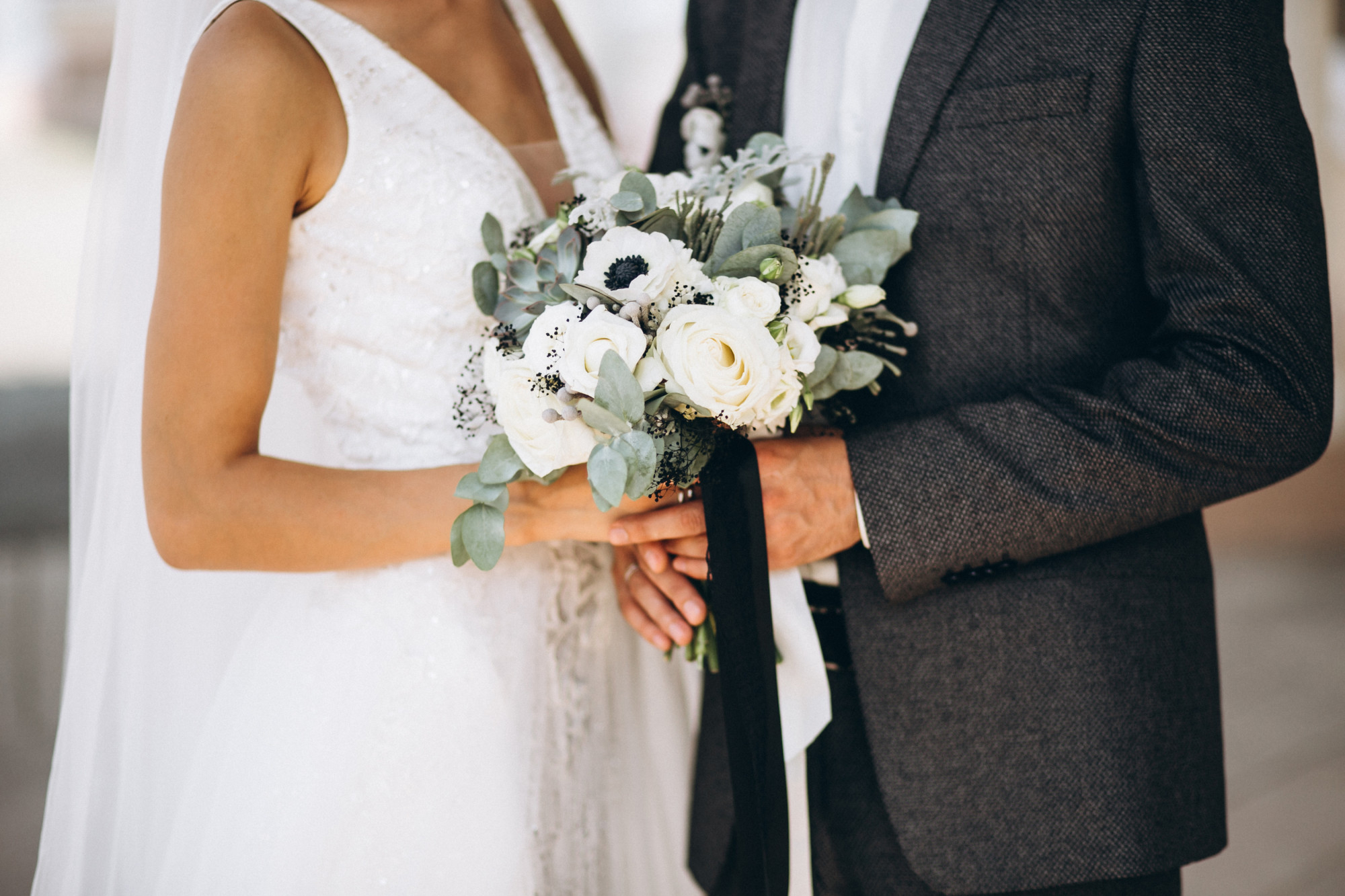
The motorcycle came up the gravel road just as the officiant said, “If anyone here has a reason these two should not be married…”
He didn’t finish the sentence.
He didn’t have to.
Because at that exact moment, the roar of an engine rolled across the whole vineyard, and a hundred and twenty guests turned around in their white chairs at the same time.
I turned too.
I was sitting in the front row in a lavender dress I’d spent three months picking out, holding a tissue I’d already used twice. My husband, Tom, was beside me in his good navy suit. My daughter, Florence, was standing at the altar under an arch of white roses, holding hands with the man she’d loved since she was nineteen.
And a giant biker I’d never seen before in my life was walking straight toward her.
Carrying a pink gift bag.
I’m going to tell you what was inside that bag.
But first I have to tell you how we got there. Because for a long time, I thought I knew everything about my daughter’s life.
I was wrong about almost all of it.
Florence had been dating Jeremy Whitmore since college.
They met in a statistics class their sophomore year at Ohio State. She was failing. He wasn’t. He offered to tutor her in the library on Tuesday nights. By the end of the semester, she had a B-plus and a boyfriend.
The first time she brought him home for Thanksgiving, I was nervous. Florence had dated a few boys in high school, and none of them had been anything to write home about. One of them stole our garden gnome as a “joke” and never gave it back.
Jeremy was different.
He showed up at our door in a pressed button-down shirt, holding a bouquet of yellow roses for me and a bottle of good bourbon for Tom. He shook Tom’s hand firmly and looked him in the eye. He called me Mrs. Callahan until I told him three times to call me Joanne. After dinner, he got up without being asked and started washing dishes.
Tom pulled me aside in the hallway.
“I like him,” he whispered. Tom doesn’t like anybody. It took him two years to warm up to our mailman.
“I like him too,” I said.
We genuinely liked him.
He was polite, hardworking, and he’d always treated our daughter well. He opened doors for her. He remembered her birthday and our anniversary. When Florence’s grandmother got sick, Jeremy drove four hours on a weeknight just to sit with her at the hospital.
After college, Jeremy went to work for his father’s commercial real estate company in Columbus. The Whitmores had money. Real money. A big house in Upper Arlington with a circular driveway and a swimming pool shaped like a kidney bean. His mother, Patricia, wore pearls to the grocery store.
Florence became a middle school art teacher. She made about a fifth of what Jeremy made. It never seemed to bother him.
They moved in together when they were twenty-four.
When Florence was twenty-six, Jeremy proposed.
She came over to show me the ring the next morning.
She didn’t even call first. I opened the front door in my bathrobe and there she was on the porch, holding out her left hand, with this enormous smile on her face.
The ring was a simple diamond on a thin gold band. Not flashy. Very Florence.
I hugged her so hard she squeaked.
“Sweetheart,” I said into her hair, “you chose the right man. You two are going to have a happy life together. Jeremy is perfect for you.”
She hugged me back.
I didn’t notice then that she didn’t say anything.
I’ve thought about that hug a thousand times since. I’ve thought about how sure I was. How I said “perfect,” like I knew. Like there was any such thing.
For months, everything revolved around the wedding.
Florence wanted something small. Patricia Whitmore wanted something large. They compromised on something medium-large, which really meant large.
A vineyard in the countryside an hour outside Columbus. An outdoor ceremony under a rose arch. A hundred and twenty guests. A reception in a big white barn with string lights and a live band. A four-tier cake.
I helped where I could. I went to dress fittings and cake tastings. I sat in on calls with the florist. I learned more about napkin folds than any human being should ever know.
Patricia called me once a week to “check in,” which really meant to tell me something else she’d changed without asking Florence.
“I’ve upgraded the champagne, Joanne. Don’t worry, we’re covering it.”
“I’ve asked the band to play a few of Gerald’s favorites. He loves Sinatra.”
“I’ve moved your sister’s table to the back. She seems like the type who’d want to be near the bathrooms.”
Florence handled it all with a patience I didn’t know she had. Whenever I complained, she’d just sigh and say, “It’s one day, Mom. After that, it’s just me and Jeremy.”
Just me and Jeremy.
She said that a lot that spring. Like she was reminding herself of something.
Then, about ten days before the wedding, Florence changed.
It was so gradual that I almost didn’t notice.
She came over for dinner on a Sunday, the way she usually did. But she barely ate. She pushed her mashed potatoes around her plate. When Tom asked her a question about the honeymoon, she didn’t hear him. He had to ask twice.
She kept checking her phone. Not scrolling. Just picking it up, looking at the screen, putting it face-down on the table. Picking it up again five minutes later.
“Who are you waiting to hear from?” Tom asked.
“Nobody, Dad.”
“You’ve looked at that thing nine times.”
“It’s work stuff.”
It was June. School was out.
I didn’t say anything. I watched her.
After dinner, she helped me with the dishes. I washed. She dried. That’s how we’ve always done it, ever since she was tall enough to reach the counter.
“Flo,” I said. “Is something wrong?”
“No.”
“You’re not eating.”
“I’m stressed, Mom. It’s a wedding. Everybody’s stressed before a wedding.”
“Are you having second thoughts?”
She put down the dish towel.
She looked at me. For just a second, something flickered in her eyes. Something that looked almost like fear.
Then it was gone.
“No, Mom,” she said. “I’m just stressed.”
I believed her.
God help me. I believed her.
The next few days, it got worse.
Florence canceled her final dress fitting. She said she had a migraine. She’d never had a migraine in her life.
She stopped answering my texts as quickly. When she did answer, it was short. “Ok.” “Sure.” “Sounds good.”
On Wednesday, Patricia Whitmore called me.
“Joanne, is Florence all right? She seemed very distracted at lunch yesterday. She barely touched her salad. And she was very short with Jeremy.”
“Short with Jeremy?”
“He asked her about the seating chart and she just got up and went to the ladies’ room for twenty minutes.” Patricia’s voice went tight. “I don’t want to say anything. But some brides get cold feet. And it would be very embarrassing. For everyone. We’ve invited the Hendersons. And the mayor.”
“I’m sure she’s fine,” I said. “She’s just stressed.”
“Well,” said Patricia. “I hope so.”
She said “I hope so” like she was warning me.
On Thursday night, two days before the wedding, I couldn’t sleep.
I got up around midnight and went downstairs for a glass of water. I was standing at the kitchen sink in the dark when my phone buzzed on the counter.
It was Florence.
“Mom? Are you awake?”
I called her right away.
She picked up on the first ring. I could hear she’d been crying.
“Flo. What’s wrong?”
“Nothing. I’m sorry. I shouldn’t have texted. Go back to bed.”
“I’m not going back to bed. Where are you?”
“In my car. Outside the apartment. Jeremy’s asleep.”
“Why are you in your car at midnight?”
She didn’t answer for a long time.
“Mom,” she finally said. “Can I ask you something?”
“Anything.”
“If you found out something. About someone you loved. Something they’d never told you. Something big. Would you want to know? Even if it ruined everything?”
My stomach went cold.
“Florence. What did you find out?”
“I’m not saying I found out anything. I’m asking a question.”
“Is Jeremy—” I didn’t know how to finish. “Is he hurting you?”
“No. God, no, Mom. Nothing like that.” She took a shaky breath. “I don’t even know if it’s true. That’s the thing. I don’t know what’s true.”
“Then tell me what you heard. Let me help.”
“I can’t. Not yet. I need to know first. I need proof.”
“Proof of what?”
Silence.
“Florence.”
“I’ll know by Saturday,” she said. “Either way. I’ll know by Saturday.”
“The wedding is Saturday.”
“I know, Mom,” she said quietly. “I know.”
Then she said she loved me, and she hung up.
I stood in my dark kitchen holding the phone for a long time.
I thought about driving over there. I thought about waking Tom.
I didn’t do either.
I told myself she was an adult. I told myself it was nerves. I told myself if something was really wrong, she’d tell me.
I went back to bed.
I didn’t sleep.
Friday was the rehearsal dinner.
It was at the Whitmores’ country club. White tablecloths, crystal glasses, men in sport coats talking about golf. Patricia gave a toast about how she’d “always known Jeremy would marry a lovely girl.” Gerald Whitmore, Jeremy’s father, gave a toast that was mostly about his company.
Jeremy gave a toast too.
He stood up with his glass of champagne and looked at Florence with his whole face soft.
“Florence,” he said. “From the first night in that library, when you threw your calculator across the table because you couldn’t figure out a standard deviation, I knew I was in trouble.” Everybody laughed. “You’re the most honest person I’ve ever met. You never pretend. You never hide anything. I don’t know how I got so lucky. But I’m going to spend the rest of my life trying to deserve you.”
Everybody clapped.
I looked at Florence.
She was smiling. But it wasn’t her smile. It was the smile she used to give the school photographer. The kind you hold until the flash goes off.
When Jeremy sat down and kissed her cheek, she flinched.
Just a little.
Just enough for a mother to see.
After dinner, out in the parking lot, Jeremy caught up with me by my car.
“Joanne. Got a second?”
“Of course, honey.”
He glanced back toward the clubhouse. Then he lowered his voice.
“I don’t want to worry you,” he said. “And I don’t want to worry Flo. She’s already so stressed. But I need to tell somebody.”
“Tell me what?”
“There’s this guy,” Jeremy said. “Kind of a crazy guy. He’s been harassing me for a few weeks. Calling. Showing up at the office. He’s got some idea in his head that I owe him something. Money, I guess. It’s a whole misunderstanding.” He rubbed the back of his neck. “He’s a biker. Big guy. Kind of scary. I’ve told building security. But I just— If somebody like that shows up tomorrow, just call the police right away. Okay? Don’t let him near Florence.”
I stared at him.
“Jeremy. Should we be worried? Should we hire security?”
“No, no. I’m sure he won’t come. I just wanted somebody to know.” He smiled and squeezed my arm. “It’s nothing. Really. Get some sleep. Big day tomorrow.”
He walked back inside.
I stood there by my car under the parking lot lights.
A biker. A crazy guy. Harassing him for weeks.
And my daughter, sitting in her car at midnight, saying, I need proof.
I didn’t put it together.
Not yet.
The wedding day was perfect.
That’s the strange part. It was the most beautiful day you can imagine. Late June. Blue sky with a few white clouds. A breeze that smelled like grapes and cut grass.
I helped Florence get dressed in the little bridal cottage at the edge of the vineyard. Her dress was simple. Ivory silk, with thin straps and a long skirt that moved like water when she walked. She’d picked it out herself, over Patricia’s objections. Patricia had wanted something with “more presence.”
I buttoned the tiny buttons down the back. All forty-two of them.
My hands were shaking.
“Mom,” Florence said. “You’re shaking.”
“I’m just emotional.”
She turned around and looked at me. Her makeup was perfect. Her hair was up in a loose twist with little white flowers pinned in it. She looked like a painting.
But her eyes were red underneath the makeup. She’d been crying again.
“Flo,” I said. “Talk to me. Please. What’s going on?”
She looked at her phone on the vanity. It was face down.
She’d checked it every two minutes since I walked in.
“He said he’d come,” she whispered. Not to me. To herself.
“Who?”
She shook her head.
“Florence. If you don’t want to do this—”
“I don’t know what I want,” she said. Her voice cracked. “I don’t know what’s real. I need to see it. I need to see it with my own eyes before I say yes to him. And if he doesn’t come…”
“If who doesn’t come?”
There was a knock on the cottage door. The wedding planner. “Five minutes, ladies!”
Florence picked up her bouquet. White peonies and little sprigs of rosemary.
“If he doesn’t come,” she said quietly, “then maybe it isn’t true. And I’ll marry Jeremy. And I’ll never ask about it again.”
She walked out the door before I could stop her.
The ceremony started at four o’clock.
The string quartet played. The flower girl, Jeremy’s little cousin, threw rose petals in big clumps. The groomsmen stood in a line in their gray suits, all looking a little hungover from the night before.
Then Tom walked Florence down the aisle.
I watched my husband walk our only child toward the altar, and I saw him squeeze her hand twice at the end. That’s a thing they’ve done since she was little. Two squeezes. It means I’m right here.
She squeezed back. Twice.
Then she let go and took Jeremy’s hands.
Jeremy was beaming. He looked at her like she was the sun. Everyone could see it. I heard a woman behind me whisper, “Look at how he looks at her.”
The officiant was a friend of the Whitmores. A retired judge with a deep voice. He talked about love and patience and building a home together.
On the wedding day, Florence and Jeremy stood together at the altar while the officiant spoke.
Everything was going exactly as planned.
And then the officiant said it. The old line. The one nobody ever answers.
“If anyone here has a reason these two should not be joined in marriage, let them speak now—”
Then we heard the motorcycle.
It came from far away at first. A low rumble, rolling over the hills.
Then louder.
Then very loud.
Guests began turning around in their chairs.
The sound came up the long gravel road that led into the vineyard. It was loud enough to drown out the string quartet. Loud enough that the officiant stopped talking.
A huge motorcycle came around the bend by the parking lot.
It was black and chrome and old. Not shiny new. Old and well taken care of. It pulled up and stopped near the edge of the lawn, maybe fifty yards from the rows of white chairs. The engine cut off.
The silence afterward was enormous.
A man got off.
He was the biggest man I’d ever seen in person. Broad-shouldered, thick through the chest and arms. Heavily tattooed, from his knuckles all the way up past his rolled-up shirtsleeves. He had a long gray beard and a bald head that shone in the sun. He wore jeans and heavy black boots and a black leather vest over a plain white T-shirt.
He looked like every warning anybody’s mother ever gave them.
And in one of his huge, tattooed hands, he was carrying a small pink gift bag.
The kind you’d buy at a drugstore. Pink with little white polka dots. Pink tissue paper sticking out of the top.
He got off the motorcycle and started walking directly toward the ceremony.
Everyone looked confused.
People were murmuring. “Who is that?” “Is he a guest?” “Is this a joke?” A child in the third row asked loudly, “Mommy, is that Santa?”
Patricia Whitmore had half stood up in the front row on the groom’s side, with her hand on her pearls.
Everyone looked confused.
Everyone except Florence.
The second she saw him, she went completely still.
She was holding Jeremy’s hands at the altar. I watched her face. I watched it go white, then something else. Not scared. Something more like relief. Like someone who’d been holding her breath for ten days and finally let it out.
Jeremy turned around.
His face changed.
I’d known Jeremy for seven years. I’d seen him happy and tired and stressed and sad. I’d never seen him look like this.
He looked terrified.
“No!” he shouted. He let go of Florence’s hands. “No! Don’t come near her!”
The biker kept walking.
He didn’t run. He didn’t hurry. He walked slowly and steadily down the center aisle between the rows of white chairs, his heavy boots crunching on the rose petals. He didn’t look at anyone. He looked only at Florence.
“Get him out of here!” Jeremy shouted. His voice cracked high. “Somebody stop him! Call the police!”
A few of the groomsmen took a step forward. Then they looked at the size of the man and stopped.
My husband started toward him.
Tom is sixty-one years old. He has a bad knee and high blood pressure and he hasn’t been in a fight since the seventh grade. But he stood up out of his chair in his good navy suit and started walking up the aisle toward that giant of a man without a second’s thought.
Then Florence raised her hand.
“Dad,” she said. Her voice was clear and steady. “Don’t.”
Tom stopped.
He turned and looked at her.
I stared at her.
She knew this man.
The biker stopped in front of her.
Up close, I could see his face. Weathered and lined and sunburned. He was older than I’d thought. Sixty, at least. His eyes were pale gray and very tired. And something else.
They were wet.
He held out the pink bag.
Jeremy lunged forward and tried to grab it.
“Don’t take that!” he said. “Florence, don’t. Whatever he told you, it’s a lie. He’s crazy. I told you he’s crazy.”
Florence pulled it toward herself.
She held the little pink bag against the front of her silk wedding dress with both hands.
The biker looked at her for a long moment.
Then he said quietly, in a deep, gentle voice I didn’t expect:
“What’s inside is what you really wanted.”
Florence looked down at the bag.
“The truth,” she whispered.
“The truth,” the biker said. “All of it. I’m sorry it took me so long, Miss Florence. The bike wouldn’t start this morning. I had to fix the carburetor.” He swallowed. “I’m sorry it had to be today.”
Jeremy said, “Florence. Please.”
It was the way he said please that made my blood go cold.
It wasn’t the voice of a man who’d done nothing wrong.
It was the voice of a man who’d been waiting for this exact moment for a very long time.
Florence reached into the pink bag.
The whole vineyard was silent. A hundred and twenty people. Not a single sound. Even the birds seemed to have stopped.
She pulled out a manila envelope. Thick. She opened it.
Inside, there were papers. A few of them. And a photograph.
She looked at the photograph first.
I saw her face crumple.
She held it for a long time. Then she turned it around, so Jeremy could see it.
From where I sat in the front row, I could see it too.
It was a little boy. Maybe six or seven years old. Standing on a front porch in a too-big T-shirt, holding up a fish on a string and grinning so wide his eyes were squeezed shut. He had dark curly hair and dimples in both cheeks and a gap where his front tooth should have been.
He looked exactly like Jeremy.
Not a little bit. Exactly. The same dimples. The same curly hair. The same way his left eyebrow went up higher than his right when he smiled.
I’d seen Jeremy’s baby pictures. Patricia showed them to everyone. The boy in the photo could have been Jeremy at seven.
A murmur went through the crowd like wind through tall grass.
Jeremy stared at the photo.
His face went completely gray.
Florence pulled out the papers one by one.
She didn’t read them out loud. She didn’t have to. Her hands were shaking so hard the pages rattled.
The first one was a birth certificate. I couldn’t read it from where I was. Later, I would. Eli James Dawson. Born in Athens, Ohio. Seven years ago this past March. Mother: Kayla Marie Dawson. Father: blank.
The second one was a paternity test. From a lab in Columbus. Dated six years ago. The probability number at the bottom had a lot of nines in it.
The third one was a legal agreement. Several pages. Florence turned to the last page. There were signatures at the bottom.
One of them was Patricia Whitmore’s.
The other was Jeremy’s.
Florence looked up from the papers.
She didn’t look at Jeremy.
She turned and looked at Patricia. In the front row. In her pearls.
Patricia’s face had gone the color of a sheet of paper.
“You have a son,” Florence said to Jeremy.
Her voice was very quiet. But in that silence, it carried to every single chair.
“Florence—”
“You have a seven-year-old son.”
“Let me explain—”
“His name is Eli,” Florence said. “He likes fishing. He’s in the second grade. He can’t say his R’s yet, so he calls himself Ewi. He sleeps with a stuffed raccoon named Bandit.” She held up the photograph. “His mom died three years ago. In a car accident. On Route 33. He’s been living with his grandfather ever since.”
She looked at the biker.
“His name is Hank,” Florence said. “Hank Dawson. He’s Kayla’s father. He’s Eli’s grandfather.”
The biker, Hank, stood very still with his huge hands at his sides.
“And for three years,” Florence said, “Hank has been trying to get you to meet your son. And you’ve been telling him to go away. And calling him crazy. And telling me he was a lunatic who thought you owed him money.”
“That’s not—”
“I saw the texts, Jeremy.”
Jeremy closed his mouth.
I couldn’t move.
I sat in my white chair in my lavender dress with my tissue crushed in my fist and I couldn’t move.
All around me, I could hear people whispering. A hundred and twenty people. Jeremy’s college friends. Florence’s teacher friends. The Whitmores’ business partners. The mayor.
Tom was still standing in the aisle. He looked at Florence. Then he looked at Jeremy. Then, slowly, he walked back to the front row and stood next to me. He didn’t sit down. He put his hand on my shoulder.
Jeremy turned around and looked at his mother.
“Mom,” he said. His voice was barely a whisper.
Patricia stood up.
She smoothed her skirt. She touched her pearls. She looked out at a hundred and twenty guests, all staring at her.
“This is a private family matter,” she said. Her voice shook only a little. “This is not the time or the place.”
“When is the time, Patricia?” Florence said.
Patricia looked at her.
“When was the time?” Florence said again. “Before the wedding? After? When we had kids of our own? When were you going to tell me Jeremy already had one?”
Jeremy’s knees seemed to give out. He sat down hard on the edge of the little step in front of the altar. In his tuxedo. With his head in his hands.
“I was twenty,” he said through his fingers. “I was twenty years old.”
Nobody said anything.
“It was the summer before I met you. I was working at my uncle’s marina down on the Hocking River. Kayla worked at the bait shop. She was nineteen. It was one summer. Just one. Then I went back to school.” He looked up. His eyes were red. “In October, she called me. She said she was pregnant. I panicked. I didn’t know what to do. I called my mom.”
Everybody looked at Patricia.
Patricia didn’t say anything.
“My mom said she’d handle it,” Jeremy said. “She hired a lawyer. They did a test. It was mine. And my mom made an agreement with Kayla. Money. Every month. As long as Kayla didn’t put my name on the birth certificate. As long as she didn’t contact me. As long as she didn’t come after the family.” He swallowed. “My mom said it was the best thing for everyone. She said I had my whole future. She said a baby with a bait-shop girl would ruin everything. And I let her. I signed it. I didn’t even read all of it. I just signed it.”
“And then you met me,” Florence said.
“And then I met you.” His voice broke. “Two months later. In that library. And I thought, this is it. This is my real life. That other thing was a mistake. My mom handled it. I never had to think about it again.”
“You never thought about it?”
“I thought about it every day,” Jeremy said. “Every single day, Florence. Every time I saw a little kid. Every time somebody asked if we wanted children. Every time you said you wanted a boy someday.” He pressed his palms against his eyes. “I just couldn’t make myself do anything about it.”
“Then Kayla died,” Hank said.
Everybody turned and looked at him.
He hadn’t moved from his spot in front of the altar. He was standing with his hands folded in front of him. He looked enormous and out of place and very, very tired.
“Three years ago,” Hank said. “March. Black ice. She was driving home from her shift at the hospital. She was a nurse’s aide. She’d gone back to school for it.” His deep voice wavered. “Eli was four. He was at my place that night. I had to tell him his mama wasn’t coming home.”
He looked at Jeremy.
“After the funeral, the checks stopped,” Hank said. “The money from your family. I guess the agreement was with Kayla. When she was gone, your mother’s lawyer sent a letter. Said the obligation was ‘concluded.'”
Somebody in the crowd made a sound. A sharp, angry breath.
“I don’t care about the money,” Hank said. “I want you to hear me say that. I’ve never cared about the money. I’m a mechanic. I own my own shop in Nelsonville. I own my house. Eli has never gone without one meal.” He took a breath. “But he asks about his daddy. Every night. He says, ‘Papa, does my dad know where I live?’ He says, ‘Does he know about Bandit?’ He says, ‘Does he know I can ride a bike now without training wheels?'”
Hank’s voice cracked.
“And I don’t know what to tell him,” he said. “So I started calling you. Two years ago. I found your number. You hung up. I called your office. You had security walk me out. I wrote you letters. You sent them back unopened. I came to your building and waited by your car. You told me if I came near you again, you’d get a restraining order.” He looked at the ground. “I didn’t want money, son. I just wanted you to meet him. Just once. So he’d know his daddy was a real person and not a story.”
Jeremy didn’t say anything.
He was crying now. Openly. Sitting on the altar step in his tuxedo with tears running down his face.
“How did you find me?” Florence asked Hank. “That first time. Ten days ago.”
Hank looked a little embarrassed.
“The newspaper,” he said. “Your wedding announcement was in the Sunday Dispatch. With your picture. And it said you were a teacher at Hilliard Middle School.” He scratched his beard. “I drove down there. School was out. But there was a lady in the office. I told her I was a friend of yours and I had something to drop off. She gave me your school email.”
“And you wrote to me.”
“I wrote to you.” He looked at her. “I’m sorry, Miss Florence. I know it wasn’t right. Going behind his back. Bothering a bride ten days before her wedding.” He shook his head. “But I’m sixty-four. I’ve got a bad heart. The doctor says I need surgery this fall. If something happens to me, Eli’s got nobody. Not one single soul in this world. And his daddy was about to marry somebody, and I thought…”
He stopped.
“I thought,” he said slowly, “maybe she’d be the kind of person who’d want to know. Maybe she’d be the kind of person who’d care about a little boy she’d never met.”
Florence was crying now too.
“I wrote back,” she said, to all of us. To me. “I told him I didn’t believe him. I told him Jeremy had already warned me about him. That he was a crazy biker who was harassing him over money.” She wiped her eyes. “And Hank wrote back one line. He said, ‘You don’t have to believe me. Just let me show you.'”
She held up the envelope.
“I told him I wanted proof,” Florence said. “Real proof. Not a story. I told him if it was true, I needed to see it before I married Jeremy. And he said he’d get it. He said it might take a while. He had to find Kayla’s lawyer’s files. He had to get a copy of the agreement. He said he’d get it to me as fast as he could.”
She looked at Hank.
“He was supposed to get it to me last night,” she said. “He didn’t come. I thought it meant it wasn’t true. I thought maybe I’d been crazy for ten days. That I almost ruined everything over nothing. So I got dressed this morning. And I walked down the aisle.”
“I’m sorry,” Hank said again. “The lawyer’s office didn’t give me the papers until four o’clock yesterday. And then the bike wouldn’t start this morning. I tried for two hours.”
“You came,” Florence said. “That’s what matters. You came.”
Then she reached back into the pink bag.
There was one more thing in it.
At the bottom, under the pink tissue paper, wrapped in a paper napkin, was something small.
Florence unwrapped it.
It was a bracelet.
A child’s bracelet. The kind you make at summer camp. Plastic beads in every color, strung on a stretchy cord. Some of the beads were letters. They spelled something.
F-O-R T-H-E B-R-I-D-E.
Florence held it in her palm and looked at it for a long time.
“Eli made that,” Hank said quietly. “Last night. At the kitchen table. I told him I was going to a wedding today. I told him the bride was going to marry his daddy.” He swallowed hard. “He didn’t understand it, really. He’s seven. But he wanted to make her a present. He said brides should get presents. He picked out the pink bag at the dollar store himself.”
He looked at Florence.
“He asked me to tell you he hopes you like pink,” Hank said. “He said all the girls in his class like pink. He wasn’t sure about grown-ups.”
Florence made a sound I’d never heard her make before. Somewhere between a sob and a laugh.
She slid the bracelet onto her wrist. Right next to the diamond ring on her left hand.
It looked so small there. Little plastic beads against white silk.
“I like pink,” she whispered.
Jeremy stood up.
He was a mess. His tie was crooked. His face was red and wet. He looked at Florence with the bracelet on her wrist, and at the photograph in her other hand, and at Hank standing beside her like a mountain.
“Flo,” he said. “Please. Let’s go inside and talk. Just us. Please.”
Florence looked at him.
“You told me Hank was a crazy man who wanted money,” she said. “You told my mother last night to call the police if he showed up. You looked her in the eye and told her that.”
Everyone turned and looked at me.
My face went hot. I nodded.
“He did,” I said. My voice didn’t sound like my own. “In the parking lot of the country club. He told me there was a crazy biker harassing him. He told me to call the police if he came anywhere near Florence.”
Jeremy closed his eyes.
“You didn’t just hide it from me,” Florence said. “You made him into a monster. A sixty-four-year-old man who’s raising your son by himself with a bad heart. You made him into a villain so I’d be scared of him. So I’d never listen.”
“I was scared,” Jeremy said. “I was so scared, Florence. Of losing you.”
“So you lied to me. For seven years.”
“I didn’t know how to tell you.”
“You stood up last night,” Florence said, “in front of all your parents’ friends, and you told everybody I was the most honest person you’d ever met. You said I never hide anything.” Her voice shook. “And you were hiding a child.”
Jeremy didn’t answer.
He couldn’t.
Florence turned to the officiant.
The retired judge had been standing there this whole time with his little leather book, looking like he very much wished he were anywhere else.
“I’m sorry,” Florence said to him. “I know you drove a long way. But I can’t do this today.”
The judge nodded slowly. He closed his book.
“I think that’s wise, young lady,” he said.
Florence turned to the guests.
A hundred and twenty people. All of them staring at her. Her friends from school, some of them crying. Jeremy’s friends, looking at their shoes. The mayor, looking very interested in a nearby grapevine.
“I’m sorry,” she said to all of them. “I’m so sorry you came all this way. There’s food in the barn. And a band. And a lot of champagne.” She almost laughed. “Patricia upgraded the champagne. Please. Eat. Drink. Dance if you want.” She took a breath. “But I’m not getting married today.”
Then she turned and looked at Jeremy one last time.
She took the diamond ring off her finger.
She held it out to him.
He didn’t take it at first. He just stared at it in her palm.
“Florence,” he whispered.
“Take it, Jeremy.”
He took it.
She left the beaded bracelet on.
Then she did something I’ll remember for the rest of my life.
She turned to Hank. She looked up at this giant tattooed man in his leather vest, who had ridden an old motorcycle sixty miles with a broken carburetor to bring her a pink bag from the dollar store.
“Thank you,” she said. “For telling me the truth.”
Hank shook his head.
“I’m sorry I ruined your day, miss.”
“You didn’t ruin it,” Florence said. “You saved it.”
And then my daughter, in her ivory silk wedding dress, stepped forward and wrapped her arms around Hank Dawson’s enormous chest.
He didn’t know what to do at first. He stood there with his arms out at his sides. Then, very slowly, very carefully, like he was afraid she might break, he hugged her back.
Over her head, his eyes met mine.
He looked so tired. So sad. So unsure.
I stood up.
I don’t remember deciding to. I just did. I walked up to the altar in my lavender dress and I put my hand on Hank’s huge, tattooed arm.
“Mr. Dawson,” I said. “I’m Florence’s mother. Joanne.”
“Ma’am.”
“Would you like a glass of water? You’ve had a long ride.”
He looked at me for a long moment. Then something in his face softened.
“Yes, ma’am,” he said. “I’d like that very much.”
The rest of the day was a blur.
Some guests left. Most stayed. I think they didn’t know what else to do. The band played. People drank Patricia’s upgraded champagne and talked in low voices at the round tables in the barn and stared at us whenever they thought we weren’t looking.
The Whitmores left within an hour. Gerald took Patricia by the arm and walked her to their car without saying a word to anyone. Patricia didn’t look back.
Jeremy stayed a little longer.
He sat alone on a hay bale behind the barn. I saw him through the open back doors. He’d taken off his tuxedo jacket. He was holding the ring in one hand and the photograph of Eli in the other. He kept looking from one to the other.
At one point, Hank went out and sat down on the hay bale next to him.
I don’t know what they said. Neither of them ever told me.
But they sat there for a long time. The big biker and the boy in the rumpled tuxedo shirt. And at one point, I saw Hank reach over and put his hand on the back of Jeremy’s neck, the way you’d hold a son.
And Jeremy put his face in his hands and cried.
Florence sat with me at an empty table in the corner of the barn. She’d taken her shoes off. Her feet were dirty from the grass. Her beautiful hair was coming down from its twist. She was still wearing the bracelet.
Tom brought us two plates of food from the buffet. Neither of us touched them.
“Why didn’t you tell me?” I said finally. “That night in the car. Why didn’t you just tell me?”
Florence looked at her lap.
“Because you’d already decided,” she said quietly.
“Decided what?”
“That Jeremy was perfect.” She looked at me. “When I showed you the ring, you said it. ‘Jeremy is perfect for you.’ Everyone said it. Dad said it. My friends said it. Patricia said it a hundred times. Everyone kept telling me how lucky I was. How I’d never find a man like him.”
“Flo—”
“And then I got this email from a stranger. A biker from Nelsonville. Saying Jeremy had a son. And I thought, if I tell anyone, they’ll think I’m crazy. They’ll say I have cold feet. They’ll say I’m looking for a reason to ruin the best thing that ever happened to me.” She shook her head. “I didn’t even believe it myself. I wanted it to be a lie so badly. I wanted Jeremy to be what everybody said he was.”
I didn’t say anything.
I thought about that morning she came over with the ring. The way I hugged her. How sure I was. You chose the right man.
I’d never once asked her if she was sure.
I’d just told her she should be.
“I’m sorry, baby,” I said. “I’m so sorry. I made it hard for you to tell me the truth.”
“It’s not your fault, Mom.”
“Some of it is.” I took her hand. “I judged that man the second he got off his motorcycle. I saw the tattoos and the leather and I thought, he’s dangerous. And I looked at Jeremy in his nice shirt with his yellow roses, and I thought, he’s safe.” I swallowed. “I was exactly wrong about both of them.”
Florence squeezed my hand.
“Everyone was,” she said.
“Not you.”
“Not me in the end,” she said. “But almost. I was almost wrong too.”
Hank found us around seven o’clock.
He’d taken his leather vest off. He was holding a paper plate with a piece of the wedding cake on it, which the caterers had cut anyway because nobody knew what else to do with a four-tier cake.
“I should get going,” he said. “My neighbor’s watching Eli. She’s eighty-two. He’s probably got her playing Uno for nickels by now.”
Florence stood up.
“Hank. Can I meet him?”
He blinked.
“Eli?”
“Can I meet him? Not today. But soon.” She held up her wrist with the beaded bracelet. “I want to thank him for my present.”
Hank stared at her.
Then this enormous, frightening-looking man, who’d ridden into a wedding like the end of the world, started to cry.
He set the cake down on the table. He wiped his eyes with the back of his huge tattooed hand.
“Yes, miss,” he said. “He’d like that. He’d like that more than anything.”
We went the next Saturday.
Florence and me. Tom wanted to come, but Florence said maybe not the first time. Maybe not too many strangers at once.
Hank’s house was on a quiet street at the edge of Nelsonville. A small white ranch house with green shutters and a big garage out back with a hand-painted sign that said DAWSON’S AUTO & CYCLE. There was a tire swing hanging from an oak tree in the front yard. A kid’s bicycle lay on its side in the grass.
Hank opened the front door before we even knocked.
He was wearing a clean button-down shirt. He’d trimmed his beard. He looked nervous. Huge and nervous.
“He’s been up since five,” Hank said. “He’s changed his shirt four times.”
Behind him, in the hallway, a little face peeked around the corner.
Dark curly hair. Dimples. A gap in his front teeth.
He was holding a stuffed raccoon by one paw.
“Eli,” said Hank gently. “Come say hi. This is Miss Florence. The lady I told you about. And her mom.”
Eli came out slowly. He stood behind Hank’s leg and looked up at Florence.
Florence knelt down on the porch, so she was at his eye level.
She held up her wrist.
“Hi, Eli,” she said. “I’m wearing your bracelet. I haven’t taken it off since the wedding.”
Eli stared at the bracelet. Then at her face.
“You like pink?” he asked. Shy. Just above a whisper.
“I love pink,” Florence said. “It’s my favorite color.”
That wasn’t true. Florence’s favorite color is green. It has always been green.
Eli’s whole face lit up.
“I picked the bag,” he said. “At the dowwar store.”
“It was the best bag I’ve ever gotten,” said Florence.
Eli stepped out from behind Hank’s leg. He held up the stuffed raccoon.
“This is Bandit,” he said. “He’s a waccoon.”
“Hi, Bandit,” said Florence solemnly, and shook the raccoon’s paw.
Eli giggled.
And I stood on that porch and watched my daughter, who should have been on her honeymoon in Maine that week, holding hands with a stuffed raccoon and a seven-year-old boy whose father had left her at the altar of a lie.
I don’t think I’ve ever been prouder of anyone in my life.
We stayed for four hours.
Eli showed us his room. His fish tank. His collection of rocks. His drawings, taped all over the refrigerator. One of them was a stick-figure woman with brown hair, holding a baby.
“That’s Mama,” Eli said, pointing. “She’s in heaven. Papa says she’s a angel now.”
“She looks very pretty,” said Florence.
“She was.” Eli nodded seriously. “She smelled like stwawbewwies.”
Hank had to go out to the garage for a minute after that.
Eli wanted to show Florence how he could ride his bike without training wheels. So we all went out in the front yard, and he rode up and down the sidewalk about forty times while Florence clapped and cheered every single time like it was the Olympics.
On the fortieth time, he stopped next to her and looked up.
“Are you gonna mawwy my daddy?” he asked.
Florence’s face went very still.
I held my breath.
“No, sweetheart,” Florence said gently. “I’m not going to marry your daddy.”
Eli looked down at his sneakers.
“Okay,” he said.
“But I’d still like to be your friend,” Florence said. “If that’s okay with you.”
Eli looked up.
“Like a weal friend? Not just today?”
“Like a real friend,” said Florence. “For as long as you want.”
Eli thought about it.
“Can you come to my birthday?” he said. “It’s in Mawch. I’m gonna be eight.”
“I wouldn’t miss it,” said Florence.
Jeremy called Florence three times the first week. She didn’t answer.
The second week, he sent a long email. She read it. She showed it to me.
It said a lot of things. That he was sorry. That he was a coward. That he’d been ashamed for seven years and let his mother handle it because it was easier than facing it. That he’d moved out of their apartment and was staying with a friend. That he’d quit his job at his father’s company.
And at the end, it said:
“I called Hank yesterday. I asked if I could meet Eli. He said yes. I’m going next Saturday. I’m terrified, Flo. I don’t know how to be anybody’s father. I don’t know how to be anybody’s anything right now. But I’m going. I don’t expect you to forgive me. I just wanted you to know I’m finally doing the thing I should have done seven years ago.”
Florence read it twice.
Then she wrote back one line.
“Good. Bring him a fish.”
Jeremy did bring Eli a fish.
A goldfish, in a little plastic bag, from the pet store. Hank told us about it later. He said Jeremy stood on the front porch for almost ten minutes before he knocked. He said when Eli opened the door, Jeremy got down on his knees right there on the welcome mat and couldn’t say anything at all.
“Who are you?” Eli asked.
And Jeremy, Hank said, just held out the goldfish in its little bag and said, “I’m your dad. I’m so sorry I’m late.”
Eli named the goldfish Wobert. Robert.
It wasn’t a fairy tale after that. I want to be honest.
Patricia Whitmore never apologized to anyone. She hired a lawyer and tried to argue that the original agreement meant the family owed Eli nothing. Gerald Whitmore eventually made her drop it. I heard he told her that if she didn’t, he’d tell the whole country club exactly what she’d done.
The Whitmores don’t visit Eli. Patricia has never met her grandson. That’s her loss. I’ve stopped feeling angry about it. Mostly.
Jeremy took a job at a different company in Athens, forty minutes from Nelsonville. He rented a little apartment. He goes to see Eli every Wednesday night and every other weekend. He’s taking parenting classes at the community center. He’s terrible at it, Hank says. He doesn’t know how to braid hair or pack a lunch or make a kid eat green beans.
“But he shows up,” Hank told me. “Every single time. Rain or shine. Never missed once.”
In the fall, Hank had his heart surgery.
A triple bypass. Seven hours. Florence and I sat in the waiting room at the hospital in Athens the whole time. Jeremy was there too, on the other side of the room. Eli sat between us, coloring in a book about trucks.
When the surgeon came out and said Hank was going to be fine, Eli looked up from his coloring book and said, “Can I see Papa now?”
And Jeremy picked him up and carried him down the hallway to Hank’s room.
Florence watched them go.
“Are you okay?” I asked her.
She was quiet for a long moment.
“I loved him, Mom,” she said. “I really did. For seven years.”
“I know, honey.”
“I don’t anymore. Not like that.” She looked down at her wrist. At the little beaded bracelet she still wore every day. “But I’m glad he’s becoming somebody worth loving. For Eli.”
It’s been a year and a half now.
Florence didn’t get married. She went back to teaching in the fall. She moved into a little apartment of her own above a bookstore in Clintonville. She started painting again, which she hadn’t done since college. She’s happy. Really happy. The kind of happy that doesn’t need anybody to tell her she’s lucky.
She goes to see Eli once a month. She went to his eighth birthday party in March, like she promised. She brought him a fishing pole and a pink gift bag from the dollar store with little white polka dots on it.
He laughed so hard he fell off his chair.
Hank comes to our house for Sunday dinner now. Not every Sunday. But a lot of them. He brings Eli. Tom and Hank sit on the back porch after dinner and argue about motorcycles and baseball and whether you can really fix a carburetor with a paper clip. (Hank says you can. Tom says that’s how you get killed.)
The first time Hank came over, my neighbor, Mrs. Pruitt, called me on the phone.
“Joanne,” she whispered. “There’s a very large man with tattoos sitting on your back porch. Should I call someone?”
“No, Ellen,” I said. “That’s family.”
Last Sunday, after dinner, I was washing dishes in the kitchen. Florence was drying, the way we always do.
Eli was asleep on the couch in the living room with Bandit tucked under his chin. Hank and Tom were on the porch. Jeremy had come by to pick Eli up, and he was sitting at the kitchen table with a cup of coffee, waiting for him to wake up. He comes to dinner sometimes now too. Florence says it’s fine. And it is. They’re kind to each other. Careful, but kind.
“Mom,” Florence said, drying a plate. “Can I tell you something?”
“Anything.”
“Remember that morning I showed you the ring? And you said Jeremy was perfect for me?”
I winced. “I remember.”
“I’ve been thinking about that a lot.” She set the plate in the cupboard. “Everybody always says to watch out for the scary-looking ones. Right? The guy with the tattoos and the motorcycle. The guy who looks like trouble.”
“That’s what my mother told me,” I said.
“Me too. That’s what you told me.” Florence picked up another plate. “But Hank was never the dangerous one. Not for one second. He was the only one telling the truth. The only one who’d ridden sixty miles to make sure a stranger didn’t make the biggest mistake of her life.”
She looked toward the kitchen table, where Jeremy was sitting with his coffee, watching his son sleep on the couch.
“And Jeremy was the one everybody trusted. Because he wore nice shirts and brought you flowers and washed the dishes.” She shook her head. “The dangerous thing was never the man who looked scary. It was the secret behind the man who looked safe.”
I didn’t say anything for a while. I just washed the same pot.
“I told you he was perfect,” I said finally. “I’m so sorry I said that.”
“Don’t be sorry,” Florence said. “Just don’t say it about the next one.”
“I won’t.”
“Say ‘Is he honest?’ instead,” she said. “Ask me that. Every time. Even if I’m annoyed.”
“I promise.”
From the porch, I heard Hank laughing at something Tom said. A big, deep, rumbling laugh that shook the windows.
On the couch, Eli stirred and opened his eyes. He looked around, confused for a second. Then he saw Jeremy at the kitchen table.
“Daddy,” he said sleepily. “Is it time to go?”
“Whenever you’re ready, buddy,” said Jeremy. “No rush.”
Eli sat up. He rubbed his eyes. He looked across the kitchen at Florence.
“Miss Fwowence,” he said. “Are you still wearing my bwacelet?”
Florence held up her wrist.
The plastic beads were faded now. One of the letters had cracked. The stretchy cord had been retied twice.
FOR THE BRIDE.
“Every day,” she said. “I never take it off.”
“But you’re not a bwide anymore,” Eli said.
Florence smiled.
“I know,” she said. “But it reminds me of the best present anybody ever gave me.”
“The bwacelet?”
“No, sweetheart,” said Florence. “The truth.”
Eli thought about that for a second, with his head tilted to one side, the way Jeremy does when he’s confused.
“The twuth was in the bag?”
“The truth was in the bag,” said Florence.
Eli nodded slowly, like that made perfect sense.
Then he picked up Bandit, and took his father’s hand, and walked out the front door.
On the porch, Hank stood up from his chair and kissed the top of his grandson’s head. Then he looked through the kitchen window at me, and raised his big tattooed hand in a little wave.
I waved back.
And I thought about the moment that motorcycle came roaring up the gravel road, and every single person at that wedding turned around and saw the most frightening man they’d ever laid eyes on.
We were all so afraid of the wrong thing.
It turns out the scariest thing that can walk into your life isn’t a stranger in a leather vest.
It’s the truth.
And sometimes, if you’re very lucky, it comes in a pink bag from the dollar store, carried by the kindest man you’ll ever meet.

Specialty: Quiet Comebacks & Personal Justice
David Reynolds focuses on stories where underestimated individuals regain control of their lives. His writing centers on measured decisions rather than dramatic outbursts — emphasizing preparation, patience, and the long game. His characters don’t shout; they act.