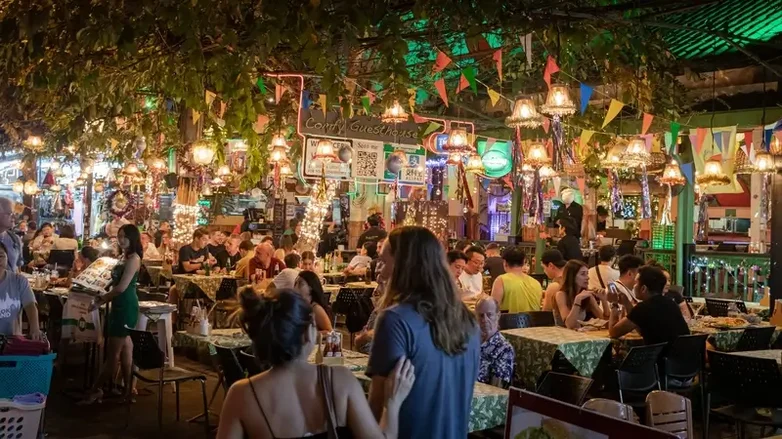
Sloane came back from wherever she had been with a look on her face I can only describe as satisfied. The kind of satisfied that makes you check your pockets. She slid back into her chair without apologizing for the absence, smoothed the front of her dress with both hands, and reached for her champagne like a woman who had just finished something she had been planning for a while.
She did not look at me right away. She looked at her mother first. A quick, small glance that passed between them like a signal. And Vivian’s shoulders dropped just slightly, the tension releasing in a way that told me whatever Sloane had gone to do, Vivian had known about it.
Then Sloane looked at me. She picked up the slim leather bill holder from her lap. I had not even seen her carry it back to the table. And without a word, without any change in her expression, she sent it sliding across the white silk tablecloth toward me. The leather caught on the fabric and made a soft dragging sound before it stopped against the edge of my bread plate.
She reached up and smoothed a strand of hair back from her face. Then she smiled.
“Consider this the cost of being welcome at this table,” she said, her voice clear and unhurried, pitched exactly loud enough for the guests nearest to us to hear every word. “If you can’t even cover this dinner, then clearly you don’t belong here.”
The table went quiet in the way that rooms go quiet when something has happened that everyone will be talking about later. Not a sudden hush. More like a tide pulling back. Forks were set down. A woman three seats away stopped mid-sentence. The man beside her turned his head just enough to see without appearing to look. Twenty-seven people found something to do with their hands that allowed them to keep their eyes on me.
I did not speak. There was nothing in me that wanted to speak. I looked at the leather folder sitting against my bread plate. I looked at Caleb. He had not moved. His hand was wrapped around his wine glass so tightly that the knuckles had gone the color of the tablecloth beneath them. He was staring straight down at the stem of the glass, and the muscle along his jaw was working steadily, rhythmically, like a man chewing on something he could not swallow and could not spit out.
He did not look up at me. He did not look up at his wife. He sat there and he held that glass. And he said nothing.
And I felt something tear quietly in the center of my chest. Not anger. Not humiliation. Something older and heavier than either of those. This was my son. This was what two years had made of him.
I reached for my purse. I found the clasp with my fingers and pressed it open. My hand moved inside and closed around my wallet, the same worn brown leather wallet I had carried for nine years. The one Caleb had given me for Mother’s Day the year he got his first real paycheck and called me from the parking lot of the store because he wanted to hear my voice when he told me he had bought me something with his own money.
My fingers tightened around it.
And then a voice came from just behind my right shoulder, low and close, carrying the particular urgency of someone who does not have much time.
“Ma’am, please don’t. You need to see something right now.”
I turned my head. The young man standing behind me was one of the wait staff. Julian, I would learn later. A server who had worked the Laura floor for two years and who had the careful, professional stillness of someone trained to be invisible until invisibility was the wrong choice. He was looking at me with an expression that had nothing to do with his job description. His eyes were steady, and his voice had dropped to just above a whisper, but there was nothing uncertain in it.
I looked at him for one full second. He did not explain himself. He simply gave the smallest nod toward the leather folder on the table.
I let go of my wallet. I pulled the folder toward me and opened it. The itemized receipt ran to nearly three thousand dollars. Twenty-seven guests. Four courses. Two bottles of imported champagne that Vivian had ordered without consulting anyone. And at the bottom of the thermal paper, printed in letters that had bled slightly at the edges, the way thermal ink does when a machine has had to work to produce them, was a single word in red.
Declined.
I read it twice. Then I set the folder down and looked across the table at Sloane. She was still smiling. But something had shifted at the edges of it. A hairline fracture in the confidence so small that if I had not been watching for exactly this kind of thing, I would have missed it entirely.
Her card had been declined before she ever sat back down. She had known when she sent that folder sliding across the tablecloth toward me that there was nothing behind it but nerve and calculation. She had not been asserting power. She had gone to the host stand to attempt the payment. And when the card came back declined, she had picked up the folder anyway and carried it back to the table. She’d been bluffing with an empty hand and hoping I would fold before anyone looked too closely at her cards.
I placed my hand flat on top of the folder and said nothing.
It was Vivian who broke first. “Oh.” She laughed, a bright and brittle sound that landed wrong in the silence. “The cake. They should be bringing out the cake any moment. Three tiers. I told them, with the spun sugar on top. Yes.”
The door from the kitchen opened. A man in a white apron pushed a cart through it. And on the cart sat a three-tiered cake with ivory frosting and fresh flowers pressed into the sides. He wheeled it to within six feet of the table and stopped. He did not reach for the lighter in his apron pocket. He did not move to place the candles. He crossed his arms and looked at Vivian with the flat, patient expression of a man who had delivered this particular news before.
“Mrs. Vivian,” he said, loud enough for the near half of the table to hear clearly, “the deposit card on file for this order was declined this afternoon. I’ll need two hundred dollars in cash before I can serve the cake.”
The color left Vivian’s face so completely and so quickly that, for a moment, she looked like a photograph of herself rather than the woman who had been holding court at the head of this table for the past two hours. Around us, the murmuring began.
Vivian recovered faster than I expected. I will give her that. Within seconds of the cake man’s announcement, she had arranged her face back into something resembling composure and turned to the woman seated to her left. Three of them dressed in the particular uniform of Charlotte’s charity circuit. Statement jewelry. Conservative hemlines. The kind of blowout that cost two hundred dollars and was meant to look effortless.
Vivian touched the arm of the nearest one, a woman with pearl-drop earrings the size of quarters, and leaned in with a laugh that was supposed to sound conspiratorial and fond.
“You know how banks are,” Vivian said, waving her hand as though dismissing a minor inconvenience. “They see international charges and they freeze everything. I was shopping in Charleston last weekend, and the same thing happened at checkout. Ridiculous, honestly.” She squeezed the woman’s arm. “Would you mind spotting me until I sort it out? You know I’m good for it, Barbara.”
Barbara looked at Vivian’s hand on her arm. Then she looked at Vivian’s face. Then she set her champagne flute down on the tablecloth with a precision that suggested she had been waiting for exactly this moment since she arrived.
“Vivian,” Barbara said, and her voice carried the particular clarity of a woman who had decided she was done being careful with her words, “you called me three weeks ago and told me this was a hosted dinner. Your treat, you said. No need to bring anything, you said.” She glanced around at the women beside her, who were already reaching for their evening bags with the focused energy of people who have identified the nearest exit. “You invited us here to make yourself look like you could afford the room, and now you want us to pay for it.”
The murmuring that had started at the edges of the table sharpened into something more distinct. A man near the far end leaned over to his wife and said something behind his hand. Two couples near the middle were already pushing back their chairs.
“That is not what—” Vivian started.
“I have an early morning,” Barbara said, standing. She smoothed her skirt with both hands, unhurried, the way a woman moves when she has absolutely nothing to apologize for. “Happy birthday, Vivian. I hope the bank gets it sorted.”
One by one, the pearl-and-blowout contingent rose from their seats. A few said nothing at all. One patted Vivian’s shoulder with the brisk sympathy you offer someone at a funeral when you have another engagement to get to. The chairs scraped against the hardwood in a small, steady percussion that seemed to grow louder the quieter Vivian became. By the time the last of them had gone, six chairs sat empty along Vivian’s side of the table, and the remaining guests had developed a sudden, intense interest in their dessert menus.
Sloane’s composure cracked along a different line than her mother’s. Where Vivian had gone pale and stiff, Sloane went red. A fast-rising flush that started at her throat and moved upward. And she turned it directly on Caleb like something she needed to put somewhere before it burned through her.
“This is your fault,” she said, her voice dropping into a register I had not heard from her before. Lower. Stripped of the careful social polish she had been wearing all evening. “You sat there all night like a piece of furniture. Your mother is sitting right there, and you haven’t done one thing.”
“Sloane,” Caleb said. “Don’t.”
She pointed at him, her finger stopping an inch from his face. “I sacrificed so much to build a life with you. I gave up things you don’t even know about, and you can’t even—” She stopped, seeming to remember the room, and recalibrated. When she spoke again, it was quieter, but the heat behind it had not gone anywhere. “I bought you that watch for our anniversary. I went without things so you could have something real to wear to evenings like this. The least you could do is act like it.”
I looked at the watch on Caleb’s wrist. It was a clean-looking piece. Silver case. Dark face. The kind of profile that was designed to suggest a certain provenance without committing to it. Thirty years of walking through other people’s homes had taught me things I had never set out to learn. I had cleaned enough bedside tables with genuine Swiss timepieces laid carefully on their sides to know what a mechanical second hand looked like in motion. The smooth, continuous sweep of a movement that cost what it cost because of what was inside it.
The second hand on Caleb’s watch ticked. One beat. Pause. One beat. Pause. The small, stuttering pulse of a quartz movement that had no idea it was pretending to be something else.
“That’s a quartz movement,” I said. I kept my voice conversational, the way you point out that someone has left their lights on. “A genuine mechanical watch, Rolex or otherwise, the second hand sweeps continuously. It doesn’t tick.”
Sloane’s eyes moved to me so fast I thought she might have hurt her neck. Caleb looked down at his wrist. Something moved across his face. Not surprised, exactly. More like the specific exhaustion of a man watching a thing he had hoped would stay buried come to the surface anyway.
“She didn’t buy it,” he said. His voice was very quiet. He was not looking at anyone in particular. “My last paycheck cleared three weeks ago. The account was gone before I saw a dollar of it.” He turned the watch over on his wrist slowly, like he was seeing it for the first time. “I bought this at a flea market on Independence Boulevard. Fifty dollars. I wore it so she’d stop asking me where the real one was.”

Sophia Rivers is an experienced News Content Editor with a sharp eye for detail and a passion for delivering accurate and engaging news stories. At TheArchivists, she specializes in curating, editing, and presenting news content that informs and resonates with a global audience.
Sophia holds a degree in Journalism from the University of Toronto, where she developed her skills in news reporting, media ethics, and digital journalism. Her expertise lies in identifying key stories, crafting compelling narratives, and ensuring journalistic integrity in every piece she edits.
Known for her precision and dedication to the truth, Sophia thrives in the fast-paced world of news editing. At TheArchivists, she focuses on producing high-quality news content that keeps readers informed while maintaining a balanced and insightful perspective.
With a commitment to delivering impactful journalism, Sophia is passionate about bringing clarity to complex issues and amplifying voices that matter. Her work reflects her belief in the power of news to shape conversations and inspire change.