What Was Under the Pillow
The officiant smiled down at my nephew.
“Bruce, may we have the rings?”
Bruce didn’t move.
He stood at the altar in his little navy suit, the one we’d bought him two weeks earlier, clutching the white ring box against his chest with both hands. His knuckles were white. His bottom lip was pushed out the way it always got when he was trying very hard not to cry.
“Sweetheart?” I whispered, bending down toward him. “It’s okay. You can give them to Pastor Greer now.”
He looked up at Douglas. Then at me. Then back at Douglas.
And then my eight-year-old nephew lifted one small finger and pointed it straight at the man I was about to marry.
“Mom told me not to give them to him,” he said, “until you see this.”
The church went silent.
Not quiet. Silent. A hundred and twenty people holding their breath at the same moment. I heard a pew creak somewhere in the back. I heard the air conditioning click on. I heard my own heart.
Bruce’s mother was my sister, Judy.
And Judy had been dead for a year.
My sister Judy died on a Tuesday afternoon in April, on her way to pick Bruce up from school.
I’ve gone over that day so many times that I can tell it to you minute by minute. That’s what grief does. It makes you an expert in the worst day of your life.
I’d stopped by her apartment around two thirty. I had the afternoon off, and I’d borrowed her good cake pan the weekend before for my friend Tasha’s birthday, and I wanted to drop it off. Judy and I lived ten minutes apart. We were in and out of each other’s places all the time. I had a key. She had a key. We’d been like that since we were kids sharing a bedroom with a strip of masking tape down the middle of the carpet.
I let myself in. The apartment smelled like coffee and the lavender candle she always burned on the kitchen counter. Bruce’s drawings were stuck all over the refrigerator. A dinosaur. A rocket ship. A picture of the three of us, Judy and Bruce and me, holding hands under a giant yellow sun.
I heard her voice coming from the bedroom. She was on the phone.
She sounded angry. Not regular angry, the way she got when the cable company put her on hold. Furious. Shaking.
“You don’t get to decide whether she deserves to know,” Judy snapped.
I stopped in the hallway with the cake pan in my hands.
“No. No. I gave you two months. Two months, and you’ve done nothing. Do you understand that? Nothing.”
A pause. Then her voice dropped, low and hard.
“If you don’t tell her by her birthday, I will. I’m done protecting you. I should never have…”
I set the cake pan down on the hall table, and it clanked against a ceramic bowl.
The bedroom went quiet.
Judy came to the door. She had the phone pressed against her chest. Her face was pale, almost gray, and her eyes were red like she’d been crying before the call.
“Anna,” she said. “I didn’t hear you come in.”
“I brought your pan back.” I looked at the phone. “Who was that?”
She ended the call without looking at it. She just pressed the button with her thumb and put the phone face down on the dresser.
“Nobody. Work.”
“Judy. That wasn’t work.”
She looked at me for a long moment. My sister had the kind of face that hid nothing. She was the worst liar I ever met. When we were kids, she’d confess to things before our mother even asked. And right then, standing in her bedroom doorway, she looked like she wanted to tell me something so badly it hurt her.
“I’ll explain tonight,” she said. “I promise. Come over after dinner. I’ll put Bruce to bed and we’ll talk. Okay?”
“Is everything all right? Are you in trouble?”
She laughed, but there was nothing happy in it. “No, I’m not in trouble.” She came over and hugged me. Hard. Harder than usual. She held on a beat too long. “I love you, you know that? Whatever happens. You’re my favorite person in the whole world except for that little monster.”
“Judy, you’re scaring me.”
“Tonight,” she said. “I promise.”
She looked at the clock on the wall. “Oh, crap, I’m going to be late for pickup.” She grabbed her keys and her purse. At the front door she turned around and pointed at me. “Eight o’clock. Bring wine. The good kind, not the stuff with the kangaroo on the label.”
“The kangaroo wine is the good kind.”
“You’re a monster,” she said, smiling, and the door closed behind her.
That was the last thing my sister ever said to me.
You’re a monster. Smiling.
Twenty-two minutes later, at the corner of Fulton and Ninth, a man in a gravel truck ran a red light at forty-three miles an hour and hit the driver’s side of Judy’s little blue Honda.
The police said she died instantly. They said she wouldn’t have felt anything. I’ve chosen to believe that. Some days it’s the only thing I can choose.
The school called me at 3:40, when nobody came to pick up Bruce. I was the second emergency contact. I drove over thinking Judy had just gotten stuck in traffic, rolling my eyes, planning to tease her about it.
Bruce was sitting on a bench outside the front office with his backpack in his lap. He was seven. He had a juice box from the secretary and his legs were swinging.
“Aunt Anna!” He jumped up. “Where’s Mom? She’s never late. Is she stuck in traffic?”
I didn’t know yet. I swear I didn’t know.
My phone rang while I was buckling him into the back seat of my car.
I stood there in the school parking lot, in the bright April sun, with my hand on my nephew’s seatbelt, and listened to a police officer tell me my sister was gone.
Bruce watched my face through the car window. He didn’t know what the words were. But he knew. Kids always know.
“Aunt Anna?” he said, very small. “Why are you crying?”
I’m not going to tell you everything about the months that came after. Some of it I don’t remember. Some of it I don’t want to.
I’ll tell you that Bruce slept in my bed every single night for the first four months. That he woke up screaming at 2 a.m., almost like clockwork, calling for her. That he stopped eating anything but plain buttered noodles and apple slices. That he asked me, again and again, in different ways, the same question.
“Is it my fault? She was coming to get me. If I didn’t have school, she wouldn’t have been driving.”
“No, baby. No. It’s not your fault. It’s never, ever your fault.”
“But if I didn’t…”
“Bruce. Look at me. A man ran a red light. That’s the only reason. That’s the whole reason.”
He’d nod, and he’d seem to believe me. And then two nights later he’d ask again.
I’ll tell you that Judy had made me Bruce’s guardian in her will. She’d done it years before, right after he was born, without even asking me. She was a paralegal at a small law firm downtown, and she believed in paperwork the way some people believe in God.
“Write it down,” she used to tell me. “If it’s not written down, it didn’t happen. If it’s not signed, it doesn’t count.”
She’d written down everything. Bruce’s pediatrician. His allergies. His favorite stuffed animal, a dirty gray elephant named Peanut. The bedtime songs he liked. A letter to me, sealed, that her boss handed me the week after the funeral.
Anna. If you’re reading this, something happened, and I’m so sorry. You’re the only person I trust with him. You’ll be a great mom. You already are, to me, half the time. Don’t let him eat cereal for dinner more than twice a week. Love you forever. J.
That’s all it said. I read it a thousand times. I kept waiting to find something else hidden in it, some explanation for that phone call. You don’t get to decide whether she deserves to know.
There was nothing.
Whatever my sister was going to tell me at eight o’clock that night, she took it with her.
Or so I thought.
And I’ll tell you about Douglas.
I’d met Douglas Reed almost exactly a year before Judy died. At a library book sale, of all places. We both reached for the same battered copy of Lonesome Dove at the same time, and he let go first, and then we argued about who should get it for ten minutes, and then he bought it and gave it to me, and then he asked me to coffee so I could tell him if it was any good.
He was thirty-three. Tall and a little shy, with dark hair that was always too long and kind brown eyes and big hands he never quite knew what to do with. He was an engineer for the county water department. He fixed things. He liked fixing things. He hummed when he cooked. He read the last page of every book first, which I told him was a sign of a deeply disturbed personality.
“I just need to know everyone’s going to be okay,” he said. “Then I can relax and enjoy it.”
“That’s insane.”
“That’s practical.”
I fell in love with him over about six months. Slowly, then all at once, the way they say.
But I didn’t introduce him to Judy until the end of January. Almost ten months in. That was my fault. I’d had a bad breakup a few years before, a man named Kyle who Judy had warned me about from the first dinner, and when it ended exactly the way she said it would, she was very kind about it. Too kind. I couldn’t stand the idea of her looking at another man I loved with that same worried face.
So I waited until I was sure. Then I invited her and Bruce over for dinner on a Saturday in January.
I remember every detail of that dinner. I’ve replayed it a hundred times since, looking for what I missed.
I made lasagna. Douglas made garlic bread and hummed while he did it. Bruce came barreling through the front door at six thirty with his elephant under one arm and announced that he’d lost a tooth at school and the tooth fairy better be good because it was a molar.
Judy came in behind him, unwinding her scarf, laughing. “It’s not a molar. Don’t let him tell you it’s a molar. It’s a regular baby tooth he’s trying to upgrade for profit.”
Douglas came out of the kitchen wiping his hands on a dish towel.
“You must be Judy,” he said, smiling.
My sister looked up.
And her face went white.
It happened in one second. I’ve thought about that second so many times. Her laugh just stopped. Her smile froze and then fell apart. She stood there in my doorway with her scarf half off and stared at Douglas like she’d seen a ghost.
And Douglas stopped too. His hand was already half reaching out to shake hers. It just hung there in the air.
I looked back and forth between them. “Do you two know each other?”
The silence lasted maybe three seconds. It felt like a lot longer.
Then Judy said, “No.” Her voice was very flat. “No, I don’t think so. You just look like someone.”
“I get that a lot,” Douglas said. “I’ve got one of those faces.”
He finished reaching out. She shook his hand. Briefly.
Then Bruce yelled, “Who wants to see the hole in my mouth?” and the moment broke.
The rest of the dinner was strange. Judy was polite, but she barely spoke. She didn’t eat. She kept looking at Douglas when he wasn’t looking. Douglas was worse. He dropped a fork. He knocked over his water glass. He excused himself to the bathroom twice and came back pale and sweaty.
“Are you okay?” I whispered to him in the kitchen.
“I think I’m coming down with something,” he said. “I’m sorry. I really wanted this to go well.”
Bruce, at least, had a wonderful time. He showed Douglas the gap in his teeth and the fourteen drawings in his backpack and the scar on his knee from falling off a slide. Douglas looked at every single one like they were the most important things in the world. When Bruce showed him the scar, Douglas got very quiet and touched it with one finger, and said, “That must have really hurt, buddy.”
“I didn’t even cry,” Bruce said proudly.
“I bet you didn’t,” Douglas said softly. And his eyes were wet.
I noticed that. I thought it was sweet. I thought it meant he’d be good with kids.
Judy left at eight. Early. She said Bruce had a cold coming on. In my doorway, while Bruce was putting on his boots, she grabbed my wrist.
“Anna,” she said quietly. “How long have you been with him?”
“About ten months. Why?”
She looked past me into the apartment, at Douglas standing in the kitchen with his back to us, gripping the edge of the sink.
“Has he ever told you anything about where he lived before? Before here?”
“Ohio, mostly. Columbus. Why? Judy, what’s going on?”
She held my wrist a second longer. Her fingers were cold.
“Nothing,” she said finally. “Nothing. I just want you to be happy.”
Then she let go and took Bruce’s hand and left.
That was in January. Ten weeks later, she was on the phone in her bedroom saying You don’t get to decide whether she deserves to know.
I didn’t put those two things together. Not once. Not in a whole year.
Isn’t that something? I’m not a stupid person. I have a master’s degree. I balance my checkbook to the penny. But I sat right next to it, every single day, and I never saw it.
Maybe I didn’t want to.
Douglas held us together after Judy died. There’s no other way to say it.
He was there at the hospital that first night, when they let me see her. He was there at the funeral home when I had to pick out a casket, and I stood in that showroom full of shiny wooden boxes and couldn’t breathe, and he took my hand and said, “This one. She’d like the color. It’s like her car.” And he was right.
He took two weeks off work. He slept on my couch so he’d be there when Bruce woke up screaming. He learned to make the buttered noodles exactly the way Bruce liked them, with the butter melted first and then the noodles stirred in, not the other way around. He sat in the hallway outside Bruce’s door at night, reading out loud from Charlotte’s Web, because Bruce wouldn’t let anyone in the room but wouldn’t let them leave either.
He went to the school with me for the meeting with the counselor. He fixed the leaky faucet in Judy’s apartment when we were packing it up. He carried every box.
When we found Peanut the elephant missing, the night after the funeral, and Bruce sobbed for two hours, Douglas drove back to Judy’s empty apartment at eleven at night and searched every inch of it with a flashlight until he found Peanut wedged behind the dryer.
He came home and handed it to Bruce without saying a word. Bruce grabbed the elephant and grabbed Douglas around the neck at the same time, and held on, and fell asleep like that, with his arms around both of them.
I stood in the doorway watching, and I thought, I’m going to marry this man.
Some nights, though, I’d find Douglas sitting alone in the dark in the kitchen. Just sitting. With a glass of water he wasn’t drinking.
“What’s wrong?” I’d ask.
“Nothing. Just thinking about Judy.”
“You barely knew her.”
He’d look at me with this terrible, tired face.
“I know,” he’d say. “That’s what I’m thinking about.”
I thought that was grief too. I thought he was sad for me. For Bruce. For the sister he’d only met a handful of times.
I thought a lot of things.
He proposed in October. Six months after Judy died.
He didn’t do it at a restaurant or on a beach or anywhere fancy. He did it in my kitchen on a Sunday morning, while Bruce was watching cartoons in the living room. He was making pancakes. He handed me a plate, and on the plate, instead of a pancake, there was a small black box.
“I know it’s soon,” he said. His hands were shaking. “I know everything’s still hard. I’m not asking you to plan anything. I just. I want to be here. For you and for him. For the rest of my life, if you’ll let me.”
I said yes before he finished. I was crying. He was crying.
Bruce came running in because he heard us. He saw the ring. He saw both of us crying. His face went very still and scared.
“Is somebody else dead?” he whispered.
I knelt down and pulled him into my arms. “No, baby. No. Nobody’s dead. Douglas asked me to marry him. These are happy tears.”
Bruce looked over my shoulder at Douglas for a long moment.
“Are you going to live with us?”
“If that’s okay with you,” Douglas said. “I’d like to. Very much.”
Bruce thought about it. He thought about it seriously, the way he thinks about everything.
“Will you still make the noodles?”
“Every night, if you want.”
“Okay,” said Bruce. And then, after a second: “Mom would’ve liked that.”
Douglas turned around fast and went to the stove and stood there with his back to us for a long time. I thought he was flipping pancakes. I didn’t see the pancakes burning. I didn’t see his shoulders.
We set the date for May. A year and a month after Judy died. A small wedding at St. Andrew’s, the old stone church where Judy and I had been baptized. A hundred and twenty people. Tasha as my maid of honor. My mother walking me down the aisle, since our father died when I was nineteen.
At dinner one night in February, while we were talking about flowers, Bruce put down his fork.
“Can I carry the rings?” he asked.
Douglas and I looked at each other.
“You want to be the ring bearer?” I asked.
Bruce nodded hard. “At my friend Leo’s uncle’s wedding, Leo carried the rings on a little pillow, and everybody clapped. I want to do that.” He paused. “Mom would’ve wanted me to.”
I had to look down at my plate for a second.
“Of course you can, sweetheart,” I said. “You’re the only person I’d ever want to do it.”
Across the table, Douglas had gone quiet. He was looking at Bruce with an expression I couldn’t read.
“What do you think?” I asked him. “Should Bruce be our ring bearer?”
Douglas swallowed. “Yeah,” he said. His voice was rough. “Yeah, buddy. That would mean a lot.”
Bruce beamed. Then he got up from the table, ran to his room, and came back holding something.
It was a small round tin with a picture of a race car on the lid. His treasure tin. He’d had it since he was five. He kept the important things in it. A shark tooth from a trip to Florida. A blue marble. A bottle cap with a star on the inside. A ticket from his first movie.
He opened it and looked inside very carefully, holding the lid at an angle so we couldn’t see.
Then he closed it again and nodded to himself, satisfied.
“What’s in there?” I asked, smiling.
“Treasure,” said Bruce. “It’s private.”
“Fair enough.”
He took it back to his room.
I didn’t think anything of it. Why would I? He was eight. Kids have treasure tins.
Douglas watched him go down the hall. He didn’t eat the rest of his dinner.
The wedding morning was perfect.
Clear blue sky. Seventy-two degrees. Lilacs blooming all along the walk to the church, exactly like they did the year Judy and I were little girls running around the churchyard in our Easter dresses.
I got ready in the bride’s room at the back of St. Andrew’s with Tasha and my mother. My dress was simple, ivory, with long lace sleeves. I wore Judy’s pearl earrings. The ones our grandmother left her. I’d asked Bruce if it was okay, and he’d said yes, and then he’d asked if he could put them in my ears himself.
He did, very carefully, with his tongue sticking out the corner of his mouth.
But that morning, Bruce was strange.
He was quiet. Too quiet. Normally on a big day he’d be bouncing off the walls, asking a hundred questions, trying to sneak cake. That morning he just sat in the corner of the bride’s room in his little navy suit, swinging his legs, staring at the wall.
And he kept one hand pressed flat against the inside of his suit jacket. The whole time. Like he had a stomachache. Or like he was holding something.
“Are you feeling okay, buddy?” I asked.
“Yeah.”
“Are you nervous?”
He nodded.
“That’s okay. Everybody’s a little nervous at weddings. I’m nervous too.”
He looked up at me. “Are you?”
“Terrified,” I said, and smiled.
He didn’t smile back. He just looked at me for a long time with those serious dark eyes. Judy’s eyes, I’d always thought. Now I’m not so sure whose eyes they are.
Tasha came over with the ring box. White satin, with a little white velvet pillow inside and the two gold bands tied to it with ribbon.
“Okay, Mister Ring Bearer,” she said. “Here’s your very important job. You hold this, you walk down the aisle in front of Aunt Anna, and when the pastor asks for the rings, you hand them over. Easy peasy.”
Bruce took the box. He held it against his chest.
“Can I hold it by myself until then?” he asked. “Nobody else touches it?”
“Sure, sweetie.”
“Promise?”
Tasha looked at me and raised her eyebrows. I shrugged.
“Promise,” Tasha said.
He took the box over to the corner. He turned his back to us. I saw his arm moving, like he was doing something with it. Then he turned back around, holding it carefully closed, and sat down again.
I thought he was just checking the rings.
Across the hall, in the groom’s room, Douglas was having his own kind of morning. My mother went over to bring him a boutonniere and came back frowning.
“Is he all right?” she asked me. “He looks like he’s about to be sick.”
“He’s nervous.”
“He’s pacing. He asked me three times where Bruce was.”
“He’s just nervous, Mom.”
But I went across the hall anyway, just before the music started. I knocked. Douglas opened the door a crack. He was in his gray suit, and his tie was perfect, and his face was the color of paper.
“You’re not supposed to see me,” I teased.
He didn’t laugh. He reached out and took my hand and held it in both of his. His hands were ice cold and sweating.
“Anna,” he said. “I love you. Whatever happens. I need you to know that. I love you and I love him. That’s the truest thing about me.”
“Doug, what’s wrong?”
He looked at me for a long moment. He opened his mouth.
Then the organ started playing, and Tasha came running down the hall hissing “Places! Places!” and he closed his mouth and kissed my forehead and let go.
I walked down that aisle on my mother’s arm with a hundred and twenty people standing up and smiling at me, and Bruce walking slowly in front of us, holding the ring box out like it was made of glass.
And I was happy. I want you to know that. For about ninety seconds, walking down that aisle, I was the happiest I’d been in a year.
Douglas was waiting at the altar. He watched me come toward him, and his eyes filled with tears, and I thought they were happy tears.
Pastor Greer welcomed everyone. He said a few words about love and family and those who couldn’t be with us today. He said Judy’s name. A soft murmur went through the church.
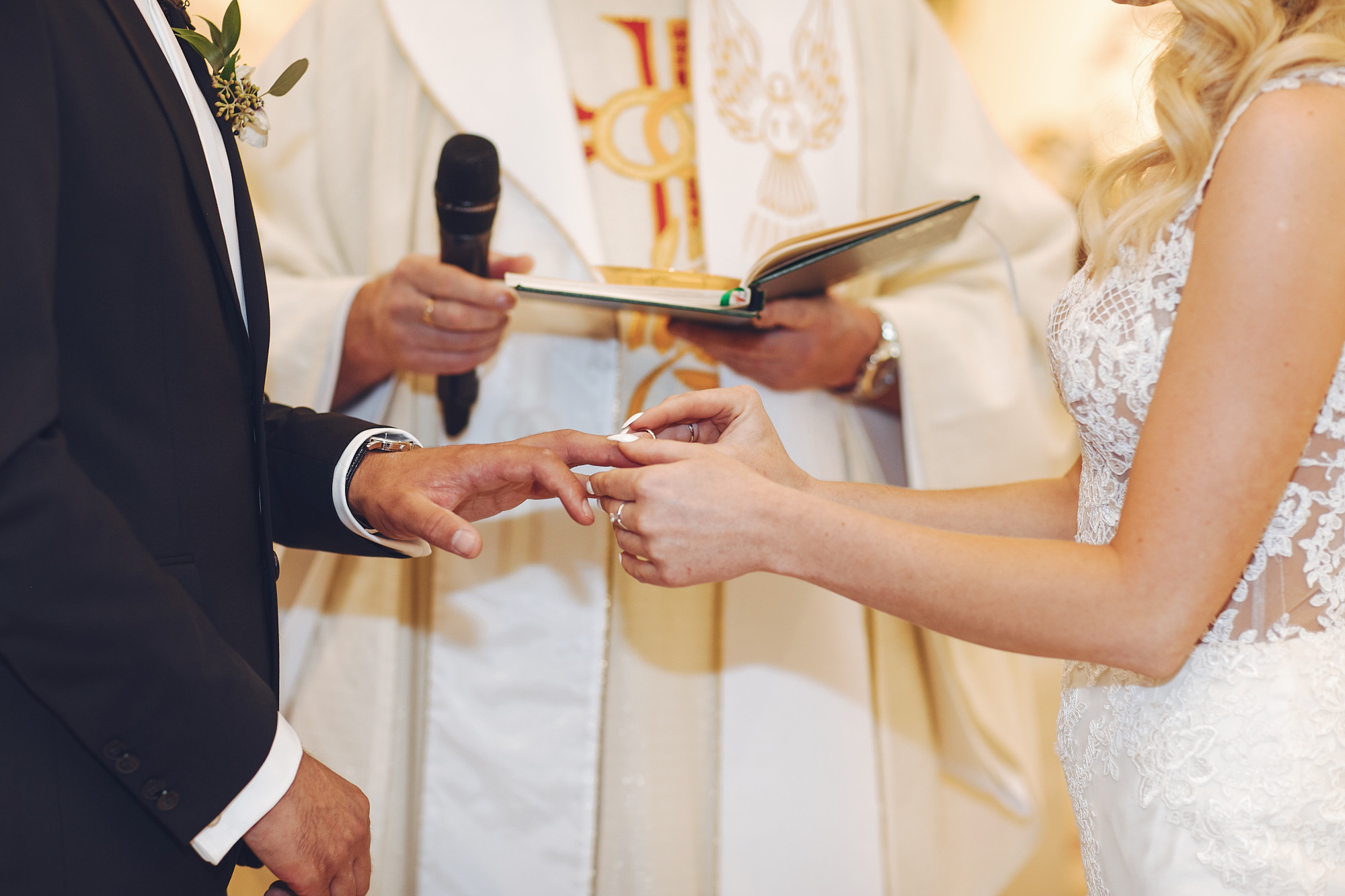
Then he smiled down at my nephew.
“Bruce, may we have the rings?”
And you know the rest. I told you at the beginning.
Bruce didn’t move.
Mom told me not to give them to him until you see this.
Silence.
Then Bruce opened the ring box.
He did it very carefully, very seriously, the way he did everything. He untied the little ribbons holding the gold bands to the velvet pillow and set the rings on the satin lid. Then he lifted the pillow itself out of the box.
Underneath it, folded small and flat to fit in the bottom of the box, was an envelope.
A tiny one. The kind you put on a birthday present. Pale blue. A little bent at the corners, a little soft, like it had been handled many times.
On the front, in handwriting I’d know anywhere, my sister’s loopy, slanting handwriting, it said:
Anna. Before the rings.
I couldn’t breathe.
“Mom gave me this,” Bruce said. His voice was shaking now. He was trying to be brave and it was coming apart. “Before. A long time ago. She put it in my treasure tin. She said it was a secret just for you. She said if you ever married Douglas, I had to show you before I gave him the rings.” He looked up at me. “I promised her. I pinky promised.”
I knelt down in my wedding dress on the cold stone floor of the altar.
“Did she tell you what it was?” I whispered.
Bruce shook his head.
“She said I wasn’t allowed to open it. Not ever. Only you.” His chin wobbled. “I didn’t open it. I didn’t, Aunt Anna. I wanted to. But I didn’t.”
“I know you didn’t, baby. I know.”
I reached for the envelope.
And above me, Douglas made a sound.
I looked up at him. He was staring at that little blue envelope in Bruce’s hand. And every bit of color had drained out of his face. I’ve never seen a face go so white. Even his lips were gray.
“Don’t,” he said.
I stayed there on my knees, my hand halfway to the envelope.
“Don’t what?”
He didn’t answer. He just stood there. Looking at the envelope like it was a gun.
My heart started pounding so hard I could feel it in my throat. In my ears. In the tips of my fingers.
I took the envelope from Bruce’s hand.
I opened it.
Inside was a photograph. A small one, a Polaroid, the white border yellowed with age. And a folded piece of lined paper, torn from a legal pad, covered on both sides in Judy’s handwriting.
I looked at the photograph first.
For several seconds, I couldn’t breathe. The church disappeared. The guests disappeared. The lilacs and the stained glass and the organ and my mother in the front pew all just went away, and the only thing left in the whole world was that little square picture.
It was my sister. Judy. Younger, maybe twenty-six, with her hair long the way she wore it before Bruce was born. She was sitting on the hood of an old red car in what looked like a parking lot by a lake. She was laughing. She was very, very pregnant.
And sitting next to her on the hood of that car, with his arm around her shoulders and his other hand resting on her big round belly, was a man.
Younger. Thinner. Shorter hair. A scruffy beard he didn’t have anymore.
But it was Douglas.
My Douglas. Grinning at the camera, with his hand on my sister’s pregnant stomach.
Underneath the photo, on the white border, in handwriting I’d seen on a thousand grocery lists and birthday cards and sticky notes left on my bathroom mirror, it said:
D + J. Baby coming in May. Lake Erie, 2015.
Douglas’s handwriting.
Bruce was born in May of 2015.
Douglas took a step toward me.
I stood up so fast I almost fell. I stumbled backward in my dress, away from him, toward the front pew.
“Don’t come any closer.”
He froze.
“Anna,” he said. “Please.”
“Don’t.”
I looked down at the picture in my hand. Then at the man standing at the altar in his gray suit with a white rose on his lapel. The man who’d made buttered noodles every night for a year. The man who’d searched Judy’s empty apartment with a flashlight for a stuffed elephant. The man who’d sat in the hallway reading Charlotte’s Web through a closed door.
The man who’d touched the scar on Bruce’s knee with one finger and said, That must have really hurt, buddy, with tears in his eyes.
My knees nearly gave out.
“Oh my God,” I whispered.
I looked at Bruce, standing beside me in his little suit with the empty ring box. I looked at his dark eyes. His long fingers. The serious little crease between his eyebrows when he concentrated.
I’d always thought he looked like Judy.
He didn’t. He’d never looked like Judy.
“How could you do this?” I said.
My hands were shaking so hard the photograph rattled. I unfolded the letter. I don’t know how I read it. I don’t know how the words held still long enough. But I did. Standing there at the altar of St. Andrew’s in my wedding dress, I read my dead sister’s last letter to me, while a hundred and twenty people watched.
Anna,
If you’re reading this, then I didn’t get to tell you myself. And that means something went wrong, or I lost my nerve, or he talked me out of it. I hope it’s the second one. I hope I’m still alive and I just chickened out and I’m sitting in the front row right now feeling like the worst sister in the world. But I don’t think that’s what happened. I think if this got to you, I’m gone.
I’m so sorry.
You always asked me who Bruce’s father was. And I always said it didn’t matter. I said he was a ghost. I said he was gone and we didn’t need him.
His name is Douglas Reed.
I met him when I was twenty-five, living in Toledo. You remember, the year I worked at the law firm there. He was an engineering student. He was funny and sweet and he read the last page of every book first. We were together for almost a year. I was happy, Anna. I want you to know that. I was really happy.
Then I got pregnant. He was over the moon. He bought baby books. He talked to my belly every night. He wrote that on the picture. He said we’d get married after the baby came.
Three weeks before Bruce was born, he was gone. No note. No phone call. His apartment was empty. His phone was disconnected. I called his school and they said he’d withdrawn. I never heard from him again.
Until I walked into your apartment in January and he came out of your kitchen holding a dish towel.
I’m sorry I lied at dinner. I didn’t know what to do. I’ve never been so scared in my life. I called him the next day. I got his number off your fridge. He said he didn’t know. He swore to me he didn’t know you were my sister when you met. He said it was a coincidence. A terrible one. He said he’d moved back to this area last year for the job, that he had no idea I’d moved here too, that when he met you at the library he had no idea.
I believe him. That’s the strange part. I believe that part.
But he begged me not to tell you. He said he loved you. He said he’d tell you himself, when the time was right, when he figured out how. He said if I told you, it would destroy everything, and you’d lose him, and Bruce would find out his father abandoned him, and it would hurt everyone.
I gave him two months. Then I gave him until your birthday.
He hasn’t told you.
Anna, you deserve to know. You deserve to decide for yourself. Not him. Not me. You. It’s your life and your heart and you get to choose with your eyes open.
And Bruce deserves to know too. Someday. When he’s ready. When you think he’s ready. That’s your call now, if you’re reading this. I trust you more than anyone.
I’m giving this to Bruce to keep in his treasure tin, with the picture. I’m telling him it’s a secret for you. I’m telling him if you ever marry Douglas, give it to you before the rings. I know that sounds crazy. But I know you, and I know you’d make Bruce your ring bearer, and I know he’d never break a pinky promise. He’s never broken one in his life. He gets that from me.
I’m also leaving a copy of this letter with Martin at the office, sealed, with some other papers. Just in case. You know me. Always write it down.
I hope I’m wrong about all of this. I hope I’m standing in the back of the church right now, watching you read this, and laughing, and you’re going to kill me later.
But if I’m not there, I want you to know two things.
I love you more than anybody except that kid.
And whatever you decide, I’m on your side. I’ve always been on your side. Even when there was masking tape down the middle of the carpet.
J.
When I looked up from the letter, the whole church was silent. Pastor Greer had his hand over his mouth. My mother was standing up in the front pew with both hands pressed against her heart. Tasha had grabbed the back of a pew to keep from falling.
And Douglas was crying.
Not the way a man cries when he’s been caught. Not angry. Not defensive. He was crying the way Bruce cried at two in the morning that first year. Completely broken open, with nothing held back, his shoulders shaking and his face wet.
“I was going to tell you,” he said. “I swear to God, Anna, I was going to tell you.”
“When?” My voice came out like broken glass. “When were you going to tell me, Douglas? After the vows? On our honeymoon? On Bruce’s eighteenth birthday?”
“I don’t know. I don’t know. Every day I woke up and said today’s the day, and every day I looked at you, and I looked at him, and I couldn’t.” He wiped his face with the heel of his hand. “Every day for sixteen months.”
“She called you.” I held up the letter. “That afternoon. The day she died. That was you on the phone.”
He closed his eyes. He nodded.
“She said she’d tell you on your birthday if I didn’t,” he said. “I told her she didn’t get to decide that. That it was mine to tell. That it would ruin everything.”
You don’t get to decide whether she deserves to know.
“And then twenty minutes later,” I said, very slowly, “she was dead.”
Douglas made a sound I’ll never forget. Like something tearing.
“Anna,” he whispered. “I know what you’re thinking. I swear on my life. I swear on that boy’s life. I didn’t…”
I didn’t let him finish.
I took Bruce’s hand. He was crying now too, silently, confused and terrified, holding the empty ring box against his chest. I bent down and picked up the two gold rings from the satin lid where he’d set them, and I put them in the little pocket on the front of his suit jacket.
“You keep these,” I told him. “You did exactly right. You kept your promise to your mom. You did everything exactly right. I’m so proud of you.”
Then I stood up. I held my nephew’s hand. And I walked back down the aisle of St. Andrew’s in my wedding dress, past a hundred and twenty silent people, past my mother reaching out for me, past the lilacs, through the big wooden doors and out into the May sunshine.
Nobody followed us. I don’t know if Douglas tried. I didn’t look back.
We sat in my car in the church parking lot for a long time. Bruce in the back seat, me in the front, still in my dress, the lace sleeves wet from wiping my eyes.
“Aunt Anna?” he said finally. “Did I ruin the wedding?”
I turned around in my seat.
“No, baby. No. You saved it. You saved me.” I reached back and held his hand. “Your mom was so smart. You know that? She was the smartest person I ever knew.”
“What was in the envelope?”
I looked at his face. At his eyes. At his long fingers wrapped around mine.
“Something your mom wanted me to know,” I said. “Something grown-up. I’m going to tell you about it someday. When you’re ready. I promise. Pinky promise.”
He held up his pinky. I hooked it with mine.
“Okay,” he said. “Can we go home and have noodles?”
I laughed and cried at the same time. “Yeah. We can go home and have noodles.”
I made them myself that night. I melted the butter first and then stirred in the noodles, the way Douglas taught me.
Bruce said they tasted different. But he ate them.
I didn’t sleep that night. Not even for a minute.
I sat at my kitchen table with Judy’s letter and the Polaroid and a legal pad of my own, and I did the only thing I could think of. The thing my sister would have done.
I wrote everything down.
Every date I could remember. When I met Douglas. When he met Judy. The dinner in January. The phone call. The crash.
And the question that wouldn’t stop circling in my head like a fly in a closed room.
Was it really an accident?
I hated myself for even writing it. I sat there looking at those words and thought about the man who’d driven back to Judy’s apartment at eleven at night to find a stuffed elephant. The man who’d read Charlotte’s Web through a closed door.
I thought about a man who’d vanished three weeks before his son was born and never looked back.
I didn’t know which one was real. I didn’t know if I’d ever known.
So on Monday morning, I did what Judy would have done. I went to the police department and asked for a copy of the accident report.
It took two days. The clerk was very kind. She’d heard about the wedding. Everybody in town had heard about the wedding by then. She slid the report across the counter in a manila envelope and patted my hand.
I sat in my car and read every page.
The driver of the gravel truck was a man named Raymond Tull, fifty-eight years old, who’d been working a double shift and fell asleep at the wheel. Three witnesses saw him run the light. A traffic camera caught it. He’d pleaded guilty to vehicular manslaughter eight months earlier, while I was too deep in grief to even follow the case. He’d written a letter to the court saying he thought about my sister every day and didn’t deserve to keep living.
Raymond Tull had never met Douglas Reed. Had never heard of him. Lived two counties away. There was nothing. No connection at all.
It was an accident. Just a terrible, ordinary, meaningless accident. A tired man and a red light.
I sat in my car in the police department parking lot and cried with relief so hard I scared a woman walking by with a stroller.
Because I’d needed it to be that. I hadn’t known how badly until right then. I’d needed the man I loved to be a coward and a liar and not a monster.
A coward and a liar. That was still bad enough.
That afternoon, Martin Feld called me.
Martin was the attorney Judy had worked for. Seventy years old, bow ties, reading glasses on a chain. He’d given me the letter about Bruce’s guardianship after the funeral. He’d cried when he handed it to me.
“Anna,” he said on the phone. “I heard about Saturday. I’m so sorry. I’ve got something I’m supposed to give you. Judy left very specific instructions. I was only supposed to deliver it if you married Douglas Reed, or if you found out on your own.” He paused. “I’d say you found out.”
I drove to his office downtown. He sat me down in a leather chair in his book-lined office and handed me a thick brown accordion folder, tied with a string.
Inside, on top, was a sealed copy of the letter from the ring box. Exactly the same. Word for word.
And underneath it, more.
A copy of Bruce’s original birth certificate. The father’s name was blank.
Printouts of emails Judy had sent to Douglas’s old university address in 2015, after he disappeared. Six of them. Please call me. Please. I just need to know you’re okay. The baby is here. He’s a boy. He’s perfect. His name is Bruce, after my grandfather. Douglas, he has your hands. All of them unanswered.
And a stack of something else.
Money order receipts.
Dozens of them. Photocopies, carefully filed in chronological order. Every single one for two hundred dollars. Every single one mailed to Judy’s address. The first one was dated July 2015, two months after Bruce was born. The last one was dated March of last year. The month before she died.
All of them sent from a post office box in Dayton, Ohio. All of them with no name. Just a short note written on the memo line.
For him.
On top of the stack, Judy had stuck a yellow sticky note in her handwriting.
He thinks I don’t know it’s him. I always knew. 81 money orders. $16,200. Never missed a month. Never wrote a word. I don’t know what that means, Anna. You decide.
I sat in Martin’s leather chair and stared at that sticky note for a long time.
Never missed a month.
Six and a half years. Every single month. Two hundred dollars. From a man who’d run away and never called and never wrote and never once came to see his son.
But never missed a month.
“Martin,” I said. “What do I do with this?”
Martin took off his reading glasses and folded them carefully.
“Judy asked me the same question,” he said. “About a year before she died. She sat right where you’re sitting. She said, ‘Martin, what do I do with a man who abandons his child and pays for it anyway?'”
“What did you tell her?”
“I told her I’d been practicing family law for forty-two years,” he said, “and I’ve learned that people are almost never just one thing. The worst ones and the best ones are usually the same person on different days.” He sighed. “Then I told her that doesn’t mean you have to forgive them. It just means you have to see them clearly before you decide.”
I went to see Douglas a week later.
He’d been staying in a motel by the highway since the wedding. I’d packed up his things in boxes and left them on the porch, and he’d come and gotten them while Bruce was at school, and he hadn’t called or texted once. I’d told him not to. He listened.
He opened the motel door looking like he hadn’t slept in a week. Unshaven. Wrinkled T-shirt. Eyes swollen.
“Anna,” he said.
“I’m not here to fix anything,” I said. “I’m here because I need to hear it. All of it. From you. No more lies, Douglas. Not one. Or I walk out of here and you never see either of us again.”
He nodded slowly. He stepped back and let me in.
We sat at the little round table by the window with the curtains open, because I wanted it that way. He talked for two hours. I didn’t interrupt him once.
He told me about Toledo. About meeting Judy at a coffee shop near the courthouse. About falling in love with her, and how she laughed at all his bad jokes, and how she made him read the middle of books instead of skipping to the end.
He told me about the pregnancy. How happy he’d been at first. How he’d bought the baby books and talked to her belly every night.
And then he told me about his father.
“He left when I was six,” Douglas said, staring at the table. “Came back when I was nine. Left again. Came back. He drank. When he was home, he’d scream at my mom until she cried. He’d scream at me. He broke my arm once, when I was eleven, because I spilled milk on his work boots.” Douglas touched his left forearm absently, like he still felt it. “Everybody always said I looked just like him. My grandmother used to say it. ‘Oh, you’re the spitting image of your father.’ Like it was a compliment.”
He swallowed.
“Three weeks before Bruce was born, I was putting together the crib,” he said. “In Judy’s apartment. I couldn’t get one of the pieces to fit. I was getting frustrated. And I yelled. Just once. At the crib. I threw a screwdriver against the wall.” He looked up at me, and his eyes were wet. “And Judy came running in from the bedroom, scared, with her hands on her belly. And I saw her face. And I heard my father’s voice coming out of my mouth.”
The room was very quiet.
“I thought, I’m him,” Douglas whispered. “I’m going to be him. I’m going to do to this baby what he did to me. I’m going to break that kid’s arm someday over spilled milk. And I couldn’t. I couldn’t let that happen. So I left. That night. While she was asleep. I told myself I was protecting them. I told myself the best thing I could ever do for my son was make sure he never had to know me.”
“That’s the most selfish thing I’ve ever heard,” I said quietly.
“I know.” He didn’t argue. “I know that now. I knew it about two weeks after I left. But by then I was so ashamed, I couldn’t go back. Every day that passed made it harder. So I sent money. It was all I could think to do. I told myself it was something. It wasn’t enough. It was never enough.”
“Eighty-one money orders,” I said.
He looked up, startled. “You know about those?”
“Judy kept every receipt. She knew it was you. She always knew.”
He put his face in his hands.
“And then you met me,” I said.
“At the library.” He laughed, a terrible broken laugh. “I swear to God, Anna. I didn’t know. You had a different last name from her. You never talked about a sister named Judy until we’d been together for months, and even then it was ‘my sister.’ I didn’t know until she walked through your door and looked at me.” He shook his head. “I almost threw up in your bathroom. Twice.”
“I remember.”
“And then I saw him. Bruce. He showed me his scar. He showed me the gap in his teeth. He had my hands.” Douglas’s voice cracked. “My son was standing in front of me showing me his scraped knee, and he didn’t know who I was, and I couldn’t tell him. I’d given up the right.”
“So you just stayed. With me. And pretended.”
“I stayed because I loved you,” he said. “That part was never a lie. Not for one second. And I stayed because after Judy died, he needed somebody. You both did. And I thought, if I can just be good to him. If I can be there every day. If I can make the noodles and read the books and find the elephant. Maybe it would count for something. Maybe I could pay back some of what I owed.”
“You can’t pay back a father, Douglas. You can’t pay back a mother either. She’s gone. She died thinking you’d let me marry you without ever telling me.”
He didn’t say anything to that. There was nothing to say.
“Did you ever think about telling him?” I asked. “Bruce?”
Douglas got up without a word. He went to the closet and came back with a cardboard shoebox. He set it on the table between us and took off the lid.
Inside were letters. Envelopes, all sealed. Maybe a dozen of them. On the front of each one, in his neat engineer’s handwriting, just a name and a date.
Bruce. May 2016. Bruce. May 2017. Bruce. May 2018.
All the way up to this past May.
“One every birthday,” he said. “I never sent them. I didn’t have the right. I just wrote them, and sealed them, and put them in the box.” He pushed it across the table toward me. “They’re his. Whenever you decide he’s ready. If you ever do. Or burn them. That’s your call. Judy was right. It was never my call.”
I looked at that box for a long time.
Then I put the lid back on it and tucked it under my arm.
“I don’t know what I’m going to do,” I said. “About us. About any of it. I need you to understand that. I don’t know if I’ll ever be able to look at you again without seeing that Polaroid.”
“I understand.”
“And Bruce comes first. Not you. Not me. Bruce. Every decision from here on out.”
“Yes.”
I stood up. At the door, I turned around.
“She had a sticky note,” I said. “On the money orders. She wrote, ‘I don’t know what that means, Anna. You decide.'”
Douglas looked at me.
“I don’t know what it means either,” I said. “But I’m going to find out.”
We found a family counselor named Dr. Ellen Marsh. She’d worked with hundreds of kids. She specialized in grief, and in what she called “complicated family truths.”
“Kids can handle almost anything,” she told me in our first meeting, “if you tell them the truth in a way they can hold. What they can’t handle is a secret that everyone’s walking on eggshells around. They feel it. They always feel it. And they almost always decide it’s their fault.”
I thought about Bruce at two in the morning that first year. Is it my fault? She was coming to get me.
We worked with Dr. Marsh for three months before we told him. Me alone first. Then me and Douglas together, which was the hardest hour of my life. Then the three of us.
We told him on a Saturday in September, in Dr. Marsh’s office, which had beanbag chairs and a fish tank and a box of tissues on every surface.
Douglas told him. Not me. Dr. Marsh and I agreed it had to be Douglas.
He sat on the floor so he’d be at Bruce’s height, and he said it slowly and simply, the way she’d helped him practice.
“Bruce. A long time ago, before you were born, I knew your mom. We loved each other. And when you were growing in her tummy, I was really scared. I was scared I’d be a bad dad, like my dad was to me. So I made a really bad choice. I left. I went away before you were born. I never came back. That was wrong. That was the most wrong thing I’ve ever done in my whole life.” He took a breath. “I’m your dad, buddy. Your real dad. And I’m so, so sorry.”
Bruce didn’t say anything for a long time. He sat in his beanbag chair hugging Peanut and staring at Douglas.
Then he asked, very quietly, “Is that what was in the envelope?”
“Yes,” I said.
Bruce looked at me. Then at Douglas. Then at the fish tank.
“Did Mom know you’d come back?”
“She found out,” Douglas said. “Right before the accident.”
“Is that why she was mad on the phone?”
I froze. I’d never told Bruce about the phone call. I didn’t know he knew.
“I heard her,” Bruce said, looking at his elephant. “In the morning. Before school. She was crying on the phone in the bathroom. She said, ‘He deserves to know who his father is.’ I thought she meant somebody else. I thought it was about a TV show.”
Douglas made a small sound. He put his hand over his mouth.
“She was mad at me,” he said through his fingers. “Not you. Never you. She was mad because I wasn’t brave enough to tell you myself. She was right to be mad.”
Bruce was quiet for a long time again.
Then he got up out of the beanbag chair. He walked across the room. And he hit Douglas.
Not hard. He was eight years old. He hit him in the shoulder with his small fist, once, and then again, and then again, and then he was crying and hitting him and saying “Why did you leave, why did you leave, why did you leave,” over and over. And Douglas just sat there and let him. He didn’t flinch. He didn’t stop him. He just sat there with tears running down his face and said, “I don’t know, buddy. I don’t know. I’m sorry. I’m so sorry.”
Until finally Bruce stopped hitting and just collapsed against him, sobbing, with his face in Douglas’s shirt.
And Douglas put his arms around his son for the first time knowing that his son knew. And held on.
Dr. Marsh passed me a box of tissues without saying a word.
I’d like to tell you everything was fine after that. It wasn’t.
Bruce was angry for a long time. He refused to let Douglas come to the house for a month. Then he’d only see him at Dr. Marsh’s office. Then at the park, on Saturdays, for an hour. He tested him. He’d cancel at the last minute to see if Douglas would get mad. Douglas never did. He’d just say, “Okay, buddy. Next Saturday, then,” and show up next Saturday.
He showed up every Saturday. Every single one. For seven months. Rain, snow, a week when he had the flu and a fever of a hundred and two and sat on a park bench in a winter coat, shivering, while Bruce played on the jungle gym.
Never missed a week.
I gave Bruce the shoebox of letters on his ninth birthday. He opened them one at a time, over several weeks, by himself, in his room. He never told me what they said. I never asked. But one night I passed his door and saw him sitting on his bed reading one, holding Peanut, mouthing the words to himself. And I saw him put it back in the envelope very carefully, and put the envelope in his treasure tin with the race car on the lid.
And me? I don’t know how to explain what happened with me.
It took a long time. Much longer than it took Bruce, honestly. Kids forgive faster than grown-ups. They have to. They don’t have any other choice.
I went to see Dr. Marsh by myself every two weeks for a year. I talked about Judy. I talked about the Polaroid. I talked about the masking tape on our bedroom carpet. I talked about how angry I was. At Douglas, for lying. At Judy, for not telling me sooner. At myself, for not seeing it. At a tired man in a gravel truck for taking my sister away before she could finish what she started.
“Do you still love him?” Dr. Marsh asked me once.
I thought about it for a long time.
“I love the man who searched for the elephant,” I said. “I don’t know if I can love the man who ran away from the crib.”
“What if they’re the same man?” she asked. “On different days?”
It sounded so much like Martin Feld that I laughed out loud.
Douglas didn’t push. That was the thing. He never once pushed. He never called me unless it was about Bruce. He never asked to come over. He never said please give me another chance. He showed up every Saturday at the park, and on Bruce’s school play night, and at the parent-teacher conference, and he sat in the back, and he kept his hands folded in his lap, and he waited.
He also did something else. Something I didn’t find out about until months later.
He went to Raymond Tull.
The gravel truck driver. In the state prison, three hours north. Douglas drove up there and asked to visit him. Raymond Tull agreed.
I only know because Raymond Tull wrote me a letter afterward.
Ms. Bennett, a man named Douglas came to see me. He said he was the father of your sister’s boy. He said he wasn’t there to blame me. He said he’d done his own share of running away and he knew what it was like to wake up every day carrying something you can’t put down. He said if the boy ever asks about me someday, he wants to be able to tell him that I’m sorry, because he heard it from me himself. I am sorry. I think about your sister every day. I would give anything. That’s all I wanted to say. R. Tull.
I read that letter at my kitchen table and then I sat there a long time with the window open and the curtains moving.
Then I picked up my phone and called Douglas for the first time in eleven months about something that wasn’t Bruce.
“Come over for dinner Sunday,” I said. “Bruce wants you to make the noodles. He says mine taste different.”
There was a long silence on the line.
“Okay,” Douglas said. His voice was thick. “Okay. Sunday.”
We got married two years after the first wedding.
Not at St. Andrew’s. In my backyard. Under the lilac bush Judy and I planted together when I bought the house, the spring before she died. Twenty people. Tasha. My mother. Martin Feld in a bow tie. Dr. Marsh, who cried more than anybody. Pastor Greer, who said that in thirty years of marrying people, he’d never been so glad to be asked to try again.
Bruce was ten.
He stood beside us in a new suit, a little too big, because he was growing so fast none of his clothes fit for more than a month. He held the white satin ring box against his chest with both hands.
The same box. He’d asked for it specifically.
When Pastor Greer said, “Bruce, may we have the rings?” everyone in that backyard went very quiet. I saw my mother grip Tasha’s hand. I saw Martin take off his glasses.
Bruce looked at Douglas. Then at me.
Then he grinned.
He opened the box. He lifted the little white velvet pillow out of it with the two gold bands tied to the top. And he turned it over, very dramatically, and showed it to everyone.
There was nothing underneath. Just white satin.
“All clear,” he announced.
Everybody laughed. It broke something open. People were laughing and crying at the same time. Douglas laughed so hard he had to wipe his eyes. I laughed until I couldn’t breathe.
Bruce untied the rings and handed them over. One to me. One to Douglas. And as he handed Douglas his, he said something very quietly that I don’t think anyone else heard.
“Mom said you’d get them after Aunt Anna saw. She saw. So you can have them now, Dad.”
He’d never called him that before.
Douglas went completely still. Then he knelt down in the grass in his good suit and put his arms around his son and held on, while twenty people waited and the lilacs moved in the wind and nobody said a word.
That night, after everyone went home, I went to check on Bruce.
He was asleep in his room with the door half open and the hall light on, the way he still likes it. Peanut was tucked under his chin, gray and worn nearly through in places. His new suit was in a heap on the floor where he’d stepped out of it.
On his nightstand sat the race car tin, with the lid off. Inside I could see the shark tooth and the blue marble and the bottle cap with the star. A stack of envelopes, softened from being read. And on top of everything, the little faded Polaroid of my sister sitting on the hood of a red car by a lake, laughing, very pregnant, with a young man’s hand on her belly.
Beside the tin, he’d set the white satin ring box. Open. Empty.
I stood in the doorway for a long time.
From down the hall, I could hear Douglas in the kitchen, washing the last of the dishes. He was humming. The window over the sink was open, and the night air was coming in, cool and sweet, smelling like lilac and cut grass and the faint warm smell of butter, still hanging in the house from the noodles he’d made for dinner, the way Bruce likes them.
Butter first. Then the noodles.

Lila Hart is a dedicated Digital Archivist and Research Specialist with a keen eye for preserving and curating meaningful content. At TheArchivists, she specializes in organizing and managing digital archives, ensuring that valuable stories and historical moments are accessible for generations to come.
Lila earned her degree in History and Archival Studies from the University of Edinburgh, where she cultivated her passion for documenting the past and preserving cultural heritage. Her expertise lies in combining traditional archival techniques with modern digital tools, allowing her to create comprehensive and engaging collections that resonate with audiences worldwide.
At TheArchivists, Lila is known for her meticulous attention to detail and her ability to uncover hidden gems within extensive archives. Her work is praised for its depth, authenticity, and contribution to the preservation of knowledge in the digital age.
Driven by a commitment to preserving stories that matter, Lila is passionate about exploring the intersection of history and technology. Her goal is to ensure that every piece of content she handles reflects the richness of human experiences and remains a source of inspiration for years to come.