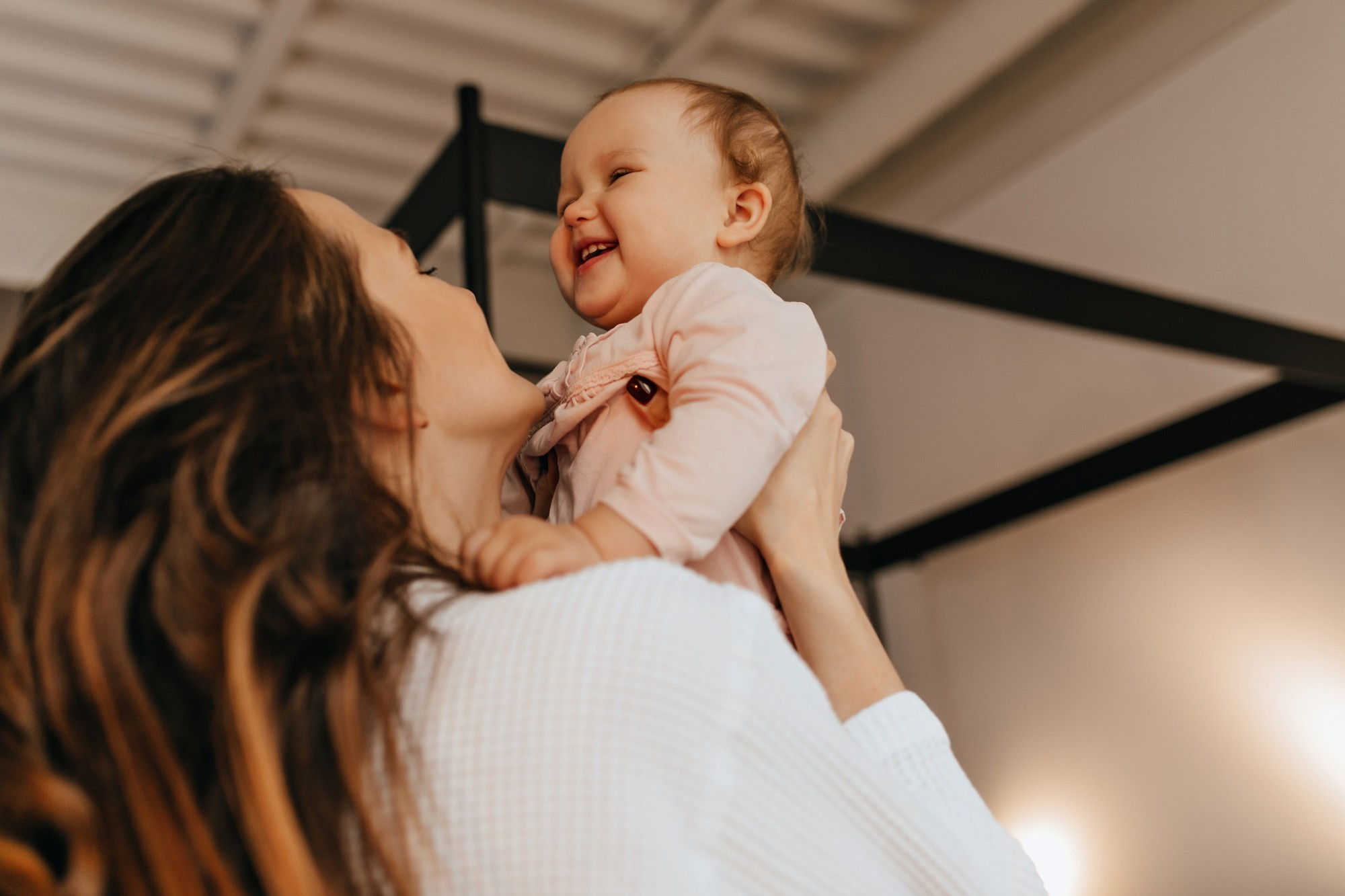
I sat down on the couch across from him. I moved a burp cloth out of the way.
I didn’t say anything. I waited.
Glen took a long, shaky breath.
“When she couldn’t breathe,” he said, “that night. When her face turned purple. You moved. You just—moved. You flipped her over and hit her back and you knew exactly what to do. And I stood there against the wall. I couldn’t move. I couldn’t do anything. My whole body froze.”
He looked at me with tears running down his face.
“I thought she was going to die,” he said. “Right there in our bed. And I couldn’t do anything to stop it. I just stood there and watched.”
“Glen—”
“And after that, every time I held her, all I could think was, What if it happens again? What if it happens when you’re not there? What if I freeze again and she dies because of me?” He was shaking. “So I stopped holding her. I stopped feeding her. I told myself you were better at it. And then I started believing it. And then I started saying it out loud. You’re better at it. That’s your department. Because if it was your department, then it wasn’t my fault if something went wrong.”
He looked down at Ava.
“And then you’d ask me to watch her, and I’d panic. Every time. My heart would start pounding. I’d feel sick. So I’d come up with an excuse. I’m tired. I work. Five minutes is enough.” He wiped his face with his free hand. “And then the excuses got easier. And easier. And I started actually believing that you didn’t need help. That you were fine. Because if you were fine, then I didn’t have to be scared.”
The house was very quiet. I could hear Ava’s little breaths. The clock ticking in the kitchen. Ellen’s footsteps on the porch, creaking the boards as she paced.
“And today?” I said quietly. “The keys?”
Glen closed his eyes.
“When you said you were going to coffee,” he said, “for two hours. On my day off. And it would just be me and her. Alone. For two hours.” He swallowed. “I panicked. Worse than ever. I kept thinking, What if she chokes? What if she won’t stop crying? What if something happens and Hannah isn’t here? And I didn’t want to tell you I was scared. I didn’t want you to know what a coward I am. So I took your keys.”
He opened his eyes and looked at me.
“And then I said the worst thing I could think of. So you’d be too angry to ask me why.”
I sat there for a long time.
Part of me wanted to cry with him. Part of me wanted to put my arms around him and tell him it was okay. That I understood. That I’d been scared too, that night. That I still woke up sometimes at three in the morning with my heart pounding, checking to make sure she was breathing.
But another part of me, a bigger part, was still holding my keys.
I could feel them in my pocket. The silver ring. The pink lanyard. The rubber duck. Pressing against my leg.
“Glen,” I said. “I believe you. I believe you were scared. I believe it was real.”
He nodded, tears running down his face.
“But you didn’t just stay away because you were scared,” I said. “You took my keys. You locked me in this house. You told me moms don’t get free time. You made me feel like I was crazy for wanting a bath.”
His face crumpled.
“Being scared isn’t an excuse for that,” I said. My voice was shaking, but I kept going. “Lots of people are scared. I’m scared. I’m scared every single day. Every time she coughs. Every time she spits up. Every time she sleeps too long and I have to go check if she’s breathing. I’m scared of doing it wrong. I’m scared of being a bad mother. I’m scared all the time, Glen. But I didn’t get to stop. I didn’t get to stand against a wall and hand her to someone else. I didn’t get to say that’s your department.”
“I know.”
“You made me do it alone. For three months. While I was terrified too.”
“I know,” he whispered. “I know. I’m so sorry, Hannah. I’m so sorry.”
“And when I needed two hours, you took my keys. That’s not fear, Glen. That’s control. Whatever it started as, that’s what it turned into.”
He didn’t argue. He just nodded, his face wet.
“I know,” he said. “Mom said the same thing. On the porch. When you left.”
The front door creaked open behind me. Ellen came in. She sat down in the armchair by the window. She looked tired. Older than I’d ever seen her.
“Can I say something?” she asked.
We both looked at her.
“When Glen was born,” Ellen said, “I wasn’t okay.”
Glen looked up.
“I’ve never told you this,” she said to him. “Your father and I never talked about it. But after you were born, I had something they didn’t have a good name for back then. Now they call it postpartum depression. Back then, they just called it baby blues and told you to get over it.”
She looked down at her hands.
“I didn’t sleep. I didn’t eat. I cried all the time. I’d look at you in your crib and feel nothing. Nothing at all. Like you were somebody else’s baby. And I was so ashamed. I thought I was a monster.”
The room was very quiet.
“Your father noticed,” she said. “One night, about six weeks in. He found me sitting on the bathroom floor at three in the morning. I’d been there for two hours. I couldn’t make myself get up and feed you.” Her voice cracked. “And you know what he did? He didn’t yell. He didn’t tell me to get over it. He didn’t tell me moms don’t get free time.”
She looked at Glen.
“He picked me up off the floor. He put me in bed. He went and got you and fed you himself with a bottle. And the next morning, he called my doctor. And then he took over. The nights. The feedings. All of it. Until I got better. It took almost a year.”
She wiped her eyes.
“I went back to work in the ER partly because I needed to,” she said. “Because being home all day with you was crushing me. And your father understood that. He never once made me feel guilty for it. He said, You take care of strangers all night. Let me take care of the people we love.”
Glen was crying again. Quietly.
“I’ve watched you for three months,” Ellen said to him. “I’ve watched your wife get thinner and paler and quieter. I’ve watched her stop laughing. I’ve watched her stop fixing her hair. I’ve watched her do every single thing alone while you sat on that couch.” Her voice went hard. “And I saw myself in her, Glen. I saw myself on that bathroom floor at three in the morning.”
She turned to me.
“I should have said something sooner, sweetheart,” she said. “I’m sorry I didn’t. I kept telling myself it wasn’t my place. That he’d figure it out.” She shook her head. “But today, when you called me and told me he took your keys, I realized that if somebody doesn’t stop this now, you’re going to end up on that bathroom floor. And nobody’s going to pick you up.”
I put my hand over my mouth.
I hadn’t told anyone. Not Jess. Not Monique. Not my own mother.
But there had been nights. A few. When I’d sat on the edge of the tub at three in the morning, next to that unopened bottle of lavender oil, with Ava finally asleep, and I’d felt so empty and so tired that I didn’t know if I could make myself stand up.
Ellen saw it on my face. She got up from the armchair and came and sat beside me on the couch. She put her arm around me.
“It’s okay,” she whispered. “You don’t have to say it. I know.”
I leaned against her and cried.
Glen sat across from us in the glider chair with Ava asleep on his chest. He was looking at me. At his mother’s arm around me. At my face.
He looked like a man seeing something for the first time.
“I didn’t know,” he said. “Hannah. I didn’t know it was that bad.”
“You didn’t look,” I said.
He flinched. But he nodded.
“You’re right,” he said. “I didn’t look. Because if I looked, I’d have to do something.” He took a deep breath. “I’m looking now.”
He looked down at Ava. Her fist was still wrapped around his collar.
“Today was the hardest day of my life,” he said. “Worse than Dad’s funeral. She cried for two hours straight. I couldn’t make her stop. I tried everything. I fed her and she threw up on me. I changed her and she peed on me. I bounced her. I sang. I walked her up and down the hallway like Dad used to do with me.” His voice wavered. “I sang Johnny Cash. I didn’t even know I remembered the words. I walk the line. Dad used to sing it. I guess I remembered from when I was a baby.”
He laughed a little through his tears.
“And then, around seven o’clock, she just stopped crying. She looked up at me. Right at me. And she grabbed my shirt. And she fell asleep.”
He stroked her back gently.
“And I sat here for an hour,” he said. “I couldn’t move. I didn’t want to move. She’s so small, Hannah. She’s so small, and she trusted me. Even after I spent three months running away from her.”
He looked up at me.
“You do this every day,” he said. “All day. Every day. Alone. And then you get up and do it all night too.” He shook his head slowly. “I don’t know how you do it. I don’t know how you’re still standing.”
“Some days I’m not,” I said quietly.
“I know that now.” He swallowed. “And I’m going to fix it. I don’t know how yet. But I’m going to fix it.”
I looked at him for a long time.
“I want to believe you,” I said. “I really do. But I’ve heard we’ll talk about it later a hundred times. I need more than words, Glen.”
“I know.”
“And I need you to know something.” I took a breath. “If you ever take my keys again, if you ever try to keep me in this house again, I’m leaving. With Ava. I’ll go to your mother’s.”
“And I’ll have the guest room ready,” Ellen said.
Glen looked at his mother. Then at me. He nodded slowly.
“That’s fair,” he said. “That’s more than fair.”

Laura Bennett writes about complicated family dynamics, difficult conversations, and the quiet moments that change everything. Her stories focus on real-life tensions — inheritance disputes, strained marriages, loyalty tests — and the strength people find when they finally speak up. She believes the smallest decisions often carry the biggest consequences.