Jonah looked at me. I nodded.
“It’s a camera, ma’am,” he said. “From Claire’s dressing room. For the documentary. It recorded everything.”
Eleanor held out her hand.
“Not now,” Maestro Cole said gently. “Eleanor. Please. Claire goes on in twelve minutes. She needs an instrument.”
Eleanor looked at him. Then at me.
Then she did something I’ll never forget.
She took my hand. Her fingers were cool and thin and a little crooked at the joints. Old violinist’s hands. Hands that had played for thousands of hours, a long time ago.
“Can you play the Sibelius?” she asked.
“Yes,” I said.
“On an instrument you’ve never touched? With twelve minutes to warm up? After what just happened?”
“Yes.”
She held my gaze for a long moment. Her eyes were gray and sharp.
“Your grandfather taught you,” she said. It wasn’t a question.
“How did you know?”
“Adrian told me about you when he chose you for the solo. A girl who learned from her grandfather on Saturdays and played his Milanese violin.” She almost smiled. “My father taught me the same way. On Saturdays. In Vienna. A long, long time ago.”
There was a knock on the door. A heavy-set man in a gray suit came in holding a dark wooden case. Marcus, the orchestra’s instrument manager. He looked nervous.
“Mrs. Whitmore? The Gagliano.”
Eleanor took the case from him. She opened it herself.
Inside was a violin the color of dark honey. The wood glowed like it was lit from inside. It was the most beautiful instrument I’d ever seen.
She lifted it out and held it for a moment. Then she held it out to me.
“Play it like you mean it,” she said. “I’ll be in the front row.”
She turned to Jonah.
“Bring me that camera,” she said. “I’ll watch it during the second half. In private.”
And she swept out of the room.
I had eleven minutes.
I didn’t have time to change into a dress. I didn’t have a dress. My sister was wearing it.
Priya, the cellist, ran to her locker and brought me her spare concert blacks. Black pants. A black silk blouse. They were a little long in the legs. I rolled them up at the ankle. Somebody found me black flats. A stagehand named Dolores pinned my hair up with bobby pins from her own head.
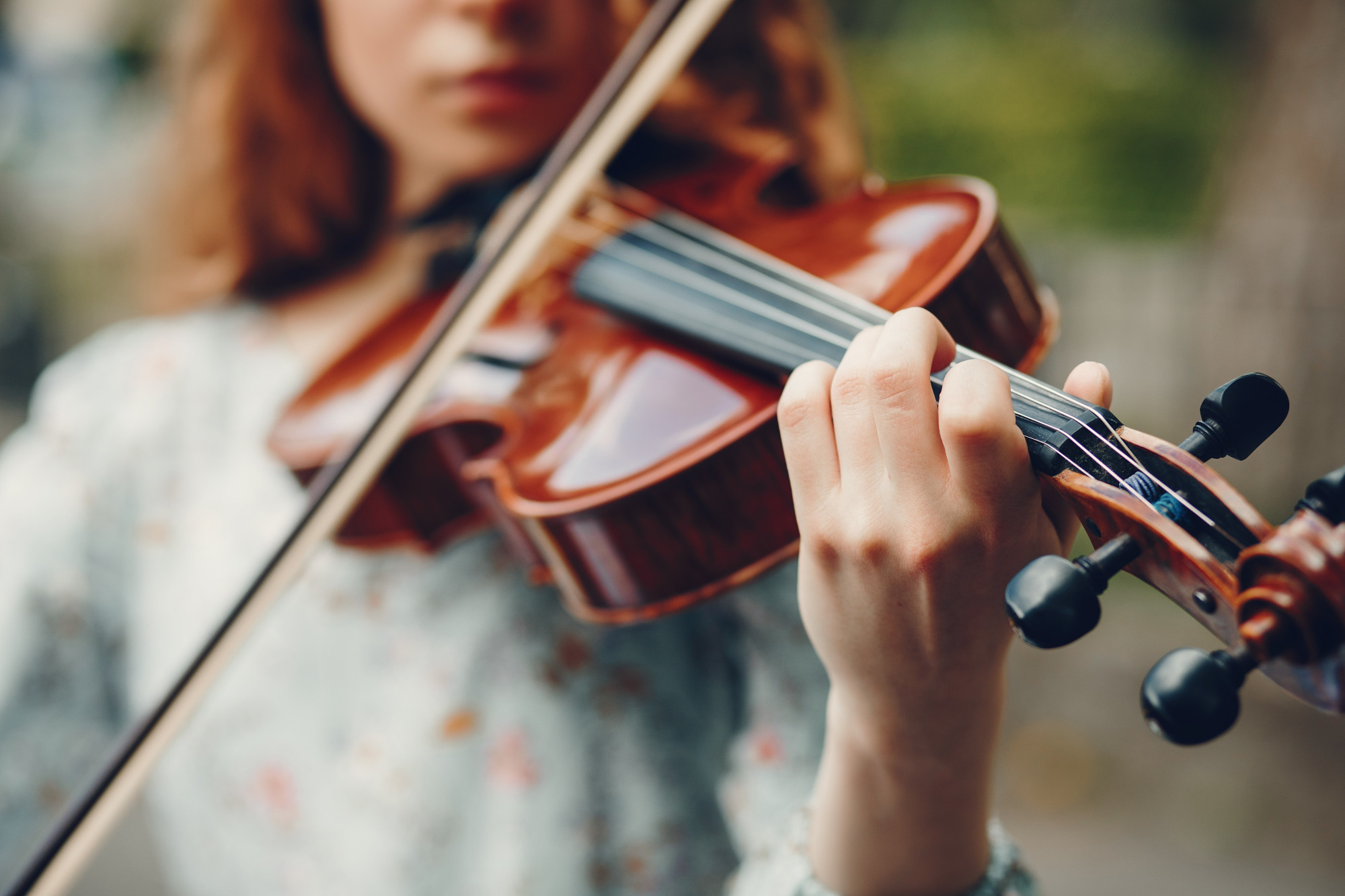
Then I stood in a practice room with the Gagliano and tuned it.
It was different from Grandpa’s violin. Brighter. Louder. Grandpa’s violin had a warm, dark sound, like a voice from another room. This one sang right in your face. It wanted to be heard.
I played a scale. Then another. Then the opening of the third movement.
My hands were shaking.
I stopped. I closed my eyes.
I thought about a church basement. A nine-year-old girl frozen on a stage after her bow slipped. A boy laughing. And from the back row, slow, steady clapping.
Keep going, Clairebear. Real musicians finish the piece. Even after the goose.
I opened my eyes. My hands had stopped shaking.
At eight-fifteen, the stage manager came to get me.
I stood in the wings and looked out at the hall. Two thousand seats. Gold balconies. The painted ceiling with its clouds and angels. Every seat was full.
In the front row, center, sat Eleanor Whitmore in her silver gown. Next to her was Ethan, in a tuxedo, looking around in confusion.
And on Ethan’s other side, in my emerald-green dress, sat my sister.
She was smiling. Chatting with the woman next to her. Touching Ethan’s arm. She looked radiant. Like she belonged there.
She hadn’t seen me yet.
Mom and Dad were in the fourth row. Dad had arrived late from a work dinner. He didn’t know anything yet. Mom was staring at the stage with her hands clasped tightly in her lap.
Maestro Cole walked out first. The audience applauded. He stepped up to the podium. He turned and looked at me in the wings.
He nodded once.
I walked out onto the stage.
I heard it before I saw it. A tiny gasp. From the front row. From Vanessa.
I didn’t look at her.
I walked to the soloist’s spot beside the podium. I bowed. The applause washed over me. I raised the Gagliano to my chin.
Maestro Cole lifted his baton.
And the orchestra began.
The third movement of the Sibelius starts with timpani and low strings. A pounding rhythm, like horses galloping across frozen ground. A British critic once called it “a polonaise for polar bears.” Grandpa loved that. He used to stomp around the living room when it came on, pretending to be a polar bear.
Then the violin comes in. Fierce and wild and dancing. Racing over the top of the orchestra like a skater on thin ice.
I came in.
And for the next seven minutes, I wasn’t in that hall anymore.
I was in Grandpa’s living room. Eight years old. His hand over mine, tilting my wrist.
The sound comes from your shoulder, not your hand.
I was in the church basement. The goose. The clapping.
I was in the hospice. His thin fingers wrapping mine around the neck of his violin.
Play the Sibelius on it someday. On a real stage. In front of people who matter.
I couldn’t play it on his violin. My sister had made sure of that.
But I could play it for him.
So I did.
I played every note like it was the last thing I’d ever get to say to him. The fast runs. The double stops. The high, screaming notes at the top of the fingerboard, where your hand has to be perfect or everything falls apart. I played it like the wind across a frozen lake. Like horses. Like polar bears. Like a girl who’d spent a thousand boring Saturdays that nobody saw.
I didn’t rush.
For the first time in my life, I didn’t rush.
When the last note ended, the hall was completely silent.
One second. Two seconds. Three.
I stood there with the bow raised in the air and my chest heaving. Sweat running down my back under Priya’s black blouse. I thought maybe I’d done something wrong. Maybe I’d played so badly that nobody knew what to do.
Then, from the front row, someone stood up.
Slow. Steady. Clapping.
It was Eleanor Whitmore.
And then the whole hall exploded.
Two thousand people on their feet. Shouting. Cheering. Stomping. Somebody in the balcony yelled “Brava!” over and over. The orchestra musicians were tapping their bows on their music stands, which is what musicians do when they want to applaud another musician. The cellists were standing. Priya was crying.
Maestro Cole stepped down from the podium and took my hand. He raised it in the air. Then he leaned close to my ear so only I could hear.
“Your grandfather would have been very proud,” he said. “You didn’t rush once.”
I started crying right there on the stage.
I bowed three times. Four. They wouldn’t stop clapping. On the fifth bow, I finally looked down at the front row.
Eleanor was still standing. Still clapping. Tears running down her face.
Ethan was clapping too, confused, looking back and forth between his mother and me.
And Vanessa was sitting perfectly still in her seat, in my emerald-green dress.
She was the only person in the entire hall who wasn’t clapping.
Her face was white as paper.
Because during the second half, while I’d been warming up with the Gagliano, Eleanor Whitmore had gone to a private room with Jonah Reyes and his little black camera.
And she’d watched everything.
I didn’t know any of that yet. Not when I walked off the stage. Not when musicians swarmed me in the wings, hugging me, shouting, laughing. Not when a man in a gray suit pushed through the crowd and handed me his card. Dr. Robert Haines. Chair, String Department. Curtis Institute of Music.
“Call me Monday,” he said. “We need to talk about next fall.”
I didn’t know any of it until I went back to my dressing room to put the Gagliano away, and found the door open.
And my sister sitting on the floor in the middle of the room, in my emerald dress, surrounded by the empty spot where my violin case had been.
Her makeup was running down her face in black streaks.
She looked up at me. Her whole body was shaking.
“Claire,” she sobbed. “Claire, please. You have to help me.”

Adrian Hawthorne is a celebrated author and dedicated archivist who finds inspiration in the hidden stories of the past. Educated at Oxford, he now works at the National Archives, where preserving history fuels his evocative writing. Balancing archival precision with creative storytelling, Adrian founded the Hawthorne Institute of Literary Arts to mentor emerging writers and honor the timeless art of narrative.