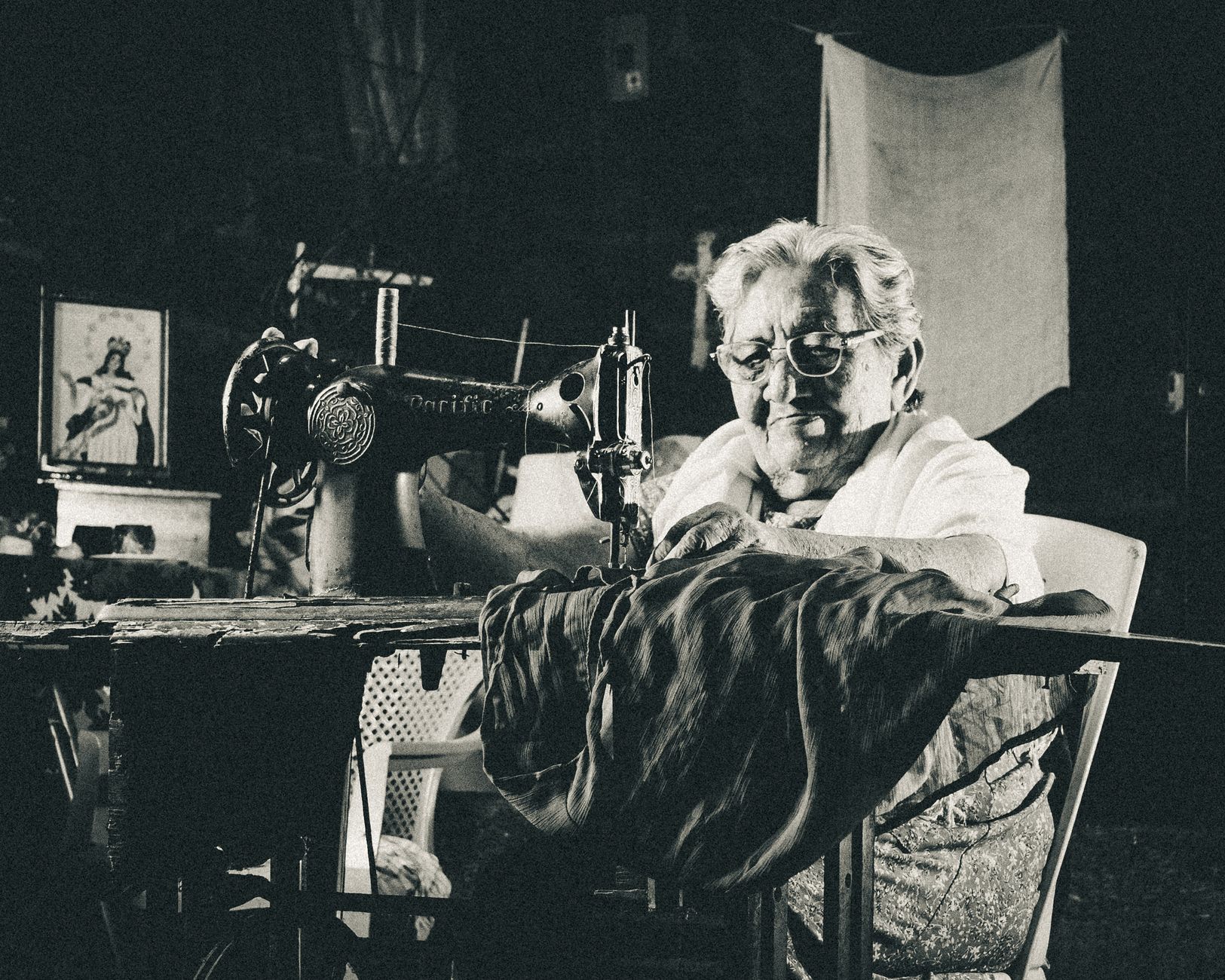
“Finley Road,” he said. “Fry. Third box past the low-water bridge. There’s a wren house on the post.”
“You know them?”
“I know the box. Young couple.” He rubbed the back of his neck. “Denise, we could just buy it back off her. Give her sixty for it. She’d be twenty ahead.”
“I thought about that.”
“Or go to Walmart and get her a brand new one and trade.”
“A hundred and forty dollar plastic machine with a nylon gear in it,” I said. “Let’s see who she is first.”
He nodded. Then he went and stood in the door of the spare room, where I’d laid the box on the bed, and looked at that blue cloth a while without a word, which is how Bill does his grieving.
We drove out Sunday after church. Bill at the wheel, me with the box on my lap, Hannah in the back seat holding Mama’s sewing basket with both hands.
It was a small white rent house with a propane tank in the side yard and a plastic tricycle turned over in the grass. A wren house on the mailbox post, just like he said.
Megan Fry came to the screen door with a baby boy on her hip and a little girl of about four hanging onto the back of her leg. She was twenty-six years old. That afternoon she looked about nineteen, with a dish towel over her shoulder.
“Can I help you?”
“I hope so,” I said. “My name’s Denise. I believe you bought a sewing machine at the shop on the square Thursday.”
Her eyes went past me to Bill, and to the car, and I watched her get scared.
“I paid for it,” she said. “I’ve got the ticket.”
“I know you did, honey. You paid fair. It was my mother’s, and she passed two weeks ago, and my sister cleared the house. That’s all right. That’s not why I’m here.”
I lifted the lid off the box.
“My mother was making this for my daughter’s graduation. She got it cut out and pinned, and then she died. And I’d like to finish it on the machine she started it for.”
Megan looked at the blue cloth and the brown tissue and all those pins. Her face went red clear to the hairline.
“Oh, no,” she said. “Oh, ma’am. You take it back. Take it right now, I’ll help you carry it. I didn’t know. I’d never have.”
“No,” I said.
“Just the forty. Or, I don’t even need all the forty, I could.”
“Megan. No.”
Because I could see past her shoulder into the house. The cabinet was standing against the kitchen wall with the lid closed and a laundry basket on the floor beside it. The basket was full of blue jeans. Other people’s blue jeans, each pair with a slip of paper safety-pinned to the waistband, a name and a number of inches.
“You hem,” I said.
She shifted the baby. “Six dollars a pair. I had a machine. One of those light ones. A gear stripped in it in March and the man in Springfield said it’d cost more to fix than it was worth.” She swallowed. “I’ve been doing them by hand since. It takes me an hour a pair by hand.”
Eight pairs a week, she told me. Forty-eight dollars. That was diapers and a tank of gas. She had paid most of a week’s hemming for my mother’s Singer, because Linda told her an old iron one would go through denim like butter.
Specialty: Emotional Turning Points
Rachel Monroe writes character-driven stories about betrayal, second chances, and unexpected resilience. Her work highlights the emotional side of family conflict — the silences, the misunderstandings, and the moments when someone quietly decides they’ve had enough.