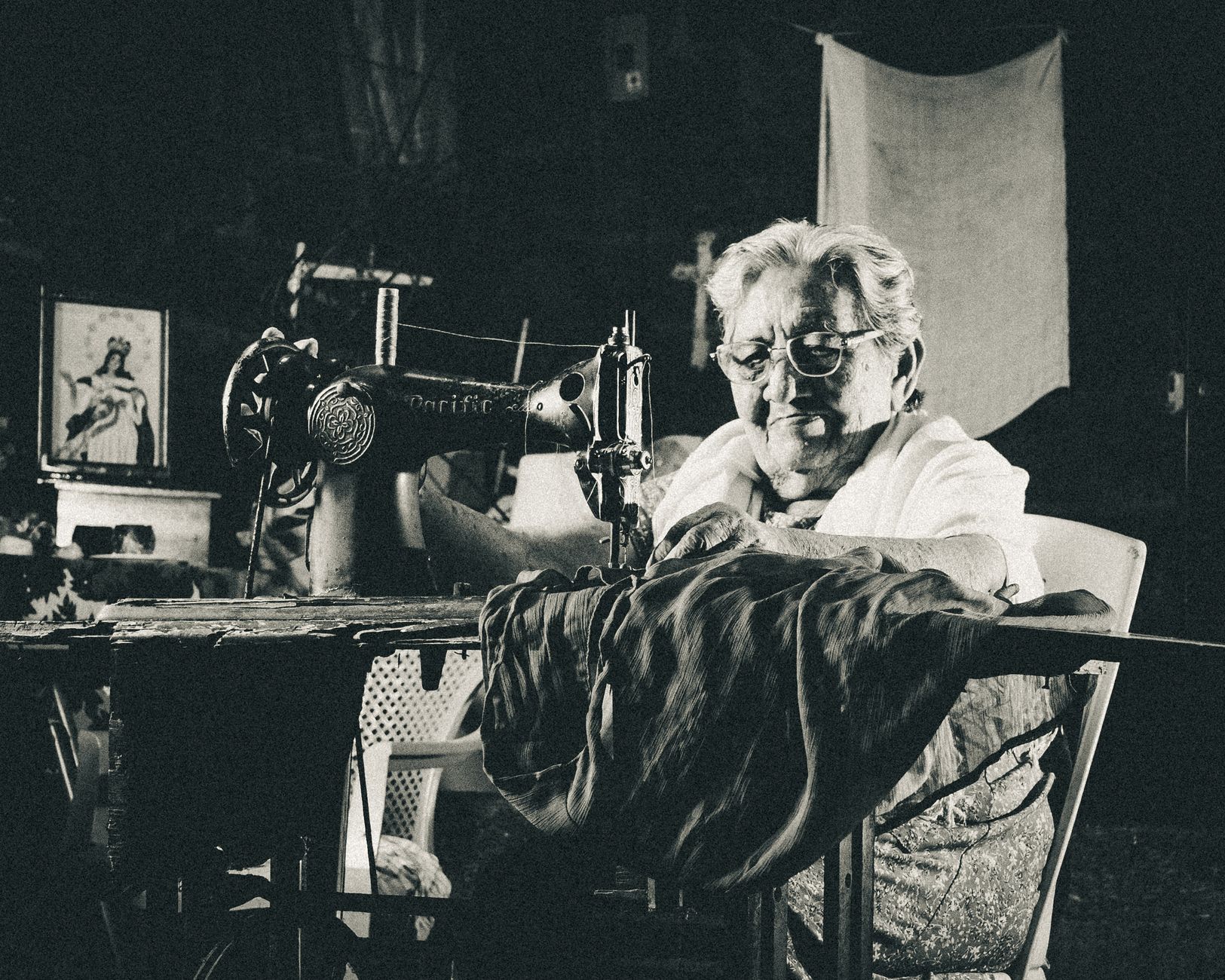
“You bought it fair and you need it,” I said. “It’s yours. I’m not asking for it back. I’m asking for four evenings at your kitchen table. I’ll bring supper.”
Megan laughed, one short unhappy laugh.
“You can have all the evenings you want,” she said. “I can’t even make it go. There’s no pedal. I’ve been hunting through that cabinet for the pedal for three days.”
I handed the box to Hannah.
I walked into that young woman’s kitchen and opened the lid of the cabinet and lifted the machine up on its hinges until it locked, the way I’d watched my mother do it ten thousand times. Black as a stove. The gold worn away on the bed where the heel of her hand had rested. It smelled like oil and warm dust and, faintly, like her house.
Then I opened the little door in the front of the cabinet and folded down the knee lever.
“There’s your pedal,” I said. “You push it sideways with your knee. It leaves your feet free to rock a baby.”
I plugged it in and leaned my knee on the lever, easy.
The light came on. The needle ran. That low steady hum came up out of it, the sound of every afternoon of my childhood, and I had to stand there a minute with my hand flat on the cabinet.
Megan laughed for real that time, and then covered her mouth, because she’d seen my face.
Bill had come in behind us with his cap in his hand. He bent down and ran the cord through his fingers, all the way to the plug.
“Unplug that,” he said quietly. “Insulation’s cracked through right here. Don’t anybody run it till I’ve been to the hardware store.”
“I don’t have,” Megan started.
“It’s a nine dollar cord,” Bill said. “Opal hemmed my britches for twenty-five years. I can stand nine dollars.”
The first evening was Monday.
Bill came straight from the post office with the new cord and had it on in twenty minutes, sitting cross-legged on Megan’s linoleum with his pocketknife and a screwdriver while her little boy, Ben, watched him from the high chair like he was a television program. I brought a pan of chicken and noodles and a loaf of bread. Megan’s husband, Cody, had already left for the mill. He works three to eleven.
When Bill left, I oiled her. Mama’s own oil can, one drop in every hole she’d shown me, wipe the extra. I wound a bobbin with white thread and showed Megan how it drops in the case and how the case snaps into the left end of the machine with a click you can feel in your fingers.
“Now thread it,” I said. “I’ll talk, you do.”
“Me?”
“It’s your machine. Off the spool, through that guide, down and around between the tension discs. Up through the take-up lever, that arm that goes up and down. Down again. The needle on this one threads from the right side to the left.”
She got it on the second try. I gave her a scrap of the blue and she pressed the lever with her knee and sewed a line. It wandered like a creek, and she looked at it as if she’d painted a picture.
“It’s so quiet,” she said.
“It’s all gears inside. No belt. Mama bought it secondhand in 1962 with her egg money, and it was eleven years old then.”

Specialty: Emotional Turning Points
Rachel Monroe writes character-driven stories about betrayal, second chances, and unexpected resilience. Her work highlights the emotional side of family conflict — the silences, the misunderstandings, and the moments when someone quietly decides they’ve had enough.