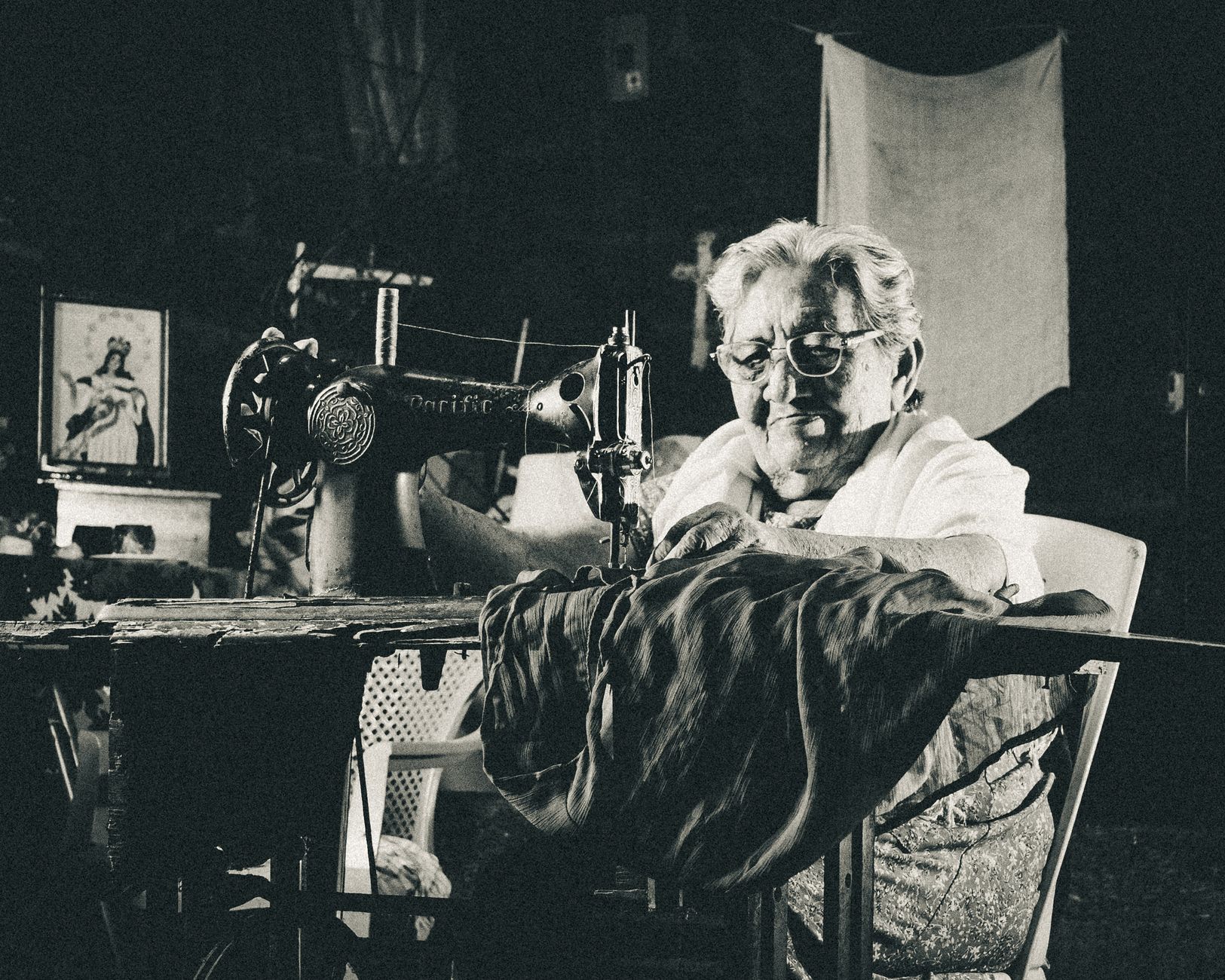
“That’s your whole seam allowance. Not a thread wasted.”
She sewed both skirt seams herself, start to finish. They were straight. I didn’t tell her they were straight. I let her run her own thumb down them and find out.
Then the gathers. I set the stitch lever to the longest stitch and ran two rows around the top of the skirt, a quarter inch apart, and showed her how to take hold of just the bobbin threads and ease the cloth along them, a little at a time, until three yards of skirt came down to fit a twenty-seven inch waist.
I was pinning the skirt to the bodice when somebody knocked on the screen door.
It was Megan’s neighbor from up the road, returning a pie plate. Donna Shelton. She had sat two pews behind my mother at First Baptist for thirty years.
She stopped dead on the kitchen linoleum.
“Why, that’s Opal’s Singer,” she said.
“Yes, ma’am, it is.”
“And you’re her youngest. Denise.” Her eyes went from the machine to the blue cloth to Megan and back to me. “What in the world?”
So I told her, short and fair. The house had to be cleared, the machine was sold, Megan bought it honest, and I was finishing my mother’s last dress on it by Megan’s kindness. I did not say one word against my sister.
Donna patted the cabinet twice, the way you’d pat a horse, and said she’d let us get on.
I put the zipper in after she’d gone. Hand-basted first, then stitched with the zipper foot, lapped, so the cloth folds over and hides the teeth. I made Megan stand at my shoulder and watch every inch.
When I held it up, it was a dress. Raw at the bottom, six inches too long, but a dress.
All it lacked was a hem.
I had three days to think about it, Friday to Sunday.
I know how to roll a hem. But the note was right, Karen’s are better. When we were girls, Mama gave us each a hanky square to practice on, and Karen’s edges came out like fine cord, and mine came out like a caterpillar.
And that wasn’t even the reason. The reason was that my mother, with her heart giving out, had sat down and written Karen into that dress on purpose. I taught her first. She knew her girls. She knew which one would be doing the carrying and which one would be standing around with her feelings hurt.
Saturday I picked up the phone twice and set it down twice.
Sunday we sat in our regular pew and Karen sat in hers, across the aisle and four rows up, next to Jeff. She didn’t turn around. After the benediction I saw Donna Shelton catch her by the elbow in the vestibule. I saw Karen’s face while Donna talked. Then Bill needed the car keys, and when I looked again, they were gone.
The fourth evening was Monday. Four days to graduation.
Hannah stood in the middle of Megan’s kitchen floor in the dress and her good shoes, straight as a fence post. I was down on my knees with Mama’s yardstick, going around her a pin at a time, eleven inches up from the linoleum all the way around. You measure a hem up from the floor, never down from the waist, because no girl alive is the same on both sides.
Emma was holding the pin cushion for me. She took the job very seriously.
Somebody knocked.

Specialty: Emotional Turning Points
Rachel Monroe writes character-driven stories about betrayal, second chances, and unexpected resilience. Her work highlights the emotional side of family conflict — the silences, the misunderstandings, and the moments when someone quietly decides they’ve had enough.