“Well,” she said finally, and wiped under each eye with one knuckle. “Have you got a size ten sharp, or do I need to use my own?”
“You brought needles?”
“I brought needles, white cotton, and Mama’s thimble. I’ve had her thimble in my pocketbook since the funeral home.” She set the pocketbook on Megan’s table. “I wasn’t sure you’d let me in the door. But I wasn’t coming without them.”
Hannah stepped out of the dress and Megan loaned her a robe.
I trimmed the skirt off even, five eighths of an inch below the pins. Karen sat in the kitchen chair by the lamp with three yards of blue skirt in her lap, and licked her thumb exactly the way our mother did, and began.
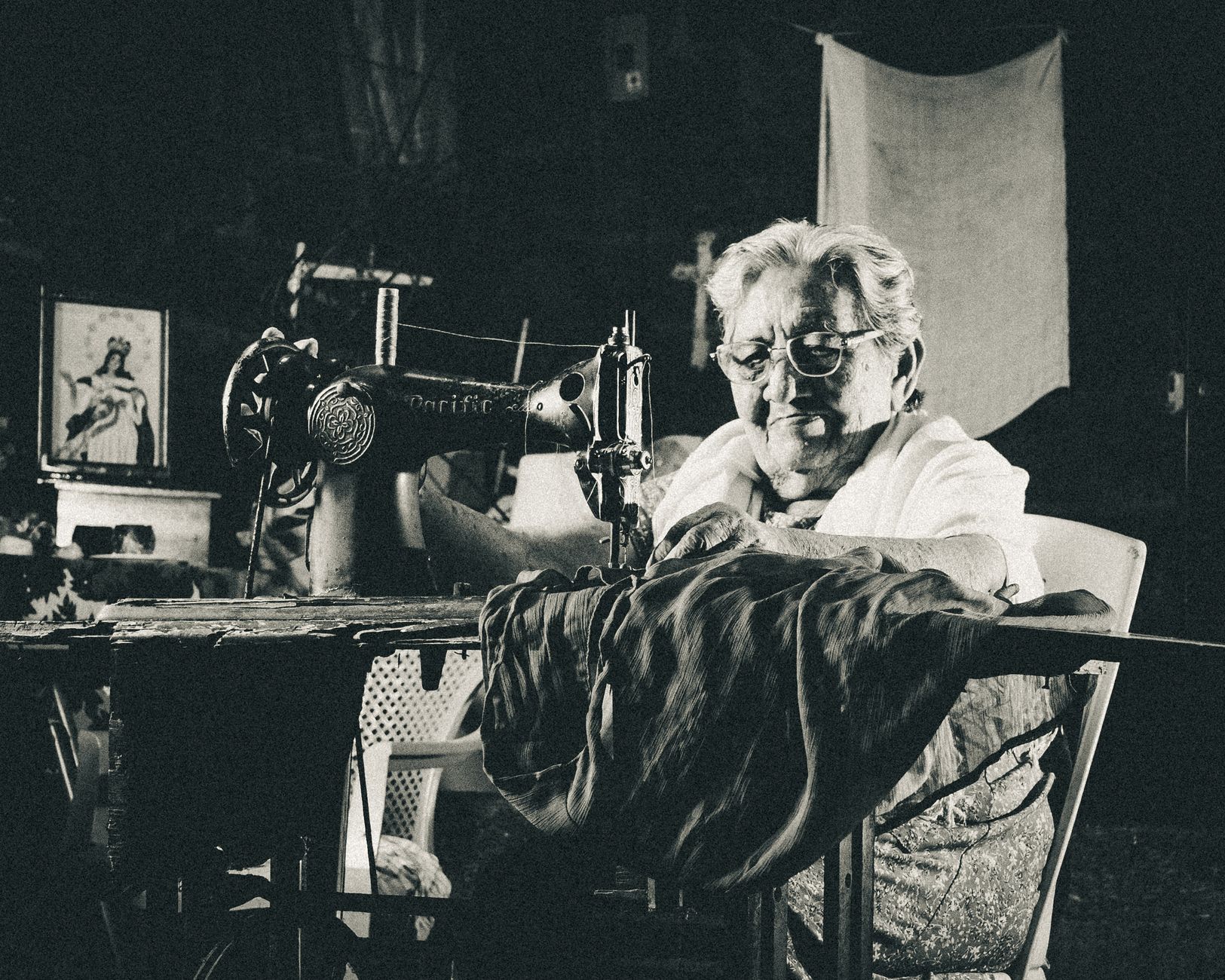
A hand-rolled hem is nothing to look at while it’s happening. You roll the raw edge toward you between your thumb and finger, tight, about as thick as a kitchen match. You catch a thread of the dress and a thread of the roll, tiny stitches, a quarter inch apart, and every inch or so you draw the thread up and the edge curls over on itself and disappears. It’s slow. Three yards of it is the better part of three hours.
Karen never looked up. Her hands knew it. Fifty-three years old and worn clear through, and her hands were ten, at a kitchen table outside Diggins, with a hanky square.
After a while Megan pulled her chair around.
“Could you show me that?” she asked. “I get asked for it. On the little girls’ Easter dresses. I always have to say no.”
Karen looked at her over her glasses. Then she scooted over, and cut a strip off the trimmings, and put a needle in that young woman’s hand.
“Roll it toward you. Tighter than you think. No, lick your thumb, it won’t roll dry. There. Now don’t pull till you’ve gone an inch.”
I sat at Mama’s machine with nothing left to sew on it, so I took the top pair of blue jeans off Megan’s basket, read the slip, thirty inches, and hemmed them. Then the next pair. I did five pairs while my sister rolled that hem. Thirty dollars of Megan’s work.
Emma lasted until nine. Then she climbed, without asking anybody, into the space between Karen’s chair and the wall, and went to sleep sitting up against Karen’s leg with the pin cushion in her lap.
Karen looked down at her.
“That’s the sound doing that,” she said. “Do you remember, Denise?”
“I remember.”
“I was on the wall side.”
“I know you were.”
She finished at twenty minutes to eleven. She bit the thread, the way we were always told not to, and shook the skirt out across her knees, and that hem ran around the bottom of it like a line drawn with a fine pen. You couldn’t find a stitch.
At the door she stopped and opened her pocketbook again. She took out a check and laid it on Megan’s table. Twenty-four dollars, from the consignment shop, not cashed.
“I couldn’t make myself take it to the bank,” she said. “It’s yours.”
“No, ma’am,” Megan said. “I got a sewing machine and four nights of lessons for forty dollars. I’m not taking money on top of it.”
Karen studied her.
“Then I’ll spend it on you,” she said, and put it back in her purse, and went out to her car.

Specialty: Emotional Turning Points
Rachel Monroe writes character-driven stories about betrayal, second chances, and unexpected resilience. Her work highlights the emotional side of family conflict — the silences, the misunderstandings, and the moments when someone quietly decides they’ve had enough.