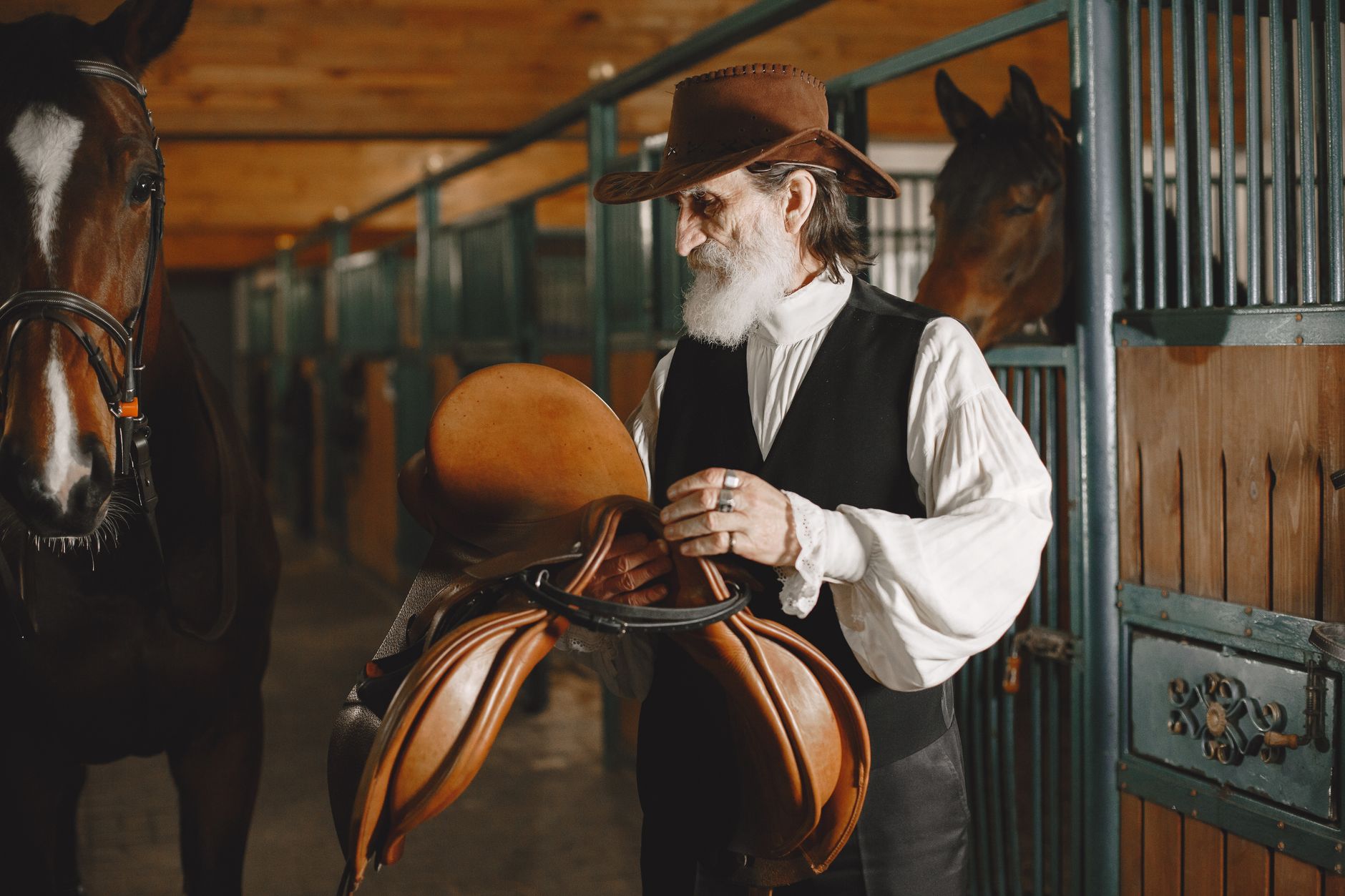
He got both arms under it and lifted it maybe an inch. The leather groaned.
“About forty pounds,” I said. “It has to be. See how thick it’s built through here?” I knocked on the fork. “When your granddad roped a steer, he took two wraps around this horn, and then six hundred pounds of animal hit the end of that rope. Everything came down on this saddle and the horse under it. A pleasure saddle would have come apart in a season.”
Cody had come around to my side. He’s the roper. He has worn the grass off the yard throwing loops at a plastic steer head stuck on a hay bale, with Dad coaching from a lawn chair.
He touched the horn. “That’s rubber.”
“Cut from an inner tube. It grabs the rope so the dally doesn’t slip. Feel that groove?”
He felt it. I saw him understand that his grandfather’s rope had made it.
“He won a buckle off this saddle in 1986,” I said. “At the roping in Woodward. He was heeling for a man named Don, and they caught in seven seconds and something, and it was the only buckle he ever won in his life. He wore it to church every Sunday for the next forty years. He was buried in it.”
“I saw it,” Luke said quietly. “Thursday.”
“I know you did, honey.”
“What horse?” Cody said.
“A buckskin gelding named Biscuit. He’d bite anybody in the county but Dad. He bit me twice. He bit the preacher.”
Luke laughed, and it was the first time I had heard that child laugh in a week.
“Your dad rode in this saddle before he could walk.” I didn’t look at the stove when I said it. “Right here, in front, with both hands on the horn, and Granddad’s arm around his middle. They’d ride the fence that way. I’ve seen the picture.”
Behind me the spoon had quit scraping the pot.
Cody ran his thumb over the off stirrup. “Why’s there wire on it?”
“That’s my favorite one. Spring of ’94, branding at the Miller place. A cow mashed him against a pipe panel and cracked that stirrup clean through the wood. He had sixty calves left to drag to the fire. So he got a piece of baling wire off the fence, wrapped it, twisted it tight with his pliers, and finished the day. Said he’d buy a new pair of stirrups Saturday.”
“Did he?”
“That’s the same wire.”
Cody grinned. He looked so much like the pictures of Dad at that age that I had to study the cornbread for a second.
“Lift up that fender,” I told him. “The big flap. The near side. Go on.”
The leather creaked when he raised it.
“What’s that scratched in there?”
“Read it to me.”
“R 79.” He bent closer. “T 82.”
“That’s your dad and that’s me. The years we were born. He scratched them in with a horseshoe nail.”
“There’s more.” Luke had shoved in under his brother’s arm. “C 12. L…” He stopped. He’s eleven. He was born in 2015. “L 15.”
Nobody in that kitchen breathed.
“Is that me?” he said.
“That’s you.”
“Grandpa put me on his saddle?”
“He put both of you on it. And he never said one word about it to anybody. I only found them yesterday.”
Luke laid his whole hand flat over those four marks and kept it there.
I heard my brother make a sound behind me, a small one, like a man who has been hit somewhere soft. I still did not turn around.

Specialty: Legal & Financial Drama
Michael Carter covers stories where money, power, and personal history collide. His writing often explores courtroom battles, business conflicts, and the subtle strategies people use when pushed into a corner. He focuses on grounded, realistic storytelling with attention to detail and believable motivations.