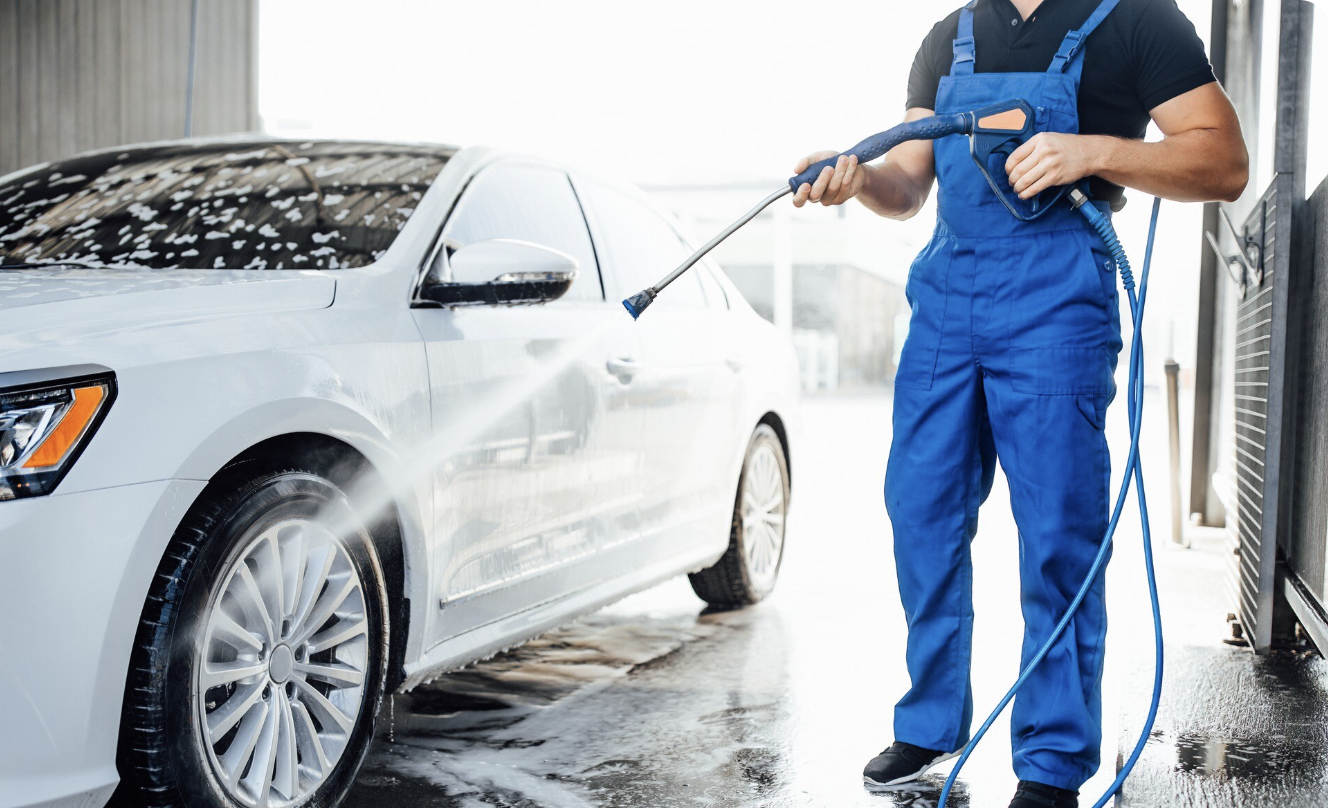
Two Washes
The memorial card was damp from the morning dew on the pavement.
I picked it up near the payment machine at the entrance to my car wash. Small. White. A little smaller than a playing card. The kind they hand out at funerals, with a prayer on the back.
I turned it over.
There was a photograph on the front.
A woman. About eighty. White hair, soft and curled. Pearl earrings. A little smile, like she knew a joke she wasn’t going to tell you.
The same woman I had just seen sitting in the passenger seat of a silver Buick LeSabre. Five minutes ago. Smiling at me through the windshield while the old man paid for two washes.
Underneath her picture, in thin gray letters:
In Loving Memory
Irene Kowalski
April 3, 1946 – December 12, 2025
December.
Six months ago.
I stood there in the parking lot of Bright Shine Car Wash with that card in my hand and looked toward the road where the Buick had disappeared. Route 4 was empty. Just the morning traffic going by. A semi. A school bus. A pickup with a ladder in the back.
No silver Buick.
And for the first time in my forty-six years, I wondered whether I’d actually seen what I thought I’d seen.
My name is Kevin Dorsey.
I’ve managed Bright Shine Car Wash on Route 4 outside Dayton, Ohio, for almost fifteen years. It’s not a big place. One automatic tunnel. Four self-serve bays. Six vacuum stations. A little office with a coffee maker that’s older than my daughter and a window that looks out over the lot.
The owner is a man named Phil who lives in Florida and calls me twice a year. Once at Christmas. Once when the water bill goes up.
I’m divorced. Eight years now. My ex-wife, Dana, remarried a nice dentist in Kettering. My daughter, Emma, is sixteen. She lives with them during the week and with me every other weekend. She thinks car washes are boring. She’s right.
But I like it.
You get to know people at a car wash. More than you’d think.
You get to know the construction workers who come in on payday Friday afternoons, their trucks caked with clay, laughing and throwing quarters at each other in the self-serve bays.
You get to know the teenagers who spend half an hour vacuuming their cars before a big date, picking up every single French fry from under the seats.
You get to know the retired couples who stop by after breakfast at the Bob Evans down the road. They always get the deluxe wash. They always argue about whether the deluxe wash is worth the extra four dollars. They always get it anyway.
You get to know the young mother who comes in every Tuesday with three kids in car seats and lets them watch the brushes through the windows because it’s the only thing that makes them stop screaming.
You get to know the guy who comes in the day after his divorce is final and sits in his car in bay two with the engine off for an hour, not washing anything, just sitting.
I know that guy. I was that guy, once. In my own car wash.
You get to know people.
But this man was different.
He started coming in February.
The second Friday in February. I remember because it was the day after a big ice storm, and every car on Route 4 looked like it had been dipped in salt. We had a line out to the road all morning.
And at exactly 7:15, a silver Buick LeSabre pulled up to the payment machine.
It was an older model. Early two-thousands, maybe. 2003 or 2004. The last good year, my father always said. Beautiful condition. Silver paint so shiny it looked wet. Chrome trim polished like a mirror. Not a scratch on it. Not a ding. Not a speck of salt.
Every other car in that line looked like it had driven through a snowbank.
The Buick looked like it had just rolled off a showroom floor.
The man inside was old. Eighty, maybe. Thin. Gray wool cap. A tan jacket buttoned all the way to the collar. Big glasses with thick frames. Both hands on the wheel. Ten and two.
He paid twelve dollars at the machine. The basic wash. Cash. Exact change.
He never rolled down his window.
He drove into the tunnel. The brushes spun. The soap came down. The dryers roared. The Buick came out the other end exactly as clean as it went in.
He pulled into a parking space near the exit. The one by the air pump. He parked there.
And he sat.
I watched him from my office window. He didn’t get out. He didn’t check his phone. He didn’t eat anything or read anything or do anything.
He just sat there behind the wheel with both hands on it, looking out his windshield. Across the road.
Exactly five minutes.
Then he started the car and pulled out onto Route 4 and drove away.
The first time, I figured he’d just bought it. People do that. Buy a nice used car and want to give it a wash right away.
The passenger seat was empty. I remember noticing that. I don’t know why.
The second Friday, he came back.
7:15. Exactly. I looked at the clock on the wall when the Buick pulled in. The second hand was on the twelve.
Same Buick. Same tan jacket. Same gray wool cap. Same twelve dollars, exact change. Same basic wash.
Same parking spot by the air pump. Same five minutes.
Same empty passenger seat.
I figured he liked keeping it clean. Some old guys are like that. My dad was like that. He used to wash his Oldsmobile every Saturday morning in the driveway with a bucket and a sponge and a radio playing the Reds game. Even if it hadn’t gone anywhere all week.
By the fifth Friday, I’d started to set my watch by him.
By the tenth Friday, I started paying attention.
The car was always spotless.
I mean always. February, March, April. Ohio in the spring is mud season. Everything’s brown. Every truck that comes through looks like it’s been rolling in a hog lot.
The Buick never had a speck on it.
No mud. No dust. No salt. No bird droppings. Not even leaves caught beneath the windshield wipers, and in April there are leaves and helicopter seeds on everything.
It looked exactly the same going into the wash as coming out.
He never used the vacuum. Never bought tire shine. Never got the triple foam or the undercarriage spray or the hot wax. Just the basic twelve-dollar wash. Every single Friday.
Then he’d park near the exit by the air pump for exactly five minutes. I timed it once. Five minutes and two seconds.
Then he’d leave.
My assistant manager, Luis, noticed too. Luis is twenty-four. He’s going to community college at night for HVAC. He’s a good kid.
“That old guy’s car isn’t dirty, boss,” Luis said one Friday in April, standing next to me at the office window. “Like, at all.”
“I know.”
“So why’s he washing it?”
“I don’t know, Luis.”
“Maybe he’s like… a car wash inspector. Secret shopper.”
“For a twelve-dollar car wash?”
“Could be.”
“It’s not a secret shopper, Luis.”
“Then what is it?”
I didn’t have an answer.
I want to be honest about something.
Part of why I noticed the old man was because he reminded me of my father.
My dad’s name is Ray Dorsey. He’s eighty-one. He drove a truck for Mead Paper for thirty-two years. He was the kind of man who wore a tie to church and a cap everywhere else and washed his Oldsmobile every Saturday whether it needed it or not.
He has Alzheimer’s.
He’s been in a nursing home in Springfield for two years. The Sunrise Care Center. Forty minutes from my house.
I hadn’t been to see him since Christmas.
That’s the truth. I’m not proud of it. Four months.
The last time I went, on Christmas Eve, I brought him a cherry pie from the Bob Evans. His favorite. I sat down across from him in the day room. There was a little fake Christmas tree in the corner with blinking lights.
He looked at me for a long time.
“Who are you?” he said.
“It’s Kevin, Dad. Your son.”
He frowned. “I don’t have a son.”
“You do. Me. Kevin.”
He shook his head. He looked at the pie. Then back at me.
“Are you from the church?” he asked politely. “Thank you for the pie. My wife makes a better one. But thank you.”
My mother has been dead for nine years.
I sat there for twenty minutes. He talked to me like I was a stranger. A nice young man from the church. He told me all about his son, Kevin, who managed a car wash and had a little girl named Emma and was very busy. He told me Kevin didn’t visit much.
“Kids are busy,” he said. “That’s all right.”
I drove home crying so hard I had to pull over twice.
And I didn’t go back.
I told myself he didn’t know the difference. I told myself it didn’t matter if I came or not, because he didn’t remember me anyway. I told myself it was kinder. For both of us.
I told myself a lot of things.
So when an old man in a cap started showing up at my car wash every Friday, washing a car that didn’t need washing, sitting alone in the parking lot for five minutes, I paid attention.
I didn’t know why yet. But I did.
One morning in late May, I walked over.
It was the fifteenth Friday. Warm. Sunny. The lilacs were blooming along the fence by the vacuums.
He was sitting in his usual spot by the air pump. Both hands resting on the wheel. Looking out the windshield, across Route 4.
I knocked lightly on his window.
He jumped a little. Then he looked up at me. He hesitated. Then he rolled the window down. Just halfway.
“Morning, sir,” I said.
“Morning.”
His voice was rough. Quiet. A voice that didn’t get used much.
“Nice Buick.”
“Thank you.”
“LeSabre. Oh-three?”
“Oh-four,” he said. “Limited.”
“My dad had a Ninety-Eight. Oldsmobile. Same kind of man as you. Washed it every week whether it needed it or not.”
He nodded. He didn’t say anything.
“Must be pretty special,” I said. “The car.”
He glanced at the passenger seat.
Just for a second. A quick look. The way you look at somebody sitting next to you when you’re about to answer a question for both of you.
The seat was empty.
“It is,” he said.
I smiled. “You keep it cleaner than most show cars.”
He nodded again.
I stood there for a moment. I almost walked away. I almost said have a good day and went back to my office.
But I didn’t. Fifteen weeks of wondering. I couldn’t help it.
“Can I ask you something?” I said. “Why do you wash it every Friday? When it never seems to get dirty?”
His expression changed.
Not anger. Not embarrassment. Something else.
Something closer to sadness. A deep, quiet sadness, like a lake on a still day. You could see all the way to the bottom of it.
He looked at me for a long moment.
“Because if I stop coming,” he said, “somebody will know she’s gone.”
I blinked.
I thought I’d misheard him.
“I’m sorry,” I said. “What do you mean?”
He looked toward the passenger seat again. The empty one.
Then he shook his head.
“Forget I said that,” he said.
He rolled up his window.
He started the engine.
And he drove away.
I probably should’ve left it alone.
I knew that. Standing there in the parking lot with the lilacs blowing and the Buick’s taillights disappearing down Route 4. I knew it wasn’t my business. He was a customer. He paid twelve dollars. That’s all I needed to know.
But I couldn’t stop thinking about it.
Somebody will know she’s gone.
Who was she? Who was somebody?
I thought about it all weekend. I thought about it when I picked Emma up on Saturday. I thought about it when we went to the movies and she made fun of me for eating an entire large popcorn by myself.
“You’re distracted,” she said in the car on the way home. “What’s wrong?”
“Nothing.”
“Dad. You’ve watched that same stoplight change twice.”
So I told her. About the old man. The Buick. The five minutes. Somebody will know she’s gone.
Emma was quiet for a while.
“That’s kind of sad,” she said finally.
“I know.”
“Maybe his wife died.”
“Maybe.”
“And maybe they used to go to the car wash together. And now he goes alone. Because it’s what they used to do.”
“Maybe.”
“That’s really sad, Dad.”
“I know, Em.”
She looked out the window. Then she said something that made my chest go tight.
“Is that why you don’t visit Grandpa anymore? Because it’s too sad?”
I didn’t answer.
She didn’t push. She just reached over and turned up the radio.
The next Friday, he didn’t show up.
Seven-fifteen came and went.
I watched the clock. The second hand went around. 7:16. 7:17. 7:20.
No Buick.
Then eight o’clock. Then nine.
Luis noticed. “Where’s your old guy?”
“He’s not my old guy.”
“He’s always here, though. Fifteen weeks. He’s never missed.”
“Sixteen weeks,” I said. “He’s never missed.”
I told myself it wasn’t my business. Maybe he was sick. Maybe he went out of town to visit family. Maybe he finally got tired of paying twelve dollars to wash a clean car. People change their routines all the time.
But I kept thinking about what I’d said. About knocking on his window. About asking.
Maybe I’d scared him off. Maybe I’d made him feel watched. Maybe I’d taken something from him. Whatever those five minutes were, I’d stuck my nose into them, and now he wasn’t coming.
I felt sick about it all day.
The following Friday, he returned.
7:15. Exactly.
Same Buick. Same silver shine. Same gray wool cap.
Except this time, there was a woman sitting beside him.
She looked about eighty. White hair, soft and curled, like she’d just been to the beauty parlor. Pearl earrings. A lavender cardigan buttoned up to her throat. Her hands were folded in her lap.
She had a little smile on her face.
The old man pulled up to the payment machine.
And for the first time in seventeen weeks, he lowered his window all the way.
“Two washes today, Kevin,” he said.
I don’t know how he knew my name. It’s on my shirt. A little patch. I guess he’d read it.
I laughed. “You only brought one car.”
He looked at me.
Then he looked toward the passenger seat.
“She says it needs another,” he said.
I glanced at the woman.
She didn’t speak. She didn’t move. She didn’t look at me.
She just sat there with her hands folded in her lap, looking straight ahead through the windshield. Across Route 4. With that little smile.
I started to feel uncomfortable. I don’t know why. There was something about how still she was. How she didn’t turn her head. How her eyes didn’t seem to be looking at anything.
The old man held out twenty-four dollars. Exact change.
I took it. I didn’t know what else to do.
He drove into the tunnel.
The brushes spun. The soap came down. I watched through the tunnel window. Through the foam and the water, I could see the shape of two people in the front seat. Two white heads. Side by side.
The Buick came out the other end. He backed up. He drove around. He went through again.
Second wash.
When it came out the second time, he parked in his usual spot by the air pump.
Five minutes.
The woman never moved. She never turned her head. She never spoke.
Then he started the car and pulled onto Route 4 and drove away.
I watched him go.
Then something caught my eye.
A small white card on the pavement near the payment machine. It must have fallen out of his window when he was handing me the money.
I picked it up.
And you know the rest. The photograph. The pearl earrings. The little smile.
Irene Kowalski. April 3, 1946 – December 12, 2025.
I went back to my office.
I sat down at my desk. I set the card in front of me. I looked at it for a long time.
It was the same woman.
I’m not crazy. I’m not a man who believes in ghosts. I go to church at Christmas and Easter and I don’t think much about what happens after. But it was the same woman. The same white hair. The same pearl earrings. The same little smile.
The same face I’d just seen through the windshield of a silver Buick. Twice. Going through my car wash.
And she’d been dead for six months.
Luis came in with two cups of coffee. He handed me one. He looked at my face.
“Boss, you look like you saw a ghost.”
I pushed the card across the desk toward him.
He picked it up. He looked at it. He looked at me.
“Is that… that’s the lady. From the Buick. Just now.”
“Yeah.”
He turned the card over. He read the dates on the front again.
“December?”
“December.”
Luis set the card down very carefully. Like it might bite him.
“Nope,” he said. “Nope. I’m not doing this. I’m going to go spray down bay three.”
He left.
I sat there alone with the card.
I thought about calling somebody. I didn’t know who. I thought about looking her up online. I opened my laptop. I typed in her name. Then I closed the laptop before I hit enter.
I didn’t want to know. Not that way. Not from a search engine.
I wanted to ask him.
I told Emma about it that weekend.
She laughed at me. She actually laughed.
“Dad,” she said. “Ghosts don’t pay twelve dollars.”
“Twenty-four,” I said. “Two washes.”
“Ghosts definitely don’t pay twenty-four dollars.”
“I know what I saw, Em.”
She stopped laughing. She looked at me across the kitchen table. We were eating pizza from Marion’s. Her favorite.
“Okay,” she said. “So what are you going to do?”
“Ask him.”
“What if he doesn’t want to tell you?”
“Then I’ll leave him alone.”
She thought about it.
“Okay,” she said. “But Dad?”
“Yeah?”
“If it turns out he’s driving around with his dead wife, I’m never coming to the car wash again.”
He came back the next Friday.
7:15. Alone. Empty passenger seat.
He paid twelve dollars. He went through the wash once. He parked by the air pump.
I waited one minute. Then I walked out of my office and across the lot.
I had the memorial card in my shirt pocket.
I knocked on his window.
He looked up. He saw who it was. He sighed. A long, tired sigh.
He rolled the window down. All the way this time.
“You dropped this,” I said. “Last week.”
I held out the card.
He looked at it in my hand. At the photograph. At the pearl earrings and the little smile.
He didn’t take it right away.
When he did, his fingers were shaking.
“Thank you,” he said quietly. “I’ve been looking for that. I keep it on the visor. It must have fallen.”
He tucked it up into the sun visor above his head. Into a little clip. I could see there were other things up there too. A grocery list. A parking stub. A photograph of two little girls in matching dresses.
“Sir,” I said. “I don’t want to pry. I really don’t. You can tell me to get lost. But last week there was a woman in your car. And she looked exactly like the woman on that card.”
He didn’t say anything.
“And the card says she died in December,” I said.
He looked at me for a long time.
Then something in his face loosened. Like he’d been holding something heavy for a very long time and his arms had finally given out.
“You must think I’m crazy,” he said.
“I don’t know what to think.”
He almost smiled.
“Do you have coffee?” he said. “In that office of yours?”
“I do. It’s terrible.”
“Irene always said the worse the coffee, the better the conversation.” He reached for his door handle. “All right, Kevin. I’ll tell you. But it’s going to take more than five minutes.”
His name was Albert Kowalski.
He was eighty-two. He’d been a machinist at the old NCR plant in Dayton for thirty-eight years. He’d been married to Irene for fifty-seven years.
He sat across from me at my cluttered little desk in the office with a styrofoam cup of my terrible coffee in both hands. He drank it black. He didn’t complain about it.
“She was a twin,” he said.
That was the first thing he told me.
“Irene and Ida. Identical. Born four minutes apart in 1946. Ida first. She never let Irene forget it.”
He smiled. A small, real smile.
“When I met Irene at a dance at St. Stanislaus in 1966, I thought she was Ida. They were both there. Same dress, practically. Same hair. I asked Ida to dance. Ida said, ‘You want my sister. She’s been staring at you all night.’ And she pointed across the room.” He shook his head. “I asked the wrong twin first. Irene never let me forget that either.”
He took a sip of coffee.
“They were never apart. Not really. When I married Irene, Ida married my best friend, Stan Lemke, six months later. We bought houses on the same street. Raised our kids together. Five kids between us. Every holiday together. Every vacation. Every Sunday dinner.”
He looked down into his cup.
“Stan died in 2015. Lung cancer. And then Ida started forgetting things.”
“It started little,” Albert said. “Like it always does. Her keys. Her glasses. Names. Then bigger things. She left the stove on. She got lost driving to the grocery store she’d been going to for forty years. She called Irene at three in the morning, crying, because she didn’t know where Stan was. Stan had been dead for four years.”
“Alzheimer’s,” I said quietly.
He looked at me. “You know it.”
“My dad,” I said. “He’s in a home in Springfield.”
Albert nodded slowly. He didn’t say anything. He didn’t have to.
“Irene took care of her,” he said. “As long as she could. Moved her into our spare room. Fed her. Bathed her. Sat up with her at night. For three years. It almost killed her. Irene was seventy-five, and she was taking care of her twin sister like a baby.”
“And then?”
“And then Ida wandered off one night in a snowstorm,” Albert said. “In her nightgown. We found her two miles away, at the bottom of a ditch, nearly frozen. The doctors said she couldn’t live at home anymore. It wasn’t safe.”
He set down his cup.
“So we found a place,” he said. “A good one. Memory care. Locked doors so she couldn’t wander. Nurses all night.” He turned in his chair. He pointed out my office window. Across the lot. Across Route 4.
“That one,” he said.
I looked out the window.
Across Route 4, behind a row of maple trees, there’s a long, low brick building with white trim and a green roof. I’d driven past it ten thousand times. I’d looked at it from this window for fifteen years.
I’d never really seen it.
MAPLE GROVE MEMORY CARE.
There’s a sign out front. Small. Tasteful. I’d never read it.
“Her room’s on the end,” Albert said. “The corner. Second window from the left. You can see it from right where I park.”
I looked.
Second window from the left. On the corner.
There was a curtain. Pale yellow. And in the window, a shape. A person. Sitting very still.
Looking out.
Looking across Route 4.
At my car wash.
“We came every Friday,” Albert said. “Irene and me. For two years. Fridays were Ida’s day. Irene wouldn’t miss it for anything. Not for snow, not for doctor’s appointments, not for grandkids’ birthdays. Friday was Ida.”
He picked up his coffee again.
“And Irene had a rule,” he said. “The car had to be clean. Spotless. Every single Friday. Before we went in to see her sister.”
“Why?”
He smiled.
“Because when they were girls,” he said, “their father drove a Buick. A big black Roadmaster. He washed it every Friday before he took the family to the Polish Club for dinner. Irene and Ida would sit on the front steps and watch him. They’d get so excited. A clean Buick meant Friday night. Pierogies and polka music and their dad dancing with their mother.”
He looked out the window toward Maple Grove.
“When Ida started forgetting, she forgot almost everything,” he said. “Her kids. Her grandkids. Stan. Her own name, some days. But she never forgot the Buick. Never. Every time she saw a clean Buick, her face would light up. She’d say, ‘It’s Friday! Daddy washed the car!’”
My throat was tight.
“So Irene made sure it was always clean,” Albert said. “And she bought this car. The LeSabre. In 2021. Used. It’s not the same as her father’s. Not even close. But it’s a Buick. And it’s silver, and it shines. And every Friday morning, we’d come here first. To your car wash. Right across the road. Because Ida’s window faces this way.”
“She could see you,” I said.
“She could see us,” Albert said. “From her window. She’d sit there every Friday morning waiting. And when the silver Buick came through the car wash, she’d know it was Friday. She’d know Irene was coming. The nurses told us. She’d start getting ready. Brushing her hair. Asking for her pearls.”
He swallowed.
“And Irene always bought two washes.”
I looked at him.
“Two washes,” he said. “Every time. I’d tell her, ‘Irene, it’s already clean. It’s a waste of twelve dollars.’ And she’d say, ‘Albert, one wash is for us. The second wash is for Ida. So she can see her face in it.’” He laughed. It broke in the middle. “Ida used to say that. When they were girls. To their father. ‘Daddy, wash it again, I want to see my face in it.’”
“And then we’d park,” Albert said. “Right where I park now. By the air pump. For five minutes.”
“Why five minutes?”
“Because Irene had to fix her lipstick,” he said. “In the visor mirror. She always fixed her lipstick before she went in to see Ida. Five minutes. She was very particular about her lipstick.” He smiled. “And from that spot, Ida could see the car sitting there. Shining in the sun. And she’d wave. From her window. And Irene would wave back.”
He was quiet for a moment.
“Then we’d drive across the road and go in.”
He told me the rest slowly.
Irene had a heart attack in December. On a Thursday night. In their kitchen. Making pierogies for Friday. She was gone before the ambulance got there.
“She was making pierogies for Ida,” Albert said. “Potato and cheese. Ida’s favorite. They were still on the counter when they took her away. I couldn’t throw them out. I put them in the freezer. They’re still there.”
I didn’t say anything. I couldn’t.
“I had to tell Ida,” he said. “Somebody had to. So the day after the funeral, I went to Maple Grove. I sat with her in her room. And I told her Irene was gone.”
He closed his eyes.
“She screamed,” he said. “Kevin, I’ve never heard a sound like that. Like I’d torn her in half. She screamed and screamed. The nurses had to come. They had to give her something. She cried for hours.”
He opened his eyes. They were wet.
“And the next morning, she’d forgotten,” he said. “She woke up and asked the nurse when Irene was coming. It was like I’d never told her.”
“Oh, God,” I said.
“So I told her again,” he said. “And she screamed again. Just like the first time. Like it was brand new. Like I’d just said it.” He shook his head. “I did that four times, Kevin. Four times, I told that woman her twin sister was dead. And four times, I watched her hear it for the first time.”
He set down his coffee. His hands were shaking.
“The doctor finally sat me down,” he said. “Dr. Patel. A kind woman. And she said, ‘Mr. Kowalski, you have to stop. Every time you tell her, she loses Irene all over again. It’s not kind. It’s cruel. She can’t hold onto it.’ And I said, ‘So what do I do? Lie to her?’ And she said, ‘Sometimes, with this disease, love means letting someone live in the world they can still bear.’”
He looked out the window. At the second window from the left.
“So I stopped telling her,” he said.
“The nurses tell her Irene’s just running late,” Albert said. “Or she’s at the doctor. Or she’s visiting the grandkids. Whatever Ida needs to hear that day. And Ida’s all right with it. Mostly. As long as Friday still comes.”
“As long as she sees the Buick,” I said.
He nodded.
“I can’t go in,” he said. “That’s the thing. I tried, in January. I went in to visit. And she looked at me and said, ‘Albert! Where’s Irene?’ And I couldn’t do it. I couldn’t lie to her face. I couldn’t sit in that room and pretend my wife was at the dentist. I broke down. In front of her. Crying like a baby. And it upset her so much she didn’t eat for two days.”
He shook his head.
“So now I just come here,” he said. “I drive through your car wash at seven-fifteen every Friday. The same as always. I park by the air pump for five minutes. Where she can see the car shining in the sun. And she knows it’s Friday. She knows Irene’s coming.”
“And then?”
“And then I drive away,” he said quietly. “And the nurses tell her Irene got held up. And she’s a little disappointed. But she’s all right. Because Friday still came. The car still came. Nothing’s changed. Not for her.”
He looked at me.
“Because if I stop coming,” he said, “somebody will know she’s gone.”
I sat there in my office and didn’t say anything for a long time.
The coffee maker gurgled. Out in the lot, a pickup pulled into bay two. Somebody was vacuuming their car. The radio on the shelf was playing an old Motown song, very quietly.
I looked across the road at the second window from the left.
The shape was still there. Sitting very still. Looking out.
“Two weeks ago,” I said finally. “You missed a Friday.”
“I fell,” Albert said. “In my bathroom. Thursday night. Hit my head on the tub. My neighbor found me in the morning. They kept me at Miami Valley for three days. For observation.”
“And Ida?”
He closed his eyes.
“The nurse called me at the hospital,” he said. “A nurse named Yolanda. She’s very good. She said Ida sat at the window all day Friday. All day. She wouldn’t eat. She wouldn’t go to the day room. She wouldn’t take her medicine. She kept asking, ‘Where’s the car? Where’s the car? It’s Friday. Where’s the car?’”
He rubbed his face with both hands.
“Saturday morning, she tried to get out,” he said. “She got out of her room somehow. Down the hall. She was trying to get to the front door. To go look for the car. She fell. Bruised her hip. They had to put her in a wheelchair.”
“I’m so sorry.”
“And then Yolanda said something,” Albert said. “She said, ‘Mr. Kowalski, I’ve been doing this for twenty-two years. I’ve seen a lot of people like Ida. And I’m telling you, she doesn’t need the truth. She needs Friday.’”
He looked at me.
“So the next Friday, when they let me out of the hospital, I asked Yolanda if I could take Ida for a ride.”
“The woman in the car,” I said slowly. “Last week.”
“That was Ida,” he said.
I stared at him.
“Identical twins,” Albert said. “I told you. You couldn’t tell them apart. Even their own mother mixed them up sometimes.” He pointed at the visor. At the memorial card tucked into the clip. “That’s Irene. The woman you saw was Ida. Wearing Irene’s pearl earrings. I gave them to her. And Irene’s lavender cardigan. Yolanda helped her get dressed.”
The relief that went through me was so strong I almost laughed. And then right behind it came something else. Something that made my chest ache.
“She sat in Irene’s seat,” I said.
“She sat in Irene’s seat,” Albert said. “First time she’s been out of that building in two years. I didn’t know if it would work. I didn’t know if it would scare her. Yolanda came with us. She followed in her own car, just in case.”
“Why didn’t she speak? Or look at me? She didn’t move at all.”
“She doesn’t talk much anymore,” Albert said. “A few words a day. On a good day. And she was concentrating. You could see it. On the car. On the brushes. On the soap. She hadn’t seen it from inside in a long time.” He smiled. “But when we came out of the wash the first time, she turned to me. And she said four words. Clear as day.”
“What?”
“‘Wash it again, Albert.’”
He laughed. Tears were running down his face.
“That’s why I said two washes,” he said. “She told me. She remembered. After two years in that building, after forgetting her own husband and her own children and her own name, she remembered that the car always gets washed twice.” He wiped his eyes. “One for us. One for Ida. So she can see her face in it.”
He came back the next Friday. And the next.
Alone. Empty passenger seat. One wash. Five minutes by the air pump.
Except now, before he pulled out onto Route 4, he’d roll down his window and wave to me in my office.
And I’d wave back.
And then I started doing something else.
At 7:20 every Friday, while Albert sat by the air pump, I’d step outside my office door. And I’d look across the road. At the second window from the left.
And I’d wave.
The first few weeks, nothing happened.
Then one Friday in June, the curtain moved. And a small hand came up behind the glass.
And waved back.
I went over there in July.
Across Route 4. To Maple Grove Memory Care. I’d been looking at that building for fifteen years and never once set foot in it.
I told myself I was going to see if Ida needed anything. That’s what I told Luis.
The truth was, I didn’t know why I was going. I just knew I needed to.
Yolanda met me at the front desk. She was maybe fifty. Short and solid, with reading glasses on a beaded chain and laugh lines all around her eyes. Her scrubs had little cartoon cats on them.
“You’re the car wash man,” she said.
“Kevin.”
“Albert told me about you.” She smiled. “You want to meet her?”
“If that’s all right.”
“She won’t know who you are,” Yolanda said gently. “She might not say anything at all. You have to be okay with that.”
“I’m okay with it.”
She looked at me for a moment. Like she was deciding something.
“Who do you have?” she asked.
“What?”
“Who do you have,” she said, “in a place like this?”
I didn’t know how she knew. Maybe it was on my face.
“My dad,” I said. “In Springfield.”
“When’s the last time you saw him?”
I didn’t answer.
Yolanda nodded slowly. She didn’t say anything else. She just took my elbow and walked me down the hall.
Ida’s room was at the end of the corridor. The corner. Bright and sunny. Pale yellow curtains.
She was sitting in a wheelchair by the window. Wearing a pink sweater. Her white hair brushed. Her hands folded in her lap.
She looked exactly like the woman on the memorial card. Exactly.
On the windowsill next to her, there was a little framed photograph. Two girls in matching dresses, maybe eight years old, sitting on the hood of a big black car. Grinning. Missing their front teeth.
“Ida,” Yolanda said softly. “You have a visitor. This is Kevin. From the car wash.”
Ida turned her head slowly.
She looked at me.
I don’t know what I expected. I think I expected nothing. A blank stare. The look my father gave me on Christmas Eve.
Instead, her eyes went to the patch on my shirt. The little patch with the Bright Shine logo. A cartoon car with bubbles all around it.
She lifted one finger. She pointed at it.
Then she pointed out the window. At my car wash. Across the road.
“Friday,” she said.
Her voice was small and papery. Like a dry leaf.
“That’s right,” I said. My voice cracked. “That’s right, Ida. That’s where Friday comes from.”
She smiled.
The same little smile. The one from the memorial card. The one from the passenger seat.
Like she knew a joke she wasn’t going to tell you.
I sat with her for an hour.
She didn’t say much. Six or seven words. “Friday.” “Pretty.” “Daddy’s car.” She held my hand for a while. Her hand was tiny and cool and soft as paper.
Mostly, we just sat there together and looked out the window at my car wash.
Watching cars go through. A red pickup. A white minivan. A muddy Jeep. Each one went into the tunnel dirty and came out shining.
Every time one came out, Ida would watch it closely. And then she’d shake her head a little. Like it wasn’t the right one.
“Not silver,” I said.
She shook her head.
“Albert comes Friday,” I told her. “In the silver one.”
She looked at me.
“Irene,” she said.
My heart stopped.
“Irene comes Friday,” Ida said. Slowly. Very carefully. Like she was reading it off a card. “Silver car. Two washes.”
I looked at Yolanda in the doorway.
Yolanda just nodded at me. Very slightly.
She needs Friday.
“That’s right, Ida,” I said. “Silver car. Two washes. Every Friday.”
Ida smiled and squeezed my hand.
I drove to Springfield that afternoon.
I left Luis in charge of the wash. I didn’t even call ahead. I just got in my truck and drove forty minutes up Route 4 to the Sunrise Care Center.
My dad was in the day room. Sitting in a recliner by the window. A Reds game on the TV with the sound off. He was wearing a cardigan I’d never seen before. Somebody had combed his hair.
He looked up when I came in.
He looked at me for a long time.
“Who are you?” he said.
I sat down in the chair across from him.
“I’m Kevin, Dad,” I said. “Your son.”
He frowned. “I don’t have a son.”
“You do,” I said. “It’s okay if you don’t remember. I’m going to sit here for a while anyway. If that’s all right.”
He thought about it.
“Are you from the church?”
“Sure, Dad,” I said. “I’m from the church.”
He nodded. That seemed to satisfy him.
He turned back to the Reds game. I watched it with him. They were losing. They’re always losing.
After a while, he said, “My boy Kevin runs a car wash.”
“Does he?”
“Down by Dayton. On Route 4. He’s a good boy.” He was quiet for a moment. “He doesn’t come much. Kids are busy.”
I swallowed.
“Maybe he’ll come more,” I said. “Maybe he just figured something out.”
My dad looked at me.
“What did he figure out?”
I thought about Albert. Sitting by the air pump for five minutes every Friday. Washing a clean car for a woman who’d forgotten everything except a silver Buick. Who’d never know if he came or not. Who’d never remember his face.
“That it doesn’t matter if you remember him,” I said. “He should come anyway.”
My dad looked at me for a long moment.
Then he reached over and patted my hand.
“That’s a good boy,” he said.
I came back the next Saturday. And the one after that.
I haven’t missed one since.
In August, Albert had a heart attack.
At my car wash.
It was a Friday. 7:15. He pulled up to the payment machine. He paid his twelve dollars. He drove into the tunnel.
And the Buick didn’t come out.
The conveyor stopped. The dryers kept roaring. Luis ran over to the tunnel and looked in through the glass and started yelling.
“Boss! BOSS!”
I ran.
The Buick was sitting at the end of the tunnel, under the dryers. Albert was slumped forward over the steering wheel. His gray wool cap had fallen off. His face was gray.
I hit the emergency stop. I yanked open his door. I got him out of the car somehow. Luis helped. We laid him down on the wet concrete floor of the tunnel, with soap dripping on us from the brushes.
Luis called 911.
I did CPR. I’d taken a class once, years ago, when the owner made all the managers do it. I didn’t think I remembered. I did. My hands remembered.
Thirty compressions. Two breaths. Thirty compressions. Two breaths.
The ambulance took eleven minutes. It was the longest eleven minutes of my life.
When the paramedics took over, Albert was breathing.
He was at Miami Valley Hospital for nine days.
I went to see him on the third day. He was propped up in bed with tubes in his nose and an IV in his arm. He looked so small. Like a bird.
When he saw me, he grabbed my wrist. Hard. Harder than I thought he could.
“Friday,” he said. His voice was a whisper. “Tomorrow’s Friday.”
“I know.”
“Somebody has to go. Kevin. Somebody has to go.”
He reached over to the little table next to his bed. His hands were shaking. He picked up something and pressed it into my palm.
A set of car keys. On a ring with a little enamel charm shaped like a pierogi.
“The Buick’s in my driveway,” he said. “My neighbor brought it home. Please. Seven-fifteen. Two washes. Park by the air pump. Five minutes.”
“Albert, I can’t—”
“Please.” His eyes were wet. “Don’t let her see an empty Friday. Please, Kevin. She can’t take another one.”
I looked at the keys in my hand.
“Seven-fifteen,” I said. “Two washes. Five minutes.”
He let go of my wrist. He closed his eyes.
“Thank you,” he whispered.
The next morning, I drove a silver 2004 Buick LeSabre Limited through my own car wash at exactly 7:15.
I paid twenty-four dollars at my own payment machine. With my own money. Luis watched me from the office window like I’d lost my mind.
The brushes spun. The soap came down. The dryers roared.
The car came out shining.
I backed it up and drove through again.
Second wash. So she can see her face in it.
Then I parked by the air pump.
I sat behind the wheel with both hands on it. Ten and two. Just like Albert did.
The car smelled like Albert. Old Spice and peppermint. And something else, very faint. Lavender. Irene, maybe. Six months later. Still there in the upholstery.
I looked across Route 4.
Second window from the left.
The curtain moved.
A small hand came up behind the glass.
And waved.
I waved back.
I sat there for five minutes. Exactly. I watched the clock on the dashboard.
And then I reached up and pulled down the sun visor. And there was the little mirror. The one Irene used to fix her lipstick in. Five minutes, every Friday, for two years.
Tucked into the clip on the visor were the memorial card, and the grocery list, and the parking stub.
And the photograph of two little girls in matching dresses. Sitting on the hood of a big black Buick. Grinning. Missing their front teeth.
On the back, in faded pencil, somebody had written:
Irene & Ida, 1954. Daddy washed it twice.
I did it every Friday for six weeks.
Albert went home from the hospital, but he was too weak to drive. His doctor wouldn’t let him. So every Thursday night, his neighbor would drop off the Buick at the car wash. And every Friday at 7:15, I’d drive it through.
Two washes. Five minutes. Wave to the window.
Then I’d drive it over to Albert’s house on Dorothy Lane. And I’d sit with him for an hour. We’d drink coffee. Mine, from a thermos. It was terrible. He drank it anyway.
He told me stories.
About the dance at St. Stanislaus in 1966. About asking the wrong twin. About Stan Lemke, who could play the accordion and couldn’t hold his liquor. About the two families, five kids, one street, fifty years of Sunday dinners.
About Irene.
“She was stubborn,” he said once. “Lord, she was stubborn. When she decided something, that was it. You couldn’t move her with a tractor.”
“Sounds like a good woman.”
“The best,” he said. “The best there ever was.” He looked at the empty chair across the kitchen table from him. Irene’s chair. Nobody had moved it. “Fifty-seven years. And I still asked the wrong twin first.”
He laughed. Then he cried. Then he laughed again.
I let him.
Emma came with me one Friday.
She’d heard me talk about Albert and Ida and the Buick so much she said she had to see it for herself.
“I still think it’s a ghost story,” she said, climbing into the passenger seat of the LeSabre. “You’re just driving a dead lady’s car.”
“It’s not a ghost story, Em.”
“Then what is it?”
I thought about it.
“It’s a love story,” I said.
She rolled her eyes. But she didn’t argue.
I drove through the wash. Once. Twice.
When we came out the second time, Emma was quiet. She was looking out the window at the soap running down the glass.
“It’s kind of beautiful,” she said. “From the inside. I’ve never been through it from the inside.”
“Your grandpa used to take me through car washes when I was little,” I said. “I was so scared of the brushes. He’d hold my hand the whole time.”
“Grandpa Ray?”
“Grandpa Ray.”
She looked at me.
“You’ve been visiting him,” she said. “Every Saturday. Mom told me.”
“I have.”
“Does he know who you are?”
“No.”
“Then why do you go?”
I parked by the air pump. I turned off the engine.
I pointed across the road. At the second window from the left.
“See that window?” I said.
Emma looked.
“There’s a woman in there named Ida,” I said. “She doesn’t know who Albert is anymore. She doesn’t know who I am. She doesn’t know her sister died. She doesn’t know what day it is, most days.” I swallowed. “But she knows when this car comes. She knows it means somebody loves her. She knows it means she’s not forgotten. Even if she can’t remember why.”
Emma was quiet.
The curtain in the window moved. A small hand came up.
Emma looked at it for a long moment.
Then she raised her own hand and waved back.
“Okay,” she said quietly. “I get it now.”
In late September, Albert was strong enough to drive again.
He came back to the car wash on a Friday. 7:15. Exactly.
He paid twenty-four dollars. Two washes. I didn’t argue.
He parked by the air pump for five minutes.
Then, instead of pulling out onto Route 4 and driving away, he did something he hadn’t done since January.
He drove across the road.
He pulled into the parking lot of Maple Grove Memory Care.
He got out.
And he went in.
He told me about it later.
He said he walked down the hall to the corner room with his hat in his hands and his heart pounding like it was going to quit again. He said Yolanda met him at the door and squeezed his arm.
He said Ida was sitting by the window in her wheelchair.
She turned her head when he came in.
“Albert,” she said.
Clear as a bell. His name. She hadn’t said his name since January.
He sat down next to her.
“Hi, Ida.”
“Irene’s late,” she said.
He took a breath. He’d practiced this in the car. A hundred times.
“She’s running late,” he said. “She’ll be along.”
Ida looked at him for a long moment.
Then she reached over and took his hand.
“You’re a good man, Albert,” she said. “Irene picked good.”
He said he didn’t cry. Not in front of her. He waited until he got back to the car.
Then he sat in the Buick in the Maple Grove parking lot for an hour and cried until he couldn’t breathe.
But he went back the next Friday.
And the next.
Ida died on October 17th.
A Thursday night. In her sleep. Peacefully, Yolanda said. Holding a stuffed rabbit one of her granddaughters had given her.
But before she died, something happened.
Something I wouldn’t believe if I hadn’t been there.
It was the Tuesday before. Yolanda called Albert at six in the evening.
“Mr. Kowalski,” she said. “You need to come. Ida’s asking for you. By name. She’s very clear tonight. I’ve seen this before. Sometimes, near the end, they have a window. A clear window. You need to come now.”
Albert called me. His voice was shaking so badly I could barely understand him.
“Kevin. I can’t drive. My hands. Can you—”
“I’m coming.”
I drove him over in the Buick. I didn’t even think about it. I just took the Buick.
We parked in the Maple Grove lot. Albert held onto my arm the whole way down the hall.
Ida was in bed. Propped up on pillows. She was so small now. Thinner than she’d been in July. Her white hair spread out on the pillow like a cloud.
But her eyes.
Her eyes were clear. Completely clear. For the first time since I’d met her, she was looking at us. Really looking. Seeing.
“Albert,” she said. “Come here.”
He went to the bed. He sat on the edge of it. He took her hand.
“I’m here, Ida.”
She looked past him. At me. Standing in the doorway.
“The car wash man,” she said.
“Hi, Ida,” I said.
She smiled. That little smile.
Then she looked back at Albert. And her face changed. It got serious.
“Albert,” she said. “I need to tell you something. While I can.”
“Okay.”
She squeezed his hand.
“Irene’s gone,” she said. “Isn’t she?”
Albert froze.
I watched it go through him. All of it. Ten months of driving through the car wash. Ten months of lies. Ten months of she’s running late, she’ll be along.
He looked at me in the doorway. Terrified. Like he didn’t know what to do.
I didn’t know either.
Ida squeezed his hand harder.
“It’s all right,” she said. “You don’t have to say it. I know.”
“Ida—”
“I knew at Christmas,” she said.
Albert’s mouth fell open.
“At the Christmas party,” Ida said. “In the day room. With the tree and the music. Irene never missed the Christmas party. Never once. Not in two years. She always brought the pierogies. Potato and cheese.” Her eyes filled with tears. “And she didn’t come. And there were no pierogies. And I looked out the window, and I saw you. In the parking lot. Sitting in the Buick. Alone. And your face, Albert.”
She shook her head slowly on the pillow.
“I knew,” she said. “Sisters know. I felt it. Like half of me went dark.”
“But you… you kept asking,” Albert stammered. “Every day. Where’s Irene? When’s Irene coming?”
“I forget things,” Ida said. “I know I do. Most days I’m in a fog. But that, I didn’t forget. I couldn’t. It’s in here.” She put her hand flat on her chest. “Even when I can’t remember my own name, I know my sister’s gone.”
Albert was crying now. Openly.
“Then why…” he said. “Why did you keep watching for the car? Every Friday? Why did you sit at that window?”
Ida looked at him for a long moment.
And then she smiled. Through the tears. That little smile, like she knew a joke she wasn’t going to tell.
“Because you kept coming,” she said. “Every Friday. Seven-fifteen. Washing that silly car. Parking by the air pump for five minutes. All by yourself.” She reached up and touched his wet cheek. “I watched you, Albert. From my window. Every week. I saw you sitting there. Alone. Where Irene used to sit next to you.”
She took a slow breath.
“And I thought, if I stop watching,” she said, “he’ll know I know. And then he’ll stop coming. And then where will he go on Fridays?”
Albert put his face down on the blanket next to her hand and sobbed.
I stood in the doorway. I couldn’t move. I couldn’t breathe.
Because if I stop coming, somebody will know she’s gone.
If I stop watching, he’ll know I know.
For ten months, Albert drove through a car wash to protect Ida from the truth.
And for ten months, Ida sat at a window to protect Albert from it.
Each of them keeping Friday alive for the other one.
Each of them thinking they were the only one who knew.
Ida stroked his white hair with her small papery hand.
“Shh,” she said. “Shh, Albert. It’s all right.”
“I’m sorry,” he kept saying into the blanket. “I’m sorry. I’m so sorry. I lied to you. I lied to you every week.”
“You didn’t lie,” Ida said. “You washed the car. That’s the truest thing anybody ever did for me.”
She looked up at me in the doorway.
“Car wash man,” she said.
“Yes, ma’am?”
“Come here.”
I came over. I knelt down by the bed on the other side.
She took my hand too. One hand in Albert’s. One hand in mine.
“You waved,” she said. “Every Friday. Since summer. From your little office door. I saw you.”
“I did.”
“Why?”
I thought about it.
“Because somebody should,” I said. “Somebody should wave back.”
She smiled.
“Somebody should,” she agreed.
She closed her eyes. She was tired. You could see it. The window was closing.
But before it did, she said one more thing. So quietly I almost didn’t hear it.
“Albert. Wash it twice. On Friday. One for you.” She squeezed my hand. “And one for him.”
She didn’t wake up clear again.
She slept most of Wednesday. On Thursday, she didn’t know anybody. She held her stuffed rabbit and hummed something. An old polka. The kind they used to play at the Polish Club on Friday nights.
She died that night. In her sleep.
Albert was with her.
The funeral was at St. Stanislaus. The same church where Albert asked the wrong twin to dance in 1966.
It was small. Ida’s children and grandchildren. Some old neighbors from the street. Yolanda and two other nurses from Maple Grove, in their regular clothes, holding hands in the third pew.
Luis came. In a borrowed suit. He sat next to me.
Emma came. She held my arm the whole time.
They buried Ida next to Stan. In the plot right beside Irene and Albert’s. The two sisters, side by side again. Four minutes apart. Ida first.
After the burial, everybody went back to the church hall for lunch. Ham sandwiches and potato salad.
And pierogies. Potato and cheese.
Albert had taken them out of his freezer. The ones Irene made the night she died. Ten months in the freezer. He fried them up himself that morning in Irene’s cast iron skillet.
“She made them for Ida,” he said quietly, setting the plate on the table. “Ida should have them.”
Everybody took one.
They were the best pierogies I’ve ever eaten.
That Friday, I didn’t think Albert would come.
Why would he? Ida was gone. There was nobody at the second window from the left. Nobody to see the car. Nobody to wave.
I sat in my office at 7:10 with a cup of terrible coffee and watched the road.
7:14.
7:15.
A silver 2004 Buick LeSabre Limited pulled up to the payment machine.
He rolled down his window.
“Two washes today, Kevin,” he said.
He went through. Once. Twice. The car came out shining so bright you could see your face in it.
He parked by the air pump.
I walked out of my office. Across the lot. I knocked on his window.
He rolled it down.
“Albert,” I said gently. “She’s gone. There’s nobody watching anymore.”
He looked across the road. At the second window from the left. The pale yellow curtains were drawn. Somebody new would be moving in soon. Yolanda had told me.
“I know,” he said.
“Then why’d you come?”
He was quiet for a long time.
“Because if I stop coming,” he said, “somebody will know.”
“Know what?”
He turned and looked at me. His old face. His wet eyes behind his big glasses.
“That I don’t have anywhere else to go on Fridays,” he said.
I looked at him.
Then I walked around to the passenger side of the Buick. I opened the door.
And I sat down in Irene’s seat.
The seat Ida sat in once, wearing pearl earrings and a lavender cardigan. The seat that had been empty for ten months. The seat that smelled, very faintly, of lavender.
Albert stared at me.
“You’ve got somewhere to go on Fridays, Albert,” I said. “You go here. Seven-fifteen. Two washes. And then you come inside and drink my terrible coffee and tell me stories for an hour.”
He didn’t say anything.
“Ida said one wash for you,” I said. “And one for me. Remember?”
He took off his glasses. He wiped his eyes with the back of his hand.
“She did say that,” he said.
“So that’s what we’re going to do. Every Friday. As long as you want.”
He put his glasses back on.
He looked out the windshield at the empty window across the road.
“Every Friday,” he said quietly.
“Every Friday.”
That was a year ago.
Albert still comes every Friday. 7:15. Exactly.
He pays twenty-four dollars. I’ve stopped arguing about it. He says Irene would haunt him if he got a free car wash.
Two washes. He parks by the air pump for five minutes. Then he comes inside, and Luis pours him a cup of coffee, and we sit in my little office and he tells me stories.
I’ve heard about the dance at St. Stanislaus maybe forty times now.
I don’t mind.
My dad moved in March.
I moved him. From the Sunrise Care Center in Springfield to Maple Grove Memory Care. Across Route 4. Yolanda helped me with the paperwork. She said she’d been saving a room for him.
It’s on the end of the hall. The corner.
Second window from the left.
He doesn’t know who I am. He still thinks I’m from the church. Some days, he thinks I’m his brother Eddie, who died in Vietnam. Some days, he doesn’t know anybody at all.
But every Friday morning, at 7:15, he sits at his window.
Yolanda says he gets restless around seven. He asks for his cap. He asks what day it is. When she says it’s Friday, he smiles and goes to the window and waits.
And when a silver 2004 Buick LeSabre Limited comes through the car wash across the road, twice, shining in the sun, and parks by the air pump for five minutes, my father leans forward in his chair.
And he waves.
He doesn’t know why. He doesn’t know who’s in the car. He doesn’t know it’s an eighty-three-year-old machinist named Albert Kowalski who asked the wrong twin to dance in 1966. He doesn’t know it’s his son’s best friend.
He just knows it’s Friday.
And somebody’s washing the car.
Albert waves back. Every week.
And then I step out of my little office door, and I look across the road at the second window from the left, and I wave too.
And my father, who doesn’t remember my name, who doesn’t remember he has a son, who thinks I’m a nice young man from the church, lifts his hand behind the glass.
And waves back at me.
Every Saturday, I go across the road and sit with him for an hour. We watch the Reds lose. He tells me about his boy Kevin, who runs a car wash down on Route 4.
“He’s a good boy,” my father says. “He comes every week now. I see him. From my window.”
“Do you?”
“Every Friday,” my father says. “He waves.”
I don’t know if he really knows. Maybe it’s the disease, mixing things up. Maybe it’s just something he says.
Or maybe, like Ida, somewhere deep in the fog, in the part of him no disease can reach, he knows exactly who’s waving.
Maybe he’s been watching for me the whole time.
Maybe he just needed me to keep coming.
People ask me sometimes why I let an old man pay twenty-four dollars every Friday to wash a car that’s never dirty.
I tell them the truth.
Because some things aren’t about getting clean.
Some things are about showing up. Same time. Same place. Every week. Whether anybody remembers you or not. Whether anybody’s watching or not.
Because somewhere, behind some window, somebody might be waiting to see if you come.
And they might never tell you.
They might not even remember why.
But if you stop coming, they’ll know.
So you keep coming.
You wash it twice.
One for you.
And one for whoever’s watching.

Adrian Hawthorne is a celebrated author and dedicated archivist who finds inspiration in the hidden stories of the past. Educated at Oxford, he now works at the National Archives, where preserving history fuels his evocative writing. Balancing archival precision with creative storytelling, Adrian founded the Hawthorne Institute of Literary Arts to mentor emerging writers and honor the timeless art of narrative.