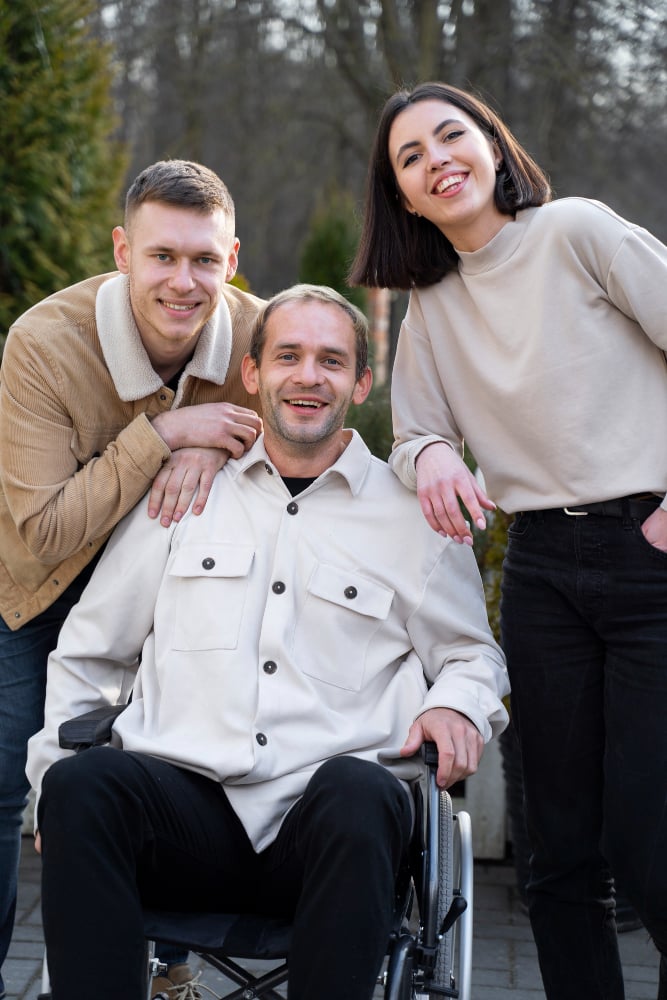
Lily walked into the kitchen exactly one year after her father’s funeral, holding a small cardboard box in both hands like it might break.
I was at the stove stirring chicken soup. It was a Tuesday. It was raining. The radio was on low, playing the same weather report it had been playing all afternoon.
She’d been quiet for days.
Not sad-quiet, exactly. Waiting-quiet. The way kids get on Christmas Eve, or the night before the first day of school. She’d been hovering around me, following me from room to room, starting sentences and not finishing them.
I’d figured it was the anniversary. A year since we put Daniel in the ground. I’d been feeling it too.
But now she was standing in the kitchen doorway in her purple socks with the box held out in front of her, and her face was so serious it scared me.
“Dad told me to give this to you today,” she said.
I turned off the burner.
“Before he died, he showed me where he hid it. In the back of his closet. Behind the winter boots.” She swallowed. “He made me promise not to touch it until today. Not even to look. And I didn’t. I promise I didn’t.”
“Okay, baby,” I said slowly. “Okay.”
“I’m supposed to say something too.”
She took a big breath. I could see her lips moving silently, practicing. Like she’d been rehearsing this for a whole year.
“You still have no idea why he chose you.”
The hair on my arms stood straight up.
I wiped my hands on the dish towel. I sat down at the kitchen table. Lily set the box in front of me and stepped back, like it was hot.
It was an old shoebox, the lid held on with a rubber band.
I took off the rubber band.
I opened the lid.
And to explain what I saw inside, and why I screamed loud enough that the neighbors came over later to check on us, I have to go back. A long way back.
Several years ago, I lost my husband and my little girl in a car accident.
My husband’s name was Sam. My daughter’s name was Josie. She was four.
Even now, there are parts of that day I can’t bring myself to talk about. I’ve tried. In therapy. With my sister. Alone in the car with the radio off. The words just stop somewhere in my throat, like a door closing.
So I won’t tell you those parts.
What I can tell you is the thing that nagged at me.
Josie had a stuffed rabbit named Mr. Bunny, and he went everywhere with her.
I mean everywhere. To the grocery store. To the pediatrician. Into the bathtub, which is why one of his ears was permanently stiff. To bed, of course, and to the breakfast table, where he had his own spot next to her cereal bowl. She wouldn’t eat anything green unless Mr. Bunny tried it first. He had a little gray felt nose and black button eyes and long floppy ears, and he’d been white once, a long time ago, but by the time Josie was four he was the color of weak tea.
She named him herself, at eighteen months. Mr. Bunny. Not Bunny. Mister. She was very firm about the Mister.
After the accident, the hospital handed me a clear plastic bag of her belongings. Her little pink sneakers. Her jacket with the ladybug buttons. A hair clip shaped like a strawberry.
I went through that bag twice.
No Mr. Bunny.
I asked the nurse. She didn’t know. I asked the police officer who came to the house. He said he’d look into it, and I could tell from his face that he thought I was a woman who’d lost her mind and was asking about toys.
Maybe I was.
Two weeks after the funeral, I drove out to the tow yard where they’d taken our car. A man in coveralls walked me out to it. He didn’t want to. He said, “Ma’am, I really don’t think you should see this.” I said, “I need to look for something.” He looked at me for a long time and then he walked away and let me be.
I searched that car for an hour. Under the seats. In the cracks. In Josie’s car seat, which I couldn’t look at directly, so I searched it with my eyes half closed.
He wasn’t there.
I had lost my whole family. My husband. My daughter. My house, eventually, because I couldn’t stand to live in it. And yet some nights, I still lay awake wondering where that rabbit had gone.
It sounds small. I know it does.
But it wasn’t small to me. His absence became one more piece of her I couldn’t bring home. Like she’d taken him with her, wherever she went. Or like someone had taken him from her at the last moment, and she’d been alone without him.
That was the thought I couldn’t stand. That she’d been scared, at the end, and he wasn’t there.
In the years that followed, I learned how to keep living without calling it moving on.
People always want you to move on. They say it kindly. They say, You’re still young. They say, Sam would want you to be happy. They say, Have you thought about seeing someone?
I never remarried. I never had another child. I never even dated. My sister, Beth, set me up once, about three years after. I sat across from a nice man at a nice restaurant and listened to him talk about his fantasy football team, and halfway through the salad I excused myself to the restroom and drove home.
I sold the house and moved into a one-bedroom apartment across town. I kept one box of Josie’s things in the closet. Her drawings. Her baby blanket. The strawberry hair clip. I didn’t open it often.
Eventually, I took a job as a housekeeper at St. Agnes Hospital.
I’d been a paralegal before. A good one. But I couldn’t go back to an office full of people who knew. Who’d tilt their heads when they talked to me. Who’d whisper that’s her when I walked to the copy machine.
At the hospital, nobody knew me. I wore a gray uniform and pushed a cart and cleaned rooms. I emptied trash cans and changed sheets and mopped floors. I learned which nurses liked to chat and which ones wanted to be left alone. I learned the difference between the smell of a room where someone was getting better and a room where someone wasn’t.
The work was quiet and predictable. Every day was the same. Fourth floor, then fifth, then the oncology wing in the afternoons.
For a long time, that was all I needed.
My friend Marisol, who worked the same shift, used to say I cleaned like I was apologizing to the room.
“You don’t have to be so gentle with the bed rails, mija,” she’d tell me. “They don’t break.”
“Everything breaks,” I’d say.
She’d look at me for a second. Then she’d hand me half her sandwich and change the subject.
Then one day I walked into Room 412 and met Daniel.
It was a Thursday in early spring. I knocked like always, said “Housekeeping,” like always, and pushed my cart in.
He was sitting up in bed, looking out the window. Thin. Gray around the edges, the way people get when they’ve been sick for a long time. He had dark hair that was going thin on top, and a face that looked like it used to smile a lot. He was maybe forty. He had an IV in one arm and a crossword puzzle in his lap.
He had terminal cancer. Pancreatic. I didn’t know that yet. I found out later from the chart on the door.
“Morning,” he said.
“Morning. I’ll be quick.”
“Take your time. I’m not going anywhere.” He smiled. “Literally.”
I didn’t laugh. Most people in the oncology wing made jokes like that, and I never knew if I was supposed to laugh.
He was a widower too. I found that out later as well. His wife, Claire, had died giving birth to their daughter. Complications. Something with her blood pressure. She’d lived long enough to hold the baby for about two minutes.
The baby’s name was Lily. She was five then. Five and three-quarters, she’d tell you, if you asked.
She showed up every afternoon at three-thirty, walked over from the elementary school across the street by one of the nurses, wearing a pink backpack that was bigger than her whole body. It had a unicorn on it with a missing eye. It bounced off the backs of her knees when she walked.
She’d come in, climb up on the bed beside her father, and tell him every single thing that had happened at school that day. Who cried at recess. What the class hamster ate. Which kid threw up during music. Daniel would listen to all of it with his eyes closed, smiling.
I started timing my cleaning of 412 so I’d be there at three-thirty.
I didn’t think about why. I just did it.
One morning, a few weeks after I first met them, I came in early and found Lily standing in the doorway with a hairbrush in her hand.
It was a Saturday. No school. Daniel had told me she’d be spending the day with him while the neighbor who usually watched her went to a wedding.
Lily had the worst tangle on her head I’d ever seen. Like a bird had moved in and built a nest and then left in a hurry.
Daniel was sitting propped up in bed, holding a hair tie, trying to help. His hands wouldn’t stop shaking. The chemo did that. He’d get the brush halfway through her hair and his fingers would tremble and the brush would slip, and Lily would wince but not say anything.
“Sorry, sweetheart,” he told her. “Daddy’s not much good at braids anymore.”
“It’s okay,” Lily said, in the voice of a kid who’d been saying it’s okay for a very long time.
I didn’t decide to do anything. I really didn’t. I put down my spray bottle and walked over.
“Give me that,” I said.
I had the brush before I’d decided anything.
Daniel looked up, surprised. Lily looked at me with big, cautious eyes. She held perfectly still, like I might change my mind if she moved.
I worked the tangle out slowly. From the bottom up, the way you’re supposed to. The way I’d done for Josie every morning, while she squirmed and complained and Mr. Bunny watched from the bathroom counter. Then I split Lily’s hair into three sections and braided it, tight and neat, down the middle of her back. I wrapped the hair tie around the end twice.
When I finished, Lily reached up and touched it with both hands. She felt it all the way down, from the top of her head to the end.
“Too tight?” I asked.
“No.” She turned around and looked up at me. “Just right.”
And she smiled.
That was all it was. A braid. Five minutes.
I had no idea how much it meant to her. I only knew she’d moved into my heart by lunchtime.
More days followed.
I braided her hair every afternoon. French braids, Dutch braids, two braids, one braid. I learned to do a fishtail from a video on my phone during my lunch break because she asked if I could.
I smuggled her granola bars from the staff room. The chocolate chip kind. She hid the wrappers in her backpack so the nurses wouldn’t see.
I checked her spelling words while Daniel slept off his chemo. Cat. Hat. Fish. Wish. She spelled wish with two h’s every single time, and every single time, I told her, “Only one h, bug. One wish, one h.” She’d giggle like it was the funniest thing she’d ever heard.
I didn’t realize I’d started calling her bug until Daniel pointed it out.
“Bug?” he said one afternoon, raising an eyebrow.
I felt my face go hot. “Sorry. It just—”
“No, I like it,” he said. “She likes it. She told me last night. She said, ‘Daddy, the cleaning lady calls me bug.'”
“I should probably stop.”
“Please don’t,” he said quietly.
Before long, Lily was sitting in my lap during his treatments. She’d climb up while I was taking my break in the visitor chair, without asking, and lean back against me and play games on my phone. And I let her.
I let her, and I held her, and some afternoons I had to close my eyes for a minute because of how much it felt like something I’d lost.
Marisol caught me once in the hallway, coming out of 412 with my eyes wet.
“Mija,” she said. “Be careful.”
“I am being careful.”
“No,” she said. “You’re not. That man is dying. And that little girl is going to need somebody. And you’re going to be standing right there.”
I didn’t answer her.
She was right. I just didn’t know yet how right.
Daniel was harder to read.
He’d watch me sometimes from across the room. While I was braiding Lily’s hair, or wiping down the windowsill, or checking her spelling words. He’d get this strange look on his face. Not unfriendly. Just searching. Like I was a word on the tip of his tongue that he couldn’t quite remember.
“What?” I asked him once.
He blinked. “Hmm?”
“You’re staring at me.”
“Nothing.” He smiled. “Gratitude. And the morphine.”
I laughed. I thought that was all it was.
I thought he was a dying father, relieved that somebody cared about his little girl. That’s what I would have felt. That’s what any parent would feel.
The two of us got close too. Slower than Lily and me, but just as real.
Tea at odd hours. He couldn’t sleep, and neither could I, so on my late shifts I’d bring two cups of chamomile from the nurses’ station and sit with him while the hospital hummed around us. Long talks, about everything and nothing. His job before he got sick; he’d been a high school chemistry teacher, and he still had opinions about the periodic table. His wife, Claire, and how she sang in the shower so loud the neighbors complained. My job as a paralegal. The books we liked. The places we’d always wanted to go.
He was funny. Not loud funny. Quiet funny. The kind of funny that sneaks up on you.
“What’s your favorite element?” he asked me one night.
“I don’t have a favorite element.”
“Everybody has a favorite element.”
“Fine. Gold.”
He made a face. “Gold. So predictable. Gold is the golden retriever of elements.”
“What’s yours?”
“Bismuth,” he said. “It makes these crystals that look like little staircases. Rainbow staircases. Nobody ever thinks about bismuth.”
“Maybe that’s why you like it.”
He looked at me for a long moment over his tea.
“Maybe,” he said.
One evening in late May, I told him about Sam and Josie.
I don’t know why. We’d been talking about Lily, and how she was scared of thunderstorms, and I said, “Josie used to be scared of thunder too,” before I could stop myself.
He went very still.
“Josie,” he said.
“My daughter.”
He didn’t ask. He just waited.
So I told him. Not the whole accident, because I never tell that part. But enough. That I’d had a husband and a little girl. That there was a car accident on a Sunday afternoon on Route 9. That I’d been at home, waiting for them to come back from the park. That I’d gotten a phone call.
I told him about the bag from the hospital. About the pink sneakers and the strawberry hair clip.
I didn’t tell him about Mr. Bunny. I don’t know why. Maybe it felt too small to say out loud to someone who was dying.
When I finished, I looked up.
His eyes had filled with tears. He turned his face away, toward the window.
“Sorry,” he said. His voice was thick. “Sorry. It’s just…” He stopped. “I… That’s a lot to hear. As a father.”
I thought he was imagining losing Lily. I thought that’s what the tears were.
“I know,” I said. “I’m sorry. I shouldn’t have—”
“No,” he said, very fast. “No. I’m glad you told me. I’m glad.”
He didn’t look at me again for the rest of the night.
When I came in the next morning, he was asleep. On his tray table, there was a piece of hospital stationery covered in writing, crossed out and rewritten so many times it was almost black.
I didn’t read it. I put it face down so it wouldn’t get wet when I wiped the table.
I thought it was a letter to Lily.
As he got weaker, the three of us started to look like a family.
I stopped pretending I was there to clean. I came in on my days off. I brought Lily coloring books and brought Daniel the crossword from the Sunday paper. We watched cartoons together, the three of us crammed onto that narrow hospital bed, with Lily in the middle. When nurses came in, they’d smile at us, and one of them, an older nurse named Pat, said to me once, “Your daughter is just precious.”
I didn’t correct her.
I should have. But I didn’t.
Then one afternoon in June, while Lily was at school, Daniel took my hand.
He hadn’t done that before. His fingers were cold and thin. I could feel every bone.
“Marry me,” he said.
I laughed. I actually laughed. I thought it was the morphine.
“Daniel.”
“I’m serious.”
“We barely know each other.”
“We’ve known each other three months.”
“Exactly.”
“Three months is a long time when you’re dying,” he said. “It’s like dog years.”
I tried to pull my hand back. He held on.
“I love you,” he said.
I stopped.
“I know how that sounds,” he went on. “I know what you’re thinking. Dying man. Hospital. Pity. But I mean it. I love you. And I won’t lie to you. I’m scared. More than anything in the world, I’m scared.” His voice cracked. “I don’t have family. My parents are gone. Claire’s parents are in a nursing home in Florida and they don’t remember her name half the time. There’s nobody. And more than anything, I want to know that when I’m gone, Lily will be with someone who loves her.”
I looked down at our hands.
By then, I already loved her.
I loved her so much it scared me. I loved the way she spelled wish with two h’s. I loved the way she leaned back against my chest during treatments. I loved the weight of her in my lap. I loved her more than I’d let myself love anything in years.
“I’m not asking you to love me back,” Daniel said quietly. “I’m asking you to love her. I’ve seen that you already do.”
I sat there for a long time. The IV machine beeped. Someone laughed in the hallway.
I thought about Josie. About the empty space she’d left, which I’d built my whole life around, like a house built around a hole in the ground.
I thought about Lily, alone in the world at six years old.
I said yes.
We married in his hospital room on a Saturday in late June.
The hospital chaplain, a round, kind man named Father Ruiz, performed the ceremony. Pat and Marisol were our witnesses. Marisol cried through the whole thing and blew her nose so loudly that Lily got the giggles.
I wore a white sundress I’d bought that morning at the department store across the street. Daniel wore a button-down shirt over his hospital gown, which Lily thought was hilarious. “Daddy’s wearing a costume,” she whispered to me.
Lily wore a yellow dress with daisies on it. I’d braided her hair into a crown around her head and tucked little white flowers into it.
She stood between us during the vows. She never let go of my hand. Not once.
When Father Ruiz said, “You may kiss the bride,” Daniel leaned over, and Lily yelled, “EW!” so loud that a nurse came running to check on us.
Everybody laughed. Daniel laughed so hard he started coughing, and I had to help him sit up, and he held onto my arm and kept laughing even while he coughed.
I hadn’t heard that much laughter in one room in years.
Before the wedding, Daniel had already signed all the paperwork. A lawyer had come to the hospital twice. Daniel had named me as Lily’s guardian after his death. Everything was settled. Everything was legal.
“I just wanted to make sure,” he told me that night, after Lily was asleep in the visitor chair, curled up under my cardigan. “Before. Just in case.”
“In case what?”
“In case I didn’t make it to the wedding.”
I held his hand in the dark.
“You made it,” I said.
“I made it,” he said, like he couldn’t believe it either.
Two weeks later, he died.
It was early on a Wednesday morning. I was asleep in the chair beside his bed. Lily was at home with the neighbor. Pat woke me up by touching my shoulder.
I knew before she said anything.
I sat with him for a long time. I held his hand until it got cold. I didn’t cry. Not then. I was too busy thinking about how I’d tell Lily.
In the end, I told her the truth. I sat on her bed that afternoon, in her room with the glow-in-the-dark stars on the ceiling, and I said, “Daddy died this morning, bug. He wasn’t in pain anymore. He went to sleep and didn’t wake up.”
She looked at me for a long time. She didn’t cry.
“Are you still here?” she asked.
“I’m still here.”
“Okay,” she said.
And then she climbed into my lap and cried so hard she threw up.
Lily and I moved into his house.
It was a small brick house on a quiet street with a big oak tree in the front yard and a tire swing that Daniel had hung the summer Lily turned three. It was full of his things. His coffee mugs. His books. His chemistry posters. His winter coat on the hook by the door.
The quiet in that house felt like somebody holding their breath.
That first year was hard.
I won’t pretend it wasn’t. There were nights Lily woke up screaming at two in the morning, calling for her daddy, and I’d run down the hall and get into her bed and hold her until she fell back asleep, and then I’d lie there awake until the alarm went off. There were mornings I burned the pancakes because I was staring out the window. There was a day in November when I couldn’t get out of bed, and Lily brought me a bowl of dry cereal and a juice box and sat on the edge of the bed and patted my hair.
“It’s okay, Mommy,” she said.
It was the first time she’d called me that.
I didn’t correct her. I just held her hand.
We grieved him together. Through burned pancakes and two-in-the-morning nightmares and a Christmas that we got through mostly by watching movies under a blanket.
But slowly, we built things that belonged only to us.
Friday pancakes, shaped like whatever Lily demanded. A dinosaur. A unicorn. Once, memorably, a pancake shaped like her teacher, Mrs. Abernathy, complete with chocolate chip glasses.
A car song with made-up words. We sang it every morning on the way to school. It was supposed to be to the tune of “Twinkle, Twinkle, Little Star,” but by spring it had evolved into something unrecognizable about a cat who drove a bus.
A way of sitting on the couch together in the evenings, with our feet tangled together under a blanket, so you couldn’t tell whose toes were whose.
I went back to work at the hospital part-time. I picked her up from school every day at three. I braided her hair every morning.
Every single morning.
Then, a year to the day after the funeral, she walked into the kitchen with the box.
I’m back now. You know where we are.
The rain against the window. The soup going cold on the stove. Lily in her purple socks, standing back from the table like the box might explode. And me, with the lid in my hand, looking down.
Mr. Bunny lay in the box.
A scream tore out of me before I could stop it.
I didn’t decide to scream. It just came. From somewhere so deep inside me I didn’t know it was there. It was the sound I hadn’t made at the hospital, or at the funeral, or in the tow yard. Six years of it. All at once.
I knew him instantly.
The fur was worn thin on his belly, where Josie used to squeeze him while she slept. His left ear still had the crooked stitch I’d sewn at the kitchen table one night after she went to sleep, when the ear started coming off at the seam. I’d used the wrong color thread, light blue instead of white, because it was all I had. Josie said it was his “fancy stitch.”
And there on his tag, in green marker, were her wobbly initials.
J.R.
She’d written them herself, at the kitchen table, with her tongue sticking out of the corner of her mouth. The J was backwards. It had always been backwards.
I couldn’t breathe.
I picked him up and pressed him to my face. He smelled like dust and cedar from Daniel’s closet. And under that, so faintly I might have imagined it, like nothing at all.
He didn’t smell like her anymore.
Six years. Of course he didn’t.
“I’m sorry!” Lily was crying. “I’m sorry! I didn’t know! I didn’t open it, I promise!”
I looked up.
Lily was backing toward the wall, frightened by my reaction. Her face was red. Her hands were up in front of her, like she was trying to protect herself from something. Six years old, crying over something she didn’t understand.
That brought me back faster than anything could have.
“Lily,” I said. “Lily, look at me.”
She was still backing up. Her back hit the wall.
“Lily. You did nothing wrong. Not one thing. Do you hear me? Not one thing.”
“Then why are you screaming?”
I looked down at the rabbit in my hands.
“Because…” My voice broke. “Because I don’t understand how your dad could possibly have this.”
I looked into the box again, and that’s when I saw the letter.
It was lying at the bottom, under where Mr. Bunny had been. A plain white envelope.
My name was written on the front in Daniel’s slanted handwriting.
My hands shook so badly as I opened it that the paper rattled. Lily slid down the wall and sat on the floor and pulled her knees up to her chin and watched me.
It was three pages long. Hospital stationery. I recognized it. It was the letter I’d seen that morning on his tray table, crossed out and rewritten so many times it was almost black.
I’d turned it face down so it wouldn’t get wet.
I started reading.
He wrote that he’d been there on the day of the accident.
He’d been driving on Route 9 that Sunday afternoon, heading home from his sister-in-law’s in Pennsylvania. He was maybe a minute behind us. He came around the curve and saw the wreck. He pulled over. He called 911. He ran to help.
Your husband was already beyond help, he wrote. I’m so sorry. I checked. I want you to know I checked.
But your daughter was still awake.
I stopped reading. I put the letter down on the table and I pressed both hands flat on top of it and I breathed.
Lily didn’t move.
I picked it up again.
I stayed with her. I couldn’t get her out. The door was jammed, and I was afraid to move her. So I reached through the window, and I held her hand, and I talked to her. I told her help was coming. I told her she was so brave. I told her about my own little girl, who was two months old, at home with her grandmother.
I think she knew she wouldn’t make it. She was very calm. She was holding this toy against her chest the whole time. Right up until the end.
Then she gave it to me.
She held it out the window and she said, “Make sure Mr. Bunny gets home to my mommy.”
And I promised her he would.
Keeping that promise became harder than I could have imagined.
I read that line three times.
Make sure Mr. Bunny gets home to my mommy.
Then I couldn’t read at all.
Some sound came out of me that I’d never heard before. Not a scream this time. Something lower. Something that came from the bottom of my chest and kept coming.
She’d been thinking of me. At the very end. Alone in that car, with her daddy already gone, and a stranger holding her hand through the window. She’d been thinking about getting her rabbit home to me.
Six years I’d lain awake wondering whether she called for me. Whether she was scared. Whether she was alone.
She wasn’t alone.
And she was thinking of me.
“Mom?” Lily asked quietly, from the floor.
And my heart shattered.
It took me a long time to keep reading.
When I did, the handwriting got messier. Like he’d written this part later, when his hands were worse.
I went to the funeral to give you the rabbit. I had him in my coat pocket. I stood in the back of the church.
But when I saw you standing next to the caskets, crying, I couldn’t do it. What do you say? How do you walk up to a woman at her daughter’s funeral and hand her a stuffed animal and tell her you were there, and you couldn’t save anybody?
So I left.
I told myself I’d wait. A few weeks. Until the hurt wasn’t so fresh. I found your address. I drove past your house four times that first year. I never stopped the car.
Then you moved, and I lost track of you. And I told myself that was a sign. That maybe it would only hurt you more.
But I never stopped thinking about that promise. As time passed, it got harder and harder. Every year, there was a better reason to wait. Then I got sick.
And then you walked into my hospital room.
I didn’t know you at first. I only saw you at the funeral from far away, and you looked so different. But then you told me your name. And then you told me about Sam, and about Josie. And I knew.
I should have told you that night. I tried. I wrote this letter seven times. I couldn’t.
I kept waiting for a perfect moment, until my illness made sure there wouldn’t be one.
So I hid the box, and I asked Lily to wait a year. So the two of you would have time to become a family first. Without this in the way.
I’m sorry. I’m so sorry. I failed your daughter’s promise.
— Daniel
I folded the letter very carefully. The way you handle something so you don’t throw it.
I laid it on the table next to Mr. Bunny.
And then I felt the grief turn.
I felt it happen. Physically. Like a car shifting gears. One second I was falling. The next second I was standing up inside myself, and something hot and hard was rising in my chest.
He knew.
He knew who I was. Every single day. Every time I braided his daughter’s hair. Every time I brought him tea at two in the morning. Every time I sat on that narrow hospital bed watching cartoons.
He knew.
He knew what that rabbit was worth to me. He watched me tell him about the hospital bag and the pink sneakers and the strawberry hair clip, and he cried and turned to the window, and he didn’t say a word.
He married me. He stood there in his button-down shirt over his hospital gown and said I do, with Mr. Bunny sitting in a box in the back of his closet across town.
He let me move into his house. He let me sleep down the hall from that closet for a whole year.
And then he died, and he passed the burden of his promise to Lily. Someone innocent. A little girl. The one person on earth I could never, ever allow my grief and my anger to touch.
Daniel picked the one person I couldn’t be angry at, and he put the truth in her hands.
Coward.
That’s what I thought.
Coward.
And there were things I’d never get to ask. Things only he knew. Was Josie scared? Did she cry? Did she say anything else? What did her voice sound like? What did she say about me?
He was gone. There would never be a fight. There would never be an apology I could throw back in his face. There would never be a chance to scream at him the way I wanted to scream.
There was only a rabbit that didn’t even smell like my Josie anymore.
“Are you mad at Dad?”
Lily’s voice was tiny.
She was still sitting on the floor with her knees pulled up. Her face was blotchy. She’d been watching me the whole time.
Could I lie to her?
I’d like to tell you I could have. That I smiled and said of course not, baby and swept it all under the rug.
But she deserved honesty. She’d already been lied to enough by grown-ups who thought they were protecting her. Daddy’s going to get better. The medicine is working. And I was too tired to do anything else.
“Yes,” I said. “I am.”
Her face crumpled.
“But listen to me,” I said, and I got up from the chair and knelt down on the kitchen floor in front of her. “None of this is your fault. Not one bit of it. Do you understand? You did exactly what your daddy asked. You kept a promise for a whole year. Do you know how hard that is? Grown-ups can’t even do that.”
Her chin wobbled anyway.
And then she asked the question she’d probably been holding for days. Maybe for a whole year.
“Are you going to leave me?”
Everything in me stopped.
Here was a child who’d already lost both her parents. Her mother before she could remember. Her father a year ago. And now she’d watched her last person cry and scream over something she’d delivered, something her daddy had made her carry, and she was doing the math.
She was six years old, and she was doing the math on whether she was about to be alone in the world.
“No,” I said. “No, no, no. Come here.”
She climbed into my lap. Right there on the kitchen floor. She grabbed my collar in both fists and held on so tight it pulled the neck of my shirt.
“I’m not going anywhere,” I told her. “I’m not going anywhere. I’m not going anywhere.”
I said it over and over, into her hair, until her breathing slowed.
But I’d be lying if I said my head was quiet.
Because I kept seeing that line he’d made her repeat. You still have no idea why he chose you.
And here’s what my mind did with it. I’m not proud of this.
I thought I finally understood.
Daniel knew I was a mother once. He’d seen what happened to my child. He’d held her hand while she died.
Maybe he’d been carrying that guilt for six years. Maybe he looked at me in that hospital room, a broken woman with an empty space where a daughter used to be, and he thought, There. That’s who can fill it. Maybe he thought, I couldn’t save her daughter. So I’ll give her mine.
Maybe I wasn’t a wife at all. Maybe I wasn’t someone he loved. Maybe I was a debt he was paying off. A way to settle his conscience before he died.
And Lily was the payment.
The memories I had of Daniel began to feel different. I went back through them, one by one, like old photographs, and I looked at them in this new light. His strange looks across the room. Gratitude. And the morphine. The way he cried when I told him about Josie. Marry me. I’m not asking you to love me back. I’m asking you to love her.
I no longer knew how much of what I’d seen in him was love, and how much had been guilt.
I hated him a little bit more.
“I think I finally get why your dad chose me,” I said. Mostly to myself. Mostly to the kitchen ceiling.
Lily lifted her head off my shoulder.
“But he didn’t,” she said. “That’s what’s weird.”
I looked down at her. “What?”
“Dad didn’t choose you.” She said it so plainly. Like she was telling me the sky was blue. “I did.”
“Lily, sweetheart,” I said slowly. “I don’t understand.”
She sat back in my lap and picked at the hem of her sleeve. She does that when she’s thinking hard.
“It was before you got married,” she said. “Before Dad even liked you like that. Like a girlfriend.” She made a face at the word. “You’d been doing my hair a lot. And you sat with me when Dad was too tired to talk. And you brought me the granola bars.”
“I remember.”
“So one night, after you went home, I asked him something.”
She glanced up at me. Her eyes were very serious.
“I said, ‘Daddy, is this what having a mommy is like?'”
I can’t tell you what those words did to me.
I can’t. I’ve tried to explain it to my sister, and to Marisol, and to the therapist I started seeing again. It was like being hit in the chest and hugged at the same time.
“He asked me what I meant,” Lily went on. “And I said you knew how I liked my hair. Not too tight. You remembered stuff I told you, like that I’m scared of thunder and I hate the crust. You helped when I got scared. And you made sure I had what I needed.”
She shrugged. A tiny, six-year-old shrug.
“And you stayed. You always stayed.”
“What did he say?” I whispered.
“He was quiet for a long time. Then he asked how I felt about you.” She looked straight at me. “And I said I wanted you to keep staying. Forever. I told Dad I wanted you.”
She smiled a little.
“And he said he wanted you too.”
I put my hand over my mouth.
Something in me loosened.
All that afternoon, I’d been afraid. Afraid that Daniel saw a grieving mother and picked me out like a replacement part. That he’d chosen me to fill an empty place in Lily’s life because of what he owed me. That I was a debt, and Lily was the payment, and none of it, none of the braids and the pancakes and the car songs, had been real.
But Lily had begun choosing me before any of those pieces came together.
Before Daniel told me he loved me. Before the wedding. Before the guardianship papers. Before anyone had a plan.
She’d chosen me in a hospital room, with a tangle in her hair, holding perfectly still so I wouldn’t change my mind.
And I had begun loving her the same way. Not because of Josie. Not because of anything Daniel owed me. Because she was Lily. Because she spelled wish with two h’s. Because she held my hand through a whole wedding and yelled EW.
Daniel’s secret ran alongside all of it.
It never made any of it.
I didn’t forgive Daniel in that kitchen.
I want to be honest about that. I didn’t sit on that floor and have some beautiful moment of understanding. I was still angry. I’m still angry, sometimes, even now.
He had kept Mr. Bunny for six years. He had driven past my house four times and never stopped the car. He had married me without telling me the truth. And he had left his six-year-old daughter to deliver it after he died, because he couldn’t face doing it himself.
Those things were real. They were wrong. Nothing Lily said could change that.
But I no longer had to wonder whether Lily had been handed to me like a consolation prize.
She chose me first.
And I chose her. Every ordinary day after. With every braid.
We sat on the kitchen floor for a long time.
The soup went cold. The rain kept falling. The radio went from weather to traffic to some old song I half recognized.
Eventually, Lily reached out and touched the rabbit’s crooked ear. The one with the light blue stitch.
“Who does he belong to?”
I took a breath.
“His name is Mr. Bunny,” I said. “Mister. You have to say the Mister. She was very firm about that.”
Lily nodded seriously.
“He belonged to my daughter.”
Lily was quiet. She stroked the crooked ear with one finger.
“I know you had a daughter,” she said carefully. Like she was walking on ice. “Daddy told me. But I never knew her name.”
I realized then that I had never said it. Not once, in that whole year. Not in that house. I’d thought about her every day, but I’d never said her name out loud to Lily.
I’d been afraid to. Afraid it would feel like a betrayal. To Josie, or to Lily. I wasn’t sure which.
“It was Josie,” I said.
Lily whispered it back, testing it out. Like a word in a new language.
“Josie.”
“Josie,” I said again. And it didn’t hurt as much as I thought it would.
I told her how Josie carried Mr. Bunny everywhere. Even into the bathtub, which is why his ear was stiff. How she loved him so hard his fur wore off on his belly. How she wrote her initials on his tag herself, and got the J backwards, and wouldn’t let me fix it.
“Why not?” Lily asked.
“She said it was his name. Backwards J. Like a secret code.”
Lily looked at the tag. She touched the backwards J.
“That’s a good code,” she said.
She was quiet, leaning on my shoulder.
Then she asked the question she actually needed.
“So… you’re still my mommy?”
“Yes.”
I said the word before she’d even finished her sentence.
She melted against me. All the tension went out of her body at once, like a balloon letting go of its air.
A moment later, she looked at the rabbit again. Her voice went soft.
“Will you tell me about Josie?”
So I did.
I started with the way Josie sang off-key in the car. Worse than me, even. She sang every song like it was the most important song in the world, at the top of her lungs, with all the wrong words.
“Like our cat bus song?” Lily asked.
“Exactly like our cat bus song.”
I told her how Josie wouldn’t eat anything green unless Mr. Bunny went first. How she’d hold him up to the broccoli and make him pretend to take a bite, and then wait, very seriously, to see if he got sick. Only after he survived would she try it herself.
Lily laughed. A real laugh. The first one in days.
“That’s smart,” she said. “He was like a tester.”
“He was exactly like a tester.”
I told her about Josie’s birthday parties. Her favorite color, which was orange, which nobody’s favorite color ever is. Her pretend restaurant in the living room, where every single dish cost “eleventy dollars.”
Lily stroked Mr. Bunny gently the whole time I talked. Slowly. Over and over. Like she was comforting him.
He’d come a long way to get here.
But finally, he’d come home. To me. Like Josie wanted.
That night, after Lily was asleep, I sat in the living room with Mr. Bunny in my lap and read Daniel’s letter again.
All three pages. Slowly. I made myself read every crossed-out word I could make out underneath the black ink.
On the second page, in the margin, so small I’d missed it the first time, he’d written something and then not crossed it out.
She said “my mommy” like you were the safest place in the world.
I sat with that for a long time.
I’d wanted to know if Josie was scared. If she called for me.
She hadn’t called for me. Not exactly.
She’d sent something home to me instead.
And then I thought about Daniel. About a man who’d reached through a broken car window and held a stranger’s child’s hand while she died. Who’d driven home that night to his own baby girl and his own wife, who’d died just two months before. Who’d carried a stuffed rabbit in his coat pocket to a funeral and couldn’t make himself walk to the front of the church.
Who’d kept that rabbit for six years, through his own grief, through raising a daughter alone, through cancer, because he’d made a promise to a four-year-old and couldn’t bear to break it, and couldn’t bear to keep it either.
He was a coward. I still think that. He should have told me. In that hospital room, on that night I told him about Josie, he should have put down his tea and said, I was there.
But he was also a man who’d held my daughter’s hand when I couldn’t.
I don’t know how to hold both of those things at the same time. I’m still learning.
A few weeks later, on a Saturday, I took Lily to the cemetery.
Not to Daniel’s grave. Not yet. I wasn’t ready for that.
To Josie’s.
It’s on a hill, under a maple tree. Sam is beside her. I hadn’t been there in almost a year. I’d been too busy. Or that’s what I told myself.
Lily held my hand the whole way up the hill. She was carrying Mr. Bunny. She’d asked if she could.
When we got to the top, she stood in front of the small gray stone and read the name out loud, slowly, sounding it out.
“Jo-sie Ann Reyes.”
“That’s her.”
Lily looked at the stone for a long time. Then she held up Mr. Bunny so he was facing it.
“He’s home now,” she told the stone. Very seriously. “My mom got him. He’s okay. You don’t have to worry.”
I had to sit down on the grass.
Lily sat down next to me. She leaned against my side. We stayed there a long time while the wind moved through the maple leaves.
On the way back down the hill, she asked, “Can we visit Daddy too? Not today. Some other day.”
“Some other day,” I said.
“Are you still mad at him?”
I thought about it.
“A little,” I said. “But less than before.”
“How come less?”
I looked down at her. At the braid I’d done that morning, tight and neat, down the middle of her back.
“Because he kept his promise,” I said. “Even though it took him a really long time. And even though he made you help.”
She nodded like that made sense.
“I’m glad I helped,” she said.
We went to Daniel’s grave the following month. On a Sunday. Lily wore the yellow dress with the daisies, even though it was getting too short for her.
I stood in front of his stone for a long time without saying anything.
Lily wandered off a little way to look at a squirrel.
And I finally had the fight I never got to have.
I didn’t yell. I talked quietly. I told him he should have told me. I told him what it did to me, opening that box in the kitchen with his daughter watching. I told him it wasn’t fair to put that on her. I told him I’d lain awake for six years wondering if my baby was scared and alone, and he’d had the answer in his closet the whole time.
Then I told him the other thing.
“Thank you for holding her hand,” I said. “Thank you for staying with her. I couldn’t be there. You were.”
The wind picked up. Somewhere behind me, Lily laughed at the squirrel.
“And thank you for Lily,” I said. “Even if it was her idea.”
I didn’t forgive him all the way that day either. I’m not sure I ever will, completely.
But I left a bismuth crystal on his headstone. Lily and I bought it at the science museum gift shop. It looks like a tiny rainbow staircase.
Nobody ever thinks about bismuth.
Mr. Bunny lives on the shelf in Lily’s room now.
I asked her where she thought he should go. I thought maybe she’d want him in her bed. Or maybe she’d want me to keep him in my room, since he was mine.
She thought about it for two whole days. Then she said, “He should go where he can see both of us.”
So he sits on the bookshelf between her bed and the door, where you can see him from the hallway. He leans against her copy of Goodnight Moon. His crooked ear with the light blue stitch flops down over one eye.
Every night, when I tuck Lily in, she says goodnight to him.
“Night, Mister Bunny.”
She always says the Mister.
Some nights, she asks me to tell her another story about Josie. I tell her about the time Josie tried to give the cat a bath. About the snowman with a carrot for a nose and a banana for a mouth. About the night she couldn’t sleep because she was worried the moon was lonely, so we went outside in our pajamas and waved at it.
And some nights, after Lily falls asleep, I stand in the doorway for a while and look at the two of them. Lily asleep under her glow-in-the-dark stars, with her braid coming loose on the pillow. Mr. Bunny on the shelf, keeping watch.
I used to think love was something you only got one of. That if you lost it, the space stayed empty forever, and the best you could do was build your life around the hole.
I was wrong.
The space doesn’t fill up. Josie’s still there. She’ll always be there. Nobody replaces anybody.
But it turns out a heart can grow a new room. Right next to the old one. And sometimes, if you’re very lucky, a little girl with a tangle in her hair walks right in and decides to stay.
Mr. Bunny came a long way to get home.
So did I.

Laura Bennett writes about complicated family dynamics, difficult conversations, and the quiet moments that change everything. Her stories focus on real-life tensions — inheritance disputes, strained marriages, loyalty tests — and the strength people find when they finally speak up. She believes the smallest decisions often carry the biggest consequences.