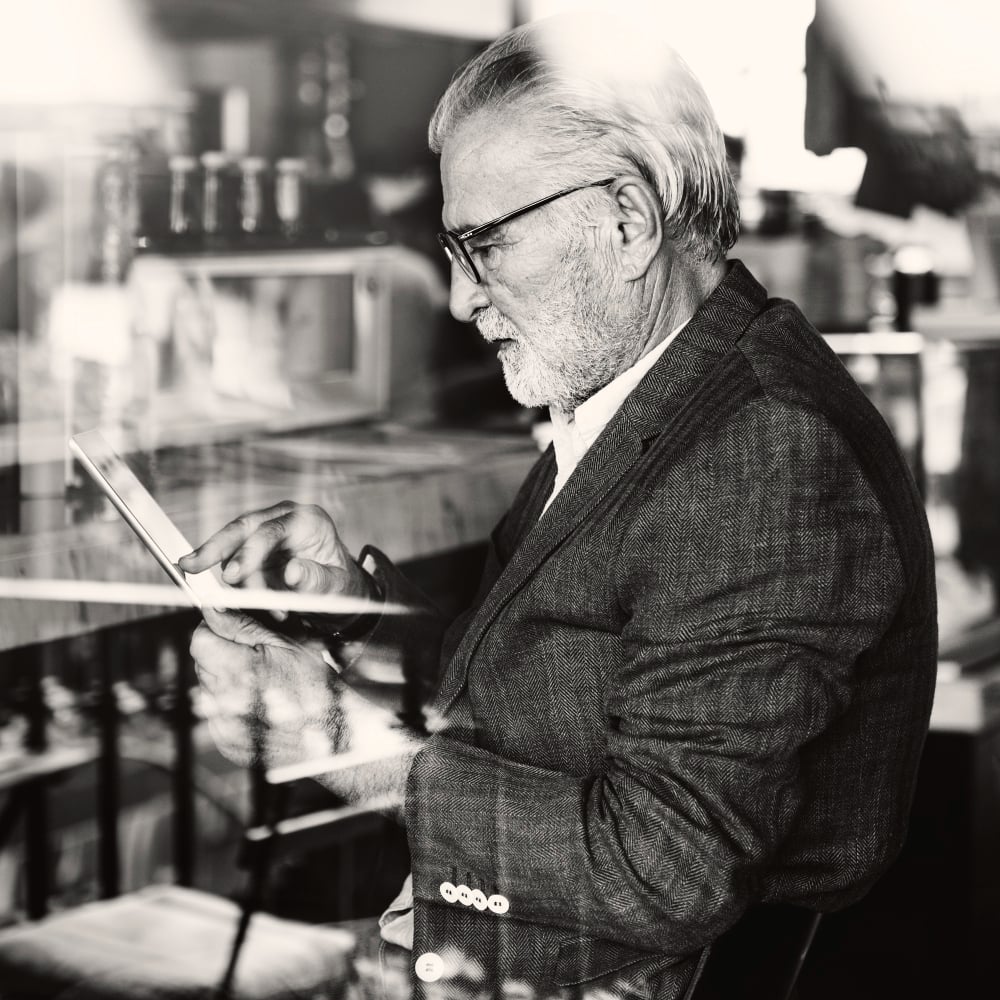
“You walk like someone who’s forgotten how to live.”
Ernest Walker said it on my third afternoon in his house. I was carrying his tea tray across the library, moving the way I always moved, fast and tight, shoulders up near my ears, like someone was timing me.
I stopped in the middle of the rug. The cups rattled on their saucers.
“I’m sorry?”
He was sitting in his leather armchair by the tall windows, both hands folded on top of his cane. Eighty years old. Snow-white hair. Gray eyes so clear and steady that I had to look away from them.
“You heard me,” he said gently.
I set the tray down on the side table. My hands were shaking a little. I didn’t know why.
“I’m just in a hurry,” I said. “I always am.”
“I know,” he said. “That’s what worries me.”
I poured his tea. I didn’t say anything else. But that night, driving home, I kept hearing it. You walk like someone who’s forgotten how to live.
I’d taken that job because I desperately needed the money.
I never imagined that the lonely old man everyone on our street had forgotten would be the one person who could see the broken parts of me I thought had died years ago.
And I never imagined what was waiting for me behind a locked door at the end of his upstairs hallway.
When I took the position, I wasn’t searching for purpose. I was searching for a paycheck.
Bills were piling up on the kitchen table. Gas. Electric. A dentist bill for my son’s braces. My husband, Greg, had lost his sales job in the spring, and the new one paid less, and he’d grown colder with every passing month. Colder and quieter, except when he was angry. Then he was very loud.
My children didn’t need me the way they once had. Ben was thirteen and lived inside his headphones. Tess was eleven and had suddenly decided I was embarrassing. They came home from school, said “hi,” and disappeared into their rooms.
Our house felt enormous. Empty. Filled with the kind of silence that slowly eats away at your heart.
I’d had Ben at eighteen. I’d married Greg at nineteen. I’d spent my entire adult life taking care of people. Packing lunches. Folding laundry. Waiting for Greg to come home and tell me what kind of mood he was in so I’d know how to act.
Somewhere in there, I’d lost track of who I was. I couldn’t even tell you when.
My neighbor Rose told me about the job. Rose was seventy and lived two doors down and knew everything about everybody on Linden Street. She caught me at the mailbox one morning in September, looking at a shutoff notice from the electric company.
“You need work,” she said. It wasn’t a question.
“I’m looking.”
“Ernest Walker needs someone in the afternoons. The house at the end of the street. Behind the big gate.”
“The mansion?”
“That’s the one.” She tapped the shutoff notice with one finger. “He pays well. And he’s lonely. You’d be doing each other a favor.”
I didn’t know it then, but Rose had been planning that conversation for a long time.
The work sounded simple enough.
Prepare his tea. Organize his medications. Read him the newspaper, because his eyesight had grown weak. Keep him company through the long hours of the afternoon.
Everybody on our street knew a little about Ernest Walker. He’d been a brilliant engineer, they said. He’d traveled all over the world building bridges and dams and things with long names. His wife had died years ago. His children lived far away. Nobody ever saw him anymore. Just the gardener on Thursdays and a grocery van on Mondays.
The house sat at the very end of Linden Street, hidden behind a tall wrought-iron gate wrapped in ivy. When I was a little girl, the kids in the neighborhood used to dare each other to touch that gate. We said it was haunted.
I’d never touched it.
The first time I stepped through it, on a gray Monday afternoon, a strange feeling washed over me.
It wasn’t fear.
It was something closer to respect. Like walking into a church. The property felt untouched by time, as if the outside world had simply forgotten it existed. The lawn was overgrown at the edges. Roses climbed the brick walls. A stone fountain stood dry in the middle of the front garden, with a carved bird on top missing one wing.
Mr. Walker greeted me at the front door himself, leaning lightly on a polished wooden cane.
Even at eighty, he stood remarkably tall. His snow-white hair framed a face carved by time and weather, but his gray eyes were sharp and bright and intense. He looked at me like he could read every single thought I was trying to hide.
He didn’t look at me the way a lot of old people do. With sadness. Or quiet surrender.
He looked curious.
Almost like he wanted to understand who I really was before either of us said another word.
“So,” he said, in a calm, steady voice. “You’re the young woman who’s going to take care of me?”
“Yes, Mr. Walker,” I said, with a nervous smile. “I’m Laura. My neighbor Rose recommended me.”
He looked at me for a long moment. A very long moment. Long enough that I started to wonder if something was wrong with my face.
Then a faint smile crossed his.
“Rose has always enjoyed involving herself in other people’s lives,” he chuckled. “Come in, Laura.”
The inside of the house felt like walking into another century.
Heavy oak furniture in every room. Faded Persian rugs. Framed black-and-white photographs lined the hallway walls. Bridges. Construction sites. A young man in a hard hat squinting into the sun. Shelves overflowed with engineering books and history books and old novels with cracked leather spines.
The air smelled like polished wood and old paper and something sweet, like pipe tobacco that had soaked into the walls years ago.
He showed me the kitchen. It was huge and old-fashioned, with a black iron stove and copper pots hanging from hooks. He showed me where the tea was kept, and the cups, and the little wooden box where his pills were sorted by day.
As I filled the kettle, I noticed him watching me from the kitchen doorway.
His gaze wasn’t uncomfortable. It wasn’t inappropriate.
It felt more like someone looking at something they hadn’t seen in a very long time.
I got self-conscious. I dropped a spoon.
“Is something wrong?” I asked, bending to pick it up.
He shook his head slowly.
“You move too fast,” he said.
I laughed awkwardly.
“I guess that’s just my life. At home I’m always rushing from one thing to the next.”
He nodded. He looked out the kitchen window at the overgrown garden for a while. Then he spoke again.
“Not here.”
I waited.
“Here,” he said softly, “there’s nowhere you need to run.”
His words settled over me in a way I couldn’t explain. Like a blanket somebody puts over you when you’ve fallen asleep on the couch.
Then he looked back at me with those clear gray eyes and quietly added:
“If you stay, Laura, you might remember what it feels like to walk slowly again.”
I didn’t know how to answer that.
But before my very first afternoon with Ernest Walker was over, I already felt something inside me beginning to wake up. Something I’d believed was gone forever.
Over the following weeks, we settled into a quiet rhythm.
I’d arrive at one o’clock. I’d brew his tea, Earl Grey with a slice of lemon and no sugar. I’d arrange his medicine in the little wooden box. Then I’d sit beside the tall library windows and read to him.
The newspaper first. He liked the obituaries, which I thought was morbid until he explained.
“At my age, Laura, it’s how you keep score,” he said. “And how you find out which of your enemies you’ve finally outlived.”
Then books. He had me read him an old adventure novel about a man sailing around the world alone. He’d close his eyes while I read. Sometimes I thought he’d fallen asleep. But the second I skipped a line, he’d open one eye and say, “You missed something.”
But here’s the strange thing.
He always asked more about my life than I asked about his.
“What did you want to be, when you were young?” he asked one afternoon.
“I don’t know. Nothing, really.”
“Everybody wants to be something.”
I thought about it. I hadn’t thought about it in years.
“I used to paint,” I said finally. “When I was a teenager. Watercolors. I was pretty good, actually. My art teacher wanted me to apply to a college program.”
“Did you?”
“I got pregnant with Ben instead.” I laughed, but it didn’t sound like a laugh. “Greg says painting is a hobby for people with too much time.”
Ernest didn’t say anything. But his hands tightened on his cane.
“And your mother?” he asked. “What did she think of your painting?”
“She hated it,” I said. “She’d get upset every time I brought my paints out. She’d find reasons for me to put them away. I never understood why.”
Ernest went very still.
Then he looked out the window for a long time, and changed the subject.
That Sunday, I had dinner at my mother’s house with Greg and the kids. We did it every other week. My mother, Clara, lived across town in a small, very neat house with plastic covers on the lampshades.
She was sixty-two. Thin. Nervous. She’d always been nervous, my whole life. She checked the locks three times before bed. She never let me walk home from school alone, not even in high school. She never let me go on overnight field trips. She never let anyone take my picture for the school newspaper.
I’d always thought she was just overprotective. That she loved me so much she was afraid of losing me.
At dinner, Tess asked me about my new job.
“Is the old man nice?”
“He is,” I said. “He’s really interesting. He was an engineer. He built a bridge in Brazil. His name is Ernest Walker, and he lives in that big house at the end of our street, behind the gate.”
My mother dropped her water glass.
It hit the edge of her plate and shattered. Water and ice and glass went everywhere. Across the tablecloth. Into the mashed potatoes. Onto Greg’s lap.
“Jesus, Clara!” Greg said, jumping up.
My mother didn’t move.
She was staring at me. Her face had gone completely white. Her hands were shaking on the tablecloth.
“Mom?” I said. “Are you okay?”
“I’m fine,” she said. Too fast. “My hand slipped.”
She got up and went into the kitchen for a towel. She was in there for a long time. When she came back, her eyes were red.
She didn’t say another word all through dessert.
As we were leaving, she grabbed my arm at the front door. Hard. Her fingers dug in.
“Laura,” she said, very low, so the kids couldn’t hear. “You should find another job.”
“What? Why?”
“Just—find another one. There are plenty of jobs.”
“Mom, it pays twice what anywhere else does. We need the money.”
“I’ll give you money.”
“You don’t have any money, Mom.”
She let go of my arm. She looked at me for a long moment with the strangest expression on her face. I’d never seen it before. I couldn’t name it.
It looked a lot like fear.
“Please,” she said. “Just be careful.”
Then she shut the door.
I didn’t quit.
I don’t know why, exactly. Maybe because for the first time in years, I had somewhere to go every afternoon that was just mine. Somewhere nobody needed me to fold their laundry or tell them where their shoes were. Somewhere a man asked me what I wanted to be and actually waited for the answer.
One rainy Tuesday in October, I was sitting in the library reading the newspaper aloud. Ernest was watching me over the rim of his teacup.
I finished an article about the city council. I turned the page.
“When did your husband stop listening to you?” Ernest asked.
The question hit me like a stone.
I lowered the newspaper.
“I never said he had.”
“You didn’t need to.”
I turned toward the window. Rain was sliding down the glass in long, crooked lines.
I thought about Greg. About the way he looked past me when I talked at dinner, at the TV over my shoulder. The way he sighed when I asked him a question. The way he’d say “what now?” when I came into a room.
“He says I’ve changed,” I whispered. “He says I’m too emotional now. Too demanding. That I need too much.”
Ernest set his teacup down carefully on its saucer.
His expression had hardened. For the first time since I’d met him, he looked angry.
“Sometimes,” he said, “people call you difficult when you finally stop accepting neglect.”
I stared at him.
No one had ever spoken to me that way. Not my mother. Not my friends. Certainly not Greg.
I didn’t know what to say. So I picked the newspaper back up and kept reading, and my voice shook for three whole paragraphs.
That evening, as I was putting on my coat to leave, Ernest called me back into the library.
He was standing by his desk. He held something out to me in his open palm.
A small brass key. Old. Worn smooth.
“There’s a locked room upstairs,” he said. “At the end of the east hallway. Tomorrow, I want you to open it.”
I looked at the key. Then at him.
“What’s in it?”
“Tomorrow,” he said.
I took the key. It was warm from his hand.
That night, I couldn’t sleep. I lay next to Greg, who was snoring, and held that little key in my fist under the pillow, and wondered.
The next afternoon, after Ernest’s tea, I climbed the wide oak staircase to the second floor.
I’d never been upstairs before. Ernest couldn’t manage the stairs anymore. He’d moved his bedroom down to the first floor years ago.
The upstairs hallway was dim and smelled like dust. The carpet was faded. There were more photographs on the walls up here. A woman with dark hair laughing on a beach. Two little children building a sandcastle. A young girl on a bicycle with no hands on the handlebars, grinning like she’d just gotten away with something.
At the very end of the east hallway, there was a door. Narrower than the others. Painted white, the paint peeling at the edges.
I put the key in the lock. I turned it.
It stuck, then gave.
The door swung open.
It was a studio.
That’s the only word for it. Tall windows on two sides, the glass smeared with years of dust, letting in gray afternoon light. A wooden easel in the middle of the floor. Tables covered in old paint tubes, dried and cracked. Jars of brushes. A potter’s wheel in the corner with a half-finished bowl still on it, gone gray and hard.
And paintings.
Everywhere. Leaning against the walls three and four deep. Hanging from nails. Stacked on the tables. Watercolors, mostly. Gardens. Rivers. A stone bridge at sunset. The fountain from the front yard, with the bird on top still whole, both wings spread.
They were beautiful. Soft and loose and full of light. The kind of paintings I used to dream about making when I was sixteen.
I walked slowly through the room. I touched nothing. It felt like a church again.
Then I saw the portrait.
It was hanging alone on the far wall, above a small wooden desk. A watercolor of a young woman, maybe eighteen or nineteen, sitting in a garden with her chin resting on her hand.
One look at it stopped my breath.
She looked almost exactly like me.
Not a little. Not sort of. Almost exactly.
The same brown eyes, set a little too far apart. The same curve to her smile, higher on the left side than the right. The same thick dark hair that never stayed where you put it.
And just above her left eyebrow, a tiny pale mark. Like a scar.
I reached up and touched my own left eyebrow.
I’ve had that mark my entire life. A tiny pale line, a quarter-inch long. Not a scar. A birthmark. My mother always told me I’d been born with it. Kids at school used to ask me if I’d been in a fight.
The girl in the painting had the exact same one.
In the exact same place.
I heard the stairs creak behind me. Slowly. One step at a time. The tap of a cane.
Ernest was standing in the studio doorway, breathing hard from the climb. He was holding the doorframe with one hand. He’d gone pale.
He hadn’t climbed those stairs in five years. He told me so later.
“Who is she?” I asked. My voice came out like a whisper.
“My daughter,” Ernest said. “Marianne.”
I remembered Rose telling me his children lived far away. I’d pictured them in London or Australia. Busy grown-ups with busy lives who forgot to call.
“Where is she now?”
Ernest held onto the doorframe harder.
“She disappeared,” he said. “Thirty-two years ago.”
His voice broke on the last word.
“She was nineteen. Pregnant. Frightened. Her boyfriend’s family convinced her to run away. And she never came home.”
A chill went through me. It started at the back of my neck and went all the way down to my feet.
I was thirty-one years old.
And my mother had always, always refused to talk about the day I was born. Where it happened. What hospital. Who was there. Every time I asked, she’d change the subject, or start crying, or leave the room.
Ernest came into the studio. Slowly. Leaning on his cane. He walked to the little wooden desk beneath the portrait and opened the top drawer. He took out an old wooden box with a brass clasp.
He opened it.
Inside, on a bed of faded blue velvet, was a silver bracelet. A thin chain with a small oval plate in the middle.
Engraved on the plate were two initials.
M.L.
I’d seen that bracelet before.
My mother kept an identical one hidden in the back of her bedroom dresser drawer, wrapped in a handkerchief, under her winter sweaters. I’d found it when I was nine, playing dress-up. She’d caught me with it and snatched it out of my hand so hard she scratched my wrist. She’d never explained. I’d never asked again.
“Ernest,” I said. “My mother has—”
My phone rang.
It was Greg.
I almost didn’t answer. But he never called me during the day. Never. My hands were shaking. I picked up.
“Laura.” His voice was sharp. Furious. “Leave that house. Right now.”
I stared at Ernest across the dusty studio.
“How do you know where I am?”
There was a silence on the line.
Then another voice came through Greg’s phone.
My mother’s voice.
“Because Ernest Walker is not the man he claims to be.”
And behind me, the heavy studio door swung shut with a crash that shook the paintings on the walls.
I whirled around.
The sound echoed down the narrow hallway like a gunshot. The door was closed. Just closed. Not locked. The old house had a draft that came up the east stairs on rainy days, Ernest told me later, and that door had always slammed in the wind. Marianne used to prop it open with a brick.
But in that moment, my heart nearly stopped.
I was clutching my phone so hard my knuckles had gone white. The brass key was still in my other hand, cold and sharp against my palm.
Through the speaker, my mother kept talking. Her voice was stripped of all the soft, worried warmth I’d spent my whole life trying to earn from her. It was sharp and metallic and trembling with a panic I’d never heard before.
“Laura, I’m telling you for the last time. Put down whatever you’re holding and walk out of that house. Right now. Do not listen to a single word that man says.”
Then Greg cut back in. Angrier. With that controlling edge in his voice that usually kept me quiet.
“What the hell are you even doing over there? Your mother called me hysterical. She drove over to the house. Are you out of your mind? Get back here this instant, or don’t bother coming home at all.”
I looked from the closed door back to Ernest.
He didn’t look panicked. He didn’t look like a fraud. He didn’t look like a dangerous stranger cornering a young woman in a dusty upstairs room.
He looked old. Exhausted.
And completely heartbroken.
Slowly, he reached out one trembling hand and pointed at my phone.
“Put it on speaker, Laura,” he whispered. His voice cracked with something heavier than thirty-two years of dust. “Ask her about the winter of 1994. Ask her whose name is on the birth certificate locked in a safe deposit box at First Federal. The one under the name Margaret Miller.”
The room seemed to shrink around me.
My breath caught in my throat.
Margaret Miller wasn’t just a random name.
It was the name of my aunt. My mother’s younger sister. The aunt my mother said had died in a car crash before I was born. The aunt whose face I’d never seen in a single family photograph. The aunt my mother refused to talk about, just like she refused to talk about my birth.
I pressed the speaker button with a shaking thumb.
“Mom,” I said. My voice was shaking so badly I barely recognized it. “Who is Margaret Miller?”
Dead silence swallowed the line.
For three long seconds, the only sound was the rain pounding against the tall studio windows.
When my mother spoke again, all the steel had gone out of her voice.
She sounded small. Defeated. Old.
“Laura,” she choked out. A sob broke through the speaker. “Please. Some truths are better left buried. They only destroy what’s left.”
“Not anymore,” Ernest said.
He stepped forward, leaning on his cane, and looked directly at the phone in my hand. His gray eyes were flashing now. Fierce. Burning. Alive in a way I’d never seen them.
“Tell her, Clara,” he said. “Tell my granddaughter why you took her from us thirty-two years ago.”
The phone slipped out of my wet fingers.
It hit the hardwood floor and skidded under the easel. My mother’s voice kept coming out of it, desperate, crying my name. But I couldn’t hear her anymore. All I could hear was the blood roaring in my ears.
My granddaughter.
Ernest looked at me. Tears were finally spilling over the edges of his weathered eyelids and running down into the deep lines of his face.
“You didn’t get your love for painting from nowhere, Laura,” he said softly. He pointed one shaking finger up at the portrait of Marianne. “She painted every one of these. Every one. She’d stay up here all night. Her mother used to bring her sandwiches.”
He lowered his hand.
“And that little mark above your left eyebrow,” he said. “You didn’t get that from Clara’s side of the family either. My wife had it. Helen. And Marianne had it. And her grandmother before that. The Walker women have had that mark for four generations.”
I reached up with a trembling hand. My fingertips brushed the spot above my eyebrow. The little pale line I’d had my whole life.
Everything shifted.
All of it. The cold distance in my marriage. The silent house. The endless rushing. My mother’s locks and her fear and the way she snatched my paints away. The crushing feeling I’d carried for as long as I could remember, of never quite belonging anywhere. Of being a guest in my own life.
It all snapped into focus at once.
I hadn’t been lost because I was broken.
I’d been lost because half of my story had been stolen from me before I was even old enough to know it existed.
We went downstairs. It took a long time. Ernest’s legs were shaking from the climb, and I held his arm on one side while he gripped the banister with the other. Halfway down, he stopped to rest, and I stood beside him on the stairs with my hand on his back, and neither of us said anything.
I’d picked my phone up off the studio floor. The call had ended. There were six missed calls from Greg. Four from my mother. I turned it face down.
The rain outside had turned into a downpour, blurring the streetlights at the end of the driveway into bleeding pools of yellow.
We sat in his study. A small, warm room off the library, with walls of leather-bound books and a fireplace and a big mahogany desk covered in old blueprints. Ernest poured two cups of tea. His hands shook so badly that he spilled some on the saucer.
Neither of us touched them.
He opened a drawer in the desk and took out a thick manila folder. It was soft and worn at the edges, like it had been opened and closed a thousand times. He set it on the desk between us.
“When Marianne disappeared,” he began, very low, “the police told me she’d run away with a boy from a troubled background. They showed me a note she’d supposedly left on her dresser. Don’t look for me. I’m happy.” He shook his head. “But I knew my daughter, Laura. She was terrified of thunderstorms. She hated leaving a painting unfinished. She’d leave a light on in the hall for her mother every night. She would never, not in a million years, leave without saying goodbye to me.”
He touched the silver bracelet, still sitting on the desk in its wooden box.
“M.L.,” he said. “Marianne Lane. Lane was Helen’s maiden name. I gave her this on her sixteenth birthday. I gave an identical one to her best friend, because the two of them were inseparable. They wore them every day for three years.”
“Her best friend,” I said.
“Clara Miller.”
I closed my eyes.
“I spent twenty years looking for her,” Ernest said. His jaw was tight. “Private investigators. Hospitals. Adoption agencies. Orphanages. I searched records in three different countries. I put ads in newspapers. I hired a man in Chicago who specialized in runaways.” He let out a breath. “Nothing. She’d vanished. As if she’d never existed at all.”
“And my mother?” I whispered. “Clara?”
“Clara disappeared too. The same winter. Her parents said she’d moved out of state for a job. I tried to find her for years. I always thought, if anyone knew where Marianne was, it would be Clara.”
He opened the folder.
On top was a photograph. Two teenage girls on the front steps of this very house, arms around each other, both wearing the silver bracelets. One of them was the girl in the portrait upstairs.
The other was my mother.
Young. Laughing. Happier than I had ever, in my entire life, seen her look.
“When Marianne got pregnant,” Ernest said, “the boy’s family found out. They were wealthy people. Powerful people in this town. They cared more about their name than about a nineteen-year-old girl and a baby. They threatened her. They told her they’d ruin her. They told her they’d take the baby away the minute it was born and she’d never see it again.”
His voice dropped.
“She didn’t come to me. I think she was ashamed. I was a hard man then, Laura. I worked too much. I was gone half the year. I’d been strict with her. Too strict. I think she was afraid of what I’d say.”
He looked down at his hands.
“So she went to Clara instead. Clara helped her run. Took her across the state. Hid her in a little apartment in Harrisburg under a fake name. Margaret Miller. Clara’s sister’s name, borrowed for the lease. Clara sheltered her through the whole pregnancy. Promised to protect the baby.”
“How do you know all this?”
“Because last spring,” Ernest said, “after thirty-two years, the last investigator I ever hired finally found a birth certificate. Filed in Harrisburg, January of 1995. A baby girl. Mother: Margaret Miller. Father: unknown.” He tapped the folder. “It took him six more months to connect Margaret Miller to Clara Miller’s family. And to connect Clara to a woman who moved to this very town twenty years ago with a daughter she named Laura.”
I stared at him.
“Twenty years. Five blocks away. I passed her in the grocery store once, I think. I didn’t recognize her.” His voice broke. “And I didn’t recognize you, either. Not until the investigator showed me your photograph. And I saw that little mark above your eyebrow.”
“Rose,” I said slowly. “Rose recommended me.”
“I asked her to,” Ernest said quietly. “I’m sorry. I didn’t know how else to meet you. I couldn’t just knock on your door. I didn’t know what Clara had told you. I didn’t know if you’d believe me. I didn’t even know if I was right.”
“So you hired me.”
“I wanted to know you first,” he said. “Before I told you anything. I wanted to know if you were happy. If you were—if you’d been loved. If I’d just be ruining your life by telling you the truth.”
He looked at me with those clear gray eyes.
“You weren’t happy, Laura,” he said. “I could see that on the very first day. You walked into my kitchen like a woman who’d been told her whole life to take up as little space as possible.”
“But what happened?” I asked. “After I was born. Why didn’t Marianne come home? Why did my mother—why did Clara—”
“That,” Ernest said, “is the part I don’t know.”
He closed the folder.
“I know Clara left Harrisburg with a baby in the spring of 1995. I know she changed her last name and moved twice. I know she had a husband for a few years, and that he left. I know she’d lost a baby of her own the year before, a little boy who was stillborn. The investigator found that too.” He shook his head slowly. “But I don’t know what happened to my daughter. Only Clara knows that.”
The study was very quiet. Just the rain and the crackle of the fire.
“She kept me a prisoner,” I said slowly. The words tasted bitter. “Not with locks and chains. With fear. And silence. And guilt.”
Ernest looked at me sadly.
“Just like your husband,” he said softly. “Some of us learn to choose people who make us feel small. So we never look up high enough to see who we really are.”
Before I could answer him, headlights cut through the rain outside the tall windows.
A car door slammed. Then another.
Heavy, fast footsteps crunched across the gravel driveway. Then the pounding started. Fists against the front door. Violent. Rattling the old wood in its frame.
“Laura!” Greg’s voice boomed through the house. “Open this door right now!”
And right behind it, another sound. The quick, frantic click of heels on the front steps. And a familiar voice, high and desperate, crying out my name.
My mother had come.
They’d come to drag me back before the truth could take root.
I stood up. My legs were shaking.
Ernest didn’t flinch.
He didn’t rush to the window. He didn’t reach for a phone to call the police.
Instead, he stood up slowly, leaning on his cane, and walked over to a small panel on the wall beside the fireplace. An old intercom system, with a brass grille and a row of buttons. His late wife had installed it, he told me later, so she could buzz in deliveries without walking all the way to the front door.
He pressed one of the buttons.
Somewhere down the hall, the front door buzzed. Then clicked.
The pounding stopped.
The door swung inward.
Greg stormed into the front hall. Rain was dripping off his shoulders and his hair. His face was red with fury. Right behind him came my mother, her coat soaked through, her gray hair plastered to her forehead, her eyes wide with a terror I’d never seen in them before.
“Laura, have you lost your absolute mind?” Greg shouted. He came marching down the hall toward the study. “We are leaving. Now. You are done playing nursemaid to some senile old—”
He stopped dead in the study doorway.
My mother stopped beside him.
Her breath caught in her throat so hard I heard it. Her eyes had landed on Ernest. Standing tall beside the fireplace. Holding the silver bracelet.
For a long moment, nobody moved.
The air in that room felt thick. Heavy with thirty-two years of lies and secrets and grief nobody had ever said out loud.
“Hello, Clara,” Ernest said.
His voice was terrifyingly calm.
“You kept her safe for a long time,” he said. “Whatever else you did. You kept her alive, and fed, and safe. And for that, part of me will always owe you a debt I can never repay.”
My mother’s knees seemed to buckle.
She reached out and grabbed Greg’s arm to keep from falling. Her lower lip was trembling.
“Ernest,” she whispered. “Please. She has a life. She has a husband. She has children. You can’t just come in after thirty years and uproot everything she knows.”
I stepped out from beside the bookshelves.
“She didn’t have a life, Mom,” I said.
My voice didn’t shake anymore. It came out clear and steady. It carried across the study with a strength I didn’t know I had.
“She had an echo,” I said. “But I’m finally learning how to speak.”
Greg glared at me. His eyes narrowed with cold disgust. The same look he gave me when I burned dinner, or asked him to help with the kids’ homework, or cried.
“Are you seriously listening to this garbage?” he said. “Get your coat, Laura. Get in the car. If you stay in this house with these lunatics, don’t ever expect to set foot in mine again.”
I looked at him.
Really looked at him. For maybe the first time in thirteen years.
I saw the coldness. The control. The small, insecure man who’d kept me tiny so he could feel tall. Who’d told me painting was for people with too much time. Who’d called me emotional and demanding every time I asked for something. Who’d looked past me at the TV for a decade.
For years, a threat like that would have paralyzed me. It would have sent me running back to the car and the kitchen table, apologizing for a crime I never committed.
Instead, I reached over to the desk and picked up the silver bracelet with the initials M.L.
I slipped it over my wrist.
It fit perfectly. As if it had been made for me.
“Don’t worry, Greg,” I said quietly, looking him straight in the eye. “I won’t be coming back.”
He stared at me.
Then he cursed under his breath, turned on his heel, and stormed out of the study. Down the hall. Through the front door. It slammed behind him with a crash that echoed through the whole house.
I heard his car start. I heard the tires spin on the wet gravel. I heard him drive away.
My mother let out a sharp, broken cry.
She collapsed into one of the heavy oak chairs by the door and buried her face in her hands. Her whole body shook.
I stood there and watched her cry.
I didn’t go to her.
I wanted to. Thirty-one years of habit pulled at me like a rope. She was my mother. She’d raised me. She’d packed my lunches and sat up with me when I had the flu and held my hand when I gave birth to Ben.
But I didn’t move.
“Mom,” I said. “What happened to her?”
My mother looked up. Her face was blotchy and wet.
“Laura—”
“What happened to Marianne? Where is she?”
Ernest had gone very still beside the fireplace. He was gripping his cane so hard his knuckles were white.
My mother looked at him. Then at me. Then at the floor.
And she told us.
It came out slowly. In pieces. Between sobs.
She’d hidden Marianne in that little apartment in Harrisburg for seven months. She’d gone to every doctor’s appointment with her. She’d held her hand in the hospital when I was born, in the middle of a snowstorm in January of 1995.
“You came so fast,” my mother whispered. “She barely made it to the hospital. She held you and she cried and she kept saying, ‘She has the mark. Look, Clara, she has Mama’s mark.’”
Ernest made a sound. A small, terrible sound. I didn’t look at him. I couldn’t.
Marianne had been terrified, my mother said. The boy’s family had found out where she was. They’d sent a lawyer to the hospital. A man in a gray suit who stood at the foot of her bed and told her she was unfit, that she was a child, that they’d go to court and take the baby.
“She wanted to call you,” my mother said to Ernest. “She wanted to so badly. She picked up the phone a hundred times. But she was so ashamed. She thought you’d be furious. She thought you’d agree with them.”
Ernest closed his eyes.
“So we made a plan,” my mother said. “I’d take you somewhere safe. Just for a little while. Just a few months, until Marianne got on her feet. Until she was brave enough to go home. And then she’d come get you.”
“Did she?” I asked.
My mother’s face crumpled.
“She was driving to meet us,” she whispered. “In March. We were in Ohio. She’d finally called her father’s house, Ernest. She’d finally worked up the courage. She was going to bring you home to him. She called me from a gas station and said, ‘I’m coming, Clara. Tell Laura I’m coming.’ I’d started calling you Laura by then.”
She stopped. She couldn’t breathe.
“There was ice,” she said. “On the highway. Outside Akron.”
The room was completely silent.
“She was driving under my sister’s name,” my mother said. “Margaret Miller. It was on her license. On her car registration. That’s who they buried. Margaret Miller. In a little cemetery in Akron. I paid for the stone.”
Ernest sat down. Slowly. Heavily. Into his leather armchair.
He put his face in his hands.
I heard my own voice from far away.
“And you never told him.”
“I was going to,” my mother sobbed. “I swear to God, Laura, I was going to. After the funeral. I was going to drive you back here and knock on his door and tell him everything. But I’d just lost my own baby the year before. My husband was leaving me. And I had you. You were the only thing I had left in the whole world. And I thought, if I give her back, I’ll have nothing.”
She looked up at Ernest. Her face was wet and broken.
“And I was so afraid of you,” she said. “Of what you’d do to me. Of what the boy’s family would do. I told myself I was protecting her. I told myself that every single day for thirty-one years.”
“You were protecting yourself,” I said.
“Yes,” she whispered. “Yes. I know.”
Ernest didn’t say anything for a very long time.
He sat in his chair with his face in his hands. The fire popped. The rain had started to slow outside, from a downpour to a steady patter.
When he finally lowered his hands, his face was wet. But his voice was steady.
“Thirty-two years,” he said. “I’ve been setting a place for her at Christmas. Every year. I bought her a birthday card every September. They’re in a box in my closet. Thirty-two of them.”
My mother made a sound like she’d been hit.
“I’m sorry,” she said. “Ernest, I’m so sorry.”
He looked at her for a long moment.
“I don’t know if I can forgive you, Clara,” he said. “I don’t know if I’ll live long enough to find out.”
My mother nodded. She didn’t argue. She just nodded, and cried.
Then Ernest turned and looked at me.
“But I’m not going to waste whatever time I have left being angry,” he said. “I’ve already lost too much of it. I’ve got a granddaughter. And she’s standing in my study, wearing my daughter’s bracelet.”
My mother left a little after midnight. I called her a cab. I couldn’t drive her. I couldn’t be in a car with her.
At the front door, she stopped and turned around.
“Laura,” she said. “I loved you. Every single day. I still love you. Whatever else I did—that part was real.”
I stood in the doorway and looked at her. This small, wet, shaking woman who had raised me and lied to me and kept me in a cage made of fear for thirty-one years.
“I know you did, Mom,” I said. “I think that’s the worst part.”
She flinched.
Then she got into the cab and it pulled away down Linden Street, and I watched its red taillights until they disappeared around the corner.
I didn’t go home that night.
Ernest made up the couch in the library for me with blankets that smelled like cedar. I lay there in the dark, listening to the old house settle around me, the rain dripping off the gutters, the clock ticking in the hall.
I called Ben around one in the morning. He was still awake. Of course he was. Thirteen-year-olds never sleep.
“Mom? Dad’s freaking out. He’s throwing stuff. He said you left. Did you leave?”
“I’m safe, honey. I’m at Mr. Walker’s house, at the end of the street. I’ll come get you and Tess in the morning. Both of you. Pack a bag. Okay?”
There was a long pause on the other end.
“Mom,” Ben said quietly. “Are you okay?”
It was the first time in two years he’d asked me that.
“Yeah,” I said. “I think I’m going to be.”
Ernest was already awake when the sun came up.
I found him in the library in his armchair by the tall windows, wrapped in a plaid blanket, watching the sky. The storm had passed. The clouds were breaking apart. The first pale rays of dawn were coming through the gaps, painting the wet street gold.
I walked over to him. Slowly. I didn’t rush.
He looked up at me. His gray eyes were red-rimmed and tired. But they were shining.
“Are you all right, my girl?” he asked softly.
I looked past him, out the window, at the light coming up over the wet rooftops of Linden Street. At the overgrown garden. At the dry stone fountain with its broken bird.
I took a deep breath. I could feel my own heartbeat. Steady. Unhurried. Mine.
“I’m more than all right, Grandpa,” I said.
The word felt strange in my mouth. New and old at the same time. Like a key that had been waiting a long time for the right lock.
His face crumpled. He reached up and took my hand and held it against his cheek.
“Say it again,” he whispered.
“Grandpa.”
He closed his eyes. Tears ran down into the deep lines of his face.
“I think,” I said, “for the very first time in my life, I’m finally learning how to walk.”
The DNA test came back three weeks later. Ernest insisted on it. Not because he doubted, he said, but because he wanted it in writing. For the lawyers. For his son. For the world.
Ninety-nine point nine percent.
He framed it. He actually framed it. He hung it in the library next to his engineering diplomas.
His son, Thomas, Marianne’s younger brother, flew in from Singapore the following month. He was fifty-five, gray at the temples, with Ernest’s gray eyes. He stood in the front hall and looked at me for a long, long time without saying anything.
Then he reached out and touched the little mark above my left eyebrow with one fingertip.
“Hi, Laura,” he said, and his voice cracked. “I’m your uncle. I used to braid your mother’s hair.”
In November, Ernest and I drove to Akron.
It took four hours. He slept for most of it in the passenger seat, his cane between his knees. I drove slowly. The speed limit the whole way. Nobody honked at me. Nobody was timing me.
The cemetery was small and old, on a hill behind a white church. It took us twenty minutes to find the stone. It was small and gray and plain, nearly hidden under a layer of fallen leaves.
Margaret Miller. 1975 – 1995.
Nothing else.
Ernest stood in front of it for a long time. He took off his hat. His hands were shaking on the head of his cane.
Then he knelt down. Very slowly. It took him almost a full minute. I held his arm the whole way.
He brushed the leaves off the stone with his bare hand.
“Hello, sweetheart,” he said. “I’m so sorry I took so long.”
I stood behind him with my hand on his shoulder and cried.
We had the stone replaced that winter. The new one is white marble. It says:
Marianne Lane Walker
Beloved daughter. Beloved mother. Artist.
She was coming home.
Greg and I separated in December. The divorce was finalized the following summer. He didn’t fight for custody. I think he was relieved.
The kids and I moved into the big house at the end of Linden Street. Ernest insisted. “Eleven bedrooms, Laura. I’ve been rattling around in here alone for twenty years. It’s time this house was loud again.”
It is loud now.
Ben took over the old billiard room and turned it into a recording studio with his headphones and his guitar. Tess claimed the bedroom with the window seat that looks out over the garden. She and Ernest play chess every afternoon at four. She hasn’t beaten him yet. She’s getting close. He told me in private that he’s started letting her think about her moves longer than he should.
I fixed the fountain. It took me three months and a lot of YouTube videos and two calls to a plumber. I couldn’t find a stone bird to match the original, so I made one. Out of clay, on Marianne’s old potter’s wheel, and fired it in a kiln at the community college.
It’s lopsided. One wing is a little bigger than the other.
Ernest says it’s perfect.
My mother calls every Sunday.
Some Sundays I answer. Some Sundays I don’t.
We meet for coffee sometimes, once a month or so, at a little diner halfway between her house and mine. We sit in a booth by the window. She asks about the kids. I tell her. She asks about Ernest. I tell her that too.
Last month, she brought the silver bracelet from the back of her dresser drawer. The other one. M.L. and C.M. on the reverse side, which I’d never seen.
She slid it across the table to me.
“I want you to have both,” she said. “They belong together. Like they used to.”
I looked at it for a long time.
“Keep it, Mom,” I said finally. “She gave it to you. Not to me.”
My mother started crying, right there in the diner. I handed her a napkin. I didn’t hug her. But I didn’t leave, either.
I don’t know if I’ll ever fully forgive her. I don’t know if I’m supposed to. Some days I think about everything she took from me. My grandfather. My uncle. My mother’s face. Thirty-one years. And I’m so angry I can’t breathe.
And some days I think about a terrified twenty-year-old in a snowstorm in Ohio, holding a baby who wasn’t hers, who’d just lost everything, and who made the worst choice of her life because she couldn’t bear to lose one more thing.
Both of those things are true. I’m learning to hold them both.
I paint again now.
Every morning, in Marianne’s studio at the end of the east hallway. I cleaned the windows. All of them. It took a whole Saturday. Now the light comes pouring in from two sides, soft and gold, just the way it must have for her.
I left her paintings exactly where they were. Leaning against the walls. Hanging on the nails. I paint among them.
Her portrait still hangs above the little wooden desk. Some mornings I talk to her. I tell her about Ben’s band and Tess’s chess games. I tell her about her father, who still takes his tea with lemon and no sugar, and still listens to the obituaries to keep score.
I tell her I’m sorry she never got to come home.
And I tell her that I did.
Ernest is eighty-one now. His legs aren’t what they were. He can’t climb the stairs to the studio anymore, not even once.
So every evening, just before dinner, I bring my newest painting downstairs to show him.
He sits in his leather armchair by the tall library windows. I prop the painting up on the easel I carried down from the studio. And he looks at it for a long time, with those clear gray eyes, the way he used to look at me on that very first day.
Last week it was the garden in October. The roses on the brick wall. The fountain, running again, with its lopsided clay bird.
He studied it for almost five minutes. Then he nodded.
“She’d have liked that,” he said.
“You think so?”
“I know so.” He smiled. “You paint like her. You leave a little bit of every color in the water.”
Then he reached for his cane.
“Walk with me,” he said.
We went out into the garden together, the way we do every evening now. Arm in arm. His cane on one side, me on the other. Down the gravel path, past the roses, around the fountain, and back.
It takes us almost twenty minutes. The whole loop is maybe a hundred yards.
Nobody’s timing us.
There’s nowhere either of us needs to run.
When I first walked through that iron gate, I thought I was taking a job. Tea and pills and newspapers. A paycheck to keep the lights on.
I didn’t know I was walking home.
And I didn’t know that the lonely old man at the end of Linden Street had been waiting thirty-two years for someone to walk slowly beside him.
It turns out, so had I.

Adrian Hawthorne is a celebrated author and dedicated archivist who finds inspiration in the hidden stories of the past. Educated at Oxford, he now works at the National Archives, where preserving history fuels his evocative writing. Balancing archival precision with creative storytelling, Adrian founded the Hawthorne Institute of Literary Arts to mentor emerging writers and honor the timeless art of narrative.