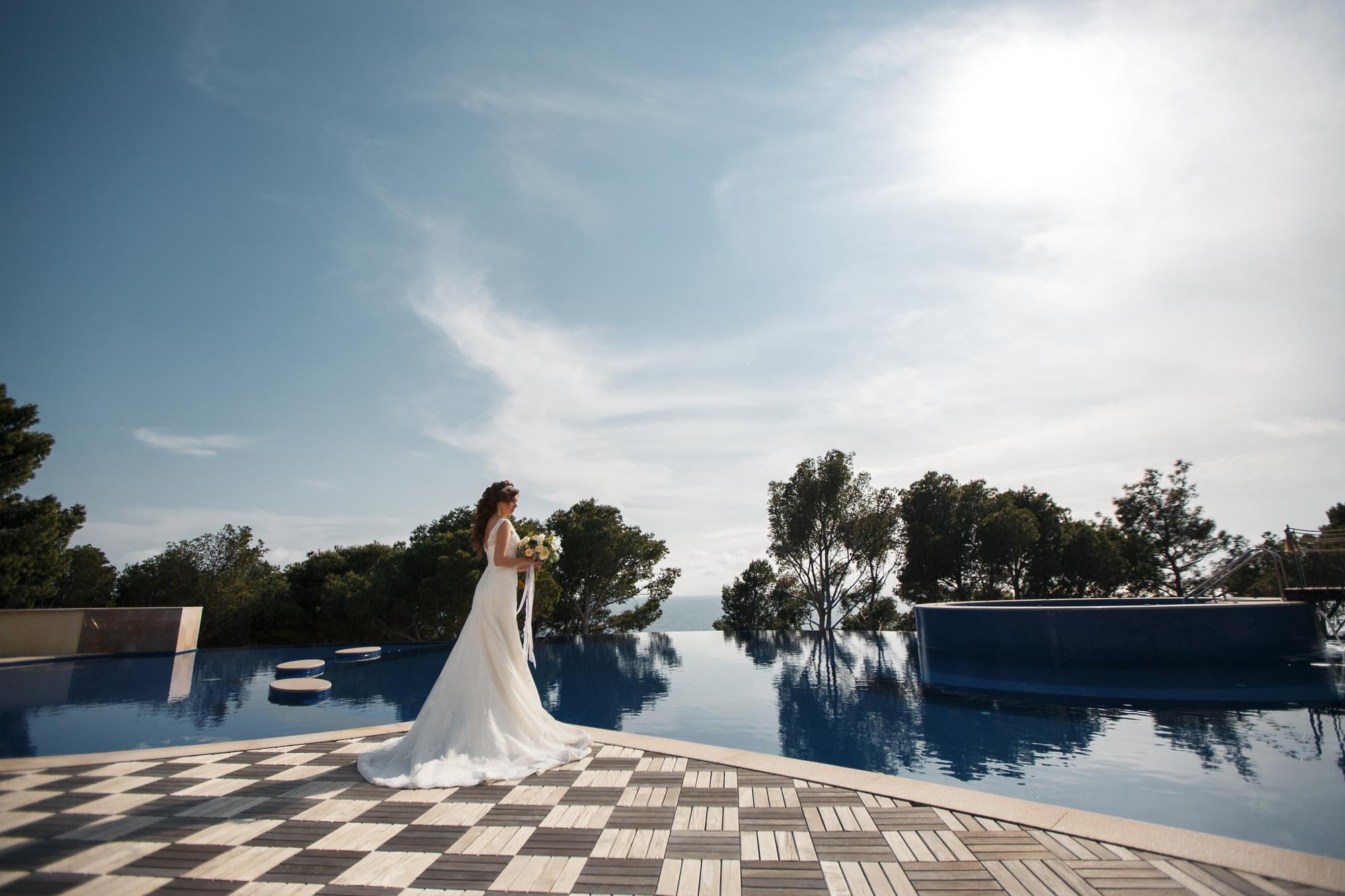
The water was colder than I expected.
That’s the first thing I remember. Not the shove. Not the sound of my husband laughing. The cold. It went through the lace and the silk and the four layers of tulle like they weren’t even there, and for one long second, I couldn’t breathe at all.
Then the dress started to pull me down.
I’d never thought about how much a wedding dress weighs when it’s wet. Nobody does. Mine was ivory silk with a long lace train and a skirt so full the seamstress had needed two fittings just to get the hem right. Dry, it weighed maybe twelve pounds. Wet, it felt like somebody had wrapped me in a carpet and thrown me into a lake.
I went under. My veil came loose and tangled around my face. I kicked, and the skirt wrapped around my legs. I reached up, and my hand found nothing but water. My heart was pounding in my ears.
When I finally got my fingers around the stone edge of the pool and dragged my head up into the air, coughing, with my hair plastered across my eyes and mascara burning in them, the first thing I heard was laughter.
Big laughter. Men’s laughter. The kind that echoes.
I pushed the hair off my face.
My husband of four hours was standing at the edge of the pool, bent over with his hands on his knees, laughing so hard he could barely breathe. Behind him, five of his college friends were holding up their phones, filming me.
“Relax, honey!” Ryan gasped. “It’s just a prank!”
I hung onto the edge of the pool with both hands and stared up at him.
And then something strange happened.
The laughter stopped.
Not slowly. All at once. Like somebody had pulled a plug.
Ryan straightened up. He turned around.
My grandfather was standing directly behind him.
I’d dreamed of my wedding day since I was a little girl.
I’m not embarrassed to say it. I was the kind of seven-year-old who made her own veil out of a lace curtain and walked down the hallway of my grandparents’ farmhouse while my grandmother hummed “Here Comes the Bride” from the kitchen. I made my grandfather play the groom. He’d stand at the end of the hall in his overalls with his hands folded, very serious, and when I got to him, he’d bow and say, “Miss Hannah, I’m honored.”
My name is Hannah Pierce. I was twenty-eight on my wedding day. I’m a pediatric occupational therapist in Madison, Wisconsin. I help little kids who have trouble holding a pencil or buttoning a coat or climbing stairs. I’ve been doing it for five years. I love it more than anything.
My father, Michael Pierce, died when I was sixteen.
He drove a milk truck for a dairy cooperative. One morning in February, a semi driver who’d been awake for twenty-two hours drifted across the center line on Highway 14 outside Janesville. My father swerved. The truck went into a ravine. He died at the scene.
I was in second-period chemistry when the principal came to get me.
My mother didn’t handle it well. I don’t blame her. She’d married my father at nineteen, and she’d never lived a day without him, and when he was gone she just sort of came apart. Within a year she’d married a man she met in a grief support group and moved with him to Scottsdale, Arizona. She asked me to come. I didn’t want to leave my school, my friends, my father’s grave.
So I moved in with my grandparents.
Walter and Rose Pierce had a hundred-and-forty-acre dairy farm outside Lodi, about half an hour north of Madison. Walter had been milking cows since he was nine years old. He was seventy then. He still got up at four thirty every morning. Rose ran the house, the garden, the books, and the church bake sale, and she made pies so good that people drove from three towns over at Thanksgiving.
They took me in without a question. Rose cleared out the sewing room and put my posters on the wall herself. Walter built me a desk out of an old barn door so I’d have somewhere to do homework. He sanded it for two days in the machine shed.
I was angry that first year. Angry at my mother, angry at the truck driver, angry at God. I slammed doors. I cried in the hayloft. I said terrible things to Rose that I still think about.
Walter never once raised his voice. He’d just find me in the hayloft and climb up the ladder, slowly, because of his knees, and sit down next to me in the hay without saying anything. Sometimes for an hour. And then he’d say something like, “The Holsteins are calving next week. Want to help?” And I’d say no. And he’d say, “Alright.” And the next week I’d be standing in the barn at two in the morning with my arm up to the elbow in a cow, crying and laughing at the same time, while Walter talked me through it.
That’s how he raised me. Not with speeches. With work, and patience, and showing up.
Rose died when I was twenty-four. Pancreatic cancer. Fast. Four months from diagnosis to funeral. Walter sold most of the herd after that. He kept six cows and the house and the land. He said he didn’t have the heart for a hundred cows without Rose to complain about them.
He was eighty-two on my wedding day. Still tall. Still broad through the shoulders, though he’d started to stoop a little. Still up at four thirty every morning, even with only six cows. Still the strongest person I’ve ever known.
I met Ryan Doyle at a friend’s Fourth of July party three years before the wedding.
He was handsome in an easy, all-American way. Blond. Tan. A big white smile. He sold medical equipment for a company in Milwaukee and he was very good at it. He could walk into any room and have everybody laughing in five minutes. He remembered everybody’s name. He told stories with his whole body.
At the party, he did a backflip off the dock into the lake on a dare. Everyone cheered. Then he came up out of the water and walked straight over to me, dripping, and said, “I did that so you’d notice me. Did it work?”
It worked.
He was fun. That’s what everybody said about Ryan. Ryan’s so fun. And he was. After years of being the serious one, the girl whose dad died, the girl who lived with her grandparents on a farm and spent her twenties going to funerals, it felt like stepping into sunlight. Ryan planned surprise trips. Ryan showed up at my work with tacos. Ryan made me laugh until my stomach hurt.
He also liked pranks.
I thought it was harmless at first. Silly. He’d hide behind doors and jump out at me. He put salt in my coffee once instead of sugar and filmed my face. He set every alarm clock in my apartment to go off at three in the morning. He told a waiter at my birthday dinner that I was allergic to air and filmed the man’s confusion.
His friends loved it. Brett, Cole, Jake, Marcus, and Danny. Five guys from his fraternity at UW Whitewater. They’d been friends for fifteen years, and they still acted like they were twenty. They had a group chat called “Doyle’s Degenerates” that buzzed on Ryan’s phone constantly. They texted each other videos of their pranks. They kept score.
Sometimes the pranks made me uncomfortable. When he filmed me crying at a sad movie and sent it to the group chat with a laughing emoji. When he told his friends at a bar, in front of me, about the time I’d tripped going up the stairs at a restaurant. When he called me “Farm Girl” in a voice that wasn’t quite affectionate.
“Lighten up, Han,” he’d say, when I didn’t laugh. “It’s just a joke. You’re way too serious. That’s what I love about you. I’m gonna teach you to have fun.”
And I’d laugh. Because I wanted to be fun. Because I’d spent so long being sad.
Walter didn’t like him.
He never said so directly. Walter doesn’t say things directly. But I could tell.
The first time I brought Ryan to the farm, Ryan spent the whole afternoon talking. About his job, his commissions, his fantasy football league. He called Walter “Walt” and slapped him on the back. He asked how much the land was worth. He asked it twice. He made a joke about Walter’s overalls and laughed at it himself.
Walter just nodded and listened and didn’t say much.
After Ryan went out to the car, Walter stood with me on the porch for a minute.
“He’s a talker,” he said.
“He’s fun, Grandpa.”
“Mm.” He looked out at the barn. Then he said, “Your grandmother used to say, watch how a man laughs. If he laughs with people, he’s alright. If he laughs at people, you watch out.”
“Ryan laughs with people.”
Walter didn’t answer. He just patted my hand and went inside.
Ryan proposed eighteen months later at a Brewers game. On the Jumbotron. In front of forty thousand people. He got down on one knee in the aisle with a camera crew filming, and the whole stadium cheered, and his friends had made signs. HANNAH SAY YES!! and FARM GIRL GETS A RING!
I said yes. Of course I said yes. Forty thousand people were watching.
When I called Walter that night to tell him, he was quiet on the phone for a long moment.
“Is that what you want, sweetheart?” he said. “Not what he wants. What you want.”
“Yes, Grandpa. I want to marry him.”
“Then I’m happy for you,” he said.
But I could hear in his voice that he wasn’t sure.
Here’s something I need to tell you, because it matters.
When my father died, the trucking company’s insurance settled with my family. My mother took her share and went to Arizona. My share went into a trust. Walter was the trustee. The money stayed in the trust until I turned thirty, when it would all come to me.
It was a lot of money. More than I ever talked about. Walter had invested it carefully for twelve years. By the time I got engaged, it was worth a little over nine hundred thousand dollars.
I’d never touched it. I lived on my salary. I drove a nine-year-old Subaru. I paid off my own student loans. The money in the trust felt like it belonged to my father somehow. Like it was the price of his life. I didn’t want to spend it on anything that wasn’t important.
Ryan knew about it. I told him the first year we dated. I thought you were supposed to be honest with the person you loved.
He was very interested.
“Nine hundred grand?” he said. “Han. That’s insane. Why are you driving that car?”
“Because I don’t need a new car.”
“But you could have one.” He shook his head, grinning. “Babe, when we’re married, we’re gonna have so much fun with that.”
I laughed. I thought he was joking.
He also knew about the farm. Walter had told me, after Rose died, that he was leaving it to me in his will. A hundred and forty acres of Wisconsin farmland, twenty minutes from Madison, with developers circling it every year with offers. The last offer had been almost two million dollars. Walter turned it down without opening the envelope.
Ryan knew all of it. He asked about it often. I told myself that was normal. That married couples talk about money. That he was just being practical.
The wedding was on a Saturday in late August at Oakmont, a restored nineteenth-century country estate about forty minutes from Madison. It had a big white stone house and gardens and a long lawn that sloped down to a lake. Behind the house, there was a covered terrace for dining and dancing, and beside it, a long rectangular swimming pool, lit from underneath, glowing blue.
I’d paid for most of it myself. Ryan’s parents contributed a little. Walter insisted on paying for the flowers. He’d picked them himself. White peonies, because Rose had carried them at their wedding in 1965.
One hundred and twenty guests.
The morning of the wedding, I was getting ready in an upstairs bedroom of the big house with my bridesmaids. My best friend from college, Priya. My cousin Jess. Two friends from work. The hairdresser was doing my curls. The photographer was taking pictures of my shoes.
Around eleven, Priya came back from getting coffee and said, “Han, is your grandpa okay? I just saw him in the parking lot talking to one of the groomsmen. They both looked really serious.”
“Which groomsman?”
“The tall one with glasses. Danny, I think?”
Danny Kowalczyk. He was Ryan’s cousin as well as his fraternity brother. The quietest of the group. He worked as an accountant in Green Bay. He’d always been polite to me. Kind, even. At our engagement party, while the others were doing shots, he’d found me in the kitchen and helped me wash glasses and talked to me about a book he was reading.
“I’m sure it’s nothing,” I said. “Grandpa probably asked him where the bathroom was.”
But when Walter came up to the bedroom twenty minutes later to see me before the ceremony, his face was strange. Gray. Tight around the mouth.
“Grandpa? Are you okay?”
“I’m fine, sweetheart.” He looked at me in my dress. And his face changed. It softened. His eyes filled up.
“Oh, Hannah,” he said quietly. “Look at you.”
I’d never seen him cry. Not at my father’s funeral. Not at Rose’s. He was a Wisconsin dairy farmer born in 1944. They don’t cry.
He cried a little in that bedroom.
“You look just like your grandmother,” he said. “On our wedding day. Just exactly like her.”
I hugged him. He smelled like Old Spice and hay, the way he always did, even in his good gray suit.
“Grandpa,” I said into his shoulder. “Is something wrong? Priya saw you talking to Danny.”
He held me a little tighter. Then he let go and stepped back and looked at me for a long moment. Like he was deciding something.
“Nothing that can’t wait,” he said. “Today’s your day. Let’s get you married.”
He patted the inside pocket of his suit jacket, just once, like he was checking that something was still there.
I didn’t think about it again. Not until the pool.
The ceremony was beautiful. I want to say that. Even after everything, it was beautiful.
It was in the garden behind the house, under an old oak tree, with white chairs in rows and the lake glittering behind. A string quartet played Pachelbel. The air smelled like cut grass and peonies.
My grandfather walked me down the aisle because my father couldn’t.
He walked slowly. Partly because of his knees. Partly, I think, because he wanted to make it last. He held my arm tightly in his. When we got to the end of the aisle, where Ryan was waiting in his navy suit, grinning, Walter stopped. He turned to me. He kissed my forehead.
“Your dad would be so proud of you, sweetheart,” he whispered.
Then he put my hand in Ryan’s.
And he held on to it just a second longer than he needed to. Just a second. Looking at Ryan.
Ryan didn’t notice. He was winking at Brett in the front row.
The vows were short. We’d written our own. Mine talked about how Ryan had brought laughter back into my life after years of grief. I meant every word. Ryan’s were mostly jokes. About my cooking. About my driving. About how I’d better get used to “a lifetime of fun.” His friends laughed and whooped. A few of the older guests looked uncomfortable.
The pastor, Reverend Lindgren from Walter’s church, a kind white-haired man who’d baptized my father, pronounced us man and wife.
Ryan dipped me back and kissed me, and his friends cheered like we’d scored a touchdown.
Walter was in the front row. He was clapping. But he wasn’t smiling.
The reception started at six.
Cocktails on the lawn, then dinner on the covered terrace, with long tables and candles and strings of lights overhead, right beside the glowing pool. It was gorgeous. Everything I’d dreamed of when I was seven with a lace curtain on my head.
Ryan had already had several drinks by the time dinner was served.
He’d started with whiskey in the groom’s room before the ceremony. Then champagne during photos. Then two beers during cocktails. By the time the salads came out, his face was flushed and his voice was loud.
His college friends were at the table next to ours. They kept whispering to each other. Laughing. Pointing at me.
At one point I caught Brett holding up his phone with the screen toward Cole and grinning. Cole looked at it and burst out laughing. Then he looked straight at me and laughed harder.
“What’s so funny?” I asked Ryan.
“Nothing, babe,” he said. “Inside joke. You wouldn’t get it.”
Jake leaned over from the next table and said something in Ryan’s ear. Ryan laughed and slapped him on the back and said, “Not yet, not yet. After the first dance.”
I should’ve known something was wrong. I know that now. All the signs were there.
But it was my wedding day. I wanted it to be perfect. I wanted it so badly that I ignored everything that told me it wasn’t.
Only one of the groomsmen wasn’t laughing.
Danny sat at the end of the table with a glass of water in front of him. He didn’t drink. He didn’t joke. He kept looking at his phone, and then at Ryan, and then at my grandfather, who was sitting at the family table across the terrace.
Once, our eyes met. Danny looked away fast, like he’d been caught at something.
Walter was watching all of it. He’d barely touched his dinner. He sat very straight in his chair with his hands folded on the table in front of him, the way he used to sit in church, and he watched Ryan’s table. Every few minutes, he touched the inside pocket of his jacket.
At eight o’clock, the band announced the first dance.
Ryan took my hand and led me out to the dance floor, a square of polished wood at the edge of the terrace, right beside the pool. The lights from the water rippled blue across the floor.
We’d picked “At Last” by Etta James. My idea. Ryan had wanted something “more fun,” but I’d insisted. My father used to dance with my mother to that song in our kitchen.
The music started.
Ryan put his hands on my waist. He swayed a little. He smelled like whiskey.
About halfway through the song, he leaned close to my ear.
“Come on, babe,” he said. “Let’s take a picture by the pool.”
“Now? We’re in the middle of the first dance.”
“That’s what makes it perfect,” he said. “First dance, by the pool, with the lights. It’ll be amazing. Come on.”
He took my hand and pulled me off the dance floor, toward the edge of the pool. The band kept playing. The guests watched, a little confused.
I followed him, holding up my expensive wedding dress so I wouldn’t trip on the long lace train.
I noticed his friends getting up from their table. Brett. Cole. Jake. Marcus. They gathered behind us on the terrace. All of them already had their phones out. Held up. Recording.
Danny didn’t get up. He stayed at the table. He’d put his head down in his hands.
Ryan positioned me at the very edge of the pool, with my back to the water. He took both my hands. He smiled at me. A big, bright, beautiful smile.
“Ready?” Ryan asked.
I smiled back at him. I thought he was going to kiss me. I thought it was going to be the most romantic picture of my life.
Then he shoved me.
Hard. Both hands, flat against my chest.
I fell backward into the water.
You know the rest. The cold. The dress. The water closing over my head. The weight dragging me down. Fighting my way to the surface. Finding the edge of the pool. Coughing.
The laughter.
Ryan doubled over at the edge of the pool. His friends filming. Brett yelling, “Oh my God! Oh my God! Did you get it? Did you get it?”
“Relax, honey!” Ryan gasped through his laughter. “It’s just a prank!”
The band had stopped playing. Etta James had stopped in the middle of a word. A hundred and twenty guests were standing up from their tables, completely silent. Some of them had their hands over their mouths. My bridesmaid Priya was running toward the pool.
I hung on to the stone edge and looked up at my husband.
My makeup was running down my face. My hair was plastered to my cheeks. My veil was floating in the water beside me like a dead jellyfish. My wedding dress, the one I’d saved for a year to buy, the one I’d had fitted three times, the one I’d imagined since I was seven, was ruined.
And my brand new husband was laughing at me.
I didn’t cry. That’s the strange thing. I was too stunned to cry. I just held on to the edge of the pool and looked at him, and something inside me went very, very quiet.
Then the laughter stopped.
Ryan turned around.
My grandfather was standing directly behind him.
I don’t know how he got there so fast. He’d been sitting at the family table across the terrace. He was eighty-two with bad knees. But there he was, standing about three feet behind Ryan, in his good gray suit, perfectly still.
He hadn’t raised his voice. He hadn’t even moved.
He was simply staring at Ryan, holding a small brown envelope in his big weathered farmer’s hand.
The friends lowered their phones. One by one. Brett first. Then Cole. Then the others. Marcus took a step back.
“Grandpa, please,” I whispered. I didn’t know what I was asking for. I was climbing out of the pool. Priya had my arm. My dress weighed a hundred pounds. Water streamed off it onto the stone.
Ryan’s smile disappeared.
He looked at the envelope in Walter’s hand. And I watched his face change. Something flickered across it. Confusion first. Then recognition. Then something I’d never seen on Ryan’s face in three years.
Fear.
“What is that?” Ryan said.
My grandfather didn’t answer. He opened the envelope. Very slowly. His hands were big and steady. He took out a folded sheet of paper. Several sheets, actually, folded together.
And Ryan suddenly lunged forward.
“Don’t you dare!”
He grabbed for the papers.
I’ll never forget what happened next. Neither will anybody else who was there. People still talk about it in Lodi.
My eighty-two-year-old grandfather, who had spent seventy-three years wrestling cows and hay bales and frozen machinery, caught Ryan’s wrist in his left hand. Just caught it. In midair. And held it.
Ryan was thirty-one years old and went to the gym five days a week. He pulled. He pulled hard. His face turned red.
Walter’s hand didn’t move. Not an inch.
“Son,” my grandfather said quietly. “I’ve been milking cows since Eisenhower. You’re going to want to stop pulling.”
Ryan stopped pulling.
Walter let go of his wrist. Ryan stumbled backward, rubbing it.
“You can’t,” Ryan said. His voice had changed. Higher. “That’s private. That’s my private property. Where did you even get…”
“Danny gave it to me,” Walter said.
Every head on the terrace turned toward the groomsmen’s table.
Danny Kowalczyk had stood up. He was standing by his chair with his hands at his sides. His face was white. But his chin was up.
“I’m sorry, Ry,” he said. His voice shook. “I couldn’t do it. I tried to tell you this morning. I told you if you went through with it, I’d tell somebody. You laughed at me.”
“You traitor,” Ryan said. “You little…”
“He’s not the traitor here,” said my grandfather.
He unfolded the papers.
“These are printouts,” Walter said, to the whole terrace. His voice wasn’t loud. He’d never been loud. But it carried. Farmers’ voices do. “Of a group chat. It’s called Doyle’s Degenerates. It’s between the groom and these five gentlemen.” He nodded toward Ryan’s friends, who were all staring at the ground now. “Danny brought them to me this morning in the parking lot. He said he’d been sick to his stomach for a week. He said he didn’t know who else to tell.”
“Grandpa,” I said. “What do they say?”
Walter looked at me. His face was very gentle.
“Sweetheart,” he said. “You don’t have to hear this. Not here. Not in front of everybody. I can give these to you later. I can take care of this quietly. That’s what I was planning to do. I was going to wait until after the reception. Take him aside.” He looked at Ryan. “But then he pushed you into the water. In front of a hundred and twenty people. And his friends filmed it.” He paused. “So I think he’s already decided this isn’t going to be quiet.”
I stood there dripping on the stone. Priya had wrapped a tablecloth around my shoulders. I was shivering.
“Read it,” I said.
Walter put on his reading glasses. He took his time. He always takes his time.
“Two weeks ago,” he read. “Brett writes: ‘Doyle. The pool. At the reception. You gotta do it. Push her in the dress. That’ll be legendary.’ Ryan writes: ‘LOL she’d kill me.’ Brett writes: ‘Five hundred bucks says you won’t.’ Cole writes: ‘I’ll put in another five hundred.’ Jake writes: ‘Same.’ Marcus writes: ‘Same. Two grand pot. Bring Farm Girl down a peg.’”
Somebody on the terrace gasped.
“Ryan writes: ‘Bet. Two grand. Easy money. She’ll cry, then she’ll get over it. She always does.’”
My grandfather turned the page.
“Brett writes: ‘What if she gets mad?’ Ryan writes: ‘She won’t do anything. Where’s she gonna go? I’ll be her husband by then. She’s too nice. She’ll forgive anything. That’s the beauty of marrying a girl with no dad. She’ll take whatever she can get.’”
The whole terrace went silent.
I felt the words land in my chest like stones.
That’s the beauty of marrying a girl with no dad.
Walter’s voice didn’t change. But I saw his jaw tighten.
He kept reading.
“Ten days ago. Cole writes: ‘Bro. You’re really doing it? Marrying her?’ Ryan writes: ‘Dude. Nine hundred grand in a trust. She gets it in two years. And the grandpa’s gonna leave her a farm worth two million. He’s eighty-two. How long’s he got? Five years? I’ll be set for life. And I don’t even have to work for it.’”
Somebody’s wine glass hit the stone floor and broke. Nobody moved to pick it up.
“Jake writes: ‘What about your debt?’ Ryan writes: ‘Seventy-two K on the sportsbook. She doesn’t know. Once we’re married I’ll get on her accounts. She trusts me. I’ll pay it off a little at a time, she won’t even notice. Then when the trust pays out, boom.’”
Walter folded the paper. He took off his reading glasses.
“There’s more,” he said. “About three pages more. I’m not going to read it. Some of it’s about my granddaughter’s body. I don’t read that kind of thing out loud. Not in front of her. Not in front of anybody.”
He turned and looked at Ryan.
Ryan was standing at the edge of the pool. His face was the color of the stone. His mouth was open a little. He looked like a man who’d been caught in a spotlight he’d built himself.
“It’s a joke,” Ryan said. His voice cracked. “That’s just. That’s how we talk. It’s guy talk. It doesn’t mean anything. Hannah. Babe. You know me. You know I didn’t mean any of that.”
I looked at him.
I looked at him for a long time. Standing there in his navy suit with his flushed face and his whiskey breath and his perfect white teeth. The man I’d married four hours earlier. The man who’d made me laugh after years of grief. The man who’d jumped off a dock so I’d notice him.
The man who’d called me Farm Girl. Who’d filmed me crying. Who’d bet two thousand dollars on making me cry on my wedding day.
That’s the beauty of marrying a girl with no dad. She’ll take whatever she can get.
“Did you mean it, Ryan?” I said. My voice came out very calm. I don’t know how.
“No! Babe, no, of course not, it was just…”
“The debt,” I said. “Seventy-two thousand dollars. On sports betting. Is that real?”
He opened his mouth. Then he closed it.
That was answer enough.
I reached down and took off my wedding ring. It was still wet. It slid off easily.
I’d picked it out myself. A thin gold band. Simple. It cost nine hundred dollars, and I’d paid for half of it.
I looked at it in my palm for a moment. Then I turned around and dropped it into the swimming pool.
It made a tiny splash. Then it sank, glinting, all the way to the bottom, and lay there in the blue light.
“Hannah,” Ryan said. “Hannah, come on. Don’t do this. Not in front of everybody.”
“You did this in front of everybody, Ryan,” I said. “I’m just finishing it.”
I turned to Reverend Lindgren, who was standing at the edge of the terrace with his hand pressed over his heart.
“Reverend,” I said. “Have you filed the marriage license yet?”
The old man blinked. Then he understood. Something like a smile crossed his face.
“No, Hannah,” he said. “It’s in my car. I was going to mail it to the county on Monday.”
“Please don’t,” I said.
Ryan made a sound like he’d been punched.
“You can’t do that,” he said. “We’re married. We said the vows. It’s legal.”
“Then I’ll get an annulment,” I said. “On the grounds of fraud. You married me for my money and you said so in writing. To five witnesses.” I looked at Brett and Cole and Jake and Marcus, who were all staring very hard at their shoes. “Six, counting Danny.”
“I’ll testify,” said Danny quietly. “If you need me to.”
Ryan looked at his cousin like he’d never seen him before.
Then Ryan’s mother came across the terrace.
Linda Doyle was a small, neat woman who taught third grade in Waukesha. She’d been very kind to me through the whole engagement. She’d hosted my bridal shower. She’d cried during the vows.
She walked straight up to her son. She looked at him. She didn’t say anything for a moment.
Then she slapped him across the face.
It wasn’t hard. Linda Doyle couldn’t have hurt a fly. But the sound cracked across that silent terrace like a gunshot.
“Seventy-two thousand dollars,” she said. Her voice was shaking. “You told your father and me you’d stopped. You swore to us. On your grandmother’s grave.” She was crying. “And you were going to steal from that girl? That sweet girl? After everything she’s been through?”
“Mom…”
“Don’t you Mom me,” said Linda Doyle. “Go get in the car. Your father will drive you home. I don’t want to look at you.”
Ryan’s father, a quiet man named Jim who sold insurance and had barely said ten words to me in three years, was already standing behind his wife with his car keys in his hand. His face was gray.
“Let’s go, Ryan,” he said.
Ryan looked at me one more time.
“Hannah,” he said. “Please.”
I didn’t say anything.
He turned around and followed his father through the crowd. The guests parted to let him through. Nobody said a word. Nobody touched him. They just watched him go.
His friends went next. Brett and Cole and Jake and Marcus, slinking off the terrace like dogs who’d been caught in the trash. Brett tried to say something to me on the way past, something that started with “Hey, Hannah, we didn’t…” and Walter just looked at him, and he stopped talking and kept walking.
Before they got to the parking lot, Priya ran after them.
“Phones,” she said. “Hand them over. Now.”
“What? No way.”
“You filmed a woman being assaulted at her wedding,” Priya said. She was five foot one and a corporate litigator. “There are a hundred and twenty witnesses on that terrace. Delete the videos right now, in front of me, or I’ll make sure every one of you spends the next year explaining it to a judge and your employers.”
They deleted the videos. All four of them. Standing in the parking lot, with Priya watching their screens.
Danny didn’t leave. He stood by the groomsmen’s table, by himself, with his hands in his pockets.
I walked over to him, dripping, in my ruined dress, with Rose’s peonies falling apart in my hair.
“Why?” I asked him. “Why did you tell my grandfather?”
Danny looked at his shoes.
“My mom,” he said. “My dad used to do stuff like that to her. Pranks. Jokes. In front of people. Everybody thought he was so fun.” He swallowed. “She cried in the bathroom a lot. I used to sit outside the door. I was seven.” He looked up at me. “When I saw the chat, I just kept thinking about my mom in that bathroom. And I couldn’t.”
“Thank you, Danny,” I said.
“Don’t thank me,” he said. “I should have told you myself. Weeks ago. I was a coward. I didn’t know how. Your grandpa seemed like he’d know what to do.” He almost smiled. “I didn’t know he’d do it like that.”
“Neither did I,” I said.
Then I turned around and looked at the terrace.
A hundred and twenty people were standing there. Silent. Staring at me. The candles were still burning on the long tables. The strings of lights were still glowing overhead. The cake was still sitting on its table, four tiers of white buttercream with sugar peonies on top. The band was frozen on the little stage, holding their instruments.
I was standing in the middle of it in a soaking wet wedding dress that weighed a hundred pounds, with mascara running down my face and pool water dripping off the hem onto the stone.
And I didn’t know what to do.
I’d spent a year planning that day. I’d planned every song. Every flower. Every seat. I’d planned the cake and the speeches and the bouquet toss. I’d planned the sparkler send-off at ten thirty.
I hadn’t planned for this.
I stood there, and I started to shake. Not from cold. From everything. From the shove, and the water, and the laughter, and the chat, and the ring sinking to the bottom of the pool. I felt it rising up through my chest. A sob. A big one. The kind that was going to bring me down to my knees right there on the stone in front of everybody I knew.
Then my grandfather walked across the terrace.
He walked slowly. His knees. He walked past the tables, past the cake, past the frozen band. He stopped in front of me.
He took off his good gray suit jacket and put it around my shoulders, over the tablecloth. It was warm. It smelled like Old Spice and hay.
Then he held out his hand.
“Miss Hannah,” he said. “I’m honored.”
I stared at him.
It was what he used to say when I was seven. At the end of the hallway in the farmhouse, in his overalls, when I walked down the aisle with a lace curtain on my head.
Miss Hannah. I’m honored.
The sob that had been rising up in my chest came out. But it came out as a laugh. A wet, broken, crying laugh.
I put my hand in my grandfather’s.
He turned to the band.
“Gentlemen,” he said. “I believe you were in the middle of something.”
The bandleader looked at me. I nodded.
The music started again. From the beginning. Etta James.
At last.
My grandfather put one hand on my waist and held my hand in the other, and we danced. Right there on the polished wood floor, in the blue light from the pool. Me in my ruined dress and his suit jacket, dripping water everywhere, my shoes squelching. Him in his white shirtsleeves and his suspenders, steady as a fence post.
He wasn’t a good dancer. He never had been. Rose used to complain about it. He just swayed back and forth, the way he used to rock the calves when they were sick.
But it was the best dance of my life.
“I’m sorry, sweetheart,” he said quietly, while we swayed. “I’m so sorry. I should have said something sooner. About him. I had a feeling. From the first day. I should have said.”
“You did say,” I told him. “You said watch how a man laughs.”
He was quiet for a moment.
“Your grandmother said that,” he said. “Not me. She was always smarter.”
“You got the envelope,” I said. “You did something. That’s what counts.”
He shook his head slowly. “When Danny handed me those papers this morning in the parking lot, I had to go sit in my truck for ten minutes,” he said. “My hands were shaking so bad I couldn’t hold them. I wanted to find that boy and…” He stopped. “Well. I’m eighty-two. And I’m a Christian. So I didn’t.”
“Why didn’t you show me before the ceremony?”
He looked down at me. His eyes were wet.
“Because you’d been dreaming about walking down that aisle since you were seven years old,” he said. “And your dad couldn’t walk you. And your grandma couldn’t see it. And I thought, I’m not going to take that away from her. Not that part. Not the walk.” He swallowed. “I figured I’d give you the walk. And then I’d give you the truth. And then you could decide.”
I put my head on his shoulder. The way I used to in the hayloft.
“I’m glad you gave me the walk,” I said.
“Me too, sweetheart.”
The song was about halfway through when I heard a splash.
I lifted my head.
Priya was in the pool.
My best friend, in her lavender bridesmaid dress and her silver heels, was standing in the shallow end of the pool, up to her waist in water, with her arms spread out.
“What?” she said, to the stunned terrace. “The bride’s wet. The bridesmaids should be wet too. That’s just etiquette.”
There was a second splash. My cousin Jess, holding her bouquet over her head.
Then my two friends from work, holding hands, shrieking.
Then Danny. Fully dressed, glasses and all. He jumped in feet first and came up sputtering.
Then Reverend Lindgren took off his shoes, very carefully, and set them side by side on the stone, and sat down on the edge of the pool, and put his feet in the water. And smiled at me.
And then, I swear to God, Linda Doyle came back. Ryan’s mother. She’d walked Ryan and Jim to the car and come back alone, and she stood at the edge of the pool for a moment in her pink mother-of-the-groom dress. Then she kicked off her shoes and jumped in.
After that, it was like a dam broke.
My boss jumped in. The string quartet’s cellist jumped in. A ninety-year-old great-aunt of mine, Aunt Doris, who walked with a cane, made two nephews lower her into the shallow end in her good blue dress, and she stood there up to her waist in the glowing water, laughing so hard she had to hold onto her nephews to keep from falling over.
People I’d known my whole life. People from church. People from the farm down the road. My clients’ parents. Kids I’d helped learn to hold a pencil. Nurses from the hospital where Rose died. Old men who’d known my father. They were all jumping into that swimming pool in their wedding clothes, laughing and splashing and shouting my name, until the pool was so full of people you could barely see the water.
Somebody was filming. A lot of people were filming. But this time, I didn’t mind.
My grandfather and I stood on the dance floor and watched them.
“Well,” Walter said finally. “That’s something you don’t see every day.”
I was crying again. But it was a different kind of crying.
“Grandpa,” I said. “Do you want to go in?”
He looked at the pool. At all the people. At Aunt Doris shrieking in the shallow end. He looked down at his good suit pants and his polished church shoes.
“Rose would have,” he said.
Then my eighty-two-year-old grandfather took my hand and walked me to the edge of the pool and, without letting go, stepped off the edge.
We went in together.
The water was still cold. My dress still weighed a hundred pounds. But this time, when I came up, there were hands everywhere. Priya’s hands. Jess’s hands. Danny’s. A dozen people holding me up. Laughing. Nobody was going to let me go under again.
And my grandfather was standing next to me in the water up to his chest, in his white shirt and suspenders, with his hair plastered to his head, laughing. Really laughing. A big booming laugh I hadn’t heard since before Rose died.
“Your grandmother,” he gasped, wiping water out of his eyes, “would have loved this. She would have been the first one in.”
The band was still playing. They’d moved on from Etta James. Somebody had requested “Shout,” and the whole pool was jumping up and down to it, splashing and singing and throwing their hands in the air.
It was the best wedding reception I’ve ever been to.
And it wasn’t even a wedding anymore.
We cut the cake at eleven o’clock, everyone dripping wet in towels Oakmont had brought out in armloads. I cut the first slice myself. Walter fed it to me, with buttercream all over his fingers. Everybody cheered.
Danny dove to the bottom of the pool around midnight and found my ring. He held it up out of the water like he’d found sunken treasure.
“You want it?” he called.
I thought about it.
“Keep it,” I said. “Sell it. Give the money to your mom.”
He looked at me for a long moment. Then he nodded. And he put it in his pocket.
He did, too. He told me months later. He sold it at a pawn shop in Green Bay for three hundred and forty dollars and took his mother out to dinner. Her first dinner at a nice restaurant in years. She cried, he said. He didn’t tell her where the money came from.
The annulment was granted four months later.
Priya handled it for free. It wasn’t complicated. Reverend Lindgren never filed the license. Danny gave a sworn statement and the printouts of the chat. Two of the other groomsmen, Marcus and Jake, gave statements too, once their lawyers explained that the alternative was being named in a civil suit. They both said it was “just a joke” and that Ryan “probably didn’t mean the money stuff.” The judge, a woman in her sixties named Judge Ostrowski, read the full chat in her chambers. Including the three pages Walter wouldn’t read aloud.
When she came back out, she looked at Ryan for a long time over her glasses.
“Mr. Doyle,” she said. “I’ve been on the bench for twenty-two years. I’ve read a lot of ugly things.” She set down the papers. “Annulment granted. On grounds of fraud. And young man? Get help. For the gambling. And for whatever else this is.”
Ryan didn’t contest it. He didn’t even come to the hearing. He sent his lawyer.
I heard later, through Linda Doyle, who still sends me a Christmas card every year, that Ryan lost his job about two months after the wedding. Somebody at his company saw a video. Not of the push. Of the pool afterward. Of a hundred people jumping in to stand with the bride. It had gone viral. Two million views. Somebody in the comments had figured out who the groom was, and then somebody else had posted his company’s name, and then the company’s phone lines had started ringing.
I didn’t post it. I didn’t post anything. I didn’t need to.
Linda says he’s living with his parents now in Waukesha. He’s going to Gamblers Anonymous three times a week. He’s working at a car dealership. She says he doesn’t talk about me. She says sometimes she finds him sitting in his car in the driveway for an hour, not going anywhere.
I hope he’s getting better. I really do. I don’t hate him. That surprised me. I thought I would. But mostly, when I think about Ryan now, I just feel tired. And a little sad. For the man who thought the funniest thing in the world was making someone cry.
The dress hung in my closet for a long time.
It never really recovered from the pool. The silk was stained with chlorine. The lace was torn at the hem. The tulle had gone limp. The dry cleaner said there was nothing she could do.
I couldn’t throw it away. I couldn’t look at it either. It just hung there in a garment bag at the back of my closet for almost a year.
Then, the next summer, I drove up to the farm for Walter’s eighty-third birthday.
I brought the dress with me.
Walter was sitting on the porch swing when I pulled up. The same swing where he and Rose used to sit on summer nights. The six cows were grazing in the pasture beyond the barn. The corn was knee-high. The air smelled like cut hay and lilacs.
He watched me carry the garment bag up the porch steps.
“What’ve you got there, sweetheart?”
“The dress,” I said.
He looked at it for a long moment.
“You want to burn it?” he said. “I’ve got the burn barrel going out back. We could have a little ceremony.”
I laughed. “No, Grandpa. I don’t want to burn it.”
“What, then?”
I sat down on the swing next to him. I unzipped the bag. The stained silk spilled out over my lap.
“Mrs. Lindqvist,” I said. “From church. The one who makes the quilts for the bazaar. I asked her if she could make something out of it.”
Walter looked at me.
“A quilt,” I said. “For your porch swing. For the cold nights.” I ran my hand over the lace. “I want to take the worst day of my life and turn it into something that keeps you warm.”
My grandfather didn’t say anything for a long time. He just sat there on the swing, looking at the dress in my lap.
Then he reached over and took my hand.
“Your dad,” he said quietly. “When he was little. Maybe six. He fell out of the hayloft. Broke his arm. Cried so hard I thought he’d never stop.” He swallowed. “And afterward, when it healed, he went and found the board that broke under him. Took it out of the loft. Asked me to help him make a birdhouse out of it.” Walter’s voice cracked. “That birdhouse hung on the oak tree out front for thirty years. Until the storm in 2019.”
I didn’t know that. Nobody had ever told me.
“You’re just like him,” my grandfather said. “Just exactly like him.”
The quilt was finished in October.
Mrs. Lindqvist made it out of ivory silk squares and lace panels, with a border of soft white cotton she said came from Rose’s old tablecloths. She’d saved them from the church sale. In the very center, she’d sewn a square of the lace from the train, the one that had floated in the pool behind me. Around it, in pale blue thread, she’d stitched a line I’d asked for.
Watch how a man laughs.
Walter keeps it on the porch swing now. He wraps it around his shoulders on cold mornings when he goes out at four thirty to see to the cows. He says it’s the warmest thing he owns.
It’s been two years since the wedding.
I’m thirty now. The trust paid out in March. I used some of it to pay off Walter’s property taxes for the next ten years, so the developers can stop sending him letters. I used some to start a scholarship at Lodi High School in my father’s name, for a senior who wants to go into a helping profession. Nursing, teaching, therapy. The first one went to a girl named Kayla who wants to be a speech therapist. She wrote me a thank-you note in purple ink.
The rest is still in the bank. I still drive the Subaru. It’s eleven years old now. The check engine light comes on every time it rains.
I’m seeing someone. It’s early. His name is Sam. He’s a veterinarian in Baraboo. He takes care of Walter’s six cows. That’s how we met. He came out to the farm last fall when one of the Holsteins had trouble calving, and I was there, and he talked me through it at two in the morning with my arm up to the elbow in a cow, laughing and crying at the same time.
He’s quiet. He doesn’t tell jokes much. When he laughs, it’s usually at himself.
The first time I brought him to Sunday dinner at the farm, Walter didn’t say much. He watched. Sam helped me clear the table without being asked. He asked Walter about the farm and listened to the answer, all forty minutes of it. When Walter told a story about Rose, Sam put down his fork and paid attention, and when Walter got to the end of the story and his voice cracked, Sam didn’t say anything. He just nodded.
After Sam went out to the car, Walter stood with me on the porch for a minute.
“He’s a listener,” Walter said.
“He is.”
Walter looked out at the barn. The sun was going down orange over the cornfields. The six cows were walking slowly in from the pasture, the way they did every evening, without being called.
“Your grandmother used to say,” Walter said, “watch how a man laughs.”
“I know, Grandpa.”
“She also used to say,” he went on, “watch how he listens.” He smiled. “That one’s even more important. Took me sixty years to figure that out.”
He patted my hand. Then he went inside.
Last month, on Walter’s eighty-fourth birthday, we had a party at the farm. Not a big one. Thirty people, maybe. Priya came up from Chicago. Jess and her new baby. Reverend Lindgren, who’s ninety now and walks with a cane but still won’t miss a party. Mrs. Lindqvist with a lemon pie. Linda Doyle drove up from Waukesha with a card. Danny came, with his mother. She was a small, soft-spoken woman in a yellow dress. She held my hand for a long time in the kitchen and didn’t say anything at all. She didn’t have to.
And Sam, of course. Standing at the grill in Walter’s old apron, which is about two sizes too big for him.
There’s no swimming pool at the farm. But there’s a stock pond out past the barn, about the size of a tennis court, where the cows drink in summer. It’s muddy and full of frogs and has a rope swing on an old willow tree that my father put up when he was twelve.
Around eight o’clock, with the sun going down, Walter stood up from the porch swing and wrapped Mrs. Lindqvist’s quilt around his shoulders and said, “Who’s coming?”
Everybody looked at him.
“Coming where, Grandpa?”
He nodded toward the stock pond.
“Walter,” Reverend Lindgren said. “You’re eighty-four years old.”
“I’m aware of that, Pastor.”
“There are leeches in that pond.”
“There’ve always been leeches in that pond,” said my grandfather. “Rose and I went swimming in it on our wedding night. In 1965. Leeches and all.” He handed me the quilt. “Hold this, sweetheart.”
And he walked down the porch steps and across the yard and out past the barn in his good Sunday clothes, slow and steady, his knees cracking, all the way to the edge of the stock pond.
Then he looked back at all of us, standing on the porch with our mouths open.
“Well?” he said.
Priya went first, of course. Then Danny. Then Sam, still in the apron. Then Jess, handing her baby to Danny’s mother. Then Linda Doyle, shrieking, in her good slacks. Then half the party. Even Reverend Lindgren went down to the edge, took off his shoes and socks, and sat on the bank with his feet in the muddy water.
I stood on the porch for a moment longer, holding the quilt.
My grandfather was standing in the stock pond up to his waist. The sun was going down behind him, orange and gold, lighting up the water and the willow and the rope swing my father hung forty years ago. He was laughing. Everybody around him was laughing. The good kind. The kind where nobody’s being laughed at. The kind where everybody’s in it together.
He looked up at the porch. He held out his hand, the way he did on the dance floor two years ago, dripping, in the blue light.
“Miss Hannah,” he called. “I’m honored.”
I folded the quilt very carefully and set it on the porch swing, with the blue stitching facing up.
Then I ran down the steps and across the yard, past the barn, through the long grass, and jumped into the pond beside my grandfather.
The water was colder than I expected.
But this time, I wasn’t alone in it.

Adrian Hawthorne is a celebrated author and dedicated archivist who finds inspiration in the hidden stories of the past. Educated at Oxford, he now works at the National Archives, where preserving history fuels his evocative writing. Balancing archival precision with creative storytelling, Adrian founded the Hawthorne Institute of Literary Arts to mentor emerging writers and honor the timeless art of narrative.