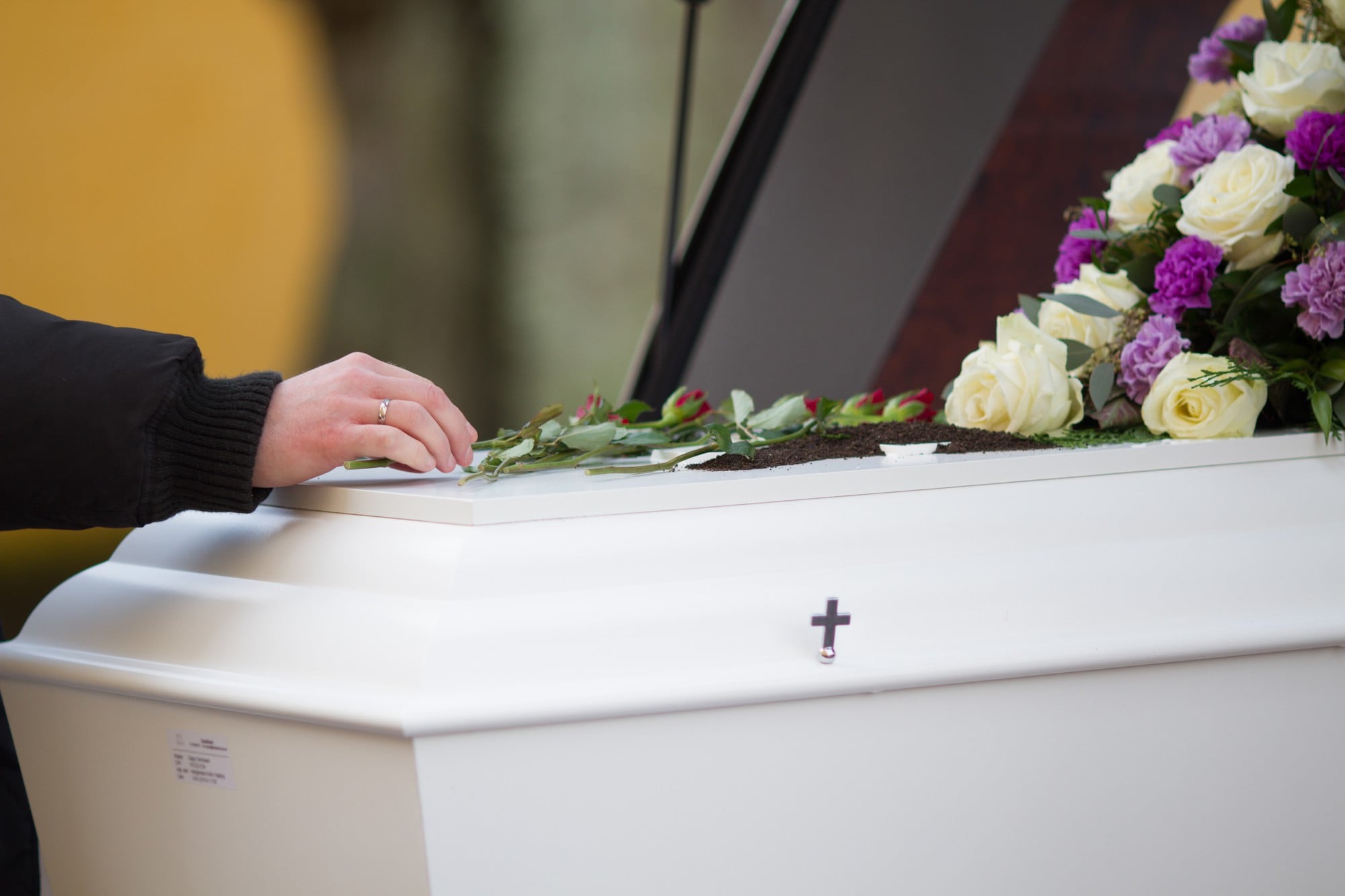
Rick stood at the casket for a long time.
I was across the room, holding a paper cup of funeral home coffee that had gone cold an hour before, and I watched him. His head was bowed. His hands were folded in front of him, the way they teach you in Sunday school. I thought, well. Maybe he’s finally saying goodbye.
Then I saw his hand move.
It was quick and quiet. He reached down into the casket and pushed back the cuff of Dad’s navy blue suit. He unbuckled the gold watch on our father’s wrist. He slid it off, and he slipped it into the inside pocket of his own jacket, smooth as a pickpocket on a train.
Right there. In front of the whole room.
I set my coffee down on the guest book table and walked over to him.
“Rick,” I said. “He asked to be buried in that.”
My brother didn’t even lower his voice.
“He’d want it to go to the son who mattered.”
Behind me, Aunt Joyce gasped out loud. The funeral director took one step toward us and then stopped, like he’d hit a glass wall.
I looked down at my father’s bare wrist. There was a pale stripe of skin where that watch had been for forty years. It looked like a scar.
My husband Tom came up behind me and put his hand on my back.
“Say something,” he whispered.
I could have. Lord knows I could have. I could have made a scene at my own father’s funeral that people in Altoona would still be talking about at Christmas.
“Okay, Rick,” I said.
He patted his pocket, and he walked away.
Three days later, at 9:02 on a Thursday morning, my phone rang. It was Rick. He was screaming so loud I had to hold the phone away from my ear.
“What did Dad do? WHAT DID DAD DO?”
I knew exactly what Dad did.
But to tell it right, I have to go back four years, to a dialysis center on Plank Road, and a man who always wanted to know what time it was.
My father’s name was Edward Hollis. Everybody called him Ed.
He worked for the Pennsylvania Railroad and then Conrail and then Norfolk Southern, which was really all the same railroad wearing different hats. Twenty five years in the Altoona shops, rebuilding locomotives. Then fifteen more as a yard supervisor. He had forearms like fence posts and a voice that could carry across a rail yard in a snowstorm.
When he retired, the company gave him a gold watch.
They don’t do that anymore, I don’t think. But they did it for Dad. A Hamilton, gold case, white face with black numbers, a brown leather band that he replaced three times over the years. On the back it was engraved:
EDWARD J. HOLLIS
25 YEARS OF SERVICE
THANK YOU
He wore that watch for forty years. Every single day.
And every single morning, before his coffee, he sat down at the kitchen table and wound it. He took it off his wrist and held it in his big rough fingers and turned the little crown, slow and careful, exactly twenty times. Then he held it up to his ear to listen to it tick. Then he set it against the clock on the stove and put it back on.
When I was little, I used to sit across the table and count the turns with him.
“Eighteen, nineteen, twenty.”
“Why do you do it every day, Daddy?”
He’d buckle the band and look at me over his glasses.
“Because a man should know what time it is, Carol.”
I thought he meant the time. It took me forty years to understand he meant something else.
There were two of us. Me and Rick.
Rick is three years older than me. He was the son, and in our house in 1975, that meant something. Dad took him to the rail yard on Saturdays. Dad taught him to throw a curveball and change the oil in the Buick. Dad came to every one of his Little League games and stood at the fence with his arms crossed and yelled, “Keep your eye on it, Ricky!”
I don’t say that to complain. Dad loved me. He came to my piano recitals and sat in the back with his hat in his lap. But Rick was the son. Rick was the one who was going to do something.
And Dad was hard on him. I want to be fair about that, because it matters later. Harder than he was on me. Rick never got a B in that house without a lecture. Rick never struck out without Dad going over it at the supper table, pitch by pitch.
“You’ve got to want it, Ricky. You’ve got to want it more than the other guy.”
When Rick was eighteen, they had a fight. I was fifteen. I was upstairs. I don’t know what started it. I only heard the end. Dad’s voice, loud enough to rattle the windows.
“If you walk out that door, don’t you come crawling back here!”
And the front door slamming.
Rick moved to Pittsburgh. Then Columbus. Then, when he was thirty, all the way out to Phoenix, Arizona, about as far from Altoona as a man can get without a passport. He sells commercial real estate. He has a big house with a pool and a second wife named Dana and a son in college who I’ve met four times.
He called Dad on his birthday and at Christmas.
Most years.
I’m the one who stayed.
I married Tom Dunn, who teaches shop at Altoona Area High School. We bought a little brick house on 6th Avenue, fifteen minutes from Dad’s. I worked thirty years in the billing office at the hospital. We raised one boy, Jake, who’s twenty now and studying engineering at Penn State.
When Mom died of a stroke nine years ago, I was the one who cleaned out her closet. I was the one who sat with Dad at the kitchen table that first terrible winter while he stared at her empty chair.
Rick flew in for the funeral. He stayed two nights. He left before the casseroles were gone.
And when Dad’s kidneys started to fail four years ago, I was the one the doctor called.
Dialysis is three times a week. Monday, Wednesday, Friday. Four hours each time.
The center was on Plank Road, next to a Panera. Dad’s chair was by the window, the third one from the end. Dad’s appointment was at six in the morning, because he said he wasn’t going to waste a whole day sitting in a chair hooked up to a machine.
So three mornings a week, for four years, I was in his driveway at 5:35.
He’d be waiting at the front door. Coat on, hat on, already wound his watch. He’d come down the porch steps holding the rail, slower every year, and get in my car and say the exact same thing every time.
“You’re three minutes late.”
“I’m two minutes early, Dad.”
He’d tap the watch. “Hamilton says three minutes late.”
“Then your Hamilton’s fast.”
“My Hamilton,” he’d say, buckling his seat belt, “has never been fast a day in its life.”
That was our whole routine. For four years. I could have recited it in my sleep. Some mornings, I think I did.
I learned to do things I never thought I’d do for my father.
I learned how to work his oxygen when his lungs started going too. How to check the tubing, how to change the tank, how to read the little gauge. I learned how to clean the fistula in his arm where they put the needles in. I learned the names of all his medicines and what time each one went down.
I cut his toenails. I want to say that plainly, because I think about it a lot. My father, who used to lift locomotive wheels with chain hoists, couldn’t reach his own feet anymore. So every other Sunday, I sat on a towel on his bathroom floor with his foot in my lap and a pair of clippers, and he looked at the ceiling and talked about the Steelers so neither of us would have to think about what was happening.
“You don’t have to do this, Carol,” he said once.
“Who else is going to do it? Rick?”
He didn’t answer that. He just looked at the ceiling.
Rick called about once a month that first year. Then every couple of months. Each time, Dad would hand me the phone afterward and say, “Your brother says hello.”
“What else did he say?”
“Said Phoenix is hot.”
“That’s it?”
“Said business is good. Said Dana’s redoing the kitchen.” Dad would look out the window. “He’s busy, Carol. He’s got a lot going on.”
I didn’t argue. What was the point?
But one Wednesday morning, about two years in, we were driving home from dialysis. Dad was tired the way he always was after, gray and quiet, with his head back against the headrest. We were stopped at the light by the Sheetz on 17th Street.
Out of nowhere, he said, “I was too hard on that boy.”
I looked over at him. His eyes were closed.
“Rick?”
“I pushed him and pushed him. Because my old man pushed me. That’s all I knew how to do.” He opened his eyes and looked at the red light. “I told him not to come crawling back. You remember that?”
“I remember.”
“Well. He didn’t.” Dad almost smiled. “He’s a Hollis. He listens when you tell him something.”
The light turned green. I didn’t move. Somebody behind us honked.
“Did you ever tell him?” I asked. “That you were too hard on him?”
Dad tapped the dashboard. “Light’s green, Carol.”
“Dad.”
“Drive the car, honey.”
I drove the car. He didn’t say another word all the way home.
He got worse the last year.
The dialysis wasn’t doing as much. His heart was getting tired. He was on oxygen all the time now, the little clear tube looped over his ears and under his nose. He stopped going down to the basement to his workbench. He stopped walking to the mailbox. He stopped watching the Pirates, which is how I knew it was bad.
But he never stopped winding that watch.
Every morning, when I let myself in at 5:35, he was at the kitchen table in his robe, oxygen hissing, turning that little crown. Eighteen. Nineteen. Twenty. Holding it to his ear. Setting it by the stove clock. Even on the mornings when his hands shook so bad it took him three tries to get the buckle.
“Let me help you with that,” I said once.
“I’ve got it.”
“Dad, your hands…”
“I said I’ve got it, Carol.” And he did it himself. Took him almost five minutes.
That was in July.
In August, sitting at that same table, he told me what he wanted.
“When I go,” he said, “I want to be buried in this.” He held up his wrist. “This watch. Don’t let them take it off me.”
“Okay, Dad.”
“I mean it. Not in a drawer. Not in some box. On my wrist. I want to be wearing it.”
“I hear you.”
He looked at me a long time. “I told your brother too. Last time he called. I said, Ricky, I want to be buried in the Hamilton. And he said, sure, Dad.” Dad put his hand flat on the table. “I told you both, so there’s no confusion.”
I didn’t think anything of it. Not then.
Three months before he died, it was a Friday in September. I’d brought him home from dialysis and gotten him settled in his recliner. I was in the kitchen making him a bowl of oatmeal, which was about all he’d eat by then.
“Carol,” he called. “Come here a minute.”
I went in. He was pointing toward his bedroom.
“In my closet. Top shelf, behind the hat boxes. There’s a little gray fireproof box. Bring it here, would you?”
I found it. It was heavier than it looked. I brought it out and handed it to him.
He held it in his lap. He didn’t open it. He just put both hands on top of it, like he was keeping it warm.
“There’s something in here for after,” he said. “For you. Not for Rick.”
“Dad, what is it?”
“You’ll know when it’s time.”
“What does that mean?”
“It means what it says.” He looked up at me. His eyes were very clear that day. The clearest I’d seen them in months. “After I’m gone, after the funeral, you come here by yourself. You sit down at that kitchen table. You open this box. Not before. Promise me.”
“I promise.”
“Here’s the key.” He took a little silver key off his key ring with shaking fingers and pressed it into my hand. “Don’t lose it.”
“I won’t lose it.”
“And Carol.” He didn’t let go of my hand. “One more thing. If your brother does something stupid at my funeral, I don’t want you fighting him. You hear me? Whatever he does. You don’t make a scene. You don’t yell. You don’t embarrass yourself in front of Joyce and the whole railroad.”
I laughed. “What do you think he’s going to do? Steal the flowers?”
“I’m serious.” His grip got tighter. “Promise me. Whatever he does, you just say, okay, Rick. And let him go.”
“Dad, you’re scaring me.”
“Promise me.”
I looked at him. His big hand, all bones now, wrapped around mine. The watch on his wrist ticking, steady.
“Okay,” I said. “I promise.”
He let go. He leaned back in his recliner and closed his eyes and didn’t say another word about it.
I put the box back on the top shelf of his closet, behind the hat boxes. I put the little silver key on my own key ring, next to the key to his front door.
And I forgot about it. Mostly. There was too much else going on.
Dad died on the second Tuesday in December. At home, in his own bed, with the oxygen hissing and the window cracked open because he always said a bedroom ought to have fresh air in it.
I was holding his hand. Tom was sitting in the chair by the dresser. Jake had driven down from State College the night before.
Dad hadn’t really talked in two days. But near the end, around four in the morning, he opened his eyes. He looked at his left wrist. At the watch.
He lifted his other hand, slow, and tapped the glass face twice with one finger.
Then he looked at me.
I didn’t know what it meant. I thought maybe he wanted to know the time.
“It’s four ten, Dad,” I said.
He almost smiled. Then he closed his eyes again.
He died at 4:47. I know because I looked at the watch on his wrist. It was still ticking. I sat there for a long time listening to it tick on a man who wasn’t there anymore.
I called Rick at seven our time, which was five in Phoenix. It rang five times.
“Hello?” Groggy. Annoyed.
“Rick. It’s Carol. Dad’s gone.”
There was a long silence.
“Okay,” he said. “Okay. I’ll book a flight.”
That’s all. Okay. I’ll book a flight.
He flew in the night before the visitation. I offered him our guest room. He said he’d gotten a hotel, the nice one by the Logan Valley Mall. He’d rented a Lexus at the Pittsburgh airport and driven it the two hours to Altoona.
He came by our house for maybe twenty minutes. He hugged me. He shook Tom’s hand. He told Jake he’d grown. He stood in our living room in a gray suit that probably cost more than our couch and looked at his phone four times.
“So what’s the plan?” he said. “For the will and everything?”
“Rick. We haven’t even had the funeral.”
“I know, I know. I’m just asking. I’ve got a flight back Friday.”
“The lawyer’s going to read it next week. Gail Ferraro, on 11th Avenue. Dad set it all up.”
“Next week.” He nodded. “Okay. I can do it over Zoom.”
Then he looked at his watch. His own watch. A big chunky silver thing with a lot of dials on it.
“I should get some sleep,” he said. “Long day tomorrow.”
After he left, Tom stood at the front window watching the Lexus pull away.
“Twenty minutes,” Tom said.
“I know.”
“He asked about the will before he asked about the funeral.”
“I know, Tom.”
He turned around. “Carol, I’m going to say something and you’re not going to like it.”
“Then don’t say it.”
“I don’t trust him.”
I sat down on the couch. “He’s my brother.”
“I know he is,” Tom said. “That’s why I don’t trust him.”
The visitation was at Dobbs Funeral Home on Union Avenue, from four to eight. Dobbs had buried everybody in my family going back three generations. Old Mr. Dobbs did Grandma and Grandpa. His son did Mom. Now his grandson, Kevin, was doing Dad.
Kevin met us at the door at three thirty. He was about thirty five, soft spoken, in a black suit that was a little too big in the shoulders.
“He looks real peaceful, Mrs. Dunn,” he said. “We did just like you asked. His blue suit. His railroad pin on the lapel. And the watch.”
“Thank you, Kevin.”
I went in alone first. Tom waited by the door.
Dad looked like Dad. Better than the last few months, honestly. Kevin had gotten his color right. The oxygen tube was gone, and I hadn’t seen his face without it in so long that I almost didn’t recognize him. His hands were folded across his chest. The Hamilton was on his left wrist, the gold catching the soft light.
I leaned down and listened.
It was still ticking.
Kevin must have wound it. Or maybe it was just still going from Dad’s last winding, three days before. Either way, I stood there and listened to my father’s watch tick in the quiet of that room, and I cried for the first time since he died.
People started coming at four.
The railroad came first. You could always tell railroad men. Big hands, careful handshakes, old work boots polished up for the occasion. A lot of them were in their seventies and eighties now. They stood by the casket in little groups and told stories about Dad in the Altoona shops.
“Your daddy could hear a bad bearing from fifty feet away,” one of them told me. “Swear to God. He’d be walking past a locomotive and he’d stop and tilt his head and say, ‘That one’s going.’ And he was never wrong.”
“Never on time for nothing in his life,” another one said. “Except work. For work, he was early every day for forty years.”
“Because of that watch,” the first one said. “That Hamilton. Remember? He’d tap it at you if you came in late.”
Everybody laughed. I laughed too.
Aunt Joyce came at five. She’s Dad’s younger sister, eighty two, five foot nothing, with a cane and a temper. She held onto my arm and looked at Dad for a long time.
“He looks good,” she said finally. “Better than he looked at Thanksgiving.”
“Kevin did a nice job.”
“Where’s your brother?”
I looked around the room. Rick had come in at four thirty. He’d shaken some hands. Then he’d sat in the corner by the coffee for almost an hour, scrolling on his phone.
“Over there,” I said.
Joyce narrowed her eyes. “Huh,” she said. That’s all. But Joyce can put a whole sermon into “huh.”
Around six forty five, the room got quiet for a minute. That happens at visitations. A lull between waves of people.
Rick got up from his chair in the corner. He walked over to the casket. He stood there.
I was by the guest book, holding my cold coffee, talking to Mrs. Kaminski from Dad’s church. I glanced over and saw Rick standing there with his head bowed, and something in my chest loosened a little.
Okay, I thought. Okay. Maybe this is it. Maybe he’s finally saying goodbye.
He stood there a long time. Maybe two full minutes.
Then I saw his hand move.
You know the rest. The cuff pushed back. The buckle. The watch sliding off my father’s wrist and into Rick’s jacket, quick and smooth and quiet.
Except it wasn’t quiet. Not really. Because Aunt Joyce was standing six feet away, and Aunt Joyce sees everything.
I set down my coffee. I walked across that room. I don’t remember my feet touching the carpet.
“Rick,” I said. “He asked to be buried in that.”
He turned around. He looked right at me. Not guilty. Not embarrassed. Like he’d been waiting for me.
“He’d want it to go to the son who mattered,” he said.
He didn’t lower his voice. Every person in that room heard him. Every railroad man. Every lady from church. Mrs. Kaminski with her hand on her chest.
The son who mattered.
Aunt Joyce gasped. Out loud. Like somebody’d poked her with a pin.
Kevin Dobbs, by the door, took one step toward us. Then he stopped. I could see him trying to figure out whether a funeral director was allowed to tackle somebody.
I looked down at Dad’s wrist.
There it was. The pale stripe. A perfect band of white skin where the sun hadn’t touched for forty years. Where the watch had been, every single day, from the day he retired until now.
It looked naked. It looked like somebody had taken something out of him.
Tom came up behind me. I felt his hand on my back, warm and steady.
“Say something,” he whispered.
And I could have. Oh, I could have. I had four years of things to say. I had every 5:35 a.m. in Dad’s driveway, every toenail, every oxygen tank, every phone call that never came. I had all of it right there in my throat, ready to come out.
Then I heard Dad’s voice.
Whatever he does. You just say, okay, Rick. And let him go.
I looked at my brother. At his expensive gray suit. At the pocket where my father’s watch was.
“Okay, Rick,” I said.
He blinked. I don’t think that was what he expected.
Then he patted his pocket, once, like he was making sure it was still there. And he walked away. Back to his chair in the corner by the coffee. He sat down and took out his phone.
The room slowly started breathing again. People started talking, quiet, the way they do. Nobody looked at Rick. Everybody looked at Rick.
Aunt Joyce grabbed my arm with her bony little hand.
“Carol Ann Hollis,” she hissed. I haven’t been Hollis in twenty six years. Joyce doesn’t care. “You are going to let him walk out of here with that?”
“Yes, Aunt Joyce.”
“That’s Eddie’s watch! Eddie wanted to be buried in it! He told me himself, at Thanksgiving!”
“I know.”
“Then why…”
“Because Dad asked me to,” I said. “Three months ago. He made me promise. Whatever Rick did today, I wasn’t supposed to fight him.”
Joyce stared at me. Then she looked at her brother in the casket, with his bare wrist.
“That stubborn old fool,” she said. Her voice cracked. “He knew. Didn’t he? He knew Ricky would do it.”
“I think so.”
She shook her head. She pulled a lace handkerchief out of her sleeve and pressed it against her eyes.
“Our father was the same way,” she said. “Always three moves ahead. Like a checkers game. Drove our mother crazy.”
Tom didn’t say anything in the car on the way home. He gripped the steering wheel and stared straight ahead.
When we pulled into our driveway, he turned off the engine and just sat there.
“I’ve never wanted to hit somebody so bad in my life,” he said quietly. “In my life, Carol. I’m fifty six years old. I teach teenagers how to use table saws. I’ve never once wanted to hit anybody. And I stood in that funeral home and I wanted to put your brother through the wall.”
“I know.”
“The son who mattered.” He hit the steering wheel with the heel of his hand. “Who drove your dad to dialysis for four years? Who sat with him every night after your mom died? Who was holding his hand when he…” He stopped. His voice was shaking.
I put my hand on his arm.
“Dad made me promise,” I said. “I told you.”
“I know you did. I just don’t understand why.”
I didn’t either. Not yet.
But I was thinking about that little gray fireproof box. Top shelf of the closet. Behind the hat boxes.
After the funeral, you come here by yourself. You sit down at that kitchen table. You open this box.
“Tom,” I said. “I need to go somewhere.”
I let myself into Dad’s house at nine thirty that night.
It was cold. I’d turned the heat down after he died, the way you do. The whole house smelled like him. Old Spice and coffee and the faint chemical smell of the oxygen machine, which was still sitting in the corner of the living room, silent now, waiting for somebody from the medical supply company to come get it.
I turned on the kitchen light.
His coffee cup was still in the drainer by the sink, where I’d washed it the morning he died. His reading glasses were on the windowsill. His chair was pulled out a little from the table, the way he always left it.
I went to the bedroom closet. Top shelf. Behind the hat boxes. The little gray box was right where I’d put it in September.
I brought it into the kitchen. I sat down in his chair.
It was the first time I’d ever sat in it. In fifty three years. That was Dad’s chair. Nobody sat in Dad’s chair.
The kitchen clock on the stove said 9:41. I remember thinking, Dad would want me to know that. Dad would want me to know exactly what time it was.
I took out my keys. The little silver one was right there next to his front door key.
I opened the box.
Inside there were two things.
A small velvet case, dark blue, the kind jewelry comes in. Square, a little bigger than my palm.
And an envelope. White, a little yellowed at the edges. On the front, in Dad’s handwriting, the big careful block letters he used for everything:
CAROL.
Underneath that, smaller:
Open the case first.
I picked up the velvet case. It was heavy for its size. I opened the lid.
And there it was.
A gold Hamilton. White face, black numbers. A brown leather band, worn soft and dark at the buckle hole where it had been fastened ten thousand times. A tiny scratch on the crystal, at about the seven, that I recognized. I’d been there the day he got that scratch, on the doorframe of my first apartment, carrying in my mattress.
I turned it over.
EDWARD J. HOLLIS
25 YEARS OF SERVICE
THANK YOU
I sat there in my father’s chair and held my father’s watch, and I could not understand what I was looking at.
Because I had just watched this watch go into my brother’s pocket. Three hours ago. In front of forty people.
I held it up to my ear.
It wasn’t ticking. It had run down. It had been sitting in a box in the dark, unwound, for three months.
My hands were shaking. I picked up the envelope and opened it.
Carol,
If you’re reading this, I’m dead, and you’ve been to my funeral, and I’m guessing your brother did exactly what I thought he’d do.
I’m sorry about that. I’m sorry you had to stand there and watch it. I know it must have killed you not to say anything. Thank you for keeping your promise. You always do.
Now let me tell you what you’re holding.
Last June, I asked you to drive me down to Sal Moretti’s jewelry store on Eleventh Avenue, remember? I told you I needed a new battery for my hearing aid. That wasn’t true. I had Sal make me a copy of the Hamilton. Gold plated brass, same face, same band, same everything. Took him six weeks. He’s good. Sal’s dad did all the railroad watches back in the day. He’s the only one in town who could pull it off.
I’ve been wearing the copy since August. The real one has been in this box. You never noticed. Neither did anybody else.
So the watch your brother took off my wrist at the funeral home is worth about forty dollars. Maybe forty five.
The real one is in your hand.
Now here’s why.
I told you both I wanted to be buried in the Hamilton. I told Ricky three times. Every time, he said sure, Dad. And every time, I could hear it in his voice. I’ve known that boy his whole life. I knew he’d come for it. I knew he’d find a way to tell himself it was his right. He’s the son. That’s what I raised him to think. That’s my fault, not his.
So I wanted to see. I wanted to know, before I died, what he’d do. And then I realized I’d never get to see it. So I made sure you would.
If he left the watch on my wrist, honey, I want you to call Sal. Sal will come over to Dobbs before they close the lid, and he’ll switch them back. Real one on my wrist. Copy in his pocket. Nobody the wiser. I’ll be buried in the Hamilton like I wanted, and your brother will have proven me wrong, and I’ll be the happiest dead man in Blair County.
But if he took it, Carol, then the real one is yours. Not his. Yours.
It belongs to the person who knew what time it was. Who was in my driveway at 5:35 every Monday, Wednesday and Friday for four years. Who never once was three minutes late, no matter what I said. Who cut my toenails and didn’t tell anybody. Who sat on my bathroom floor and listened to me talk about the Steelers so I wouldn’t have to think about my feet.
That’s the person who mattered. That’s who I want wearing my watch.
Now. One more thing.
Turn the copy over sometime, if you ever get a look at it. Sal engraved the back for me. I’m not going to tell you what it says. Your brother will find out soon enough. I’d give anything to see his face when he does.
There’s a second envelope in the bottom of this box, under the velvet. It’s for Ricky. Don’t give it to him now. Don’t mail it. Don’t send it with the lawyer. You hold onto it until he comes back to this kitchen and sits down at this table himself. If he never does, burn it.
I love you, Carol. I didn’t say it enough. I said it with the watch, every time I tapped it at you in the car. I hope you knew.
Wind it every morning. Twenty turns. A woman should know what time it is too.
Dad
I read it twice.
Then I put it down on the table, and I looked at the gold watch in my other hand. And I thought about my brother, in his gray suit, sitting in his chair in the corner at the funeral home. Patting his jacket pocket. Making sure it was still there. A forty dollar watch from Sal Moretti’s on Eleventh Avenue.
And I started to laugh.
I couldn’t stop. I sat there at my father’s kitchen table at almost ten o’clock at night with his letter in my lap and his watch in my hand, and I laughed until I couldn’t breathe. Until my stomach hurt. Until the laughing turned into something else without me even noticing, and I was crying, really crying, with my forehead down on that old Formica table where he wound his watch every morning for forty years.
He’d known.
The whole time. Every 5:35 a.m. Every “you’re three minutes late.” Every time he tapped that watch at me in the car.
He’d been wearing a fake since August, and laughing to himself about it.
When I finally sat up, my face was a mess. I wiped it with a dish towel.
Then I picked up the Hamilton, and I took the little crown between my fingers, and I turned it.
One. Two. Three.
All the way to twenty.
I held it up to my ear.
Tick. Tick. Tick.
I set it by the clock on the stove. 10:06. And I buckled it on my wrist. It was too big for me. The band went all the way around and then some. I didn’t care.
I looked at the bottom of the fireproof box. Under where the velvet case had been, flat against the metal, there was another envelope.
RICKY, it said.
I didn’t open it. I put it back in the box and locked it.
The funeral was at ten the next morning at St. Mark’s, and the burial was after at Grandview Cemetery, up on the hill overlooking the rail yards.
I got to Dobbs at eight thirty, before anybody else. Kevin let me in. He looked tired and nervous.
“Mrs. Dunn,” he said. “About last night. I’m so sorry. I didn’t know what to do. Should I have stopped him? I’ve never had anything like that happen. My grandfather would have known what to do.”
“You did fine, Kevin,” I said. “Can I have a minute with Dad before you close it?”
“Of course.”
I stood by the casket. Dad’s left wrist still had that pale stripe across it. Bare.
I’d thought about it all night. Whether to put the real watch back on him. It’s what he’d asked for. It was the whole reason for everything.
But he’d also written it down, clear as day. If he took it, the real one is yours.
So I didn’t.
Instead, I took off my own watch. A little Timex with a gray band that I’d bought at Kmart in 2009 and never replaced. It was the watch I’d looked at every morning in his driveway. The watch that said I was two minutes early when he said I was three minutes late.
I pushed back his cuff, and I buckled my Timex around my father’s wrist, right over that pale stripe of skin.
“There,” I said quietly. “Now you know what time it is too.”
Then I let Kevin close the lid.
Rick was at the funeral. He sat in the front pew with me and Tom and Jake and Aunt Joyce. He wore a black suit this time.
And he was wearing the watch.
On his left wrist, the gold Hamilton copy. Sal’s watch. Shining in the light from the stained glass windows.
He kept looking at it. All through the service. When Father Bianchi talked about Dad’s forty years on the railroad. When the old railroad men stood up together and sang “Wreck of the Old 97,” because Dad had asked them to, and half of them couldn’t get through it. When Jake read from Ecclesiastes. To every thing there is a season, and a time to every purpose under the heaven.
Rick sat there looking at his watch.
Aunt Joyce, on my other side, kept looking at it too. Then at Rick. Then at me. She didn’t say anything. But her mouth got smaller and smaller until it practically disappeared.
At the cemetery, after they lowered Dad down, people came up one at a time and said things to us. Rick shook hands. Rick said “Thank you for coming” to everybody. Once, I saw a railroad man named Gus Sabatini look at the watch on Rick’s wrist, and then look at Rick’s face, and then turn around and walk away without saying anything at all.
I kept my left hand in my coat pocket the whole time. Covering the Hamilton on my own wrist.
Rick flew back to Phoenix on Friday morning, a day early.
He didn’t say goodbye.
On Thursday morning, a week after the funeral, at 9:02, my phone rang.
I was at Dad’s house. I’d been going over every day, sorting things. Clothes for the Salvation Army. Books for the library sale. Dad’s tools for Jake, who’d asked for them. I was standing in the basement holding Dad’s old level when the phone buzzed in my back pocket.
RICK.
I looked at it for three rings. I almost didn’t answer.
I answered.
“Hello?”
“WHAT DID DAD DO?”
He was screaming. Screaming. I had to hold the phone away from my ear.
“Rick, calm down.”
“Don’t tell me to calm down! What did he do? What did Dad DO?”
Behind him, I could hear another voice. A man’s voice, very calm, almost bored. I caught pieces of it.
“…gold tone plating over a brass case…”
“…quartz movement, not mechanical…”
“…appraisal value I can give you is…”
“Rick,” I said. “Where are you?”
“I’m at a jeweler! In Scottsdale! I came to get the watch appraised, for insurance, and the guy says it’s a FAKE! He says it’s worth forty bucks! He says it’s not even a Hamilton! He says somebody made it, it’s a copy, and it’s not even a good copy, it’s got a quartz battery in it, he opened it up right in front of me…”
“Huh,” I said.
“Don’t you huh me! Did you do this? Did you switch it? When did you switch it? Did you switch it at the funeral home?”
“I didn’t switch anything, Rick. I never touched it.”
“Then WHAT DID DAD DO?”
I sat down on the basement stairs. I was still holding the level.
“Turn it over,” I said.
“What?”
“Turn the watch over. Look at the back.”
“I KNOW what’s on the back! Twenty five years of service, Edward J…”
“Look at it again.”
There was a pause. I heard him fumbling. I heard the jeweler say something, and Rick say “Give me that.” I heard him breathing.
Then nothing.
Silence. For maybe ten seconds. The longest ten seconds I can remember.
“Rick?”
When he spoke again, his voice was completely different. All the screaming was gone out of it.
“What is this,” he said. Not a question. Just flat.
“What does it say?”
He didn’t answer.
“Rick. Read it to me.”
I heard him take a breath. When he read it, his voice was so quiet I could barely hear him over the hum of Dad’s old furnace.
“To the son who mattered,” he read. “A man should know what time it is. Call your sister.”
Neither of us said anything for a long time.
I sat on the basement stairs in my father’s house with his level in my lap and his watch on my wrist. Somewhere two thousand miles away, my brother sat in a jewelry store in Scottsdale holding a forty dollar watch.
“He knew,” Rick said finally. His voice was hoarse. “Didn’t he? He knew I’d take it.”
“He knew.”
“How long?”
“He had it made in June. He’d been wearing the copy since August.”
“Since August.” Rick laughed. It wasn’t a good laugh. “I called him in September. For his birthday. He sounded fine. He didn’t say a word.”
“Would you have listened?”
He didn’t answer that.
“Where’s the real one?” he asked.
I looked down at my wrist.
“I’ve got it.”
“You’ve got it.” Something hard came back into his voice. “Of course you’ve got it. Of course. Carol the good daughter. Carol the saint. So he left it to you. And he set me up. In front of everybody. In front of Joyce and the whole damn railroad. He set me up to look like a…”
“You took it off his body, Rick.”
“He was dead!”
“He asked to be buried in it.”
“He…” Rick stopped. I heard him breathing hard. “You know what, I’m not doing this. I’m not doing this right now.”
He hung up.
I sat on the basement steps for a long time. Then I took the Hamilton off my wrist and wound it, twenty turns, even though I’d already wound it that morning. Just to have something to do with my hands.
The will was read the following Tuesday in Gail Ferraro’s office on Eleventh Avenue, three doors down from Sal Moretti’s jewelry store.
I went with Tom. Rick was on a laptop screen on Gail’s desk, from his office in Phoenix. He had his arms crossed. He didn’t say hello.
Gail read it out. It wasn’t complicated. Dad’s house went to me. His savings, which came to about ninety thousand dollars, were split down the middle between Rick and me. His tools went to Jake. His railroad pins went to Aunt Joyce. Five thousand dollars went to St. Mark’s for the food pantry.
And then Gail read the last line.
“My Hamilton wristwatch I have already disposed of according to my wishes, as my children will know.”
On the laptop screen, Rick made a sound like he’d been punched.
“The house,” he said. “She gets the house?”
“That’s what the will says,” Gail said calmly. She’s been a lawyer for forty years. She doesn’t rattle.
“That house is worth two hundred grand! She gets the house and half the money and the watch? I get forty five thousand dollars and a fake?”
“Mr. Hollis…”
“This is ridiculous. This is elder abuse, is what it is. She’s been over there every day for four years. She had access to everything. She could have put him up to anything.”
Tom stood up out of his chair. I grabbed his arm.
Gail took off her reading glasses and folded them.
“Mr. Hollis,” she said. “Your father came to see me in this office in June. By himself. He drove himself, in fact, which I strongly advised him against. He sat right there in that chair. He was completely lucid. He was, if I may say so, the most lucid client I’ve had in some years.” She paused. “He told me you might say exactly what you just said. He asked me to tell you something if you did.”
Rick stared at the screen.
“He said,” Gail went on, reading from a yellow legal pad, “‘Tell Ricky the house goes to the person who drove to it three times a week. If he wants to contest that, he can come to Altoona and explain to a judge why he flew in once in four years.’”
Rick’s face went red. Then white.
He closed the laptop.
The screen went black.
Gail put her glasses back on and looked at me over the top of them.
“Your father,” she said, “was a very interesting man.”
Rick hired a lawyer in Phoenix. The lawyer sent Gail a letter. Gail sent a letter back. I didn’t read them. Tom read them and said they were mostly lawyers growling at each other like dogs on either side of a fence.
I kept going to Dad’s house every day.
I didn’t really know why. I could have hired somebody to clean it out. Tom offered to help. Jake offered to come home for a weekend. But I wanted to do it myself, slowly, one drawer at a time.
Every morning, I sat at the kitchen table in Dad’s chair and wound the Hamilton. Twenty turns. I held it to my ear. I set it by the clock on the stove. Then I made coffee in his old percolator and drank it out of his old cup and started on another drawer.
I found things. You always do.
A shoebox of photographs. Rick at six, in a cowboy hat, sitting on Dad’s shoulders at Lakemont Park. Rick at twelve, in his Little League uniform, with his arm around Dad. Rick at sixteen, holding up a fish almost as long as his leg, and Dad beside him, grinning like a fool.
I found Rick’s report cards. Every single one, first grade through twelfth. In a manila folder, labeled RICKY in Dad’s handwriting.
I found his letters. Rick’s letters. From Pittsburgh, from Columbus, from Phoenix. There weren’t many. Maybe fifteen, over thirty five years. Dad had kept every one. They were in a cigar box in the drawer of his nightstand, under his Bible, tied with a piece of red string.
And I found a calendar. On the inside of the pantry door, where I’d never looked. A big wall calendar from the Altoona Mirror. On every page, in Dad’s handwriting, little check marks.
It took me a minute to understand it.
Every Monday, Wednesday and Friday. A little check mark. And in the corner of the box, a number. 5:32. 5:34. 5:31. 5:35. 5:33.
The time I pulled into his driveway.
Every single time. For four years. He’d written it down.
Never once later than 5:35.
Three weeks after the will reading, on a Saturday evening in January, I was at Dad’s house later than usual. I’d been working on the attic. I came down covered in dust with a box of Christmas ornaments in my arms, and I heard a car pull into the driveway.
I set the box down. I looked out the front window.
It was a rental car. A gray Toyota. Not a Lexus this time.
My brother got out.
He stood in the driveway in the snow for a long time, just looking at the house. He had his hands in the pockets of a coat that was too thin for Pennsylvania in January. He looked older than he had at the funeral. Much older.
Then he came up the porch steps. He held onto the rail. Same way Dad used to.
He knocked.
I opened the door.
“Rick.”
“Hey, Carol.”
We stood there. Snow was coming down behind him, light and slow.
“Can I come in?” he asked.
I stepped back.
He stood in the kitchen doorway and looked around. At the stove clock. At the percolator. At the coffee cup in the drainer. At Dad’s chair, pulled out a little from the table.
“It smells the same,” he said. “It smells exactly the same.”
“Old Spice and coffee.”
“Old Spice and coffee.” He almost smiled.
“Why are you here, Rick?”
He didn’t answer right away. He took off his thin coat and hung it on the hook by the back door. The same hook where he used to hang his Little League jacket.
“Dana left,” he said.
I didn’t say anything.
“In November. Before Dad died. I didn’t tell anybody.” He sat down at the kitchen table. Not in Dad’s chair. In the chair across from it. His old chair. “She said I was never home. Said I only cared about closing deals. Said I was just like my father.” He laughed, a short ugly laugh. “I told her she didn’t know anything about my father.”
I sat down too. In Dad’s chair.
“And the business,” Rick said. “The business has been in trouble for two years. Commercial real estate in Phoenix. Everybody’s working from home now. Nobody wants office space. I’ve got two buildings I can’t lease and loans on both of them.” He rubbed his face with both hands. “I was going to sell the watch, Carol. That’s the truth. I was going to have it appraised and sell it. A collector’s piece like that, a vintage Hamilton with the railroad engraving, I figured eight, ten grand. I needed it.”
“So you took it off his body.”
“I took it off his body.” He said it slowly, like he was making himself hear it. “And I told everybody I was the son who mattered. And then I sat in a jewelry store in Scottsdale and found out I’d stolen a forty dollar watch from a dead man who’d seen me coming a mile away.”
He looked up at me. His eyes were red.
“He was right,” Rick said. “Wasn’t he? About all of it. I’m exactly what he thought I was.”
I didn’t answer him.
Instead, I got up. I went to the bedroom closet. Top shelf. Behind the hat boxes. I brought back the little gray fireproof box and set it on the table between us.
I took out my keys. The little silver one.
I opened the box. I took out the envelope from the bottom. I set it in front of my brother.
RICKY.
He stared at it.
“What’s this?”
“Dad left it for you. In the box. With the watch.”
“When?”
“I don’t know when he wrote it. He gave me the box in September.” I sat back down. “He said I wasn’t supposed to give it to you until you came back to this kitchen and sat down at this table yourself. He said if you never did, I should burn it.”
Rick’s hand was shaking when he picked it up. Just like Dad’s used to.
“Did you read it?”
“No.”
“Why not?”
“Because it’s not mine.”
He looked at me for a long moment. Then he opened it.
I didn’t watch him read it. I got up and stood at the kitchen window and looked out at the snow coming down in the yard. At Dad’s old bird feeder, empty now. At the garage where he used to fix the Buick, with Rick handing him wrenches.
Behind me, I heard my brother make a sound. A small, broken sound. Then another one.
When I turned around, he was sitting at the kitchen table with his head in his hands and the letter flat on the table in front of him, and his shoulders were shaking.
I went over. I didn’t say anything. I put my hand on his back.
He held the letter up without looking at me. Like he wanted me to read it. Like he couldn’t say it out loud himself.
So I took it.
Ricky,
If you’re reading this, you came back to the kitchen. I didn’t think you would. I hoped you would. I’ve been wrong about you before.
I know what you did at the funeral home. Or I know what I think you did. If I’m wrong, then I’m a foolish old man and you can laugh at me. But I don’t think I’m wrong.
Here’s what I want to tell you.
I was too hard on you, son. Your whole life. I pushed you because my father pushed me, and his father pushed him, and I thought that’s what a father was supposed to do. Push the boy until he’s a man. I told you that you had to want it more than the other guy. I told you that you were the son, and the son had to matter.
I never told you that you already did.
I never told you that I was proud of you every single day. When you hit that double off the Hollidaysburg kid in ‘79. When you got into Pitt. When you called me from Phoenix and said you’d closed your first big deal. I sat right here at this table and I cried, and your mother asked me what was wrong, and I said nothing’s wrong, Ruthie, that’s our boy.
But I never told you. I told you to keep your eye on the ball.
And when you were eighteen, I told you not to come crawling back. I’ve regretted those words every day for forty two years. You’re a Hollis. You listened.
So here it is. Come crawling back, son. Come crawling back anytime. The door was never locked. I just never told you that either.
Your sister has the watch. I want her to have it. She earned it, Ricky, sitting in my driveway at 5:35 in the morning for four years while you were in Arizona. I know you might be angry about that. Be angry. But then look at her. Really look at her. She’s the best of both of us, your mother and me. She’s the only one who knew what time it was.
There’s one thing I left you that she doesn’t have. My railroad token. The brass one I carried in my pocket every day I worked in the shops, for forty years. It’s in the pocket of my brown work coat, hanging in the basement. Nobody’s ever touched it but me. Take it.
And then call your sister. Not on her birthday. Not at Christmas. Call her on a Thursday morning for no reason at all. That’s all I want.
A man should know what time it is, Ricky.
It’s time to come home.
Dad
I put the letter down on the table.
Neither of us said anything for a long time. The clock on the stove ticked. The furnace hummed. Snow kept falling outside the window.
Then Rick stood up.
He walked to the basement door. He opened it. He went down the stairs, slow, holding the rail.
I heard him crossing the basement floor. I heard the closet door by Dad’s workbench creak open. I heard a long, long silence.
When he came back up, he was holding Dad’s brown work coat. The canvas one, with the corduroy collar, stained dark with forty years of grease. He was holding it against his chest with both arms. Like a child holding a blanket.
He sat back down at the kitchen table. He reached into the right front pocket. He pulled out a small brass disk, about the size of a half dollar, worn smooth on both sides. You could barely make out the letters. PENNSYLVANIA RAILROAD. ALTOONA SHOPS. And a number. 4471.
Dad’s employee number.
Rick held it in his palm and looked at it for a long time.
“I used to play with this,” he said. His voice was barely a whisper. “When I was little. He’d come home from work and empty his pockets on this table and I’d grab it. He’d say, ‘Ricky, that’s my lucky coin, give it back.’ And I’d hide it. And he’d pretend he couldn’t find it.” Rick closed his hand around it. “Every night. For years. He always pretended he couldn’t find it.”
“I remember,” I said.
He looked up at me.
“I’m sorry, Carol,” he said. “For the funeral. For the watch. For calling you a saint like it was a bad word. For four years in Arizona while you were here doing everything.” His voice cracked. “For not knowing what time it was.”
I reached across the table. I put my hand over his, over the closed fist with Dad’s token inside it.
“Okay, Rick,” I said.
And for the first time in my life, it meant something completely different.
He stayed for five days.
He slept in his old bedroom, on his old twin bed, under the Steelers poster from 1979 that Dad had never taken down. He helped me finish the attic. He found his own baseball glove in a box under the eaves and sat on the floor and put it on and smelled it.
He went through Dad’s nightstand and found the cigar box with his letters in it, tied with red string. All fifteen of them. He sat on the edge of Dad’s bed and read every single one.
“I didn’t even remember writing half of these,” he said.
“Dad remembered.”
He found the calendar on the inside of the pantry door, with all the little check marks and the times in the corners. 5:32. 5:34. 5:31. He stood there looking at it for so long that I finally went and stood next to him.
“Four years,” he said.
“Four years.”
“He wrote down every single time.”
“I didn’t know either. Until a few weeks ago.”
Rick put his finger on one of the boxes. Some Wednesday in March of last year. 5:35. Then he took his finger away.
“You were never late,” he said.
“He always said I was three minutes late.”
“Because he wanted to tap the watch at you.” Rick almost laughed. “That’s how he said he loved you. He did the same thing to me with that coin.”
On his last morning, a Thursday, I came downstairs at six and found Rick at the kitchen table.
He was sitting in his own chair, across from Dad’s. He had the copy of the Hamilton on his wrist. Sal’s watch. The forty dollar one, with the battery inside and the engraving on the back.
“You kept it,” I said.
“Of course I kept it.” He turned his wrist so the gold caught the light from the window. “Best thing he ever gave me. Reminds me what an idiot I am.”
He reached over and slid Dad’s chair out from the table. Just a few inches. The way Dad always left it.
“Sit down,” he said. “I want to watch you do it.”
So I sat in Dad’s chair. I took off the real Hamilton. I held it in my fingers, and I wound it, slow, while my brother watched from across the table.
He counted with me under his breath. The way we both used to when we were kids, sitting across from Dad at this table.
“Eighteen. Nineteen. Twenty.”
I held it up to my ear. Tick. Tick. Tick. I set it by the clock on the stove.
“6:04,” I said.
“6:04,” Rick repeated. He checked Sal’s watch. “Mine says 6:06.”
“Then yours is fast.”
He grinned at me. For a second he looked about eleven years old.
“My watch,” he said, “has never been fast a day in its life.”
Rick dropped the lawsuit. He called Gail Ferraro himself and told her. Gail told me afterward that it was the first time in forty years of practicing law that she’d heard a man apologize to her on the phone.
He went back to Phoenix. He sold one of the buildings, at a loss, and he’s trying to sell the other one. He and Dana aren’t back together, but they’re talking. He says he’s seeing somebody. A counselor, I mean. To talk about Dad, and about himself, and about why a man would take a watch off his father’s wrist in front of forty people.
“Turns out I’ve got a lot of stuff to unpack,” he said on the phone. “My counselor says I’ve been trying to be the son who mattered for so long, I forgot I already was one.”
“Dad said that too,” I said. “In his letter.”
“Yeah,” Rick said. “I know. I keep it on my nightstand.”
I sold Dad’s house in the spring.
It was hard. Harder than I thought. Tom and Jake helped me carry the last boxes out on a Saturday in April. The new owners are a young couple with a baby on the way. He works for Norfolk Southern, in the same rail yards where Dad spent forty years. When I told him that, he looked at the house with different eyes.
I left one thing for them. The calendar on the inside of the pantry door, with all the check marks and the little numbers in the corners. I don’t know why. It just felt like it belonged to the house.
I put half the money from the sale in a savings account for Jake. I put the other half in an account in Rick’s son’s name, for his last two years of college. Rick tried to argue. I told him Dad would have wanted it that way.
“You don’t know that,” he said.
“I know it better than you,” I said. “I’m the one who knew what time it was.”
He laughed. He let me.
Rick calls me every Thursday morning now.
At 9:02. Every single Thursday. Not on my birthday. Not at Christmas. Just on Thursday, for no reason at all.
Sometimes we talk for an hour. Sometimes for two minutes. He tells me about Phoenix, how hot it is, how his counselor made him cry again. I tell him about Jake and Tom and Aunt Joyce, who is eighty three now and still won’t let anyone say Rick’s name in front of her without adding “that rascal.”
Last week, I said, “Rick, why 9:02? You always call at exactly 9:02.”
He was quiet for a second.
“Because that’s the time I called you from the jewelry store,” he said. “Screaming. Remember? That was the worst phone call of my life.” He paused. “I figure if I call you at 9:02 every week for the rest of my life, maybe eventually I’ll make up for it.”
“You don’t have to make up for it.”
“I know,” he said. “I want to.”
Every morning, I sit at my own kitchen table now, on 6th Avenue, in the little brick house where Tom and I raised our boy.
And I wind my father’s watch.
It’s still too big for my wrist. I had Sal punch two more holes in the leather band, and it still slides around a little. Sal said he could put on a new band, a ladies’ one, smaller. I told him no. I want it the way Dad wore it.
I take it off. I hold it in my fingers. I turn the little crown, slow and careful.
Eighteen. Nineteen. Twenty.
I hold it up to my ear and listen to it tick. Then I set it by the clock on my stove, and I buckle it on.
Tom watches me some mornings from across the table, with his coffee.
“You know you don’t have to do that every single day,” he said once. “It’ll keep running for thirty six hours.”
“I know.”
“So why do you?”
I looked down at the watch on my wrist. At the tiny scratch on the crystal at about the seven, from the doorframe of my first apartment. At the little gold hands sweeping around, the way they did for forty years on a man who never once let himself be late for anything that mattered.
“Because a woman should know what time it is,” I said.
Tom smiled and went back to his coffee.
And at 9:02, my phone rang. It was Thursday.

Specialty: Emotional Turning Points
Rachel Monroe writes character-driven stories about betrayal, second chances, and unexpected resilience. Her work highlights the emotional side of family conflict — the silences, the misunderstandings, and the moments when someone quietly decides they’ve had enough.