My wedding ring had been loose for weeks.
I kept meaning to get it resized. Every morning I’d think, today. And every morning something else happened. A diaper blowout. A load of laundry. A newborn who’d decided that sleep was for other people’s babies.
So there I was at Gate B14 at seven-thirty on a Tuesday morning, twisting it around my finger and watching it slide way too easily over my knuckle.
I made myself a promise. The minute we land, I’m finding a jeweler. The very first minute.
I did not know yet that I’d come very close to never seeing that ring again.
Or that my ten-year-old daughter would be the one to get it back.
My name is Julia Bennett. I’m thirty-six.
Five weeks before that flight, I gave birth to our son, Noah. Seven pounds, two ounces. Bald as an egg. With a voice like a fire alarm and opinions about everything.
He was strapped to my chest in a soft gray baby carrier, warm and heavy and finally, finally quiet. For the first time in five weeks, he’d slept almost four hours straight the night before. I’d woken up at four a.m. in a panic, sure something was wrong, and stood over his bassinet for ten minutes watching him breathe.
He was fine. He was just sleeping. Like a normal human.
I’d cried a little, standing there in the dark. Out of relief. Out of exhaustion. Out of whatever it is that happens to your brain five weeks after you have a baby.
Beside me stood my daughter, Lily.
Ten years old. Brown braids. Purple backpack with a cartoon owl on it. She was clutching our big diaper bag with both arms like it was a matter of national security. She’d asked to carry it. She’d insisted.
“I’m the diaper bag manager,” she’d told me in the car on the way to the airport. “It’s an important job.”
“The most important job,” I’d agreed.
“More important than pilot?”
“Way more important than pilot. Pilots don’t have to deal with diapers.”
She’d nodded, very seriously, and hugged the bag tighter.
This was my first flight alone with both kids.
My husband, Ethan, had flown out to Phoenix four days earlier. His father had a heart attack. A bad one. He’d had emergency bypass surgery, and for a few hours on Friday night, we didn’t know if he’d make it.
He made it. He was going to be okay. But he was going to be in the hospital for at least another week, and then a long recovery at home. Ethan had grabbed the first flight out Friday night, with nothing but a backpack.
And the one thing his dad kept asking for, groggy and drugged up in the ICU, was to meet his new grandson.
“Bring the baby,” he’d whispered to Ethan over the phone. “Before anything else happens. I want to hold the little guy.”
So I’d booked a flight.
I’d planned every single detail of that trip. Down to the snack bars in Lily’s backpack.
I’d made lists. Three of them. One for the diaper bag. One for my carry-on. One for Lily’s backpack. I’d packed and repacked them twice. I’d watched a YouTube video called How to Fly Alone with a Newborn and Survive. I’d read every rule on the airline’s website about traveling with infants.
And I’d done one more thing.
I’d paid extra for two seats together. Row 12. An exit-adjacent row with more legroom. Twelve A, the window, for Lily. Twelve B, the middle, for me and Noah on my lap.
It cost more than I wanted to admit. Way more. Money was tight. I was on unpaid maternity leave, and Ethan had just taken unpaid time off to be with his dad.
But I needed the space. And more than that, I needed Lily close. Right next to me. Where I could reach her.
She was only ten.
“Mom,” Lily said, tilting her head up at me while we waited at the gate. “Do you want me to hold the boarding passes?”
“That would be a huge help, sweetheart.”
I handed them to her. She looked at them very carefully, reading every word. Then she tucked them into the front pocket of her backpack. Zipped it. Patted it twice.
Just the way she’d seen me do it a hundred times.
Then she looked up at my hand.
“Your ring’s doing that thing again.”
I looked down. It had slid all the way around so the little diamond was facing my palm.
“I know,” I said, twisting it back. “I’ll get it fixed when we land. I promise.”
“You said that last week.”
“I mean it this time.”
She gave me a look. The look. The one she’d gotten from me.
“Mom. You always mean it this time.”
She was right. I’d been saying it for two weeks.
The ring had always fit perfectly. For eleven years. Then I got pregnant, and my fingers swelled up like little sausages, and I couldn’t get it off at all for the last three months. I’d had to wear it on a chain around my neck.
Then Noah was born. And the swelling went away all at once. And somehow, between not eating and not sleeping, my fingers got thinner than they’d been before I was ever pregnant.
Now the ring slid around like a hula hoop.
The ring wasn’t expensive. That’s the thing. If you took it to a pawnshop, they’d probably offer you a couple hundred dollars for it.
It was a thin gold band with one tiny diamond in a little prong setting. Not even a real carat. A chip, really.
But Ethan had saved for months to buy it.
We were twenty-four. He was working at a hardware store and taking night classes in accounting. I was a waitress at a diner downtown. We lived in a basement apartment with a window that looked out at people’s feet.
He’d put twenty dollars a week into a coffee can in the back of his closet for seven months. I didn’t know. I found out later. He paid for the ring in cash at a tiny family jeweler on Fourth Street, and the old man who ran the shop knocked fifty dollars off because, he said, “Anybody who saves in a coffee can deserves a discount.”
Ethan proposed in the diner. In the back booth. At the end of my shift, with my apron still on and ketchup on my sleeve.
Inside the band, the jeweler had engraved four words, in tiny slanting letters.
Every chapter. Always. E.
Every scratch on that ring marked another chapter of our life together. The scratch from when I’d caught it on the car door the day we brought Lily home from the hospital. The dent from when I’d slammed my hand on the counter in frustration the day Ethan lost his first real job. The worn spot from eleven years of washing dishes.
Losing it wouldn’t have meant losing gold.
It would’ve meant losing a piece of our family’s story.
Sometimes I forgot how quickly Lily was growing up.
In my head, she was still the little girl who reached for my hand before crossing every single parking lot. Who slept in my bed during thunderstorms. Who called spaghetti “pasketti” until she was six.
But that wasn’t her anymore.
She was ten now. She read thick mystery novels with flashlights under her covers after bedtime. She wanted to be a detective when she grew up. Or a marine biologist. Or a detective who solved crimes about marine animals. She hadn’t decided yet.
She noticed everything. Everything. License plates. People’s shoes. Who’d moved the remote. Which neighbor got a new car. She once told me our mailman had a new girlfriend because he’d started wearing cologne.
She was right, too. He got married that spring.
And for the last five weeks, since Noah was born, she’d been helping me so much. Fetching diapers. Rocking the bassinet. Reading picture books to her baby brother even though he was too little to understand. Making me peanut butter sandwiches when I forgot to eat.
She shouldn’t have had to carry so many grown-up worries. Not at ten.
But she did. And she never once complained.
“Group four,” the gate agent announced over the speaker. “Group four, now boarding.”
Lily popped up out of her chair like a jack-in-the-box.
“That’s us!” she whispered. She straightened her backpack. She straightened her shoulders. She looked like a soldier reporting for duty.
We shuffled into line. We shuffled down the jet bridge. Noah’s tiny fingers curled against my collarbone, through the thin cotton of my shirt.
Halfway down the jet bridge, Noah’s blanket slipped out of the side of the carrier. I stopped to tuck it back in.
The man behind us let out a loud, long, exaggerated huff.
A businessman in a gray suit. Fifties. Rolling a sleek black carry-on. Holding his phone in his other hand. He sighed again, louder, and looked at his watch.
My face flushed hot.
“Sorry,” I said. “Sorry. Just one second.”
Lily turned around. She looked right up at the businessman.
“Take your time, Mom,” she said. Clearly. Loud enough for him to hear every single word. “Noah’s more important than his schedule.”
The businessman’s face went red.
I almost laughed out loud right there in the jet bridge.
Ten years old. And she already had a spine I sometimes wished I could borrow.
I should tell you something about Lily and me.
I’m not brave. I’ve never been brave. I’m a people-pleaser. A smoother-over. The kind of person who apologizes when someone else bumps into me in a store.
When a waiter brings me the wrong food, I eat it anyway. When someone cuts in front of me in line, I let them. When my mother-in-law criticizes my cooking, I say thank you for the advice.
I don’t make scenes. Ever.
But I’d tried to teach Lily something a little different. Something I’d only figured out in my thirties.
When she was seven, her teacher had told the class that whales were fish. Lily knew they weren’t. She’d read it in a book. So she’d stood up in the middle of class and shouted, “That’s WRONG! Whales are MAMMALS!”
The teacher was humiliated. Lily got sent to the principal’s office.
That night, I sat on the edge of her bed.
“You were right about the whales,” I told her. “One hundred percent right.”
“Then why’d I get in trouble?”
“Because you embarrassed her. In front of everybody.” I brushed her hair off her forehead. “Here’s the thing, baby. When somebody’s wrong, you’re allowed to tell them. You should tell them. But you try to tell them quietly first. Just them. So they have a chance to fix it without everyone watching. That’s the kind thing to do.”
“And if they don’t listen quietly?”
I thought about that.
“Then,” I said, “you’re allowed to say it louder.”
She’d remembered that. Every word. I didn’t know how much until that flight.
We stepped into the cabin.
The flight attendant at the door gave us a tight smile. She was in her forties, with a sleek dark bun and a name tag that said DENISE.
She glanced at Noah strapped to my chest. Then at Lily with her enormous diaper bag.
“Row 12,” she said. “Straight back on your left.”
“Thank you.”
We started down the narrow aisle. Lily went first, carrying the diaper bag in front of her like a battering ram. I followed, turning sideways so Noah wouldn’t get bumped by people’s elbows.
Then I saw row 12.
And my stomach sank.
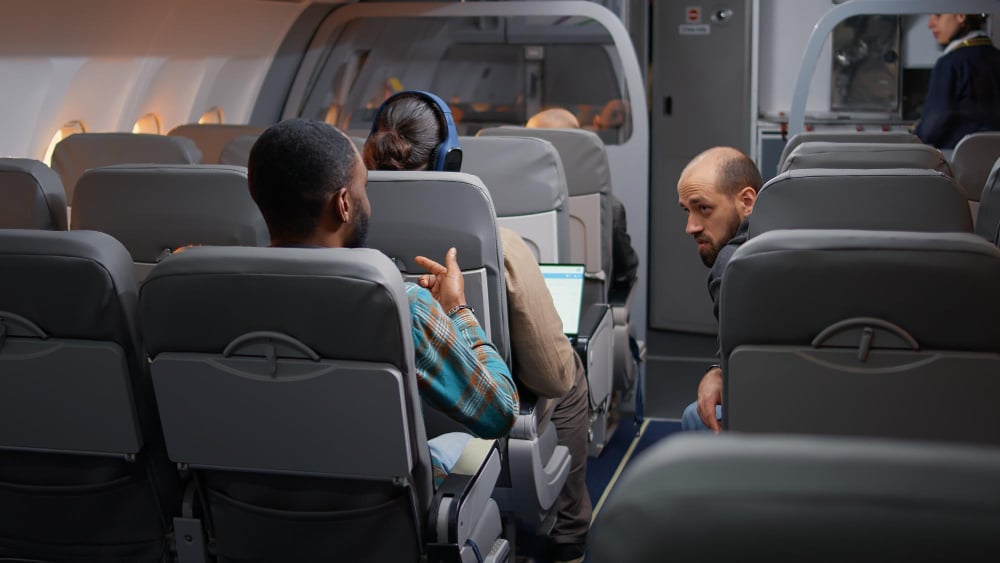
There was a woman already sitting there.
She was sprawled across the window seat. Twelve A. Lily’s seat. She looked to be in her late forties. Blond highlights, big sunglasses pushed up on top of her head, big gold hoop earrings. She had expensive white headphones on, and her eyes were closed.
Her camel-colored wool coat was draped over the middle seat. My seat. Twelve B.
Her designer handbag was sitting on the tray table in front of it.
And she’d kicked off one of her shoes. A shiny black flat. Her bare foot was pressed flat against the wall of the cabin, under the window.
She looked like she’d moved in.
“Mom,” Lily whispered. She stopped in the aisle and turned back to me. “Isn’t that our row?”
“Yes,” I said. “Let me handle it.”
I checked the numbers above the seats, just to be sure. 12 A. 12 B. Then I reached into the front pocket of Lily’s backpack and pulled out our boarding passes.
Row 12. Seat A. Row 12. Seat B. Both circled in blue pen. By me. Twice.
My stomach tightened. But I told myself it was probably just a simple mistake. People sit in the wrong seats all the time. Maybe she was in 21 and got her numbers mixed up. The kind of thing you sort out in thirty seconds with a smile and a boarding pass.
I pulled Noah a little closer. I felt Lily press up against my hip.
I stepped forward.
“Excuse me,” I said. Pleasantly. “I’m sorry. I think you might be in our seats?”
The woman didn’t open her eyes.
She didn’t move.
Behind me, I could feel the line of passengers stacking up in the narrow aisle. Somebody’s rolling suitcase bumped the back of my leg. I heard a sigh. Then another one.
Every eye in the area was already turning toward row 12.
I leaned in a little closer.
“Excuse me,” I said again. Softer this time. Gentler. “Ma’am? Those are our seats. My daughter has the window.”
The woman opened her eyes.
She looked at me. Slowly. Up and down. At the baby carrier. At the diaper bag. At Lily.
She didn’t take off her headphones.
“I heard you,” she said. “The first time.”
I held out our boarding passes, so she could see them clearly.
“Ma’am, we paid extra for these two seats. Together. My daughter is ten. She needs to sit next to me.”
She let out a long, heavy sigh. Like I’d interrupted something enormously important. Then she reached up and pulled one earbud out.
“Look,” she said. “I’m already settled. I’ve got my things where I want them. I’ve got my coat. My bag. My shoe off.” She waved a hand at all of it. “And honestly? Mothers with babies always expect everybody else to rearrange their whole lives around them. You chose to travel with two children. That isn’t my problem.”
Heat rushed into my face. All the way up to my hairline.
Behind me, someone muttered something about the delay. Someone else said, “Come on.”
I stood there with Noah on my chest and my boarding passes held out in my shaking hand, and I couldn’t think of a single thing to say.
This is the moment, I thought. This is where a braver woman would stand up for herself. Raise her voice. Make her move.
I just stood there.
Then Denise, the flight attendant, slipped through the crowd in the aisle behind me.
She glanced at the boarding passes in my hand. Then she pulled up something on her tablet. Her frown deepened. She tapped the screen a few times.
Then she leaned in close to me and spoke very quietly. Too quietly for anyone else to hear.
“There’s been a double assignment,” she whispered. “On the window seat. The system issued 12A twice. It happens sometimes. I’m so sorry.”
“Okay. But she’s in my seat too. 12B. Her coat’s on it.”
“I know.” Denise pressed her lips together. “I’ve already asked her twice, before you boarded. Nicely. She won’t move. And I can’t remove her before departure without a supervisor and a whole process, and we’ll lose our slot.”
She glanced at her watch.
“The flight’s completely full. The only seat left on the whole plane is 15C. Three rows back. On the aisle.”
She looked at me apologetically.
“Your daughter can stay here in 12B, and you can take the baby to 15C. Or we can try to sort this all out after takeoff. But I’m so sorry, we have to close the doors. Right now. We’re already four minutes late.”
I stared at her.
“You want me,” I said slowly, “to leave my ten-year-old up here? Alone? Next to her?”
Denise winced.
“I know, ma’am. I know. It’s not okay. But the second that seatbelt sign goes off, I’ll come back and fix this myself. I promise you. I’ll get you all moved together. And we’ll process a partial refund for the seat upgrade after landing. Please.”
From her nest in 12A, the woman smirked. She’d put her earbud back in, but she’d obviously heard everything. She didn’t even look up.
“Why should I move?” she said, to nobody in particular. “She’s the one traveling with all that.”
She flicked one perfectly manicured finger toward Noah.
Like he was an oversized carry-on bag. Like he was a piece of luggage I’d tried to sneak past the gate agent.
Noah whimpered against my collarbone. He’d woken up. He could feel my heart pounding. Babies always know.
His little blanket slipped out of the carrier again. It fell to the floor right by the woman’s seat, near her bare foot.
I bent down to grab it. Awkwardly, with Noah on my chest. I had to grip the armrest of 12B with my left hand to balance myself while I reached down with my right.
My left hand brushed against the seat cushion as I stood back up. Against her coat.
Noah fussed. Squirmed. Opened his mouth to cry.
I didn’t think about anything else. I just stood up and tucked the blanket back around him and bounced him and said shh, shh, shh.
I didn’t feel anything.
I didn’t notice a thing.
Then Lily tugged on my sleeve.
Hard. Twice.
“Mom,” she said. “Wait. I think something—”
She almost never interrupted grown-ups when they were talking. Never. It was one of our rules. For one split second, I wondered what could possibly be so important.
But before she could finish her sentence, the woman in 12A snapped at her.
“Stop bothering me, kid.”
She hadn’t even been talking to her. Lily had been talking to me.
“God,” the woman said loudly, rolling her eyes toward the passengers in the next row. “Some children have no manners.”
Lily flinched.
Just a little. Her shoulders came up toward her ears, the way they do when she’s embarrassed.
She looked at the woman. Then at me.
Then she swallowed whatever she’d been about to say.
“It’s okay, Mom,” she said quietly. “I’ll be fine. I can see you from here.”
I crouched down in the aisle. With Noah on my chest, it wasn’t easy. I balanced on the balls of my feet so I was at her level.
I brushed a loose strand of hair behind her ear.
“Are you sure, baby?”
She nodded.
“I’m sure.”
Every single instinct I had was screaming at me. Don’t leave her. Don’t you dare leave her here with that woman.
But Noah was fussing. The aisle was blocked. There were thirty people standing behind me with their bags, glaring. Denise was looking at her watch. Every second I stood there made it worse.
And I’m not brave. I never have been.
So I gave in.
I hated myself for it. I still do, a little.
I leaned in and kissed her forehead.
“Buckle up,” I told her. “And if you need me, for anything, press the call button. Okay? Anything at all.”
“I will.”
“Promise?”
“Promise, Mom.”
Lily slid past the woman’s knees and squeezed into 12B, the middle seat. She had to move the woman’s camel coat to sit down. She folded it carefully and set it on the floor at the woman’s feet, because there was nowhere else to put it.
The woman didn’t say thank you.
Lily set her purple owl backpack on her lap. She buckled her seatbelt. She looked up at me.
I made my way back three rows to 15C.
The man in 15B was enormous. He was asleep before we even took off, his elbow spilling over into my armrest. But he didn’t seem to mind sharing the space with a baby, which was something.
I took Noah out of the carrier, the way the flight attendants require for takeoff, and held him on my lap with the little infant belt looped through mine. I settled him against my shoulder.
And then I immediately turned around and looked back toward row 12.
From 15C, if I leaned out into the aisle, I could see the back of Lily’s head. Her brown braids.
I watched the woman in 12A.
She stretched her long legs out. Out of her own foot space. Into Lily’s. Her bare foot slid right into the space under Lily’s seat.
Then, without even taking off her headphones, she reached over and planted her elbow on the armrest between them. Hard. She took the whole armrest. All of it.
Lily ended up squeezed against the other side of her seat. As small as she could make herself.
I watched my daughter quietly fold her hands in her lap.
She didn’t complain. She didn’t say a word. She didn’t press the call button. She just sat there, small and quiet, with her owl backpack on her knees.
I closed my eyes.
Just get through the flight, I told myself. Just get through it. Just breathe. Denise will come back. Just breathe.
The engines roared.
The plane rolled down the runway, faster and faster, and then lifted. My stomach dropped. Noah startled awake and screamed for about thirty seconds, then settled back down when I gave him a bottle to help his ears.
The plane climbed. Through the clouds. Up into the bright blue sky above them.
I kept my eyes on the back of Lily’s head the whole time.
Ten minutes later, there was a soft chime. The seatbelt sign clicked off.
I kept watching Lily while Noah drifted back to sleep against my chest.
At first, she was just sitting there. Still. Hands folded. Looking straight ahead.
Then I noticed something.
She kept glancing to her left. At the woman beside her. Then down at the floor, where she’d folded that camel coat. Then back at the woman. Then down at the coat again.
Her expression was changing.
It wasn’t fear. I know my daughter’s afraid face. This wasn’t it.
It was her thinking face. Her detective face. The face she makes when she’s trying to remember where she left her library book, or trying to figure out which neighbor’s dog keeps digging up our tulips.
She looked like she was trying to remember something.
Then Lily unbuckled her seatbelt.
She stood up. In the space in front of her seat. With her purple owl backpack still on her shoulders.
I leaned out into the aisle so I could see her better. Noah stirred against me.
Lily folded both hands in front of her. Neat and polite. Like she was about to give a book report in front of her class.
She turned to face the woman in 12A.
“Ma’am,” she said.
Her voice was clear and steady. Not loud. Not quiet either. I could hear it from three rows back.
“My mom taught me that you should never embarrass people in public,” Lily said. “That you should always try to tell them things quietly first. That’s why I tried to tell you quietly. Before. When we were sitting down.”
The woman groaned. Loudly. Loud enough for half the rows around her to hear.
She pulled out an earbud.
“Then stop talking, kid.”
Lily didn’t sit down.
She just looked at the woman for one long second. Very calm. Very still.
Then she said:
“If that’s really your seat, why are you sitting on my mom’s wedding ring?”
The cabin fell completely silent.
The man in 12C, across the aisle, turned his head. The woman in 13A behind them lowered her book. Two rows of people stopped talking. Even Denise, standing at the drink cart up near the front, stopped pouring a ginger ale and turned around.
The woman in 12A laughed. A short, sharp, nasty laugh.
“I have absolutely no idea what you’re talking about.”
Lily pointed. Very precisely. At the gap between the seat cushion of 12A and the armrest.
“It fell off,” she said. “When my mom bent down to get Noah’s blanket. Before we took off. She grabbed your armrest to balance, and her ring came off, because it’s too big. It’s been too big for weeks.” She took a breath. “I was leaning around her to grab my juice box off the seat. And I saw it fall. I saw it roll right under your leg. That’s what I was trying to tell my mom. Before you yelled at me.”
I looked down at my left hand.
My stomach dropped through the bottom of the airplane.
The ring wasn’t there.
My finger was bare. There was just a faint pale band where it had been for eleven years. A shiny, smooth, empty strip of skin.
I remembered it then. Bending down for Noah’s blanket. Gripping the armrest with my left hand. The woman shifting in her seat, rearranging her coat. Noah fussing.
At the time, it hadn’t seemed important.
Now it was the most important moment of my entire morning.
Every head near row 12 tipped down toward the woman’s seat.
My face went hot. I gripped Noah tighter against my chest.
And I hated myself. I hated myself so much in that moment. For not being the one standing there. For leaving my ten-year-old to fight my battle for me. For losing the ring in the first place, because I’d been too busy and too tired and too scared to make a scene about anything.
The woman in 12A rolled her eyes dramatically.
Then she lifted herself up off the seat. Just an inch or two. Just enough to show the empty cushion underneath her.
“Well?” she said. Loudly. To everyone. “Go ahead. Look.”
People actually looked.
The man in 12C, across the aisle, leaned way over. He was in his sixties, gray-haired, with reading glasses on a cord around his neck. The woman in 13A leaned forward over the seatback. Somebody two rows up pulled out their phone and turned on the flashlight and shined it down into the seat.
I held my breath.
Nothing.
No glint of gold. No ring. Just a crumpled-up napkin wedged in the gap. And a single cracker crumb.
“See?” the woman said.
She sat back down. Slowly. Smugly. Her mouth curled into a smile.
“Maybe,” she said, looking directly at me over the seatbacks, three rows away, “you should teach your daughter not to make things up.”
My stomach dropped all over again.
I stood halfway up out of my seat before I could even think about it. The big man in 15B grunted in his sleep.
“Lily,” I called. My voice was shaking. “Sit down, sweetheart. It’s okay. Come sit down.”
But Lily didn’t move.
She stood there, very still, with her hands still folded in front of her.
I watched her eyes. They went from the empty seat cushion. Down to the floor. Down to the camel-colored wool coat, still folded at the woman’s feet. The coat she’d folded and put there herself, when she sat down.
And I watched something click behind her eyes.
I saw it happen. Like a light switching on.
“You reached down,” Lily said quietly. Very quietly. “Right after it fell. When I was still bent over next to Mom, getting my juice box.”
The woman’s smile froze.
“I thought you were fixing your coat,” Lily said. “Because it was on the seat. Mom’s seat. And you picked it up a little. But you didn’t fix it. You put your hand down by your leg. Where the ring was. And then you put your hand in the pocket. In your coat pocket.”
She pointed down at the camel coat on the floor.
“I saw it,” Lily said. “I just didn’t understand it. Until now.”
The woman’s face did something strange.
For a split second, something flashed across it. Panic. Then it was gone, and the smug look was back. But it was a little thinner. A little shakier.
“Kids imagine all sorts of things,” she said. Loudly. To the passengers around her. She spread her hands out wide, palms up. Like she was inviting everybody’s sympathy. “Honestly. Some parents.”
A few people looked away. Uncomfortable. Embarrassed.
My throat burned.
I pictured it. That ring, gone forever. In the pocket of this woman’s camel coat. Walking off the plane with her. Disappearing into the airport. Into a pawnshop somewhere. For a couple hundred dollars.
And I pictured having to tell Ethan. At his father’s bedside. In the hospital in Phoenix.
That I’d lost it. The one thing he’d slipped onto my finger in the back booth of a diner eleven years ago, with ketchup on my sleeve.
Every chapter. Always. E.
I started walking up the aisle.
I didn’t decide to. My legs just did it. I unbuckled the little infant belt, held Noah tight against my chest, and stepped out into the aisle.
But Denise was already moving.
She came down the aisle from the front of the plane, fast, past the drink cart. Past row 10. Past row 11. Her mouth was pressed into a thin, flat line I hadn’t seen on her face before.
She stopped at row 12.
She looked at Lily. She looked at the woman in 12A. She looked down at the camel coat on the floor.
Then, without a word, she turned and walked back up to the galley and picked up the interphone mounted on the wall beside it.
She spoke into it, very quietly. I couldn’t hear what she said. She listened for a few seconds. Then she gave a short, sharp nod.
She hung up the phone.
She walked back to row 12.
She looked directly at the woman in 12A.
“Ma’am,” Denise said. “I’ve just spoken with the captain.”
The color drained out of the woman’s face.
All of it. All at once. Like someone had pulled a plug.
“He’s asked me to tell you,” Denise said, clearly and calmly, “that a passenger has reported a theft of personal property on this aircraft. Our policy is that we’ll ask you to voluntarily show us the contents of your coat pocket.”
She paused.
“If you refuse,” she said, “the captain will radio ahead, and airport police will be asked to meet the aircraft at the gate after landing. You’ll be held on board while the report is investigated.”
She held the woman’s gaze.
“Your pocket, please, ma’am.”
The woman stared at her.
“Excuse me?” she said. “Why on earth would I do that? This is outrageous. Because some child—”
“Several passengers,” Denise said evenly, “have reported that they saw you bend down and pick something up before takeoff.”
The woman’s mouth opened. Then closed.
Across the aisle, the gray-haired man in 12C cleared his throat.
He’d been frowning this whole time. A thoughtful frown. Like he was working through a math problem.
“I’ll be honest,” he said slowly. “I kept turning it over in my head. When we were boarding. I thought you were just adjusting your bag. But the more I pictured it, the more sure I was.” He looked at the woman directly. “You slipped something into that coat. I watched you do it. I just didn’t know what it was.”
The woman in 13A, right behind them, leaned forward into the aisle.
“I saw it too,” she said firmly. “You definitely put something in your pocket. You looked around first. Like you were checking if anybody was watching.”
Every head in the front half of the airplane turned toward row 12.
The woman in 12A started to stammer.
“This is— this is ridiculous. I don’t have to— You can’t make me—”
Her hand was hovering near the coat on the floor. Not touching it. Just hovering.
“Ma’am,” Denise repeated quietly. “Please.”
For a long moment, nobody moved.
I stood frozen in the aisle in front of row 14, holding Noah, holding my breath.
Then, slowly, the woman leaned down. She picked up the camel coat. She held it in her lap.
She reached into the right-hand pocket.
And her fingers came out holding my gold wedding ring.
A soft gasp rippled through the cabin.
It sounded like wind going through tall grass. Starting in row 12 and going out in every direction.
The ring caught the light from the window. The little diamond sparkled. I could see the dent in the side. The one from the kitchen counter.
I walked the last two rows forward.
But I didn’t have to reach for it.
Lily got there first.
She held out her hand. Calm. Polite. Palm up.
The woman looked at her for a long second.
Then she dropped the ring into Lily’s open hand.
Her own hand was trembling.
Lily closed her fingers around it. She turned around. She held it out to me.
She placed it in my palm.
“It must have fallen in there,” the woman muttered, not looking at anyone. “Into my pocket. When I moved my coat. I didn’t even notice.”
Nobody said anything.
Nobody believed her. You could feel it. Thirty people in the surrounding rows, all not believing her at the same time.
Denise stood up straighter.
“Please gather your belongings, ma’am,” she said. “You’ll be sitting in the rear of the aircraft for the remainder of the flight. Row 31. Seat B. We’ll be filing an incident report upon landing.”
“Row 31? That’s the middle seat. By the bathrooms.”
“Yes, ma’am,” Denise said. “It is.”
The woman gathered up her coat. Her designer handbag. She put her shiny black flat back on her bare foot. She stood up and squeezed out into the aisle, past Lily, past me, past Noah, not looking at any of us.
She walked all the way to the back of the plane. Every head in every row turned to watch her go.
And then somebody in row 14 started clapping.
Just one person, at first. A young guy in a college sweatshirt.
Then another passenger joined in. The woman in 13A. Then the gray-haired man in 12C. Then the whole row behind them.
And then, I swear, the whole front half of that airplane was clapping.
Applauding my daughter.
Lily turned bright red. She ducked her head. She looked like she wanted to sink straight through the floor.
But she was smiling.
I sat down in 12B. In my real seat. The seat I’d paid extra for.
Denise brought my diaper bag forward from 15C. Then she knelt down in the aisle next to us.
“I’m so sorry,” she said quietly. “For all of it. For asking you to move. I should’ve fought harder. I should’ve gotten a supervisor.” She looked at Lily. “She shouldn’t have had to do that.”
“She did great,” I said.
“She did amazing.” Denise reached over and gave Lily a little fist bump. “We’ll take care of the refund. And more. Leave it to me.”
Lily climbed back into 12A. Her window seat. Finally.
She looked out at the clouds. Then she looked at me.
I pulled her over against my side, as close as I could get her with Noah on my other shoulder. I held her there.
Then, with shaking fingers, I slipped the ring back onto my finger. Pushed it all the way down. Felt the familiar weight of it.
Every chapter. Always.
I held my hand up to the window, and the little diamond caught the sun.
“Lily,” I said. My voice cracked. “How did you know? How did you even— I didn’t feel anything. I didn’t notice anything. I’m the one wearing it.”
Lily shrugged. Like it was nothing.
“I always watch your ring,” she said. “Since it got too big. Every time you move your hand, I check. Because you said you’d fix it and you didn’t.” She looked up at me. “So I was being the ring manager. Like the diaper bag manager.”
I laughed. Half a laugh. Half something else.
“And when she yelled at you? Why didn’t you just tell me then? Why’d you wait?”
“Because you told me,” Lily said. “When I was seven. About the whales. You said you’re supposed to tell people quietly first. Just them. So they have a chance to fix it.” She frowned. “I gave her a chance. When we sat down. I said excuse me, I think you have something that’s my mom’s. Really quietly. And she put her headphones back in. So I tried to remember what I saw. Really carefully. To make sure. And then I said it louder.”
She shrugged again.
“I was just doing what you would do, Mom.”
I didn’t have the heart to tell her that I wouldn’t have.
That I’d stood in that aisle with my boarding passes shaking in my hand, and I couldn’t think of a single thing to say. That I’d given up my seat and left her alone because thirty strangers were sighing at me and I was afraid of making a scene.
That the woman I’d taught her to be was somebody I’d only ever pretended to be.
I just kissed the top of her head. Held her close. Held Noah close.
And somewhere above the clouds, I made myself two promises.
The first one was that I’d never underestimate her again.
The second one was that I’d try to become the mother she already thought I was.
The rest of the flight was quiet.
Denise brought Lily a whole can of ginger ale instead of the little cup. And three bags of pretzels. And a set of plastic pilot’s wings from a secret stash in the galley.
“Usually these are for the little kids,” she told Lily, pinning them to her owl backpack. “But I think you earned the real ones.”
The gray-haired man in 12C leaned across the aisle about halfway through the flight.
“Young lady,” he said to Lily. “I was a police detective for thirty-one years. In Chicago. Retired now.” He nodded at her. “That was some of the best witness work I’ve ever seen. You stayed calm. You remembered details. You didn’t accuse until you were sure. That’s harder than it sounds.”
Lily stared at him with her mouth open.
“You were a real detective?”
“For thirty-one years.”
“I’m going to be a detective,” she said. “Or a marine biologist.”
He smiled.
“Well,” he said, “from what I just saw, you’re already halfway to the first one.”
She didn’t stop smiling for the rest of the flight.
When we landed in Phoenix, two airport police officers were waiting at the gate.
Not for us. For her.
Denise asked us to wait in our seats while everyone else got off. She told us the woman’s name was Carla. That this wasn’t the first incident report the airline had on file for her. That there’d been a complaint about a missing watch on another flight, six months before. Nobody had been able to prove anything then.
“Your daughter,” Denise said, “might have just helped close two cases.”
A police officer took my statement in the jet bridge. Then Lily’s. She told him everything, slowly and clearly, with her hands folded in front of her.
The officer wrote it all down. When she finished, he looked at me.
“She always this observant?”
“Always,” I said.
“Hang on to her.”
“I plan to.”
Ethan was waiting at the bottom of the escalator in baggage claim.
He looked exhausted. Four days of hospital chairs and vending machine coffee. He hadn’t shaved. His shirt was wrinkled.
But when he saw us coming down the escalator, his whole face changed. Like the sun coming out.
Lily ran the last ten feet and threw herself at him. He caught her and spun her around even though she was way too big to be spun.
Then he came to me. He wrapped his arms around me and Noah both, carefully, and held on.
“How’s your dad?” I asked into his shoulder.
“Better,” he said. “Sitting up. Asking for real food. Asking for his grandson every five minutes.”
He pulled back and looked down at Noah, asleep in the carrier.
“How was the flight?” he asked. “Was it awful? Alone with both of them?”
Lily and I looked at each other.
“Dad,” Lily said. “You’re not going to believe this.”
She told him the whole story. All the way out to the parking garage. All the way to the car. She did all the voices. The businessman’s huff. The woman’s some children have no manners. Denise’s your pocket, please.
When she got to the part where the ring came out of the coat pocket, Ethan stopped walking. Right in the middle of the parking garage.
He looked at my hand. At the ring.
Then he looked at Lily.
He didn’t say anything for a long moment.
Then he knelt down on the concrete in front of her. Right there in the parking garage, with cars driving past.
“You know I saved up for that ring for seven months?” he said. “In a coffee can?”
“Mom told me,” Lily said. “A bunch of times.”
“It’s the most important thing I ever bought,” Ethan said. His voice was rough. “And you saved it.”
“I was the ring manager,” Lily said simply.
Ethan laughed. And then his eyes filled up, and he pulled her into a hug and held on for a long time.
The next morning, before we went to the hospital, Ethan drove us to a little jeweler near the hotel.
Not a fancy one. A tiny family shop squeezed between a dry cleaner and a taco place. An old man with a magnifying loupe on his forehead stood behind the counter.
“I need it resized,” I told him. I put the ring on the glass counter. “It’s too big. It’s been too big for weeks. It fell off yesterday. On an airplane. I almost lost it forever.”
The old man picked it up and turned it over in his fingers. He held it up to the light.
He read the engraving inside.
Every chapter. Always. E.
He looked up at me over his loupe.
“Somebody saved up for this,” he said.
“In a coffee can,” Lily said.
The jeweler smiled. A slow, crinkly smile.
“Those are the best ones,” he said. “The coffee-can rings.” He set it carefully on a little velvet pad. “Come back in an hour. I’ll make sure it never goes anywhere again.”
An hour later, it fit perfectly.
Snug. Solid. The way it used to.
I slid it on in the shop and held my hand up to the window, and the little diamond chip caught the Arizona sunlight.
Lily leaned over and inspected it very closely. She turned my hand back and forth. She tugged on the ring with two fingers to make sure it wouldn’t come off.
“Okay,” she said finally. “I approve.”
“Thank you, ring manager.”
“You’re welcome.” Then she looked up at me. “Does this mean I’m fired?”
“No, baby,” I said. I pulled her against my side. “It means you’re promoted.”
That afternoon, in a hospital room in Phoenix that smelled like hand sanitizer and lime Jell-O, Ethan’s father held his grandson for the very first time.
He cried. Big, quiet tears that ran down into the oxygen tube under his nose.
“Look at him,” he whispered. “Look at this little guy. Bald as an egg.”
Lily stood next to the bed with her plastic pilot’s wings still pinned to her owl backpack.
“Grandpa,” she said. “Do you want to hear about the airplane?”
He looked over at her.
“Was something wrong with the airplane?”
“No,” Lily said. “Something was wrong with a lady.”
And she told the whole story all over again. All the voices.
Ethan’s dad laughed so hard that a nurse came in to make sure his stitches were okay.
I’ve thought about that flight a lot since then.
About how I stood in that aisle with my boarding passes shaking in my hand and couldn’t find my voice. About how I gave up my seat because I was more afraid of thirty strangers sighing at me than I was of leaving my daughter alone.
About how I’d spent eleven years apologizing for taking up space. Eating the wrong orders. Letting people cut in line. Never making a scene.
And about how a ten-year-old with brown braids and an owl backpack stood up in the middle of an airplane, folded her hands like she was giving a book report, and quietly, politely, refused to let somebody walk away with something that wasn’t theirs.
She didn’t yell. She didn’t make a scene. She did exactly what I’d taught her to do. She tried quietly first. She gathered her facts. She waited until she was sure.
And then she said it louder.
I’d taught her that.
I just hadn’t ever learned it myself.
I’m learning now.
Last week, at the grocery store, the cashier rang up my avocados twice. A year ago, I would have just paid for them. Two dollars and fifty cents. Not worth making a fuss about.
This time, I said, “Excuse me. I think those got scanned twice.”
The cashier checked. She apologized. She fixed it.
That was it. Thirty seconds. No scene. Nobody died.
Lily was standing next to me, holding the cart.
She didn’t say anything.
But she looked up at me, and she smiled.
And she gave me a very small, very serious thumbs-up.
I’ve still got a long way to go.
But at least now I know who to learn from.

Adrian Hawthorne is a celebrated author and dedicated archivist who finds inspiration in the hidden stories of the past. Educated at Oxford, he now works at the National Archives, where preserving history fuels his evocative writing. Balancing archival precision with creative storytelling, Adrian founded the Hawthorne Institute of Literary Arts to mentor emerging writers and honor the timeless art of narrative.