My son told me at the dinner table, between bites of macaroni and cheese, like it was the most ordinary thing in the world.
“Grandma said your blue box is heavy.”
My hand froze on the serving spoon.
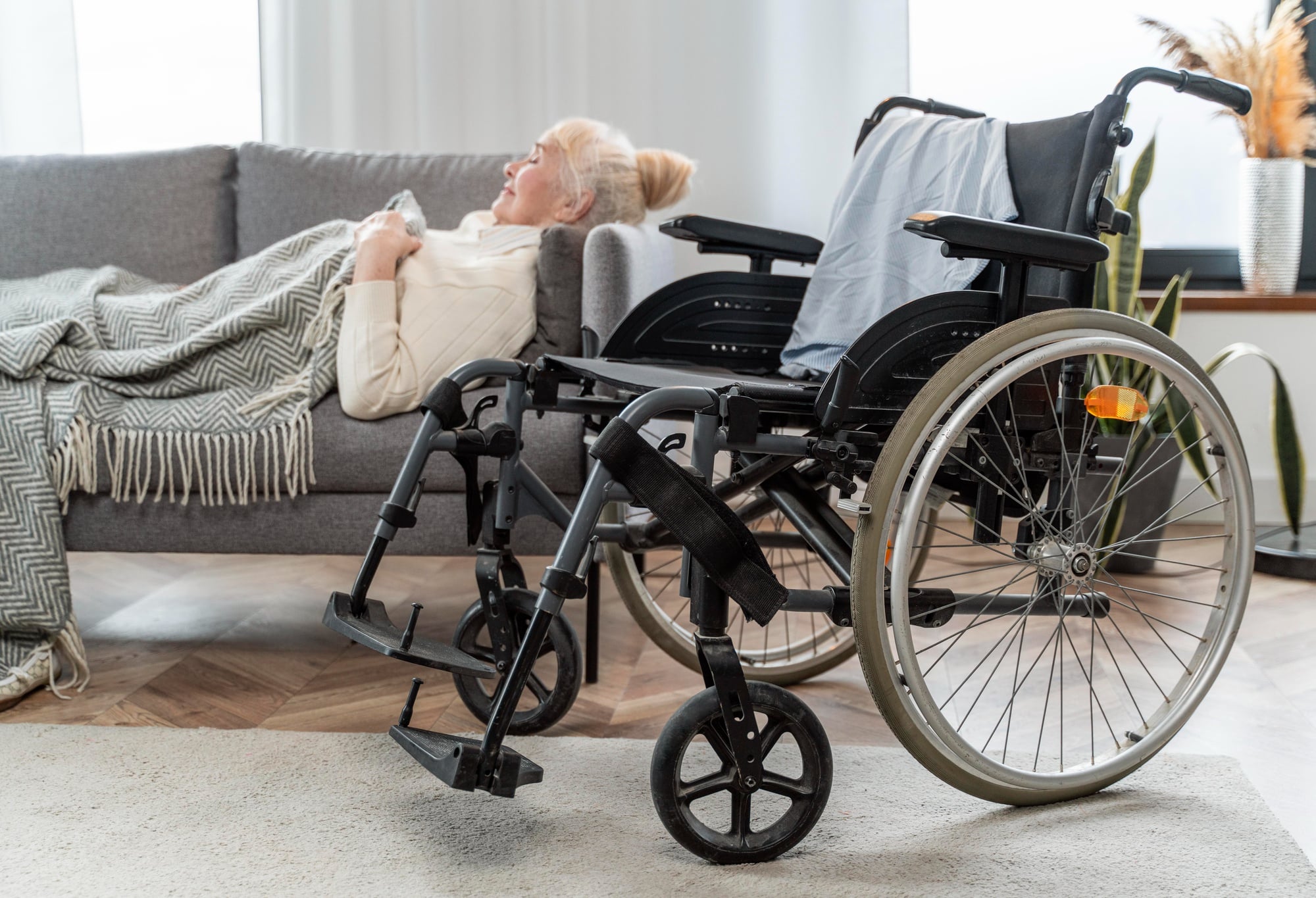
It was a Tuesday evening in late March. Nathan was still out in the garage, working on the lawn mower he’d been trying to fix since February. The kitchen smelled like cheese sauce and the lemon dish soap I’d used on the pots. Down the hall, in the room that used to be my sewing room, my mother-in-law was sitting in her wheelchair by the window, the way I’d left her twenty minutes earlier, with a blanket over her knees and the television on low.
She hadn’t spoken a word in eight months.
“What blue box?” I said.
Ben shoveled another forkful of macaroni into his mouth. He’s seven. He talks with his mouth full no matter how many times I tell him not to.
“The one on the bottom shelf of your closet,” he said. “Under your sweaters.”
I set the spoon down very carefully.
“Ben,” I said. “Grandma can’t talk, sweetheart.”
He frowned at me. That serious little frown he gets, the same one his father gets when somebody tells him something obviously wrong.
“Yes, she can,” he said.
My heart started to beat faster.
“What did she say, Ben?”
He looked at his plate. Then at the hallway. Then back at me.
“She told me to bring it to her,” he said. “When you weren’t home and Dad was in the garage.”
And then his eyes went very wide, and he put his hand over his mouth.
“Oops,” he said through his fingers. “Grandma said that was our secret.”
I don’t remember standing up. I remember being on my feet beside the table, and I remember my knees didn’t feel like they belonged to me.
That box held almost everything I had left of my mother.
She died when I was twenty-four. Ovarian cancer. Four months from the diagnosis to the funeral. There was no money. No house. She’d rented a little apartment over a bakery in Dayton for most of my life, and when she was gone, I packed up what mattered into one blue cardboard storage box from Target. Her letters, in a bundle tied with a shoelace. A few pieces of jewelry, mostly costume. Her reading glasses. A recipe card for her pineapple upside-down cake in her handwriting.
And her pearl necklace. A single strand. Real pearls, small and slightly uneven, the only valuable thing she ever owned. Her own mother gave it to her on her wedding day in 1979. She gave it to me in the hospital, two weeks before she died, pressing it into my hand.
“For your wedding,” she whispered. “So I’m there.”
I wore it the day I married Nathan. The clasp broke at the reception. I’d taped it with a piece of Scotch tape inside the velvet pouch and never been able to afford to fix it.
“Ben,” I said. “Did you give the box to her?”
He nodded slowly. He looked scared now. I must have looked scary.
“Yes,” he said. “Last week. And the week before.”
“And what did she do with it?”
“She looked at stuff,” he said. “And read the letters. And then she carried it back to her room so she could put it under her bed.”
I gave a nervous laugh. It came out wrong. High and thin.
“Honey,” I said. “Grandma can’t walk. You know that. That’s why she has the wheelchair.”
His face turned very serious. More serious than I’d ever seen it.
“She does when you’re gone,” he said.
I need to tell you about Diane. Because you won’t understand what I saw the next day unless you know who she was to me.
My name is Erin Whitaker. I’m thirty-four years old. I’m a kindergarten aide at Fairmont Elementary in Kettering, Ohio. I help a teacher named Mrs. Delgado wrangle twenty-four five-year-olds through the alphabet every day. I tie shoes. I wipe noses. I hold hands on the way to the bathroom. It doesn’t pay much. I love it.
I met Nathan Whitaker eleven years ago at a friend’s birthday party. He was a civil engineer for the county, tall and quiet and kind, with sawdust on his jeans because he’d been building a bookshelf that afternoon. He spent the whole party in the kitchen helping the host’s grandmother with the dishes. I fell in love with him over a sink full of soapy water.
His mother was a different story.
Diane Whitaker was fifty-six when I met her. Tall, elegant, with silver hair she wore in a sharp bob and reading glasses on a gold chain. She’d owned a jewelry store in Oakwood, the wealthy suburb next to Dayton, for thirty-one years. Whitaker Fine Jewelry. She designed custom engagement rings for doctors and lawyers. She repaired antique pieces for women whose grandmothers had left them heirlooms. She was famous for her hands. People said she could fix anything that had ever been made of gold.
Her husband, Nathan’s father, had died when Nathan was fifteen. She raised Nathan alone and ran the store alone, and she was proud of both, and she made sure everyone knew it.
The first time Nathan brought me to her house, she looked at me for a long time over her glasses. At my discount-store dress. At my hands, which were rough from work. At my shoes.
“And what do you do, Erin?” she asked.
“I’m a teacher’s aide,” I said. “In kindergarten.”
“An aide,” she said. “Not a teacher.”
“Not yet,” I said. “I’m going back to school when I can afford it.”
She nodded slowly. She didn’t say anything else to me the rest of the afternoon.
After that, it got worse.
She never said anything cruel in front of Nathan. She was too smart for that. She said things to me. In the kitchen. In the hallway. At Christmas, while Nathan was out getting more firewood. Quiet things. Small things. Things that stuck in me like splinters.
You’ve put on a little weight, haven’t you, dear.
That’s an interesting color on you.
Nathan always did like to rescue strays.
And then, two weeks before the wedding, at my bridal shower, in her own kitchen, while everyone else was in the living room opening presents, she said the thing I’ve never forgotten.
“One day he’ll realize he chose wrong,” she said. She was arranging cookies on a plate. She didn’t even look at me. “Nathan deserves someone prettier. Smarter. Someone who fits this family.” She picked up the plate. “I just hope it’s before there are children.”
Then she carried the cookies into the living room and smiled at all my friends.
I went into her downstairs bathroom and locked the door and cried for twenty minutes. Then I fixed my makeup and went back out and opened presents.
I never told Nathan. Not that day. Not ever. I didn’t want him to have to choose.
For ten years, Diane and I were polite. That’s the best word for it. Polite. She came for holidays. She sent Ben birthday cards with fifty-dollar checks inside. She called Nathan every Sunday. She never called me.
And then, last July, everything changed.
She was driving home from her store on a Saturday evening. A teenage boy in a pickup truck ran a red light at the corner of Far Hills and Dorothy Lane. He hit her driver’s side door at forty-five miles an hour.
She survived. That’s the first thing the doctors told us, standing in a family room at Miami Valley Hospital at two in the morning. She survived. And then they told us the rest.
Her spine was injured. Not severed. Bruised, badly, in her neck. Swelling around the spinal cord. And she’d had a stroke, on the left side of her brain, from the trauma. The part that controls language.
She couldn’t move anything below her shoulders. She couldn’t speak. She could blink. She could move her eyes. That was all.
“Will she get better?” Nathan asked. His voice was shaking.
The neurologist was a careful woman named Dr. Feldman. She looked at the floor before she answered.
“Spinal cord contusions can improve,” she said. “Sometimes. Some function can come back over months. Strokes like this can improve too, with therapy. But at her age, with injuries this severe.” She paused. “I don’t want to give you false hope. Most of what she’s going to recover, she’ll recover in the first three months. After that, it’s usually very slow. Often there’s no further change at all.”
Diane was in the hospital for six weeks. Then a rehabilitation center for eight more. Physical therapy every day. Speech therapy every day. Very little progress. Her right hand could twitch a little by October. Her eyes could follow you across the room. She could make a sound sometimes. Not a word. Just a sound. Like a hum.
In November, the rehab center said they’d done what they could. Her insurance wouldn’t pay for more. She needed to go somewhere with full-time care.
The nursing homes Nathan looked at were either terrible or eight thousand dollars a month. Diane’s savings were mostly tied up in her store, which was sitting closed on a dark corner in Oakwood with a sign on the door that said CLOSED DUE TO FAMILY EMERGENCY.
Nathan sat at our kitchen table with his head in his hands.
“I don’t know what to do, Erin,” he said. “I can’t put her in one of those places. I can’t. She’s my mother.”
I sat across from him. I thought about the bridal shower. The cookies. Nathan deserves someone prettier.
Then I thought about my own mother. In a hospital bed at Kettering Medical Center. With nobody but me.
“She can stay here,” I said.
Nathan looked up.
“In my sewing room,” I said. “It’s on the first floor. There’s a bathroom right across the hall. We can get a hospital bed. I’ll take care of her.”
“Erin,” Nathan said. “You can’t. You work. You have Ben.”
“I work until two fifteen,” I said. “Ben’s at school until three. I’ll do the mornings and afternoons. You’ll do the nights. We’ll get a home health aide to come in for a few hours while I’m at work.” I took a breath. “We’ll figure it out.”
Nathan stared at me.
“After everything she’s said to you?” he said quietly.
I froze.
“You knew?”
“I’m not stupid, Erin,” he said. “I’ve heard her. Not everything. But enough.” He looked down at the table. “I should have stopped her. Years ago. I didn’t know how. She’s my mother.”
“I know, honey.”
“Why would you do this for her?”
I thought about it for a long time.
“Because she’s Ben’s grandmother,” I said. “And because my mother would have done it. And because I don’t want to be the kind of person who doesn’t.”
Diane moved into our house the first week of December.
For eight months, I took care of her.
I’m not going to pretend it was easy. It was the hardest thing I’ve ever done.
I got up at five thirty every morning. I went down the hall to her room. I turned her in bed so she wouldn’t get bedsores. I washed her face with a warm cloth. I brushed her teeth. I changed her. I dressed her. I helped the aide move her from the bed to the wheelchair with a lift that took two people and twenty minutes. I fed her oatmeal, one spoonful at a time, wiping her chin. I gave her medications. Nine different pills. Some of them crushed into applesauce.
Then I went to work and tied shoes for six hours.
I came home at two forty-five. I relieved the aide. I fed Diane lunch. Soup, mostly. I washed her hair in the afternoons, in a special basin that hooked over the back of her wheelchair. I brushed it out. I put on the lotion she’d always used, an expensive French one that I found in a bag Nathan brought from her house. I read the newspaper to her. I put on the television. Her old favorite shows. Jeopardy. Antiques Roadshow.
I turned her in bed at night when Nathan was too exhausted to wake up.
And through all of it, she never moved anything but her eyes.
She watched me. All the time. When I fed her. When I washed her. When I changed her. Her gray eyes followed me around the room. I couldn’t tell what she was thinking. I imagined the worst. I imagined her lying there, hating me, judging me, thinking that if she could talk, she’d tell me I was doing it all wrong.
Sometimes I talked to her anyway. While I washed her hair. About Ben. About my kindergartners. About my mother.
“She would have liked you,” I said once, rubbing lotion into her hands. “My mom. She liked everybody. She’d have brought you a pineapple upside-down cake.” I laughed a little. “You’d have hated it. It was always a little burnt on one side.”
Diane’s eyes moved to my face.
She looked at me for a very long time.
I couldn’t read it. I never could.
Ben was the only one who wasn’t afraid of her.
He’s seven. He doesn’t understand what it means to be paralyzed. He just understood that Grandma lived in Mom’s sewing room now and couldn’t talk, so he talked for her.
Every day after school, he’d run straight down the hall to her room. He’d tell her about his day. About his teacher, Mr. Abernathy. About his best friend, Theo, who could burp the whole alphabet. About the class guinea pig, whose name was Professor Nibbles. He’d show her his drawings. He’d read her his spelling words.
Sometimes I’d stand in the hallway and listen.
“Grandma,” he’d say. “Can you say ‘because’? It’s my hardest one. B-E-C-A-U-S-E. Can you say it?”
And she’d hum. That little sound. And Ben would laugh and say, “Close, Grandma! Almost!”
I thought it was sweet. I thought it was just a little boy talking to his paralyzed grandmother.
I didn’t know.
After Ben told me about the blue box, I barely slept.
I lay in bed next to Nathan, staring at the ceiling, listening to the house. To the furnace clicking on and off. To the hum of the baby monitor we kept on my nightstand, the one that connected to Diane’s room so we’d hear if she needed anything.
I kept thinking about it. Over and over.
Diane had spent ten years telling me I wasn’t good enough for her son. Diane had told me she hoped he’d leave me before there were children. And now she was secretly sending my son into my bedroom for my mother’s things.
Why?
What would she want with a box of costume jewelry and old letters?
And then I thought about the pearls.
Real pearls. Diane owned a jewelry store for thirty-one years. She’d know exactly what they were worth. She’d know they were real the second she touched them.
Was she planning to take them? Sell them? Was she angry that I’d worn them at my wedding instead of the diamond pendant she’d offered me, the one I’d politely turned down?
I didn’t want to think it. I’d spent eight months washing her hair.
But I couldn’t stop.
And the walking. She does when you’re gone.
That wasn’t possible. Dr. Feldman had said so. The rehab center had said so. Eight months. Nothing but her eyes.
Unless.
At three in the morning, I got up and went to my closet. I knelt down and pulled out the bottom shelf, under my sweaters.
The blue box was there. Right where I’d always kept it.
I opened it.
The letters were there, tied with my mother’s shoelace. The costume jewelry. The reading glasses. The recipe card.
The velvet pouch with the pearls was gone.
I sat on the floor of my closet in the dark with the box in my lap, shaking.
The next morning was Saturday.
I told Nathan I was going to the grocery store. He said he was going to finish the lawn mower in the garage. He kissed my cheek and went out the back door. A minute later, I heard the garage door go up and the radio come on.
I’d ordered a nanny camera on Amazon the night before at three thirty in the morning. Same-day delivery. It came in a little cardboard box at eight. A tiny black camera, the size of a book of matches, that plugged into an outlet and looked like a phone charger.
While Diane was asleep, I plugged it into the outlet behind her nightstand. Pointed at the room. I connected it to the app on my phone. I tested it. It worked. I could see her bed. Her wheelchair by the window. The doorway to the hall.
Then I got Diane up, with the aide’s help, who came for two hours on Saturday mornings. A young woman named Keisha. I fed Diane her oatmeal. I gave her her pills. I got her settled in her wheelchair by the window with her blanket over her knees and Antiques Roadshow on the television.
She watched me the whole time. Her gray eyes.
“I’m going to the store, Diane,” I said. “I’ll be back in about an hour. Nathan’s in the garage if you need anything.”
She blinked.
Keisha left at nine. I grabbed my purse and my keys. I told Ben I was going to the store and he should watch cartoons in the living room and not bother Grandma.
“Okay, Mom,” he said, without looking up from the TV.
I drove to the Kroger on Stroop Road. I parked. I got a cart. I walked inside.
I didn’t buy anything.
I walked to the end of the cereal aisle, where nobody was, and I took out my phone, and I opened the camera app.
Ten minutes had passed.
Diane was sitting motionless in her wheelchair by the window. Her hands were in her lap on the blanket. The television was flickering. Antiques Roadshow. A man in a bow tie holding up a vase.
I watched her for two full minutes. She didn’t move.
I started to feel stupid. Ashamed. Ben was seven. He had an imagination. Maybe he’d taken the pearls himself. Maybe he was playing a game.
Then Ben walked into the room.
He went right up to her wheelchair. He leaned close.
“Mom’s gone,” he whispered.
I could hear it clearly through the camera.
Diane’s eyes moved. She glanced toward the hallway. Toward the door. Toward the back of the house, where the garage was.
And then her fingers curled around the armrests of her wheelchair.
Both hands. Slowly. Her knuckles went white.
She pushed.
Slowly. Very slowly. Her arms shaking. Her face tight with effort.
She pushed herself upright.
I stopped breathing.
Right there in the cereal aisle at Kroger, with a woman in a Buckeyes sweatshirt reaching past me for a box of Cheerios, I stopped breathing.
Diane’s legs trembled. Visibly. Like a newborn colt’s. She leaned forward, gripping the armrests. Her whole body was shaking.
But she stood.
My mother-in-law, who hadn’t moved anything but her eyes in eight months, was standing up in my sewing room.
Then she leaned down and whispered something to Ben.
I couldn’t hear what. Her voice was too low. Just a sound. A rasp.
But Ben nodded. And hurried down the hall. Toward my bedroom.
While he was gone, Diane turned. Slowly. Holding onto the back of her wheelchair. She took one step. Then another. Toward the window. She reached behind the long curtains, the floral ones I’d sewn myself when the room was still my sewing room.
She pulled out a black duffel bag.
I knew that bag. It was Diane’s. Nathan had brought it from her house in December, with her clothes and her toiletries. I’d never opened it. I’d assumed it had more clothes in it. I’d put it in the closet in her room. I didn’t know it had been moved behind the curtains.
Diane set it down on the bed. She unzipped it.
And then Ben came back into the room carrying my blue box. Holding it in both arms like it was very heavy.
That was enough.
I called Nathan. It rang four times. Five. Six. Voicemail. He must have had the leaf blower on, or the radio, or both.
I called again. Voicemail.
I abandoned my empty cart in the middle of the cereal aisle. I ran out of the Kroger. I drove home with my hands shaking on the steering wheel. I ran two stop signs. I don’t remember the drive at all.
All I could think was: she’s stealing from me. She’s been pretending this whole time. Eight months. Eight months of me washing her hair and changing her and feeding her oatmeal with a spoon. And she could stand. She could walk. She could talk to my son. And she was using him to steal my dead mother’s pearls.
I pulled into the driveway. I could hear the leaf blower roaring in the garage. I didn’t stop. I ran up the front steps. I threw open the front door. I ran down the hall.
When I rushed into the room, I stopped dead.
Diane was standing in the middle of the room.
Not by the bed. Not holding onto anything. Just standing. On her own. In her slippers and her pale blue cardigan. Her legs were shaking. But she was standing.
Ben was beside her, holding her hand.
My mother’s blue box was open on the bed.
So was the black duffel.
And then I saw what they’d been doing.
The duffel bag wasn’t full of clothes.
It was full of tools.
Tiny tools. Jeweler’s tools. Pliers so small they looked like toys. A little hammer. A jeweler’s loupe, the kind you put to your eye. Coils of thin silk thread in different colors. A small wooden board with a velvet lining and little grooves cut into it. A tiny scale. Tweezers. A little glass bottle of something clear.
Spread out on the velvet-lined board, in a long curved row, were my mother’s pearls.
Not on their old thread. Not on the old string that had broken and been taped. On a new one. New silk thread. White. With tiny, perfect knots between every single pearl. The way pearls are supposed to be strung, so that if the strand ever breaks again, you’ll only lose one.
And at the end, there was a clasp. Not my mother’s old broken one. A new one. Gold. Small and delicate and beautiful, shaped like a little flower. With a tiny diamond in the middle.
Next to the board, there was a notebook. A spiral notebook, the kind Ben uses for school. It was open.
On the page, in shaky, uneven handwriting, like a child’s, over and over, filling the whole page:
ERIN.
ERIN.
ERIN.
ERIN.
And at the bottom of the page, in letters so wobbly they were almost unreadable:
I AM SORRY.
I covered my mouth.
And started crying.
For a long time, nobody said anything.
Diane stood there in the middle of the room, shaking, holding onto Ben’s hand. She was looking at me. Her gray eyes were wet.
Ben looked from her to me.
“Mom,” he said, in a small voice. “You weren’t supposed to come back yet. It was a surprise.”
I couldn’t speak.
Diane opened her mouth. I watched her work at it. Her jaw moving. Her lips trying to shape something. It took a long time. Her face was tight with effort, the way it had been on the camera when she pushed herself up from the wheelchair.
“Er,” she said. A rasp. Barely a sound.
She stopped. She breathed. She tried again.
“Er. In.”
My name.
The first word I’d ever heard her say since July.
My name.
“Erin,” she said again. Clearer this time. Still broken. Still slow. Like every letter cost her something.
I took a step toward her. My legs were shaking as badly as hers.
“Diane,” I whispered.
She looked down at the board. At the pearls. Then back at me.
“Fix,” she said. “For. You.”
Then her knees started to buckle.
I caught her. I don’t know how I got across the room so fast. I caught her under her arms, the way I’d caught her a hundred times getting her from the bed to the wheelchair. Ben grabbed the wheelchair and pushed it behind her, and I lowered her into it, very gently.
She was breathing hard. Her face was gray. Her hands were shaking in her lap.
I knelt down in front of her wheelchair.
“Diane,” I said. “Diane, look at me.”
She looked at me.
“How long?” I said. “How long have you been able to stand?”
She didn’t answer. She couldn’t. She was too out of breath.
“Since Christmas,” said Ben.
I turned and looked at my son.
“Grandma’s fingers moved at Christmas,” Ben said. “When I was showing her my new Lego set. Her finger moved. Like this.” He wiggled his pointer finger. “And I said, Grandma, your finger moved! And she looked at me really scared. And she shook her head. Like, don’t tell.”
“Ben,” I said. “That was three months ago.”
“I know,” he said. He looked at the floor. “She said it was a secret. She made me promise. She said she wanted to surprise you.”
“Surprise me,” I repeated.
“She said she had to fix something first,” Ben said. “Something important. Before she could tell you she was getting better.” He looked at the pearls on the velvet board. “She’s been working on it every day. When you’re at work. And when you go to the store. I bring her the box. She does a little bit. Then she gets tired and I put it back.”
“She couldn’t hold the tools,” I said. “Her hands. Her hands don’t work.”
“They didn’t at first,” said Ben. “She dropped everything. She cried sometimes. Really quiet. So nobody would hear.” He looked at his grandmother. “But I helped her practice. Every day. Squeezing a ball. And picking up Cheerios with the tweezers. And holding my pencil. She got better.” He swallowed. “And I helped her practice talking. With my spelling words. She can say lots of words now. She can say ‘because.’ She says it better than me.”
I looked at Diane.
She was looking at the notebook on the bed. The page of ERIN. ERIN. ERIN.
“Your name was the first word she wanted to learn,” Ben said quietly. “She practiced it every day. She said she had to say it right.”
I put my face in my hands.
Down the hall, the back door slammed. Footsteps in the kitchen. Nathan’s voice.
“Erin? Erin, I saw your car, I thought you were at the store. You called me like five times, what’s wrong? Is Mom okay?”
He came around the corner into the doorway. He was wearing his old work jacket and his safety glasses pushed up on his head. There was grass on his jeans.
He stopped.
He looked at me kneeling on the floor. At Ben. At his mother in her wheelchair. At the black duffel bag full of tiny tools. At the pearls on the velvet board. At the notebook.
“What,” he said slowly. “What is this?”
I looked up at him.
“Your mother can stand, Nathan,” I said. “And walk. And talk.”
Nathan stared at me.
Then he looked at his mother.
Diane looked back at him. Her chin was trembling.
“Nate,” she said.
Just that. Just his name. The one she’d called him since he was a baby.
My husband sat down on the floor in the doorway, very hard, like his legs had been knocked out from under him. And he put his face in his hands.
It took a long time to understand all of it.
Diane couldn’t talk much that first day. She was exhausted. Standing, walking those few steps to the curtains and back, finishing the clasp that morning while Ben watched the hallway, it had taken everything she had. We put her back in bed. She slept for four hours.
But over the next few days, slowly, with Ben’s help, and with a notebook and a pen and the few words she had, she told us.
Her right hand had started moving in December. Just a twitch. A finger. Then two. By Christmas, she could close her hand around something small. Ben noticed first. She made him promise not to tell.
Her legs started a few weeks later. A toe. A foot. In January, while I was at work and the aide was in the bathroom, she pushed herself up from the wheelchair for the first time. She stood for four seconds before she fell back down.
She didn’t tell anyone.
Her speech came back last. And slowest. Single words. Then two words together. She practiced with Ben. His spelling words. His library books. His homework sheets. She could say maybe a hundred words now. Slowly. With effort. Sometimes the wrong word came out, and she’d shake her head in frustration and try again.
“Why?” Nathan asked her, on the second day. He was sitting on the edge of her bed holding her hand. “Mom. Why didn’t you tell us? We’d have gotten you therapy. We’d have gotten you help. Dr. Feldman said if there was any progress, you should be back in rehab immediately. You could have been walking by now. Really walking.”
Diane looked at him for a long time.
Then she looked at me, standing in the doorway.
She reached for the notebook on her nightstand. Ben’s spiral notebook. She opened it to a new page. She picked up the pen. It took her a long time. Her hand shook. The letters were huge and wobbly.
When she was done, she turned it around so we could see.
ASHAMED.
Nathan looked at it. He looked at his mother.
“Ashamed of what?”
Diane closed her eyes. She took a breath. She opened them. She looked straight at me.
“Her,” she said. Out loud. Slowly. “Hurt. Her.” She swallowed. “Years.”
Nathan looked at me.
I didn’t say anything.
Diane picked up the pen again. She wrote for a long time. Ten minutes. More. Ben sat next to her on the bed and helped her hold the notebook steady. When she finally turned it around, there were four lines. Each word separated. Some of them misspelled.
SHE WASH MY HAIR.
SHE CHANGE ME.
I SAY SHE NOT GOOD.
SHE BETTER THAN ME.
I stood in the doorway and read it three times.
“I thought,” Diane said slowly, out loud. Each word a separate effort. “If I. Get better. She. Stop.” She swallowed. “Stop. Coming.”
“Stop coming?” I said. “Stop taking care of you?”
Diane nodded. Her eyes were wet.
“Every day,” she said. “You come. You talk. To me.” She swallowed again. “Nobody. Talk. To me. Like that. Since Walter.”
Walter. Nathan’s father. Who died when Nathan was fifteen.
“Twenty,” Diane said. “Years. Nobody.”
I came into the room. I sat down on the other side of her bed.
“Diane,” I said. “You were afraid if you got better, I’d stop talking to you?”
She nodded.
“And you were ashamed,” I said. “Because of what you said to me. Before.”
She nodded again. Tears were running down her face now.
“I tell you,” she said. “You. Not good. Enough.” She stopped. She shook her head hard. She was frustrated. The words weren’t coming. She grabbed the pen and the notebook again and wrote fast, sloppily, huge letters:
I WAS WRONG.
YOU WERE ALWAYS GOOD ENOUGH.
I WAS NOT.
I took the notebook from her. I held it in my lap. I looked at the words for a long time.
“Diane,” I said. “Why the pearls?”
She looked at me.
Then she reached over, very slowly, with her trembling right hand, and opened the drawer of her nightstand. Inside was a bundle of letters. My mother’s letters. Tied with my mother’s shoelace.
She took one out. One envelope. Old and yellowed. She held it out to me.
I knew that envelope.
I’d forgotten it was in the box. My mother wrote it in the hospital, two weeks before she died, the same day she gave me the pearls. She was too weak to sit up. She dictated half of it to a nurse. On the front, in my mother’s shaky handwriting, it said:
To the mother of the man my Erin marries.
She’d given it to me with the pearls. “Give this to his mother,” she said. “Whoever she is. When the time comes.”
I never gave it to Diane.
After the bridal shower, after Nathan deserves someone prettier, I put it in the bottom of the blue box and never took it out again. I didn’t want Diane to have anything of my mother’s. Not even a letter.
“You read it,” I whispered.
Diane nodded.
“Ben. Bring. Box,” she said. “First time. December. I want. See. Pearls. From wedding.” She paused. “Picture. In hall. You. In pearls. I see. Clasp. Broken. Tape.” She shook her head. “I think. I fix. For you. Surprise. Small thing.” She looked at the letter in my hands. “Then. I find. This.”
I opened it.
I hadn’t read it in ten years. I’d forgotten what it said. Maybe I’d never let myself really read it at all.
My mother’s handwriting. Shaky, then in a nurse’s neat cursive, then back to my mother’s, crooked and weak at the end.
To whoever you are,
I won’t ever meet you. I’m sorry about that. I would have liked to.
My name is Helen. I’m Erin’s mother. I’m writing this from a hospital bed because I’m not going to make it to my daughter’s wedding, whenever it is, whoever it’s to. So I’m asking you a favor, one mother to another.
Please be good to her.
She’s going to come into your family without a mother. Without a father either. Her dad left when she was two. It’s always just been the two of us. She doesn’t have aunts or grandmothers or anyone else. When I’m gone, she’ll be alone.
She’ll seem strong. She is strong. She’ll take care of everybody. She’ll work too hard and say yes to everything and never ask for help. She’ll wash your dishes without being asked. She’ll remember your birthday. She’ll bring you soup when you’re sick.
But she’ll need somebody to be her mother, sometimes. Even when she’s thirty. Even when she’s fifty. Everybody does.
I’m asking if that could be you.
I know it’s a lot to ask. I know you didn’t choose her. Your son did. But I’m hoping that if you love him, you’ll find a way to love her too. She’s very easy to love. I promise. I’ve done it every day for twenty-four years, and it’s the best thing I ever did.
I’m sending her pearls with this letter. My mother gave them to me on my wedding day. Now they’re hers. If you see her wearing them, that’s me. That’s me there, with her. Please look after them. Please look after her.
Thank you. From one mother to another.
Helen
P.S. She’ll probably make you a pineapple upside-down cake. It’s my recipe. It’s always a little burnt on one side. Please eat it anyway.
I sat on the edge of Diane’s bed with my mother’s letter in my hands and couldn’t see anything at all.
Diane reached over. Very slowly. With her shaking hand. She put it on top of mine.
“I read,” she said. “December. Every night. When you. Sleep.” She swallowed. “I cry. Every night.”
I looked at her.
“She ask me,” Diane said. “Be. Your mother.” Her voice broke completely. “And I. I tell you. Not good. Enough.”
She was sobbing now. Her whole body shaking in the bed.
“Ten years,” she said. “She ask me. And I. Say. Those things.”
I didn’t know what to say. So I didn’t say anything. I just held her hand.
Nathan was sitting on the other side of the bed with his face wet.
Ben climbed up between us and put his arms around his grandmother’s neck.
“It’s okay, Grandma,” he said. “Mom’s not mad. Look. She’s crying. That means she’s happy.”
Diane looked at me over Ben’s head.
“Is,” she said. “That. True?”
I wiped my face.
“I don’t know yet, Diane,” I said honestly. “I think so. I think it might be.”
She nodded slowly.
Then she reached past Ben, very carefully, to the velvet board on her nightstand, where the pearls lay in their long, curved row on the new white silk thread with the little gold flower clasp.
She picked them up. It took her three tries. Her fingers kept slipping. Ben held the board steady. Finally she lifted them. They draped over her shaking hand.
She held them out to me.
“Your mother,” she said. “Ask me. Look after. Them.” She swallowed. “Look after. You.”
I didn’t move.
“I can’t,” Diane said. “Look after. You. Yet. Can’t. Walk. Good. Can’t. Talk. Good.” She held the pearls out further. “But. Pearls. I can. Fix.”
I took them.
They were warm from her hand. The new silk thread was perfect. Every knot exactly the same size. The little gold flower clasp clicked open and shut, smooth and tight. I turned it over. On the back of the clasp, so tiny I almost didn’t see it, there were two letters engraved in delicate script.
H & D.
“Helen,” I whispered. “And Diane.”
Diane nodded.
“Two mothers,” she said. “One. Necklace.”
I put it on.
My hands were shaking so badly that Nathan had to help me with the clasp. He fastened it at the back of my neck. The pearls settled against my collarbone. Cool and smooth. The way they had on my wedding day.
Diane looked at me wearing them.
And for the first time in eleven years, my mother-in-law smiled at me.
I called Dr. Feldman on Monday morning.
She didn’t believe me at first. She asked me to repeat myself. Twice. Then she asked if she could come to the house.
She came on Tuesday afternoon. She examined Diane for an hour and a half. She had Diane squeeze her fingers. Push against her hands with her feet. Stand up from the wheelchair holding onto the walker Nathan had dug out of the garage. Take six steps across the room. Say the alphabet. Say her name. Say the date. Say who the president was. Diane got all of it right except the president, which she said she didn’t want to talk about.
Dr. Feldman sat down on the edge of the bed afterward. She took off her glasses. She looked at Diane for a long time.
“Mrs. Whitaker,” she said. “In twenty-two years of neurology, I have never seen recovery like this at eight months. Never.” She shook her head. “And you did this by yourself? With no therapy?”
Diane pointed at Ben, who was sitting in the corner with his Legos.
“Not. Myself,” she said. “Him.”
Dr. Feldman looked at Ben.
“I helped her pick up Cheerios,” Ben said. “With tweezers. And I did my spelling words with her. She’s really good at ‘because’ now.”
Dr. Feldman laughed. A real laugh. She put her glasses back on.
“Well,” she said. “Whatever you two have been doing, keep doing it.” She turned to Nathan and me. “I’m writing a referral today. Outpatient physical therapy three times a week. Speech therapy twice. Occupational therapy for her hands.” She looked at Diane. “You’re going to work very hard, Mrs. Whitaker. Harder than you’ve ever worked. And if you keep improving like this, I think by the end of the year, you might walk out of this house on your own two feet.”
Diane looked at me.
“Then,” she said slowly. “I go. Home?”
The room got very quiet.
Nathan looked at me. I looked at Diane.
I thought about it. About what it would mean. Her going back to her house in Oakwood. Her store. Her life. Our house without her in it. My sewing room. Quiet again.
I thought about her lying awake every night since December, reading my mother’s letter, crying where nobody could hear.
“Diane,” I said. “Do you want to go home?”
She looked down at her hands. At the trembling fingers that had restrung my mother’s pearls one tiny knot at a time.
“No,” she said quietly. “I want. Stay. If. You. Want.”
I didn’t answer right away.
“I’d like that,” I said finally. “I think I’d like that very much.”
She looked up at me. She was crying again. She cried a lot, those first few weeks. Dr. Feldman said it was common after a stroke. She said it was the brain healing.
I think it was more than that.
Recovery was hard. Harder than the eight months of her being paralyzed. Harder than anything.
Diane went to physical therapy three days a week at a rehab clinic on Wilmington Pike. A therapist named Marcus, a former college linebacker with forearms like hams and the patience of a saint, worked her until she cried. Then he made her keep going. She learned to walk with a walker. Then with a cane. She fell twice. Once in the clinic. Once in our kitchen at two in the morning, trying to get herself a glass of water without waking anybody. Nathan found her on the floor. She was laughing. She said she’d been stubborn her whole life and she wasn’t going to stop now.
Speech therapy was worse. Her words came back slowly. Painfully. She’d know exactly what she wanted to say and be unable to find the word. She’d say “chair” when she meant “table.” She’d say “Walter” when she meant “Nathan.” She’d get so frustrated she’d throw the flashcards across the room.
Ben kept helping. Every day after school. They’d sit at the kitchen table with his spelling words and his library books, and he’d read a sentence, and she’d repeat it. Over and over. He was very strict. He made her say everything three times.
“You’re a very good teacher, Ben,” the speech therapist told him once.
“I learned it from my mom,” he said. “She works at a school.”
And Diane and I talked.
Really talked. For the first time in eleven years.
At first it was slow. A few words at a time. In the afternoons, while I washed her hair, which I kept doing even after she could lift her arms to do it herself, because she asked me to. She’d sit in her wheelchair with the basin hooked over the back, and I’d pour the warm water over her silver hair, and she’d close her eyes, and she’d talk.
She told me about her own mother-in-law. Nathan’s grandmother. A woman named Eleanor Whitaker who’d run the jewelry store before her. Who’d told Diane, at her own bridal shower in 1972, that she was a gold digger from the wrong side of Dayton who’d trapped her son. Who’d never once said a kind word to her in twenty-three years. Who’d died in 1995 without ever saying she was sorry.
“I hate. Her,” Diane said, with her eyes closed under the warm water. “My whole. Life. I hate her.”
“And then you did it to me,” I said quietly.
Diane opened her eyes.
“Yes,” she said. “I. Become. Her.” She swallowed. “I don’t. Know. How. It happen. I just. Did. Like. She live. In me.”
I rinsed the shampoo out of her hair.
“My mom used to say something,” I said. “She used to say the hardest thing in the world isn’t forgiving somebody else. It’s noticing when you’ve turned into the person you needed to forgive.”
Diane was quiet for a long time.
“Your mother,” she said finally. “Very. Smart.”
“She was.”
“I wish,” Diane said. “I meet. Her.”
“Me too,” I said. “She’d have made you a pineapple upside-down cake.”
Diane laughed. A real laugh. Rusty and strange. She hadn’t laughed in front of me in eleven years.
“Burnt?” she said. “On one. Side?”
“Always,” I said.
In June, on my birthday, I came home from work and the kitchen smelled like caramel and pineapple.
Diane was standing at the stove.
Standing. With her cane hooked over the edge of the counter. Wearing my lemon apron. Ben was standing on a chair beside her, holding my mother’s recipe card in both hands like it was a holy text, reading it out loud.
“Brown sugar,” he read. “Half a cup. Butter. Melted. Pineapple. One can. Cherries.”
“Cherries,” Diane said. “Where. Cherries?”
“In the fridge, Grandma.”
Diane turned around and saw me in the doorway.
There was a cake on the counter beside her. A pineapple upside-down cake, turned out onto my mother’s old blue plate. It was lopsided. The pineapple rings were crooked. And it was burnt on one side. Black. Badly.
“Happy,” Diane said. “Birthday. Erin.”
I stood in the kitchen doorway with my school bag on my shoulder.
“You made it,” I said. “You made my mom’s cake.”
“Ben. Read. I. Bake,” Diane said. She looked at the cake. She frowned. “Burnt.”
“It’s perfect,” I said. My voice cracked. “It’s exactly perfect.”
“Burnt. On one. Side,” she said. “Like. Letter. Said.” She looked at me. “I eat. It. Anyway.”
We ate it at the kitchen table. All four of us. Nathan came in from the garage and Diane made him wash his hands first. The burnt side was terrible. The rest of it was the best thing I’d ever tasted.
Diane ate two pieces. The burnt part too.
Halfway through her second piece, she put down her fork.
“Erin,” she said.
“Yes?”
She looked at me across the kitchen table for a long time. She was working on something. I could see it. The words. Getting them in the right order. Making sure they came out right.
“Your mother,” she said slowly. “Ask me. In letter. Be your. Mother. Sometimes.”
I didn’t say anything.
“I can’t,” Diane said. “Be. Helen. Never.” She swallowed. “But. Maybe. I can. Be. Something.”
She reached across the table with her trembling hand and touched the pearls at my throat. I’d worn them every day since March. I hadn’t taken them off once.
“If,” she said. “You. Let. Me.”
I looked at my mother-in-law. At her silver hair, which I washed every afternoon. At her gray eyes, which had watched me for eight months while I took care of her and I’d thought she hated me. At her shaking hand on my mother’s pearls.
“Diane,” I said. “You already are.”
She closed her eyes.
Ben, across the table, licked caramel off his fork and said, “Can I have the burnt part? Nobody wants the burnt part.”
“Take it,” said Diane, without opening her eyes. “Take. All. Burnt.”
It’s been a year now.
Diane walks with a cane. Most days. Some days she doesn’t need it at all. Her speech is almost back to normal. She still loses words sometimes. She still says “Walter” when she means “Nathan,” and when she does, she laughs and says, “Well. He was. Handsome too.”
She didn’t go back to her house in Oakwood. She sold it in September. And she didn’t reopen the store. She sold that too, to a young jeweler named Priya who’d apprenticed with her years ago. Priya kept the name. Whitaker Fine Jewelry. She lets Diane come in on Tuesday mornings and work at the bench in the back. Repairing old pieces. Restringing pearls. Diane says it’s the only thing that makes her hands stop shaking.
She lives with us. Not in my sewing room anymore. We converted the garage in the summer. Nathan did most of the work. It’s a little apartment now, with its own entrance and a kitchenette and a big window that looks out at the backyard. Diane calls it her cottage. She has her own key.
She still comes into the main house every afternoon at three. When Ben gets home from school. They sit at the kitchen table and do his homework. He’s eight now. He’s in second grade. He’s learning cursive. She’s teaching him. She’s very strict.
And every afternoon, at three thirty, after Ben’s homework is done, I wash her hair.
She doesn’t need me to anymore. She can do it herself. Her hands are strong enough now. Her arms reach.
But she asks me to. And I say yes.
She sits in the kitchen chair with the basin hooked over the back, and I pour the warm water over her silver hair, and she closes her eyes, and we talk. About everything. About Nathan. About Ben. About my kindergartners. About her store. About my mother.
She asks about my mother a lot. She wants to know everything. What kind of music she liked. What she was afraid of. What she laughed at. How she met my father. What she said at the very end.
I tell her. All of it.
Last week, while I was rinsing out the conditioner, Diane said, “Erin. I have. Something. For you.”
“What?”
She reached into the pocket of her cardigan. She took out an envelope. Cream colored. Thick. On the front, in her handwriting, which is almost back to the elegant script it used to be, it said:
To the mother of the woman my grandson marries.
I stared at it.
“Diane,” I said. “Ben’s eight.”
“I know,” she said. “I am. Seventy. I might. Not. Be here.” She held it out to me. “Keep. In blue. Box. With. Helen’s.”
I took it.
“Can I read it?” I said.
“No,” said Diane firmly. “Not yours. Hers. Whoever. She is.” She looked at me. “But. I tell you. What. It says.”
“What does it say?”
Diane closed her eyes under the warm water.
“It says,” she said slowly. “My grandson’s. Mother. Is the best. Woman. I ever. Knew.” She swallowed. “It says. Be good. To his wife. Even. If. She is not. Who you. Pictured.” She opened her eyes. “It says. I was. Wrong. Once. For ten. Years. Don’t. Be wrong. Like me.”
I couldn’t say anything. I just held the envelope.
“And,” Diane said. “It says. If she. Makes. A cake. Burnt. On one. Side. Eat it. Anyway.”
I laughed. Through the tears. I couldn’t help it.
“That’s from my mom’s letter,” I said.
“I know,” Diane said. “Good. Advice. Should. Pass. Down.”
That night, after Ben was asleep, I went into my bedroom and knelt down in front of my closet. I pulled out the blue box from the bottom shelf, under my sweaters.
It’s not heavy anymore. Not the way it used to be.
I opened it. My mother’s letters, tied with her shoelace. Her reading glasses. Her recipe card for pineapple upside-down cake. A few pieces of costume jewelry.
And a velvet pouch. Empty. Because the pearls are around my neck. Where they’ve been every day for a year.
I took out my mother’s letter. To the mother of the man my Erin marries. I read it again. I’ve read it a hundred times now. I know it by heart.
Then I took Diane’s envelope. To the mother of the woman my grandson marries.
I put them in the box together. Side by side. Tied together with my mother’s shoelace.
Two letters. Two mothers. One box.
I closed the lid. I put it back on the bottom shelf.
Then I went down the hall and out the back door and across the yard to Diane’s cottage. The light was still on. I knocked.
She opened the door in her robe, holding her cane. Her silver hair was still a little damp from the afternoon.
“Erin?” she said. “Something. Wrong?”
“No,” I said. “Nothing’s wrong. I just wanted to say goodnight.”
She looked at me for a long moment.
Then she reached up, slowly, with her steady hand, and touched the pearls at my throat. The new silk thread. The little gold flower clasp. H & D.
“Goodnight,” she said. “Daughter.”
She’d never called me that before.
I stood on her doorstep under the porch light with tears running down my face.
“Goodnight,” I said. “Mom.”
She smiled.
Then she closed the door, and I stood there in the dark backyard for a long time, under the stars, with my hand on my mother’s pearls.
Both my mothers’ pearls.
And I listened to the sound of Diane inside her cottage, humming. That old sound. The one she used to make when she couldn’t talk. When I thought she hated me. When I thought she was just lying there, watching me, judging me.
It turns out she was just practicing.
Learning how to say my name.

Adrian Hawthorne is a celebrated author and dedicated archivist who finds inspiration in the hidden stories of the past. Educated at Oxford, he now works at the National Archives, where preserving history fuels his evocative writing. Balancing archival precision with creative storytelling, Adrian founded the Hawthorne Institute of Literary Arts to mentor emerging writers and honor the timeless art of narrative.