“Karen, the kitchen is perfectly usable. There’s no reason to replace everything.”
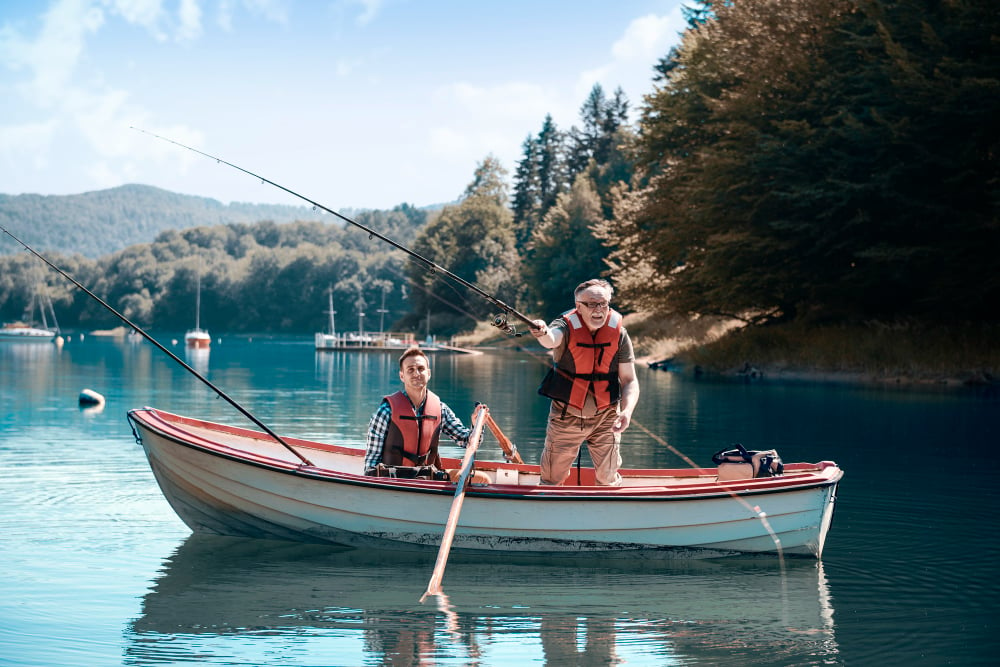
My husband said this standing in our driveway with one hand resting on the side of a brand-new bass boat. Green and silver. Sparkly paint that caught the late-afternoon sun like a fishing lure. It sat on a trailer behind his pickup with the price sticker still stuck to the windshield.
The sticker said $10,995.
I had just come home from work. I was still in my navy blue blazer with my name tag pinned to the lapel. KAREN. TELLER. HAPPY TO HELP!
My purse was still on my shoulder. My car keys were still in my hand.
“Rick,” I said. “Where did the money come from?”
He didn’t answer right away. He looked at the boat. He ran his thumb along the edge of the windshield.
“Rick.”
“The kitchen account,” he said.
I stood there in the driveway and felt the ground tilt under me.
My name is Karen Schmitz. I’m fifty-three years old. I’ve been a teller at the First Prairie Bank branch in Ames, Iowa, for twenty-two years.
For six years, I’d set aside forty dollars from every single paycheck.
Every Friday. Without missing one.
Not when the furnace died in the middle of January. Not when our son Tyler needed help with his first apartment deposit. Not when my mother passed and I had to drive back and forth to Marshalltown every weekend for four months, burning gas I couldn’t really afford. I always found the forty dollars. Sometimes I skipped lunch for a week to do it. I brought peanut butter sandwiches in wax paper and ate them in my car in the bank parking lot so nobody would ask why I wasn’t going to the Hy-Vee deli with everybody else.
Forty dollars, every Friday, for six years.
It added up to eleven thousand, two hundred and eighty dollars.
And now it was a boat.
I need to tell you about our kitchen.
We bought our house on Maple Street in 1996. A little white ranch with green shutters, a big backyard, and a kitchen that had been remodeled exactly once, in 1978, by people with very strong opinions about the color harvest gold.
The cabinets were dark wood laminate, peeling at every corner. Three of the doors didn’t close all the way. One of them, the one over the sink, had to be held shut with a rubber band.
The linoleum floor was a brownish-orange checkerboard pattern that looked like a 1970s game show. It had a curled-up spot in front of the dishwasher that I’d tripped over approximately two thousand times.
The stove was the worst part. It was the original harvest gold electric range from 1978. Four burners. Three of them worked normally. The fourth one, the front left, had only one setting. High. You could turn the knob to Low, to Medium, to Simmer, and it didn’t matter. It went red-hot either way. I’d ruined more pots of rice on that burner than I could count.
The oven ran forty degrees hot. I had to set it to 310 to bake anything at 350. Every recipe I made, I had to do math in my head.
And there was only one tiny counter, about three feet long, between the stove and the sink. That was it. That was where I rolled out pie crust. That was where I cut vegetables. That was where I did everything. When Tyler was little, I used to set him on the counter while I cooked so he could watch, and he took up half the space.
For twenty-eight years, I’d made every Thanksgiving dinner on that three-foot counter. Every Christmas ham. Every birthday cake.
I wanted a kitchen. That’s all. Not a fancy one. Just one where all four burners worked. Where the cabinet over the sink didn’t need a rubber band. Where I could roll out a pie crust and still have room to set down a cup of coffee.
Six years ago, I’d had a contractor come out and give us an estimate.
His name was Gary Vollmer. He’d been doing kitchens in Story County for thirty years. He stood in my kitchen with his tape measure and his clipboard and shook his head slowly.
“This is a time capsule, Karen,” he said. “My grandma had this exact stove.”
“Does your grandma’s still work?”
“No. She’s been dead since 1994.”
He wrote up an estimate. New cabinets. A real countertop, butcher block, the long kind. New flooring. A new stove, a gas one, with all four burners. A little island in the middle where people could sit and talk while I cooked.
Eleven thousand dollars, if we did some of the painting ourselves.
I put the estimate on the refrigerator under a little magnet shaped like an ear of corn. Tyler had bought it for me at the Iowa State Fair when he was nine.
It was still there. That estimate. Six years later. Yellowing at the edges, under the corn.
We’d opened a separate savings account for it. Not at my bank. At a little community bank in Nevada, Iowa, about twelve miles east of us.
That had been my idea.
“If it’s at my branch,” I told Rick, “I’ll see the balance every day. And I’ll be tempted to dip into it. For the furnace. For Tyler. For whatever. If it’s in Nevada, I can’t touch it without driving over there. It’ll be safe.”
Rick had laughed. “You don’t trust yourself with forty bucks a week?”
“I don’t trust life with forty bucks a week,” I said.
So it went in the account in Nevada. Every Friday, I transferred the forty dollars online. I checked the balance once a month, on the first Saturday, sitting at the kitchen table with my coffee. I’d write the new number on a little piece of paper and tape it to the bottom of Gary’s estimate.
$2,080.
$4,160.
$7,800.
$10,920.
$11,280.
That last number had gone up two weeks ago. I’d written it down and stood back and looked at the estimate on the refrigerator and thought, we’re there. We finally made it.
I’d called Gary the next morning to ask when he could start.
“Early October,” he’d said. “If you can wait that long.”
“I’ve waited six years,” I told him. “I can wait three more months.”
Rick knew the account was in both our names. I’d insisted on that too. It was our kitchen. Our money.
So he’d driven over to Nevada on a Tuesday, when I was working a double shift. He’d walked into that little community bank, shown his ID, and asked the teller to close the account. He took it all out in a cashier’s check.
Then he drove to Story City, where a man named Darrell was selling a barely used bass boat because his wife had made him choose between the boat and the marriage.
“At least I was smart enough not to do it at your branch,” Rick said, standing in the driveway.
I think he meant it as a kindness. Like he’d spared me the embarrassment of my coworkers seeing.
It didn’t feel like kindness.
Later, people asked me why I didn’t just make him take the boat back.
I thought about it. I really did. I stood there in the driveway in my blazer and thought about calling this Darrell in Story City and demanding he return our money.
But Rick had already told me. Darrell had sold the boat that same morning. He’d taken the cashier’s check, shaken Rick’s hand, gotten in his own truck, and headed south on Interstate 35 toward Missouri. He was moving to Branson to be closer to his daughter. He’d probably already deposited the check.
The sale was done. Signed, sealed. The title was in Rick’s name.
There was no simple way to get the money back.
So I just looked at my husband.
I looked at him for a long time. At his sunburned neck. His gray-streaked hair. The old Iowa Hawkeyes cap he’d worn every summer since 2003. His big work-rough hands resting on the side of his new boat.
He was waiting for me to yell. I could see it. His shoulders were up around his ears, braced. He’d been married to me for thirty-one years. I’d yelled before. Not often. But I had.
I didn’t yell.
“Well, Rick,” I said. “Thank you for being honest with me.”
He blinked at me. Like I’d spoken in a foreign language.
Then I turned around and went inside and started making pot roast.
I didn’t cry while I made the pot roast.
I want to be honest about that. I thought I would. I stood at that three-foot counter, chopping carrots and onions and celery, and I kept waiting for it to happen. For my eyes to sting. For my throat to close up.
It didn’t.
I just felt very calm. Very quiet. Like the moment after a car accident, when you’re sitting in your seat and you realize you’re not hurt, and everything is very still.
I browned the roast on the front left burner. The one that only goes on high. For once, it was perfect for the job.
I put it in the oven at 285, which meant 325.
Then I set the timer and sat at the kitchen table and looked at Gary’s estimate on the refrigerator. Under the corn magnet. With all my little pieces of paper taped to the bottom.
$11,280.
And I had an idea.
At 5:50 that evening, I went into the dining room and started pulling our maple dining table toward the front door.
It’s a heavy table. Solid maple. My parents gave it to us as a wedding present in 1993. It weighs about a hundred and fifty pounds, and it’s six feet long, and it doesn’t fit through doorways easily.
I got about three feet before Rick came out of the living room.
He’d been sitting in his recliner with the TV on, not watching it. Waiting for whatever was going to happen.
He saw me wrestling with the table. He didn’t ask what I was doing.
He just went around to the other end and picked it up.
That was one thing about Rick. In thirty-one years, I’d never once seen him watch somebody struggle with heavy furniture without jumping in to help. Not me. Not a neighbor. Not a stranger at the Walmart parking lot. Once, he pulled over on Highway 30 to help a woman he’d never met get a couch back onto the roof of her minivan.
He’s a good man. That’s what made all of it so hard.
Together, we carried the table out the front door. Down the porch steps. Across the lawn.
“Where are we going with this?” Rick finally asked, breathing hard.
“Driveway.”
He didn’t say anything else.
We set it down on the concrete, right next to the boat trailer. Then I went back inside and came out with my mother’s old tablecloth.
Red and white checkers. Cotton, soft from a hundred washings. My mother had used it every summer Sunday of my childhood, for picnics in the backyard in Marshalltown. When she died, it was one of the only things I asked for.
I didn’t put it on the table.
I spread it across the boat. Across the front seating area, where there was a little flat bench between the two swivel seats.
Then I went back inside and came out with two dinner plates. Silverware. Two glasses of iced tea. Salt and pepper shakers shaped like chickens.
I set it all out on the checkered cloth. Inside the boat.
Then I went back in and got the pot roast, steaming, in my blue enamel roasting pan, and I carried it out and set it in the middle.
Rick stood in the driveway next to the empty maple table, staring.
“Karen,” he said. “What is this?”
“Supper’s ready,” I said. “Better come eat while it’s warm.”
“In the boat?”
“In the boat.”
“Why?”
“Because,” I said, “this is where our kitchen went.”
Rick stood there for a long time.
I don’t know what he was thinking. I’ve never asked. He looked at the boat. He looked at me. He looked at the empty dining table sitting in the middle of the driveway like it had been abandoned there.
He looked across the street at Marlys Henning’s house, where the front curtains had just twitched.
Then, after a very long silence, he climbed aboard.
He sat down in one of the swivel seats. I sat down in the other one. We faced each other across my mother’s tablecloth.
I picked up the serving fork and gave him a big piece of pot roast. Carrots. Potatoes. Gravy.
“Thank you,” he said quietly.
“You’re welcome.”
We ate.
Neither of us said anything else. It was the quietest dinner we’d had in thirty-one years of marriage.
The pot roast was very good, though. I’ll say that.
The next evening, I made meatloaf.
At 5:55, I carried the plates out to the boat. The maple table was still sitting in the driveway. Rick had covered it with a tarp overnight, in case of dew.
This time, I brought an empty Mason jar with a candle in it. A vanilla one, from the Bath & Body Works in the mall. I lit it and set it in the middle of the checkered tablecloth.
“For atmosphere,” I said.
Rick looked at the candle. Then at me.
He didn’t say anything. He just climbed into the boat and sat down.
Across the street, Marlys Henning’s front door opened.
Marlys is seventy-four years old. She’s lived across the street from us since 1988. She’s a retired kindergarten teacher, a widow for twelve years, and the single nosiest woman in Story County. I say that with love.
She came out her front door carrying a folding lawn chair and a mug of coffee.
She walked down her driveway. She set up the lawn chair at the very end of it, on the edge of the curb, facing our house. She sat down. She crossed her ankles. She took a sip of coffee.
And she watched us.
She watched us with the deep, total concentration of a woman following the final round of a championship golf match.
Rick glanced over at her.
“She’s watching us,” he muttered.
“I know.”
“She brought a chair.”
“I see that.”
Rick ate his meatloaf with his head down.
When we were finished, Marlys stood up, folded her lawn chair, and gave us a little wave before she went back inside.
“See you tomorrow!” she called.
Rick groaned.
I never raised my voice about the boat. Not once.
I didn’t lecture Rick. I didn’t throw anything. I didn’t call my friends and tell them what a terrible husband he was. I didn’t post anything angry online. I didn’t make announcements to the neighbors.
I just served supper in the boat.
Because here’s what you need to understand. Despite what he’d done, I knew my husband wasn’t a cruel man.
Rick has worked for the Midland Power Cooperative for thirty years. He’s a lineman. He climbs poles and fixes power lines. In blazing hundred-degree Iowa summers, when the asphalt goes soft. In freezing rain that coats the lines in ice an inch thick. In blizzards, in tornado warnings, in the dark at three in the morning.
Several of our Christmas Eves ended with him getting a call in the middle of dinner and leaving the table to go restore somebody’s power. I’d wrap up his plate in tinfoil and put it in the oven and wait.
Once, during the terrible ice storm of 2007, he worked eleven days straight. Sixteen hours a day. Sleeping three hours a night in the cab of his truck. He came home on the twelfth day with frostbite on two of his fingers. The tips went black. The doctor thought he might lose them.
He didn’t. But they still go white and numb every winter.
Rick has worked so hard, for everything we have.
And I knew something about him that most people didn’t.
When Rick was fourteen, he had a minibike. A little red Honda, used, beat-up, with a dented gas tank. He’d bought it himself. He’d saved up for two years, mowing lawns and detasseling corn every summer.
He loved that minibike more than anything in the world. He rode it up and down the gravel roads around his family’s farm outside Boone every single day after school.
That fall, the farm was struggling. His father was behind on the mortgage. And one Saturday morning in October, without saying a word to anyone, Rick’s father loaded the minibike onto the back of the truck and drove it to the farm auction in Jefferson.
He sold it for sixty dollars.
Rick came home from school and found it gone.
He told me that story on our third date. Thirty-two years ago. We were sitting in his truck outside the Dairy Queen, and he told me, and his voice went flat and strange, and he didn’t look at me the whole time.
“I never asked him about it,” Rick said. “Not once. And he never said anything.”
Ever since that day, Rick had almost never bought anything just for himself. Just because he wanted it. He bought work boots and tools and truck parts and Christmas presents for me and Tyler. He fixed things. He provided.
But he didn’t play. He didn’t have toys. He didn’t have hobbies that cost money. He fished off the bank at Saylorville Lake with a twenty-year-old rod, and he never once complained.
So I understood why the boat mattered to him. I truly did.
But understanding him didn’t excuse what he’d done. He’d taken our kitchen. Six years of my Fridays. Without asking. Without even telling me first.
Both of those things were true at the same time.
On the third night, I made pork chops with applesauce.
Marlys was already in her lawn chair when I carried the plates out. She waved.
“Evening, Karen!”
“Evening, Marlys.”
“What’s on the menu?”
“Pork chops.”
“Oh, lovely.” She took a sip of coffee. “With applesauce?”
“With applesauce.”
“Homemade?”
“From the jar.”
“Well,” Marlys said. “Nobody’s perfect.”
Rick climbed into the boat. He sat down heavily in his swivel seat.
He tried to make a joke halfway through dinner.
“At least we’ve got a nice view,” he said. Gesturing out at the street.
I looked at him.
“I’ve had a nice view for thirty-one years, Rick,” I said. “I just wanted a kitchen to go with it.”
He stopped smiling. He looked down at his plate.
He didn’t try to make any more jokes that night.
On the fourth evening, his fishing friends Duane and Lyle came by.
Duane Albrecht and Lyle Peterson. They’d worked with Rick at the cooperative for twenty-five years. Duane was big and red-faced and loud. Lyle was skinny and quiet and chewed sunflower seeds constantly.
They’d heard about the boat, of course. Rick had called them the day he bought it, before I came home from work. They’d been planning to take it out to Saylorville that weekend.
Then they’d heard about the dinners.
They pulled up in Duane’s pickup around 5:45. They sat in the truck for a minute, looking at the maple table under its tarp and the boat with my mother’s tablecloth spread across it. Then they got out slowly.
“Hey, Karen,” Duane said, carefully. Like he was approaching a skittish horse.
“Hi, Duane. Hi, Lyle.”
“We, uh. We just came by to see the boat.”
“It’s very nice,” I said. “Have you two eaten?”
They looked at each other.
“Um,” Lyle said. “No?”
“Well, I made chicken and noodles. Homemade noodles. There’s plenty. You should stay for supper.”
Duane looked at Rick. Rick looked at the ground.
“In the boat?” Duane said.
“In the boat,” I said.
So all four of us sat in the boat and ate chicken and noodles.
Duane and Lyle sat on the back bench, by the motor. Rick and I sat in the swivel seats. Everybody held their plates in their laps except me and Rick, because the tablecloth only fit across the front.
It was the most uncomfortable meal of my life. And also, somehow, one of the funniest.
Duane kept trying to make conversation. He talked about the weather. He talked about the Hawkeyes. He talked about a transformer that blew out on Lincoln Way last week.
Lyle didn’t say a word. He just ate his chicken and noodles and kept glancing over at Marlys, who’d brought out a second lawn chair for her friend Bev from two doors down.
“Mighty good noodles, Karen,” Duane said, at the end.
“Thank you, Duane.”
“Real good.”
“I’m glad you liked them.”
Duane looked at the boat. At the tablecloth. At the candle in the Mason jar.
“So,” he said. “How long you planning to do this?”
I smiled at him.
“Until it’s done,” I said.
After Duane and Lyle drove away, the street got quiet. Marlys and Bev folded up their chairs and went inside.
It was just Rick and me, sitting in the boat. The candle had burned down almost to the bottom of the Mason jar. The fireflies were starting to come out over the lawn.
Rick reached across the checkered tablecloth.
He took my wrist. Gently. His big rough hand, with the two fingertips that still go white in winter.
“Karen,” he said. “I turned fifty-five back in March.”
I didn’t say anything. I just listened.
“Not long after that,” Rick said, “my pension statement came in the mail. From the cooperative. With the projections. How much I’ll get when I retire. How much I’d have if I worked till sixty-two. Or sixty-five. Or seventy.”
He looked down at the tablecloth.
“I sat in my truck in the parking lot at work for forty-five minutes,” he said. “Just staring at those numbers. And I kept thinking—” He stopped. Swallowed. “I kept thinking, I’ve been climbing poles for thirty years. My knees are shot. My back’s shot. My fingers don’t work right in the cold. And I could keep doing it till I’m sixty-five, and I could die, and I’d never have owned one single thing I bought just because I wanted it.”
The candle flickered.
“Not one thing,” he said. “Since I was fourteen years old.”
He took a slow, shaky breath.
“I’m sorry, Karen,” he said. “I’m so sorry.”
I put my hand over his.
I could feel that he meant it. I’d been married to him for thirty-one years. I know his real apologies from his fake ones. This was real.
But an apology didn’t solve the problem.
Six years of my Fridays were still missing. Six years of peanut butter sandwiches eaten in my car. The front left burner still only went on high.
“I know you’re sorry, Rick,” I said. “I believe you.”
He looked up. Hopeful.
“I’ll have supper out here at six tomorrow,” I said.
His face fell.
But he nodded.
On the fifth night, I made tacos. Ground beef, the crunchy shells, shredded cheese, sour cream. Rick’s favorite.
And our son Tyler came by with his wife, Jenna.
Tyler is twenty-eight. He’s a high school science teacher in Ankeny. He looks just like his father did at that age, which is to say tall and gangly and a little goofy. Jenna is a nurse at Mary Greeley Medical Center. She’s sweet and practical and has never once taken Tyler’s side against me, which is why I love her.
Tyler had called me that afternoon.
“Mom,” he said. “Marlys called Grandma Henning’s sister’s daughter, who told Jenna’s cousin at the hospital, who told Jenna. Are you seriously making Dad eat dinner in a boat?”
“I am,” I said.
There was a long silence.
“Can we come?”
They brought a pan of brownies. Jenna made them from scratch, with walnuts.
Tyler walked up the driveway, took one look at the boat and the maple table under the tarp and his father sitting in a swivel seat with a taco, and burst out laughing.
He laughed so hard he had to sit down on the porch steps.
“Dad,” he wheezed. “Dad. What did you do?”
“You know what I did,” Rick muttered.
“You spent Mom’s kitchen money on a boat?”
“Our kitchen money.”
“Oh my God.” Tyler wiped his eyes. “Oh my God. You’re a dead man. You know that, right? You’re a dead man walking.”
“I’m a dead man eating tacos,” Rick said. “In a boat.”
Jenna sat down next to me in the back of the boat and squeezed my hand.
“You okay, Karen?”
“I’m okay.”
“You sure?”
I looked over at Rick. He was trying not to smile at Tyler, who was still laughing on the porch steps.
“Getting there,” I said.
Halfway through dinner, a Midland Power Cooperative utility truck drove slowly past the house.
Then another one. Then a third.
Rick’s coworkers. On their way home from the evening shift. They’d heard.
The first truck honked. Two short beeps.
The second truck slowed way down. The window rolled down. A big bearded guy leaned out.
“Don’t eat everything, Schmitzy!” he shouted. “Save some for the fish!”
The third one just laid on the horn the whole length of the block.
Rick put his face in his hands.
Tyler laughed so hard he got taco sauce on his shirt.
By that point, people well beyond Maple Street had heard about our little arrangement.
Somebody’s teenage kid had taken a picture from across the street and posted it on Facebook. Somebody in Ames is making her husband eat dinner in his new boat and I am HERE for it. It had six hundred shares by Thursday morning.
At work, three of my coworkers asked me about it. One of them, a young teller named Brianna, asked if she could come watch.
“It’s not a show,” I told her.
“It kind of is, though,” she said.
My sister, Deb, called me from Marshalltown on Thursday night after the tacos.
Deb is three years older than me. She’s been married four times. She has opinions about everything.
“Karen,” she said, the second I answered. “Are you deliberately making Rick look like a fool in front of the entire town?”
“No, Deb.”
“It’s on Facebook, Karen. Linda Pruitt from church showed me. It has six hundred shares. Somebody made it into a meme.”
“I didn’t post it. I didn’t ask anyone to post it.”
“Then what’s the point? Why not just yell at him like a normal person and get it over with? Or make him sell it? Or take him to court?”
I sat at our kitchen table. The real one was out in the driveway, so I was sitting at the little card table I’d set up in the dining room. I looked through the doorway at the kitchen. At the harvest gold stove. At Gary’s estimate on the refrigerator, under the corn.
“Because yelling doesn’t change anything, Deb,” I said. “I’ve yelled before. He says sorry, I say okay, and three months later he does something else without asking me.”
“So?”
“So I want him to look at me,” I said. “Across the dinner table. Every single evening. And remember what he decided without asking me first. I want him to sit in that boat and think about it. Really think. For as long as it takes.”
Deb was quiet for a long moment.
“That’s either the craziest thing I’ve ever heard,” she said, “or the smartest.”
“Can’t it be both?”
“With you, Karen,” she sighed, “it’s always both.”
On the sixth night, Rick was late.
There’d been a storm out west of Boone that afternoon. Straight-line winds. Three poles down on Highway 17. The cooperative called in every lineman they had.
He called me at 5:30.
“I’m gonna be late, Karen. Real late. Probably after nine.”
“Okay.”
“Don’t wait for me. Eat without me.”
“I’ll keep a plate warm.”
There was a pause.
“In the boat?” he said.
“In the boat,” I said.
I heard him laugh. Tired. But a real laugh.
“Okay,” he said. “In the boat.”
I made beef stroganoff that night. I set the table in the boat for two, like always. The checkered tablecloth. The candle in the Mason jar. Two plates.
Then I sat there alone and ate.
Marlys wasn’t out in her lawn chair. Too windy, I guessed. The storm was coming our way.
It was the first time I’d sat in that boat by myself.
And I’ll be honest. Sitting there in the gathering dark, with the wind picking up and the clouds rolling in over the cornfields to the west, I started to cry.
Not about the boat. Not even about the money.
I cried about my mother’s kitchen. In Marshalltown. A big yellow kitchen with a long wooden table and two ovens and a counter that ran the whole length of the wall. Every Thanksgiving of my childhood, all four of my aunts would cram into that kitchen with my mother and cook all day, and laugh, and fight, and my cousins and Deb and I would sit under the table and steal olives.
I wanted a kitchen like that. That’s all. A kitchen where people could gather. Where Tyler and Jenna could sit at an island and talk to me while I cooked. Where someday, maybe, their kids could steal olives under the table.
I’d wanted that for twenty-eight years.
And I’d been so close.
Rick got home at 9:40. Soaking wet. Muddy to the knees.
He came up the driveway and saw me sitting alone in the boat, with his plate covered in tinfoil, and the candle almost out.
He stopped.
He looked at me. I don’t know if he could tell I’d been crying. It was dark.
Then he climbed into the boat. Muddy boots and all. He sat down across from me and pulled the tinfoil off his plate.
He ate the beef stroganoff cold. Every bite.
“It’s good,” he said. “Thank you for waiting.”
“I always wait,” I said.
He looked up at me then.
And I think, maybe, that was the night it really started to sink in.
On the seventh night, Marlys came over.
Not to her lawn chair. All the way over. She walked across the street with a plate of lemon bars covered in plastic wrap, and she stood at the edge of our driveway, and she said, “May I join you?”
I looked at Rick. Rick shrugged.
“Of course, Marlys,” I said.
She climbed into the boat with great difficulty and a lot of help from Rick. She sat on the back bench with her lemon bars on her lap. I gave her a plate of chicken pot pie.
She ate slowly, very daintily, with her napkin tucked into her collar.
Then, halfway through, she set her fork down.
“You know,” she said. “Walt bought a motorcycle once. Without asking me.”
Rick and I both looked at her.
Walt was her husband. He’d died twelve years ago. A big, quiet man who’d been a mail carrier for thirty-five years and grew enormous tomatoes in their backyard.
“A Harley,” Marlys said. “In 1979. Blue. Used. He spent the money we’d been saving for a new roof. Twenty-two hundred dollars. Which was a lot of money in 1979.”
“What did you do?” I asked.
“I yelled,” Marlys said. “I yelled for a week straight. I called him every name I could think of. I made him sleep on the couch for a month.”
She took a bite of pot pie.
“And then,” she said, “I made him sell it.”
She looked out at the street. At her own little house, with the roof that she’d eventually gotten replaced.
“He did. He sold it to a kid from Nevada. Got back about eighteen hundred. We put on the new roof.” She was quiet for a moment. “And he never bought anything for himself again. Not once. For thirty years. He never complained. But he never bought anything. Never went anywhere. Never did anything just for fun.”
She looked at Rick.
“When he died,” Marlys said, “I found a brochure in his sock drawer. For Harley-Davidson. From 2004. He’d circled one. A blue one. Just like the first one.” She shook her head. “He kept it in his sock drawer for eight years. And never said a word.”
The street was very quiet.
“I won the argument,” Marlys said softly. “In 1979. I was right. He was wrong. He should have asked me.” She picked up her fork again. “But I’ve thought for a long time that maybe I won it the wrong way.”
After Marlys went home, Rick and I sat in the boat for a long time without saying anything.
“She’s never told me that,” I said finally. “In thirty-six years.”
“Me neither,” Rick said.
He was looking at his hands.
“I’m not Walt,” he said quietly. “And you’re not Marlys.”
“No.”
“But I think I get what she meant.”
On the eighth night, the rain came.
A steady, soaking, all-evening rain. Not a storm. Just the kind of gray late-summer rain that settles in over central Iowa and stays for hours.
I thought about calling it off. Eating inside, for once.
Then I thought, no.
I made beef stew. A big pot of it, with potatoes and carrots and celery, simmered all afternoon. I ladled it into two of our deep pottery bowls. I tucked a loaf of French bread under my arm.
I got Rick’s big golf umbrella out of the hall closet. The navy blue one he’d won in a raffle at the cooperative picnic.
And I carried it all out to the boat.
Rick watched me through the front window. When he saw me heading down the porch steps with the stew and the umbrella, he came out after me.
He didn’t argue.
He just took the umbrella from me and held it over both of us, and we climbed into the boat together.
We sat under that big golf umbrella with the rain pattering all around us. On the umbrella. On the boat. On the driveway. Dripping off the edges in a little curtain.
The checkered tablecloth was getting wet. I didn’t care.
We ate our stew. It was hot and thick and steaming in the cold rain. We tore off chunks of French bread and dunked them.
For a long time, neither of us said anything.
Then, finally, Rick set down his spoon.
“Karen,” he said. “What can I do to fix this?”
That was the question I’d been waiting for.
For eight nights. Eight suppers. Pot roast and meatloaf and pork chops and chicken and noodles and tacos and stroganoff and pot pie and stew.
I’d been waiting for him to ask it.
Not are you still mad? Not how long are we going to do this? Not when can I take it out fishing?
What can I do to fix this?
I looked at him across the boat, under the umbrella, in the rain. His Hawkeyes cap was dripping. His face was tired and sad and very serious.
And I wanted so badly to tell him.
Sell it. Get my money back. Give me my kitchen.
That’s what Marlys had done. That’s what Deb would have done. That’s what almost anybody would have done.
But I thought about Walt. And the brochure in the sock drawer.
And I thought about a fourteen-year-old boy coming home from school to find his minibike gone.
I shook my head.
“That’s something you have to figure out yourself, Rick,” I said.
He looked at me.
“I can’t decide this one for you,” I said. “You decided the last one without me. I’m not going to decide this one without you.”
He looked down at his stew for a long time.
Then I added, “I’ll have supper ready out here at six tomorrow.”
He nodded slowly.
“Okay,” he said. “Six.”
The ninth evening fell on a Saturday.
The rain had cleared out overnight. It was a beautiful evening. Clear and warm, with a soft breeze, and the sky going pink and gold in the west over the cornfields.
I made pot roast again. Exactly the way I’d made it the first night. Same roast. Same carrots, onions, potatoes, celery. Same blue enamel roasting pan.
I didn’t know why. It just felt right.
When I came out of the house at 5:55, carrying the plates, I stopped on the porch steps.
There were people everywhere.
Marlys was already stationed at the end of her driveway in her lawn chair, with her coffee. Bev was next to her in a second lawn chair. And then a third chair, with Bev’s husband, Harold, who never came outside for anything.
Duane and Lyle were standing on the curb in front of our house, hands in their pockets. Lyle was eating sunflower seeds.
Tyler and Jenna’s car was parked across the street. They were sitting on the hood.
And there were three more cars I didn’t recognize, pulled over along the opposite curb with their engines off. People just sitting inside them. Watching.
A couple of neighborhood kids on bikes had stopped at the end of the block.
It seemed like half the neighborhood had come out to see how this was going to end.
“Oh, for heaven’s sake,” I said out loud.
I carried the plates to the boat and set them down on my mother’s tablecloth. I lit the candle in the Mason jar. I went back inside and got the pot roast.
Then I sat down in my swivel seat and waited.
At exactly six o’clock, the front door opened.
Rick stepped out onto the porch.
He was wearing his good blue button-up shirt. The one he wore to Tyler and Jenna’s wedding two years ago. The one he wore to my mother’s funeral. He’d ironed it. I could see the crease down the sleeves. He’d shaved. He’d combed his hair, and he wasn’t wearing his Hawkeyes cap.
That surprised me.
But what really caught my attention was what he was holding.
A folded piece of paper. White. Official-looking. With a blue printed letterhead across the top.
He came down the porch steps slowly.
He didn’t climb into the boat.
He walked right past it. Right past me, sitting in my swivel seat with the pot roast getting cold. He walked to the very end of our driveway, where it meets the sidewalk, where everybody could see him.
He stopped there.
Marlys lowered her coffee cup.
Duane and Lyle stopped talking. Lyle stopped chewing.
Tyler slid off the hood of his car.
The whole street went quiet.
Rick unfolded the paper. He looked down at it for a moment. Read it over.
Then he looked up.
Straight at me.
“Karen,” he said.
His voice was steady, but I could hear something underneath it.
“Could you come stand beside me,” he said, “before I put my signature on this?”
I climbed out of the boat. Slowly.
I walked down the driveway to where he was standing.
He held out the paper.
At the top, under the blue letterhead, it said: IOWA DEPARTMENT OF NATURAL RESOURCES. VESSEL BILL OF SALE.
I read it.
Seller: Richard J. Schmitz.
Buyer: Duane R. Albrecht.
Vessel: 2022 Tracker Pro Team 175, Green/Silver.
Purchase Price: $10,500.00.
There was a blank line at the bottom for Rick’s signature. Duane had already signed his part.
I looked up at Rick.
“You’re selling it,” I said quietly.
“To Duane,” Rick said. “He’s wanted a boat for ten years. His bank already approved the loan. He’s got a cashier’s check in his truck right now.” He swallowed. “It’s ten-five. I lose four hundred and ninety-five dollars. I’ll pick up overtime to cover that. I’ll have it back in the kitchen account in three weeks.”
He looked at me.
“You’ll have your kitchen, Karen. By October. Like Gary said.”
I stood there at the end of the driveway, holding that bill of sale, with half the neighborhood watching.
Rick reached into his shirt pocket and pulled out a pen. He held it out to me.
“I wanted you here,” he said. “Standing next to me. When I sign it. Because the first time, I did it without you. And I never should have.”
I took the pen.
I looked at the bill of sale. At the blank line.
I looked over at the boat. At my mother’s checkered tablecloth, spread across the front. At the candle flickering in the Mason jar. At the two plates of pot roast, getting cold.
I looked over at Marlys, sitting in her lawn chair across the street.
She was looking right at me. She didn’t nod. She didn’t shake her head. She just looked at me.
And I thought about a brochure in a sock drawer. Eight years. A blue motorcycle, circled.
I thought about a fourteen-year-old boy getting off a school bus in Boone and walking up the gravel driveway and seeing the empty spot in the barn where his minibike used to be.
I thought about Rick sitting in his truck in the parking lot at work for forty-five minutes, staring at his pension statement.
I could die, and I’d never have owned one single thing I bought just because I wanted it.
I handed the pen back to him.
“No,” I said.
Rick stared at me.
“Karen—”
“Not like this,” I said.
Behind us, I heard Marlys let out a little breath.
“I didn’t do nine nights of this to make you sell your boat, Rick,” I said. “I didn’t do it to win.”
“Then what—”
“I did it,” I said, “so that next time, you’d ask me first. That’s all I wanted. That’s the whole thing. For you to stand next to me when you make a decision about our money. About our life. Like you’re doing right now.” I took a breath. “And you are. You’re standing right here. You put on your good shirt and you asked me. In front of the whole town.”
Rick didn’t say anything. His eyes were wet.
“So I’m answering,” I said. “Since you finally asked. Don’t sell it.”
Duane, standing on the curb, made a small, heartbroken sound.
“Sorry, Duane,” I said.
“No, no,” Duane said. “It’s fine. It’s fine. I’ll just. It’s fine.”
Rick was still staring at me.
“But the kitchen,” he said. “The money. Your Fridays. Six years, Karen.”
“I know,” I said. “I was there for every one of them. I ate a lot of peanut butter sandwiches.”
I looked at the bill of sale in his hand.
Then I looked at Duane. And at Lyle, standing next to him with his sunflower seeds.
And an idea came to me. A good one. The kind of idea you only get after nine nights of sitting in a boat thinking.
“Duane,” I said. “How much did your bank approve you for?”
He blinked. “Uh. Eleven thousand.”
“And Lyle. You’ve been fishing with Rick off the bank at Saylorville for twenty years. You ever think about a boat?”
Lyle stopped chewing.
“Every single day,” he said. “For twenty years.”
So here’s what we worked out. Right there at the end of the driveway, with half the neighborhood listening.
Rick wouldn’t sell the boat to Duane.
He’d sell two-thirds of it. To Duane and Lyle.
Thirty-five hundred dollars each. Seven thousand total.
The three of them would own it together. Equal shares. They’d split the gas, the insurance, the storage, the trailer registration. They’d take turns. Rick got the first weekend of every month, and every Fourth of July. Duane got Memorial Day. Lyle got Labor Day.
The seven thousand would go straight back into the kitchen account in Nevada. That night. Duane’s cashier’s check, and Lyle would write a personal check Monday morning.
And Rick would pick up storm overtime with the cooperative this fall to cover the rest. Forty-two hundred and eighty dollars. Every extra shift, every storm call, every holiday, until it was paid back.
“That’ll take you till Christmas,” I said. “Maybe longer.”
“I don’t care,” Rick said.
“Those are long nights. Cold ones.”
“I know,” Rick said. “I’ve done longer. I’ve done colder.”
He looked at me.
“And this time,” he said, “I’ll know what it’s for.”
Then he got out his pen and crossed out Duane R. Albrecht on the bill of sale. In the margin, in his blocky lineman’s handwriting, he wrote: Duane Albrecht, 1/3. Lyle Peterson, 1/3. Rick Schmitz, 1/3.
He didn’t sign it. Not yet.
He held the pen out to me again.
“There’s one more thing,” he said. “Under Seller. I want you to sign it too.”
I looked at him.
“It’s not my name on the title.”
“It should be,” Rick said. “It was our money. It’s our boat. My third of it. Half of that is yours. You’ve earned it. You’ve eaten nine dinners in it.”
I laughed. I couldn’t help it.
Then I took the pen. And right there, under Richard J. Schmitz, I signed my name.
Karen A. Schmitz.
Rick signed under me.
And from across the street, Marlys Henning stood up out of her lawn chair and started clapping.
Then Bev started clapping. Then Harold. Then Tyler and Jenna, sitting on the hood of their car. Then the kids on their bikes. Then somebody in one of the parked cars honked.
Duane threw his arms around Lyle. Lyle dropped his sunflower seeds.
And Rick put his arms around me, right there at the end of our driveway, with half of Ames watching. He held me so tight I couldn’t breathe.
“I’m sorry, Karen,” he said into my hair. “I’m so sorry.”
“I know,” I said. “I know you are.”
“Can we eat now?” he said. “The pot roast’s getting cold.”
“In the boat?”
He pulled back and looked at me.
“In our boat,” he said.
We had dinner in the boat one last time that night. All of us.
Duane and Lyle climbed in the back. Tyler and Jenna squeezed in on the side bench. Marlys came over with her lemon bars, and Rick helped her in. Bev and Harold sat on the edge of the trailer.
I had to go back in and make another pot of potatoes. There wasn’t nearly enough pot roast for everybody.
We sat out there until well after dark. The fireflies came out. Somebody brought a radio. Duane told the story of the time Rick fell off a pole into a snowbank in 1998 and climbed right back up.
At one point, Marlys leaned over and patted my knee.
“You won it the right way, Karen,” she said softly.
I squeezed her hand.
“I had a good teacher,” I said.
Gary Vollmer started on our kitchen the second week of October. Right on schedule.
He tore out the harvest gold cabinets in one afternoon. He pulled up the orange checkerboard linoleum and found the original 1950s hardwood underneath, which he said was a miracle. He hauled the 1978 stove out to his truck and stood next to it in the driveway, shaking his head.
“I’m keeping this,” he said. “For my shop. As a warning to others.”
He put in white cabinets with little brass knobs. A long butcher-block countertop that ran the whole length of the wall. Twelve feet of it. A gas stove with five burners, all of which worked at all of their settings.
And in the middle of the kitchen, a little island. Big enough for three stools.
Rick worked storm overtime every chance he got that fall. A windstorm in October. An early ice storm right before Thanksgiving. He came home exhausted and sore and muddy. His fingers went white and numb again by November.
He never complained. Not once.
On December 19th, he put the last forty-two dollars back in the kitchen account in Nevada. He drove over there himself to deposit it. He came home and taped a little piece of paper to the bottom of Gary’s estimate, which I’d kept on the brand-new stainless steel refrigerator, under the same corn magnet.
$11,280.
PAID BACK. LOVE, R.
We had Christmas dinner that year in the new kitchen.
Tyler and Jenna came. Deb drove over from Marshalltown with husband number four, who turned out to be very nice. Marlys came, and Bev and Harold. Duane and Lyle came with their wives.
I cooked all day on that five-burner stove. I rolled out three pie crusts on that twelve-foot butcher-block counter and still had room for my coffee. Jenna and Deb sat on the stools at the island and talked to me while I cooked. Marlys stole olives off the relish tray when she thought nobody was looking.
It was everything I’d wanted. For twenty-eight years.
After dinner, everybody went into the living room to open presents.
Rick handed me a small flat box wrapped in green paper.
Inside was a photograph. In a little wooden frame.
It was the boat. Parked at the boat ramp at Saylorville Lake, on the first weekend of December, right before the lake froze. The last outing of the season.
On the back of the boat, painted on the side in neat white letters, was a name.
THE KITCHEN FUND.
I laughed so hard I cried.
People still ask me about those nine nights. Even now. Somebody at the bank brought it up just last week.
They want to know if I was angry. I was. They want to know if I thought about leaving him. I didn’t, not really. They want to know if I’d do it again.
I tell them yes. But not for the reason they think.
I didn’t serve my husband supper in a boat for nine nights to embarrass him. Or punish him. Or win.
I did it because I wanted him to sit across from me, every single evening, and look at me. And remember that I was there. That I was half of every decision. That the money in that account wasn’t mine or his.
It was ours.
And so was everything else.
Rick still takes the boat out the first weekend of every month, and every Fourth of July. Sometimes Duane and Lyle go with him. Sometimes, now, he asks me to come.
I usually say yes.
I bring my mother’s checkered tablecloth.
And I always pack supper.

Lila Hart is a dedicated Digital Archivist and Research Specialist with a keen eye for preserving and curating meaningful content. At TheArchivists, she specializes in organizing and managing digital archives, ensuring that valuable stories and historical moments are accessible for generations to come.
Lila earned her degree in History and Archival Studies from the University of Edinburgh, where she cultivated her passion for documenting the past and preserving cultural heritage. Her expertise lies in combining traditional archival techniques with modern digital tools, allowing her to create comprehensive and engaging collections that resonate with audiences worldwide.
At TheArchivists, Lila is known for her meticulous attention to detail and her ability to uncover hidden gems within extensive archives. Her work is praised for its depth, authenticity, and contribution to the preservation of knowledge in the digital age.
Driven by a commitment to preserving stories that matter, Lila is passionate about exploring the intersection of history and technology. Her goal is to ensure that every piece of content she handles reflects the richness of human experiences and remains a source of inspiration for years to come.