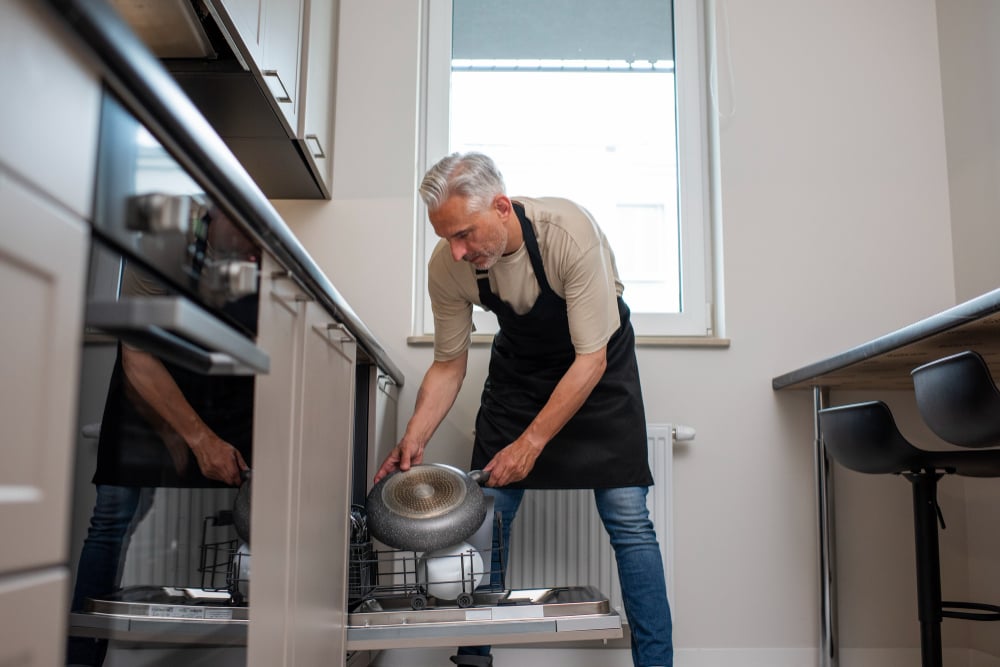
The soup had been simmering for almost two hours when I turned my back on it.
It was only for a minute. I’d run out of bay leaves, and I was sure there was a jar at the back of the pantry, behind the cereal boxes and the cans of tomatoes nobody ever used. I found it. I shook it to make sure it wasn’t empty. Then I turned around.
My father-in-law was standing over my stove.
He had one finger in the pot, knuckle-deep in the broth, and he was stirring it in a slow little circle, like he was testing bathwater.
He pulled it out. He put it in his mouth. He sucked it clean.
Then he looked at me and gave me that smug little grin I’d come to hate.
“Mmm,” Henry said. “Needs more salt.”
I stood in the pantry doorway holding a jar of bay leaves and couldn’t move.
I should explain something before I go any further.
That wasn’t the first time. It wasn’t even the tenth time.
My father-in-law, Henry Cole, waits until I turn my back, then sneaks into my kitchen and sticks his fingers into whatever I’m cooking.
Soup.
Gravy.
Sauce.
Nothing is safe.
He dips a finger in and licks it. Then he goes right back for another taste. Same finger. Same pot.
Sometimes he helps himself to half the food before dinner is even ready. He’ll pull a chicken thigh out of the roasting pan with his bare hand and eat it standing over the sink. He’ll take a fork to the lasagna while it’s still resting and dig out a corner piece, the crispy one, the one everybody wants.
And when I finally call everyone to the table?
“Oh, I’m full already,” he says from the couch.
No apology.
No thank-you.
Not even the decency to wait for the rest of us.
I’d asked him to stop more times than I could count.
“Henry, please use a spoon. Everyone has to eat that food.”
He’d just laugh.
“Relax, sweetheart. A little taste never hurt anybody.”
My husband, Jasper, had talked to him too. More than once. He’d take his dad aside after dinner, out on the back porch, and I’d watch them through the kitchen window. Jasper with his hands in his pockets, looking at his shoes. Henry nodding, patting him on the shoulder, laughing.
Then Jasper would come back in and kiss my forehead.
“I talked to him. He gets it.”
And the next Sunday, Henry would have his finger in the gravy again.
Apparently, asking nicely only worked until the next pot started bubbling.
So there I was, in my own kitchen, on a Sunday in late September, watching him do it again.
But this time something was different.
This time I’d watched him reach for the pot a second time. The same finger. The one that had just been in his mouth.
“Henry!” My voice came out louder than I meant it to. “You just licked that finger! You’re going to put it back in the soup again?”
He chuckled. He actually chuckled. And he kept reaching toward the pot.
“Oh, don’t be ridiculous. I’ve been doing this my whole life.”
“That’s disgusting! We’re all supposed to eat that!”
He rolled his eyes at me. A sixty-four-year-old man, rolling his eyes like a teenager.
“Then don’t eat it. More for me.”
I put the jar of bay leaves down on the counter. Hard. The lid popped off and a few leaves scattered across the floor.
That was the last straw.
“Maybe you should start cooking your own meals,” I said, “if you can’t respect mine!”
His expression changed.
The grin went away. Something colder came in to replace it.
He wiped his finger on the dish towel hanging from my oven door. My clean dish towel.
“Listen, sweetheart,” he said, and every syllable of that word was an insult. “This is my son’s house. I don’t need your permission to taste a damn thing.”
I turned to look at Jasper.
He’d been standing in the kitchen doorway the whole time. Leaning against the frame with a beer in his hand. He’d come in from the living room when he heard me raise my voice.
He’d seen everything.
He’d seen the finger go in. He’d heard what his father said to me.
And then?
He put his beer down on the counter.
And he walked out.
Just like that. He turned around and walked down the hallway, and I heard the door to the garage open and close.
I stood there, speechless.
My face was hot. My hands were shaking. I could hear the soup bubbling behind Henry, a gentle, stupid, ordinary sound.
I’d spent months asking Jasper to stand up for me.
Every time, he’d promised he’d handle it.
And every time Henry laughed at me, I’d wondered how much longer I could keep pretending it didn’t hurt.
Was Jasper really going to walk away again?
Henry chuckled. He picked up the wooden spoon, finally, and gave the soup a stir, like he was doing me a favor.
“See?” he said. “Even my son knows you’re making a fuss over nothing.”
To understand why that moment hit me the way it did, you have to understand how we got there.
Jasper and I had been married six years. We met at a friend’s barbecue. He was the guy standing at the grill, flipping everyone else’s burgers while his own sat cold on a paper plate. I remember thinking that was sweet. I remember thinking, there’s a man who takes care of people.
I met his parents about two months after we started dating.
Helen opened the front door before we’d even knocked. She was small and round, with short gray curls and reading glasses on a beaded chain around her neck. She was wearing a yellow apron with little white daisies on it, faded almost to cream from a hundred washes.
She took both of my hands in hers.
“You must be Lisa,” she said. “Have you eaten? Come in, come in. I made too much.”
She always made too much. I learned that quickly.
I loved Helen from that first afternoon.
She was the kind of woman who remembered how you took your tea after one visit. Milk, no sugar. She’d have it waiting for me on the table before I’d even taken off my coat. She asked about my job at the dental office, and about my sister, Nora, and about my mother’s knee surgery, and she remembered the answers the next time.
But there was one thing I noticed, even back then, that I didn’t think much about.
Helen never sat down.
At every meal, she was moving. Bringing out another dish. Refilling the water pitcher. Getting Henry more butter. Getting Jasper more potatoes. By the time she’d perch on the edge of her chair, everyone else was half done.
And she’d always look around the table and say the same thing.
“Has everyone got enough?”
I thought it was just who she was. A woman who liked to fuss.
I didn’t know any better yet.
Henry, back then, I didn’t think much about at all.
He was loud and big and red-faced, a retired foreman from a lumber yard who told the same three stories at every dinner. He called me “the girl” for the first year. He’d pat Helen on the backside when she walked past with a dish and say, “That’s my woman,” and she’d swat at him with a dish towel and smile.
He wasn’t cruel. Not then. Not in any way I could see.
He was just a man who was used to being served.
And Helen served him.
Helen died four years ago. In February. A heart attack, in the grocery store, in the line for the deli counter. She was sixty-one.
At the funeral, Henry stood by the casket in a black suit that was too tight across his shoulders. He shook hands with everyone who came by. He didn’t cry. Not once. Not that I saw.
But afterward, back at the house, I found him in the kitchen.
He was standing in front of the open refrigerator, just staring into it. It was full of casseroles people had dropped off. Foil pans stacked three high.
“I don’t know how to heat any of these,” he said quietly.
He wasn’t talking to me. I’m not sure he even knew I was there.
I showed him how to turn on the oven. He’d been living in that house for thirty-eight years.
For the first couple of years after Helen died, we didn’t see much of Henry. He stayed in their old house across town. He went to the diner every morning. He watched baseball. Jasper called him every Wednesday night, and the calls lasted about four minutes.
“You eating okay, Dad?”
“I’m fine.”
“You need anything?”
“I’m fine.”
Then, last spring, Henry decided to sell the house.
It was too big, he said. Too many stairs. He bought a small apartment in a senior building about ten minutes from us.
And it was my idea, God help me, to start Sunday dinners.
“He’s alone,” I said to Jasper one night in bed. “He’s eating frozen dinners in front of the TV. Your mom would hate that.”
Jasper was quiet for a moment. Then he rolled over and hugged me.
“You’re a good person, you know that?”
I felt like one. That first Sunday, I really did.
The first Sunday, I made pot roast.
Henry came in, sniffed the air, and headed straight for the kitchen. Before I could even say hello, he’d lifted the lid off the Dutch oven, reached in with his bare fingers, pulled out a chunk of carrot, and popped it in his mouth.
“Hot!” he said, laughing, fanning his mouth.
I laughed too. I thought it was a little funny. A little gross, but funny. He was a grieving widower. He was lonely. He was excited to have a home-cooked meal.
The second Sunday, he did it with the mashed potatoes. A whole finger, dragged through the bowl, right down the middle, like he was drawing a line.
The third Sunday, he did it with the gravy. Twice.
By the fourth Sunday, I’d stopped laughing.
“Henry,” I said that fourth Sunday, as nicely as I could. I held out a clean spoon. “Here. If you want to taste something, use this.”
He looked at the spoon like I’d handed him a dead mouse.
“What for?”
“Well, everyone’s going to eat it. It’s just more sanitary.”
He laughed. A big belly laugh.
“Sanitary! Listen to her. Helen never handed me a spoon in forty years.”
“I’m not Helen,” I said.
I meant it kindly. Or I thought I did.
He stopped laughing. He looked at me for a second too long.
“No,” he said. “You’re not.”
He went back to the living room. He didn’t take the spoon.
That night, I told Jasper about it while we were loading the dishwasher.
“Can you say something to him? Please? It’s really getting to me.”
Jasper sighed. He rinsed a plate and handed it to me.
“He’s old-school, babe. That’s just how he is. He’s always done that.”
“That doesn’t make it okay.”
“I know. I know.” He rubbed his eyes. “I’ll talk to him.”
“When?”
“Next time. I promise.”
He did talk to him. I’ll give Jasper that. He talked to him out on the porch the next Sunday, and I watched through the window, and I saw Henry nodding.
Then Henry came back inside, walked past me to the stove, and stuck his finger in the spaghetti sauce.
He looked right at me while he did it.
I want to be fair here. I’ve thought about this a lot since, and I want to be fair to everybody, including Henry, and including myself.
I wasn’t perfect. I got short with him. I sighed loudly. I hid things. I started making meals in the slow cooker so I could keep the lid on and stand guard. One Sunday I made lasagna and covered it in tinfoil and literally put it on top of the refrigerator to rest, where he couldn’t reach it without a step stool.
He found the step stool.
I came back from the bathroom and the corner piece was gone, and there was a fork sitting in the sink with red sauce on it, and Henry was on the couch watching the Patriots.
“Did you eat some of the lasagna?”
He didn’t take his eyes off the TV.
“Just a little piece. Couldn’t wait. Smelled too good.”
I suppose that was meant to be a compliment.
When I called everyone to the table forty minutes later, he waved his hand.
“Oh, I’m full already. You two go ahead.”
He sat on the couch the whole meal. Jasper and I ate at the table, alone, with half a lasagna between us and the sound of the football game filling up the silence.
My sister Nora lives three states away. She’s two years older than me and has never once in her life kept her opinion to herself.
I called her that night.
“He did what?” she said.
“He ate the corner piece and then didn’t come to dinner.”
“Lisa. Why are you still cooking for this man?”
“Because he’s Jasper’s dad. Because he’s lonely. Because Helen would want—”
“Helen’s not there,” Nora said. Then, more gently: “Sorry. I know you loved her. But you can’t keep making a dinner that only gets eaten by the one person who won’t sit at the table.”
I didn’t say anything.
“What does Jasper say?”
“He says he’ll handle it.”
“Has he?”
I looked down the hall toward our bedroom, where Jasper was already asleep.
“He’s trying,” I said.
Nora made a noise. It wasn’t a kind noise.
“Trying,” she said, “isn’t the same as doing.”
It got worse over the summer.
In July, I made a big pot of chili for Jasper’s thirty-seventh birthday. We had friends coming. Twelve people. I made cornbread from scratch. I made two kinds of toppings.
Henry came early. “To help,” he said.
He did not help. He stood at the stove and ate chili out of the pot with a tortilla chip. Then with another tortilla chip. Then with the same tortilla chip, which had broken in half, so his fingers were in the chili.
“Henry, people are coming in twenty minutes.”
“So? There’s plenty.”
“You’re double-dipping.”
“Double-dipping,” he repeated, laughing, and he said it in a high, whiny voice that I guess was supposed to be mine.
Jasper’s friend Mike walked in at that moment. He saw Henry at the stove. He saw my face.
Mike didn’t eat any chili that night. I noticed. I noticed everything that night.
After everyone left, I was scraping the bottom of the chili pot into the trash and I started crying. Not big, ugly crying. Just quiet tears that wouldn’t stop.
Jasper came up behind me.
“Hey. Hey. What’s wrong?”
“Do you know what Mike’s wife said to me? She said, ‘Your father-in-law is quite a character.’ And she said it like she felt sorry for me.”
“Lis…”
“I’m embarrassed, Jasper. In my own house. I’m embarrassed every single Sunday.”
He put his arms around me.
“I’ll talk to him again.”
I pulled away.
“You keep saying that.”
“Because I keep meaning it.”
“Then why doesn’t anything change?”
He opened his mouth. Then he closed it.
He didn’t have an answer. I don’t think he’d ever asked himself that question.
In August, Henry said something that I still think about.
I’d made a peach cobbler. I was proud of it. It was the first time I’d gotten the crust right. I’d set it on the windowsill to cool, like a lady in a 1950s commercial, and I’d told Henry, clearly, “That’s for after dinner. Please don’t touch it.”
He touched it. Of course he touched it.
He broke off a piece of the crust from the edge and dipped it into the bubbling peach filling with his fingers. He burned himself, swore, and sucked his thumb.
“Henry! I asked you!”
He looked at me with real annoyance, like I was a mosquito.
“You know what your problem is?” he said. “You treat that kitchen like it’s a museum. Helen’s kitchen was a home. People went in and out. Nobody needed a permit.”
I opened my mouth.
He went on before I could speak.
“Helen never once complained. Forty years. Not once.”
And he walked out of my kitchen, still sucking his thumb.
I stood there looking at the broken edge of the cobbler.
Helen never once complained.
I’d heard him say it before. I would hear him say it again. And every time, a small, quiet voice in the back of my head would ask the same question.
How would you know?
That brings me back to the soup.
It was Helen’s recipe. I should tell you that.
About a year before she died, I had a bad flu. Jasper was out of town for work. Helen drove over in a snowstorm with a giant pot of chicken soup wrapped in towels in the back seat of her car.
She sat on the edge of my couch and made me eat a whole bowl while she watched.
“Did you eat today, before this?” she asked.
“Some crackers.”
She clucked her tongue.
“Crackers aren’t food.”
Later, when I felt better, I asked her for the recipe. She wrote it out for me on an index card, in her neat, slanting handwriting. At the bottom, she’d added a line.
Taste with a clean spoon. Season at the end, not the beginning. Always make enough for whoever shows up.
That card was taped to the inside of my cabinet door, right above the stove. It had been there for five years.
And that Sunday in September, I’d made her soup, from her recipe, for her husband.
And he’d put his finger in it.
And then he’d told me, in my own house, that I didn’t get a say.
I was standing there with the lid in my hand, about to put it back on the pot, when I heard the door to the garage open again.
Jasper came back down the hall.
He was carrying something from the garage.
Something heavy.
Something metal.
When he came into the kitchen, Henry was still leaning against my counter with the wooden spoon. He glanced up, ready to make another joke.
And when he saw what Jasper was carrying, his grin disappeared.
It was an old red toolbox.
The kind with the rounded lid and the metal latch. The paint had worn off in patches down to the gray steel underneath, and there was a dent in one corner, and the handle was wrapped in black electrical tape.
Jasper placed it on the counter.
The metal handle rattled.
Henry stared at it.
“Where did you get that?”
“Your old toolbox, Dad,” Jasper said. “You left it here when you helped me clear out our garage. Back in April. When you were moving.”
I remembered. Henry had brought over a carload of things from the old house that he didn’t have room for in his new apartment. A lawnmower. A box of Christmas decorations. A fishing rod. And that toolbox. He’d said he’d come back for it.
He never had.
Henry frowned.
“What does that have to do with anything?”
Jasper didn’t answer. He undid the latch. He opened the lid.
Inside were several old wrenches, rusted around the jaws. A hammer with a worn wooden handle. Some loose screws in a margarine tub. And a screwdriver. A flathead, long, with a wooden handle that had a crack running down the side, wrapped tight with old tape.
Jasper picked up the screwdriver.
“Remember this?”
Henry glanced at it.
“Of course. I’ve had that thing forever.”
“Remember when I borrowed it?”
Henry gave a short laugh.
“You borrowed plenty of my tools.”
“I was twelve,” Jasper said. “I took it without asking because my bicycle chain was loose.”
He turned the screwdriver over slowly in his hand.
“You found me using it. Out in the driveway. Remember what happened?”
Henry shrugged.
“I taught you a lesson.”
“You made me clean the entire garage. Six hours. On a Saturday. In August. Because I touched something that belonged to you.”
Henry nodded.
“That’s right. And you never did it again.”
Jasper nodded too.
“No,” he said. “I didn’t.”
I didn’t know where this was going. I really didn’t.
I’d never heard this story. In six years of marriage, Jasper had never once mentioned a screwdriver, or a garage, or a hot Saturday in August.
I looked at my husband’s face. He was very calm. Calmer than I’d ever seen him around his father.
He placed the screwdriver down on the counter, right next to the soup pot.
“Tell me what you said that day,” he said.
Henry looked irritated.
“How should I remember something from twenty-five years ago?”
“I remember,” Jasper said.
His voice was quiet.
“You stood in the doorway of the garage. I was sweeping. I was crying. And you told me that if a man works hard for something, nobody has the right to touch it without permission.”
Henry folded his arms across his chest.
“Good advice.”
“It was,” Jasper said. “It was really good advice. I’ve lived by it my whole life.”
He looked at his father.
“So why doesn’t it apply to Lisa?”
Silence.
The soup bubbled. The refrigerator hummed. Outside, a neighbor’s dog barked twice and stopped.
Henry blinked.
“What?”
“She worked two hours making dinner. She’s asked you, over and over, not to touch her food. You keep doing it anyway.”
Henry waved a hand at the pot.
“You’re comparing a screwdriver to soup?”
“I’m comparing respect to respect.”
“Oh, for heaven’s sake.”
Jasper didn’t move. He didn’t raise his voice. He just stood there, with one hand resting on the open toolbox.
“You taught me to respect everything a man works for,” he said. “Who taught you that a woman’s work doesn’t count?”
I looked at my husband.
I’d never heard him speak to his father like that.
Not once.
Not in six years. Not at the funeral. Not when Henry called me “the girl.” Not when Henry ate the corner off the lasagna. Not at the birthday party.
Jasper was a peacemaker. That was who he was. He was the guy who flipped everyone else’s burgers. He was the guy who changed the subject at Thanksgiving when politics came up. He was the guy who said, “I’ll talk to him,” and then talked to him so gently that nothing ever changed.
But this wasn’t gentle.
Henry’s face reddened. It started at his neck and climbed up to his ears.
“Don’t start lecturing me about women,” he said. “Your mother cooked for forty years and never made this much fuss.”
Jasper’s expression changed.
“Mom stopped making a fuss,” he said, “because you never listened.”
Henry laughed. It was a sharp, ugly laugh, with nothing funny in it.
“Your mother was happy taking care of her family.”
Jasper stared at him.
“Was she?”
“Of course she was.”
“Then why did she never sit down to eat with us?”
Henry frowned. For a second he looked honestly confused.
“What are you talking about?”
“Sunday dinners,” Jasper said. “Remember?”
“Your mother always fed everybody first. That’s what she liked doing.”
Jasper glanced at the soup.
Then he said something that made my stomach tighten.
“She used to tell me she was already full.”
Henry shrugged.
“Exactly. She tasted everything while she was cooking. Just like I do.”
Jasper shook his head slowly.
“No, Dad.”
His voice had changed.
Not louder.
Sadder.
“I believed that for years.”
He pulled out one of the kitchen chairs. But he didn’t sit in it. He just stood behind it with both hands on the back, like he needed something to hold onto.
“When I was little,” he said, “Mom always gave me the biggest piece of chicken.”
He paused.
“She’d wink at me and call it the cook’s secret privilege. Even though she never kept the best piece for herself.”
Henry rolled his eyes.
“Because you were growing.”
“She’d give you two pieces. Sometimes three. Then she’d tell me she wasn’t hungry.”
“What’s your point?”
Jasper looked down at the kitchen table. Our table. The one we’d bought at a flea market our first year of marriage and refinished together in the backyard.
“I remember one Sunday,” he said. “When I was about ten.”
He paused again. I watched him swallow.
“You came home early from the lumber yard. You helped yourself before dinner. Mom had made chicken and potatoes.”
Henry said nothing.
“You ate straight from the roasting pan. Standing at the stove. Just like you do here. Then you filled your plate before Mom even called us. When she finally sat down, the chicken was gone.”
Jasper swallowed again.
“Mom put the last piece on my plate. I asked her where hers was.”
He looked at his father.
“She said she’d already eaten.”
Henry gave an impatient sigh.
“So?”
“That night, I woke up thirsty,” Jasper said.
His fingers tightened around the back of the chair. I could see his knuckles going white.
“I went downstairs to get a glass of water. Mom was sitting at the kitchen table. In the dark. Just the light over the stove on. She was eating a slice of bread.”
Henry looked away. Toward the window.
“People eat bread, Jasper.”
“She was hungry.”
“You don’t know that.”
“She told me.”
Jasper’s eyes were wet now. I’d seen my husband cry exactly three times. At our wedding. At his mother’s funeral. And when our dog, Biscuit, died two years ago.
This was the fourth.
“I asked her why she was eating so late,” he said. “She said she hadn’t been hungry earlier.”
He stopped.
“But I remembered. At dinner. She’d told me she’d already eaten.”
The kitchen was completely quiet.
“She smiled at me,” Jasper said, “and told me to go back to bed.”
He looked at his father.
“And I did. I thought nothing of it.”
His voice broke slightly.
“For twenty-seven years, Dad, I thought nothing of it.”
Henry shifted his weight from one foot to the other. He put his hand flat on my counter, like he needed to steady himself too.
“Your mother,” he said, “never went hungry in my house.”
Jasper answered immediately.
“She wasn’t full, Dad. She was making sure we were.”
Henry opened his mouth.
Nothing came out.
I looked at the soup on my stove.
At the chicken I’d carefully shredded by hand.
At the carrots and celery and onions I’d chopped.
At Helen’s recipe card, taped inside the open cabinet door, with her neat slanting handwriting.
Always make enough for whoever shows up.
And suddenly I understood why Jasper had gone so quiet. Why he’d walked out of the kitchen. He hadn’t been running away from the fight.
He’d been remembering.
This wasn’t only about my dinner.
It was about every dinner he’d remembered wrong.
Henry finally found his voice.
“Your mother could’ve made herself something else.”
Jasper stared at him.
“She already made dinner.”
“Well, she never complained.”
“That’s what you keep saying.”
“Because it’s true!”
Jasper pushed the chair back in. The legs scraped across the tile.
“Did you ever ask her?”
Henry frowned.
“Ask her what?”
“Whether she’d eaten. Whether she was tired. Whether she wanted you taking food out of the pan before everyone sat down.”
Henry looked offended. Deeply, honestly offended.
“I worked hard to provide for that family.”
“And Mom worked hard taking care of it.”
“I paid for everything!”
Jasper shook his head.
“That didn’t mean you were entitled to everything.”
Henry’s face went from red to almost purple.
He turned and pointed at me. His finger, the one that had been in my soup, was aimed right at my chest.
“This is what happens,” he said, “when a man lets his wife turn him against his own father.”
I felt my face burn.
I opened my mouth. I had a lot to say. Months’ worth of things to say.
But before I could say any of it, Jasper stepped between us.
He literally stepped in front of me. Put himself between his father’s finger and me.
“Don’t blame Lisa.”
“She started this argument!”
“No, Dad. You did.”
Henry stared at him.
Jasper took a breath.
“Actually,” he said, “you started it years ago.”
Then he looked down at the toolbox again. At the cracked screwdriver.
And something else seemed to come back to him. I watched it happen. I watched it cross his face like a shadow.
“Do you remember,” he said slowly, “when I was twelve? The same summer as the garage. And I complained about Mom’s meatloaf?”
Henry frowned.
“What about it?”
“I told her it was dry. I said she should learn to cook properly.”
Henry gave a faint smile. Almost fond.
“Kids say things.”
“I said it exactly the way you used to say it.”
The smile vanished.
Jasper went on.
“Mom took my plate away. Right off the table. In front of you.”
I hadn’t heard this story before either. I was starting to realize there was a whole childhood my husband had never told me about. Not because he was hiding it.
Because he’d never looked at it closely enough to think it was worth telling.
“She told me I could have it back,” Jasper said, “when I learned to speak respectfully.”
Henry snorted.
“She was teaching you manners.”
“That’s what I thought.”
Jasper looked toward the window over the sink. The afternoon light was going gold. The maple in our backyard was just starting to turn.
“Later that night,” he said, “she came to my room. She sat on the edge of my bed. She asked me why I’d spoken to her that way.”
He paused.
“I told her I was only joking. Like you.”
Henry’s jaw tightened.
“And she said something I’ve never forgotten.”
Jasper looked straight at him.
“She said, ‘Your father taught you that people should respect what belongs to you. I want you to remember that other people deserve respect, too.’”
Nobody moved.
I didn’t breathe. I’m not sure Henry did either.
“She wasn’t angry about the meatloaf,” Jasper said.
His voice was barely above a whisper.
“She was worried about the man I was becoming.”
Henry shook his head. He shook it hard, like he was trying to get water out of his ears.
“You’re making your mother sound miserable.”
“No.”
Jasper swallowed.
“I’m remembering how hard she tried to keep me from making somebody else miserable.”
I felt tears gathering in my own eyes.
Helen had died four years earlier.
I’d only known her a few years.
But I remembered her warmth. I remembered the way she always offered me another cup of tea. The way she’d ask whether I’d eaten. Every single time. Even when everyone else had finished. Even when it was obvious.
Have you eaten? Come in, come in. I made too much.
I’d thought she was simply thoughtful. A sweet, fussy, old-fashioned woman.
Now I stood in my kitchen and wondered how many times Helen had asked other people that question because no one had ever asked her.
I wondered how often she’d learned to put herself last.
And I wondered, with a cold little shiver, whether I’d been starting to learn it too.
Because hadn’t I stopped arguing with Henry, some Sundays? Hadn’t I started hiding the food instead of standing up for it? Hadn’t I eaten half a lasagna at a quiet table and told myself it was fine?
Henry rubbed his forehead with the heel of his hand.
“Your mother loved me,” he said.
“I’m sure she did,” Jasper said.
“Then stop talking like I was some terrible husband.”
Jasper’s answer came slowly.
“Did you make her feel loved?”
Henry stared at him.
“Of course.”
“When did you last thank her for cooking?”
“Don’t be ridiculous.”
“When did you last wait for her to sit down before you started eating?”
Henry said nothing.
He opened his mouth. He closed it. He looked at the floor.
He said nothing at all.
Jasper closed the toolbox.
The lid came down with a sharp metal click that made both of us flinch. Me and Henry both.
“Dad,” Jasper said. “I can’t change what happened with Mom.”
He looked at me.
“But I can change what happens here.”
Henry straightened up. He pulled his shoulders back, the way he must have done on the lumber yard floor for thirty years when a younger man talked back to him.
“What does that mean?”
“It means Lisa doesn’t have to beg for respect in her own home.”
I hadn’t realized how badly I needed to hear those words until I heard them.
Something in my chest let go. Something I’d been holding tight for months.
Jasper turned toward me.
“I’m sorry,” he said.
I blinked.
He kept going.
“I kept asking Dad nicely because I didn’t want a fight. I told myself I was keeping the peace.”
His eyes met mine. They were red. They were steady.
“But you were the one paying for it.”
I couldn’t speak. I just nodded. I put my hand over my mouth and nodded.
Henry interrupted.
“Oh, come on. All this? Over a little soup?”
Jasper turned back to him.
“No. Over you ignoring my wife. Again and again.”
He pointed toward the pot.
“She told you not to touch it. You did it anyway. Then you told her she had no say because this is my house.”
Henry lifted his chin.
“Well? Isn’t it?”
Jasper didn’t hesitate.
“No.”
Henry looked startled. Like someone had pulled a chair out from under him.
“This is our home,” Jasper said. “Lisa’s and mine. Both of our names are on the mortgage. Both of us pay for it. Both of us live in it.”
He took a step closer to his father.
“And you don’t get to disrespect her in it.”
For a moment, I thought Henry might apologize.
I really did. I saw something flicker across his face. Something uncertain. Something almost frightened.
Then it was gone.
He grabbed his jacket off the back of the kitchen chair. A tan windbreaker, the same one he’d worn every Sunday since spring.
“So that’s it?” he said. “You’re choosing her over your own father?”
Jasper answered calmly.
“I’m choosing to be a good husband.”
Henry’s face hardened. He shoved one arm into his jacket, then the other.
“After everything I’ve done for you?”
Jasper nodded toward the front door.
“You’re welcome here when you can treat Lisa respectfully, Dad,” he said. “Until then, Sunday dinners are off.”
Henry stared at him.
Then at me.
I expected another insult. I braced for it. I could feel my shoulders coming up around my ears, the way they had every Sunday for six months.
But he said nothing.
He looked at me for a long moment. And I don’t know what he saw. I’ve wondered about it since.
Then he turned around and walked out of my kitchen. Down the hall. Past the photographs on the wall, Jasper’s graduation, our wedding, Helen and Henry on their thirtieth anniversary.
The front door opened.
The front door closed.
A few seconds later, I heard his car start in the driveway. I heard it back out. I heard it drive away.
And for the first time in months, my kitchen felt quiet.
Jasper stood beside the counter.
He didn’t move for a long time. He just stood there, with one hand resting on top of the red toolbox.
The soup was still warm. Still bubbling gently.
But neither of us wanted it.
I reached over and turned off the burner. The bubbling slowed. Then stopped.
Jasper looked at the pot.
“I’m sorry about dinner,” he said.
I shook my head.
“It’s not the soup.”
“I know.”
He reached for my hand.
“I should’ve stopped this sooner.”
I squeezed his fingers. I thought about telling him it was okay. That he’d done it now, and that’s what mattered. That’s what a nice wife says. That’s what Helen would have said.
But I’d just stood in a kitchen and listened to what happened to a woman who always said the nice thing.
“Yes,” I said. “You should have.”
He nodded.
No excuses.
No argument.
He didn’t tell me I was being harsh. He didn’t explain why it was hard for him.
He just nodded and said, “I know. I’m sorry.”
Just an apology.
We ordered sandwiches that evening, from the deli on Maple. A turkey club for me, an Italian sub for him, and a bag of salt and vinegar chips we split down the middle.
We ate them at the kitchen table with the overhead light on. The soup pot sat on the cold stove with the lid on.
And we talked.
We talked for hours. Longer than we’d talked in months.
About Helen.
About the dinners Jasper remembered.
About how easily a child can mistake silence for happiness.
“I keep trying to remember,” he said, around nine o’clock. He was turning a chip over and over in his fingers. “If I ever saw her eat a full meal. Sitting down. At the table. With us.”
“And?”
He was quiet for a long time.
“Christmas,” he said finally. “Christmas, she’d sit. Because Aunt Carol came, and Aunt Carol made her.” He almost laughed. “Aunt Carol would literally push her into the chair. ‘Helen, sit down, for God’s sake.’”
“Good for Aunt Carol.”
“Yeah.” He put the chip down. “One day a year, Lis. One day a year somebody made her sit down.”
Later, he told me about the garage. The whole day of it.
How hot it was. How he’d swept and sorted and scrubbed the oil stain on the concrete with a wire brush until his hands blistered. How Helen had brought him out lemonade three times, and the third time, when Henry wasn’t looking, she’d slipped him a peanut butter sandwich wrapped in a napkin.
“She’d cut the crusts off,” he said. “I was twelve. I was too old for that. But she did it anyway.”
He was smiling. Then he wasn’t.
“She probably didn’t eat lunch that day either.”
Around ten, I got up to make tea. Milk, no sugar. I put the kettle on and stood at the stove, waiting.
Jasper came up behind me and looked at the recipe card taped to the inside of the cabinet door.
He read it out loud, quietly.
“‘Taste with a clean spoon. Season at the end, not the beginning. Always make enough for whoever shows up.’”
He stood there for a long moment.
“She wrote this for you?”
“When I had the flu. Remember? You were in Denver.”
He reached up and touched the edge of the card, very carefully, like it might crumble.
“Taste with a clean spoon,” he said again.
Then he laughed. A wet, broken little laugh.
“She knew, Lis. She knew exactly what she was writing.”
That night, lying in bed, Jasper admitted something to me in the dark.
“I never helped her,” he said. “Not once. I never set the table without being told. I never offered to wash a dish. I never asked if she wanted to sit and let me get the potatoes.”
“You were a kid.”
“I wasn’t a kid at twenty-five. Or thirty. I came home for Sunday dinner every week for years before I met you, and I sat at that table and let her wait on me just like he did.”
I rolled over to face him.
“She probably knew you loved her,” I said.
He was quiet.
He looked up at the ceiling.
“I hope so,” he said.
A week passed.
Henry didn’t visit.
He didn’t call. He didn’t text. When Wednesday came, Jasper’s usual night for the four-minute phone call, Jasper picked up his phone, looked at it for a long time, and put it back down.
“You can call him,” I said. “I’m not going to be upset.”
“I know.”
“Then why don’t you?”
He thought about it.
“Because every time there’s been a fight, my whole life, I’m the one who called first. I’m the one who smoothed it over. Mom did it too. We’d both make it okay, so Dad never had to.” He shook his head. “If I call him now, I’m just teaching him the same thing again.”
Jasper didn’t chase him.
It was the hardest thing I ever watched him do.
That Sunday, the first one without Henry, I didn’t know what to do with myself.
I woke up at seven out of habit, already making a mental list. What to cook, what to buy, what to hide. I lay there and remembered that I didn’t have to do any of it.
It was strange. It should have felt like relief. It mostly felt empty.
Jasper came into the kitchen around eleven. He was wearing sweatpants and a Red Sox shirt. He stood at the stove with his hands on his hips, looking at it like it was a car engine.
“Teach me something,” he said.
“What?”
“Cooking. Teach me to make something. I’m thirty-seven years old and I can make toast and scrambled eggs and that’s it.”
I stared at him.
“You’re serious?”
“I’m serious. Teach me Mom’s soup.”
So I did.
I showed him how to cut an onion without crying, mostly. I showed him how to brown the chicken so the skin went crispy, and how to scrape up the brown bits from the bottom of the pot with a wooden spoon. I showed him how to chop the carrots so they were all the same size.
He was terrible at it. Slow and careful and terrible. His carrots were all different shapes. He burned his wrist on the side of the pot and swore.
At one point, he reached toward the pot with his finger, to taste it.
He stopped halfway. Froze.
He looked at me. I looked at him.
And we both burst out laughing. Real laughing. Leaning against the counter, wiping our eyes, laughing.
He got a clean spoon from the drawer.
“Old habits,” he said.
“Apparently they run in the family.”
He tasted it. Considered it.
“Needs more salt,” he said.
I threw a dish towel at him.
We ate that soup together at the table. Both of us sitting down at the same time. Both of us with full bowls.
Halfway through, Jasper put his spoon down.
“This is really good,” he said.
“You made it.”
“No. I mean thank you. For all of it. For all the Sundays. I don’t think I ever said it.”
I looked down at my bowl.
He was right. He never had.
Neither had his father.
“You’re welcome,” I said.
It’s funny how little it takes. Two words. Two words I’d been waiting for months to hear, without even knowing I was waiting.
On Thursday, I ran into one of Henry’s neighbors at the grocery store. Mrs. Okafor, from the apartment across the hall from his. I’d met her once, when we helped him move in.
“How’s Henry doing?” I asked carefully.
She made a face.
“He’s very quiet this week. He usually comes to the bingo in the community room, Tuesday nights. He didn’t come.” She lowered her voice. “He sat in the lobby on Sunday afternoon for a long time. Just sitting. In his jacket. Like he was waiting for somebody to pick him up.”
I felt a twist in my stomach.
I thought about it all the way home. Henry sitting in the lobby of his building in his tan windbreaker, on a Sunday afternoon, with nowhere to go.
I told Jasper that night.
He was quiet for a long time.
“I know it’s hard,” I said. “Do you want to call him?”
He shook his head slowly.
“I want to,” he said. “But he knows where we live. He knows what he has to do.”
He rubbed his face with both hands.
“God, Lis. I hate this.”
“I know.”
“Do you think I’m being cruel?”
I thought about it. I really thought about it, because he deserved an honest answer.
“No,” I said. “I think you’re being kind in a way he’s not used to.”
Then, the following Saturday, Henry called.
It was late in the afternoon. Jasper and I were in the backyard raking leaves. His phone buzzed in his pocket. He pulled it out, looked at the screen, and went completely still.
“It’s him.”
He looked at me. I nodded.
He answered on speakerphone and held the phone between us.
“Hi, Dad.”
There was a long pause on the other end. I could hear a television in the background. A game show. Someone was spinning a wheel.
“Jasper,” Henry said. His voice was rough. Like he hadn’t used it much that week.
“Yeah, Dad.”
Another pause.
“Could I come by tomorrow?”
Jasper looked at me.
I nodded.
“Only if you’re ready to apologize to Lisa,” he said.
There was a long silence.
The game show audience applauded. Someone had won something.
Then Henry answered.
“All right.”
That night I couldn’t sleep.
I lay awake trying to imagine how it would go. In half the versions in my head, Henry showed up and said a quick “sorry” and then went right for the stove. In the other half, he didn’t show up at all.
“What if he doesn’t mean it?” I whispered to Jasper around midnight.
He was awake too. I could tell from his breathing.
“Then he doesn’t come in,” Jasper said. “Simple.”
“It’s not simple. He’s your dad.”
He was quiet for a moment.
“I know he’s my dad,” he said. “But you’re my wife. And I let it be complicated for too long. I’m keeping it simple now.”
Sunday morning, I made soup.
I almost didn’t. I almost made something else. Something neutral. Spaghetti, maybe. Something that didn’t mean anything.
But I stood in front of the open cabinet, looking at Helen’s recipe card, and I thought, no.
This was the right soup.
I made it from scratch. I took my time. Jasper chopped the carrots, and this time they were all almost the same size.
Sunday afternoon, around three o’clock, the doorbell rang.
Henry had never once rung our doorbell. Not since spring. He’d always just walked in. Opened the front door and called out, “It’s me,” and headed straight for the kitchen.
Jasper opened the door.
Henry stood on the front step holding a small brown paper bag.
He looked uncomfortable. He was wearing a button-down shirt I’d never seen before, blue, still with the creases from the package. He’d shaved. He looked like a man going to a job interview.
He came inside slowly.
And for once, he didn’t walk straight toward the kitchen.
He stopped in the front hall.
He waited.
“Lisa,” he said.
I folded my arms.
“Henry.”
He glanced at Jasper. Then back at me.
He took a breath, a real one, the kind you take before you go underwater.
“I owe you an apology.”
I said nothing.
I let the silence sit there. For once, I didn’t rush to fill it. I didn’t say, “Oh, it’s fine,” or “Don’t worry about it,” or “Come in, come in.” I’d spent six months making things easier for him.
I wanted to see what he’d do if I didn’t.
He shifted the paper bag from one hand to the other.
“I shouldn’t have put my fingers in your food,” he said. “Not once. Not any of the times. And I shouldn’t have spoken to you like you had no right to tell me what to do.”
He swallowed.
“This is your home too.”
Jasper stayed quiet. He stood a little behind me, by the coat rack. He didn’t jump in. He didn’t help his father along.
Henry kept going.
“I kept telling myself Helen didn’t mind,” he said. “Because she stopped arguing.”
He looked down at the floor. At the hall rug.
“But after I left here last week, I couldn’t stop thinking about what Jasper said. About the bread.”
His eyes dropped further.
“I went home and I sat in that apartment and I tried to remember. All those dinners. And I could see her. Standing by the stove while I ate. Every single time. I could see her, clear as day. Standing there with a dish towel over her shoulder.”
He shook his head slowly.
“I don’t think I ever once asked her to sit down.”
Jasper looked at him.
Henry rubbed his big rough hands together. I noticed for the first time how swollen his knuckles had gotten.
“I got used to having things my way,” he said. “And when Helen stopped complaining, I decided that meant she was happy.”
He shook his head again.
“Maybe I just didn’t want to hear otherwise.”
Jasper spoke then. Gently.
“She can’t tell us now, Dad.”
“I know.”
Henry looked older suddenly.
Not physically.
Just tired.
“I wish I’d asked her more often whether she’d eaten,” he said.
Nobody answered right away.
I didn’t know what to say. I’d prepared for anger. I’d prepared for a half-hearted mumble. I’d even prepared for him to not show up.
I hadn’t prepared for this.
Then Henry held out the paper bag.
I took it from him. It was light. I opened it and reached inside.
It was a small framed photograph, in a plain wooden frame.
Helen, standing in her kitchen. The old kitchen, in the old house across town, with the green linoleum and the window over the sink.
She was smiling. Not at the camera. At someone off to the side of it. Her head was tilted back a little, like she was laughing at something somebody had just said.
She was wearing the faded yellow apron with the little white daisies.
“I found this yesterday,” Henry said. “In a box. I was looking for something else.”
His voice caught.
“She loved that apron. Wore it till it was almost see-through. I offered to buy her a new one once and she about took my head off.”
Jasper stepped forward and took the photograph from me. He held it carefully, with both hands, like it was made of glass.
For a moment, neither man spoke.
They just stood there in my front hallway, father and son, looking down at the same small picture of the same woman.
I watched Jasper’s thumb move across the glass, right over his mother’s face.
“Who was she laughing at?” he asked quietly.
Henry took a long time to answer.
“Me,” he said. “I’d just dropped a whole tray of dinner rolls on the floor. Fourth of July. Her sister was coming. I was trying to help.” He almost smiled. “Only time I ever tried to help. And I made a mess of it.”
He looked at the photo.
“She laughed so hard she had to sit down.”
Then Henry turned toward me.
“I know saying sorry doesn’t fix everything,” he said.
“No,” I answered. “It doesn’t.”
He nodded. He didn’t argue. He didn’t tell me I was being difficult. He just nodded, like he’d expected that answer and thought it was fair.
“But I’d like to do better,” he said.
I looked at Jasper.
Then at Henry.
At his creased new shirt and his swollen knuckles and his tired eyes.
I thought about Mrs. Okafor, telling me he’d sat in the lobby all Sunday afternoon in his jacket.
I thought about Helen, eating bread in the dark.
I thought about all the things I could say to him. I’d been saving them up for months.
“Then we’ll start with something simple,” I said.
I walked into the kitchen.
A fresh pot of chicken soup was simmering on the stove. Helen’s soup. The whole house smelled like it.
Henry followed me down the hall.
He stopped at the kitchen doorway.
He stopped. Right at the edge, where the hallway carpet met the kitchen tile. He stood there with his hands at his sides, like there was an invisible line on the floor.
“May I come in?” he asked.
I almost smiled.
Six months of Sundays. Six months of him walking right past me to the stove like I was a piece of furniture.
And now: May I come in?
“Yes,” I said.
He approached the stove slowly.
He leaned over the pot and breathed in. Closed his eyes for a second.
“Smells good,” he said.
“Thank you.”
He kept his hands at his sides. I could see him keeping them there. I could see the effort it took. His right hand twitched once toward the pot, and he curled it into a fist and put it in his pocket.
Then he asked, “Would you like me to help?”
I’d never heard him ask that. Not in six years. I don’t think Helen ever heard him ask it in forty.
I opened the drawer beside the stove. I took out a clean spoon. A big silver soup spoon, from the set my sister gave us as a wedding present.
I handed it to him.
“You can start,” I said, “by tasting this properly.”
He accepted it.
He looked at the spoon for a second. He turned it over in his hand, the way Jasper had turned over the screwdriver.
Then he dipped it into the pot. One spoonful. He blew on it. He tasted it.
No fingers.
He stood there with the spoon, thinking about it, his eyes on the pot. I waited for “needs more salt.”
It didn’t come.
“It tastes like hers,” he said quietly.
“It’s her recipe.”
He looked up at me, surprised.
I pointed at the open cabinet door. At the index card taped inside.
Henry leaned closer and read it. I watched his lips move as he read. Taste with a clean spoon. Season at the end, not the beginning. Always make enough for whoever shows up.
He stood there for a long time.
Then he put the spoon in the sink. Not back in the pot. In the sink.
“She had nice handwriting,” he said. His voice was thick. “I never told her that either.”
He didn’t go to the couch after that.
He stayed in the kitchen. He leaned on the counter, out of the way, and asked Jasper what he’d been up to at work. He asked me how Nora was. He actually remembered I had a sister named Nora. I don’t know how. I’d mentioned her maybe twice.
When the bread came out of the oven, he didn’t reach for it.
When I asked him to get the butter out of the refrigerator, he got it and put it on the table and asked if I needed anything else.
Jasper set the table. Three bowls. Three spoons. Three napkins.
I caught him counting the chairs under his breath.
And when dinner was ready, Henry didn’t reach for the pot.
He waited while I filled the bowls. Jasper’s first. Then Henry’s.
Then mine.
I turned around with my own bowl in my hands.
Henry was standing at the table.
He’d pulled out a chair.
Not for himself.
For me.
He stood behind it with both hands on the back, waiting. The same way Jasper had stood behind a chair a week before, holding on while he remembered his mother eating bread in the dark.
I looked at Henry. He looked at the floor. His ears were going red.
I sat down.
He pushed my chair in, a little clumsily. It bumped the table and my soup sloshed. He muttered, “Sorry, sorry.”
Then he went around to his own chair and sat down.
We all sat down together. At the same time. Three bowls of soup going cold, and none of us eating yet.
Henry looked at his soup.
Then he looked at me.
“Thank you for dinner, Lisa,” he said.
It was a small thing.
Five words. That’s all it was. People say them every day without thinking.
But Jasper reached beneath the table and squeezed my hand. Hard. And I knew he was thinking the same thing I was.
How many dinners had Helen made? Thousands. Tens of thousands. Forty years of Sundays and Mondays and Tuesdays.
And how many times had she heard those five words?
I looked across the room at the photograph. Jasper had put it on the shelf above the kitchen table, next to the cookbooks and the little ceramic rooster my mother gave me.
Helen in her yellow apron. Laughing at a tray of dinner rolls on the floor.
I wished she’d heard those words more often.
That was eight months ago.
I’d love to tell you Henry became a completely different man overnight. He didn’t.
He still talks too loud. He still tells the same three stories from the lumber yard. He still calls me “sweetheart” sometimes, though it sounds different now. It sounds like he’s trying.
And once, in November, I came back from the pantry and caught him leaning over the gravy with his finger halfway there.
He saw me. He froze.
We stared at each other for a long second.
Then he slowly pulled his hand back, opened the drawer, and took out a spoon.
“Muscle memory,” he said, sheepish.
“Forty years of it,” I said.
“Sixty-four,” he said. “My mother let me do it too.”
That was the first time I ever thought about Henry’s mother. About who stood at her stove while he ate.
Sunday dinners started again. Every week.
But they’re different now.
Henry comes at three. He rings the doorbell. Every time. Even though Jasper has told him a dozen times that he doesn’t have to.
“I like ringing it,” he said once. “Reminds me.”
He brings something every week. Usually bread from the bakery near his building. Once, a store-bought pie that was still frozen in the middle. Once, a bunch of daisies he’d clearly bought at the gas station. He handed them to me without a word and went to wash his hands.
Jasper cooks with me now. Every Sunday. He’s gotten good. Better than good. His carrots are all the same size. He makes a meatloaf that’s better than mine, and that’s not easy for me to admit.
The first time he made it, Henry took a bite and chewed for a long time.
“It’s moist,” Henry said. Then, after a pause, so quiet I almost didn’t hear him: “Your mother’s never was. I used to tell her so.”
He put his fork down.
“I shouldn’t have.”
Jasper didn’t say anything. He just nodded and passed his father the potatoes.
In the spring, Henry asked if I’d teach him to make the soup.
I said yes.
He’s worse at chopping than Jasper was. His knuckles don’t bend the way they used to. He’s slow and stubborn and he argues with every instruction. He thinks I put in too much dill. I think he’s wrong.
But he uses a clean spoon.
Every single time.
And when it’s done, he ladles the first bowl and carries it over to the table and sets it in front of my chair.
Then he goes back for his own.
Last week, after dinner, I found him standing alone in front of the shelf. Looking at the photograph of Helen.
He didn’t hear me come in. He was talking to her. Very softly.
“You’d like it here,” he was saying. “They make me sit down.”
I backed out of the kitchen quietly and let him have the moment.
I think a lot about what Jasper said that day, standing behind that kitchen chair.
She wasn’t full, Dad. She was making sure we were.
I think about the bread in the dark. About a ten-year-old boy who saw his mother eating alone and went back to bed and didn’t think anything of it for twenty-seven years.
I don’t think Helen was miserable. I think she loved her family with everything she had. I think she found real joy in feeding them.
But I think somebody should have fed her too.
I think somebody should have pulled out a chair.
We couldn’t give Helen those Sundays back.
None of us could. Not Jasper. Not Henry. Not me.
But we can give them to each other now.
The red toolbox is still in our garage. Henry never took it home. Once, I asked him if he wanted it.
He thought about it.
“Leave it here,” he said. “In case anybody needs reminding.”
So it’s out there, on a shelf next to the Christmas decorations, with the cracked screwdriver inside.
And Helen’s recipe card is still taped inside my cabinet door, above the stove, where all of us can see it.
Taste with a clean spoon.
Always make enough for whoever shows up.
I used to think that second line was the important one. Now I think they belong together. You make enough for everyone, and then you make sure everyone, including the cook, gets to sit down and eat it.
In my kitchen, nobody has to earn respect by going without.
Not anymore.

Specialty: Legal & Financial Drama
Michael Carter covers stories where money, power, and personal history collide. His writing often explores courtroom battles, business conflicts, and the subtle strategies people use when pushed into a corner. He focuses on grounded, realistic storytelling with attention to detail and believable motivations.