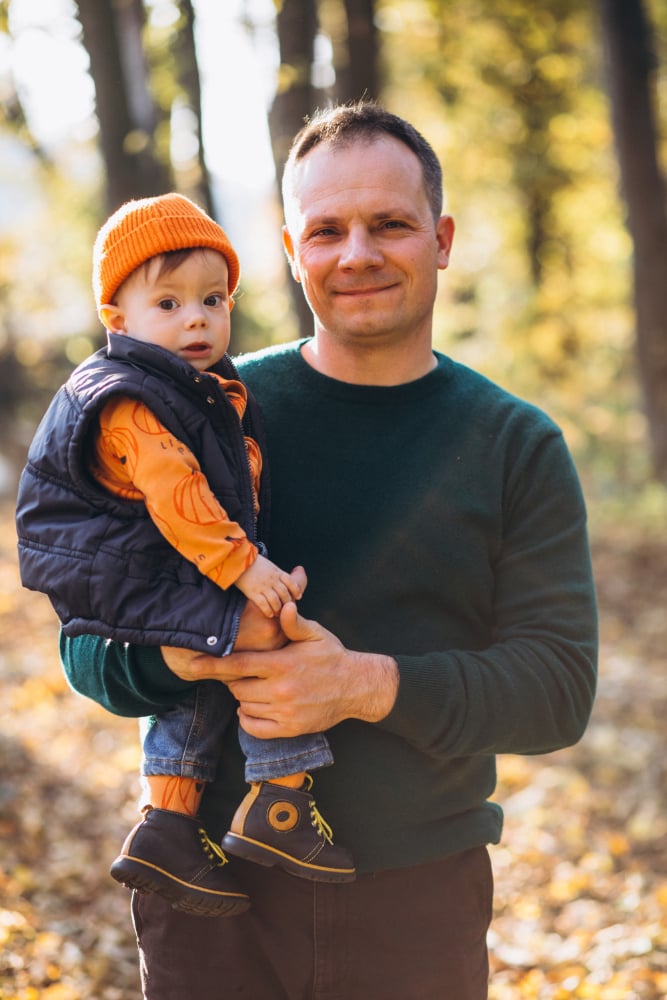
Ellie threw herself into my arms the second she opened the door.
She hit me so hard I nearly fell back down the porch steps. Her arms went around my neck. Her legs went around my waist. She smelled like strawberry shampoo and crayons, and she was squeezing me so tight I could barely breathe.
For one perfect second, it was exactly the homecoming I’d imagined.
Then she pulled back and glanced over her shoulder. Toward the stairs. Toward the inside of the house.
She was checking whether her mother was watching.
Then she leaned close to my ear and whispered, “Mom said you weren’t allowed to come back.”
I froze.
Before I could ask what that meant, she pulled back and looked at me with big, worried eyes.
“Daddy,” she whispered, “am I in trouble for opening the door?”
My six-year-old daughter was afraid of letting me into my own home.
I knelt down on the porch so we were eye to eye. I set down my duffel bag and the little gift bag I’d been carrying since the airport. I put both hands on her face, gently, the way I used to when she was a baby and wouldn’t stop crying.
“No, sweetheart,” I said. “You did nothing wrong. Nothing. Okay?”
She nodded. But she didn’t look like she believed me.
I looked past her into the house.
Behind her, beside the stairs in the front hall, three cardboard boxes were stacked on top of each other.
Each one had the same word written across it in black marker.
ELLIE.
My name is Pat Donnelly. I’m thirty-four years old. I’m a sergeant first class in the United States Army.
I’d been deployed for nine months. Kuwait, mostly, and then a stretch in Iraq. Long days. Hot nights. Sand in places sand shouldn’t be.
For nine months, I’d imagined this exact moment.
I’d imagined it in my bunk at night with my eyes closed. I’d imagined it on long convoys staring out at the desert. I’d imagined it in the chow line, in the shower, in the gym at four in the morning when I couldn’t sleep.
In my head, it always went the same way.
I’d walk up the front steps. Megan would open the door. Her face would light up, and she’d say my name the way she used to, like it was the best word she knew.
And Ellie would come flying down the stairs and demand that I carry her everywhere for the rest of the day. To the kitchen. To the bathroom. To the mailbox. Everywhere.
We’d have dinner together. Spaghetti, probably, because that’s Ellie’s favorite. All three of us at the same table.
And nobody would have to say goodnight through a phone screen.
My return date was supposed to be the twenty-first.
Ellie and I had circled it on her calendar together the night before I left. It was a purple calendar with unicorns on it, hanging on the wall next to her bed. I’d taken a red marker and drawn a big circle around the twenty-first. She’d drawn a heart inside the circle. Then a smiley face. Then a second heart, because the first one “looked lonely.”
“Every night, you cross off one square,” I told her. “And when you get to the heart, I’ll be home.”
“Every single night?”
“Every single night. That’s your job. Can you do that for me?”
She nodded very seriously. She was five then. Her two front teeth were missing.
“I’m a good crosser-offer,” she said.
Then, about three weeks before the end of our rotation, my commander called me into his office.
The relief unit was arriving early. A scheduling thing. Half of our company would rotate home twelve days ahead of time.
“You’re on the first flight out, Donnelly,” he said. “Go home to your kid.”
I walked out of his office and sat down on a pallet of water bottles behind the motor pool and put my face in my hands. My buddy Sergeant Dominguez found me there ten minutes later.
“You okay, Pat?”
“I’m going home early.”
He grinned. “So why do you look like you’re about to cry?”
“Because I’m about to cry.”
He sat down next to me and punched me in the shoulder. “You gonna tell Megan?”
I thought about it.
“No,” I said. “I’m going to surprise them.”
I kept it a secret for almost three weeks.
It was hard. Every video call, I wanted to tell them. Ellie would hold up her calendar to the camera and count the squares out loud.
“Twenty-six more days, Daddy!”
“Twenty-six. Wow. That’s a lot of crossing off.”
“I’m a good crosser-offer.”
“The best one.”
And I’d sit there in the little phone room at the base, with sweat running down my back, biting my tongue. Because I knew the real number was fourteen.
The video calls with Megan had gotten harder over those last few months.
I didn’t really let myself think about it. You learn not to, on deployment. You learn to put things in boxes in your head and close the lids. You can’t fix anything from eight thousand miles away. So you don’t try.
But I noticed.
In the beginning, she’d call every day. She’d tell me about Ellie’s day at school. About the neighbor’s dog getting loose again. About the leaky faucet in the upstairs bathroom. She’d stay on the line after Ellie went to bed, and we’d just talk. About nothing. About everything.
Around month four, the calls got shorter.
“I’m so tired, Pat. Can we talk tomorrow?”
Around month six, she started handing the phone to Ellie and walking out of the frame.
“She wants to talk to you. I’ve got laundry.”
Around month seven, I’d ask how she was doing, and she’d say “Fine,” and look somewhere off to the side of the camera.
“Megan. Talk to me. What’s going on?”
“Nothing’s going on. I’m just tired. I’m doing everything by myself, Pat. The house. The bills. Ellie’s school. The car. Everything.”
“I know, babe. I know. I’m sorry.”
“We’ll talk when you get back,” she said.
She said it a lot, those last few months. We’ll talk when you get back.
I thought she meant about how hard it had been. About needing more help. About maybe me trying for a stateside assignment next time.
I didn’t think she meant anything else.
We’d been married eleven years.
I met Megan when I was twenty-three, at a friend’s Fourth of July barbecue outside Fort Campbell. She was wearing a red sundress and laughing at something with a paper plate of potato salad in her hand, and I walked right up to her and said the dumbest thing I’ve ever said to a woman in my life.
“Is that potato salad any good?”
She looked at me. Then at the potato salad.
“It has raisins in it,” she said.
“Raisins?”
“I know. It’s a crime. Somebody should be arrested.”
We talked for four hours that day. We got married eighteen months later.
It wasn’t my first deployment. It was my third.
The first one was hard for her. We were young. She cried every night. I promised it would get easier.
The second one was easier. She’d made friends. She’d gotten a job at a dental office. She was busy.
This one was the first one since Ellie had gotten old enough to understand. To ask questions. To cry at bedtime because she wanted her daddy.
I knew it was going to be the hardest one for both of them.
I didn’t know how hard.
On the flight home, I had a two-hour layover in Atlanta.
I walked through the airport in my uniform and people kept stopping me to shake my hand. An old man in a Vietnam veteran cap saluted me outside the bathroom. A little boy asked if I’d killed anybody, and his mother turned bright red and dragged him away.
I found a gift shop near my gate. They had a whole wall of stuffed animals.
I picked out a gray rabbit with long floppy ears and a little pink nose. It was soft as anything. It had a tag that said its name was Clover.
Ellie had been asking for a bunny for a year. A real one. Megan said no. Too much work.
“This one doesn’t poop,” I said to myself, holding it up.
The woman at the register laughed.
I also bought a box of chocolates for Megan. The fancy kind, in a gold box. Salted caramels. Her favorite.
I paid for both. I put them in a gift bag with purple tissue paper.
Then I sat at my gate and called nobody, because I wanted it to be a surprise.
My brother Mike picked me up at the airport.
He was the only person I’d told. He’s two years older than me, and he lives twenty minutes from our house. He’s a firefighter. He’s big and loud and hugs like a bear.
He hugged me so hard in the arrivals area that my duffel bag fell off my shoulder.
“Look at you,” he said. “You look like a lizard. A tan, skinny lizard.”
“Thanks, Mike.”
“Seriously. Eat something.”
On the drive home, he kept glancing at me.
“You talked to Megan lately?” he asked.
“Couple days ago. Why?”
He shrugged. “No reason.”
“Mike.”
“I don’t know. I just haven’t seen her around much. I stopped by a few times to cut the grass. She was kind of… I don’t know. Weird. Didn’t really want me to come in.”
“She’s been stressed out.”
“Yeah,” Mike said. “Probably.”
He didn’t say anything else. But he kept glancing at me the whole way home.
He dropped me off at the end of my street around 3:30 in the afternoon. I wanted to walk the last part. I wanted to see the house before it saw me.
“Call me tomorrow,” Mike said. “I want to see the kid.”
“I will.”
“Pat?”
I looked back at him through the window.
“Welcome home, little brother.”
I walked up the street with my duffel bag on my shoulder and the gift bag in my hand.
It was a Wednesday. Late September. The leaves were just starting to turn. Somebody down the block was mowing their lawn.
Our house was the yellow one with white shutters, halfway down on the left. Two stories. A front porch with a swing that squeaked. A basketball hoop over the garage I’d put up for Ellie even though she was way too small to reach it.
Megan’s car was in the driveway.
Ellie’s purple bicycle, the one with the streamers on the handlebars, was leaning against the porch railing. The training wheels were off now. I’d missed that. Megan had sent me a video.
Everything looked normal.
I walked up the steps. I rang the doorbell, because I wanted it to be a real surprise.
I heard little feet running.
The door flew open.
And then Ellie was in my arms.
So there I was. On my knees on my own front porch. Looking past my daughter at three boxes with her name on them.
“Why are your things in boxes, sweetheart?” I asked.
She looked back at them. Then at me.
“For my new room.”
“What new room?”
“At Ryan’s house.” She brightened a little. “He said I can have pink walls.”
Something cold went through my stomach.
“Who’s Ryan?”
“Mommy’s best friend.”
She said it so simply. Like it was the most normal thing in the world.
I didn’t say anything. I couldn’t. I reached into the gift bag and pulled out the rabbit.
Ellie gasped. She grabbed it with both hands and squeezed it against her chest.
“His name is Clover,” I said.
“Clover,” she whispered. She buried her face in its ears.
Then she looked up at me over the top of its head.
“Are you coming with us, Daddy?”
My stomach tightened.
“Going where, baby?”
“We’re moving on Saturday.”
It was Wednesday.
Saturday was three days away.
My return date was the twenty-first. Twelve days from now.
They were leaving before I was supposed to come home.
Footsteps sounded upstairs.
“Ellie?” Megan’s voice. From the top of the stairs. “Who are you talking to?”
Ellie went rigid in my arms.
Megan appeared on the landing. She was carrying a laundry basket full of folded towels. Her hair was pulled back in a messy ponytail. She was wearing leggings and a gray sweatshirt I didn’t recognize.
She looked down the stairs.
And when she saw me, the basket fell out of her hands.
It hit the stairs and tumbled. Towels went everywhere. A plastic hanger clattered all the way down to the bottom.
“Pat?”
“Surprise,” I said.
She didn’t smile.
That’s the thing I’ll remember for the rest of my life. Eleven years of marriage. Nine months apart. And when she saw me standing in our front hallway, she didn’t smile.
She just went pale.
“You weren’t supposed to be here yet,” she said.
“That’s what Ellie told me.”
Megan’s eyes went to our daughter.
Ellie shrank back against my leg, holding Clover.
“Ellie,” Megan said. Her voice was tight. “Go upstairs.”
Ellie’s eyes filled with tears.
“Did I ruin the secret?” she whispered.
I crouched down beside her.
“No,” I said firmly. “You didn’t ruin anything. Take Clover upstairs and show him your room, okay? Mommy and I need to talk.”
She hesitated. She looked at me. Then at her mother. Then at me again.
“You’ll still be here?”
“I’ll still be here.”
She climbed the stairs slowly, stepping around the towels. At the top, she looked back one more time.
Then her bedroom door closed.
I turned to Megan.
“Start with the boxes.”
She came down the stairs and started picking up the towels. She didn’t look at me. She folded them as she picked them up, very carefully, corner to corner, like it was the most important job in the world.
“I’m reorganizing,” she said.
“Ellie says you’re moving on Saturday.”
“We were considering it.”
“Considering moving to another state?”
Her hands stopped.
She was holding a blue bath towel. She stood there on the bottom step holding it against her chest.
“Ellie told you that too?”
“She told me more than you have.”
Megan sat down on the couch. Hard. Like her legs gave out. She was still holding the towel.
“Pat,” she said. “I’ve been doing everything alone. For nine months. The house. The bills. Ellie’s school. Her ear infection in March. The car breaking down on the highway in the rain. The basement flooding. All of it. By myself.”
“I know,” I said. “You told me.”
“I was exhausted.”
“I know you were.”
“You always said we’d talk when you got back.”
“I’m back,” I said.
She looked away.
I stayed standing. I didn’t sit down next to her. I don’t know why. It just didn’t feel like my couch right then.
“Who’s Ryan?” I asked.
Megan picked at a loose thread on the towel.
“A friend,” she said. “Who helped me when I needed somebody.”
“Does your friend know you’re married?”
“Yes.”
“Does he know our daughter thinks I’m forbidden from coming home?”
Megan’s face changed.
“I never meant for her to say it like that.”
“How did you mean for her to say it?”
She didn’t answer.
The clock on the wall ticked. Upstairs, I could hear Ellie talking to Clover in a quiet little voice.
“Are you in love with him?” I asked.
She was quiet for a very long time.
Then she nodded.
My wife had fallen in love with another man while I was deployed.
I stood there in our living room with my duffel bag still on my shoulder and the gift bag still in my hand. The chocolates were still in it. Salted caramels in a gold box.
I wanted to ask a hundred questions.
How long?
Where had they met?
Had he been sitting at my dinner table? Sleeping in my bed? Drinking out of my mug?
But I looked past her at those boxes by the stairs. ELLIE. ELLIE. ELLIE.
The boxes mattered more.
“Are you taking Ellie to live with him?” I asked.
“Yes.”
“And when were you planning to tell me?”
Megan wiped her cheeks with the back of her hand.
“Once we were settled.”
I stared at her.
“You were going to call me,” I said slowly. “After you’d taken our daughter away?”
“I wasn’t keeping her from you,” Megan said quickly. “We’d arrange visits. Holidays. Summers. Whatever you wanted.”
“You made that decision without speaking to me.”
“I thought it would be easier.”
“For whom?”
She opened her mouth.
She had no answer.
I set the gift bag down on the hall table, very carefully. I put my duffel bag on the floor beside it.
Then I walked into the kitchen.
I don’t know why. I just needed to be somewhere else for a second. Somewhere I could breathe.
The kitchen looked the same. The same yellow curtains. The same fruit bowl with two brown bananas. Ellie’s drawings stuck to the refrigerator with magnets. A rainbow. A dog. A picture of a man in a green uniform with a big smile. It said DADDY across the top in purple crayon.
Two mugs sat beside the sink.
One was Megan’s. White, with a lipstick mark on the rim.
The other one was mine.
The chipped blue mug Ellie had painted for me at the pottery place for Father’s Day when she was four. It had a lopsided yellow sun and three stick figures holding hands. ME. MOMMY. DADDY. Somebody had drunk coffee out of it that morning. There was still a brown ring in the bottom.
I picked it up. I looked at it for a long time.
“Does Ryan come here?” I asked.
Megan had followed me into the kitchen. She was standing in the doorway.
“Sometimes,” she said.
I put the mug back down.
“Does Ellie know about you two?” I asked.
“She knows he’s my friend.”
“Does she know he’s the reason you’re moving?”
Megan came into the kitchen and leaned against the counter.
“She’s six, Pat. I didn’t tell her about the relationship.”
“But you told her I couldn’t come home.”
“I was trying to prepare her.”
“For losing her father?”
“For a different life.”
I thought about Ellie’s purple calendar.
The red circle around the twenty-first. The two hearts. The smiley face.
During our last video call, just four days ago, she’d held it up to the camera and counted the squares out loud, one by one, touching each one with her finger.
“Sixteen, Daddy! Sixteen more!”
Then she’d put the calendar down and looked at me very seriously.
“Daddy. When you come home on the heart day. Can you pick me up from school?”
“From school?”
“Kaylee’s daddy picked her up from school when he came home from the Army. He came right into the classroom. Everybody clapped.”
“I can do that.”
“Promise?”
“I promise, Ellie-bean.”
She’d smiled so big that her new front teeth showed.
And now Megan was planning to move her to another state before she could get to the heart day.
“Does Ryan think I agreed to this?” I asked.
Megan stared at the floor.
She didn’t answer for a long time.
“Yes,” she said finally.
That changed everything.
Up until that moment, I’d thought Megan was just hiding an affair. That was bad enough. That was the kind of bad I’d seen happen to other guys. You hear about it on deployment all the time. Some guy gets a phone call. Some guy gets a letter. Some guy comes home to an empty house.
But this was different.
She’d been telling other people that I’d approved this. That I’d agreed to let her take our daughter to another state. That I’d signed off on it.
She’d been telling people I said yes to something I didn’t even know about.
“Who else thinks I agreed?” I asked.
Megan didn’t look up.
“My mother.”
“Did you tell Ellie’s school?”
She hesitated.
“Megan.”
“I asked for the withdrawal forms.”
“When?”
“Monday.”
“And when did you say Ellie would be leaving?”
She swallowed. “Friday.”
Friday. Two days. Her last day at Lincoln Elementary would have been Friday, and nobody would have told me.
I took out my phone.
“I’m calling the school.”
Megan pushed off the counter. “Pat, please. Don’t. You’re making me look terrible.”
I stopped. I turned around and looked at her.
“I haven’t told anyone about Ryan,” I said quietly.
Then I walked out onto the front porch and closed the door behind me.
The school secretary’s name was Mrs. Hutchins. She’d been at Lincoln Elementary since before Megan and I bought the house. She answered on the second ring.
“Lincoln Elementary, this is Doris.”
“Mrs. Hutchins, this is Pat Donnelly. Ellie Donnelly’s father.”
“Oh! Sergeant Donnelly! Are you back? Ellie talks about you every day. She told the whole class you’re coming home on the twenty-first.”
“I’m back early,” I said. “Mrs. Hutchins, I need to ask you something. Did my wife request withdrawal paperwork for Ellie this week?”
There was a pause.
“She did,” Mrs. Hutchins said carefully. “On Monday. I’m afraid I can’t discuss all the details over the phone, Sergeant. But I can tell you that Mrs. Donnelly did request the forms.”
“I didn’t know about it,” I said. “I never agreed to it.”
Another pause. Longer.
“I see,” Mrs. Hutchins said. Her voice had changed. “Let me get you in with Principal Alvarez first thing tomorrow morning. Eight o’clock?”
“Eight o’clock. Thank you.”
“Sergeant Donnelly?”
“Yes, ma’am?”
“Welcome home,” she said softly.
When I came back inside, Megan was sitting at the kitchen table, crying.
“You don’t understand how lonely I was,” she said.
I stood in the doorway.
“Every night,” she said. “Every single night. Lying in that bed by myself. Ellie crying for you at bedtime. Me crying after she fell asleep. Nine months, Pat. Nine months. And before that, eight months. And before that, eleven. You’ve been gone for more than two years of our marriage. Did you know that? I counted.”
I didn’t say anything.
“I’m not like you,” she said. “I can’t just put things in a box and close the lid. I’m not built like that.”
I let out a long breath.
“I believe you were lonely,” I said. “I do. I know it was hard. I know I wasn’t here. I’ll own that.”
She looked up at me.
“But being lonely doesn’t make cheating okay,” I said. “And it doesn’t make taking Ellie okay either.”
Megan looked toward the stairs.
“Please,” she said. “Please don’t tell Ellie about Ryan.”
“I won’t make her carry our marriage problems,” I said. “She’s six. She shouldn’t have to carry any of this.”
Megan let out a breath. Relieved.
“But I’m not going to help you lie to her,” I said.
Ellie came downstairs before dinner.
She was carrying Clover by one ear. She’d put a little pink hair bow on his head. She stood at the bottom of the stairs and looked at me.
“Daddy,” she said. “Are you staying tonight?”
“Yes.”
She came over and climbed into the kitchen chair beside mine. She pulled her box of crayons over and a piece of paper and started coloring.
I watched her. I’d missed nine months of this. Nine months of her hair getting longer and her legs getting longer and her front teeth growing in.
She was drawing a house.
It had a purple roof. Purple windows. A purple door. A little purple bicycle out front.
“Is that our house?” I asked.
“The old one,” Ellie said, without looking up.
The old one.
“Why’s the roof purple?” I asked.
“Because I like purple better than pink.”
She kept coloring. She started on a purple tree.
“Ryan makes pancakes,” she said. “Chocolate chip ones. With whipped cream.” She switched crayons. “But he doesn’t know how to turn on my star light.”
I remembered the little night light beside her bed. A plastic dome that projected glowing stars onto the ceiling. You had to push the button twice, not once, or it would only turn on the blue setting, and Ellie hated the blue setting.
“I know where it goes,” I said.
“Twice,” Ellie said. “You have to push it twice.”
“I know. I remember.”
She nodded. Like that settled something.
Then she said, still coloring, “Mommy says Ryan makes her happy.”
I didn’t say anything.
Ellie stopped coloring. She looked up at me.
“Does that mean you can’t live here anymore?”
“Who told you that?” I asked.
“Mommy. Last night.”
“What did she say?”
Ellie rubbed Clover’s ear between her fingers. Back and forth. Back and forth.
“She said you weren’t allowed to come back to our house,” she said. “She said we had to get used to it being just us. And then Ryan.” She looked down. “She said not to cry about it.”
“Did she say why?”
“She said grown-up things changed.”
I reached over and took her hand. Her small, sticky hand, with purple crayon all over the fingertips.
“Some grown-up things might change, Ellie,” I said. “That’s true. I’m not going to lie to you about that. But I’ll always be your daddy. That’s never going to change. Not ever.”
“Even if Mommy doesn’t want you here?”
I swallowed hard.
“Even then.”
She leaned over and put her head on my arm.
For nine months, I’d worried about missing things. Birthdays. School projects. Bedtime stories. Her first lost tooth. I’d lain awake in my bunk worrying that she’d forget what my voice sounded like.
I hadn’t known that the whole time, my daughter was being taught to be afraid of me coming home.
Megan made spaghetti for dinner.
We sat at the table, all three of us. Exactly like I’d imagined it for nine months.
Nobody said anything.
Ellie ate three bites and pushed her plate away. Megan didn’t eat at all. I ate everything on my plate because the Army teaches you to eat when there’s food in front of you.
Halfway through, Megan got up and went to the hall table. She picked up the gift bag I’d left there. She looked inside.
She saw the gold box. The salted caramels.
She stood there in the hallway with her back to me, holding it.
Then she put it back down and came back to the table and sat down. She didn’t say anything about it.
Neither did I.
After dinner, I gave Ellie her bath.
She talked the whole time. About school. About her best friend, Harper, who had a hamster named Pancake. About a boy named Tyler who’d eaten a crayon on purpose. About how Ms. Park, her teacher, let her be the line leader on Tuesdays.
I sat on the closed toilet lid and listened to every word.
Then I put her in her pajamas, the purple ones with the stars, and tucked her into bed.
I pushed the button on her star light. Twice.
The ceiling lit up with yellow stars.
“See?” Ellie said, pleased. “You remember.”
“I’ll always remember.”
She looked up at the stars for a long time.
“Daddy?”
“Yeah, Ellie-bean?”
“I counted every night. I didn’t miss one. Not even when I was sick.”
“I know you didn’t.”
“Mommy said I didn’t have to anymore. Last week. She said to stop counting. But I kept counting anyway. I hid it.”
I didn’t trust my voice. I just kissed her forehead.
She was asleep in five minutes, with Clover under her arm.
After she fell asleep, I found Megan in the living room. She was sitting on the couch with her knees pulled up to her chest.
“I need Ryan’s number,” I said.
She looked up, startled. “Why?”
“Because anybody who’s helping you move Ellie deserves to know that I never agreed to it.”
She hesitated.
“Pat, please don’t start a fight with him.”
“I’m not going to start a fight. I’m going to tell him the truth.”
She didn’t move.
“Megan,” I said. “I’m not letting Ellie go without a fight. You can give me his number, or I can find it myself. But I’m going to talk to him tonight.”
She looked at me for a long time.
Then she picked up her phone and texted it to me.
I went out onto the back porch. It was dark. The air was cool. I could hear crickets.
I sat down on the top step and dialed.
Ryan answered on the third ring.
“Hello?”
“This is Pat,” I said. “Ellie’s father.”
Silence.
A long, long silence.
I could hear a television on in the background. Then it went quiet. He must have turned it off.
“Megan told me you knew about us,” he finally said. His voice was careful. Low.
“I found out today. About three o’clock this afternoon.”
“She said you two were separating. She said you’d been talking about it for months. She said you’d agreed Ellie could move with her.”
“We never discussed either one,” I said.
He paused.
“She said you were fine with it,” he said slowly. “She said it was mutual. She said you’d even suggested it. Because you were going to keep deploying, and you thought Ellie would be better off somewhere more stable.”
I closed my eyes.
“I never said any of that,” I said. “I never talked to Megan about separating. I never talked to her about Ellie moving. I didn’t know you existed until my six-year-old told me you were going to paint her new bedroom pink.”
He didn’t say anything for a while.
I could hear him moving around. Walking. A door opening and closing.
“I believed her,” he said. “I believed she’d talked to you.”
“She hadn’t.”
He let out a long breath.
“Look,” he said. “I know this is ugly. I know how this looks.”
“You knew she was married,” I said.
“Yes.”
“You knew Ellie was waiting for me to come home.”
There was a pause.
“Yes,” he said.
“Then don’t pretend you thought this would be simple.”
He sighed. It was a heavy sigh. The sigh of somebody who’d been telling himself a story and had just heard it fall apart.
“That’s fair,” he said quietly.
I told him what Ellie had said at the door.
Mom said you weren’t allowed to come back.
Am I in trouble for opening the door?
Ryan went completely quiet.
“She told Ellie you weren’t allowed home?” he said finally.
“Those were Ellie’s words. Not mine.”
“I didn’t know that,” he said. His voice had changed. “I swear to God, I didn’t know that.”
“I believe you,” I said. And I did. I don’t know why. Something in his voice. “I’m not calling to argue with you about the affair, Ryan. That’s between me and Megan, and honestly, I’m too tired tonight to even think about it. I’m calling to tell you that I never agreed to move my daughter. Not to your house. Not to your state. Not anywhere.”
He was quiet.
“I’ll talk to Megan,” he said.
Before we hung up, I asked him one more thing.
“Megan’s mother is supposed to come over tomorrow afternoon to help pack. Are you still in town?”
“I’m at a hotel. Out by the highway. I drove in Monday to help. I was supposed to drive them back Saturday.”
“Would you come by tomorrow afternoon? When her mother’s here?”
He hesitated.
“Why?”
“Because I want everybody in the same room,” I said. “So nobody can tell anybody else a different story.”
There was a long pause.
“Okay,” Ryan said. “I’ll be there.”
I slept in the guest room that night.
It was a small room at the end of the hall with a twin bed and a sewing machine Megan never used. The sheets smelled like the cedar closet. It was the first real bed I’d slept in for nine months that wasn’t a cot.
I couldn’t sleep.
I lay there staring at the ceiling, thinking about the blue mug in the kitchen. About the boxes by the stairs. About the gold box of chocolates on the hall table.
Around one o’clock, the door creaked open.
“Daddy?”
Ellie was standing in the doorway in her star pajamas, holding Clover by the ear.
“I’m here, baby.”
She padded across the room and climbed up onto the bed next to me.
“I thought you might go away while I was sleeping,” she whispered.
“I’m staying.”
“Promise?”
“Promise.”
She curled up against my side and put her head on my shoulder. Her hair smelled like strawberries. Her feet were freezing.
“Daddy?”
“Yeah?”
“Can you still pick me up from school?”
“I can pick you up this Friday.”
She lifted her head. “This Friday? Before our calendar day?”
“Before our calendar day.”
She smiled in the dark. I could see her teeth.
“Then I won’t have to count so many squares.”
She fell asleep again in about two minutes.
I lay there with her on my shoulder for almost an hour, not moving, listening to her breathe.
Then I carefully picked her up and carried her back to her room. I tucked her in. I pushed the star light button twice.
Before I left, I looked at the purple calendar on her wall.
She’d crossed off every square in pencil. Every single one. Neat little X’s. A few were wobbly, like she’d done them half asleep.
Twelve squares were left. Twelve, until the red circle with the two hearts and the smiley face.
Megan had planned to take Ellie away before she could cross off the last one.
The next morning, I put on the only pair of jeans I owned that still fit and drove to Lincoln Elementary.
Principal Alvarez was a small, serious woman with reading glasses on a beaded chain. She shook my hand at the door of her office and thanked me for my service. Then she sat down behind her desk and folded her hands.
“Sergeant Donnelly,” she said. “Mrs. Hutchins told me you had some concerns.”
I told her everything I knew. Not about Ryan. Just about the move. That I’d come home early. That I’d found boxes. That I’d never agreed to anything.
She listened. She didn’t interrupt.
When I finished, she nodded slowly.
“I can confirm that Mrs. Donnelly requested withdrawal paperwork on Monday,” she said. “She told us the family was relocating out of state. She said Friday would be Ellie’s last day.” She paused. “She did not complete the process. The forms haven’t been returned.”
I let out a breath.
“I want to be very clear with you, Sergeant,” Principal Alvarez said. “The school cannot settle a disagreement between parents. That’s not our role, and I won’t take sides.”
“I understand. I’m not asking you to.”
“But I can tell you this. Our policy requires both parents’ signatures for a withdrawal when there’s no custody order in place. If you haven’t signed, the withdrawal doesn’t go through.”
“Thank you,” I said.
“And I’ll add you to our contact list,” she said, “so that you’re informed of any future changes.”
I wasn’t asking her to choose a side.
I just wanted to make sure nobody mistook my absence for permission.
From the school, I drove downtown to see a family law attorney.
Mike had given me her name. Teresa Lindqvist. She’d handled his friend’s divorce. Mike said she was “kind of terrifying, in a good way.”
She was about fifty, with short gray hair and a navy blazer and a firm handshake. Her office was on the third floor of an old brick building with a view of the courthouse.
I told her everything. All of it. Ryan. The boxes. The school. The phone call. What Ellie said at the door.
She took notes on a yellow legal pad. When I got to Mom said you weren’t allowed to come back, she stopped writing and looked up at me over her glasses.
“She said that? Your daughter? Those exact words?”
“Those exact words.”
Teresa wrote it down. She underlined it twice.
“Okay,” she said. “Here’s what I need from you, Sergeant. First, preserve everything. Every text message, every email, every voicemail between you and your wife. Don’t delete anything. Take screenshots. Send copies to me.”
“Okay.”
“Second, do not, under any circumstances, have a confrontation with your wife in front of your daughter. No yelling. No slamming doors. Nothing. If you need to have a hard conversation, you do it when Ellie is asleep or out of the house.”
“Okay.”
“Third, don’t move out. Don’t let her talk you into staying somewhere else ‘for a few days to cool off.’ You live there. That’s your home. You stay in it.”
“Okay.”
“And fourth,” Teresa said. “Don’t try to stop her yourself. Don’t take Ellie and leave. Don’t hide her car keys. Nothing like that. If she tries to move your daughter out of state without your consent, we handle it through the court. The right way. Understand?”
“I understand.”
She looked at me for a long moment.
“You’d be surprised,” she said, “how many good fathers lose their kids because they get angry and do something stupid. Don’t be one of them.”
I wrote everything down on the back of a receipt from my wallet.
Then I drove home.
When I walked into the house, Megan was in the front hall sealing another box.
She pulled the tape across the top with a loud rrrrrip. She didn’t look up.
“Ryan called me,” she said.
“I know.”
“He says he won’t help us move until we sort this out.”
“Good.”
She pressed the tape down with her palm. Hard.
“You’ve turned him against me,” she said.
“No,” I said. “I told him what you left out.”
She pulled another long piece of tape off the dispenser. It screeched.
“I thought,” she said, not looking at me, “that once we moved, you’d calm down. You’d see it was better. And we’d work out visits.”
I looked at the box she was taping. ELLIE — BOOKS.
“You planned where Ellie would sleep,” I said. “You planned her bedroom. You planned the color of her walls. You planned her new school. You planned what to tell your mother. You planned what to tell Ryan.”
Megan stopped taping.
“You planned how I’d find out,” I said. “You even planned that.”
She stood very still with the tape gun in her hand.
“The only thing you didn’t plan for,” I said, “was me coming home.”
Megan’s mother, Barbara, arrived a little after one o’clock.
Barbara’s in her sixties. A retired nurse. Practical. Sturdy. She’d always liked me. She used to send me care packages on deployment with homemade oatmeal cookies and copies of the local newspaper so I’d know what was going on back home.
She came through the front door with an armload of flattened moving boxes and a roll of bubble wrap. When she saw me in the kitchen, she dropped all of it.
“Pat!” She came across the kitchen and hugged me hard. “Oh, honey. You’re home! Megan didn’t say you were home early.”
“It was supposed to be a surprise.”
She pulled back and looked at me. Then at Megan, who was standing in the doorway.
“Well,” Barbara said, a little confused. “I’m so glad you’re here. Megan said you two had talked everything through. I’m just glad you’re being so mature about it all.”
I looked at her.
“We haven’t,” I said.
Barbara’s expression changed.
“Haven’t what?”
“Talked anything through.”
She looked at Megan.
Megan looked at the floor.
Ryan arrived about ten minutes later.
I heard his car pull into the driveway. I heard the car door close. I heard footsteps on the porch steps.
He knocked. Megan went to open the door.
He was standing on the porch holding a roll of packing tape. He was about my age. Medium height. Brown hair. A plaid flannel shirt and jeans. He looked like a regular guy. Like somebody you’d stand next to at a Little League game and talk about the weather.
That somehow made it worse.
He saw me standing in the hallway behind Megan. He stopped.
Seeing him standing in my doorway, holding packing tape, hurt more than I’d expected it to. It hurt worse than the boxes. Worse than the blue mug.
But I didn’t ask him to leave.
“Come in,” I said.
Ellie was upstairs watching a movie in her room. Something with singing animals. I could hear it faintly through the ceiling.
We all gathered in the living room. Barbara sat in the armchair. Megan sat on the couch with her arms crossed. Ryan stood awkwardly by the fireplace with the roll of packing tape still in his hand.
I stayed standing.
I turned to Barbara first.
“Barbara,” I said. “Did Megan tell you I agreed to the move?”
“Yes,” Barbara said. “She said you both thought it was best. She said you’d talked about it on your video calls. She said you were relieved, because you were thinking about re-enlisting and you didn’t want Ellie to have to keep going through this.”
“I learned about it yesterday,” I said. “At three o’clock. When Ellie opened the door.”
Barbara stared at me.
Then she slowly turned to look at her daughter.
“Is that true?” she said.
Megan didn’t say anything for a long moment.
Then she nodded.
Ryan set his roll of packing tape down on the coffee table. Very quietly. Like it suddenly weighed a hundred pounds.
I kept going.
“I didn’t know about the relationship,” I said. “I didn’t know Ellie was being taken out of her school. I didn’t know about any of it. And I didn’t know that Ellie had been told I wasn’t allowed to come home.”
Barbara went pale.
She looked at Megan like she’d never seen her before.
“You told that child,” she said slowly, “that her father couldn’t come back?”
“I was preparing her,” Megan said.
“For what?” Barbara demanded.
“For things changing!”
“Then tell her what’s changing!” Barbara’s voice rose. I’d never heard her raise her voice before. “Tell her the truth! Don’t tell a six-year-old something that isn’t true! Don’t make her think her daddy doesn’t want her!”
Megan started crying.
“I couldn’t keep explaining why Pat wasn’t here!” she said. “Every night! Where’s Daddy? When’s Daddy coming? Why can’t Daddy come now? Every single night! I couldn’t do it anymore!”
“She knew why I wasn’t here,” I said quietly. “She knew I was deployed. She had a calendar. She counted every night.”
Megan looked up at me. Her face was wet.
“I didn’t know how to tell her we weren’t going to live together anymore,” she whispered.
“Then you should have told me first,” I said.
Ryan finally spoke.
“I won’t help move Ellie this Saturday,” he said.
Megan turned around sharply on the couch.
“You promised you’d support me.”
“I thought Pat knew,” Ryan said. He didn’t look at her. He looked at the floor. “You told me he knew. You told me he agreed. You told me he was the one who suggested it.”
“Ryan—”
“I’m not going to be the guy who takes a kid away from her dad while he’s overseas,” Ryan said. His voice cracked a little. “I can’t be that guy, Meg. I’ve got to be able to look at myself in the mirror.”
He glanced over at me. Just for a second.
“My dad left when I was seven,” he said quietly. “Never came back. I’m not doing that to somebody else’s kid.”
Barbara nodded slowly.
She stood up from the armchair. She walked over and put her hand on Megan’s shoulder.
“I’ll help you, honey,” she said. “I’ll help you through a separation. Whatever you need. I’ll help you find an apartment. I’ll babysit. I’ll do whatever I can.” She squeezed Megan’s shoulder. “But I won’t help you move Ellie without sorting this out with her father first.”
Megan stared up at her mother.
The two people she’d been counting on were both refusing to help her leave.
Then I heard a creak on the stairs.
We all turned.
Ellie was standing halfway down the staircase. Her movie must have ended. She was clutching Clover against her chest with both arms.
She’d heard. I don’t know how much. But she’d heard enough.
“Mommy?” she said.
Megan turned around.
“Sweetheart,” she said quickly. “Go back upstairs.”
But Ellie didn’t move. She stayed right there on the stairs.
“If Daddy can stay,” she asked, very quietly, “why did you say he couldn’t come back?”
The room went completely silent.
Megan got up from the couch. She walked to the bottom of the stairs. She knelt down so she was eye level with Ellie.
“Ellie,” she said. Her voice was shaking. “I said something wrong.”
“Was I bad for opening the door?”
“No, honey. No.”
“Then why was it a secret?”
Megan put her hand over her mouth. She couldn’t answer. Her shoulders were shaking.
I walked to the stairs. I knelt down beside Ellie, next to her mother.
“You did nothing wrong, Ellie,” I said. “Nothing. You hear me?”
Ellie looked at me. Her chin was wobbling.
Megan took a long, shaky breath. She lowered her hand from her mouth.
“Daddy was always allowed to come home,” she said. Her voice broke on every word. “Always. I shouldn’t have told you he wasn’t. That was wrong. That was a lie. I’m so sorry, baby. I’m so sorry.”
Ellie looked at her mother for a long time.
Then she looked at me.
“Are you still my daddy?”
“Always,” I said.
She came down the last three stairs and threw herself into my arms.
I held her. I held her right there at the bottom of the stairs, with her face buried in my neck and Clover squished between us. She was trembling. Her whole little body was shaking.
I held her until she stopped.
Over the top of her head, I looked at Megan.
Megan was still kneeling on the floor. Crying. Barbara was standing behind her with one hand on her back.
“You don’t have to love me anymore, Megan,” I said quietly. “That’s your choice. I can’t make you.”
She looked up at me.
“But you don’t get to make our daughter believe I stopped loving her.”
Later that afternoon, Megan told her mother to stop packing.
Barbara folded up the flattened moving boxes and put them back in her car. She hugged me in the driveway before she left.
“I’m so sorry, Pat,” she said. “I’m so sorry. I should have asked you. I should have called you. I just believed her.”
“It’s not your fault, Barbara.”
“She’s my daughter,” Barbara said. Her eyes were wet. “So in a way, it is.”
Ryan left that evening.
Before he got in his car, he stopped on the porch and turned around.
“For what it’s worth,” he said. “I’m sorry. Not for… I’m not going to pretend I’m sorry I fell for her. I’d be lying. But I’m sorry about this part. The Ellie part. I should have asked more questions.”
“Yeah,” I said. “You should have.”
He nodded.
He held out his hand.
I looked at it for a long time.
I didn’t shake it. I couldn’t. Not yet.
He put his hand back in his pocket. He nodded once. Then he got in his car and drove away.
The boxes marked ELLIE stayed beside the stairs.
Still packed. Still taped. Nobody touched them.
That night, after Ellie was asleep, Megan and I sat at the kitchen table.
It was the first real conversation we’d had in months. Maybe a year. Neither of us yelled.
She told me about Ryan. They’d gone to high school together. He’d moved to Indiana after college. They’d found each other again on Facebook in February. Just messaging at first. Then phone calls. Then, in May, he drove down for a weekend while Ellie was at Barbara’s.
“I didn’t mean for it to happen,” she said. “I know everybody says that. But I didn’t.”
“I believe you.”
“I was so lonely, Pat.”
“I know.”
“And he was there. You weren’t.”
“I know.”
She looked at me across the table.
“I’m not going to try to fix this,” she said quietly. “Our marriage. I don’t think I can. I don’t think I want to.”
I thought about that for a long time.
“I don’t think I want to either,” I said. And it was the truth. I’d known it, I think, since the laundry basket fell.
She nodded slowly.
“But I’m not going to let you take Ellie,” I said. “Not like this. Not to another state. Not without me.”
“I know,” she said. She wiped her face. “I won’t. I promise. I won’t move her while we work this out.”
But I knew a promise made at our kitchen table at eleven o’clock at night wasn’t enough.
Not after this.
The next morning, I called Teresa Lindqvist. She helped me start the custody process that same day.
I gave her everything. The screenshots of Megan’s messages about the move. The texts to Barbara that Barbara forwarded to me, where Megan said I’d agreed. The school’s confirmation of the withdrawal request. The dates. Saturday. Friday. Monday.
I told her about Ellie’s calendar. About the twelve squares left.
And I told her, again, what Ellie had said when she opened the door.
Teresa wrote it all down.
“You’re doing this right, Pat,” she said. “Keep doing it right.”
I didn’t want to take Ellie away from her mother. I want to say that clearly. Megan wasn’t a monster. She was a woman who’d been lonely and exhausted and made a terrible decision, and then kept making it worse because she didn’t know how to stop.
Ellie loved her mother. Ellie needed her mother.
I just wanted to make sure neither one of us could ever take Ellie away from the other without consequences.
On Friday afternoon, at 2:55, I was standing outside Ms. Park’s first-grade classroom at Lincoln Elementary.
I was wearing my uniform. Ellie had asked me to, the night before.
“So everybody knows you’re the real Army daddy,” she said.
Ms. Park opened the classroom door a crack and smiled at me. She held up one finger. One minute.
I heard her inside.
“Ellie Donnelly, you have a visitor.”
Then I heard a scream.
The door flew open, and Ellie came running out so fast her backpack bounced up and down on her back. Her shoelace was untied. Her hair bow was crooked. She had marker on her chin.
“DADDY! YOU CAME!”
I lifted her up into my arms. She wrapped her legs around my waist and her arms around my neck.
Behind her, the whole class of first graders came crowding into the doorway to look. Somebody started clapping. Then everybody was clapping. Even Ms. Park.
“Of course I came,” I said.
“Kaylee! Kaylee! That’s my daddy! I told you!”
A little girl with red pigtails waved at me from the doorway.
Ellie leaned back and looked at my face.
“Are you coming next time too?”
“I’m going to keep showing up, sweetheart,” I said. “Every time I can.”
She wrapped her arms around my neck and squeezed.
And for the first time since I’d come home, she didn’t look over her shoulder.
That night, Ellie took her pencil and crossed off a square on her purple calendar. Then she stopped. She looked at the rest of them. The eleven squares left until the red circle with the two hearts.
“Daddy,” she said. “What do I do with these now? You’re already home.”
I thought about it.
“What do you want to do with them?”
She thought about it too. Very seriously.
Then she took a purple crayon and drew a big heart around that day. That Friday. The day I’d picked her up from school.
“This is the new heart day,” she said. “The real one.”
The custody case took about six weeks.
Megan moved out in October. She got a small apartment across town, about fifteen minutes away. Barbara helped her paint it. Ryan came down from Indiana most weekends. He didn’t come to the house. He waited in his car at the curb when he picked her up, and he never once came to the door.
I appreciated that.
I applied for a non-deployable assignment at the base. My commander signed off on it without a second thought. Two years, stateside, desk job, home every night by five-thirty. Mike offered to pick Ellie up from school on the days I had to stay late. Barbara offered too, which surprised me.
“She’s my granddaughter,” Barbara said. “And you’re still her father. That’s not changing just because my daughter made a mess.”
On a cold morning in November, we stood before a family court judge.
Her name was Judge Hargrove. She was in her sixties, with short white hair and very sharp eyes behind rimless glasses. She’d read everything. Every page Teresa had sent. Every page Megan’s attorney had sent.
Megan testified first.
She didn’t lie. I’ll give her that. She’d stopped lying by then.
She admitted that she’d planned to move Ellie to Indiana without my agreement. She admitted she’d requested the withdrawal forms from Ellie’s school. She admitted she’d told her mother and Ryan that I’d consented, when I hadn’t.
And when Teresa asked her, very quietly, what she’d told Ellie, she admitted that too.
“I told her,” Megan said, barely above a whisper, “that her father wasn’t allowed to come home.”
Judge Hargrove looked at her over her glasses for a long time.
She didn’t say anything. She just wrote something down.
Then it was my turn.
Teresa asked me about my parenting history. About Ellie’s bedtime routines. About the star light. About pushing it twice. About her best friend, Harper, and the hamster named Pancake.
She asked me about my new assignment. About Mike. About Barbara.
She asked me what I wanted.
“I want Ellie to stay in her house,” I said. “In her school. With her friends. I want her to have her mom in her life. I want her to see her mom as much as she can.” I took a breath. “I just never want her to have to be afraid to open the door for either one of us.”
The judge took a short recess.
When she came back, she read her ruling from a sheet of paper. She read it slowly and clearly.
She’d considered our parenting history. Ellie’s need for stability. Her school. Her community. The arrangements I’d made to care for her now that I was home.
She’d also considered, she said, the attempted relocation without consent, and the statements made to the child.
When she got to the end, I could barely breathe.
I was awarded primary physical custody.
Ellie would stay in her house. In her school. In the community she knew. Lincoln Elementary. Harper. Pancake the hamster.
Megan would have scheduled parenting time. Every other weekend. Every Wednesday for dinner. Alternating holidays. Two weeks every summer.
And neither one of us could relocate Ellie in violation of the court’s order.
Megan started crying.
She put her face in her hands, right there at the table, and her shoulders shook. Her attorney put a hand on her back.
I didn’t feel triumphant.
I thought I would. For six weeks, I’d imagined this moment. But I didn’t feel like I’d won anything.
She was still Ellie’s mother. Ellie still loved her. Ellie still drew pictures of her and put them on the refrigerator.
But the decision meant that Megan could never again make plans to take our daughter away and expect me to find out about it afterward.
That was all I’d wanted.
Outside the courthouse, it was cold. Gray sky. Wind blowing leaves across the steps.
Megan stopped beside me on the sidewalk. She had her coat pulled tight. Her eyes were red.
“I never thought it would end like this,” she said.
“Neither did I.”
We stood there for a moment. Not looking at each other.
“I remember the potato salad,” she said suddenly.
I looked at her.
“At the barbecue. When we met. You asked me if it was any good.” She almost smiled. “It had raisins in it.”
“It was a crime,” I said.
“Somebody should have been arrested.”
For a second, we were both quiet.
Then she looked down at the sidewalk.
“I know I hurt Ellie,” she said. “I know that. I think about it every night. What she said to you at the door.”
“Then help her heal,” I said. “She needs both of us now. She needs both of us to tell her the truth.”
Megan nodded slowly.
“I will,” she said. “I promise. I’ll do better.”
It wasn’t forgiveness. Not yet. I don’t know if it’ll ever be forgiveness.
But it was a beginning.
That evening, Ellie sat at the kitchen table with her purple calendar spread out in front of her.
It was a new one. For the next year. Barbara had bought it for her. Unicorns again, because Ellie insisted.
She’d taken the old calendar off the wall and put it in her memory box, the one under her bed. She’d shown it to me before she put it away. The red circle on the twenty-first. The two hearts. The smiley face. And the big purple heart she’d drawn around the Friday I’d picked her up from school.
“That’s the real one,” she said again. “Remember?”
“I remember.”
Now she was carefully marking the new calendar. With a pink crayon, she drew little hearts on the days she’d spend with her mom. Every other weekend. Every Wednesday.
“Mommy says I can still see her,” she said, concentrating.
“Of course you can.”
“And Wednesdays she’s going to make me chocolate chip pancakes for dinner. For dinner, Daddy.”
“That sounds amazing.”
“And I get to stay at my school?”
“Yes. You get to stay at your school.”
She looked up at me.
“With Harper?”
“With Harper.”
“And Pancake?”
“And Pancake.”
She went back to coloring.
Then she stopped. She put down her crayon. She looked at me very seriously, the way she does when she’s thinking something big.
“And you’re allowed to live here?”
I set down the dish towel I was holding.
I came over to the table. I pulled out the chair beside her and sat down.
“Ellie,” I said. “I was always allowed to come home.”
She studied my face for a long time.
“Then why did Mommy say you weren’t?”
“Mommy made a mistake,” I said gently. “A very big one. Grown-ups make mistakes sometimes. Even big ones.” I tucked her hair behind her ear. “But none of it was because of you. Not one bit. You didn’t do anything wrong. Ever.”
She was quiet for a moment.
“Did the judge say I could stay with you?”
“Yes, sweetheart.”
Her whole face lit up. Like somebody had flipped on a light switch inside her.
“Then I don’t have to pack my purple room?”
“No,” I said. “You don’t have to pack it.”
She slid off her chair and wrapped both arms around my neck.
That weekend, Mike came over with a box cutter.
He and I unpacked all three of the boxes marked ELLIE. Every single thing. Her books went back on her bookshelf. Her stuffed animals went back on her bed. Her clothes went back in her dresser, folded the way she likes, with her purple shirts on top.
Ellie supervised from the bed, sitting cross-legged with Clover in her lap.
“That goes on the top shelf, Uncle Mike.”
“Yes, ma’am.”
“No. The other top shelf.”
When we were done, I broke down the three cardboard boxes and carried them out to the recycling bin.
Ellie came out on the porch to watch me do it. She stood there in her socks.
When the last box went in, she let out a big breath. Like she’d been holding it for a long time.
“Bye, boxes,” she said.
That night, I tucked her into the same bed she’d slept in before my deployment.
The same purple comforter. The same pillow with the unicorn on it.
I pushed the button on her star light. Twice.
The ceiling lit up with soft yellow stars.
Clover was tucked under her arm. He’d already lost a little bit of his fluff on one ear from being carried around everywhere by it.
“Daddy?” Ellie said sleepily.
“Yeah, Ellie-bean?”
“You’ll be here in the morning?”
“I’ll be here in the morning.”
“And the morning after that?”
“And the morning after that.”
She smiled with her eyes closed.
“Good,” she said.
She was asleep before I got to the door.
I stood in her doorway for a long time, watching the stars move slowly across her ceiling.
I’d come home twelve days early, hoping to surprise my family.
Instead, I’d found out that my daughter was about to lose her home, her school, her friends, and the father she’d been counting the days to see.
I couldn’t save my marriage. I know that now. I’m not sure I could have, even if I’d come home on time. Some things break slowly, so slowly that you don’t hear it happening until it’s already done.
But I’d protected my daughter’s place in my life. And mine in hers.
Downstairs, the chipped blue mug was back in the cabinet. ME. MOMMY. DADDY. I’d washed it and put it on the shelf. I still drink my coffee out of it every morning.
The family on it isn’t the family we have anymore.
But Ellie painted it, and Ellie’s still here.
And when morning came, she wouldn’t have to wonder whether I was allowed to be there.
She’d just come down the stairs in her star pajamas, dragging Clover by one ear, and climb into the chair beside me.
And ask for pancakes.

Laura Bennett writes about complicated family dynamics, difficult conversations, and the quiet moments that change everything. Her stories focus on real-life tensions — inheritance disputes, strained marriages, loyalty tests — and the strength people find when they finally speak up. She believes the smallest decisions often carry the biggest consequences.