The Back of the Room
The first charge I didn’t understand was $1,140 to a place called Glow Medical Spa.
It was 11:20 on a Tuesday night in early October. I was sitting at my kitchen table in my pajamas with a cup of tea gone cold and a stack of bank statements I had printed at the library that afternoon, because our home printer had been out of ink since August.
The statements belonged to the Westbrook Middle School Parent-Teacher Association.
I had been the PTA treasurer for exactly five weeks.
I read the line again.
09/14 — GLOW MEDICAL SPA — DEBIT CARD PURCHASE — $1,140.00
I went down the page with a yellow highlighter. I’d bought the highlighter for this, though I didn’t really know what “this” was yet. I just had a bad feeling, the way you get a bad feeling when you smell something burning and can’t find the stove that’s on.
Starlight Dance Academy — $865.00.
Amazon — $312.47.
Amazon — $189.99.
Nordstrom — $604.10.
Starlight Dance Academy — Competition Fee — $1,250.00.
By midnight, three pages of the statements were more yellow than white.
At the top of every page, in small gray print, it said: Westbrook Middle PTA — Sensory Room Fund.
My husband, Ben, came downstairs for a glass of water and found me there.
“Erin? What are you still doing up?”
I turned the stack around so he could see it.
He picked up the first page. He read it. Then he sat down slowly in the chair across from me.
“Who has the debit card for this account?” he asked.
I didn’t answer right away. I didn’t want to say it out loud, because once I said it, it would be real.
“Karen Sloane,” I said.
Ben looked up at me.
“Oh,” he said. “Oh, Erin.”
Upstairs, behind her bedroom door, our fourteen-year-old daughter was asleep with a cookbook open on her chest.
I didn’t know it yet, but in three weeks, those yellow pages and that cookbook were going to end up in the same room.
My daughter Lily has loved baking since she was six.
That was the year she discovered she could make something come out exactly right if she followed the steps. A quarter teaspoon was always a quarter teaspoon. Three hundred and fifty degrees was always three hundred and fifty degrees. If you creamed the butter and sugar for four minutes, not three, the cookies came out softer every single time.
The world doesn’t make that kind of sense very often. Especially not to Lily.
Lily is autistic. She was diagnosed when she was four, after a year of her preschool teachers telling us she was “just quiet” and “in her own world.” She didn’t talk much until she was almost five. She still doesn’t talk much with people she doesn’t know. Loud rooms hurt her ears. Bright lights give her headaches. When she’s overwhelmed, she rubs her thumb back and forth along the seam of her sleeve, over and over, until it calms her down. Most of her sweaters have a soft, worn spot on the left cuff.
But give her flour, butter, frosting, and a piping bag, and she can sit at our kitchen counter for hours working on the tiniest details. She once spent forty-five minutes piping the scales onto a single dragon cookie for her cousin’s birthday. Every scale was the same size. I measured.
So when the school announced in September that they were holding a Halloween Fair on the last Saturday of October, I was surprised at dinner when Lily put down her fork and said, “I want to do a bake sale table.”
Ben and I looked at each other.
“A table?” I said carefully. “By yourself?”
“Yes.”
“With people coming up to it? Talking to you? Asking questions?”
She was quiet for a moment. She rubbed her sleeve.
“Yes,” she said. “I’ve thought about it for four days. I can make a script.”
Lily makes scripts for hard things. Ordering at a restaurant. Answering the phone. Calling her grandmother. She writes them on index cards and practices them in the mirror.
“Ms. Delgado said the money from the fair goes to the new sensory room,” Lily said. “The one they’re building next to the library.”
Ms. Delgado is Lily’s special education teacher. Lily adores her.
“The calm corner in Ms. Delgado’s room only has one beanbag,” Lily went on. “And the light buzzes. If they build a real room, there will be dimmer switches. And weighted blankets. And a door that closes.”
She looked at her plate.
“I want to help pay for the door,” she said.
I had to get up and pretend I needed more water so she wouldn’t see my face.
Lily signed up the next morning. The registration form was due in the school office by October 10th. I watched her fill it out at the kitchen counter in her neat, careful print.
Student name: Lily Caldwell. Grade: 8. Table type: Bake Sale. Table name: Lily’s Spooky Bakery. Proceeds go to: Sensory Room Fund.
There was a fifteen-dollar table fee. She paid it out of her own savings. She has a jar on her dresser labeled MONEY in block letters, and she counted out a ten and five ones and put them in an envelope.
At the bottom of the form, there was a line for a parent signature. I signed it.
Above it, in smaller print, it said: Table assignments approved by Fair Committee Chair: Karen Sloane.
I looked at that name for a long time.
I need to tell you about Karen Sloane.
Karen has been the chair of the Westbrook PTA for three years. She’s tall, with expensive blonde highlights and a laugh you can hear across a parking lot. She drives a white Escalade with a sticker on the back window that says Dance Mom. She organizes everything: the fall carnival, the teacher appreciation luncheon, the spring auction. She runs the parent Facebook group, which has eleven hundred members, and she posts in it every day, usually with a lot of exclamation points.
Her daughter, Madison, is in Lily’s grade. Madison is bright, bubbly, and very pretty, and she competes in dance at a studio in town that costs, I would later learn, about as much each year as a used car.
Karen and I had never been friends. But I’d never had a real problem with her, either. Not until the sixth-grade orientation night two years ago.
The gym was packed and loud. Lily was wearing her noise-canceling headphones, the big gray ones, and holding my hand. A boy knocked into her, and she flinched hard and made a small sound, almost a squeak, and pressed her hands against the headphones.
Karen was standing right next to us with a clipboard.
She looked at Lily. Then she looked at me with a little sympathetic face, the kind of face you make at a dog with three legs.
“Oh, bless her,” she said. “Is she going to be in the regular classes? Or the… other ones?”
“She’s in regular classes,” I said. “With support.”
“Well, that’s so brave of you,” Karen said. And she patted my arm and walked away.
Lily didn’t hear it. The headphones were good ones.
But I did.
So when Karen asked me in August to be the new PTA treasurer, I almost said no.
She called me out of the blue on a Saturday morning.
“Erin! Hi! I hope I’m not bothering you. Listen, Gloria Brennan is moving to Ohio, so we need a new treasurer, and someone told me you’re an accountant?”
“I’m a bookkeeper,” I said. “For a dental practice.”
“Same thing! It’s super easy. Honestly, you’d just be signing checks and doing a little report at the meetings. Four meetings a year. Tops. Gloria’s leaving us a beautiful set of books.”
I said I’d think about it.
That evening, Gloria called me herself. I barely knew her. She was older, with grown kids, and she’d been the treasurer for six years.
“Erin, I heard Karen asked you,” she said. Her voice sounded strange. Careful. “I wanted to tell you something before you say yes.”
“Okay.”
“When you take over, make sure you get on the bank account yourself. As a signer. With your own login. Don’t let anyone tell you it’s not necessary.”
“Why would anyone tell me that?”
There was a long pause.
“I tried to get the debit card back last spring,” she said finally. “Karen has it. She said she needed it for fair supplies and the teacher luncheon. I asked for receipts. She kept saying she’d get them to me. I’m moving on Friday, Erin. I’m tired. I’m sixty-four years old, and I’m tired of fighting her. But I didn’t feel right leaving without telling somebody.”
“Gloria, are you saying—”
“I’m not saying anything,” she said quickly. “I’m saying get on the account. And count everything twice.”
It took me five weeks to get on the account.
The PTA bank is Harbor Valley Credit Union, a small branch on Center Street with a drive-through and a bowl of lollipops on the counter. The signer change required the PTA meeting minutes showing my election, a signed resolution from the board, and both my driver’s license and Karen’s in person.
Karen kept canceling.
“So sorry, Erin! Madison has a competition in Raleigh this weekend.”
“Ugh, I have a migraine, can we do next week?”
“Honestly, is this even necessary? I can just email you screenshots.”
Finally, on October 4th, I went to the credit union by myself with the board minutes and asked to speak to the branch manager.
Her name was Deborah Linh. She was maybe sixty, small and precise, with silver glasses and a sweater with little apples on it.
I explained everything. Gloria’s call. Karen’s cancellations.
Deborah listened without interrupting. Then she said, “Mrs. Caldwell, the bylaws you’ve shown me say the treasurer is a required signer on this account. The board resolution is valid. Let me see what I can do.”
She made two phone calls. She checked the board resolution against what they had on file. She typed for a long time.
Then she printed out a form and slid it across her desk.
“You’re on the account,” she said. “Effective today. Here’s your temporary login. I’d suggest you review the last twelve months of statements.”
She paused.
“Carefully,” she said.
That was how I ended up at my kitchen table at midnight with a yellow highlighter.
The Sensory Room Fund was a separate savings account the PTA had opened eighteen months earlier, after the spring auction raised a little over fourteen thousand dollars. Everyone had cheered when Karen announced it. She’d stood on the stage in the cafeteria with a big cardboard check.
$14,280 for the Westbrook Sensory Room!
I remember Lily sitting beside me, not clapping because the cheering was too loud, but smiling at her hands.
According to the credit union, the balance on that account as of October 1st was $2,417.63.
Every month since the auction, money had moved from the Sensory Room savings account into the main PTA checking account. And from the checking account, it had gone out on the PTA debit card.
To a medical spa. To a dance studio. To Nordstrom. To a restaurant in Charlotte called The Capital Grille, $486.20, on a Friday night in March. To a hotel in Myrtle Beach, $1,092.44, the same weekend as a regional dance competition.
Some of the charges were real. Paper plates. Balloons. A rented popcorn machine for the spring carnival. I gave Karen the benefit of the doubt on anything that could possibly be school business.
When I was done, I added up everything that couldn’t.
$11,860.27.
I sat back in my chair and stared at that number.
Lily had paid fifteen dollars out of her MONEY jar to sell cookies for a room that Karen Sloane had already spent.
I didn’t go to the police that night. I didn’t post anything on Facebook. I want to be clear about that. I know what it looks like when someone accuses someone else without proof, and I’m a bookkeeper. I believe in proof.
The next morning, I emailed Karen.
Hi Karen, I’m finally on the credit union account. I’m reconciling the books for the October meeting and I’m missing receipts for several debit card charges from the last year. I’ve attached a list. Could you get me the receipts by the 20th? Thanks so much. — Erin
I attached a spreadsheet with forty-one lines on it.
She didn’t answer for three days.
Then, on Friday night, she called me. She was laughing.
“Erin, oh my gosh, I just saw your little spreadsheet. You’re so thorough! Gloria never asked for half of this.”
“I know,” I said. “That’s why I’m asking.”
The laugh stopped for just a second. Then it came back.
“Okay, so, a lot of those were reimbursements. I’d pay for something for the PTA out of my own pocket, and then use the card to pay myself back. Totally normal. I just have to dig up the receipts. It’s a mess, honestly, I’ve had such a crazy fall.”
“The Glow Medical Spa charge,” I said. “What PTA expense was that reimbursing?”
Silence.
“That was for the teacher appreciation gift baskets,” Karen said. “Spa gift cards. For the teachers.”
“All right. Can you send me the list of which teachers received them?”
“Erin.” Her voice changed. It got low and flat, like a door closing. “Are you accusing me of something?”
“I’m asking for receipts,” I said. “That’s the treasurer’s job.”
“You know what, I don’t love your tone. I brought you onto this board. I can take you off it.”
“The treasurer is elected by the membership, Karen. Not appointed by the chair. It’s in the bylaws. Section four.”
There was a long, cold silence on the line.
“I’ll get you your receipts,” she said. And she hung up.
She never sent them.
I called Principal Ruiz’s office and made an appointment for Monday, November 2nd, at eight in the morning. The first opening she had. I didn’t tell her assistant what it was about. I just said it concerned PTA finances and it was important.
I printed out every statement, every highlighted page, and my spreadsheet, and I put them in a blue folder.
Then I put the blue folder in my purse.
I didn’t want it in the house, where Lily might see it on the counter and ask what it was. And I didn’t want it in the car, where someone could break in.
So for three weeks, everywhere I went, I carried $11,860.27 of somebody else’s lies in my purse.
Meanwhile, Lily was baking.
She started the Wednesday before the fair. She made a plan first, of course. She typed it up and printed it and taped it to the kitchen cabinet.
WEDNESDAY: Sugar cookie dough (4 batches). Chill overnight. Pumpkin cupcakes (48). Freeze.
THURSDAY: Cut and bake sugar cookies (ghosts, bats, pumpkins, cats). Make royal icing (orange, black, white, purple, green).
FRIDAY: Decorate cookies. Frost cupcakes. Make brownie spiders. Make the sign. Practice script.
She’d made a budget too. She’d walked through the Food Lion with a calculator and her list, adding everything up as she went.
Flour, sugar, butter (6 lbs), eggs (3 dozen), canned pumpkin (4), cream cheese (3), powdered sugar (4 lbs), meringue powder, gel food coloring (5 colors), cupcake liners (Halloween), cellophane bags, ribbon.
Total: $96.18.
She’d paid for it herself. Out of the MONEY jar. I offered. She refused.
“If I pay for it, then it’s my bakery,” she said.
Ben came home from his shift at the hospital on Wednesday night and found every surface in our kitchen covered in mixing bowls.
“What happened in here?” he said. “Did a bakery explode?”
“Lily’s Spooky Bakery,” Lily said, without looking up from the stand mixer. “Opening Saturday at ten a.m.”
Ben grinned. “Do you need a taste tester?”
“No,” said Lily seriously. “I need a dishwasher.”
So Ben washed dishes until midnight.
On Thursday night, I sat at the counter and watched her cut cookies.
She lined up the ghost cutter exactly a quarter-inch from the edge of the dough. Every time. She pressed down, wiggled the cutter twice, lifted it up, and moved the ghost to the baking sheet with a thin metal spatula. She placed each cookie exactly one inch from the next. She had a ruler on the counter beside her for this purpose.
“Lily,” I said. “Can I ask you something?”
“Yes.”
“Are you nervous? About Saturday? About talking to people?”
She lined up the next ghost.
“Yes,” she said. “My stomach feels like it’s full of bees.”
“You know you don’t have to do the whole thing by yourself. I’ll be right there.”
“I know.” She pressed down on the cutter. Wiggle, wiggle. Lift. “But I want to try. Ms. Delgado says if I always let other people do the talking, I’ll forget what my voice sounds like.”
“Your voice sounds lovely.”
She almost smiled.
“It sounds quiet,” she said. “But that’s okay. Quiet isn’t the same as nothing.”
I wrote that down later. I still have it, on a sticky note on my bathroom mirror.
Quiet isn’t the same as nothing.
On Friday night, she decorated.
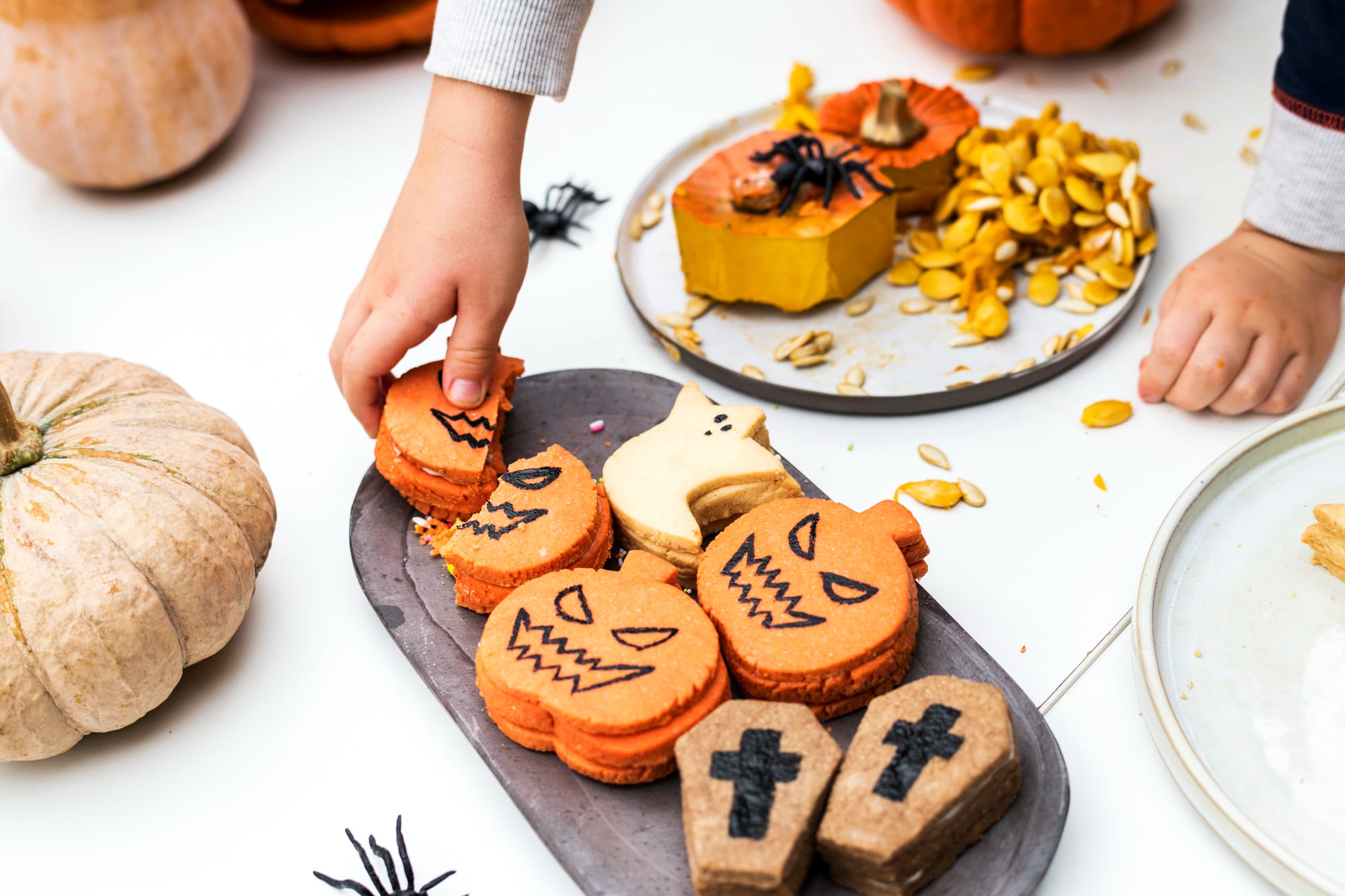
Two hundred and sixteen sugar cookies. Ghosts with tiny black eyes and little open mouths that said Boo in white letters so small you needed to lean in to read them. Bats with purple wings. Pumpkins with green stems and orange icing that she’d blended to look like real pumpkin skin. Black cats with yellow eyes and one paw raised, like they were waving.
Forty-eight pumpkin cupcakes with cream cheese frosting piped in perfect swirls, each one topped with a tiny candy pumpkin.
Thirty-six brownie spiders, with pretzel legs and candy eyes.
At eleven o’clock, she stepped back from the counter and looked at all of it.
Ben and I stood in the kitchen doorway and looked too.
“Lily,” Ben said softly. “This is incredible.”
She didn’t say anything. She was rubbing her sleeve. But her eyes were shining.
Then she sat down at the kitchen table with her index cards and practiced her script one more time, out loud, for the two of us.
“Hi. Welcome to Lily’s Spooky Bakery. Cookies are two dollars. Cupcakes are three dollars. Spiders are two dollars. All the money goes to the new sensory room. Would you like something?”
“Perfect,” I said.
“I’ll say it slower tomorrow,” she said. “I go fast when my stomach has bees.”
She’d made a sign, too, on a piece of black poster board with orange paint pen. LILY’S SPOOKY BAKERY. Underneath, smaller: All proceeds go to the Westbrook Sensory Room. And underneath that, smallest of all, in purple: Everything here was made by hand.
On Saturday morning, we loaded everything into the back of my Honda in plastic containers stacked like bricks.
We got to the school at 9:05. The fair started at ten.
The gym was already loud and bright. Somebody was testing a speaker system, and a recording of a witch cackling kept echoing off the walls. Parents were dragging folding tables around. Kids in costumes were running everywhere. There was a smell of popcorn and fog-machine juice.
Lily put on her headphones before we walked in.
Her table was number seventeen. Against the far wall, near the windows. A good spot. There was a printed label taped to the front edge: 17 — Lily’s Spooky Bakery — L. Caldwell.
She saw her own name, and her whole body relaxed a little.
We spent forty minutes setting up. She’d brought a black tablecloth and little wooden stands for the cupcakes. She arranged the cookies by type, in rows, ghosts at the front left, then bats, then pumpkins, then cats. She checked each row with her ruler. She taped the sign to the front of the table. She put the cash box, a small gray metal one I’d bought at Staples, on her right side, where her right hand could reach it.
At 9:40, she stood back and looked at it.
“It’s good,” she said.
“It’s beautiful,” I said.
“Can you get me a lemonade?” she asked. “My mouth is dry. Bees.”
“Of course, sweetheart. I’ll be right back.”
The concession stand was on the other side of the gym, by the stage. There was a line. A dad in a Spider-Man costume was arguing about whether popcorn came with the five-dollar wristband.
I was gone maybe twelve minutes.
When I came back, holding two lemonades, I stopped walking.
Madison Sloane was sitting behind Lily’s table.
Sitting in Lily’s chair. Wearing a sparkly witch hat and cat-eye makeup, smiling, with her phone propped up against the cupcake stand.
And Lily was standing behind her.
Not beside her. Behind her. Three or four steps back, almost against the wall, with her headphones on and her arms wrapped tight around herself and her thumb going back and forth, back and forth, on the seam of her sleeve.
Her face was white.
Karen was standing beside the table, in a black sweater and orange earrings shaped like pumpkins, moving Lily’s cookies.
She was mixing them up. Taking ghosts out of the ghost row and putting them between the bats. Picking up cupcakes and stacking them on a different stand. Pushing the brownie spiders off to one side.
She took the cash box off Lily’s right side and set it down in front of Madison.
Then she peeled up the edge of Lily’s sign and taped it lower on the table, half-hidden behind the tablecloth.
I walked over so fast that lemonade sloshed over my hand.
“What’s going on here, Karen?”
She turned around and gave me a big, bright smile.
“Oh, Erin! Hi! Since I’m the chair of the parent committee and one of the organizers of this fair, I made a few small changes. My daughter will be running this table now.”
My throat went completely dry.
“But why?”
Karen leaned closer to me and lowered her voice, like she was telling me something kind. Something just between us moms.
“Lily barely talks to anyone. You know that. Madison knows how to talk to people. She’s a natural. We’re trying to raise money here, Erin.” She tilted her head, toward the back wall, where my daughter was standing. “Your daughter would be better off standing in the back.”
I looked at Lily.
She had heard it.
The headphones are good ones, but they’re not perfect. And Karen hadn’t lowered her voice quite as much as she thought.
Lily’s eyes were full of tears. She wasn’t crying yet. Lily doesn’t cry easily, not in public, not when people are watching. She holds it in her whole body until she gets somewhere safe. I could see her holding it. Her shoulders were up near her ears. Her jaw was clenched.
The thumb went back and forth, back and forth.
Quiet isn’t the same as nothing.
I set the lemonades down on the table, very carefully, next to a row of mismatched cookies.
“Karen,” I said, as calmly as I could. “This is Lily’s table. She registered for it. She paid the table fee. She spent three nights and ninety-six dollars of her own money making everything on it. Please let Madison go back to her own table.”
“Madison doesn’t have a table,” Karen said cheerfully. “She’s been so busy with competition season, she didn’t have time to bake. But she really wanted to be part of the fair. So this works out for everyone!”
“It doesn’t work out for Lily.”
“Erin.” She sighed, like I was being difficult on purpose. “Be realistic. Does she even want to talk to all these people? Look at her. She’s terrified. I’m doing her a favor.”
“You didn’t ask her.”
“I didn’t need to ask her. I’m in charge of organizing the tables for this fair.” She laughed. Right in my face. “Listen. My daughter will be better at selling. So it’s settled, and we’re not going anywhere.”
Madison was looking at her phone. She didn’t look up. But I saw her cheeks turn pink under her witch hat.
There were people watching now. Parents at the nearby tables. A dad with a face-painting station. Two moms from the 8th-grade volleyball team who were selling raffle tickets. They’d all gone quiet.
I looked at Karen, in her little pumpkin earrings, standing in front of my daughter’s cookies, with her daughter sitting in my daughter’s chair.
And I thought about the yellow pages in my purse.
Sensory Room Fund.
$11,860.27.
Lily had wanted to help pay for the door. The door that closes. So that kids like her had somewhere to go when the world got too loud.
And this woman had already spent the money for that door on a medical spa and a hotel in Myrtle Beach.
And now she was standing in front of my child, telling her to stand in the back.
Something inside me snapped. Clean and quiet, like a twig.
I smiled at Karen.
“You know what?” I said. “You’re right. We’ll leave.”
Karen’s smile got bigger.
“Oh, good! I knew you’d understand. Madison, honey, put the cash box where you can reach it.”
But I didn’t leave.
I reached into my purse.
I took out the blue folder.
I opened it, and I pulled out the first page of the Sensory Room Fund statement, the one I’d highlighted most. The yellow ran down it in thick stripes, line after line after line.
I held it up. Right in the middle of the gym. Where everyone could see it.
And I said, loud enough for the tables around us to hear, but not shouting, “Since we’re leaving, I’ll be taking the Sensory Room Fund statements straight to Principal Ruiz this morning, instead of waiting until our meeting on Monday.”
Tanya Brooks, the PTA vice president, was standing two tables over, selling pumpkin raffle tickets. She’d seen the letterhead before. Harbor Valley Credit Union, in green, across the top. She’d sat beside Karen at the spring auction when they held up the big cardboard check.
She looked at the page in my hand. She saw the account name. She saw all that yellow.
Her face went pale.
Beside her, Dennis Whitley, who’d been the PTA secretary for two years, put down his roll of raffle tickets.
The two volleyball moms looked at each other.
One by one, the parents nearby looked at the page in my hand, and then, slowly, they turned and looked at Karen.
For one second, Karen didn’t move.
Then her whole face changed. The smile fell off it like a mask somebody dropped.
“How dare you?” she screamed. Her voice cracked across the gym. The witch-cackle sound effect cut off in the middle. “Get rid of that! Now!”
Fifty people turned around to look at us.
And I stood there in the middle of the Westbrook Middle School Halloween Fair, holding one piece of paper, and I didn’t put it away.
“Put that away,” Karen said again, lower now, and she lunged across the table and grabbed for it.
I stepped back. Her hand knocked over a lemonade. It splashed across the black tablecloth and ran under a row of ghosts.
Lily made a small sound behind Madison. A squeak, like the one at orientation.
“Mom,” said Madison. She’d stood up. Her witch hat was crooked. “Mom, stop it. What is that?”
“It’s nothing, baby. Sit down.”
“It’s the PTA’s bank statements,” I said. “From the Sensory Room Fund. The money we raised at the auction. For the room.”
“That’s private PTA business!” Karen said. “You have no right to wave it around like that! I’ll have you removed from the board! I’ll have you removed from this building!”
“Karen.”
A new voice. Quiet. Firm.
Dr. Angela Ruiz, the principal, was walking toward us across the gym floor in a Westbrook Wildcats sweatshirt and orange cat ears. She’d been at the dunk tank. Her hair was wet on one side.
She looked at the spilled lemonade. At the cookies. At Lily against the wall. At Madison in Lily’s chair. At Karen.
And at the page in my hand.
“Mrs. Caldwell,” she said. “Is that what our Monday appointment is about?”
“Yes, Dr. Ruiz.”
She held out her hand.
I gave her the page. Then I gave her the whole blue folder.
She opened it right there, standing in the middle of the gym, and flipped through the first few pages. I watched her eyes move down the highlighted lines. I saw her stop on one. Then another.
She closed the folder.
“Karen,” she said, very calmly. “I’m going to need you to come to my office.”
“This is ridiculous. This is a misunderstanding. Those were reimbursements, I’ve told her—”
“Now, please,” said Dr. Ruiz.
And then she turned to Madison. Her voice softened.
“Madison, sweetheart. Is this your table?”
Madison looked at her mother. Then at Lily, still pressed against the wall. Then at the sign, half-hidden under the tablecloth. LILY’S SPOOKY BAKERY.
She took off her witch hat.
“No,” she said quietly. “It’s Lily’s.”
She got up out of the chair. She picked up her phone. And without looking at her mother, she walked away into the crowd.
Karen stood there for a second longer. Her face had gone a blotchy red. Then she turned and followed Dr. Ruiz toward the hallway, her pumpkin earrings swinging.
The whole gym was silent.
Then somebody’s toddler started crying in a stroller, and the witch-cackle sound effect came back on, and slowly, the noise of the fair started to fill the room again.
I went to Lily.
She was still against the wall. She had both hands pressed over her headphones now, and her eyes were squeezed shut, and she was rocking a little, heel to toe, heel to toe.
I didn’t touch her. Lily doesn’t like to be touched when she’s like this. I just crouched down in front of her so she’d see my shoes when she opened her eyes.
“Lily. It’s Mom. I’m right here.”
She didn’t open her eyes.
“We can go to the quiet room. Ms. Delgado’s room. Right now. Nobody will follow us.”
Very slowly, she nodded.
We walked down the empty hallway together. Her hand found the hem of my sweater and held on, the way she did when she was little.
Ms. Delgado’s classroom was unlocked. Ms. Delgado was there, actually, grading papers at her desk during the fair, because she said fairs give her a headache too. She took one look at Lily’s face, didn’t say a word, turned off the overhead lights, and turned on the little lamp in the calm corner.
Lily sat down on the one beanbag and pulled her knees up to her chin.
The fluorescent light in the hallway outside buzzed through the door. She’d been right about that.
Ms. Delgado brought her a cup of water and set it beside her without speaking. Then she came and stood beside me by the door.
“What happened?” she whispered.
I told her.
Ms. Delgado’s jaw went tight. She’s a small woman, maybe fifty, with gray streaks in her black hair and sneakers with little rainbows on them. I’d never seen her look angry before.
“The Sensory Room Fund,” she said. “I’ve been asking Karen for an update on that money since May. She kept telling me it was ‘tied up in planning.’”
“It’s tied up in a medical spa,” I said.
Ms. Delgado closed her eyes.
We sat in that dim room for half an hour.
Lily drank the water. She rubbed her sleeve. Slowly, her shoulders came down.
Then she said, without looking up, “She said I should stand in the back.”
“I know, sweetheart.”
“I’ve been standing in the back my whole life.”
I didn’t say anything. I couldn’t.
“At birthday parties,” Lily said. “At assemblies. In group projects. People say, ‘Lily, you can just hold the poster.’ ‘Lily, you can be in charge of the timer.’ ‘Lily, you don’t have to talk.’”
She looked up at me then. Her eyes were red.
“I wanted to talk,” she said. “I practiced. I had cards.”
“I know you did.”
“Why does everybody think quiet means I don’t want anything?”
I sat down on the floor next to the beanbag. My knees cracked.
“I don’t know, Lil,” I said. “I think a lot of people are afraid of quiet. They fill it up with whatever they want to hear.”
She thought about that for a long time.
Then she reached into the pocket of her hoodie and pulled out her index cards. They were a little bent.
Hi. Welcome to Lily’s Spooky Bakery.
She looked at them.
“Mom,” she said. “Is my table still there?”
It was still there.
Somebody had cleaned up the lemonade. Somebody had moved the ghosts back into the ghost row, the bats back into the bat row. Not quite as straight as Lily would have done it. But close.
Tanya Brooks was standing beside the table, guarding it, with her arms crossed. When she saw us coming, she uncrossed them and stepped aside.
“I didn’t let anybody touch anything else,” she said. “Except to wipe up. I hope that’s okay.”
Lily looked at the table. She took out her ruler. She straightened three ghosts and one bat.
Then she pulled the sign up from where Karen had taped it, and stuck it back at the top of the tablecloth, where it belonged.
LILY’S SPOOKY BAKERY.
She sat down in her chair.
She put the cash box back on her right side, where her right hand could reach it.
Then she took a pen and an index card out of her pocket and wrote something on it in her careful, neat print. She propped it up against the cupcake stand, facing out.
Hi. I’m Lily. I’m autistic. I might not talk very much, but I made everything on this table myself. You can point to what you want. Thank you for supporting the sensory room.
She looked at me.
“Is that okay?”
I nodded. I couldn’t speak.
“You can stand next to me,” she said. “Not behind me. Next to me.”
So I did.
The first person who came to the table was the dad in the Spider-Man costume from the concession line.
He read the card. He looked at Lily. He took off his Spider-Man mask, which I thought was a kind thing to do.
“Wow,” he said. “You made all of these?”
Lily nodded.
“Even the little cats? With the paws?”
Lily nodded again. Then she took a breath and said, quietly but clearly:
“Cookies are two dollars. Cupcakes are three dollars. Spiders are two dollars.”
“I’ll take four cats,” he said. “My kids are going to lose their minds.”
Lily put four cat cookies into cellophane bags and tied each one with a black ribbon. She took his ten-dollar bill. She counted out two dollars in change, very carefully, into his palm.
“Thank you for supporting the sensory room,” she said.
“Thank you,” he said, and he meant it.
Then there was another person. And another.
I don’t know if it was what happened with Karen, or the card, or just the cookies. Maybe word got around the gym. Maybe people wanted to see the girl who’d been told to stand in the back.
But by eleven o’clock, there was a line.
Some people talked to her. Some people just pointed. Some people read her card and then said, “I have a son who’s autistic,” or “My niece is autistic,” or “I think I might be autistic, honestly,” and laughed, and Lily laughed a little too.
A grandmother in a purple coat bought twelve cupcakes for her bridge club and told Lily the frosting was the best she’d had in forty years.
A little boy in a dinosaur costume pointed at a ghost, and then at a bat, and then at a ghost again, and couldn’t decide, and Lily gave him both and only charged him for one, and then looked at me guiltily.
“It’s your bakery,” I said. “You’re the boss.”
Twice, Lily had to put her head down on the table for a minute and breathe with her headphones on. Both times, the line just waited. Nobody said anything. A teenage boy behind the grandmother said, “Take your time,” and then looked embarrassed he’d said it.
Ms. Delgado came out of her classroom at noon and stood at the end of the line like a customer. When she got to the front, she bought a cupcake and said, “I’m proud of you, Lily,” and Lily turned bright red and said, “Thank you, Ms. Delgado. The light in your room buzzes.”
“I know it does,” said Ms. Delgado. “That’s why we’re building a new one.”
By 1:45, everything was gone.
Every ghost. Every bat. Every pumpkin and every cat. Every cupcake. Every spider, down to the very last pretzel leg.
Lily opened the gray metal cash box and counted the money on the black tablecloth. She stacked the bills by denomination and the coins by size.
She counted it twice, the way Gloria Brennan told me to count everything.
“Four hundred and twelve dollars,” she said. “And seventy-five cents. Somebody gave me three quarters for no reason.”
I looked at my daughter, sitting behind her own table, with her headphones around her neck and frosting on her sleeve, holding four hundred and twelve dollars and seventy-five cents for a room with a door that closes.
“Lily,” I said. “Do you know what you just did?”
She thought about it seriously.
“I sold out,” she said.
“You sure did.”
“And I talked,” she said. “Not a lot. But some.”
“You talked plenty.”
She put the money back into the cash box very carefully and closed the lid.
“Mom,” she said. “Where is that money going to go now? If Mrs. Sloane spent the other money? Is she going to spend this too?”
It was a fair question. It was the question everyone in that gym had been thinking for three hours.
“No, baby,” I said. “Nobody’s spending this but the sensory room. I promise.”
Dr. Ruiz called me at home that evening.
“I wanted to thank you for coming to me,” she said. “And to say I’m sorry it happened the way it did. In front of your daughter.”
“I’m sorry about the way I did it,” I said. “I didn’t plan it. I just couldn’t stand there.”
“I understand. Honestly, I’m not sure I could have either.”
She told me that Karen had refused to answer any questions in her office. That she’d said the statements were “out of context,” and that she’d “have her attorney deal with it.” That she’d left the building without taking Madison, and Madison’s father had come to pick her up.
“I’ve contacted the district office,” Dr. Ruiz said. “Mr. Greer, from district finance, will be meeting with you and me on Monday instead of just me. And I’ve asked the PTA board to have the credit union freeze the debit card tonight. Tanya Brooks already called them.”
“Thank you.”
“Mrs. Caldwell?”
“Yes?”
“Lily’s table. I heard she sold out.”
“Four hundred and twelve dollars,” I said. “And seventy-five cents.”
Dr. Ruiz laughed. It sounded tired and happy.
“Please tell her I said that’s the most any single table has ever raised at the Halloween fair,” she said. “By about two hundred dollars.”
On Sunday morning, someone posted in the parent Facebook group.
Not Karen. Karen had gone completely silent. Her profile picture was gone.
It was a mom named Jessica Paulsen, who I barely knew, who posted a photo of Lily’s index card propped up against the cupcake stand. Hi. I’m Lily. I’m autistic. I might not talk very much, but I made everything on this table myself.
Underneath, Jessica wrote:
I watched a PTA parent tell this girl to “stand in the back” yesterday. Twenty minutes later, she came back out, wrote this card, and sold out her entire table. Best cupcake I’ve ever had. Lily, if you see this, you’re amazing.
By Sunday night, the post had six hundred comments.
By Monday morning, it had been shared nineteen hundred times.
Lily wouldn’t read it. She said it made her stomach feel like bees again.
But I read every single comment. Twice.
The meeting on Monday morning was in the small conference room behind the principal’s office.
There was Dr. Ruiz. There was Mr. Thomas Greer from the district finance office, a tall, gray, careful man with a laptop and a calculator, who spoke slowly and wrote everything down. There was Tanya Brooks, the vice president, and Dennis Whitley, the secretary.
And there was Deborah Linh from Harbor Valley Credit Union, in a different sweater with little acorns on it, carrying a box of documents.
“I don’t normally make house calls,” she told me quietly. “But Dr. Ruiz asked very nicely.”
We went through everything for three hours.
Every highlighted line. Every charge.
Deborah had brought copies of the original debit card transaction records, with merchant names and locations. Mr. Greer checked every one against the PTA’s budget and the meeting minutes. Tanya and Dennis checked them against their own memories of what the PTA had actually done that year.
Some of the charges turned out to be real PTA expenses after all. A balloon arch for the spring carnival I hadn’t known about. The rental for the auction tent. Mr. Greer took those off the list.
The rest stayed.
At the end, Mr. Greer typed for a while on his laptop. Then he turned it around.
Total unsubstantiated expenditures, PTA debit card ending 4471, January 2025 through October 2026: $11,860.27.
The same number I’d gotten at my kitchen table at midnight.
“Your books were perfect, Mrs. Caldwell,” Mr. Greer said. He sounded almost disappointed. I think he’d been hoping I’d made a mistake. “To the penny.”
“I’m a bookkeeper,” I said. “It’s what I do.”
Dennis Whitley put his face in his hands.
“I signed the minutes,” he said. “Every month, Karen said the Sensory Room Fund was ‘on track.’ I wrote it down. I never asked to see the account. Not once.”
“None of us did,” said Tanya quietly. “She made it so easy not to.”
Karen’s attorney sent me a letter on Wednesday.
It came by certified mail. I had to sign for it at the post office. It was on heavy cream-colored letterhead from a law firm in Charlotte.
Dear Mrs. Caldwell,
This firm represents Karen Sloane. It has come to our attention that on October 31st, you publicly displayed confidential financial records and made statements which falsely imply that our client engaged in misconduct. These statements have caused our client severe reputational harm and emotional distress. We demand that you immediately cease and desist from making any further statements regarding our client, and that you publicly retract your accusations. Failure to do so may result in legal action against you for defamation.
I sat in my car in the post office parking lot and read it four times. My hands were shaking.
Defamation.
I’m a bookkeeper at a dental practice. I make forty-eight thousand dollars a year. Ben is a respiratory therapist. We have a mortgage and a minivan payment and a daughter who will need support for a long time. We did not have money for a lawsuit.
I called Priya Natarajan.
Priya’s son is in Lily’s grade. She’s a lawyer at a small firm downtown that handles mostly business disputes. She’d been one of the parents at the volleyball raffle table on Saturday. She’d sent me a text that night: If you need anything. Anything. Call me.
She met me at a coffee shop that afternoon. She read the letter twice and then put it face down on the table.
“Erin, I’m not your lawyer yet. But let me tell you how this looks from where I’m sitting.”
“Okay.”
“You didn’t say she stole anything. I was there. You said you were taking the statements to the principal. Which you were. Which is your literal job as treasurer. You didn’t post anything online. You didn’t call the newspaper. You went to the principal, the district, and the bank. With documents.”
She tapped the letter.
“This is a scare letter. It’s designed to make you feel small and quiet and go away. If you want, I’ll write them back. No charge. Our firm does some pro bono work for the school foundation. I’ll call it that.”
“Why would you do that for me?”
Priya looked at me for a long moment.
“Because my son is autistic too,” she said. “He’s eleven. He’s in sixth grade. Last year, Karen Sloane told me at the book fair that he’d be ‘more comfortable’ at a different school.”
She put her hand flat on the letter.
“I didn’t say anything back,” she said. “I went home and cried in the bathtub. I’ve been sorry ever since.”
Priya’s reply was one page long.
I still have a copy. It said, among other things, that truth is a defense, that the statements were PTA records I had a duty as treasurer to review, that I had brought them only to the school administration and the bank, and that if Mrs. Sloane wished to pursue the matter further, she was welcome to explain the Glow Medical Spa charges under oath.
We never heard from Karen’s attorney again.
On Thursday after school, Madison came to our house.
She rang the doorbell and stood on the porch in her school uniform, holding a paper bag from the grocery store, looking at her shoes.
Lily answered the door. She stood very still when she saw who it was.
“Hi,” said Madison.
“Hi,” said Lily.
Neither of them said anything for a long time. I stood in the kitchen doorway and didn’t move.
“I brought you this,” Madison said finally. She held out the bag.
Lily took it and looked inside.
It was a bag of flour. And a bag of sugar. And a pound of butter. And a container of orange gel food coloring.
“Because you used all yours,” Madison said. “I figured. For the fair.”
Lily looked at the flour for a long time.
“Thank you,” she said.
“I’m sorry I sat in your chair,” Madison said. Her voice was shaking. “My mom told me you said it was okay. She said you didn’t want to talk to people anyway. And I knew that wasn’t true. I knew it because you’re in my English class, and you always raise your hand, you just wait till everyone else is done. And I sat there anyway. Because I didn’t want my mom to be mad.”
Lily didn’t say anything.
“And I didn’t know about the money,” Madison said, and now she was crying. “I swear I didn’t. My competition fees. The hotel in Myrtle Beach. She told me Grandma paid for it. I didn’t know it was for the sensory room. I didn’t know it was supposed to be for kids like you.”
“Kids like me,” Lily repeated.
Madison flinched. “I didn’t mean—”
“It’s okay,” Lily said. “I am a kid like me.”
Madison laughed through her tears. A wet, surprised sound.
Lily looked at the bag of flour again. Then she looked at Madison.
“Do you want to learn how to make the cat cookies?” she said. “With the paws?”
Madison wiped her eyes on her sleeve.
“I’m really bad at baking.”
“That’s okay,” Lily said seriously. “I’ll make you a script.”
They baked until seven o’clock that night. Madison’s cats had lopsided ears. Lily said they had character. Madison laughed so hard she got flour in her hair.
I stood at the kitchen sink and washed dishes, the way Ben had, and didn’t say a word.
The emergency PTA general meeting was held on the second Tuesday of November in the school cafeteria.
The bylaws say any member can call one if enough members sign a petition. Tanya Brooks got eighty-four signatures in two days. Most of them came from the Facebook post.
The cafeteria was packed. More than two hundred parents. People were standing along the back wall, against the trash cans. Someone had set up folding chairs in rows. Mr. Greer from the district was there, in the front row, with his laptop. Dr. Ruiz stood off to the side.
Ms. Delgado was there with her rainbow sneakers.
So was Priya.
So was Deborah Linh from the credit union, in a sweater with little turkeys on it.
Lily came. She wore her headphones and sat in the very last row with Ben, near the door, so she could leave if she needed to. Madison sat with them. I didn’t know she was coming. She just walked in and sat down beside Lily and didn’t say anything.
At seven o’clock, Tanya called the meeting to order.
Karen walked in at 7:04.
The whole room turned to look at her.
She was wearing a navy blazer and pearls and holding a leather folder. Her face was very calm. Too calm. Her husband, Greg, walked behind her with his eyes on the floor.
She sat down in the front row, right across the aisle from Mr. Greer.
Tanya swallowed hard and read the agenda. Then she said, “I’d like to ask our treasurer, Erin Caldwell, to give a financial report on the Sensory Room Fund.”
I stood up and walked to the little podium in front of the cafeteria stage.
My legs were shaking. I’m not a public speaker. I’m a bookkeeper. I like numbers on paper, not two hundred faces looking at me.
But I’d made a script. Lily helped me. It was written on index cards.
I read it slowly.
I told them about Gloria Brennan’s phone call. About the five weeks it took to get on the account. About the statements. I didn’t say the word steal. Priya told me not to. I just read the numbers.
The balance after the auction: $14,280.00.
The balance on October 1st: $2,417.63.
The total unsubstantiated charges verified by the district office: $11,860.27.
Then I read some of the lines out loud. Not all of them. Just enough.
Glow Medical Spa — $1,140.00.
Starlight Dance Academy — Competition Fee — $1,250.00.
Ocean Reef Resort, Myrtle Beach — $1,092.44.
I heard a woman in the third row gasp.
I sat down.
Karen stood up.
She didn’t ask to speak. She just walked to the podium and put her leather folder on it and turned around to face the room.
“I’m not going to stand here and be humiliated by a woman who is clearly on some kind of personal vendetta,” she said. Her voice was steady. She’d practiced too. “Erin Caldwell has had a problem with me since her daughter started at this school. She resents my involvement. She resents my daughter’s success. And on October 31st, in front of children, she staged an ugly scene to try to destroy my reputation.”
She opened her folder.
“Every one of those charges was a legitimate reimbursement. I’ve spent thousands of dollars of my own money on this PTA over the past three years. I’ve given my life to this school. And I have the documentation to prove it.”
She held up a stack of papers. Receipts. Printouts.
Mr. Greer raised his hand.
“Mrs. Sloane, may I see those?”
She hesitated. Just for a second. Then she handed them to him.
He went through them slowly while the whole cafeteria watched. He turned each page over. He checked each one against his laptop.
It took about four minutes. It was the quietest four minutes I’ve ever heard two hundred people make.
Then Mr. Greer looked up.
“Mrs. Sloane,” he said, in his slow, careful voice. “These are receipts for PTA expenses. A balloon arch. Paper goods. A popcorn machine rental. All of them were already removed from the disputed total. None of these receipts correspond to the charges in question.”
He set them down.
“Do you have documentation for the Glow Medical Spa charge?”
“It was teacher gifts. Spa gift cards. For teacher appreciation week.”
From the side of the room, Ms. Delgado stood up.
“I’ve been a teacher at Westbrook for nineteen years,” she said. “Teacher appreciation week last May was a breakfast and a mug. I still have the mug.” She held it up. It said WESTBROOK WILDCATS — WE APPRECIATE YOU in orange. “No teacher I know got a spa card.”
Several teachers along the wall nodded.
Karen’s face went white.
“Do you have documentation for the Starlight Dance Academy charges?” Mr. Greer asked.
Karen said nothing.
“The Myrtle Beach hotel?”
Nothing.
“Mrs. Sloane. I need to ask you directly. Did you use the PTA debit card for personal expenses?”
The cafeteria was completely silent.
Karen looked around the room. At the parents she’d run the Facebook group for. At the board members she’d brought on. At Greg, her husband, who would not look up from the floor.
Then her eyes went to the back of the room.
To Madison.
Madison was looking right back at her.
And I watched Karen’s face fall apart. Not all at once. Piece by piece. Like a sandcastle when the tide comes in.
“I was going to pay it back,” she said. Her voice had gone very small. “Greg’s business had a bad year. We were behind on everything. The mortgage. The car. Madison’s competition fees were six thousand dollars just this season. I couldn’t take her out of dance. I couldn’t. Everyone would have known. Everyone would have talked.”
“So you took it out of the sensory room,” I said quietly.
She didn’t answer.
“There are eleven kids in this school who use Ms. Delgado’s calm corner,” I said. “One beanbag. A light that buzzes. My daughter’s one of them. That money was for a door that closes.”
Karen put her hand over her mouth.
And then, from the very back of the cafeteria, a quiet voice said, “Can I say something?”
Every head turned.
Lily was standing up.
She had her headphones around her neck. She was holding an index card in one hand. Her other thumb was rubbing the seam of her sleeve, back and forth, back and forth.
Ben was standing beside her. Madison was standing on her other side.
Tanya looked at me. I nodded.
“Of course, Lily,” Tanya said.
Lily didn’t walk to the podium. She stayed where she was, in the back row, by the door. And I understood why. It was the farthest she could be from all those faces. And it was where she’d been told to stand.
She looked down at her index card. Her voice was quiet. But in that silent cafeteria, everyone could hear it.
“My name is Lily Caldwell. I’m in eighth grade. I’m autistic.”
She took a breath.
“At the fair, Mrs. Sloane said I would be better off standing in the back. I’ve been thinking about that for ten days.”
She looked up from her card.
“I am standing in the back right now. And you can still hear me.”
Nobody moved.
“I don’t need to stand in the front to matter,” Lily said. “I just need people to stop deciding for me where I’m supposed to stand.”
She looked down at her card one more time.
“I raised four hundred and twelve dollars and seventy-five cents for the sensory room. I would like it to go to the sensory room. Thank you.”
She sat down.
For a second, nobody did anything.
Then Ms. Delgado started clapping.
Then Priya. Then Tanya. Then Deborah Linh in her turkey sweater. Then the whole cafeteria, two hundred people, on their feet.
And Lily, in the back row, put her headphones back on, because it was too loud.
But she was smiling.
The PTA membership voted that night to remove Karen Sloane as chair, effective immediately. The vote was 211 to 3. Tanya said she was fairly sure one of the three was Karen herself.
Karen didn’t stay for the vote. She walked out of the cafeteria with Greg about ten minutes after Lily spoke, without looking at anyone.
Madison stayed. She sat with Lily in the back row until the meeting was over.
Then Greg came back in to get her. He stopped in front of Lily for a moment. He looked like he wanted to say something.
“Thank you,” he said finally. “For being kind to my daughter.”
Then he took Madison home.
The rest happened slowly, the way real things do.
The PTA board, with Priya’s help, filed a report with the police department. A detective named Sandra Holloway met with me twice and with Mr. Greer three times. She took copies of everything.
In January, Karen signed a restitution agreement. Priya drafted it, with Karen’s attorney’s input. Karen agreed to repay the full $11,860.27 to the Westbrook PTA Sensory Room Fund. The first payment of $3,000 came in a cashier’s check the following week. The rest came in monthly installments of $740, by automatic transfer, through Harbor Valley Credit Union.
Deborah Linh called me personally every time one of the payments cleared.
“Just wanted you to know,” she’d say. “Another one in.”
I don’t know all the details of what happened with the police. That’s between Karen and the court. I heard there was a hearing in March and that she accepted a plea agreement for a misdemeanor, with probation and community service. I didn’t go. I didn’t need to.
I heard she and Greg sold the white Escalade.
I heard Madison quit competitive dance. She told Lily she didn’t really like it anymore. She said she’d only kept doing it because her mom needed her to win.
Karen and I have not spoken since that night in the cafeteria. I saw her once in the parking lot of the Food Lion in February. She saw me too. She turned around and walked back to her car.
I didn’t feel triumphant. I thought I would. I just felt sad, standing there by the shopping carts.
She’d been so afraid of people talking.
And she’d been willing to steal from children to keep them quiet.
The Westbrook Sensory Room opened on a Monday in April.
It’s a converted storage room next to the library, painted soft blue-gray. There are dimmer switches on every light. There are three beanbags and two weighted blankets and a little tent made of soft fabric where a kid can crawl inside and be alone. There’s a bubble tube in the corner that changes colors very slowly. There’s a basket of fidget toys and noise-canceling headphones in four sizes.
And there’s a door.
A solid wooden door, with a little window and a sign you can flip to say Please Knock.
The total cost, Mr. Greer told me, was $15,940. The fund paid for it with Karen’s restitution, the $412.75 from Lily’s table, and the rest of the Halloween fair proceeds. A local hardware store donated the paint. A carpenter whose grandson goes to Westbrook installed the door for free.
There was a little ribbon-cutting ceremony. Dr. Ruiz gave a short speech. Ms. Delgado cried.
Dr. Ruiz asked Lily if she wanted to cut the ribbon.
Lily said no. Too many people. Too much clapping.
Instead, she baked two hundred cookies shaped like little doors. Each one was decorated with royal icing to look like the real door, wood grain and all, with a tiny window and a tiny Please Knock sign on it.
She set them out on a table outside the sensory room with a card.
Take one. Thank you for helping me pay for the door.
Madison helped her decorate. Madison’s doors were a little crooked.
They all got eaten anyway.
There’s a small brass plaque beside the door to the sensory room now. The PTA board voted on it in May.
It says:
The Westbrook Sensory Room
Opened April 2027
“Quiet isn’t the same as nothing.”
— Lily Caldwell, Class of 2027
Lily was embarrassed when she saw it. She said they should have asked her first.
Then she stood in front of it for a very long time.
Lily started high school this fall.
She bakes every weekend now. After the fair, people kept asking for her cookies. A woman from church wanted three dozen for a baby shower. Ms. Delgado wanted them for the end-of-year party. Jessica Paulsen, who wrote the Facebook post, ordered six dozen for her daughter’s birthday.
So Ben and I sat down with Lily at the kitchen table, with her calculator, and helped her figure it out properly.
We looked up our state’s rules for selling homemade baked goods. We found out which things she could sell from our home kitchen and which labels she’d need. We opened a custodial savings account for her at Harbor Valley Credit Union. Deborah Linh set it up herself and gave Lily a lollipop, even though she’s fourteen.
Lily keeps a spreadsheet. Of course she does. Ingredients, orders, prices, profit. Every penny. She charges two dollars a cookie, three for a cupcake, and she won’t change it, because she says those were the prices at the fair and it would be dishonest.
As of last month, she’s saved $1,846.20.
She says she’s going to culinary school someday. Or open a bakery. A small one, with dim lights and a quiet corner where people can sit and eat cookies without anyone bothering them.
“A bakery with a door that closes,” she said.
The Westbrook Halloween Fair was last Saturday.
Lily’s not a Westbrook student anymore. But Dr. Ruiz called and asked her personally if she’d come back and run a table. She said she’d waive the fifteen-dollar fee.
Lily said she’d pay the fee. It’s her bakery.
Her table was number seventeen again. Against the far wall, near the windows.
The sign was new. Black poster board, orange paint pen. LILY’S SPOOKY BAKERY. And under it, smaller: All proceeds go to the Westbrook Sensory Room. (For more beanbags.)
She still had the index card, too. The same one, a little faded now, laminated so it wouldn’t get frosting on it.
Hi. I’m Lily. I’m autistic. I might not talk very much, but I made everything on this table myself. You can point to what you want.
Madison sat beside her. Not behind her. Not in front of her. Beside her. When people wanted to chat, Madison chatted. When people pointed, Lily bagged the cookies and counted the change.
I stood off to the side with a lemonade and watched them.
About an hour in, a little girl came up to the table. Maybe six or seven years old, in a ladybug costume, with big noise-canceling headphones on, the gray kind. Her mother was standing behind her, looking nervous.
The little girl stared at the cookies. She didn’t say anything. She gripped the edge of her costume with one hand and rubbed it between her fingers, back and forth.
Her mother bent down. “Sweetie, do you want to say what you want? Or should I just pick?”
The little girl didn’t answer.
Lily looked at her for a long moment.
Then she reached over and tapped the laminated card. Gently. So the little girl would see it.
You can point to what you want.
The little girl read the card. She looked up at Lily.
Lily smiled at her. A small, quiet smile.
The little girl lifted one finger and pointed at a black cat cookie with yellow eyes and one paw raised, like it was waving.
Lily put it in a cellophane bag and tied it with a black ribbon.
“That one’s free,” she said quietly. “For first-timers.”
The little girl took it. She held it against her chest.
Then, very softly, so softly I almost didn’t hear it, she said, “Thank you.”
Her mother put her hand over her mouth.
Lily just nodded, the way you nod at someone who speaks your language.
And I stood in the middle of that loud, bright gym with my lemonade, and I thought about the back of the room. About all the people who had stood there, for years, because someone decided that’s where they belonged. Who learned to make themselves small. Who learned to stay quiet. Who learned to hold the poster and be in charge of the timer.
My daughter spent fourteen years being told to stand in the back.
She found out you can be heard from anywhere.
You just need people willing to stop talking long enough to listen.

Laura Bennett writes about complicated family dynamics, difficult conversations, and the quiet moments that change everything. Her stories focus on real-life tensions — inheritance disputes, strained marriages, loyalty tests — and the strength people find when they finally speak up. She believes the smallest decisions often carry the biggest consequences.