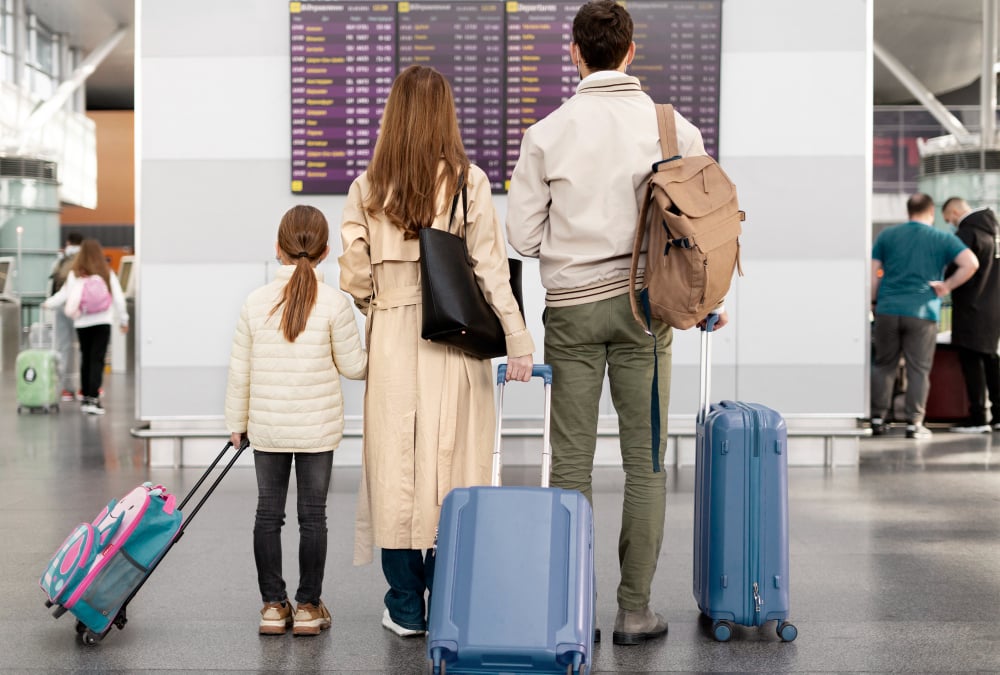
My nine-year-old daughter called me sobbing at 5:42 on a Thursday evening.
“Mom,” she said. “Grandma and everyone got on the plane without me.”
I was standing in a hotel hallway in Minneapolis, holding a paper cup of conference coffee and a lanyard that said RACHEL DAWSON — SPEAKER. I’d just walked off a stage after giving a talk on network security to four hundred people.
The coffee hit the carpet.
“Emma? Sweetheart, slow down. Where are you?”
“I’m at the gate. The one where the plane was.” She hiccuped. “Aunt Lauren said somebody would come back. She said to sit right here and somebody would come back for me. But everybody got on the plane. And then they closed the door.”
I pressed my back against the wall.
“Are you alone?”
She started crying harder. Big, gulping sobs that came through the phone like she was right next to me.
“Yes,” she said. “Mommy, did I do something wrong?”
“No,” I said. “No, honey. You did absolutely nothing wrong. Listen to me. Stay exactly where you are. Don’t move. Don’t go anywhere with anybody. And keep talking to me. Okay? Keep talking.”
“Okay.”
“What gate are you at?”
“B… B19. It says B19 on the sign.”
“What airport?”
“Denver.”
“Good girl. You’re doing so good. Are there people around you?”
“Some. There’s a man sleeping. And a lady with a baby.”
“Okay. Switch to video, sweetheart. Press the little camera button. I want to see you.”
Her face came up on my screen. Red and blotchy and wet. Her purple backpack strap over one shoulder. Behind her, a big window, and on the other side of it, an empty jet bridge pulled back from where a plane used to be.
I’ve never felt anything like what I felt in that moment. I don’t think I ever want to again.
While I was talking to her, my phone buzzed with a notification across the top of the screen.
It was our family group chat. The one called Dawson Crew . Mom had named it when they started planning the trip.
A message from my sister-in-law, Lauren.
There were only 5 discounted first-class upgrades available. Emma was the easiest one to leave since Rachel can arrange another flight for her.
I read it twice.
I couldn’t believe what I was seeing. I read it a third time to make sure.
Emma was the easiest one to leave.
Six people had been traveling with my daughter.
My parents. My younger brother, Scott. His wife, Lauren. Their two girls, Ava and Mia, who are twelve and eight.
The gate agent had offered five discounted first-class upgrades.
Five seats. Six adults and children who weren’t Emma.
All any one of them had to do was say, I’ll stay back in economy with Emma. One of them. Just one. My mother. My father. My brother. Anyone.
Instead, they’d taken all five upgrades, put the sixth person on the plane in the regular seat they’d already booked, and left my nine-year-old sitting at the gate.
Another message popped up. From my father.
She’s safe inside the terminal. Airport employees handle children all the time. Stop overreacting.
I hadn’t even said anything yet.
He was telling me to stop overreacting before I’d typed a single word.
My hands were shaking so badly I could barely work my phone. I kept Emma on video with one hand and used the hotel’s landline in a little alcove by the elevators with the other.
I called the Denver airport police. I gave them Emma’s location, her full name, her date of birth, a description of what she was wearing. Purple backpack. Gray hoodie with a cat on it. Pink sneakers.
Then I called the airline’s customer-service line. I was on hold for six minutes. I gave them the booking number, the flight number, the names of the six people who’d boarded, and the name of the one who hadn’t.
“She’s nine,” I kept saying. “She’s nine years old. She’s alone.”
I stayed on video with Emma the whole time. I kept talking. I don’t remember half of what I said. I told her about the hotel. About the conference. About how there was a dog in the lobby wearing a little bow tie.
“What kind of dog?” she asked, sniffling.
“A corgi.”
“With a bow tie?”
“A red one. With polka dots.”
She almost smiled.
Eleven minutes after I hung up with the airport police, I watched a man in a dark blue uniform walk into the frame behind her.
He crouched down beside her chair so they were at the same height.
“Hi there,” he said gently. “Are you Emma Dawson?”
She nodded. She held up the phone.
“My mommy’s on the phone.”
He leaned into the frame.
“Ma’am, I’m Officer Ruiz, Denver Airport Police. I’ve got her. She’s okay. She’s going to stay with us until we can arrange to get her back to you safely. She’s not going to be alone again.”
That’s when I finally started breathing like a normal person.
I slid down the wall of that hotel hallway and sat on the floor next to my spilled coffee and cried.
My name is Rachel Dawson. I’m thirty-six years old. I’m a director of cybersecurity for a healthcare company in Phoenix.
That means I spend my days protecting hospital systems from hackers. People who try to break into things they shouldn’t. People who look for the weakest point and push on it until something gives.
I’m very good at my job.
I’d just never thought to use those skills on my own family.
I should explain how Emma ended up at that gate.
My parents, Gary and Sharon Dawson, live in Mesa, about twenty minutes from my house in Phoenix. My brother Scott and Lauren live in Chandler, close by.
That spring, Lauren’s sister got married in Denver. The whole family drove up for the wedding. And afterward, my mother came up with an idea.
“Let’s make it a real vacation,” she said on the phone. “Fly from Denver to San Diego for five days. The beach. The zoo. SeaWorld. All the grandkids together. Emma too. It’ll be so good for the cousins.”
Emma had been begging to go to the San Diego Zoo for two years. She’d seen a documentary about pandas and decided she had to see one in person. Then they sent the pandas back to China, and she was devastated, and then she found out there was a new pair coming, and she was beside herself.
But I had a conference in Minneapolis that week. I was giving a keynote. I couldn’t get out of it.
“We’ll take her,” my mother said. “Don’t worry about a thing. She’ll be with us the whole time.”
I said yes.
I paid for everything.
That wasn’t unusual. I’d been paying for things for a long time.
I paid for Emma’s plane tickets. Denver to San Diego and San Diego home to Phoenix. I booked the hotel through my company’s corporate travel program, which got a big discount at a resort in La Jolla. Three rooms. Five nights. I paid for Emma’s zoo tickets and SeaWorld tickets and the whale-watching boat.
And I gave my parents a travel card. A credit card linked to my account, with their names on it. For emergencies. And for Emma’s meals and anything she needed.
“Just use it for Emma’s stuff,” I said. “And emergencies. Okay?”
“Of course, honey,” my mother said.
For years, I’d been the one who fixed things in my family.
When my parents’ roof leaked three years ago, I paid for the repair. When Scott lost his job at the car dealership, I covered his rent for four months. When Lauren’s car broke down, I lent her the money for a new transmission. She never paid it back. Nobody ever asked her to.
When my parents decided they wanted to sell their house and buy a retirement townhouse in a nice gated community in Scottsdale, they couldn’t qualify for the mortgage on their own. Dad’s pension wasn’t enough.
So I agreed to guarantee the loan. With my income. My credit. My name on the papers.
The closing was scheduled for three weeks after the San Diego trip.
I didn’t mind most of the time. I made good money. I had more than I needed. They were my family.
But there was always something underneath it. Something I tried not to look at too closely.
I had Emma when I was twenty-seven. I wasn’t married. Her father and I had been together for two years, and when I told him I was pregnant, he packed a bag and moved to Portland. I haven’t heard from him since.
My parents never quite forgave me for that.
They loved Emma. I believed that. They came to her birthday parties. They sent her cards. My mother knitted her a sweater once.
But I noticed things.
How my mother called Ava and Mia “my girls.” And called Emma “Rachel’s daughter.” How, at Christmas, Ava and Mia’s presents were always bigger. How, when the cousins fought, it was always Emma who got told to share.
I told myself I was imagining it.
I told myself a lot of things.
I booked the earliest flight back to Denver that I could find. A 7:15 that evening. I sprinted out of the conference center without saying goodbye to anyone. I left my laptop bag in the speaker’s lounge. A colleague mailed it to me later.
In the cab to the airport, I called my attorney.
Her name is Maya Reynolds. She’s handled my contracts and my will and my house closing. She’s sharp and calm and doesn’t waste words.
I told her everything.
She was quiet for a moment.
“Rachel,” she said. “Save every single message. Every photo. Every voicemail. Screenshot the group chat right now, before anybody deletes anything. Then call me back when you’re on the ground in Denver.”
I screenshotted the group chat in the back of the cab.
My hands were shaking so badly I had to do it three times.
While I was on the plane, the photographs started appearing.
I’d paid for the in-flight Wi-Fi so I could stay in contact with Officer Ruiz. So I saw them in real time.
My mother, smiling in a wide leather seat, tucked under a soft gray first-class blanket. A glass of champagne on the tray table in front of her.
Lauren, holding her phone up to take a picture of her own legs stretched out in front of her. The caption: So much legroom!!
Ava and Mia, side by side, each holding up a little dish of warm chocolate lava cake with ice cream on top. Grinning at the camera.
Best family vacation ever! Lauren wrote under it. Making memories!
Then my mother added another message.
Rachel always fixes whatever Emma turns into a crisis. Maybe this will teach the child that she can’t always get special treatment.
The child.
Not Emma. Not my granddaughter.
The child.
I sat in seat 23C on that flight to Denver and read it over and over. Thirty-five thousand feet up, between a businessman with his laptop open and a college kid asleep against the window.
Special treatment.
My daughter had been left alone at an airport gate. In a city she didn’t know. With no money, no adult, and no idea when anyone was coming back.
And my mother thought Emma was the one asking for special treatment.
I saved every photograph. Every message.
For years, I’d covered my family’s unexpected expenses. I’d paid bills they couldn’t afford. I’d rescued them every time their plans fell apart.
And sitting there in 23C, I understood something I’d been refusing to understand for a very long time.
They’d decided that abandoning my daughter was just one more inconvenience Rachel would pay to fix.
They hadn’t even worried about it. They’d ordered champagne.
I landed in Denver at 10:48 that night. I ran the whole way from my gate to the airport police office on the main level. I’m not a runner. I had blisters for a week.
Officer Ruiz met me at the door.
Emma was sitting on a bench in the little office, next to a female officer named Brooks. She was wrapped in a fleece blanket with the airport logo on it. She was holding a paper cup of hot chocolate with both hands.
She looked up and saw me.
She dropped the hot chocolate. It went all over the floor. Nobody cared.
She ran across the room and threw herself into my arms so hard I almost fell over.
“Mommy,” she sobbed into my neck. “I thought nobody was coming. I thought nobody was ever coming.”
I held her. I held her so tight. I could feel her whole body shaking.
“I will always come for you,” I said. “Always. No matter where you are. No matter what. Do you hear me? I will always, always come.”
An airline manager came down to the police office around midnight. A tired-looking woman named Deborah with reading glasses on a beaded chain.
She’d pulled the records.
“There was no unaccompanied minor service requested for your daughter,” she told me. “No paperwork. No approved arrangement for her to travel alone. No arrangement for our staff to supervise her at the gate. Nobody from your party spoke to any of our agents about her at all.”
“Nobody told anyone she was there?”
“No, ma’am. The gate agent noticed her sitting alone about twenty minutes after the door closed. That’s when she called it in. Right around the same time you did.”
She slid a form across the table. A formal incident report.
I read every word. Then I signed it.
Then, at 12:40 in the morning, sitting in that little police office with Emma asleep against my side, I made three phone calls.
The first was to my bank. I froze the travel card. The one with my parents’ names on it.
The second was to my company’s corporate travel office. Their night line. I withdrew authorization for the hotel booking in La Jolla. The three rooms had been reserved under my corporate account with my company’s rate. Without my authorization, the discount was gone.
The third call, I made at eight the next morning, when the office opened.
It was to the real estate attorney handling my parents’ townhouse purchase in Scottsdale.
I told her I was withdrawing my agreement to guarantee their mortgage. Effective immediately. Before closing.
She was quiet for a moment.
“Ms. Dawson,” she said carefully. “You understand what that means for the purchase?”
“I understand.”
“May I ask why?”
I looked down at my daughter, asleep with her head in my lap and the airport blanket still wrapped around her.
“Because they left my nine-year-old alone at an airport,” I said. “And I’m done paying for their choices.”
My family landed in San Diego Thursday night believing they’d had a wonderful first-class flight.
They had no idea what was going to happen when they tried to pay for the rest of their vacation.
The first call from my father came less than an hour after his plane landed.
I didn’t answer it. I was in the police office, signing papers.
He called again the next morning. Emma and I had gotten a room at the airport hotel at around two a.m. She was sitting cross-legged on the bed, clutching her stuffed rabbit, Biscuit, watching cartoons with the sound turned low.
I looked at her before I answered.
“Rachel,” my father said. His voice was sharp. “What’s wrong with the travel card? The rental-car company keeps declining it. We’ve been standing at this counter for twenty minutes.”
“I froze it,” I said.
“You did what?”
“I froze it, Dad. You left my nine-year-old daughter alone at an airport. You’re not using my money for the rest of your vacation.”
He let out a long, angry sigh. I could picture him. Standing at the rental counter in his Hawaiian shirt, red in the face.
“Emma was perfectly safe,” he said. “She was in a secure terminal. Full of police. You’re making everybody suffer over a misunderstanding.”
“A misunderstanding,” I said, “doesn’t involve five adults deliberately boarding a plane without the child they promised to take care of.”
He hung up on me.
Twenty minutes later, Lauren called from the lobby of the resort in La Jolla.
She was shouting before I even said hello.
“Rachel! What did you do? They’re saying the reservation isn’t valid! They’re saying the corporate rate’s been withdrawn and they need a new payment method!”
“That’s right.”
“The rooms are over eight hundred dollars a night now! Do you expect us to sleep in the car?”
“You can book somewhere you can afford.”
“Our daughters were looking forward to this vacation! Ava’s been talking about it for months!”
I looked across the hotel room at Emma. At her puffy eyes. At Biscuit clutched against her chest.
“So was Emma,” I said.
Lauren went silent.
Then she said, “You’re punishing innocent children. You’re punishing my girls for something they didn’t even do. That’s sick, Rachel.”
I ended the call.
The next morning, my bank’s fraud department called me.
“Ms. Dawson, we’re reviewing some recent charges on the travel card that’s now frozen,” the woman said. “We want to verify a few transactions before you file any disputes.”
She read them to me.
A charge to the airline. Thursday afternoon. Gate B19.
First-class upgrades. Qty: 5.
$3,742.00.
My stomach dropped.
They hadn’t just left Emma behind for the upgrades.
They’d paid for the upgrades with my card. The card I’d given them for Emma’s meals. For emergencies.
They’d used my money to buy the seats that left my daughter alone.
I disputed the charges. I forwarded every record to Maya.
“Keep everything,” Maya said again. “The messages. The photos. The receipts. All your communications with the airline. And Rachel, I mean this. Don’t negotiate with your family directly. Don’t argue with them. Don’t explain yourself. If they call, let it go to voicemail and send it to me.”
“Okay.”
“How’s Emma?”
I looked over at the bed.
“Not good,” I said.
Emma was struggling.
She’d barely slept that first night. She woke up twice, sobbing, reaching across the bed in the dark to make sure I was still there.
“Mommy? Mommy, are you there?”
“I’m right here, baby.”
“Are you going to disappear while I’m asleep?”
“No. I’m not going anywhere.”
In the morning, when I went into the bathroom to brush my teeth, she followed me to the doorway and stood there watching me.
“Mommy,” she said. “You’re not leaving, right?”
I put down my toothbrush. I knelt down on the cold bathroom tile in front of her.
“No, sweetheart,” I said. “I’m staying right here. I’m not going to leave you. Ever.”
She nodded. But she didn’t look like she believed me.
She stood in the doorway the whole time I brushed my teeth.
I made an appointment with a pediatrician in Denver that afternoon. A kind older doctor named Dr. Feldman who checked Emma over and then sat down and talked to me privately while Emma colored in the waiting room.
“Physically, she’s fine,” he said. “But she’s been through something frightening. A child that age, left alone by the adults she trusted most…” He shook his head. “I’d hold off on another flight for a few days if you can. Let her feel safe on the ground first. Drive home if it’s possible. And I’d find her a counselor when you get back.”
So we didn’t fly home. We rented a car and drove.
Fourteen hours from Denver to Phoenix, over two days. We stopped in a little town in New Mexico and stayed in a motel with a pool shaped like a kidney. Emma swam for an hour. It was the first time I’d seen her laugh since the phone call.
That afternoon, before we left Denver, a detective from the airport police called me.
Detective Harris. He had a low, steady voice.
“Ms. Dawson. I wanted to give you an update. We’ve reviewed the security footage from Gate B19.”
I sat down on the edge of the motel bed.
“What does it show?”
He was quiet for a moment.
“It shows your daughter standing next to the boarding line with your family,” he said. “Your sister-in-law bends down and speaks to her. Then your mother points toward a row of seats near the window. And Emma walks over and sits down. With her backpack.”
I closed my eyes.
“Then the adults scan their boarding passes,” he said. “One by one. Your father. Your mother. Your sister-in-law and the two girls.”
“And my brother?”
The detective paused.
“Your brother was the last one to board,” he said. “He scanned his pass. He started down the jet bridge. Then he stopped. He turned around and looked back toward your daughter. For about four seconds.”
My hand tightened on the phone.
“And then he turned around,” Detective Harris said, “and kept walking.”
I sat there on the motel bed. Emma was in the bathroom, singing to herself in the tub.
“He saw her,” I said. “He looked right at her.”
“Yes, ma’am. That’s what the footage appears to show.”
“Did anybody talk to any airline employee? Anybody at all?”
“No, ma’am. We’ve confirmed that with the airline. Nobody from your family asked anyone to supervise her. No arrangement was made.”
My family hadn’t misunderstood some arrangement.
They’d never made one.
By the third day of their vacation, I heard later, Lauren’s credit card was almost maxed out. The family checked out of the resort in La Jolla and moved into a roadside motel near the freeway in Chula Vista.
They never made it to the zoo. Or SeaWorld. Or the whale-watching boat.
By the fifth day, my parents got worse news.
The lender handling their townhouse purchase called. The closing was suspended. Without my guarantee, without my income backing up the application, they didn’t qualify. They’d have to qualify on their own, or find another guarantor.
They couldn’t do either.
My mother left me a voicemail that night.
I listened to it once.
She was sobbing.
“We could lose our forty-five-thousand-dollar deposit because of you, Rachel. Forty-five thousand dollars. That’s our retirement. How could you do this to your own parents? How could you destroy everything we worked for over one little mistake?”
One little mistake.
I forwarded the voicemail to Maya.
A week after the airport, my family drove back home to Arizona.
I thought maybe, once they got home, once they’d had time to think about it, they’d finally understand why I wouldn’t talk to them.
I thought maybe one of them would call and say they were sorry.
Instead, that Sunday morning, my security camera chimed on my phone.
Motion detected — Front Door.
I opened the app.
My father was standing on my front porch. Behind him were my mother, Scott, and Lauren.
Emma was upstairs. Our neighbor, Diane, had come over that morning to do a jigsaw puzzle with her. Diane’s a retired kindergarten teacher who lives across the street with three cats and an endless supply of patience. Emma loves her.
They were at the little table in Emma’s room, working on a thousand-piece puzzle of a lighthouse.
I was in the kitchen.
I stood very still and watched the camera feed on my phone.
My father raised his fist and started pounding on the door.
BANG. BANG. BANG.
“Rachel! Open up! We know you’re in there! Your car’s in the driveway!”
BANG. BANG.
“We’re not leaving until you explain how you’re going to fix this!”
Lauren stepped up close to the camera. Her face filled the screen. She looked like she hadn’t slept in days. Her mascara was smudged.
“You’ve humiliated this entire family,” she said. “Everybody knows. Everybody’s talking. We need to settle this. Before the police make it worse.”
Then my mother stepped forward.
She looked up at the camera. She knew exactly where it was. She’d helped me pick it out.
And she said something that made my blood run cold.
“If you won’t open the door,” she said, “then we’ll go upstairs and talk to Emma ourselves. She can tell everyone it wasn’t that bad. She’s a big girl. She’ll tell them she was fine.”
I picked up my phone and called 911.
They’d already abandoned my daughter once.
I wasn’t going to let them pressure her into defending what they’d done.
While I was on with the dispatcher, I pressed the intercom button on the doorbell app.
“Leave my property,” I said. My voice came out through the little speaker by the front door. Calm. Steady. “I’ve called the police.”
Lauren stared straight into the camera.
“You’re calling the police? On your own family?”
“You left my daughter alone at an airport,” I said. “And now you’re standing on my porch threatening to pressure her into changing her story.”
My mother stepped forward. She looked genuinely offended. Like I’d insulted her.
“We only want to explain to her that nobody meant to hurt her,” she said. “That’s all. We just want to talk to her.”
“Then explain it to the investigators,” I said.
My father pointed at the camera. His face was purple.
“Rachel, we raised you better than this!”
I almost laughed.
They had raised me. That’s true. They’d raised me on a single rule, repeated over and over at every Sunday dinner and every Christmas and every birthday.
Family comes first. Always. No matter what.
And somehow, that rule hadn’t applied at Gate B19. When Emma needed just one adult to stay with her.
Upstairs, I heard Diane’s voice. Calm. Cheerful. “Let’s find all the blue sky pieces, Emma. Can you help me?”
She’d heard the pounding. She knew. She kept Emma busy without making a fuss.
I’ll love Diane forever for that.
A patrol car pulled up about six minutes later.
A young officer got out. She walked up my front path and talked to my family on the porch. I couldn’t hear all of it through the camera. But I heard enough.
“Ma’am. Sir. The homeowner has asked you to leave. If you don’t leave the property now, you could be cited for trespassing.”
My father argued for a while. My mother cried. Lauren kept pointing at the door.
Scott didn’t say anything. He just stood at the back of the group with his hands in his pockets, looking at the ground.
Finally, the officer pointed at the driveway.
Scott was the first to turn and walk toward the cars.
Before he got into his car, he stopped.
He looked up. At the second floor of my house.
At Emma’s bedroom window.
He stood there for a long moment. Just looking.
I wondered if he was remembering Gate B19. If he was remembering standing on the jet bridge, turning around, and looking back at her.
Four seconds.
Then he got in his car and drove away.
The next morning, Maya sent formal letters to my parents, to Scott, and to Lauren.
The letters said, in very clear legal language, that none of them were to contact Emma directly. Not in person, not by phone, not by text, not by mail. They were not to approach her school. They were not to come to my house without my written permission.
I called Emma’s school myself. I removed every one of their names from her emergency contact list. From her authorized pickup list. From everything.
I signed the forms at the front office. The secretary, Mrs. Kowalski, looked at the names I was crossing out. My mother. My father. My brother.
She didn’t ask any questions. She just nodded and made copies.
Explaining it to Emma was harder than signing the papers.
We were eating breakfast. Cheerios. She was pushing them around her bowl with her spoon.
“Mommy?”
“Yeah, baby?”
“Are Grandma and Grandpa angry with me?”
I put my coffee down.
“No, sweetheart,” I said. “They’re not angry with you. They’re upset because the grown-ups made a decision that hurt you. And now they have to answer for it.”
She kept pushing her cereal around.
She didn’t eat any of it.
Then she asked, very quietly, “Would Grandma have stayed if I’d asked her?”
I got up from my chair. I moved it around the table so it was right next to hers. I sat down and pulled her against me.
“Emma,” I said. “Listen to me. You should never have needed to ask. Not ever. Keeping you safe was their job. Not yours. That’s what grown-ups are supposed to do. You didn’t do anything wrong by not asking.”
She leaned against me.
But I could tell the words didn’t make the fear go away. Not all of it.
Over the next few weeks, it got harder before it got better.
Emma followed me from room to room. If I went downstairs to switch the laundry, she’d be standing at the top of the stairs when I came back up. If I stepped out to get the mail, she’d be at the front window, watching.
When she couldn’t see me, she panicked.
One afternoon, I went out to the backyard to water the tomatoes, and I didn’t tell her first. When I came back inside five minutes later, she was standing in the middle of the kitchen, crying so hard she could barely breathe.
“I couldn’t find you,” she sobbed. “I looked everywhere. I couldn’t find you.”
I held her on the kitchen floor until she stopped shaking.
At school, her teacher called me. Emma had asked her six times in one day to confirm who was picking her up.
“It’s you, right? My mom’s picking me up? Not anybody else? You’re sure?”
I found her a counselor. A woman named Dr. Patel, who specializes in children who’ve been through something scary. Her office has a sand table and a dollhouse and a beanbag chair shaped like a frog.
Emma went every Tuesday.
At first, she didn’t want to talk. She just played in the sand.
By the third week, she was building airports in the sand table. Little runways and gates and planes. And she’d make one little figure sit alone by the gate while all the other figures got on the plane.
Dr. Patel told me that was good. That was Emma working it through.
It didn’t feel good to watch.
Meanwhile, the investigators kept working.
They reviewed the airport footage. They subpoenaed the group chat messages. They interviewed the gate agent and the flight attendants.
And then, about three weeks after the airport, Detective Harris called me again.
“Ms. Dawson,” he said. “I’ve got some news you might not expect.”
“Okay.”
“Your brother has requested a separate interview. Without the rest of your family. And without their attorney.” He paused. “He’s no longer supporting the family’s original explanation.”
I sat down on the stairs.
“What did he say?”
Detective Harris told me.
Scott admitted that the adults had discussed the upgrades before boarding. A real discussion. While they were standing at the gate.
According to Scott, it was my father who first said, One of us should stay back in economy with Emma. Then the rest of us can take the upgrades.
That was the right answer. That was the obvious answer.
But my mother objected.
She’d never flown first class before. Not once in her whole life. She’d always wanted to. And she said she shouldn’t have to give up the chance for—and I’m repeating Scott’s words, exactly as Detective Harris read them to me—“Rachel’s child.”
Then Lauren suggested they take a vote.
My father put it to the group. Two options. Turn down the upgrades and everybody sits in economy. Or leave Emma at the gate until Rachel could arrange another flight for her.
They voted.
The second option won.
Emma wasn’t asked.
I sat completely still on the stairs.
“They voted,” I said slowly. “They took a vote. On whether to leave a nine-year-old alone in an airport.”
“That’s what your brother stated,” Detective Harris said. “We’re comparing his account to the messages we’ve obtained.”
“How did Scott vote?”
There was a long pause.
“He says he voted to stay with her,” the detective said. “He says he was outvoted. Four to one. The girls didn’t vote.”
“And then he got on the plane anyway.”
“Yes, ma’am.”
Later that afternoon, Maya forwarded me a screenshot.
The investigators had recovered it from the family group chat. It had been deleted, but deleted messages aren’t really gone. I could have told them that. It’s my job.
It was a conversation from 4:51 p.m. at Gate B19. While Emma was sitting right there.
Lauren had written:
Emma is the easiest one to leave. Rachel will just fly in and collect her. She always does.
And my father had replied:
Let’s vote so nobody gets blamed individually.
I stared at those words for a long time.
So nobody gets blamed individually.
They hadn’t panicked. They hadn’t made a confused last-second mistake in a busy airport. They hadn’t misunderstood each other.
They’d talked about it. In writing. They’d talked about abandoning my daughter, and they’d come up with a plan to spread the blame out so it wouldn’t land on any one of them.
My father taught high school civics for twenty-eight years. He knew exactly what he was doing.
That evening, my phone rang from a number I didn’t recognize.
I answered it. I thought it was Dr. Patel’s office, calling about the next appointment.
It wasn’t.
“Rachel,” Lauren said. “Don’t hang up. Please. Please don’t hang up.”
I didn’t hang up. I didn’t say anything either.
“Scott’s telling the police everything,” she said. Her voice was shaking. “Everything. He went in there by himself. He didn’t even tell me. If you don’t help us get our stories straight, this whole family could be destroyed. Do you understand? Destroyed.”
I looked through the doorway into the living room.
Emma was sitting on the floor with Diane, drawing. They had a big pad of paper between them. Emma was drawing a sea otter. She’d been obsessed with sea otters ever since Dr. Patel showed her a picture.
She was humming.
For the first time, Lauren sounded truly frightened.
But she wasn’t frightened about what had happened to Emma.
She was frightened that the truth was finally catching up with her.
“Scott is blaming me,” Lauren said. “Your father’s blaming your mother. Your mother’s blaming your father. And now everybody’s changing their stories. Nobody can keep it straight.”
“Then tell the truth,” I said.
“You weren’t there, Rachel.”
“Emma was.”
Lauren went quiet. Then she tried something else.
“Our daughters are suffering,” she said. “Ava won’t stop crying. Mia’s wetting the bed again. We spent our whole savings trying to salvage that trip. Your parents might lose their townhouse deposit. Scott and I are fighting every single night.” Her voice cracked. “How much more do you want from us?”
I looked through the kitchen window. Diane and Emma had gone out to the backyard. They were planting marigolds in the flowerbed by the fence. Emma was wearing Diane’s enormous straw hat. It came down over her eyes.
“I didn’t create your debts, Lauren,” I said. “I just stopped paying for them. And the investigation is happening because you left my daughter alone at an airport.”
“We made one mistake!”
“A mistake is grabbing the wrong suitcase off the carousel,” I said. “You discussed abandoning Emma. You voted on it. You wrote down that you were doing it so nobody would get blamed. And then you got on the plane and ordered lava cake.”
Lauren started crying.
“You’ve always helped us before,” she said. “Always. Every time. You’ve always helped.”
“I know,” I said. “That’s exactly why you thought you could do this.”
I ended the call.
Then I wrote down everything she’d said, word for word, with the date and the time and the number she’d called from. I sent it to Maya.
For years, Lauren had depended on me.
To cover her unexpected bills. To lend her money she never paid back. To settle family fights. Whenever she cried, my parents expected me to sacrifice something to make her comfortable again. Give up my seat at Thanksgiving. Give up my weekend. Give up my money.
And I always did.
But Emma’s safety wasn’t something I would ever negotiate. Not for Lauren’s tears. Not for anybody’s.
Two months later, the prosecutor’s office in Denver called Maya.
Charges related to the airport incident had been authorized. Against my parents. Against Lauren. And against Scott.
The legal process took months. I won’t bore you with all of it. There were hearings and filings and depositions. Investigators reviewed boarding records, security footage, the deleted messages, the photos.
The photos hurt them more than anything. Ten minutes after leaving Emma at the gate. Champagne. Lava cake. Making memories!
In the end, my parents accepted plea agreements.
Probation. Mandatory counseling. Community service. And repayment of the emergency expenses I’d had to cover: my last-minute flight to Denver, the hotel, the rental car, Emma’s medical appointment.
And the $3,742 in first-class upgrades they’d charged to my card.
Lauren entered a diversion program. Parenting classes. Child safety education. Regular check-ins. If she completed it, the charges would be dismissed.
Scott’s cooperation with the investigators got him a less severe outcome. A lighter version of the same thing.
But it didn’t save his marriage.
Lauren blamed Scott for telling the police about the vote.
Scott blamed Lauren for suggesting the vote in the first place.
They fought for months. I heard about it from cousins. From Diane, who heard it from somebody at church.
They separated the week before Thanksgiving.
My parents lost the townhouse in Scottsdale.
Without my guarantee, they couldn’t get financing. The sellers kept most of their deposit. The forty-five thousand dollars my mother had cried about on my voicemail.
My mother told every relative who’d listen that I’d left them homeless.
That wasn’t true.
They still had their savings. They still had the house in Mesa, the one I grew up in, paid off for ten years. They just couldn’t afford the lifestyle they’d planned. The gated community with the pool and the golf course. The life they’d built around the assumption that my income would always be there.
When the relatives started calling me selfish, I didn’t argue with them.
I just sent them documents.
The financial records, showing how much I’d paid for my family over the years. The roof. Scott’s rent. Lauren’s transmission. The vacation. The travel card.
And the messages. Emma was the easiest one to leave. Let’s vote so nobody gets blamed individually.
And then, if they still called me selfish, I sent them the photographs.
My mother, smiling under her gray first-class blanket, holding up a glass of champagne.
Lauren’s photograph of her own legs stretched out. So much legroom!!
Ava and Mia with their chocolate lava cakes.
Not one adult in any of those pictures looked worried about the child they’d left behind.
The photos were very hard to reconcile with my mother’s version of the story. In her version, everybody had been sick with worry the whole flight. They’d been calling and calling. They’d been desperate to get back to Emma.
The timestamps on the photographs said otherwise.
Several relatives stopped talking to me after I sent them the pictures.
My aunt Barbara, my mother’s sister, called me crying.
“I didn’t know,” she said. “Rachel, I swear, your mother told me it was a misunderstanding. She told me you were overreacting. She said Emma wandered off. I didn’t know they voted.”
“I know, Aunt Barb.”
“Is Emma okay?”
“She’s getting there.”
“Can I send her something? Is that allowed?”
“You can send her something,” I said.
She sent a stuffed sea otter. Emma named it Barbara.
I never published the photographs. I never posted them online or tried to embarrass my family in public. I want to be clear about that. It would have been easy. A single post. Thousands of people would have seen it.
I didn’t.
I only shared them privately. When somebody repeated the lie that I’d made the whole thing up. That it was just a misunderstanding. That I’d overreacted.
That’s all.
By winter, Emma was making real progress.
She’d stopped building lonely airports in Dr. Patel’s sand table. She was building aquariums instead. Big ones, with sea otters and jellyfish and sharks.
She could go downstairs without checking where I was. She could let me go to the grocery store without her. She stopped asking her teacher who was picking her up.
But she still got anxious whenever I traveled for work.
I’d cut way back. I’d turned down two conferences. But I couldn’t avoid all of them.
One evening in January, she found me at the kitchen table looking at airline tickets on my laptop. A two-day meeting in Austin.
She stood behind my chair.
“Are you going somewhere?” she asked.
“Not without telling you, sweetheart,” I said. “You’ll always know. Always, before I go anywhere.”
She hesitated.
Then she asked something that broke my heart.
“What if somebody offers you a better seat?”
I closed the laptop.
I turned around in my chair and pulled her into my arms.
“Then I stay in the seat beside you,” I said.
She nodded slowly.
But I could see her thinking about it. Turning it over in her head. Wondering if it was true.
I didn’t go to Austin. I sent my deputy instead.
A few weeks later, Dr. Patel asked to talk to me alone after Emma’s session.
“I think she’s getting ready to try traveling again,” she said. “She’s been talking about it. Not in a scared way. In a curious way.”
“Are you sure?”
“I’m sure she’s ready to talk about it. If you plan a trip, plan it together. Let her be part of every decision. Let her set the pace. And don’t push.”
Then, a few weeks before her tenth birthday, Emma surprised me.
We were sitting on the couch watching a nature documentary. About the Pacific Ocean. A sea otter floated across the screen on its back, cracking open a clam on its belly.
Emma sat up.
“Mom,” she said. “Can we go to the Monterey Bay Aquarium? For my birthday?”
I looked at her.
“Of course, sweetheart,” I said. “We can drive, if you’d rather. It’s a long drive, but we could make it fun. Stop at the Grand Canyon. Stop in Vegas. Stay in another weird motel with a pool.”
She shook her head.
“I want to fly,” she said.
I studied her face.
“Are you sure, baby?”
“Yes,” she whispered.
Then she looked down at her hands.
“But this time,” she said, “I want to see what happens when they call our boarding group.”
I realized then that she wasn’t asking for another vacation.
She wasn’t asking for sea otters. Not really.
She wanted to find out whether she could trust an airport again.
She wanted to find out whether, when they called the boarding group, the people she loved would still be standing beside her.
“Can we sit together the whole time?” she asked while I booked our tickets on my laptop. She was sitting right next to me, watching the screen. Watching every click.
“Of course, sweetheart.”
“Even the bathroom?”
“I’ll stand right outside the door.”
She thought about it.
“What if somebody offers you first class?”
I turned and looked at her.
“Then I tell them I’m staying with my daughter.”
“Even if it’s free?”
“Even if it’s free.”
She studied my face for a long time. Searching it.
Then, for the first time in months, she smiled while we talked about flying.
I let her choose our seats. She chose row seventeen. A and B.
“Seventeen’s a good number,” she said. “It’s lucky.”
“Why is it lucky?”
“Because it’s not nineteen.”
On the morning of our trip, Emma held my hand so tight walking into Phoenix Sky Harbor that my fingers went numb.
She watched everything. The security officers. The departure screens. The families walking toward the gates with their rolling suitcases. A dad carrying a little boy on his shoulders. A grandmother holding hands with two little girls.
She watched them all very carefully.
I didn’t rush her.
We’d gotten there three hours early. On purpose. So we’d have plenty of time.
We found our gate. We sat down together in two chairs by the big window.
And we watched other flights board. One after another. For two hours.
Emma watched every single one. She watched every family walk up to the counter together. Scan their boarding passes together. Walk down the jet bridge together.
Nobody was left behind.
Not once.
When they finally announced our boarding group, Emma’s fingers tightened around mine.
Her face went pale.
“Mom,” she whispered. “What if they close the door before we get there?”
“They won’t,” I said. “And if there’s a problem, any problem at all, we handle it together. You and me. Okay?”
She nodded.
We stood up together.
We walked to the counter together. I scanned my boarding pass. Then I handed Emma hers and let her scan it herself. The little machine beeped green.
She looked up at me.
“It beeped,” she said.
“It beeped.”
We walked down the jet bridge side by side. Holding hands. She kept looking back over her shoulder, at the gate behind us, like she was checking.
Nobody was sitting alone by the window.
Our seats were in row seventeen.
Emma slid into the window seat. She put her purple backpack under the seat in front of her. The same backpack. She’d insisted on bringing it.
Then she watched me.
She watched me sit down in seat B, right beside her. She watched me put my bag under the seat. She watched me buckle my seatbelt. Click.
“You’re really staying?” she said quietly.
I reached over and took her hand.
“There’s nowhere else I’d rather be,” I said.
After takeoff, she stared toward the front of the plane for a long time. At the blue curtain that separated first class from the main cabin. It swayed a little when the flight attendants went in and out.
She didn’t say anything.
Then she leaned her head against my shoulder.
And she fell asleep.
I sat perfectly still for the whole rest of the flight.
My arm went numb. My neck got stiff. I didn’t care.
I didn’t want to disturb the peaceful look on her face. I’d missed it for so long.
Our trip to Monterey was wonderful.
The aquarium was everything she’d hoped. She stood in front of the sea otter tank for forty-five minutes without moving. She watched the jellyfish glow in the dark room with her mouth open. She touched a bat ray in the touch pool and screamed and laughed and made me do it too.
We ate clam chowder in sourdough bread bowls on Cannery Row. We rented a little surrey bike with a fringed canopy and pedaled along the coast. We watched the sun go down over the ocean from a bench on the bluff.
On her actual birthday, she blew out ten candles on a cupcake in our hotel room and wished for something she wouldn’t tell me.
“If I tell you, it won’t come true.”
“Fair enough.”
But the moment I remember most didn’t happen at the aquarium.
It happened on the flight home.
After we landed in Phoenix, while everybody else was standing up and grabbing their bags from the overhead bins, a flight attendant stopped at our row. She was older, maybe sixty, with silver hair in a neat bun and a pin on her uniform shaped like a pair of wings.
She smiled down at Emma.
“Excuse me, young lady,” she said. “Would you like to see the cockpit? If the captain can fit you in?”
Emma’s whole face lit up.
And then she immediately turned and looked at me.
“Can my mom come too?” she asked.
The flight attendant didn’t even hesitate.
“Of course she can,” she said. “Moms are always welcome.”
Emma grinned.
We stood together in the doorway of that tiny cockpit while the captain, a tall man with a gray mustache, showed Emma all the buttons and switches. He let her sit in his seat. He gave her a pair of plastic pilot wings to pin on her hoodie.
But I wasn’t really watching the cockpit.
I was watching Emma.
That small question she’d asked. Can my mom come too? It showed me how far she’d come.
Six months earlier, she would have been too scared to go anywhere without me. She would have frozen. Or cried.
And a year before that, she would have just gone with the flight attendant without asking. Because that’s what kids do. They trust the adults.
Now she’d found the middle. She was learning to ask for what she needed. Out loud. Instead of silently being afraid she’d be forgotten.
Meanwhile, my family kept living with the choices they’d made.
My parents moved into a smaller house in Mesa after the townhouse fell through. They sold the house I grew up in. My mother complained about it to everybody.
Lauren took extra shifts at the medical billing office where she works. She has Ava and Mia most of the time. Scott has them every other weekend.
Scott moved into a one-bedroom apartment near his work. He started going to therapy. I heard that from Aunt Barbara.
None of them have unrestricted access to Emma.
My father sent several letters. Through Maya, the way the court order required.
I read them. Most of them were the same. Long explanations about how stressful the vacation had been. How crowded the airport was. How the gate agent rushed them. How they’d been sure Emma would be fine. How they’d never meant for it to turn into such a big deal.
He never once said I’m sorry.
I put the letters in a box in my closet.
Then, about eighteen months after the airport, my mother sent a letter.
It was different.
It was short. One page. Handwritten. Her handwriting was shaky. She’d crossed out a few words and started over.
Rachel,
I chose a comfortable seat over staying beside my granddaughter.
I expected you to fix everything because you always had. I never once thought about what it would be like for Emma. I thought about what I wanted.
I called her “Rachel’s child.” I’ve been calling her that for ten years, in my head. I’m ashamed of that too.
I am ashamed that Emma was the one who paid for my selfishness.
I don’t expect you to forgive me. I don’t expect Emma to forgive me either. I just wanted you to know that I finally understand what I did.
Mom
I read it twice.
For once, my mother hadn’t blamed me. Or Emma. Or the airline. Or the gate agent. Or a misunderstanding.
For once, she’d just said it.
I didn’t write back.
I put the letter in the box with the others.
Someday, when Emma is older, she can decide if she wants to read them. All of them. Or none of them.
I’m not going to pressure her into forgiving anyone before she’s ready.
That’s her decision. Not mine. And definitely not theirs.
A few months later, Scott wrote to me separately.
His letter was even shorter.
Rach,
I looked back and saw Emma standing alone. I could have stayed. I wanted to stay.
I boarded because disagreeing with everyone felt uncomfortable. Because Mom and Dad and Lauren were all looking at me. Because I’ve been going along with whatever everybody else wants my whole life.
I’ve regretted that choice every single day since.
I’m sorry.
Scott
I read it at the kitchen table.
I thought about my little brother. Five years younger than me. The one I used to walk to school. The one who used to sleep on my bedroom floor during thunderstorms. The one who was always the peacemaker. Who always went along.
Four seconds on a jet bridge.
I wrote back. Just a few lines.
Scott,
Thank you for telling the truth. To the police, and to me.
Keep doing that. Even when it’s hard. Especially when it’s hard.
Rachel
Our family never went back to what it had been.
I don’t think it ever will.
But my life got quieter. Simpler. I stopped answering phone calls that started with Rachel, we need a favor. I stopped paying bills that weren’t mine. My savings account grew. I started a college fund for Emma.
And Emma, slowly, gradually, stopped asking whether I would disappear every time I left the room.
One evening, months later, Emma and I were sitting on the couch looking through photographs from Monterey on my laptop.
The sea otters. The jellyfish. The bread bowls. The surrey bike.
And then a picture of the two of us on the airplane. Row seventeen. Emma in the window seat, grinning, holding up her plastic pilot wings. Me beside her. A flight attendant had taken it for us.
Emma pointed at it.
“Mom,” she said. “Do you remember when Grandma chose first class instead of staying with me?”
I looked at her.
“I remember,” I said.
She studied the picture.
“That was a terrible choice,” she said.
“Yes, sweetheart,” I said. “It was.”
She studied the photograph for a long time.
At her own face, grinning in the window seat.
At me, beside her. In seat B.
Then she smiled.
“But you didn’t leave,” she said.
I kissed the top of her head.
“No,” I said. “I didn’t.”
For years, I believed that being a good daughter meant solving every problem my family created.
I paid their bills. I rescued their plans. I took the blame whenever I said no. I thought that was what family comes first meant.
But when they left Emma at Gate B19, I finally understood the difference.
There’s a difference between helping your family and letting them hurt somebody you love.
I’d spent my whole life not seeing it.
They thought five first-class seats were worth leaving my daughter behind.
They voted on it. Four to one.
I couldn’t change what they chose that day.
I could only make sure Emma never had to wonder whether I’d make the same choice.
We’ve flown a lot since then.
To Seattle, to see the ferries. To Chicago, to see the dinosaur at the museum. To Washington, D.C., to see the pandas at the National Zoo. She finally got to see a panda. She cried.
Every time, she picks the seats.
Every time, when they call our boarding group, she looks up at me.
And every time, I give her the same answer.
I stay beside her.

Sophia Rivers is an experienced News Content Editor with a sharp eye for detail and a passion for delivering accurate and engaging news stories. At TheArchivists, she specializes in curating, editing, and presenting news content that informs and resonates with a global audience.
Sophia holds a degree in Journalism from the University of Toronto, where she developed her skills in news reporting, media ethics, and digital journalism. Her expertise lies in identifying key stories, crafting compelling narratives, and ensuring journalistic integrity in every piece she edits.
Known for her precision and dedication to the truth, Sophia thrives in the fast-paced world of news editing. At TheArchivists, she focuses on producing high-quality news content that keeps readers informed while maintaining a balanced and insightful perspective.
With a commitment to delivering impactful journalism, Sophia is passionate about bringing clarity to complex issues and amplifying voices that matter. Her work reflects her belief in the power of news to shape conversations and inspire change.