The Bluebird Card
The first thing my husband’s grandmother did when she walked into our falling-down house was put her hand flat on the kitchen doorframe.
She didn’t look at the peeling wallpaper. She didn’t look at the hole in the ceiling where Nate had pulled out the old knob-and-tube wiring. She didn’t look at the bucket in the corner catching drips from the roof.
She looked at the doorframe.
Under four layers of paint, if you squinted, you could see little pencil lines. Dozens of them, climbing up the wood. Some had letters next to them, too faint to read.
Opal ran her thumb over one of the lowest marks. Her hand was shaking.
“My mother measured me here,” she said. “Every birthday. Until I was fourteen.”
I stood very still in the middle of the kitchen with my car keys in my hand.
“Opal,” I said. “I didn’t know you’d ever been here.”
“I was born in the back bedroom, Callie. In 1938. In the middle of a blizzard. The doctor couldn’t get through, so a neighbor woman did it.” She turned around and looked at me with her sharp blue eyes. “My name was Opal Miller before it was Opal Brenner. This was my family’s house.”
Then she reached into her purse and took out a folded piece of paper.
“And that’s not the only reason I asked you to bring me here,” she said. “I need your help. And I need you to keep it from Ronald.”
She handed me the paper.
It was a collection letter. For a hospital bill. From the hospital where I work.
“I’ve never once in my life been sent to collections,” Opal said. “Not in eighty-eight years. And I have money. Or I did.”
She lowered herself carefully into the one good chair we owned.
“I think my son has been stealing from me,” she said. “And I think the twenty thousand dollars he gave your brothers and sisters-in-law at Easter was mine.”
To understand how we got there, I have to go back two years. To another Easter.
To the envelopes.
My in-laws, Ron and Judy Brenner, have hosted Easter dinner every year for as long as anyone can remember. They live on the edge of Corwin, Iowa, in a big white farmhouse with a wraparound porch and a basketball hoop that nobody has used since 1998.
Judy cooks for two days. Ham with brown sugar glaze. Scalloped potatoes. Green bean casserole. Deviled eggs arranged on a glass platter shaped like an egg. Three kinds of pie. She sets the long dining table with her good china, the white plates with the little blue flowers around the rim, and she puts a folded napkin in every water glass, like a fan.
That year, there was something new on the table.
Under every couple’s plates, there was an envelope.
We didn’t notice at first. We sat down. Ron said grace. Judy started passing the ham. It wasn’t until Kim lifted her plate to make room for the potatoes that she saw it.
“Mom? What’s this?”
Judy smiled the smile she uses when she’s been waiting to be asked something.
“Go ahead and open it, honey.”
Kim is the oldest of Ron and Judy’s three children. She’s forty, an elementary school principal, married to a quiet man named Doug who sells insurance. She slit the envelope open with her butter knife.
She took out a card. Then a check fell into her lap.
She picked it up. Read it. Then she covered her mouth with both hands.
“Mom. Dad. Oh my gosh.”
“For a house,” Ron said. He was sitting at the head of the table with his coffee mug, beaming. “Time you two stopped renting.”
Jeff opened his next. Jeff is thirty-seven, a sales rep for a seed company, with his father’s big laugh and his father’s big truck. His wife, Brittany, leaned over his shoulder.
He whistled.
“Twenty grand? Dad. Are you serious?”
“Serious as a heart attack.”
Then Stacy. Stacy’s the youngest, thirty-four, a hairdresser in Ames. She opened her envelope with shaking fingers and saw the check and burst into tears and grabbed her napkin out of her water glass and pressed it to her face.
“Daddy,” she sobbed. “Daddy, I don’t know what to say.”
“You don’t have to say anything, sweetheart.”
Each of them had received twenty thousand dollars. To put toward a home.
I looked down at my own plate.
There was an envelope under it, too.
Nate is Ron’s oldest son. But he’s not Judy’s.
His mother, Ellen, died of breast cancer when he was five. Ron married Judy two years later. Kim was born the year after that. Then Jeff. Then Stacy.
Nate doesn’t talk about his mother much. He has one photograph of her, in a frame on his dresser. She’s standing in front of a red barn in a sundress, laughing at something off-camera, holding a baby on her hip. The baby is Nate.
Judy raised him. I’ll give her that. She fed him and clothed him and drove him to Little League. But Nate told me once, early on, that growing up in that house felt like being a guest who’d overstayed.
“Nobody was ever mean to me,” he said. “They just always set my place a little farther from the middle.”
I lifted my plate.
The envelope was cream-colored, the same as the others. I opened it.
There was a card inside, with a bluebird on the front. A pretty one, sitting on a branch of white blossoms.
I opened it.
There was no check.
Just Judy’s neat, looping handwriting.
You’ve always been such a capable couple! We know you can handle anything. Love, Mom & Dad.
I looked inside the envelope again. I don’t know why. I think I thought maybe the check had gotten stuck. I even shook it a little, over my lap.
Nothing.
Nate took the card out of my hand. He read the message. He didn’t say anything. He folded the card in half, neatly, along the crease, and slipped it into the front pocket of his flannel shirt.
His ears were bright red.
I’ve been married to Nate Brenner for eleven years. He’s a farm equipment mechanic. He can fix a combine in a cornfield in the middle of the night with a flashlight in his teeth. He doesn’t yell. He doesn’t slam doors. He’s the calmest man I’ve ever known.
But when he’s upset, his ears turn red. Every time. He can’t hide it.
At the head of the table, Ron lifted his coffee mug in our direction.
“Every word is true,” he said. “You two are the most independent kids we’ve got. You should take it as a compliment.”
Everyone at the table was looking at us. Kim with her check. Jeff with his check. Stacy with her wet napkin and her check.
“Thank you,” I said. “The card is beautiful.”
Judy smiled at me. “I picked out the bluebird myself. For happiness.”
“It’s lovely.”
I wanted to ask. I wanted to say, Why? Why them and not us? What did we do?
But you can’t demand a gift. Not at Easter. Not at your mother-in-law’s table, after she’d spent two days making scalloped potatoes. Not with everyone watching.
And Nate didn’t say a word.
So I passed the green beans.
Grandma Opal was at that dinner, too.
She sat at the far end of the table, by the window, in her lavender church dress and her pearl earrings. She was eighty-six then. Ron’s mother. She’d moved into a small apartment at Prairie View Senior Living in town after she fell and broke her hip the winter before.
She didn’t say anything when the checks came out.
But I saw her watching. Her eyes went from Kim’s check, to Jeff’s, to Stacy’s. Then to the bluebird card disappearing into Nate’s shirt pocket.
Then to her son, at the head of the table, with his coffee mug raised.
Her mouth went very thin.
At the time, I thought she just disapproved of showing off.
I didn’t know yet what she was really looking at.
We drove home in silence.
Nate’s truck is a 2006 Ford F-150 with a cracked windshield and a heater that only works on high. We bounced along the gravel roads, past fields still brown from the winter, the radio off.
About halfway home, Nate finally spoke.
“How much money do we have saved?”
I didn’t have to look it up. I’m the one who keeps track. I work in insurance billing at Corwin Regional Medical Center. Numbers are my whole day.
“Six thousand two hundred dollars. In the savings account at First Farmers.”
He nodded slowly. Watched the road.
“Then we’ll have to make more,” he said. “I’ll start taking extra harvest repair jobs. Nights. Weekends. Whatever comes in.”
“And I’ll pick up shifts at the diner,” I said.
He reached over and took my hand on the bench seat.
Neither of us said anything about the card.
When we got home, he took it out of his shirt pocket, unfolded it, and looked at it for a long time at the kitchen table.
Then he put it in the drawer by the stove where we keep the rubber bands and the batteries.
He didn’t throw it away. I noticed that.
Here is what the next two years looked like.
Monday through Friday, from eight to four-thirty, I sat in a gray cubicle in the basement of Corwin Regional, processing insurance claims. Medicare. Medicaid. Blue Cross. Supplemental plans. I fought with insurance companies on the phone about denied surgeries and miscoded X-rays and billing errors that made old people cry.
Every Friday and Saturday night, and every Sunday morning, I waited tables at the Big Rig Diner, a truck stop out on Highway 30. I wore a brown polyester apron with a little pocket for tips. I carried plates of chicken-fried steak and hash browns to truckers from Nebraska and Ohio and Texas. I learned which ones tipped in cash and which ones left you a quarter and a religious pamphlet.
Nate spent his evenings in other people’s machine sheds, fixing combines and tractors and grain dryers. In the fall, during harvest, he’d come home at two in the morning smelling like hydraulic fluid and fall asleep with his boots still on.
In June, he sold his fishing boat.
It was a little sixteen-foot aluminum boat with a forty-horse Mercury motor. His grandfather, Opal’s husband, had left it to him. Nate had taken it out on Saylorville Lake every summer Saturday since he was nineteen.
A man from Ankeny bought it for $4,800 cash.
Nate watched him tow it away from the end of our driveway, his hands in his pockets.
“Grandpa would understand,” he said.
I wasn’t sure Grandpa would. But I didn’t say so.
We ate a lot of eggs.
Scrambled eggs. Fried eggs. Egg salad sandwiches. Egg casserole with leftover potatoes. A woman at church raised chickens and sold us eggs for two dollars a dozen. We bought four dozen a week.
We stopped going out to eat. We canceled the TV. I cut Nate’s hair in the kitchen with a pair of clippers from Walmart. He looked a little lopsided for most of that year. He said he didn’t care.
We didn’t tell anyone.
Not Ron and Judy. Not Kim or Jeff or Stacy. Not even my own mother in Des Moines.
It wasn’t pride, exactly. It was something harder to explain.
If we told the family we were struggling, it would sound like we were asking for money. It would sound like we were saying, Why didn’t you give us twenty thousand dollars too?
We were never going to say that.
We were the capable ones, after all.
At family dinners, we listened.
Kim and Doug bought a three-bedroom ranch in Ankeny. Jeff and Brittany bought a two-story in a new subdivision outside Ames, with a three-car garage. Stacy bought a little bungalow in Ames with a sunroom and a pink front door.
At Thanksgiving, everyone passed around their phones with pictures of granite countertops and new carpet.
“And how about you two?” Judy asked me, passing the cranberry sauce. “Still in that little rental on Second Street?”
“Still there,” I said.
“Well, I’m sure you’ll get there someday. You’re so capable.”
Nate’s ears turned red.
I passed the stuffing.
By the second spring, our savings account at First Farmers & Merchants Bank had $43,186.40 in it.
I kept a spreadsheet. Every dollar. Every tip. Every harvest job. The boat money. My diner wages. Nate’s overtime.
I knew it wasn’t enough for a regular house. Not even close. The cheapest houses in Corwin were selling for a hundred and thirty, a hundred and forty thousand. With what we had, we could make a down payment. But our monthly mortgage would eat us alive.
Then, in March, I was reading the Corwin Courier on my lunch break.
I was flipping past the obituaries toward the crossword when I saw it. In the legal notices section, in tiny gray print.
NOTICE OF PUBLIC TAX SALE. Delphi County Treasurer. The following real property will be offered at public auction for delinquent property taxes on Monday, April 14th, at 10:00 a.m., on the steps of the Delphi County Courthouse…
There were seven properties listed. Six were empty lots.
One was a house.
Parcel #14-22-300-007. Former Miller property. 4182 Old Mill Road. Approx. 2.3 acres with dwelling. Delinquent taxes, penalties and costs: $9,214.63.
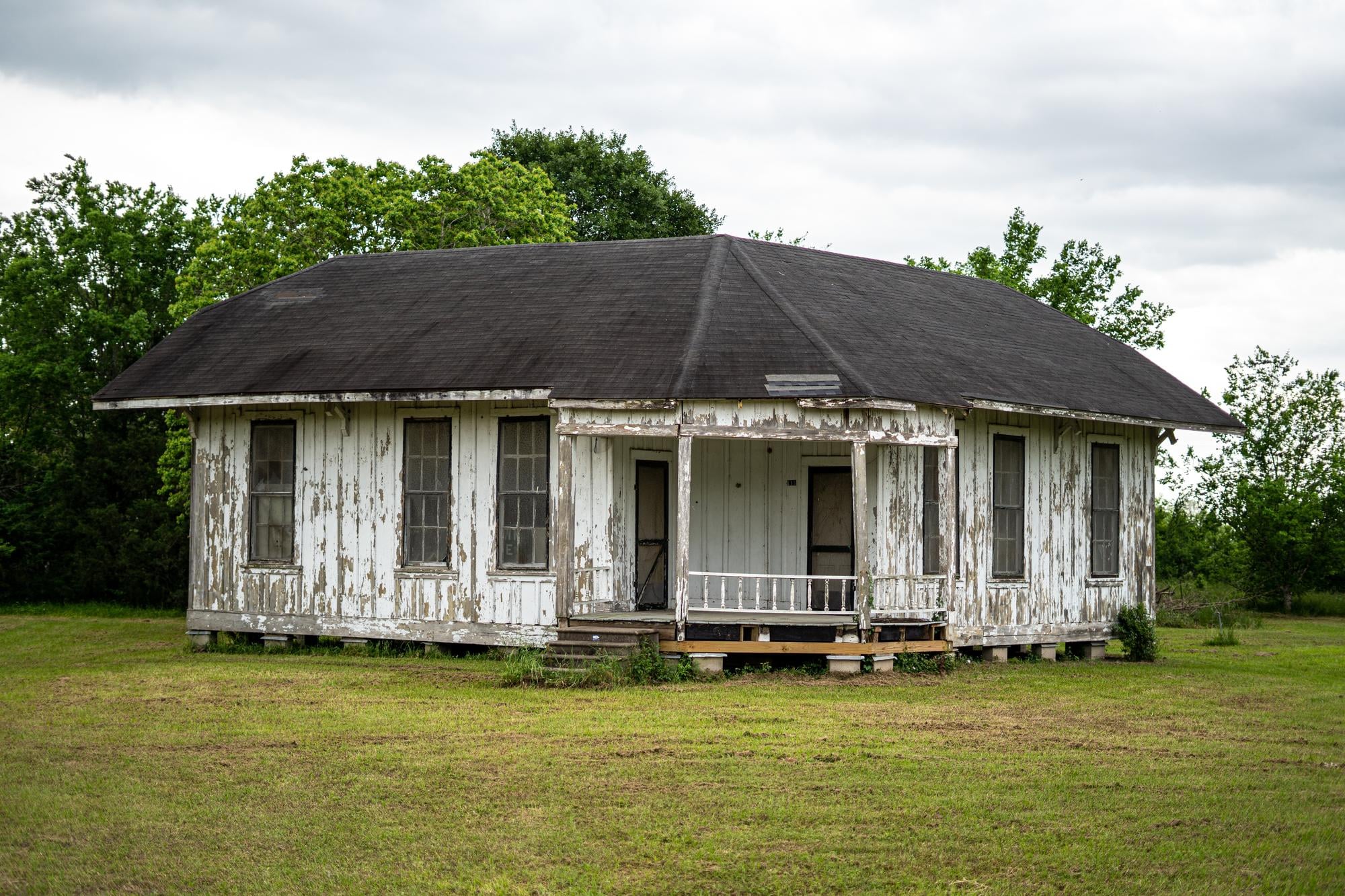
I knew the Miller place. Everybody in Corwin knew it. It sat on a little rise off Old Mill Road, about six miles outside town. A two-story white farmhouse with a big front porch and a red barn behind it, slowly falling in.
Nobody had lived there in six years. Not since old Walt Miller died. Somebody said he’d had no family left. Somebody said his estate never went through probate, and the taxes just stopped getting paid.
I tore the notice out of the paper and put it in my apron pocket.
We drove out to look at it that Saturday.
The front porch was sinking at one corner like a tired horse. The yard was full of waist-high weeds and thistles. Three of the upstairs windows were cracked. A family of raccoons had clearly been living in the barn.
Nate parked the truck on the gravel drive and got out.
He walked all the way around the outside of the house. Twice. He crouched down and looked at the foundation. He knocked on the siding with his knuckles. He looked up at the roofline for a long time, squinting.
He got down on his back in the weeds and slid under the edge of the porch and stayed under there so long I started to worry.
Finally he came back out, brushing dirt off his jeans.
“The foundation’s limestone,” he said. “Somebody built this thing right. The sills are good. The roof needs to come off, and the wiring’s probably from the forties, and God knows what the plumbing looks like. But the bones are solid.”
“Nate. Look at it.”
“I am looking at it,” he said. “I’m looking at it like a combine with a blown engine. The frame’s good. Everything else, you just fix.”
He turned around and looked at me.
“I can fix this, Callie.”
The auction took place on the courthouse steps at ten in the morning on April 14th.
It was cold and windy. About twenty people showed up. Some were just curious. Some were farmers looking at the empty lots next to their fields. A man from the Courier was there taking pictures.
And there was one man who was clearly there for the Miller house.
He was about fifty, in a padded green vest over a pressed button-down shirt, with expensive sunglasses pushed up on his head. He had a leather folder and a phone he kept checking. He drove a black Silverado with a magnetic sign on the door: HEARTLAND PROPERTY SOLUTIONS — WE BUY HOUSES.
The auctioneer was a man named Dobbs. Everybody in the county knew Dobbs. He was seventy-something, bald, with a voice like a cattle auction, which is what he’d done for forty years before he retired and the county hired him for tax sales.
He read the parcel number off a clipboard.
“Now, folks, we’re gonna start the Miller place at the amount of taxes and costs owed. Nine thousand two hundred fourteen dollars and sixty-three cents. Do I hear nine-two?”
The man in the padded vest raised one finger.
“Nine-two! Do I hear ten?”
Nate raised his hand.
“Ten! Do I hear fifteen?”
The investor raised his finger again. He didn’t even look at us.
It went fast after that. Fifteen. Twenty. Twenty-five. Thirty. The investor raised his finger every time without hesitating. Nate raised his hand every time without looking at me.
At thirty-five, the investor glanced over at us for the first time. He looked at Nate’s work jacket. At my diner sneakers. He smiled a little. Not a nice smile.
“Thirty-eight,” he said.
“Forty,” said Nate.
“Forty-one.”
The crowd went quiet. People were looking at us now.
I squeezed Nate’s arm. We had talked about this the night before, at the kitchen table, over egg salad sandwiches. Our absolute limit was $42,000. That would leave us with almost nothing for repairs. Anything more, and we’d have to walk away.
Nate took a breath.
“Forty-one thousand five hundred,” he called.
The investor looked at him for a long moment. Then down at his phone. Then back at us.
He shook his head and stepped back.
Dobbs looked around the crowd.
“Forty-one five, going once. Forty-one five, going twice.”
He banged his little wooden gavel on the courthouse railing.
“Sold! To the young couple in the Carhartt.”
My knees almost gave out.
Nate put his arm around me and held on.
The man from the Courier took a picture of us. I remember thinking, Oh, no.
Inside the courthouse, in the Treasurer’s office on the first floor, a woman named Marcy Hollister sat behind a counter with a calculator and a stack of forms. She was maybe sixty, with reading glasses on a chain and a cardigan with little tulips on it.
“Congratulations,” she said. “Payment in full is due today.”
I took out the cashier’s check from First Farmers. Forty thousand dollars even. I’d gotten it from the bank on Friday, with our names on it.
Then I reached into my purse and took out a fat white envelope.
Inside was $1,500 in cash. Ones, fives, tens, and twenties. Two years of diner tips. Some of them still smelled faintly of coffee and maple syrup. A few of the ones had phone numbers written on them by truckers who’d hoped I’d call.
Marcy looked at the envelope. Then at me.
“Tips?” she said.
“Tips.”
She smiled. Then she counted every bill. Twice.
When she was done, she wrote out a receipt. Then she handed me a set of keys on a rusty ring. Three old skeleton keys, worn smooth.
“These were in the house file,” she said. “Nobody’s touched them in six years.”
She paused.
“There’s paperwork that will follow,” she added. “The deed will be recorded after all the county’s requirements are met. I’ll mail you a copy. But the keys are yours.”
I held them in my palm. They were heavier than they looked.
“Thank you,” I said.
“Honey,” Marcy said, looking at my tip envelope, “you earned every one of those.”
We didn’t tell anyone.
Not Ron and Judy. Not the siblings. Not anyone at church.
Nate went out to the Miller place every night after work. He started with the wiring. He tore out the old knob-and-tube from the forties, room by room, and ran new wire through the walls. He didn’t hire an electrician. He couldn’t afford one. He bought a book about residential wiring at the library sale for a dollar and read it in bed at night with a flashlight.
I peeled wallpaper. There were four or five layers in every room. Roses on top of stripes on top of little teapots on top of something from the 1920s with peacocks on it. I used a spray bottle of hot water and fabric softener and a plastic scraper from Menards, and I scraped until the skin on my thumbs cracked and bled. I wrapped them in Band-Aids and kept going.
We patched the roof with tarps and a borrowed ladder. We hauled eleven truckloads of junk out of the barn. We pulled a dead raccoon out of the chimney. I cried for an hour when I found a box of old Christmas ornaments in the attic, wrapped in newspaper from 1956, and I didn’t know why.
It was the best and worst spring of my life.
And then, in May, the deed was recorded.
And the Corwin Courier printed it in the legal notices section. In tiny gray print, under the county’s other land transactions.
Treasurer’s Deed. Parcel #14-22-300-007, 4182 Old Mill Road. Grantor: Delphi County Treasurer. Grantees: Nathan R. Brenner and Callie A. Brenner. Recorded May 22nd.
Almost nobody in Corwin reads the legal notices.
But Nate’s grandmother read every single word of that section. Every week. She’d been doing it for sixty years.
Opal called me at the hospital on a Thursday afternoon.
I almost didn’t recognize her voice. It was low and clipped. Nothing like the soft, slow way she usually talked at family dinners.
“Callie. It’s Opal.”
“Opal? Is everything okay? Are you hurt?”
“I’m fine. I read the Courier this morning.”
My stomach dropped.
“Oh,” I said. “Opal, we were going to tell everyone. We just—”
“Never mind that,” she said. “I want you to pick me up after church on Sunday. At Prairie View. Eleven-thirty. And don’t mention this to Ronald.”
“Don’t mention—why?”
“Just don’t,” Opal said. “I’ll explain on Sunday.”
She hung up.
I sat in my cubicle and stared at the phone.
Opal Brenner had never asked me for a single thing in eleven years.
That Sunday, I picked her up at Prairie View Senior Living at eleven-thirty sharp.
She was waiting in the lobby in her lavender church dress, with her purse on her lap and her cane leaned against the chair. She stood up when she saw me and walked out to my car without waiting for help.
“Take me to the Miller place,” she said, buckling her seat belt.
I drove her the six miles out Old Mill Road. She didn’t say anything the whole way. She just looked out the window at the fields. Corn coming up in long green rows. A red-tailed hawk sitting on a fence post.
When we turned into the gravel drive and the house came into view, I heard her breath catch.
She sat very still in the passenger seat for a long time.
“Oh,” she said softly. “Oh, look at it.”
“It’s a mess right now,” I said. “Nate’s doing the wiring. The roof’s—”
“It’s beautiful,” Opal said.
She didn’t sound like she was talking to me.
I helped her up the sagging porch steps. Nate had braced them with two-by-fours, but they still creaked. She held onto my arm with one hand and her cane with the other.
At the front door, she stopped and looked at it.
It was the original door. Heavy oak, with a little oval of wavy glass at the top. Somebody had painted it green a long time ago. Most of the paint had flaked away.
“My father hung this door in 1931,” she said. “The year he married my mother.”
I unlocked it with one of the three skeleton keys.
She walked through the front room slowly, her cane tapping on the bare wood floor. Past the fireplace. Past the window seat with the cracked glass. Past the stairs, with their wobbly banister.
Into the kitchen.
And that’s when she put her hand on the doorframe. And found the pencil marks.
“Opal,” I said. “I didn’t know you’d ever been here.”
She told me then.
She was born Opal Miller, in the back bedroom, in the blizzard of 1938. Her father, Henry Miller, farmed the land around the house. Her mother, Alma, kept chickens and grew tomatoes and measured her two children on the kitchen doorframe every birthday. Opal and her little brother, Walter.
“Walt,” she said. “Walt was the one who died here. Six years ago. He never married. He never left. He stayed in this house his whole life.”
“I’m so sorry.”
“Don’t be. He was happy here. He was a stubborn old goat, and he didn’t want anybody’s help, and he wouldn’t let me pay his property taxes even when he was too sick to go to town.” She shook her head. “When he died, there was nobody to take care of it. He never made a will. I was too old to fight the county for it. Ronald said it wasn’t worth anything. He said let it go.”
She ran her thumb along the faint letters next to one of the pencil marks.
OPAL — 1946.
“I’ve driven past this house a hundred times since Walt died,” she said. “Every time, I thought, Somebody’s going to tear it down. And then I read in the paper that my grandson bought it.”
She turned around and looked at me. Her eyes were wet.
“My grandson. The one Ronald and Judy gave a bluebird card.”
That’s when she handed me the collection letter.
MIDWEST MEDICAL RECOVERY
RE: Corwin Regional Medical Center. Patient: Opal M. Brenner. Date of service: January 14th through January 22nd. Right hip arthroplasty.
Balance due: $6,840.12.
This account has been placed with our agency for collection.
I recognized the format immediately. I see letters like that every day at work.
“Opal, this was your hip surgery. That should have been covered. You have Medicare. And a supplemental plan. Don’t you?”
“I had a supplemental plan,” Opal said. “Through Prairie Mutual. Two hundred and fourteen dollars a month. I’ve had it since 1993. It was always paid automatically from my checking account.”
“So why—”
“I called them,” Opal said. “On Monday. The woman on the phone told me my policy was canceled. For nonpayment. Last November. Two months before I fell.”
I looked at the letter in my hands.
“And when I called the bank,” Opal said, “to find out why my premiums hadn’t been paid, the girl at the front desk told me I’d need to talk to the account manager. Because my son had changed the mailing address on my statements. To his house.”
She sat down slowly in our one good chair, by the kitchen window.
“Callie,” she said, “I haven’t seen a bank statement of my own in two years.”
I sat down on an overturned five-gallon bucket across from her. My knees felt weak.
“When I fell,” Opal said, “in the winter, after the surgery, I was in the rehabilitation center for six weeks. I was on so many pills I couldn’t remember what day it was. Ronald came in one afternoon with a lawyer from town. He said I needed to sign a power of attorney. In case something happened. So he could pay my bills while I was laid up.”
“Did you read it?”
“I couldn’t read anything. I couldn’t find my glasses. He said it was just for bills.” She looked down at her hands. “I signed it. The notary was some young woman from the lawyer’s office. She didn’t ask me a single question.”
“Opal, how much money did you have? Before?”
She told me.
Her late husband, Raymond, had worked thirty-eight years at the John Deere plant in Waterloo. He had a good pension, and when he died in 2009, there was a life insurance policy that paid out $150,000. Opal had been careful. She’d lived on her Social Security and Raymond’s survivor pension and hardly touched anything else. She’d kept it all at First Farmers & Merchants Bank, in Corwin. Savings. A couple of CDs. Her checking account.
“One hundred and ninety-one thousand dollars,” she said. “That’s what I had when I fell. I remember because I’d just gotten the statement that December. I was so proud of it. Raymond always said, Opal, you never have to depend on anybody.”
“And now?”
She reached into her purse and took out a slip of paper. A balance inquiry from the ATM at Prairie View.
Available balance: $41,206.18.
I couldn’t say anything for a long time.
Outside, a meadowlark was singing in the weeds. The wind came through the cracked window and moved the loose wallpaper on the wall.
“Opal,” I said finally. “What makes you think the money at Easter came from you?”
She looked at me with those sharp blue eyes.
“Because I’ve known my son for sixty-two years,” she said. “And Ronald has never had twenty thousand dollars to give anybody. Let alone sixty.”
She folded her hands on top of her cane.
“His equipment business has been failing for five years. Judy’s got her credit cards. They refinanced that house twice. I know, because Ronald asked me for a loan for the property taxes in 2022, and I gave him eight thousand dollars, and he never paid it back.”
“So when he stood at the head of that table with his coffee cup—”
“I sat there and watched him hand out three checks,” Opal said. “And I thought, Where did you get that money, Ronald? And then I watched Judy give my grandson a card with a bird on it.”
She was quiet for a moment.
“I should have said something then,” she said. “I didn’t. I was eighty-six and tired and I didn’t want to make a scene at Easter. That was wrong of me. I’ve been sorry ever since.”
“Why me?” I asked her. “Why did you call me? Instead of Nate?”
“Because Nate would drive straight to his father’s house and say something he can’t take back,” Opal said. “He gets that from his mother. Ellen had a temper like a grass fire. Quiet for a long time, and then everything’s burning.”
She almost smiled.
“And because you work in hospital billing. You know what a collection letter means. You know what a supplemental plan is. You know how to read a bank statement.”
“I do.”
“And,” Opal said, “because you’re the only one at that table who wasn’t bought.”
I told Nate that night.
We were sitting on the sagging front porch of the Miller house, eating egg salad sandwiches out of a cooler, watching the sun go down behind the barn.
I told him everything. The doorframe. The pencil marks. The blizzard. The collection letter. The power of attorney. One hundred and ninety-one thousand dollars, down to forty-one.
He didn’t say anything the whole time.
When I was done, he sat very still with half a sandwich in his hand.
His ears were red. Redder than I’d ever seen them.
He put the sandwich down.
Then he stood up, walked to the end of the porch, and hit the corner post with the side of his fist. Once. Hard. The whole porch shook.
He stood there with his back to me for a long time.
“He gave my brothers and sisters twenty thousand dollars,” Nate said finally, very quietly, “out of Grandma’s savings. And then his wife wrote me a card telling me I was capable.”
“Nate—”
“I sold Grandpa’s boat, Callie.” His voice cracked. “I sold Grandpa Raymond’s boat to buy this house. And the whole time, Dad was spending Grandpa Raymond’s money on Jeff’s three-car garage.”
He turned around. His eyes were wet.
“I want to drive over there right now.”
“I know.”
“I want to put him through a wall.”
“I know. That’s why Opal called me instead of you.”
He laughed. A short, broken laugh.
“Of course she did,” he said. “She always was the smartest one in the family.”
He sat back down next to me on the porch. He took my hand. His knuckles were bleeding a little.
“Okay,” he said. “So what do we do?”
“Opal wants to go to the bank,” I said. “Tomorrow. With us. Before Ronald finds out.”
First Farmers & Merchants Bank sits on the corner of Main Street and Third, in a brick building with a clock on the front that has been three minutes slow since 1987.
The branch manager was a woman named Gail Stoddard. She’d been at the bank for thirty years. She’d known Opal since Gail was a teller and Opal came in every Friday to deposit Raymond’s paycheck.
She took us into her office in the back and closed the door.
“Opal,” she said. “I’ve been hoping you’d come in.”
“You knew something was wrong?”
Gail hesitated.
“I can’t say I knew,” she said carefully. “Ron had a valid power of attorney on file. Signed and notarized. Legally, he’s had authority to access your accounts since February of two years ago. But some of the activity—” She stopped. “I had concerns. I just couldn’t do much about them without you.”
“I’m here now,” Opal said. “Show me.”
Gail turned her computer monitor toward us. Then she printed out two years of statements. Checking. Savings. Both CDs.
She laid them on the desk.
Opal put on her reading glasses. I sat beside her and read along. Nate stood behind us with his arms crossed.
I’ve read thousands of financial statements in my life. I read them all day at work.
I’ve never read anything like that one.
02/28 — Transfer to Ronald J. Brenner, Checking — $8,000.00
03/15 — Transfer to Ronald J. Brenner, Checking — $12,500.00
03/22 — Early withdrawal, Certificate of Deposit #2241, penalty $1,187.40 — $50,000.00
03/29 — Cashier’s check, payable to Kimberly A. Brenner-Lowe — $20,000.00
03/29 — Cashier’s check, payable to Jeffrey R. Brenner — $20,000.00
03/29 — Cashier’s check, payable to Stacy L. Brenner — $20,000.00
The three checks were dated March 29th.
Easter was March 31st that year.
Opal put her finger on the three lines and held it there.
She didn’t say anything.
I kept reading.
05/11 — Payment to Ag Credit Services, Loan #4471 (Brenner Equipment) — $38,412.00
08/02 — Payment to Delphi County Treasurer, Parcel #09-14-101-002 — $6,880.00
That was Ron and Judy’s farmhouse. Opal’s money had paid their property taxes.
Recurring — Payment to Capital One, Judith K. Brenner — various amounts — total $11,244.16
11/01 — Recurring payment to Prairie Mutual Insurance — STOPPED BY ACCOUNT HOLDER’S AGENT
That was the line that made my stomach turn.
Two hundred and fourteen dollars a month. Opal’s Medicare supplement. The insurance that would have covered her hip surgery.
He had stopped it.
Probably to save two hundred and fourteen dollars a month.
And two months later, his mother fell on the ice outside Prairie View and broke her hip, and the hospital billed her, and the bill went to an address she never saw, and then to collections.
Gail added it all up on her calculator.
“Since the power of attorney was filed,” she said quietly, “transfers and payments that don’t appear to be for your benefit, Opal, total one hundred forty-eight thousand, six hundred and twelve dollars. And some change.”
Opal took off her reading glasses.
She folded them.
She put them in her purse.
“Gail,” she said. “I want to stop him. Today.”
“I can put a note on the accounts right now,” Gail said. “Flag them for review. But to fully revoke the power of attorney, you’ll want an attorney. A proper one. And I’d suggest you open a new account, in your name only, and move what’s left into it this morning.”
“Then that’s what we’ll do.”
Gail called in a young woman named Jolene, who was a notary. Jolene checked Opal’s driver’s license and watched her sign the new account paperwork. She asked Opal questions. Did she understand what she was signing? Was anyone pressuring her? Did she want to do this?
“Yes,” said Opal. “No. And yes.”
Jolene smiled and stamped the page.
“That’s three more questions than the last notary asked me,” Opal said.
That afternoon, we went to see Martin Vos.
His office was in a little brick building across from the courthouse. Vos & Kemper, Attorneys at Law. Estate Planning, Elder Law, Real Estate. He was in his sixties, tall and stooped, with white hair and a soft voice and a jar of Werther’s candies on his desk.
He read everything Gail had printed. Every line. He took notes on a yellow legal pad.
Then he looked up at Opal.
“Mrs. Brenner,” he said gently, “a power of attorney gives someone the authority to manage your money for you. To pay your bills. To act in your interest. It doesn’t give them permission to give your money away to themselves or their children. Not unless you specifically agreed to that.”
“I never agreed to anything,” Opal said. “I couldn’t find my glasses.”
“Then we have some decisions to make.”
He explained her options, slowly and plainly. He’d draft a revocation of the power of attorney and deliver it to the bank and to Ron. He’d send a letter to Ron, formally requesting an accounting of every dollar he’d spent and asking for the money to be returned. He could also help her report what happened to the sheriff’s office, or to the state’s adult protective services. That was her choice.
“You don’t have to decide all of that today,” he said.
“I’ve decided some of it,” said Opal.
She pulled a piece of paper out of her purse. She’d written on it in her careful, old-fashioned cursive while we waited in the lobby.
“I want to revoke Ronald’s power of attorney,” she said. “Today. And I want a new one. Naming my grandson Nathan, and his wife, Callie. Together. They both have to sign for anything. That way, nobody’s ever alone with my money again.”
Nate made a small sound behind me.
“Grandma,” he said. “You don’t have to—”
“Hush, Nathan. I’m eighty-eight years old. I know what I have to do.”
She turned back to Martin.
“And I want to change my will.”
Martin pulled her old will out of a file cabinet. Opal had signed it in 2010, the year after Raymond died.
He read the important part out loud.
All the rest and residue of my estate I leave to my son, Ronald J. Brenner.
Everything. To Ron.
“I trusted him,” Opal said quietly. “He was my only child. Raymond and I tried for years after him. It never happened. So Ronald was all we had.”
She looked at Nate.
“I wasn’t thinking about grandchildren when I signed that. I should have been.”
Martin drafted the new will that afternoon. Opal told him what she wanted, and I won’t tell you all of it. That’s her business. But I’ll tell you one line, because she read it to us out loud in his office, after Martin typed it up.
To my grandson, Nathan R. Brenner, and his wife, Callie A. Brenner, I leave the family Bible of my parents, Henry and Alma Miller, and the photographs of the house at 4182 Old Mill Road, to keep in the house where they belong.
Then she signed it. Two witnesses from Martin’s office watched. Martin’s secretary, a cheerful woman named Peg, notarized it.
When she was done, Opal set down the pen.
“There,” she said. “Now let’s go to the hospital, Callie, and you can tell me what to do about this collection letter.”
I’ll tell you what we did about the collection letter, because it’s the one thing in this whole story I was actually trained to fix.
I pulled Opal’s file at work the next morning. I called Prairie Mutual Insurance and spoke to a supervisor named Dwight. I explained that Opal’s premiums had been stopped by someone acting under a power of attorney that she had now revoked, and that we believed the cancellation was the result of financial exploitation.
Dwight was quiet on the phone for a long time.
“I’m going to need some documentation,” he said. “But ma’am, I’ll be honest with you. In twenty years, I’ve seen this more times than I’d like to.”
It took six weeks and a stack of paperwork as thick as a phone book, with Martin Vos writing letters and Gail Stoddard sending bank records. But in the end, Prairie Mutual agreed to review the claim.
In the meantime, Opal paid the hospital directly, out of her new account. The collection agency recalled the account.
I printed the letter that said PAID IN FULL and brought it to her at Prairie View.
She held it in her lap and looked at it for a long time.
“Eighty-eight years,” she said. “And I almost went out with a mark against my name.”
“You didn’t,” I said. “It’s clean.”
Martin Vos’s letter went to Ron and Judy by certified mail on a Tuesday.
Ron called Nate that night at nine o’clock.
I was sitting next to Nate on the couch in our rental on Second Street. I could hear every word, because Ron was shouting.
“What the hell is this? A lawyer? You got your grandmother a lawyer? To come after me? Your own father?”
Nate’s voice was very calm.
“Grandma got herself a lawyer, Dad. She’s eighty-eight. She’s not senile. She can still read.”
“She signed that power of attorney fair and square! Everything I did, I did to help this family!”
“You stopped paying her Medicare supplement, Dad. Two months later, she broke her hip. Her bill went to collections. Did that help the family?”
Silence on the line.
“That was a mistake,” Ron said finally. “That was an oversight.”
“An oversight,” Nate repeated. “Two hundred and fourteen dollars a month.”
“You don’t understand the pressure I’ve been under! The business—”
“You gave Kim, Jeff, and Stacy sixty thousand dollars of Grandma’s money,” Nate said. “At Easter. At her own table. While she sat there watching.”
Silence.
“And you gave me a card with a bird on it,” Nate said. “And told me I was capable.”
His voice cracked on the last word.
“I am capable, Dad. I sold Grandpa’s boat. I bought a house on the courthouse steps with my wife’s tip money. I’ve been rewiring it with a library book. I’m more capable than you’ll ever know.”
He hung up.
Then he sat on the couch with the phone in his lap and cried. Quietly. With his red ears and his bruised knuckles.
I held him until he stopped.
Judy called me the next morning.
She didn’t shout. Judy never shouts. She just got very cold and very polite, which is worse.
“Callie. I want you to know that I know exactly what you’re doing.”
“What am I doing, Judy?”
“Turning an old woman against her own son. Getting your name on her accounts. I know how these things go. I watch the news.”
“Opal named Nate and me together. Both signatures required. She did that so nobody could ever do to her what you and Ron did.”
“How dare you.”
“I work in hospital billing, Judy. I see what happens to old people when their families take their money. I see the collection letters. I see them lose their supplemental insurance and then break a hip. I see it every single week.”
“Ron loves his mother.”
“Then he should have paid her insurance,” I said.
Judy hung up on me.
The siblings found out a few days later.
Ron called them. He told them, I found out later, that Opal was “confused,” and that Nate and I had “gotten into her head,” and that we were trying to take all her money.
Stacy called me the next afternoon. She was crying so hard I could barely understand her.
“Callie, is it true? Was the money really Grandma’s? Dad said it was his. He said he’d been saving it for years. For us.”
“It came from Grandma’s savings account, Stace. I’ve seen the statements. The cashier’s check to you is dated March twenty-ninth. Two days before Easter.”
Stacy sobbed.
“I put it on my house,” she said. “The bungalow. The one with the pink door. I’ve been so proud of that pink door.”
“I know you didn’t know.”
“I should have known,” Stacy said. “Dad’s business has been going under for years. Mom’s always complaining about bills. I should have asked where twenty thousand dollars came from. I didn’t want to know. I just wanted the house.”
Then she said something I didn’t expect.
“I was the one who asked Mom about you two,” she said. “At Easter. Before dinner. I asked why there wasn’t a check for you and Nate. Mom said, ‘Nate doesn’t need our help. He’s not really ours.’”
I sat down on the edge of my desk at work.
“She said that?”
“I’m so sorry, Callie,” Stacy said. “I didn’t say anything. I just took the envelope.”
Opal’s eighty-ninth birthday was on the second Sunday in June.
It has always been held at Ron and Judy’s house. A ham, a cake, her favorite strawberry pie. The whole family.
Everyone assumed it was canceled that year.
But Opal called Judy herself, on the Friday before.
“I’ll be there at one,” she said. “Set the table for everyone. Including Nathan and Callie. And don’t make it awkward, Judith. Just set the table.”
Then she called me.
“I’m going to need a ride,” she said. “And I’m going to need some envelopes.”
We pulled up to Ron and Judy’s white farmhouse at five minutes to one.
Everyone was there. Kim and Doug. Jeff and Brittany. Stacy, by herself, with puffy eyes. Ron and Judy.
Nobody said much.
The dining table was set with Judy’s good china. The white plates with the little blue flowers. A napkin folded like a fan in every glass. A big sheet cake with Happy 89th Grandma! in pink frosting.
Opal walked in slowly on my arm, in her lavender church dress and her pearl earrings. She went straight to the head of the table, where Ron always sat, and stood there.
“Ronald,” she said. “I’d like your chair today.”
Ron looked at her. His face was gray. He looked like he hadn’t slept in a week.
He pulled out the chair for his mother.
She sat down in it.
We ate in silence. Ham, potatoes, green beans. Nobody tasted anything.
Then Judy brought out the cake and lit the candles. Eight big ones and one small one. Everyone sang. Quietly.
Opal blew out the candles in one breath.
Then she reached into her big lavender purse.
She took out a stack of cream-colored envelopes.
“I had Callie help me pick these out,” she said. “At the Hallmark store in Ames.”
She handed them down the table. One envelope to each couple. She set them under the dessert plates.
“Go ahead,” she said. “Open them.”
Kim opened hers first.
She took out a card. It had a bluebird on the front, sitting on a branch of white blossoms. The exact same card. Opal had made me drive to three stores to find it.
Kim opened it. A folded piece of paper fell out.
She read the card. Then she unfolded the paper.
It was a photocopy. Of a single line from Opal’s bank statement.
03/29 — Cashier’s check, payable to Kimberly A. Brenner-Lowe — $20,000.00
Kim’s face went white.
Inside the card, in Opal’s careful old-fashioned cursive, it said:
You’ve always been such a capable granddaughter. I know you can handle the truth. That check was my money, Kimberly. Your grandfather earned it at the John Deere plant over thirty-eight years. I never gave your father permission to give it away. I love you. — Grandma
Kim put her hand over her mouth. The same way she had two years ago. But not from happiness this time.
Jeff opened his. Same card. Same photocopy. Same words.
He read it twice. Then he put it down and stared at his father across the table.
“Dad,” he said. “You told me you saved this. You told me you’d been putting money away since I was a kid.”
Ron didn’t answer.
Stacy opened hers. She’d already known. She just started crying, quietly, into her napkin.
Then Opal handed one more envelope down the table.
To Ron and Judy.
Ron opened it slowly. His hands were shaking.
A bluebird card.
Inside, there was a thicker stack of paper. A photocopy of every line on Opal’s bank statement that Gail Stoddard had highlighted. One hundred forty-eight thousand, six hundred and twelve dollars. And a copy of Martin Vos’s letter.
And in Opal’s cursive, inside the card:
You’ve always been such a capable couple. I know you can handle anything. Including paying it back.
Judy read it over Ron’s shoulder.
She turned red. Then white. Then red again.
“This is cruel,” she said. “This is cruel and petty and vicious, Opal, at your own birthday dinner—”
“It’s the same card you gave my grandson, Judith,” Opal said. “I thought you liked the bluebird. You said it was for happiness.”
Ron put the card down on the table.
He put his face in his hands.
For a long time, nobody said anything. The candles on the cake were still smoking a little.
Then Ron started to talk. Not to anyone in particular. To the tablecloth.
“The business has been going under for six years,” he said. “Ag Credit was going to call the loan. Thirty-eight thousand. They were going to take the shop. The equipment. Everything I built. And Judy’s cards were maxed. And the property taxes on this house were past due. Again.”
He took a shaky breath.
“When Mom fell, and I had to sign her bills, I saw how much she had. Sitting there. Doing nothing. A hundred and ninety-one thousand dollars. And I thought, She’s eighty-six. She’ll never spend it. It’s going to come to me anyway someday. What’s the difference?”
“The difference,” Opal said quietly, “is that I was still alive.”
Ron flinched.
“I was going to pay it back,” he said. “Once the business turned around.”
“And the sixty thousand for the children?” Opal asked. “Was that going to turn the business around?”
Ron didn’t answer for a long time.
Then he said, “Judy wanted them to have houses. She said it wasn’t fair that her kids were renting. She said it would look good. Generous. And I wanted to—” His voice broke. “I wanted to be the father who gave his kids houses. Just once. Instead of the one who couldn’t pay the property taxes.”
“Judy’s kids,” said Nate.
The whole table turned to look at him.
He was sitting very still beside me. His ears were bright red.
“You said it, Dad,” Nate said. “Judy wanted her kids to have houses. That’s why there was no check for me.”
Ron looked up at his oldest son. For the first time in my eleven years in this family, I saw him actually look at Nate. Really look.
“Nate,” he said.
“It’s okay,” said Nate. “I already know. I’ve known since I was seven years old. I just didn’t know it had a price tag.”
Judy stood up.
“I’m not going to sit here and be attacked in my own house,” she said. “Ron, say something.”
But Ron didn’t say anything.
It was Jeff who spoke. He was still holding his bluebird card.
“Mom,” he said. “Sit down.”
Judy looked at him like she’d never heard him use that voice before.
“Sit down,” Jeff said again. “Grandma’s not done.”
Judy sat.
Opal folded her hands on the table.
“I’m eighty-nine years old,” she said. “I don’t have time to be angry for very long. So here’s what’s going to happen.”
She looked at Ron.
“Martin Vos has drawn up an agreement. You’ll sign it. You’ll pay back every dollar you took, with a schedule we can live with. If you do that, I won’t take this to the sheriff. If you don’t, I will. That’s your choice, Ronald. Not mine.”
Ron nodded slowly. He couldn’t speak.
Then she looked down the table at Kim, Jeff, and Stacy.
“I’m not asking you three to give the money back tomorrow,” she said. “You didn’t know. I believe that. You’ve put it into your homes, and I’d never put my great-grandchildren out on the street. But it was my money. Your grandfather’s money. And I want it treated that way. Martin will draw up a note for each of you. You’ll pay it back slowly, to me, while I’m alive, or to my estate when I’m gone. No interest. Just honesty.”
Stacy wiped her eyes. “Yes, Grandma.”
Kim nodded. “Yes.”
Jeff looked at his father for a long moment. Then back at his grandmother.
“Yes, ma’am,” he said.
Then Opal turned to Nate and me.
She reached into her purse one last time.
She took out a white envelope. Not cream-colored. Not a bluebird card. Just a plain envelope, the kind you buy at the drugstore in a box of fifty.
She handed it to Nate.
He opened it.
Inside, there was a check. Written in Opal’s own shaky handwriting, from her new account at First Farmers & Merchants.
Pay to the order of Nathan R. Brenner and Callie A. Brenner. Twenty thousand dollars and no cents.
In the memo line, she’d written: For the roof. And for the boat.
Nate stared at it.
“Grandma,” he said. “No. We can’t. You need this. After everything—”
“I’m the one who decides what I need, Nathan,” Opal said. “That’s the whole point of today.”
She looked around the table at her family.
“I gave the other three their twenty thousand without knowing it,” she said. “I’m giving this one with my eyes wide open.”
Nate held the check in both hands. His ears were bright red.
And this time, he didn’t fold it up and put it in his shirt pocket.
He put it on the table in front of him, where everyone could see.
Ron signed the repayment agreement in Martin Vos’s office two weeks later.
He sold his second truck. He sold his bass boat. He sold a parcel of pasture behind the shop that he’d been holding onto for twenty years. That covered almost forty-one thousand dollars. He refinanced the farmhouse, again, with a smaller loan. He set up automatic payments to Opal’s account. Eleven hundred dollars a month.
Brenner Equipment closed that fall. Ron took a job as a service manager at the John Deere dealership in Ames. The same company his father worked for. Thirty-eight years at the plant in Waterloo.
I think about that sometimes.
Kim and Jeff signed their promissory notes. Kim paid hers off in three years. Jeff is still paying, two hundred dollars a month, without missing one.
Stacy sold her bungalow with the pink door. She said she couldn’t live in it anymore. She paid Opal back the whole twenty thousand at closing and moved into an apartment above a coffee shop in Ames.
“It’s small,” she told me. “But it’s mine. All of it.”
Judy didn’t speak to me for a year.
Then, one Saturday, she came into the Big Rig Diner, where I still waited tables on weekends. She sat at the counter. I poured her coffee. She didn’t look at me.
When she left, there was a twenty-dollar bill under her saucer.
And a note on a napkin. I was wrong about you.
I don’t know if she meant it. But I kept the napkin.
Prairie Mutual Insurance finished reviewing Opal’s claim that fall. They reinstated her coverage, retroactive to the date of the cancellation. They reimbursed her $6,840.12 for the hospital bill.
Dwight the supervisor called her personally to tell her.
“Mrs. Brenner,” he said, “I hope you have a long and healthy life. And I hope you never need us again.”
“So do I, young man,” said Opal. “But I’ll keep paying you anyway.”
We used Opal’s twenty thousand for the roof.
Real shingles. Not tarps. Nate hired a crew of Amish roofers from Kalona, who did the whole thing in three days and wouldn’t let me pay them extra for lunch.
Then he finished the wiring. Then the plumbing. Then the new porch.
It took us two more years.
But on a Sunday afternoon in October, the Miller house was done.
White paint. Green shutters. A new front porch with wide steps and a railing Nate built himself, out of oak boards from the old barn. The original oak door, stripped and refinished and painted green again. The same green Opal’s father used in 1931. She told me the color from memory, and I had it matched at the hardware store.
There was a downstairs bedroom, too. Nate built it out of the old back parlor. Wide doorways for a walker. A bathroom with grab bars and a walk-in shower. A window looking out at the fields where Henry Miller used to farm corn.
The back bedroom. The one where Opal was born, in the blizzard of 1938.
Opal moved in the week before Thanksgiving.
She was ninety by then. She brought her rocking chair from Prairie View, her lavender quilt, and a framed photograph of her parents, Henry and Alma, standing on the front porch of the house in 1931. Her father in his good suit. Her mother in a white dress, holding a bouquet of zinnias.
She hung the photograph herself, over the fireplace in the front room. She had to stand on a step stool. She wouldn’t let me help.
“I’m capable,” she said, winking at me.
There was one more thing.
When Nate stripped the paint off the kitchen doorframe, he did it by hand. With a heat gun and a dental pick and a magnifying glass, one tiny section at a time, so he wouldn’t scrape away the pencil marks underneath.
It took him three weeks.
When he was done, you could see them all. Dozens of little pencil lines, climbing up the old wood.
WALT — 1944.
OPAL — 1946.
WALT — 1949.
OPAL — 1952. 14 yrs.
Nate didn’t paint over it. He sealed it with clear varnish so it would stay just like that forever.
On Thanksgiving, after dinner, Opal stood in the kitchen doorway and looked at the marks for a long time.
Then she picked up a pencil from the counter.
“Nathan,” she said. “Come stand here.”
“Grandma, I’m thirty-nine years old.”
“I don’t care how old you are. Stand against the frame.”
He stood against the frame. She reached up as high as she could, which wasn’t very high, and Nate had to crouch down a little, and she drew a line across the top of his head.
Next to it, in her shaky, careful cursive, she wrote:
NATHAN — Thanksgiving. Capable.
Then she turned around and handed me the pencil.
“Your turn,” she said.
We’ve had Easter at the Miller house every year since.
Ron and Judy come now. Not every year. But most years. Ron sits on the porch with Nate after dinner and they talk about combines, which is the only language either of them has ever really been fluent in. Ron fixed the porch swing last spring without anyone asking him to.
Kim and Doug come with their kids. Jeff and Brittany. Stacy, sometimes, with a new boyfriend who seems kind.
I set the table with mismatched plates from the Goodwill. Nate carves the ham. Opal sits at the head of the table in her lavender dress.
There are no envelopes under anybody’s plate.
Except one.
Nate still has the bluebird card.
The one Judy gave us that Easter. He kept it in the junk drawer by the stove for two years, with the rubber bands and the batteries.
When he rebuilt the kitchen wall at the Miller house, the one beside the doorframe with the pencil marks, he put the card inside the wall. Before he hung the new drywall. Folded along the same crease, tucked against a stud, with a note.
I asked him what the note said.
He wouldn’t tell me for a long time.
Finally, one night on the porch, after Opal had gone to bed, he told me.
To whoever finds this someday:
Being capable is not the same as not needing anyone. Everybody needs somebody to pull out their chair. My grandmother did it for me when she was eighty-nine.
If you’re the capable one in your family, I hope somebody does it for you, too.
— N.B.
Opal is ninety-one now.
Every morning, she sits in her rocking chair on the front porch of the house where she was born, with a cup of coffee and the Corwin Courier. She still reads every word of the legal notices.
Last week, she called me into the kitchen and pointed at the paper.
Notice of Public Tax Sale. Delphi County Treasurer.
There was an old farmhouse on the list. Out on County Road F. Nobody’s lived there in eight years.
“There’s a young couple at my church,” Opal said. “He works at the grain elevator. She cleans houses. They’ve been saving for two years. Living on eggs, I’d guess.”
She folded the paper and handed it to me.
“I think somebody ought to let them know,” she said. “And I think somebody ought to sit with them at the auction. So they’re not alone on those steps.”
I looked at her. Ninety-one years old. Born in a blizzard. Still reading the small print.
“I’ll call them tonight,” I said.
“Good,” said Opal. She picked up her coffee. “And Callie? Bring a lawn chair. Dobbs takes forever.”

Specialty: Quiet Comebacks & Personal Justice
David Reynolds focuses on stories where underestimated individuals regain control of their lives. His writing centers on measured decisions rather than dramatic outbursts — emphasizing preparation, patience, and the long game. His characters don’t shout; they act.