Mud
I spent nine months planning that wedding.
Nine months of spreadsheets and swatches and phone calls. Nine months of saving every extra dollar from my bakery. Nine months of lying awake at two in the morning wondering if the peonies would be in season and whether the barn would be too hot in June and if my mother would have liked the dress.
I did it because I wanted one day.
Just one.
That felt entirely mine.
I didn’t get it.
Not the way I planned.
I got something else.
Something I didn’t know I needed.
My name is Nina Castell. I’m thirty-one years old.
I own a bakery in Sturgeon Bay, Wisconsin. Up in Door County. Where the peninsula sticks out into Lake Michigan like a thumb. It’s called Elena’s, after my mother. I make cherry pies and kringle and sourdough and the best morning buns between Green Bay and Washington Island. That’s not me bragging. That’s the Door County Advocate. They wrote it in 2022 and I framed it.
I get up at three-thirty every morning. Six days a week. I’ve done it for five years.
My hands always smell like butter.
My mother raised me alone.
Elena Castell. She came to Wisconsin from Puebla, Mexico, when she was nineteen. She cleaned rooms at a resort in Fish Creek. She married my father when she was twenty-two. He left when I was three. I don’t remember him.
She raised me in a two-bedroom apartment above a hardware store in Sturgeon Bay. She worked two jobs. Housekeeping in the day. Baking at night. At a little café on Third Avenue that closed in 2009.
She taught me to bake when I was five. Standing on a chair at our kitchen counter. With flour all the way up to my elbows.
“Mija,” she’d say. “Dough knows when you’re scared. Be brave with it.”
She died three years ago.
Ovarian cancer. She was fifty-four.
She left me two things.
Her recipe box. Tin. Red. Dented. Full of index cards in her handwriting. Half in English. Half in Spanish.
And a necklace.
A thin gold chain. With a small locket. Oval. Engraved on the front with a tiny sprig of lilac. Her favorite flower.
Inside, two pictures. Cut by hand. Me as a baby. And her mother, my abuela Rosa, as a young woman in Puebla.
She wore it every day of her life.
She took it off in the hospital. The last week. She put it around my neck with her shaking hands.
“For your wedding, mija,” she whispered. “So I’m there.”
I met Frank at the bakery.
Four years ago. October. He came in at six-fifteen on a Tuesday. Before I’d even flipped the sign. He’d seen the lights on through the window.
He knocked on the glass.
I opened the door a crack.
“We’re not open,” I said.
“I know,” he said. “But it smells so good I think I might die if I don’t come in.”
He was tall. Sandy hair. A Green Bay Packers beanie. A Carhartt jacket. He worked for his father’s construction company. Lindqvist & Son. They built docks and boathouses all along the peninsula.
I let him in.
I gave him a morning bun. Warm. Still sticky.
He ate it standing at the counter. He closed his eyes.
“Will you marry me?” he said.
He was joking.
Mostly.
He came back the next day.
And the next.
Every morning at six-fifteen. For three months. Before he asked me to dinner.
He proposed two years later. On the beach at Cave Point. At sunset. In November. In the freezing cold. With the waves crashing on the limestone.
He got down on one knee on the rocks. He slipped. He almost fell into the lake.
I said yes before he finished the question.
From the moment Frank proposed, his mother made it clear she didn’t approve of me.
Carol Lindqvist.
Fifty-nine. Blonde. Always blonde. Perfectly highlighted every four weeks at a salon in Green Bay. Pearl earrings. Cashmere sweaters. A Lexus SUV. White.
She ran the Sturgeon Bay Women’s Club. The Garden Society. The church altar guild at St. Joseph’s. She chaired the fundraising committee for the Door County Maritime Museum.
Everybody knew Carol.
Everybody said how lovely she was.
She was lovely to everybody.
Except me.
The first time I met her, at the Lindqvists’ big house on the bluff in Ephraim, she looked at my hands.
At the burns on my forearms. Little white scars from oven racks. Every baker has them.
“Oh,” she said. “What happened to your arms?”
“Ovens,” I said.
“Oh,” she said again.
She didn’t shake my hand.
After Frank proposed, it got worse.
“You’re sweet,” she told me. At Thanksgiving. In her kitchen. While I was helping with the gravy. She smiled. A tight smile. Her lips barely moving.
“But my son needs someone—” she paused. “—more polished.”
I didn’t say anything.
I stirred the gravy.
She criticized everything.
My dress was too simple.
I showed her a picture on my phone. Ivory silk. A fitted bodice. A little beading along the neckline. A soft train.
She looked at it for two seconds.
“Oh,” she said. “It’s very… plain. Is that what you can afford?”
The venue was underwhelming.
A restored dairy barn outside Egg Harbor. Red. Built in 1912. With a stone foundation and a hayloft and string lights and a garden out back. I fell in love with it the first time I saw it.
“A barn?” Carol said. “For a wedding? Frank, we could have gotten the Landmark Resort. Or the Yacht Club. My friend Barbara’s daughter got married at the Yacht Club.”
“Nina likes the barn, Mom,” Frank said.
“Nina likes the barn,” Carol repeated. Like I was a child who liked a toy.
The menu was peasant food.
I wanted my mother’s recipes. Mole poblano. Tamales. Arroz rojo. And Door County whitefish. And a cherry pie bar. Twelve kinds.
“Mexican food,” Carol said. “At my son’s wedding. Do people even eat that up here?”
She asked Frank once.
In front of me.
At a Sunday dinner. In March. Three months before the wedding.
She put down her fork.
She looked at her son.
“Frank,” she said. “Are you sure this isn’t a mistake?”
The table went quiet.
Frank’s father, Garold, looked at his plate.
Frank’s younger sister, Paige, home from Oregon for the weekend, closed her eyes.
Frank laughed.
A nervous laugh.
“Mom,” he said. “Come on.”
That was all.
Mom. Come on.
In the car on the way home, I asked him.
“Why do you let her talk to me like that?”
Frank kept his eyes on the road. Highway 42. Dark. Snow on the shoulders.
“That’s just how she is,” he said.
“How she is with me. She’s not like that with anybody else.”
“She’s protective,” Frank said. “I’m her only son. She’ll come around.”
“She asked if our marriage was a mistake, Frank. At dinner. In front of me.”
Frank was quiet.
“She didn’t mean it,” he said.
That’s just how she is.
He said it a lot.
Every time.
That’s just how she is.
She doesn’t mean anything by it.
Don’t let it get to you.
I let it get to me.
There’s something I need to tell you about Frank’s father.
Garold Lindqvist.
Sixty-four. Big. Six-foot-three. Broad shoulders. Gray hair cut short. Hands like shovels. Scarred. Calloused. He’d been building docks on Lake Michigan for forty years. He started the company with his father in 1983.
He was quiet.
So quiet I almost forgot he was there sometimes.
At dinners, he sat at the end of the table. He ate. He listened. He said please and thank you and that’s good, Carol.
When Carol said something, he agreed.
Always.
Yes, Carol. You’re right, Carol. Whatever you think, Carol.
When Carol criticized my dress, Garold looked at his plate.
When Carol called my food peasant food, Garold looked at his plate.
When Carol asked if our marriage was a mistake, Garold looked at his plate.
Quiet. Careful. Invisible.
I thought he agreed with her.
I thought he was just like her. Only quieter.
I was wrong.
There were things I noticed. Little things. That didn’t fit.
He wore long sleeves.
Always. Even in July. Even working on the docks in ninety-degree heat. Flannel. Buttoned at the wrist.
Frank said his dad got sunburned easily.
He had a scar on his left hand. A burn. Across the back. Shiny and pink. The shape of something curved.
Frank said he’d burned it on a welding torch in 2009.
He flinched.
Not much. Just a little. When Carol came up behind him. When she put her hand on his shoulder. When she raised her voice.
I noticed it at Thanksgiving. She reached past him for the salt. He flinched.
I thought I imagined it.
And once, in May, a month before the wedding, I saw something.
I’d gone to the Lindqvists’ house to drop off the seating chart. Carol wanted to approve it. Of course.
Nobody answered the front door. I went around to the back. To the kitchen.
Through the window, I saw them.
Carol and Garold. In the kitchen.
She was standing very close to him. Talking. I couldn’t hear. Her face was red. She was pointing her finger in his face.
Garold was standing against the counter. His hands at his sides. Looking at the floor.
Then she picked up a coffee mug.
And threw it.
Not at him. Past him. It hit the cabinet behind his head. It shattered.
Garold didn’t move.
He didn’t flinch.
He just stood there. Looking at the floor.
Like it had happened before.
I backed away from the window.
I went back to my car.
I sat there for ten minutes. Shaking.
Then I drove home.
I told Frank that night.
He looked at me for a long time.
“Mom has a temper,” he said finally. “She throws things sometimes. She always has.”
“She threw a mug at your father’s head, Frank.”
“Not at him,” Frank said. “Past him.”
Not at him.
Past him.
“That’s just how she is,” Frank said.
The dress was perfect.
Ivory silk. From a little bridal shop in Green Bay. A woman named Margaret did the alterations. She’d been sewing wedding dresses for forty years.
The neckline was hand-beaded. Tiny seed pearls. In a pattern of lilacs. I asked for that. For my mother. Margaret did it herself. It took her three weeks.
The bodice was fitted. Just enough. Not too much. It made me feel beautiful.
I hadn’t felt beautiful in a long time.
And my mother’s necklace.
The thin gold chain. The oval locket with the lilac sprig.
It rested on my collarbone. Just above the beaded lilacs on the neckline. Like it belonged there.
I looked at myself in the mirror in the bridal suite. In the hayloft of the barn. With the morning sun coming through the old wood slats.
I touched the locket.
“You’re here, Mamá,” I whispered.
The ceremony was at two.
In the garden behind the barn. Under an arch Frank built himself. Out of driftwood from the beach at Cave Point.
A hundred and twelve guests. White chairs in rows. Peonies everywhere. Pink and white. They were in season. I cried when I saw them.
I walked down the aisle alone.
My mother was gone. My father was a stranger. I didn’t have anybody to give me away.
I didn’t want anybody.
I walked down the aisle by myself. With my mother’s locket against my heart. And my bouquet of peonies and lilacs.
Frank cried when he saw me.
He stood under the driftwood arch in his gray suit. With a lilac in his lapel. And he cried.
“You look,” he said. And couldn’t finish.
We said our vows.
We kissed.
Everybody clapped.
Carol sat in the front row.
In a pale blue dress. Silk. With pearls. And a big white hat.
She didn’t clap.
The outdoor photoshoot was after the ceremony.
Behind the barn. In a little garden. Old. Overgrown. With lilac bushes and wild roses and a narrow stone path that wound through it. Flagstones. Uneven. With moss between them.
It had rained the night before.
A thunderstorm. A big one. Off the lake. It rolled through at midnight. I lay awake listening to it, terrified it would rain on the wedding.
It stopped at four a.m.
By two o’clock, the sky was perfect. Blue. Clear. Not a cloud.
But the ground was still soft.
The grass was wet. And between the flagstones on the path, in the low spots, there were patches of mud.
Dark. Black. Thick. Wisconsin clay.
The photographer was a woman named Joy. Forties. Short gray hair. Two cameras around her neck.
“Careful,” she said. “The ground’s still really soft. Let’s stay on the path. Don’t step off the stones.”
We did the family pictures first.
Me and Frank. Frank and his parents. Frank and Paige. All of us together.
Carol stood next to Frank in every one. Her hand on his arm. Smiling.
She stood as far from me as she could get.
Then Joy wanted pictures of just me.
“The bride alone,” she said. “By the lilacs. With the train spread out on the path. It’ll be gorgeous.”
I stood on a flagstone at the edge of the path. Next to a big lilac bush. Purple. In full bloom. The smell was everywhere.
Joy’s assistant, a young guy named Theo, spread my train out behind me. On the stones. Carefully. So it wouldn’t touch the mud.
“Perfect,” Joy said. “Don’t move.”
That’s when my mother-in-law stepped closer.
Carol came down the path. In her pale blue silk. Her white hat. Her heels. Clicking on the stones.
She stopped behind me.
Right on the edge of my train.
“Oh, honey,” she said. “Let me fix your train.”
Sweetly.
So sweet.
The kind of sweet that only appeared when people were watching.
I hesitated.
I looked at Joy. Joy was looking at her camera screen.
I looked at Frank. Frank was talking to his best man. By the barn door. Twenty feet away.
I looked at Garold.
Garold was standing at the edge of the garden. Next to Paige. Watching.
He wasn’t looking at me.
He was looking at Carol.
“It’s fine, Carol,” I said. “Theo already—”
“Oh, nonsense,” Carol said. “Look, there’s a wrinkle right here.”
She bent down.
She reached for my train.
Then—
Her heel slipped.
That’s what she said later. That’s what she told everybody. That’s what she said to the police.
My heel slipped.
I felt her hand.
On the small of my back.
Flat. Firm.
And push.
I went down.
Hard.
Sideways. Off the flagstone. Off the path. Into the low spot between the stones and the lilac bush.
Into the mud.
I put my hands out. To catch myself.
They sank.
Up to the wrists. Into cold, black, thick Wisconsin clay.
Then my knees.
Then my hip.
Then my whole left side.
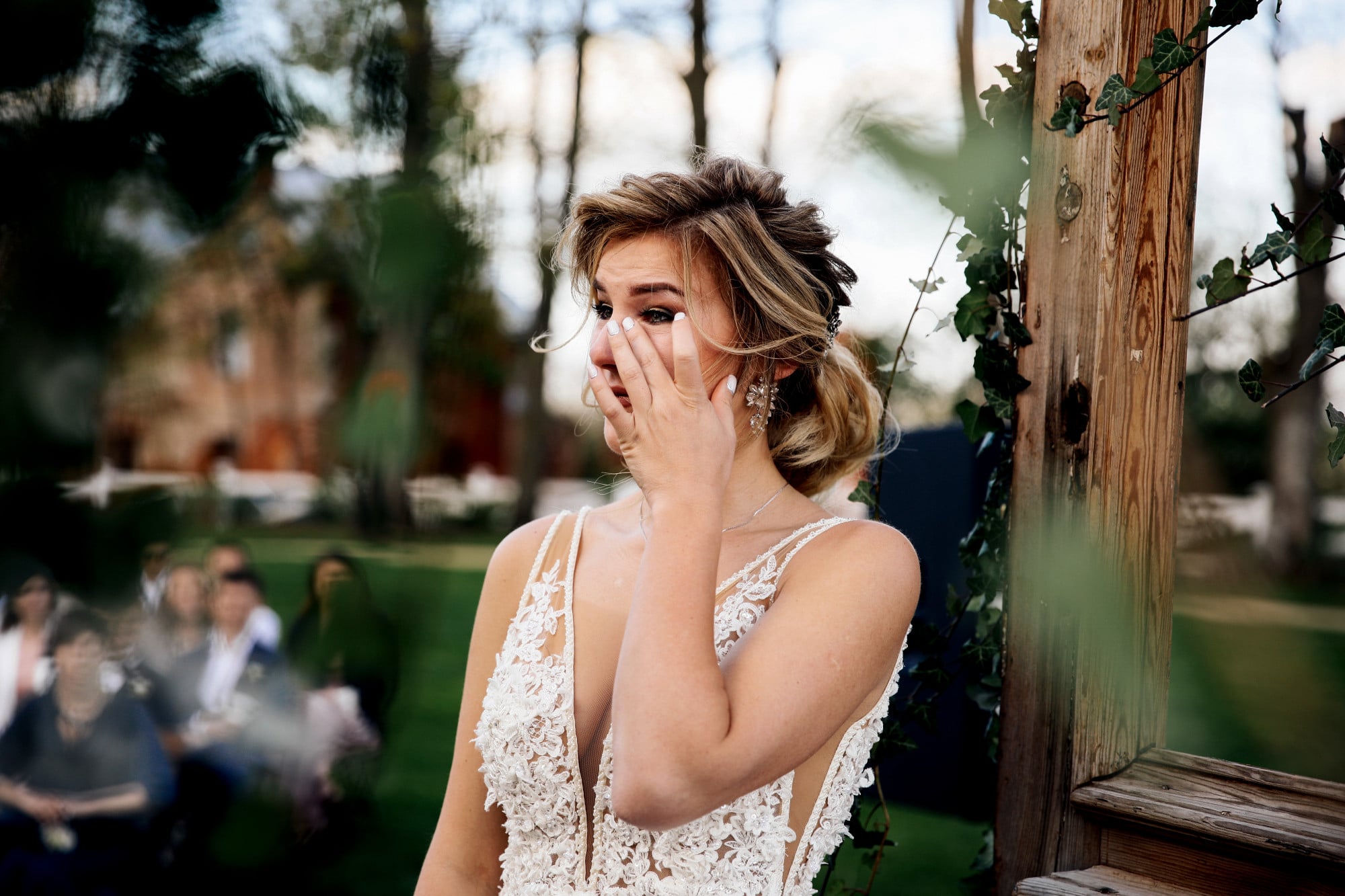
Cold mud soaked through the silk instantly.
I felt it. Seeping in. Through the ivory. Through the lining. Against my skin. Cold. Wet. Heavy.
My dress.
My dress.
I looked down.
The left side was black. From my shoulder to my hem. Mud everywhere. On the silk. In the beading. In the tiny seed-pearl lilacs Margaret spent three weeks sewing by hand.
The train was dragged into it. Twisted. Soaked.
I heard gasps.
Behind me. All around me. Guests had been watching. From the barn. From the path. From the garden.
Somebody said Oh my God.
Somebody said Is she okay?
Carol stood over me.
She covered her mouth with her hand.
“Oh my God!” she said. Loud. Very loud. So everybody could hear. “Oh my God! I slipped! Are you okay?”
I looked up at her.
At her face.
At her eyes.
They weren’t shocked.
They weren’t sorry.
They were satisfied.
Just for a second.
A little light in them. A little glint.
Like she’d finally done something she’d been waiting a long time to do.
Tears blurred my vision.
I sat there in the mud. On my knees. In my ruined dress.
And everything crashed down on me at once.
Every you’re sweet but. Every more polished. Every is that what you can afford. Every peasant food. Every are you sure this isn’t a mistake.
Every that’s just how she is.
Four years of it.
All at once.
In the mud.
“I’m fine,” I whispered.
I wasn’t.
I reached up to my neck.
To touch my mother’s locket.
It was gone.
The chain had snapped. When I fell. It wasn’t on my neck.
I looked down. At the mud. Black. Thick. Up to my wrists.
It was in there.
Somewhere.
My mother’s locket.
In the mud.
I started to cry.
Really cry.
On my knees. In front of a hundred and twelve people.
My husband stood frozen.
Frank. By the barn door. Twenty feet away.
He’d turned around when he heard the gasps. He saw me in the mud.
He didn’t move.
He just stood there. With his mouth open. Looking at me. Looking at his mother.
Guests murmured.
Nobody stepped in.
Nobody helped me up.
Nobody said anything to Carol.
They just stood there. On the path. In the garden. By the barn. Watching.
Carol’s friends from the Women’s Club. Frank’s cousins. My friends from the bakery. Joy the photographer, with her camera still raised.
Nobody moved.
Except one person.
My father-in-law.
Garold.
He walked across the garden.
Slowly. Steadily. In his gray suit. His big boots on the wet grass.
Not on the path. Straight through the garden. Through the wet grass. Through the mud. He didn’t care.
He didn’t come to me.
He walked past me.
He stopped directly in front of Carol.
He was six-foot-three. She was five-foot-four. Even in her heels.
He looked down at her.
The garden went completely still.
Even the birds stopped.
Nobody had ever seen Garold Lindqvist stand in front of his wife.
Not once.
In thirty-six years of marriage.
“Carol,” he said.
Quietly. Very quietly. Barely above a whisper.
But everybody heard.
“Tell them,” he said. “Or I will.”
Carol blinked.
Her face went white.
Not pale. White. Like paper. Under her makeup.
She looked up at her husband.
She looked at the guests. Watching.
She looked at me. In the mud.
“Garold,” she said.
Her voice was different. Low. Sharp. A voice I’d never heard her use in public.
“Don’t you dare—”
But it was too late.
Garold turned around.
He faced everyone.
A hundred and twelve people.
He looked at me first.
On my knees. In the mud. Crying.
His face changed. Something in it broke.
Then he looked up.
At the guests.
“She didn’t slip,” he said.
The garden was dead silent.
“I was watching her,” Garold said. “The whole time. From the moment she walked down that path.”
He looked at Carol.
“She walked to the edge of Nina’s train,” he said. “She waited until the photographer was looking at her screen. Until Frank had his back turned.”
He pointed at Carol’s feet.
“Her heels are on the stone,” he said. “Both of them. Look. She didn’t slip. Her feet never left the path.”
Everybody looked.
Carol’s heels. White. Satin. On the flagstone.
Clean.
Not a speck of mud on them.
“She put her hand on Nina’s back,” Garold said. “And she pushed. Hard. On purpose.”
He looked at the guests.
“I watched her do it,” he said. “From fifteen feet away.”
Carol’s face went from white to red.
“He’s lying,” she said. Loud. “He’s confused. He’s—Garold, you’ve had too much champagne. You don’t know what you saw.”
“Mrs. Lindqvist.”
A woman’s voice.
From the path.
Joy. The photographer.
She was standing on the flagstones. Holding her camera. Looking at the screen.
Her face was white too.
“I had it on burst mode,” Joy said quietly. “Twelve frames a second. I was setting up the shot.”
She looked up.
“I didn’t see it happen,” she said. “I was looking at the screen. But the camera did.”
She turned the camera around.
She held up the screen.
Everybody leaned in.
Frame one. Carol bending down behind me. Her hand reaching toward my train.
Frame two. Carol’s hand not on my train. On my back. Flat. Fingers spread.
Frame three. Carol’s arm extended. Her elbow straight. Her weight forward. My body tipping sideways.
Frame four. Me in the air. My hands out.
Frame five. Carol standing perfectly upright. Both heels on the stone. Looking down.
Frame six.
Her face.
Looking at me in the mud.
Smiling.
Somebody in the crowd gasped.
Then somebody else.
Paige, Frank’s sister, walked forward.
She looked at the screen.
She looked at her mother.
“Mom,” she said. Her voice was shaking. “You smiled.”
Carol grabbed for the camera.
Joy pulled it back.
“Give me that,” Carol said. “That’s private property. That’s my son’s wedding. You have no right—”
“Ma’am,” Joy said. “I’ve been photographing weddings for nineteen years. I’ve seen a lot of mothers-in-law.”
She held the camera against her chest.
“I’ve never seen one do that,” she said.
“There’s more,” Garold said.
Everybody turned back to him.
He was standing in the middle of the garden. In his gray suit. With mud on his boots.
He looked very tired.
He looked very old.
He looked like a man who’d been carrying something heavy for a very long time.
“Carol,” he said. “This is your last chance. Tell them.”
Carol looked at him.
She didn’t say anything.
Garold nodded slowly.
“Okay,” he said.
He reached up.
He unbuttoned the cuff of his left sleeve.
He rolled it up.
Slowly.
To the elbow.
His arm was covered in scars.
Not one. Many.
Burns. Old ones. White and shiny. New ones. Pink and angry.
Bruises. Yellow. Green. Purple. Old ones fading. New ones dark.
A long, thin scar along his forearm. Stitched once. Badly.
And on the back of his hand, the curved burn. The shape of something round.
The shape of the bottom of a coffee pot.
The garden went silent.
Garold held up his arm.
So everybody could see.
“Thirty-six years,” he said quietly.
Nobody moved.
“She started in 1990,” Garold said. “When Frank was two. She threw a frying pan. It hit my shoulder. I told the doctor I fell off a dock.”
He looked at the scar on his forearm.
“1998,” he said. “A kitchen knife. She was cutting onions. I said the roast was a little dry. I told the ER I cut myself on a saw.”
He turned his hand over. The curved burn.
“2009,” he said. “A coffee pot. Off the burner. She held it against my hand. Because I forgot to pick up her dry cleaning.”
He looked at the guests.
“I told everybody it was a welding torch,” he said.
Frank was standing by the barn door.
His face was gray.
“Dad,” he said.
Barely a whisper.
Garold didn’t look at him.
Not yet.
“Every year,” Garold said. “Something. A slap. A shove. A burn. A thrown plate. She broke my wrist in 2015. Pushed me down the basement stairs. I told the doctor I slipped on ice.”
He looked at Carol.
“In June,” he said.
“I wear long sleeves,” Garold said. “Every day. Thirty-six years. In July. In ninety degrees. On the docks. Because if I roll them up, people see.”
Carol’s face was twisted now.
Red. Furious. Not afraid. Angry.
“You’re lying,” she said. “You’re a liar. You’re humiliating me. In front of everyone. At my son’s wedding.”
“I’m not humiliating you, Carol,” Garold said. “I’m telling the truth.”
“Nobody will believe you,” Carol said. “A man? Six-foot-three? Two hundred and forty pounds? Beaten by his wife?”
She laughed.
A terrible laugh.
“They’ll laugh at you, Garold,” she said. “They’ll laugh.”
“I know,” Garold said.
He looked at her for a long time.
“That’s why I never said anything,” he said. “For thirty-six years. Because I knew they’d laugh.”
He looked at me.
In the mud.
On my knees.
Holding my ruined dress in my muddy hands.
“Until today,” he said.
“She’s done it to other people,” Garold said.
He looked at the crowd.
“Not just me,” he said.
He looked at Paige.
Paige closed her eyes.
“Paige,” Garold said gently. “Tell them why you moved to Oregon.”
Paige opened her eyes.
She looked at her mother.
Her chin was trembling.
“When I was fifteen,” she said, “she slapped me. In the car. On the way to school. Because I wore lip gloss. She said I looked cheap.”
She swallowed.
“She hit me so hard my head hit the window,” Paige said. “I had a concussion. She told the school nurse I fell in gym.”
The crowd murmured.
“I left when I was eighteen,” Paige said. “I went as far as I could go. Portland. Two thousand miles.”
She looked at her father.
“I asked Dad to come with me,” she said. “He said he couldn’t leave Frank.”
Frank made a sound.
“And Danielle,” Garold said.
Frank went very still.
Danielle Moreau.
Frank’s girlfriend in college. Before me. They dated for three years. Frank told me about her once. He said it ended badly. He said she just stopped calling. He never knew why.
“Danielle came to Thanksgiving,” Garold said. “In 2016. Frank brought her home.”
He looked at Carol.
“In the kitchen,” he said. “After dinner. When Frank was watching football with me. Carol took Danielle to the back porch. To show her the garden.”
He swallowed.
“Danielle came back in ten minutes later,” Garold said. “Crying. With a red mark on her cheek. She wouldn’t say what happened. She left that night. She never came back.”
Frank was staring at his mother.
“Mom,” he said. “What did you do to Danielle?”
Carol didn’t answer.
“She called me,” Garold said quietly. “Danielle. A week later. At the office. She told me what happened. On the porch.”
He looked at his son.
“Carol slapped her,” Garold said. “And told her if she married you, she’d make her life a living hell. And then she told her she’d tell you Danielle was cheating on you. If she ever said anything.”
Frank sat down.
On the wet grass. In his gray suit. With a lilac in his lapel.
He put his face in his hands.
“I didn’t tell you,” Garold said. “I should have. I didn’t. I was a coward. I thought—I thought if I kept her calm, if I kept her happy, she’d leave you alone. She’d leave Paige alone. She’d only take it out on me.”
He looked at his son on the grass.
“I was wrong,” he said. “She never stopped. She just got better at hiding it.”
Then Garold looked at me.
In the mud.
“When Frank brought Nina home,” he said, “I watched Carol. The first night. At dinner. I watched her look at Nina’s hands. At the burns from the ovens.”
He looked at Carol.
“And I knew,” he said. “I knew what she was going to do. I’ve seen that look for thirty-six years.”
“I tried to stop it,” Garold said. “In my way. I told Carol to leave her alone. Every night. After every dinner. In our kitchen. Where nobody could see.”
He touched the newest bruise on his arm. Dark. Purple. From last week.
“Every time I said it,” he said, “Carol made me pay.”
He looked at the guests.
“Last Tuesday,” he said, “I told Carol I’d tell everyone. At the wedding. If she did anything to Nina.”
He held up his arm.
“She threw a cast iron skillet,” he said. “It hit my arm.”
“I didn’t think she’d do it,” Garold said. “In front of everybody. In front of a hundred people. With a photographer standing right there.”
He looked at Carol.
“I thought,” he said, “even you wouldn’t do that.”
Carol looked around.
At the guests.
At their faces.
Her friends from the Women’s Club. Barbara. Lorraine. Nancy. Standing together by the barn. Staring at her.
Her cousins. Frank’s cousins. The pastor from St. Joseph’s.
All of them.
Staring.
She took a step back.
Toward the path.
Toward the parking lot.
Toward her white Lexus.
“I’m leaving,” she said. “I’m not staying here to be slandered. By a drunk old man and a—”
She looked at me.
“—a baker,” she said.
She turned around.
She started walking.
Nobody planned it.
Nobody said anything.
But the guests moved.
Barbara from the Women’s Club stepped onto the path. In front of her. In her yellow dress.
Nancy stepped next to her.
Then Lorraine.
Then Frank’s cousin Mike. Big. A firefighter in Sturgeon Bay.
Then my friend Sofia from the bakery.
Then the pastor from St. Joseph’s.
Then Paige.
They formed a line.
Across the narrow stone path.
Between Carol and the parking lot.
Nobody touched her.
Nobody said anything.
They just stood there.
Carol stopped.
She looked at them.
“Get out of my way,” she said.
Nobody moved.
“Get out of my way!” Carol screamed.
Barbara looked at her.
Barbara Haugen. Sixty-two. Carol’s best friend for thirty years. Vice president of the Sturgeon Bay Women’s Club.
“Carol,” Barbara said quietly. “I’ve known you since 1994. I’ve had dinner at your house a hundred times. I’ve sat next to Garold at every Christmas party.”
She looked at Garold’s arm.
“I always wondered,” Barbara said, “why he never rolled up his sleeves.”
She looked back at Carol.
“I’m not getting out of your way,” she said.
The guests surrounded her.
Not close. Not touching. Just a circle. On the path. In the garden. Behind the barn.
Carol stood in the middle of it. In her pale blue silk. Her white hat. Her clean satin heels.
Trapped.
Then somebody pulled out a phone.
It was Mike. Frank’s cousin. The firefighter.
He held it up.
“I’m calling the Door County Sheriff,” he said.
“For what?” Carol shrieked. “I slipped!”
“For assault,” Mike said. “On Nina. On camera.”
He looked at Garold’s arm.
“And then,” he said, “they can ask Uncle Garold about the rest.”
The sheriff’s deputies arrived fourteen minutes later.
Two of them. A man and a woman. In tan uniforms. With hats.
They walked into the garden.
They saw a bride on her knees in the mud.
They saw a hundred and twelve wedding guests standing in a circle.
They saw a blonde woman in pale blue silk standing in the middle of it.
They saw a big gray-haired man with his sleeve rolled up.
The female deputy looked at Garold’s arm.
She looked at it for a long time.
Then she looked at Carol.
“Ma’am,” she said. “I’m Deputy Halvorsen. I need you to come with me.”
They took Carol to the Door County Justice Center in Sturgeon Bay.
In the back of a patrol car.
In her pale blue silk and her white hat.
The guests watched her go.
Nobody said anything.
As the patrol car pulled out of the parking lot, Carol looked out the back window.
At the barn. At the garden. At the guests.
At me.
I was still on my knees in the mud.
I looked back at her.
I didn’t look away.
Then Garold knelt down next to me.
In the mud.
In his gray suit. His knees sinking into the black clay. He didn’t care.
He looked at me.
“Nina,” he said. “Are you hurt?”
“No,” I whispered. “My dress is.”
“I know.”
“And my necklace,” I said. “My mother’s locket. It broke. It’s in the mud. Somewhere.”
Garold looked at the mud.
He looked at me.
Then he put his hands in it.
His big, scarred hands. Burned and broken and bruised. Into the black Wisconsin clay. Up to his wrists.
He started feeling around.
“Mr. Lindqvist,” I said. “You don’t have to—”
“Garold,” he said. “Please.”
He kept searching.
“I’ve been digging in Lake Michigan mud for forty years,” he said. “Docks. Pilings. Boathouses. I know how to find things in mud.”
Paige knelt down on my other side.
She put her hands in the mud too.
Then Sofia from the bakery.
Then Barbara from the Women’s Club. In her yellow dress.
Then Mike the firefighter.
Then Joy the photographer. She took her camera off. She handed it to Theo. She knelt down.
Frank was still sitting on the grass.
He watched them.
All of them. On their knees. In the mud. Digging for my mother’s locket.
Then he got up.
He walked over.
He knelt down in front of me.
In his gray suit. With the lilac in his lapel.
He put his hands in the mud.
“Nina,” he said. “I’m sorry.”
I didn’t say anything.
“I’m so sorry,” Frank said. “That’s just how she is. I said it a hundred times. I said it about you. I said it about Dad. I said it about the mug.”
He was crying.
“I knew,” he said. “Somewhere. I always knew. I just didn’t want to.”
He looked at his father. On his knees in the mud. With his sleeve rolled up.
“I learned it from him,” Frank said quietly. “Looking at my plate. Saying Yes, Mom. Not seeing.”
Garold stopped digging.
He looked at his son.
“I’m sorry, Frankie,” he said.
Frank shook his head.
“You don’t have anything to be sorry for, Dad.”
“I do,” Garold said. “I let you grow up thinking that’s what marriage is. Keeping quiet. Looking at your plate. Taking it.”
He looked at me.
“I almost let you do it to her,” he said.
Garold found the locket.
Eleven minutes later.
He pulled his hand out of the mud.
He opened it.
There it was.
Black. Covered in clay. The chain broken in two places.
But the locket was closed.
Oval. With the tiny lilac sprig on the front.
He held it out to me.
I took it.
My hands were shaking.
I wiped the mud off with my thumb.
I opened it.
Inside, two pictures.
Me as a baby.
My abuela Rosa as a young woman in Puebla.
Dry.
Perfect.
Not a speck of mud.
I started to cry.
“She sealed it,” I whispered. “My mom. When she had it engraved. She had the jeweler put a little rubber gasket inside. She said in case I ever went swimming in it.”
I laughed. Through the tears.
“I never went swimming in it,” I said.
Garold looked at the locket.
“Smart woman,” he said quietly.
We didn’t stop the wedding.
Everybody thought we would. The caterer. The DJ. The venue coordinator. They all came up to me. Do you want to cancel the reception? Do you want to go home?
I stood up.
In the garden. In my ruined dress.
The whole left side black with mud. From my shoulder to my hem. The train soaked. The beading caked. The seed-pearl lilacs Margaret spent three weeks on, filled with clay.
“No,” I said.
I looked at the guests.
A hundred and twelve people. Most of them with mud on their knees. On their hands. On their nice clothes.
“We’re having a reception,” I said. “I worked nine months on this. I made twelve kinds of cherry pie.”
Somebody laughed.
“And I’m wearing this dress,” I said.
The venue coordinator, a woman named Kristin, looked at me.
“Nina,” she said gently. “There’s a spare dress in the bridal suite. One of our emergency ones. White. It might fit.”
I looked down at my dress.
At the mud.
At the black clay on the ivory silk.
“No,” I said. “This is my dress.”
I held up my mother’s locket. Muddy. Broken chain.
“My mother came to Wisconsin from Puebla when she was nineteen,” I said. “She cleaned rooms at a resort in Fish Creek. She scrubbed toilets for rich people for nine years. She came home every night with her hands raw. She never once complained.”
I looked at the guests.
“She used to say, Mija, there’s no shame in dirt. Dirt washes off. Shame doesn’t.”
I looked down at my dress.
“This dirt washes off,” I said.
I looked at Garold. At his arm. At his sleeve still rolled up.
“What we just saw doesn’t,” I said.
We had the reception.
In the barn. Under the string lights. With the hayloft doors open and the sunset coming in.
I wore my muddy dress.
Frank wore his muddy suit.
Half the guests had mud on their knees. Barbara Haugen had mud all down the front of her yellow dress. She didn’t care. She danced to September with Mike the firefighter and laughed so hard she had to sit down.
We ate my mother’s mole poblano. And tamales. And arroz rojo. And Door County whitefish.
Nobody called it peasant food.
Barbara had three helpings.
We ate twelve kinds of cherry pie.
And then the DJ called for the father-daughter dance.
I hadn’t planned one.
I didn’t have a father. My mother was gone. I’d told the DJ to skip it.
But he called it anyway.
I looked at him. Confused.
Garold was standing next to the DJ booth.
He’d asked.
He walked across the barn floor.
In his gray suit. With mud dried on the knees. And his sleeve still rolled up.
He hadn’t rolled it back down.
Not all evening.
He stopped in front of me.
He held out his hand.
His big, scarred, burned hand.
“Nina,” he said. “Would you dance with me?”
I took his hand.
The DJ played a song.
I didn’t recognize it at first.
Then I did.
Bésame Mucho.
My mother’s favorite song.
She sang it in the kitchen. Every Sunday morning. While she made pan dulce. Off-key. Loud. With flour on her hands.
I looked at Garold.
“How did you know?” I whispered.
“Paige asked Sofia,” Garold said. “From your bakery. Sofia said your mother sang it every Sunday. Sofia said you sing it too. In the bakery. At four in the morning. When you think nobody can hear.”
I started to cry.
Again.
I’d cried more that day than in three years.
Garold held me.
We danced.
Slowly. Around the barn floor. Under the string lights. Him in his muddy suit with his sleeve rolled up. Me in my muddy dress with my mother’s locket in my hand.
“Thank you,” I whispered. “For what you did. In the garden.”
Garold didn’t say anything for a long time.
“I should have done it thirty-six years ago,” he said finally.
“You did it today.”
“I did it today,” he said. “Because of you.”
I looked up at him.
“Because of me?”
He looked at the mud on my dress.
“You fell,” he said. “In front of everybody. In the mud. And you didn’t scream. You didn’t fight. You didn’t run.”
He swallowed.
“You said I’m fine,” he said. “And you were crying.”
He looked at me.
“I’ve said I’m fine for thirty-six years,” he said. “With my sleeves rolled down.”
He shook his head.
“I watched you on your knees in that mud,” he said. “Saying I’m fine. And I thought, No. Not her. Not one more person in this family saying I’m fine.”
Carol was charged with assault.
Misdemeanor battery. On me. For the push. The photographs were the evidence. All twelve frames.
Then Garold went to the sheriff.
On Monday.
With a folder.
He’d kept a record.
Thirty-six years.
Every injury. Every date. Every lie he told every doctor.
Photographs. Polaroids at first. Then digital. In a shoebox in his workshop. Under the workbench. Behind a can of wood stain.
ER records he’d requested himself, years ago, and never shown anybody.
A journal. Leather. Brown. In his blocky handwriting.
June 14, 2015. Pushed down basement stairs. Left wrist. Told Dr. Ruiz I slipped on ice. It was June.
“Why did you keep all this?” Deputy Halvorsen asked him. “If you never planned to tell anybody?”
Garold looked at the shoebox.
“In case something happened to me,” he said quietly. “I wanted somebody to know. After. Why.”
Carol was charged with domestic battery. Eleven counts. The ones within the statute of limitations.
She pleaded no contest in October.
Two years probation. A domestic abuse intervention program. Twenty-six weeks. Anger management. A no-contact order. With Garold. And Paige. And me.
She moved to a condo in Green Bay.
She left the Women’s Club. The Garden Society. The altar guild.
Barbara Haugen became president of the Women’s Club in September.
The first thing she did was start a fund. For domestic violence survivors in Door County.
All genders.
She called it the Long Sleeves Fund.
Garold filed for divorce in August.
He moved out of the big house on the bluff in Ephraim.
He bought a little cabin. On the water. Outside Baileys Harbor. One bedroom. A porch. A dock he built himself.
He goes to a support group now.
In Green Bay. Every Thursday. For men who’ve been abused by their partners.
He said there were six men at the first meeting. Now there are fourteen.
He said the first time he went, he sat in the parking lot for forty-five minutes before he went in.
He said the first time he spoke, he couldn’t finish a sentence.
He said a man named Ray, seventy-one, a retired paper mill worker from Kaukauna, put his hand on his shoulder and said, Take your time. We’ve all got time now.
He wears short sleeves.
All summer. On the docks. In the sun.
The scars show.
He doesn’t care.
He told me once that people stare. At the gas station. At the hardware store.
“What do you do?” I asked.
“I let them,” he said.
Frank and I go to counseling.
Every week. A woman named Dr. Engstrom in Sturgeon Bay.
Frank goes alone too. On Tuesdays.
He’s learning things.
He’s learning that That’s just how she is isn’t a reason. It’s an excuse.
He’s learning that looking at your plate is a choice.
He doesn’t look at his plate anymore.
When something’s wrong, he says it.
Sometimes too loud. Sometimes at the wrong time. He’s still learning.
But he says it.
Paige moved back from Oregon in October.
She lives in Sturgeon Bay now. She works at the hospital. She’s a social worker.
She comes to the bakery every Saturday morning at six-fifteen. Before I flip the sign.
She knocks on the glass.
I let her in.
I give her a morning bun.
And the dress.
I couldn’t throw it away.
I took it to Margaret. At the bridal shop in Green Bay. The woman who spent three weeks hand-sewing the seed-pearl lilacs.
She looked at it for a long time.
The mud. Dried now. Cracked. Black. Down the whole left side.
“Oh, honey,” she said. “I can clean it. It’ll take a while. But I can get most of it out.”
I looked at the dress.
At the mud on the ivory silk.
At the clay caked in the tiny pearl lilacs.
“No,” I said.
Margaret looked at me.
“Don’t clean it,” I said. “Preserve it. The way it is.”
She preserved it.
It’s in a shadow box now.
On the wall of my bakery. Behind the counter. Where everybody can see it.
Ivory silk. Hand-beaded lilacs. And the whole left side black. From shoulder to hem. Wisconsin clay.
Under it, a little brass plate.
My mother said there’s no shame in dirt.
Dirt washes off.
Silence doesn’t.
People ask about it.
Tourists. Every summer. They come in for morning buns and cherry pie. They see the dress. They ask.
Did you fall at your wedding?
I tell them the truth.
No. I was pushed.
By someone who’d been pushing people for thirty-six years.
And a quiet man finally stood up and said so.
Last month was our first anniversary.
Garold came to dinner.
At our little house in Sturgeon Bay. Frank grilled whitefish. I made mole. Paige brought a bottle of wine.
Garold brought something too.
A small box. Wrapped in brown paper. Tied with twine.
He handed it to me.
Inside was my mother’s necklace.
The thin gold chain. Repaired. Both breaks soldered so you couldn’t see them.
And the oval locket. Cleaned. Polished. The tiny lilac sprig shining.
“I took it to a jeweler in Green Bay,” Garold said. “The week after the wedding. You’d given it to me to hold during the reception. Remember? You didn’t want to lose it again.”
I didn’t remember.
“You never asked for it back,” Garold said. “I think you forgot.”
“I did forget,” I whispered.
“I wanted to fix it right,” Garold said. “So it would last. For your daughter. Someday.”
I opened the locket.
Me as a baby. My abuela Rosa.
And on the inside of the lid, where it used to be blank, there was something new.
Engraved. Tiny. In script.
She was there.
I looked at Garold.
He looked at the table.
“You said that,” he said. “At the wedding. When you put it on in the morning. Paige heard you. You’re here, Mamá.”
He swallowed.
“I wanted you to know,” he said. “She was. In the mud. When it mattered.”
He looked up at me.
“She sent the person who’d finally say something,” he said.
I put the necklace on.
Frank fastened the clasp.
After dinner, we sat on the back porch.
The four of us. Me and Frank. Paige. Garold.
Looking out at the bay. At the sunset over the water.
Garold was wearing a short-sleeved shirt.
Blue. Plaid.
His arms were bare.
The scars catching the last of the light.
Frank looked at his father’s arms for a long time.
Then he said something.
“Dad,” he said. “Can I ask you something?”
“Of course.”
“In the garden,” Frank said. “At the wedding. You said Carol, tell them. Or I will.”
“I did.”
“What if she’d told them?” Frank said. “What if she’d admitted it? Right there? That she pushed Nina? Would you have still rolled up your sleeve?”
Garold didn’t answer right away.
He looked at his arms.
At the burns. The bruises. The scar from the kitchen knife. The curved burn from the coffee pot.
“Yes,” he said finally.
“Why?” Frank said. “If she’d confessed?”
Garold looked out at the bay.
“Because it wasn’t about the push,” he said quietly. “Not really.”
He looked at me.
“It was about the I’m fine,” he said. “Nina on her knees in the mud. Saying I’m fine. With her mother’s necklace lost. With a hundred people watching. Nobody helping.”
He looked at his son.
“I’d been saying I’m fine for thirty-six years,” he said. “So had you. That’s just how she is. So had Paige. In Portland. Two thousand miles away.”
He held up his arm.
“I wasn’t going to let one more person in this family say I’m fine,” he said.
Frank looked at his father for a long time.
Then he reached over.
He unbuttoned the cuff of his own shirt.
He rolled up his sleeve.
There was a scar.
On his forearm. Small. Old. White.
A burn. In the shape of a curling iron.
Paige put her hand over her mouth.
“I was nine,” Frank said quietly. “I knocked over her makeup. On the bathroom counter. She pressed the curling iron against my arm.”
He looked at it.
“I told my teacher I burned it on the stove,” he said. “Making grilled cheese.”
Garold put his face in his hands.
“Frankie,” he said. “I didn’t know. I swear to God. I didn’t know.”
“I know you didn’t, Dad,” Frank said.
He looked at the scar.
“I’ve worn long sleeves since I was nine,” he said. “I just never noticed I was doing it.”
Nobody said anything for a long time.
The sun went down over the bay.
Then Paige rolled up her sleeve too.
People ask me sometimes about my wedding day.
They’ve heard the story. It went around Door County like wildfire. The bride in the mud. The mother-in-law arrested. The quiet father-in-law who rolled up his sleeve.
They want to know about the push. The photographs. The deputies.
I tell them about that.
But mostly, I tell them about the dance.
A big, quiet man with his sleeve rolled up. Dancing with a bride in a muddy dress. To Bésame Mucho. Under string lights in a barn in Egg Harbor.
In front of everybody.
For thirty-six years, he hid.
Long sleeves. I’m fine. Yes, Carol. Looking at his plate.
He told me once he thought nobody would believe him.
A man. Six-foot-three. Two hundred and forty pounds.
They’ll laugh at you, Garold.
Nobody laughed.
A hundred and twelve people stood in a garden with mud on their knees.
And formed a line across a narrow stone path.
And didn’t move.
That’s what I tell them.
Sometimes the person who saves you isn’t the one you married.
It’s the quiet one at the end of the table.
The one in long sleeves.
The one you thought agreed with everything.
He was just waiting.
For someone to fall.
So he could finally stand up.

Adrian Hawthorne is a celebrated author and dedicated archivist who finds inspiration in the hidden stories of the past. Educated at Oxford, he now works at the National Archives, where preserving history fuels his evocative writing. Balancing archival precision with creative storytelling, Adrian founded the Hawthorne Institute of Literary Arts to mentor emerging writers and honor the timeless art of narrative.