“I’ve been seeing someone.”
I remember exactly where I was sitting when my husband said it.
At our kitchen table. The old pine one we bought at an estate sale the year Josh was born. I was in the chair by the window, the one with the wobbly back leg. I had a pen in my hand, because I’d been writing out a list of things I needed to return to the medical supply store. A shower chair. A walker. A box of unopened bed pads.
My mother had been dead for nineteen days.
Daniel was sitting across from me with his hands folded on the table. He wasn’t looking at me. He was looking at the salt shaker.
“Who?” I said.
He looked down.
“It doesn’t matter,” he said.
“For how long?”
He was quiet for a long moment.
“Long enough,” he said.
Those two words ended fourteen years of marriage.
I’ve thought about them a thousand times since. Long enough. How strange it is that a whole life can come apart over two words. Not even a sentence. Not even an explanation.
I put the pen down.
I remember that the refrigerator was humming. I remember that the dishwasher was running, because I’d started it before he came in. I remember the light coming through the window, late afternoon, falling across the table in a long yellow stripe.
And I remember that I didn’t cry. Not then.
I just sat there and looked at him. At the man I’d married when I was twenty-five. At the gray coming in at his temples. At his hands, folded on the table, very still.
“Get out,” I said.
He nodded.
He didn’t argue. He didn’t explain. He didn’t beg.
He just got up from the table and went upstairs, and I heard him open the closet in our bedroom.
My name is Claire. I’m forty-eight years old.
Daniel and I met at a friend’s Fourth of July barbecue when I was twenty-three. He was standing by the grill, trying to flip burgers with a pair of salad tongs because somebody had lost the spatula. Half the burgers were on the ground. He looked so serious about it.
I walked over and said, “You know those are for salad.”
He looked at the tongs. Then at me.
“I’m improvising,” he said.
“You’re failing,” I said.
He laughed. A big, surprised laugh. And he handed me the tongs.
I flipped the rest of the burgers. We talked the whole time. Then we talked for the rest of the night, sitting on the back steps, while everybody else watched the fireworks.
We were married two years later.
He was an architect. He designed schools, mostly. Elementary schools and libraries. He had a way of looking at a building like it was a puzzle he was trying to solve. He’d stand in a doorway for ten minutes, just looking at the light coming in through the windows.
He was quiet. Not shy. Just quiet. He thought before he talked. He listened.
He had terrible jokes. The worst jokes you’ve ever heard. Puns, mostly. He told them with a completely straight face, and then he’d wait, and when you groaned, he’d smile like you’d given him a present.
He sang in the car. Off-key. Loudly. To everything. Jazz, mostly. He loved old jazz. Every Sunday morning, he’d put on a record, Miles Davis or Chet Baker or Ella Fitzgerald, and make pancakes for the whole family.
Emma was born when I was twenty-eight. Josh came two years later.
Wait. I’m getting that backward. Josh was first. Josh is the older one. He’ll be furious if he ever reads this.
Josh was born when I was twenty-eight. Emma came two years later.
Every Sunday morning, from the time they were old enough to sit at the table, Daniel made them pancakes. Josh wanted blueberries. Emma wanted chocolate chips. Every single Sunday. Chocolate chips.
“Emma, you can’t have chocolate chips every week,” I’d say.
“Why not?”
“Because it’s basically cake.”
“So?”
And Daniel would look at me over the stove with a little smile and drop a handful of chocolate chips into the batter.
We were happy.
I want to say that clearly. I want to be honest about it.
We were happy for a long time. Not perfect. We argued about money sometimes. About whose turn it was to take out the trash. About whether Josh should be allowed to play tackle football. About Daniel working too late on deadlines.
But we were happy.
Then my mother got sick.
My mother was diagnosed with heart failure when I was thirty-eight.
My father had died years before. I was an only child. There wasn’t anybody else.
At first, she could live on her own. She had her little house across town. I drove over twice a week to check on her, bring her groceries, make sure she was taking her pills.
Then she fell in her kitchen and couldn’t get up. She lay on the floor for six hours before a neighbor found her.
After that, she moved in with us.
She lived with us for three years.
I can’t really explain those three years to someone who hasn’t done it. I’ll try.
I organized her medication. Eleven different pills, some twice a day, some three times. A big plastic box with little compartments for every day of the week. I refilled it every Sunday night at the kitchen table.
I took her to every doctor’s appointment. Cardiologist. Nephrologist. Her regular doctor. The lab, every two weeks, for blood work.
I helped her bathe. At first, she just needed someone to help her get in and out of the tub. Then she needed help washing her back. Then she needed help with everything.
At night, when she couldn’t be left alone, when her breathing got bad and her legs swelled up and she got confused, I slept on the couch in the living room. Right outside the door to the guest room, where she was. So I could hear her if she called.
She called at all hours.
Claire. Claire, I can’t breathe.
Claire, where am I?
Claire, I need the bathroom.
Claire, is it morning yet?
Daniel helped when he could. He really did. I want to be fair.
He built a ramp to the back door so she could get out to the garden in her wheelchair. He drove her to appointments when I was sick. He sat with her on Sunday afternoons and watched old movies with her, the black-and-white ones she loved.
But I was the one she called. Always. At two in the morning. At four in the morning. It was always Claire.
And for three years, I was so tired that I didn’t remember what not being tired felt like.
Somewhere in there, our marriage turned into something else.
It turned into a schedule. A list of appointments. A conversation about whose turn it was to pick up Mom’s prescriptions. Text messages that just said Did you give her the 4pm pill? and Running late, can you get Josh from practice?
We stopped going to the movies. We stopped going out to dinner. We stopped sitting on the back porch at night, talking. We stopped talking about anything at all except Mom.
I didn’t notice it happening.
I was too tired to notice.
My mother died in March. In the guest room. In the middle of the night.
I was asleep on the couch, right outside her door. I didn’t hear her. That’s the thing I still think about. After three years of hearing every sound she ever made, I didn’t hear the last one.
I found her in the morning.
At the funeral, people kept telling me I’d done everything right. That she’d been lucky to have me. That I should be proud.
I nodded and thanked them.
After the funeral, at home, I sat in the living room on the couch. The couch I’d slept on for three years. Daniel sat down next to me.
“How are you doing?” he said quietly.
I didn’t answer right away.
Then I told him something I’d never told anyone. Something I was ashamed of.
“I feel guilty,” I said.
“For what? Claire, you did everything for her.”
“I feel guilty,” I said, “because part of me is relieved. That I can sleep through the night now. That I don’t have to listen for her.” I put my face in my hands. “What kind of person feels relieved when her mother dies?”
He put his arm around me.
“An exhausted one,” he said.
I leaned against him.
“I want my life back,” I said into his shoulder. “I want us back. I want to go to the movies. I want to go out to dinner on a Friday night. I want a whole weekend where nobody needs anything from me.”
He didn’t say anything.
He just held me. For a long time.
I didn’t notice that his hand was shaking.
Nineteen days later, he sat across from me at the kitchen table and said, I’ve been seeing someone.
The divorce happened fast.
Faster than I would have thought possible. Faster than anybody I knew who’d ever gotten divorced.
Daniel didn’t fight for anything.
He didn’t fight for the house. The house we’d bought together when I was pregnant with Josh. The house he’d spent ten years fixing up, weekend by weekend. He signed it over to me.
He didn’t fight for most of our savings. He took a small amount. Enough for a deposit on an apartment and a few months of rent. He left the rest. The college funds. The retirement accounts. All of it.
He didn’t fight about the kids. My lawyer, a sharp woman named Patricia Gold, proposed a parenting schedule. Every other weekend, and Wednesday nights. Daniel’s lawyer, who I think was just a friend of his doing him a favor, looked at it for about two minutes and said, “That’s fine.”
That was it.
The whole thing was done in four months.
I thought I understood.
I thought he was in a hurry. Eager to start over. Eager to get to her. Whoever she was. I thought he didn’t fight for the house because he didn’t want it anymore. Because he had somewhere better to be.
I thought he was buying his way out.
I thought he felt guilty. Good. I wanted him to.
But no woman ever appeared.
That was the strange part. The part that bothered me, in the back of my mind, for years.
There was never anybody.
Josh and Emma went to his apartment every other weekend at first. They never met anyone. Never saw a woman’s toothbrush in the bathroom, or a second coffee mug in the sink, or a pair of earrings on the nightstand.
Our friends saw him around town. Shopping alone at the grocery store. Eating alone at the diner on Main Street, in a booth in the back, with a newspaper.
Always alone.
He moved into a small apartment on the other side of town. A one-bedroom, on the ground floor of an old brick building near the train station.
And he got quiet.
He’d always been quiet. But this was different. He got so quiet that after a while, even the kids stopped asking him personal questions. They’d go over for the weekend and watch TV and come home on Sunday night and say, “It was fine.” That was all. It was fine.
At first, I told myself the woman must have left him.
That she’d been a fling. That it hadn’t worked out. That he’d blown up his whole life for nothing.
And I told myself I was glad.
I told myself I was glad to see him still hurting. Still alone. Still eating at a diner by himself on a Friday night.
I said it out loud, once, to my friend Anna, over a glass of wine.
“Good,” I said. “I hope he’s miserable.”
Anna looked at me for a long time over her glass.
“Are you?” she said.
“Am I what?”
“Glad.”
I didn’t answer her.
Josh was fifteen when it happened. Emma was thirteen.
They took it differently.
Josh got angry. Loud angry. He slammed doors. He quit the soccer team. He refused to go to his father’s apartment after the first three months. He just stopped going. Daniel would come to pick him up on Friday nights, and Josh would stay in his room with the door locked and his music turned up.
Daniel would stand in the front hallway for a few minutes. Then he’d say, “Tell him I’ll see him next time,” and leave.
He never forced it. He never fought it. He never once called a lawyer about it.
He just kept showing up. Every other Friday. And standing in the front hallway. And leaving.
Emma was different. Emma got quiet. Like her father.
She kept going to his apartment for a while. Every other weekend. But she’d come home and go straight to her room and not talk about it.
When she was fifteen, she stopped going too.
When she was seventeen, she graduated from high school a year early. She was valedictorian. She gave a speech in the high school gymnasium about resilience.
Daniel came to the graduation. He sat in the very back row of the bleachers, by himself.
We had a dinner afterward. At the Italian place downtown. My friends. Emma’s friends. Anna and her husband.
Emma made me promise not to invite her father.
“I don’t want him there,” she said. “I don’t want to have to look at him. Not tonight. Not on my night.”
So I didn’t invite him.
And when one of Emma’s friends asked, during dinner, “Where’s your dad?” Emma said, very loudly, so the whole table could hear, “We don’t talk about him.”
But here’s the thing.
He came to everything.
Every birthday. Every school play. Every soccer game Josh played before he quit. Every piano recital. Every graduation. Josh’s high school graduation. Emma’s. Josh’s first college semester orientation day, when Josh wouldn’t even look at him.
He came to everything.
He’d sit in the back. He’d watch. He’d clap.
And then he’d leave before dessert.
Every single time. Before the cake. Before the presents. He’d stand up quietly in the middle of things and slip out the side door. Sometimes I wouldn’t even notice he’d gone until I looked over and his chair was empty.
I thought he was being rude. I thought he couldn’t stand to be around us. Around me.
I thought he had somewhere better to be.
I remember Josh’s eighteenth birthday.
We had a little party in our backyard. Burgers. Josh’s friends from college. Some of the neighbors.
Daniel came. Josh didn’t talk to him. Daniel stood by the fence, holding a paper plate, not eating.
When it was time to go down the steps from the deck to the yard, I saw him grip the railing. Both hands. White-knuckled. He went down very slowly. One step at a time. Like an old man.
He was forty-eight.
I walked over to him.
“Are you okay?” I asked. I didn’t really want to know. I was just being polite.
“Twisted my ankle,” he said. “Last week. Stepping off a curb. Stupid.”
He was wearing a blue shirt. A light blue button-down. I remember because it was the one I’d bought him for our tenth anniversary.
“You should ice it,” I said.
“I will,” he said.
He left before the cake.
That was five years of my life.
Five years of hating him. Five years of being glad he was alone. Five years of telling the kids it wasn’t their fault, and believing that it was his.
And then, on a Friday afternoon in October, my phone rang.
I was at work. I’m a medical receptionist at a family practice. I was sitting at the front desk, checking in a patient, when my cell phone buzzed in my pocket.
I didn’t recognize the number. I almost let it go to voicemail.
I answered it.
“Claire?”
It was Daniel’s voice.
But it didn’t sound like Daniel. It sounded thin. Slow. Like he was talking through cotton.
“Daniel? Is that you?”
“Can you come?” he said.
“Come where?” I said. “What’s going on? What happened?”
There was a long pause. I could hear beeping in the background. A machine. And a woman’s voice on a loudspeaker, paging a doctor.
“I’m at St. Luke’s,” he said. “Room four-twelve.”
“The hospital? Daniel, what happened? Are you hurt? Were you in a car accident?”
“Please,” he said. “Please come. I need to tell you something.”
“Tell me what? Daniel, you’re scaring me.”
“I’ll tell you when you get here.”
He took a breath.
“And Claire,” he said. “Please. Don’t call the kids yet.”
I told my supervisor I had a family emergency.
I don’t know why I said family. He wasn’t my family anymore. Hadn’t been for five years.
But that’s what came out of my mouth.
When I got to Room 412, I stopped in the doorway.
I barely recognized him.
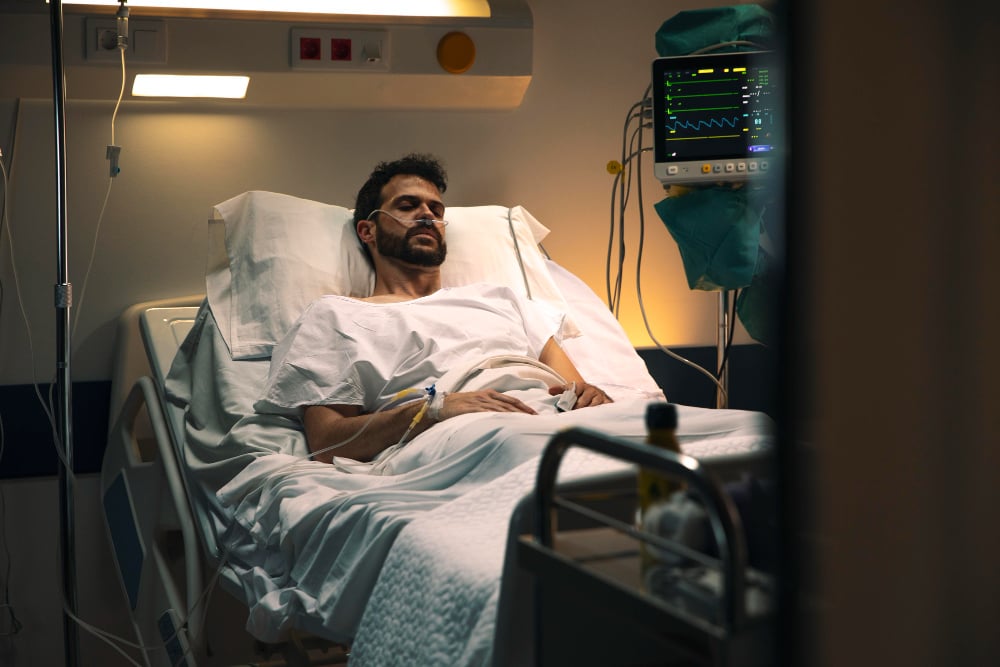
He was lying in a hospital bed with the head raised up. There was an IV in the back of his left hand. A clip on his finger. Wires running from under his gown to a monitor on the wall.
He’d lost so much weight. His cheeks had sunk in. His collarbones stuck out under the thin hospital gown. His hair was almost completely gray now.
He was trying to pull the blanket up over his chest. His right hand was gripping the edge of it. His left hand just lay there on the mattress, curled, not quite moving the way it should.
There were bruises up and down his right forearm. Dark purple. Yellow at the edges. Old ones and new ones.
He saw me in the doorway.
“Thank you for coming,” he said.
His voice was very soft. And a little slurred. Like he’d had a couple of drinks. But I knew he hadn’t.
I didn’t come in all the way. I stood just inside the door with my purse still on my shoulder.
“What is this about, Daniel?”
He looked at me for a long time.
“Something I should have told you,” he said, “five years ago.”
I sighed. I was so tired, suddenly. I’d been tired of him for five years.
“Daniel,” I said. “If this is about the divorce…”
“I never cheated on you,” he said.
I laughed.
It came out of me like a bark. Short and ugly. Even though nothing was funny. Even though nothing about any of this was funny at all.
“You told me,” I said, “that you were sleeping with someone else. You sat at our kitchen table and told me.”
“I know,” he said.
“You watched me pack your clothes. You stood in our bedroom and watched me throw your shirts into garbage bags.”
“I know.”
“You let the children believe you’d destroyed our family.”
Tears were running down his face now. Slowly. He didn’t wipe them.
“I know,” he said.
I stood up straighter. I took a step toward the bed.
“Then why,” I said, “would you lie about something like that?”
Daniel tried to sit up straighter in the bed.
His left hand slipped off the edge of the blanket. It fell to his side, limp. He reached over with his right hand and picked his left hand up by the wrist and set it back on top of the blanket.
Like it was an object. Like it wasn’t part of him.
I watched him do it.
Something cold went through my whole body.
“Because I was sick,” he said.
“What?”
He took a long breath. It rattled a little in his chest.
“Five years ago,” he said, “a neurologist diagnosed me with a progressive neurological disease. It’s called multiple system atrophy. MSA.”
I’d never heard of it.
I work in a medical office. I hear about diseases every day. I’d never heard of that one.
“It affects movement,” Daniel said. He said it slowly, like he’d memorized it. Like he’d said it to himself a hundred times. “Balance. Coordination. And things your body usually does without you having to think about them. Blood pressure. Heart rate. Bladder control. Digestion.”
He looked down at his left hand on the blanket.
“Eventually,” he said, “swallowing. And breathing. Those can get very difficult.”
I looked at the equipment beside his bed. The monitor with its green numbers. The IV pole. The plastic tube coming out of the wall, with a nasal cannula lying on the pillow next to his head.
“Is this why you’re here?” I said.
“I fainted,” he said. “At home. On Wednesday night. My blood pressure drops when I stand up. Sometimes it drops so fast I just go down. I hit the floor in the kitchen. I couldn’t get back up.” He swallowed. “I lay there for a while. A long while. Then my neighbor heard me calling. Mrs. Okafor. Upstairs. She called the ambulance.”
I sat down.
There was a plastic chair beside his bed. I didn’t decide to sit in it. My legs just stopped holding me up, and I sat.
“Five years,” I said. “You’ve known about this for five years?”
He nodded.
“And instead of telling your wife,” I said slowly, “you told her you loved somebody else?”
He was quiet for a long time.
“Your mother had just died,” he said finally.
I stared at him.
“I remember what you said,” Daniel said. “After the funeral. On the couch. You said you felt guilty because you were relieved. Because you could sleep through the night. You said you wanted your life back.”
He looked at me.
“I’d gotten the diagnosis two weeks before that,” he said.
I couldn’t breathe.
“Two weeks before Mom died?”
“I’d been having problems for months,” he said. “I kept getting dizzy when I stood up. My handwriting was getting small. I tripped on the stairs a few times. I thought it was stress. Mom was so sick. We were both so tired. I thought I was just tired.”
He looked down at his hands.
“Then my left hand started shaking. At work. At my drafting table. I couldn’t hold a pencil straight. So I went to a doctor. And then a neurologist. And then another neurologist.” He swallowed. “And then I sat in an office downtown, and a woman with very kind eyes told me what it was. And what was going to happen.”
“You didn’t tell me.”
“Your mother was dying, Claire. In our guest room. You were sleeping on the couch. You hadn’t slept a whole night in three years.”
“So you made up an affair,” I said.
“I remembered what you said,” he said again. Quietly. “I want my life back. I’d just been told I was going to need someone to help me bathe. Help me eat. Help me with my medications. Help me use the bathroom. For years. Maybe a lot of years.” He looked at me. “I’d just watched you do all of that for your mother. For three years. I’d watched what it did to you.”
“I meant,” I said, and my voice broke, “I meant I wanted to go to the movies, Daniel. With you. I wanted to go out to dinner. I wanted weekends where we didn’t have to worry about Mom’s pills. I wanted us.”
He didn’t say anything.
“I didn’t mean I wanted to be free of you,” I said.
“I thought you were finally free,” he said. “I thought, she’s finally free. She’s finally got her life back. And now I’m going to take it away from her again. All over again. And this time, it’ll be worse. Longer. And she’ll do it, because she’s Claire, and Claire always does it. And it’ll eat her alive.”
“Free to do what?” I said. “Free to lose my husband?”
He looked away. At the window. At the gray October sky.
“The specialist couldn’t tell me how fast it would go,” he said. “Some people get worse in three years. Some people last ten. I didn’t know. Nobody knew.” He swallowed. “I remembered what you’d gone through. Every single night. I couldn’t ask you to do that again. Not for me.”
“You didn’t ask me anything,” I said.
“I thought you’d stay,” Daniel said. “Just because you felt like you had to. Because you were my wife. Because that’s who you are. You’d stay out of duty. And you’d end up hating me anyway. Just slower.”
“So you made me hate you,” I said. “Faster.”
He closed his eyes.
“I figured you’d meet somebody,” he said. “Someone healthy. The kids would grow up in the house. You’d have a chance at another life. A better one.”
“You decided,” I said, “what kind of life I deserved. Without even giving me a vote.”
“I know,” he said. “I know I was wrong.”
“No,” I said. “You know it failed. That’s different.”
He didn’t answer that.
I sat there in that plastic chair and tried to understand.
For five years, I’d imagined her. The other woman.
I’d imagined what she looked like. Younger than me, probably. Prettier. Thinner. Somebody who didn’t smell like hospital soap and exhaustion. Somebody who wasn’t sleeping on a couch outside her mother’s room.
I’d imagined running into them at the grocery store. What I’d say. What I’d wear.
I’d imagined confronting her. A hundred times. In my car. In the shower. At three in the morning.
And worse than that.
I’d blamed myself.
For years, I’d blamed myself. For being so exhausted during Mom’s illness that I stopped paying attention to him. For not noticing he was pulling away. For letting our whole marriage turn into appointments and pill schedules and text messages about who was picking up Josh. For not being enough.
I’d thought, Of course he found someone else. Look at me. Look at what I turned into.
And now he was telling me there was nobody.
That he’d watched me suffer, for five years, believing all that about myself.
And he’d called it kindness.
“Did you ever plan to tell me?” I said. “Ever?”
“At first, no,” he said. “I thought that was the whole point. That you’d never know. That you’d just move on.”
“And later?”
“Later,” he said, “I was ashamed. Every year I thought about it. Every birthday. Every Christmas. And every year, I thought, It’s too late now. It’s been too long. It’ll just hurt her all over again.” He looked at me. “I kept thinking I’d waited too long. And then I’d wait another year.”
I wiped my face with the back of my hand. Hard. Angrily.
“Emma wouldn’t let anyone say your name at her graduation dinner,” I said. “Did you know that? Her best friend asked where you were, and she said, We don’t talk about him. In front of everybody.”
He flinched.
“Josh spent three years refusing to stay at your apartment,” I said. “Three years, Daniel. He locked himself in his room every other Friday so he wouldn’t have to see you. He quit soccer. He failed two classes his junior year. Did you think about that?”
“Every day,” Daniel said.
“Then you should have told them.”
He covered his eyes with his right hand.
“I didn’t want them watching me become helpless,” he said into his hand. “I didn’t want my son to have to help me to the bathroom. I didn’t want Emma to have to feed me with a spoon. I didn’t want that to be what they remembered.”
“They were already watching you disappear,” I said.
He started crying harder then.
Big, heaving sobs that shook his whole body in the bed. The monitor beeped faster.
I sat there in my plastic chair.
I couldn’t comfort him.
Not yet. I couldn’t.
A nurse came in. A young woman with a long braid, in purple scrubs.
“Sorry to interrupt,” she said. “I just need to check his blood pressure.”
She looked at Daniel. Then at me. Then she looked at the monitor, and back at me again. She didn’t say anything. But I saw her face.
“I’ll step out,” I said.
I went into the hallway.
I walked down to the end of it, by a window that looked out over the parking lot. I stood there with my forehead against the cold glass.
Then I took out my phone and called Anna.
Anna and I have been best friends since we were nine years old. She’s a high school English teacher. She has three kids and a husband named Marcus who builds furniture in their garage. She knows everything about me. She’s the only person I told, at the time, about Daniel saying long enough.
She picked up on the first ring.
“Claire? Are you okay?”
“I need you to tell me I’m not imagining this,” I said.
I told her everything.
I stood there by the window and whispered it into the phone. The hospital. The bruises. The left hand he had to pick up with his right. Multiple system atrophy. The diagnosis two weeks before Mom died. I want my life back.
I never cheated on you.
Anna listened without saying a word. Not one.
When I finished, she was quiet for a long time.
Then she said, “Claire. You’re allowed to be furious with him.”
I didn’t answer.
“You’re allowed,” she said. “Even if he’s dying.”
I hadn’t said he was dying.
I hadn’t said that word. Not once. I hadn’t even thought it. Not in so many words.
I turned around and looked back down the hallway. Through the open doorway of Room 412.
The nurse was gone. Daniel was alone. He was trying to drink from a little plastic cup of water with a straw. His right hand was shaking so badly that the water was spilling down his chin. Onto his gown. He kept trying.
“Is he?” Anna asked quietly.
I watched him try to get the straw into his mouth.
“I don’t know,” I whispered.
When I went back into the room, there was a folder sitting on his bed.
A thick manila folder. He’d gotten it out from somewhere. His bag, maybe. It was lying on the blanket next to his right hand.
“I asked Mrs. Okafor to bring this,” he said. “From the apartment. Yesterday. I knew I was going to call you.” He pushed it a little toward me. “I thought you’d want to see it. So you’d know I wasn’t lying. Again.”
I picked it up. I sat back down in the plastic chair. I opened it.
Inside were five years of medical records.
Appointment summaries. Lab results. Lists of medications, crossed out and rewritten as they changed. Physical therapy notes. Occupational therapy notes.
And a letter from his neurologist. Dr. Rebecca Shaw. On letterhead from the university hospital downtown. Dated five years ago. March.
Two weeks before my mother died.
Based on clinical presentation, autonomic testing, and MRI findings, I am confirming a diagnosis of multiple system atrophy, parkinsonian type…
I read the whole folder.
It took me almost an hour. Daniel didn’t say anything while I read. He just lay there with his eyes closed.
The diagnosis had been confirmed years ago. Twice. By two different specialists.
Over time, his walking had gotten worse. His balance. He’d started using a cane three years ago. A walker last year.
Lately, his blood pressure had been dropping suddenly whenever he stood up. Sometimes so fast that he fainted. There were notes about four falls in the last six months. Four that he’d reported, anyway.
His doctor had told him to stop driving. A year and a half ago. There was a letter about it.
And then there were the notes I couldn’t stop reading.
Patient missed scheduled appointment. Called to reschedule. Patient reports difficulty arranging transportation.
Patient missed scheduled appointment.
Patient missed scheduled appointment. Reports he could not find a ride.
He’d missed his own doctor’s appointments.
Because he couldn’t drive. And he had nobody to ask.
He lived four miles from me.
“Why didn’t you tell Emma?” I said. “Or Josh? When they got older? Josh is twenty, Daniel. He has a car. He could have driven you.”
Daniel opened his eyes.
“I was afraid they’d feel responsible,” he said. “For taking care of me. They’d already lost the family they grew up with. Because of me. I didn’t want them to spend their twenties driving their sick father to appointments and cleaning up after him. I didn’t want that for them.”
“So you let them believe you were a cheating husband,” I said, “instead.”
He looked down at the blanket.
“I thought they’d move on,” he said. “That they’d be angry for a while, and then they’d get over it, and they’d just… live their lives. And by the time I realized how much I’d actually hurt them…”
He stopped.
“I didn’t know how to tell them the truth,” he said. “I didn’t know how to undo it.”
“Do you hear yourself?” I said.
He was quiet for a long time.
“I’ve spent five years,” he said, “trying to spare people trouble. Trying not to be a burden. Trying to make everything easier for everybody.”
He laughed a little. A short, broken laugh.
“And I’ve made more trouble,” he said, “than I ever could have imagined.”
I left before dinner.
I stood up and put the folder back on his bed and picked up my purse.
He watched me.
“Will you come back?” he said.
I didn’t answer.
I didn’t promise anything. I couldn’t. I didn’t know what I was going to do. I didn’t know what I felt. I didn’t know anything.
I just walked out.
I drove home. I don’t remember the drive.
I walked into my house. The house that used to be ours. The house he’d signed over to me without a fight.
I went into the living room. To the cabinet under the bookshelf, where I keep the old photo albums.
I hadn’t opened that cabinet in five years.
I sat on the floor and opened the drawer full of old family photographs. Loose ones. The ones that never made it into albums.
There were hundreds of them.
Daniel teaching Emma to ride a bike in our driveway. She was seven. She had pink training wheels and a helmet with butterflies on it.
Josh asleep on Daniel’s chest on the couch when he was a baby. Both of them asleep, actually. Daniel’s mouth open. Josh’s tiny fist curled around Daniel’s shirt.
The four of us at the beach in South Carolina. All of us sunburned. Daniel holding Emma upside down by her ankles while she screamed with laughter.
I looked at them one at a time.
Then I found one from the year before the divorce.
Daniel’s birthday. His forty-third. We’d had a little party in the kitchen, just the four of us and my mother, in her wheelchair at the end of the table.
In the picture, Daniel was holding his birthday cake. Chocolate. With too many candles. I was standing next to him, laughing at something outside the frame. Probably something Josh said.
I remembered that evening.
After the cake, Daniel had started washing the dishes. Halfway through, he’d stopped. He’d turned off the water and pulled out a kitchen chair and sat down right there in the middle of the kitchen, with soap still on his hands.
“What’s wrong?” I’d said.
“Nothing,” he said. “Just tired.”
“Getting old,” I teased. “Forty-three and you can’t even do the dishes.”
He smiled.
But he didn’t get up for several minutes. He just sat there in the kitchen chair with soap on his hands, looking at nothing.
I sat on the living room floor holding that photograph.
Was he already afraid then? Had he already noticed something? The dizziness? His handwriting getting small?
Was he already trying to figure out how to tell me?
And I’d made a joke.
At ten o’clock that night, I called the hospital.
I asked to speak to Daniel’s doctor.
The nurse who answered said the doctor would need Daniel’s permission before she could share any medical information with me. Since I wasn’t his wife anymore.
Since I wasn’t his wife anymore.
She put me on hold. She went to ask him.
She came back two minutes later.
“He says yes,” she said. “He says you can know anything you want. Anything at all.”
The doctor called me back the next morning. Her name was Dr. Amara Singh. She was the hospitalist in charge of his care.
She explained things gently. Slowly. The way I’ve heard doctors explain things to families a thousand times, sitting at my front desk at work.
His condition had gotten much worse, she said. Much faster in the last six months.
He’d developed serious swallowing problems. When he tried to eat or drink, some of it went into his lungs instead of his stomach. Two weeks ago, before he fell, he’d developed something called aspiration pneumonia. An infection in his lungs. From food and water getting in where it shouldn’t.
He’d been sick at home for almost two weeks. Alone. With a fever. Not eating.
That was probably part of why he fainted.
“We’ve treated the pneumonia with antibiotics,” Dr. Singh said. “But his body isn’t responding the way we’d hoped. His lungs are very weak. His swallowing is getting worse. And the disease itself is very advanced now.”
She paused.
“I want to be honest with you, Claire,” she said. “We’ve reached a point where further treatment is very unlikely to reverse what’s happening. Our priority now is keeping Daniel comfortable.”
I was standing in my kitchen. At the counter. By the coffee maker. Holding the phone.
“How much time does he have?” I said.
There was a long pause.
“It’s very difficult to predict exactly,” she said gently. “But we’re concerned that he may only have days.”
Days.
I put my hand flat on the kitchen counter to hold myself up.
I’d just found out. Yesterday. I’d just found out the truth. That he hadn’t cheated. That he’d been sick. That he’d been alone for five years.
And now I had days.
Not years. Not months.
Days.
That afternoon, I went to his apartment.
Daniel had asked me to. He’d called me that morning, after I talked to Dr. Singh. His voice was even weaker than the day before.
“Could you bring me some clothes?” he said. “My own clothes. I hate this gown. And my reading glasses. They’re on the nightstand.” He paused. “Mrs. Okafor has a key. She lives upstairs. Apartment 2B. I’ll call her.”
I wasn’t ready for what I found.
It was a small apartment. One bedroom. Ground floor. It smelled stale. Like a room where the windows haven’t been opened in a long time.
There were dishes in the kitchen sink. Not a lot. A few plates. A bowl. A coffee mug. They’d been there for a while. There was a skin on the coffee.
Mail covered the little kitchen table. Envelopes. Bills. Unopened, a lot of them. Medical bills. I could see the hospital logos through the windows of the envelopes.
I opened the refrigerator.
There was almost nothing in it. Three cups of yogurt. Half a loaf of bread. A carton of milk that had gone bad. A bottle of something called Thick-It, a powder you add to drinks for people who have trouble swallowing.
That was it.
In the bedroom, there was a walker standing next to the bed. One of those metal ones with tennis balls on the back legs. The handle had been wrapped in duct tape, around and around, where the foam grip had worn through.
There were grab bars screwed into the wall next to the bed. Crooked. Like he’d installed them himself. With one good hand.
The bathroom smelled like damp towels. There was a plastic shower chair in the tub. And a hand-held shower head. And another grab bar.
There was a pill organizer on the bathroom counter. A big plastic one with little compartments for every day of the week. Morning, noon, evening, night.
The exact same kind I used to fill for my mother every Sunday night at the kitchen table.
Half the compartments were still full. From last week.
On the chair next to the bed, there was a shirt.
A blue button-down. Light blue.
The one I bought him for our tenth anniversary. The one he wore to Josh’s eighteenth birthday party. The day he gripped the railing with both hands going down the deck stairs and told me he’d twisted his ankle stepping off a curb.
He hadn’t twisted his ankle.
On the refrigerator, held up by a single magnet, there was a photograph.
The four of us. At the beach in South Carolina. Sunburned. Daniel holding Emma upside down by her ankles while she screamed with laughter.
The same picture I’d been holding on my living room floor the night before.
He’d kept a copy.
It was the only thing on his refrigerator.
I sat down on the edge of his bed.
And I cried.
I cried harder than I’d cried at my mother’s funeral. Harder than I’d cried the night he said long enough. Harder than I’d cried in five years.
He’d been here. This whole time. Four miles away.
Struggling. Alone. Falling down in his kitchen. Missing his doctor’s appointments because he couldn’t find a ride. Eating yogurt and bread because he couldn’t swallow anything else. Wrapping duct tape around his walker. Screwing grab bars into the wall with one hand.
And the whole time, I’d believed he was living the happy new life he’d chosen.
I’d been glad.
Good, I’d said to Anna. I hope he’s miserable.
When I got back to the hospital that evening, I had a bag of his clothes and his reading glasses.
I put them on the table next to his bed.
Then I sat down in the plastic chair.
“I went to your apartment,” I said.
He looked at me. He knew what I’d seen. I could tell.
“You should have asked someone for help, Daniel,” I said.
“I know.”
“Why didn’t you?”
He was quiet for a long time.
“I was embarrassed,” he said finally.
I looked at him.
At the man I’d once stood in front of, in a white dress, in a little church with my mother crying in the front row. The man I’d promised to spend my whole life with. In sickness and in health.
In sickness.
“You didn’t have to do everything alone, Daniel,” I said.
His eyes filled with tears.
“I know that now,” he said.
The next day, a woman from the palliative care team came to talk to us. Her name was Grace. She was in her sixties, with gray hair cut short and reading glasses on a beaded chain. She sat down on the edge of Daniel’s bed and took his good hand in both of hers.
She asked him what he wanted.
Not what the doctors wanted. Not what I wanted. What he wanted.
Daniel thought about it for a long time.
“I don’t want any more tubes,” he said. “I don’t want a feeding tube. I don’t want a breathing machine. I’ve read about it. I don’t want that.”
Grace nodded.
“I want to be comfortable,” he said. “And I want…” He stopped. “I want to be somewhere quieter. Than here. Somewhere without all the beeping.”
Grace nodded again.
She explained that a hospice might be the right place for him. If they could find a bed. There was one nearby, she said. A small one. In an old house that had been converted. With a garden. They might have a bed in a day or two.
Daniel looked over at me.
“Would you come and see me?” he asked. “There? At the hospice?”
I didn’t answer right away.
I thought about five years. About long enough. About Emma saying We don’t talk about him. About Josh locked in his room every other Friday. About the duct tape on the walker. About the blue shirt on the chair.
About the photograph on his refrigerator.
“Yes,” I said finally. “I’ll come.”
Then came the conversation I’d been dreading most.
Emma was eighteen now. She was a freshman at the state university, forty minutes away. Josh was twenty. He was a junior, at a different school, about an hour north.
The divorce had left them both with wounds that neither of them liked to talk about. Josh had gotten better over the years. He’d started going to therapy in college. He was calmer now. Quieter. But he still didn’t talk about his father. Emma hadn’t spoken a single word to Daniel in almost three years.
I’d promised Daniel I wouldn’t call them yet.
But I couldn’t keep that promise anymore. Their father was dying. In days. And they deserved the chance to see him. Whatever they decided to do with that chance.
That evening, I called them both.
“Can you come home?” I said. “Tonight. If you can. Both of you. I need to talk to you. In person.”
Josh got there first. A little after eight. He came through the front door still in his work clothes. He works part-time at a hardware store near his campus. He had sawdust on his jeans.
“Mom?” he said. “What’s going on? Is it Dad? Is Dad in trouble?”
I don’t know why he guessed that. Maybe something in my voice on the phone.
“He’s in the hospital,” I said.
Emma arrived twenty minutes later.
She came in and set down her backpack by the door. She heard the end of something Josh said.
“Is this about Dad?” she said.
I nodded.
Emma crossed her arms.
“Another excuse,” she said, “for us to feel sorry for him?”
I sat them both down on the couch.
The couch I’d slept on for three years, outside my mother’s door.
And I told them the truth.
As carefully as I could. As gently as I could. Everything. The diagnosis. The timing. The affair that never happened. Long enough. The apartment. The walker. The yogurt and bread. The missed appointments. The photograph on the refrigerator.
Neither of them interrupted me. Not once.
When I finished, Josh was staring at the floor. His elbows were on his knees. His hands were clasped together so tightly his knuckles were white.
Emma was sitting with her arms crossed. Very still.
“So he wasn’t having an affair,” Emma said finally.
Her voice was flat. Like she was reading something off a sign.
“No,” I said.
“There was never anybody.”
“No.”
“And he let us believe there was,” Emma said. “For five years.”
“Yes.”
Josh looked up from the floor.
“How long has he got?” he said quietly.
I took a breath.
“The doctors think,” I said, “it may only be days.”
Emma’s face crumpled.
All at once. Like something had been holding it up for five years and suddenly let go.
She started crying.
“I hated him, Mom,” she said. “I hated him. For what he did to you. For what he did to us. I wouldn’t even let my friends say his name. I didn’t invite him to my graduation dinner. I told everybody at my graduation dinner that we don’t talk about him.”
“I know, sweetheart.”
“He was sitting in the back of the bleachers,” Emma said. “At my graduation. I saw him. I saw him sitting there all by himself. And I was glad. I was glad he was alone.”
She put her face in her hands.
“He let me hate him,” she said through her fingers, “while he was dying?”
“He thought he was protecting us,” I said.
Emma took her hands away from her face. Her eyes were red and furious.
“That’s not protecting anyone!” she said. “That’s not protecting! That’s… that’s…”
She couldn’t finish.
I didn’t try to finish it for her. I didn’t know what it was either.
Josh wiped his eyes with the back of his wrist. Sawdust came off on his face.
“Can we see him?” he said.
“Yes,” I said. “I’ll take you both tomorrow morning.”
The next morning, we went to the hospital together.
The three of us. In my car. Nobody talked the whole way.
Emma sat in the back seat, staring out the window. Josh sat in the front, next to me, with his knee bouncing up and down.
In the elevator, Emma took my hand. She hadn’t held my hand in an elevator since she was about ten.
Daniel was sitting up in his bed when we came in.
The nurse had helped him into the clothes I’d brought. A gray T-shirt and flannel pajama pants. His reading glasses were on the table next to him. Someone had combed his hair.
He was looking at the door. Waiting. I’d told him we were coming.
When he saw the kids, his whole face changed.
“Emma,” he whispered. “Josh.”
Emma stopped at the foot of the bed.
She didn’t come any closer. She stood there with her arms wrapped around herself.
“Why didn’t you tell us?” she said.
Daniel looked down at his hands on the blanket.
“I knew if I told you,” he said, “you’d want to help. Both of you. I imagined you missing your classes. Driving home every weekend. Turning down things. Opportunities. Jobs. Trips. Spending all your free time taking care of me. Feeding me. Helping me to the bathroom.” He swallowed. “I thought if I stayed away, I’d be protecting you from that.”
“So you made us think,” Emma said, “that you were a cheating husband. Instead.”
His eyes filled.
“I thought you’d move on,” he said. “I thought you’d be mad for a while and then you’d just… go live your lives. And then later, I was so ashamed. And I didn’t know how to tell you the truth. I didn’t know how to fix it.”
Josh shook his head slowly.
He was standing by the window with his hands in his pockets.
“We would have helped you, Dad,” he said.
“I know,” Daniel said.
“You didn’t even give us the chance.”
Daniel started crying.
“I was afraid,” he said. “Of being a burden. Of being the thing you had to take care of. I convinced myself that staying away was the kindest thing I could do. For everybody.”
Emma wiped her cheeks with the sleeve of her sweatshirt.
“Well,” she said. “It wasn’t.”
“I know,” Daniel said. “I know. I’m so sorry. I’m so sorry, Emma. Josh. I’m so sorry.”
For a long moment, nobody spoke.
The monitor beeped. A cart rattled by out in the hallway. Somewhere down the hall, someone was laughing.
Then Emma walked around the side of the bed.
She pulled the plastic chair up next to him. Right next to him. And she sat down in it.
“I don’t know,” she said, “if I can forgive you yet.”
“You don’t have to,” Daniel said.
She looked at him for a long time.
Then she reached out and took his hand.
His left hand. The one that didn’t work right anymore. The one he had to pick up with his other hand and put back on the blanket.
She held it in both of hers.
“But I’m here,” she said.
Josh came away from the window.
He walked to the other side of the bed. He stood there for a moment. Then he put his hand on his father’s shoulder. Just rested it there.
Daniel reached up with his good hand and covered Josh’s hand with his.
I stood at the foot of the bed and watched them.
And for the first time in five years, the four of us were all together in one room.
Two days later, Daniel was moved to the hospice.
It was called Willowbrook. An old white farmhouse on the edge of town that had been turned into a hospice twenty years ago. There were only eight beds. Each room had a big window that looked out over a garden. There were bird feeders outside every window. And a cat named Marmalade who wandered from room to room and slept on the patients’ beds if they wanted her to.
By then, Daniel was much weaker.
He could barely sit up without help. Talking wore him out. He’d say a few sentences and then close his eyes and rest for a long time before he could say any more.
The nurses at Willowbrook were very kind. They explained everything to us. They said his condition was getting worse quickly now. They said their job was to keep him comfortable. To manage his pain and his breathing and his fear. They said that was all that mattered now.
Emma and Josh came every day.
Emma drove home from school every afternoon after her last class. Josh took the week off from work and his classes. He told his professors his father was dying. It was the first time I’d heard him say father in five years. Usually, he just said him.
Sometimes, we just sat quietly next to Daniel’s bed while he slept. Marmalade curled up at the foot of the bed. The birds came to the feeder outside the window. Chickadees and cardinals.
Other times, we brought photographs and went through them together. We told him about things he’d missed. Josh’s first apartment. Emma’s roommate who kept a pet snake in the closet. Emma’s first college boyfriend, who she’d broken up with because he didn’t like dogs.
Daniel would listen with his eyes closed. Sometimes he’d smile.
On Thursday afternoon, Emma brought a photograph.
The one from the drawer. Daniel teaching her to ride her bike in our driveway. Pink training wheels. Butterfly helmet.
She held it up in front of his face.
“Remember this?” she asked.
Daniel opened his eyes. He looked at it for a long time.
A faint smile crossed his face.
“You fell into the bushes,” he said. His voice was a whisper.
Emma laughed through her tears.
“Because you let go!” she said.
“You told me to,” Daniel whispered.
“I was seven!”
And for a moment, he laughed too. A small, wheezing laugh. It made him cough, and the nurse came in and helped him sit up until it passed.
But he’d laughed.
Later that afternoon, the kids went downstairs to the little kitchen to get coffee.
Daniel opened his eyes.
“Claire,” he whispered. “Can you stay? For a minute?”
“I’m here,” I said.
I pulled the chair closer to his bed.
He was quiet for a long time. Gathering his strength.
“Do you hate me?” he whispered.
I looked at him.
At his sunken cheeks. At the oxygen tube in his nose. At his left hand lying on the blanket, curled, not moving.
I didn’t lie to him.
“I did,” I said. “For a long time.”
He closed his eyes.
“I don’t blame you,” he said.
“I don’t hate you now, Daniel,” I said quietly. “I don’t. But I’m still hurt. I’m still so hurt.”
“I know.”
“If you’d told me,” I said, “five years ago. At the kitchen table. If you’d just told me the truth. Maybe we’d still be married. Maybe we wouldn’t. I don’t know. Maybe it would have been hard. Maybe it would have been the hardest thing either of us ever did.”
I took a breath.
“But we would have decided it together,” I said. “That’s what you took from me. Not the marriage. The choice.”
A tear slipped down the side of his face. Onto the pillow.
“I should have trusted you,” he whispered.
“Yes,” I said. “You should have.”
He reached for my hand. With his good one. His right hand. It was shaking.
I took it.
“I can’t give you those years back,” he whispered.
“No,” I said. “You can’t.”
I held his hand until he fell asleep.
It didn’t take long. A few minutes. His breathing slowed. His grip loosened.
I kept holding on anyway.
That evening, the hospice nurse took me aside in the hallway. Her name was Bernadette. She was in her fifties, Irish, with a soft accent and gentle hands.
“His breathing is changing,” she said quietly. “His body is starting to slow down. I think you should spend whatever time you can with him now. And tell the children.”
I nodded.
“How long?” I said.
“I can’t say for certain,” Bernadette said. “But I’d come early tomorrow, if I were you. Very early.”
I called Emma and Josh from the parking lot. They’d gone back to my house to sleep.
“Come back in the morning,” I said. “Early. Before breakfast.”
Emma was quiet on the phone for a long time.
“Is it tomorrow?” she whispered.
“I think it might be, sweetheart,” I said.
On Friday morning, exactly one week after Daniel called me from the hospital, I got to Willowbrook before breakfast.
It was barely light outside. There was frost on the garden.
Emma and Josh were already there.
They’d gotten up at five and driven over without me. They were sitting in the two chairs next to Daniel’s bed. Emma was still in her pajama pants. Josh had a blanket around his shoulders.
Daniel was sleeping.
His breathing was slow and uneven. He’d take a breath. Then a long pause. Then another breath. Sometimes the pause was so long that I found myself holding my own breath, waiting.
Bernadette came in and checked him. She stood next to the bed for a while and watched him breathe.
Then she turned to us.
“He’s nearing the end,” she said gently. “It won’t be very long now. He can probably still hear you. Hearing is the last thing to go. Talk to him. Hold his hand. Let him know you’re here.”
We pulled our chairs close to his bed.
Emma held his left hand. The one that didn’t work right. Josh sat right next to her, with his hand on her back.
I sat on Daniel’s right side. I held his good hand.
For a while, nobody spoke.
The birds were coming to the feeder outside the window. A cardinal. Bright red against the frost.
Then Josh took out his phone.
He scrolled for a minute. Then he pressed play and set the phone down on the pillow next to Daniel’s head.
It was jazz. An old song. A trumpet, slow and sad and sweet. Chet Baker.
The same kind of music Daniel used to play every Sunday morning, on the record player in our kitchen, while he made pancakes.
I hadn’t heard it in five years.
Daniel’s eyes opened.
Just a little. Just for a moment. He looked toward the music.
Emma leaned close to his face.
“Remember the pancakes, Dad?” she whispered.
A faint smile crossed his face.
“You always wanted chocolate chips,” he whispered.
His voice was barely there. Like the breath was carrying the words out by accident.
Emma laughed through her tears.
“Every Sunday,” she said.
Daniel turned his head. Very slowly. Toward me.
“Claire?” he whispered.
“I’m here,” I said.
His voice was barely audible. I had to lean very close to hear him.
“Will you stay?” he said.
I leaned closer. I took his hand in both of mine.
“Yes, Daniel,” I said.
“Even after everything?”
I looked at him.
I thought about the kitchen table. Long enough. The garbage bags full of his shirts. The duct tape on the walker. The yogurt and bread. The photograph on his refrigerator. The blue shirt on the chair. Five years.
“Even after everything,” I said.
He squeezed my fingers. Very weakly. Barely at all.
“Thank you,” he whispered.
I reached up and brushed his hair away from his forehead. The way I used to, a long time ago. When we were young. When he’d fall asleep on the couch with a book on his chest.
“You can rest now,” I said softly. “We’re all here. You’re not alone anymore.”
His eyes slowly closed.
We sat beside him while the music played quietly on the pillow.
Chet Baker. Then Miles Davis. Then Ella Fitzgerald.
Emma held his left hand. Josh held Emma. I held his right.
After a while, his breathing got slower. The pauses between each breath got longer. And longer.
The cardinal came back to the feeder outside the window.
Then Daniel took one long, slow breath.
And he didn’t take another one.
I waited.
I sat there, still holding his hand. Waiting for the next breath. Like I used to wait outside my mother’s door at night, listening.
It didn’t come.
Bernadette came forward from where she’d been standing quietly in the corner. She checked his pulse. She put her stethoscope on his chest and listened for a long time.
Then she looked up at us.
“He’s gone,” she said gently. “I’m so sorry.”
Emma started sobbing. She put her face against Josh’s shoulder, and Josh put his arms around her, and they held on to each other.
Josh was crying too. Quietly. The way his father used to cry.
I leaned over Daniel.
I kissed his forehead.
“Goodbye,” I whispered.
Then I pulled the blanket up gently over his hand. And I stayed there beside him, holding on to the edge of the blanket, while our children cried.
The music kept playing on the pillow.
Nobody turned it off.
We buried Daniel four days later.
It was a small service. Smaller than I expected. His sister flew in from Oregon. A few of his old coworkers from the architecture firm came. Mrs. Okafor, his upstairs neighbor, came in a black hat and cried through the whole thing. Anna and her husband came and stood right behind me.
Emma and Josh stood on either side of me, at the graveside, as his casket was lowered into the ground.
I hadn’t expected to cry as much as I did.
I’d thought I’d done all my crying. In the hospice. In his apartment. On my living room floor with the photographs.
But when Josh stepped forward and knelt down and placed a photograph beside the flowers on top of the casket, I couldn’t hold it back.
It was the one from the beach. South Carolina. The four of us. Sunburned. Daniel holding Emma upside down while she screamed with laughter.
The one from his refrigerator.
After the funeral, we went back to my house.
People came by. Neighbors with casseroles. Anna stayed until everyone else had gone, washing dishes in my kitchen. Then she hugged me at the door and said, “Call me tomorrow. And the day after. And the day after that.”
When it was just the three of us, we sat in the living room.
And for the first time in five years, we talked about Daniel without anger.
We remembered his terrible jokes.
“What do you call a fake noodle?” Josh said. “An impasta. He told me that one every single time we had spaghetti. For like ten years.”
“He told me that one at my eighth birthday party,” Emma said. “In front of all my friends. I wanted to die.”
We remembered his Sunday pancakes. Blueberries for Josh. Chocolate chips for Emma. Every single week.
We remembered how he sang in the car. Off-key. Loud. Every song. Even the ones he didn’t know the words to. He’d just make up his own.
“He sang Bohemian Rhapsody on the way to my first day of high school,” Josh said. “The whole thing. All six minutes. Every part. Including the operatic part. In the drop-off line. With the windows down.”
Emma laughed so hard she started crying again.
Then Emma got quiet.
“I wish I’d known,” she said. “Before. I wish I’d had more than a week.”
“So do I, sweetheart,” I said.
“He came to my graduation,” she said. “He sat in the back of the bleachers. By himself. And I didn’t even look at him.”
Josh put his arm around her.
“He knew you graduated first in your class,” Josh said. “He knew. He told me. In the hospital. On Wednesday, when you went to get coffee. He said he was so proud of you he couldn’t breathe.”
Emma put her face in her hands.
That evening, after the children left, I went to the cabinet under the bookshelf.
I took out our old family photograph. The one from the beach.
I’d made a copy at the drugstore before the funeral. I’d put it in a frame. A simple wooden one.
I put it on the mantel above the fireplace.
It was the first photograph of Daniel that had been on display in this house in five years.
I stood in front of the mantel and looked at it for a long time.
At the four of us. Sunburned. Laughing. Daniel holding Emma upside down by her ankles.
He looked so healthy in that picture. So strong. So happy.
He didn’t know yet.
None of us knew.
I thought about the kitchen table. I’ve been seeing someone. Long enough.
I thought about how he’d sat there and looked at the salt shaker. How he hadn’t been able to look at me.
I’d thought it was guilt.
It was. Just not the kind I thought.
“I wish you’d told me, Daniel,” I whispered.
The next Sunday morning, I woke up early.
I lay in bed for a long time, listening to the house. It was so quiet.
Then I got up and went downstairs.
I went to the cabinet in the dining room. In the back, behind the good china, there was a box of old records. Daniel’s records. He’d left them when he moved out. I’d never thrown them away. I’d never really known why.
I found the one I was looking for. Chet Baker.
The record player was in the garage, covered in dust. I carried it inside and plugged it into the outlet by the kitchen counter. I put the record on.
The trumpet started. Slow and sad and sweet.
Then I got out a mixing bowl.
At ten o’clock, the front door opened.
Josh and Emma came in together. They’d driven over without calling. They both stopped in the kitchen doorway.
They looked at the record player. At the mixing bowl. At the stack of pancakes on the plate by the stove.
Nobody said anything for a long moment.
Then Emma came over to the stove and looked at the pancakes.
“Are there chocolate chips in those?” she said.
“Every single one,” I said.
We ate at the old pine table in the kitchen. The one with the wobbly chair by the window. The one where Daniel sat five years ago and told me something that wasn’t true.
Josh sat in Daniel’s old chair.
Nobody said anything about it.
I’ve thought about it a lot since then. Whether I was right to stay angry with him, after I knew the truth. Whether I should have just let it all go, right there in that hospital room, the minute he said I was sick.
I don’t think it works like that.
I think you can understand why someone did something, and still be hurt by it. I think you can forgive someone for loving you the wrong way, and still grieve everything it cost you. I think both things can sit at the same table.
Daniel thought he was giving me my life back.
What he really took was the one thing I never got the chance to give him.
My answer.
If he’d asked me, at that kitchen table, I know what I would have said. I’ve known it every single day since that phone call from the hospital.
I would have said yes.
I would have stayed.
Not because I had to.
Because I wanted to.
The record ended. The needle clicked around and around at the center.
Josh got up and flipped it over.
Emma reached for another pancake.
And the three of us sat at the kitchen table, in the Sunday morning light, and listened to the music Daniel loved, and remembered him out loud.

Laura Bennett writes about complicated family dynamics, difficult conversations, and the quiet moments that change everything. Her stories focus on real-life tensions — inheritance disputes, strained marriages, loyalty tests — and the strength people find when they finally speak up. She believes the smallest decisions often carry the biggest consequences.