The Name on the Watch
Part One: The Dream
My husband, Aaron, and I have been together for eight years, and from the very beginning we dreamed of having a big family. We talked about it on our second date, sitting in a booth at a diner outside Grand Rapids, Michigan, splitting a slice of cherry pie. He wanted four kids at least, maybe five. I laughed and said he’d better be ready to change a lot of diapers, and he said he’d change every single one.
But there was one thing Aaron wanted more than anything, and he never pretended otherwise. He wanted a son. Even before we got married, he talked about it constantly, in a way that was sweet at first and then, slowly, became something I didn’t know how to name.
“I just can’t picture it,” he told me once, the night he proposed, as we sat on the dock at his family’s cabin on Lake Michigan. “Only daughters. I mean, I’d love them, obviously. But I need a boy, Meredith. Somebody to carry on the Bowman name.”
I remember the way he said need. Not want. Need. I remember thinking it was an odd word for a man who had everything else he wanted sitting right beside him on that dock. But I was twenty-six and in love, and I put it down to tradition and family pride and moved on.
My name is Meredith Bowman. I’m thirty-four years old, and I’m a pharmacist at a hospital in Grand Rapids. Aaron is thirty-six. He sells commercial roofing for a company his grandfather started in 1961, the company his father ran for thirty years and that now has the name Bowman & Sons Roofing painted on the side of every truck.
Bowman & Sons. I didn’t notice the significance of that sign the first time I saw it. I noticed it a lot later.
We got married in June, eight years ago, at a little Lutheran church in Holland, Michigan, with tulips in every window. Not long after, I found out I was pregnant. I took the test on a Saturday morning in our tiny apartment, and when I came out of the bathroom holding it, Aaron dropped his coffee mug on the kitchen floor.
He was over the moon. He picked me up and spun me around the kitchen in my bare feet with the coffee spreading across the linoleum. That afternoon he went to Target and came home with a tiny Detroit Lions onesie and a little foam football. “For when he’s old enough,” he said, and he set them on the dresser in the spare room like a promise.
Part Two: Four Daughters
We had a girl.
We found out at the twenty-week ultrasound. The technician moved the wand across my belly and smiled and said, “Looks like a little girl.” I looked over at Aaron. He was smiling too, but his smile had gone stiff at the corners, like a photograph held a second too long.
He loved her, of course. When Hazel was born, seven pounds, two ounces, with a full head of dark hair, he held her against his chest in the delivery room and cried. He walked the halls with her at three in the morning and sang her old Bob Seger songs off-key. But a week after we brought her home, I found the Lions onesie and the little foam football in a box on the top shelf of the closet, and I knew he’d been hoping for something else.
“Don’t worry,” he told me that night, rocking Hazel in the glider. “We’ll give her a little brother someday.”
So we had another baby, two years later. Another girl. We named her Iris.
I watched Aaron’s face at the ultrasound that time, and I saw the disappointment cross it like a cloud moving over a field. It was there for only a second before he covered it with a smile and squeezed my hand and said, “Two princesses. Lucky me.” But I’d seen it.
Then came our third daughter, Clara, and eventually our fourth, Maisie. Four girls in seven years. Our little house in Kentwood filled up with pink sneakers and hair ties and the sound of four voices shouting over each other at the dinner table. Every spare surface held a drawing or a Barbie or a half-finished craft project, and I loved every chaotic inch of it.
I adored every one of them, and Aaron was a loving father. I want to be very clear about that. He coached Hazel’s soccer team. He learned to French braid from YouTube videos, badly at first and then pretty well. He read bedtime stories in four different voices. On Saturday mornings he made pancakes shaped like Mickey Mouse, and he let all four girls pile into our bed to watch cartoons.
But whenever we found out we were expecting another girl, I saw that familiar disappointment on his face. It never stayed long. It was always there.
After four pregnancies, I was honestly exhausted. My back hurt all the time. My body didn’t feel like my own. I was working three twelve-hour shifts a week at the hospital pharmacy and coming home to four children under eight, and some nights I fell asleep at the kitchen table with my head on a pile of unfolded laundry.
After Maisie was born, I told Aaron I thought we were done. We were sitting on the back porch after the girls were asleep, watching the fireflies over the lawn. I said I was tired. I said four was a lot, and four was enough. I said we had a beautiful family.
He was quiet for a long time. “I know,” he said finally. “I know we do.” Then he said, “But what if the next one is a boy?”
I didn’t answer. I just looked out at the fireflies, and I wondered, for the first time, whether he would ever be satisfied with the family we already had.
Part Three: Bowman & Sons
To understand Aaron, you have to understand his father.
Gerald Bowman is sixty-eight years old, and he is the kind of man who fills a room without saying a word. He’s tall and heavy-shouldered, with a gray crew cut and hands like baseball mitts from forty years of roofing. He ran Bowman & Sons for three decades before he retired and handed it to Aaron. He’s not cruel, exactly. He’s just never once in his life said anything he didn’t think was true, and he doesn’t see why he should start now.
The first time I met him was at a Fourth of July barbecue at the cabin. He shook my hand, looked me up and down, and said, “Pharmacist. Good. Steady work.” Then he turned to Aaron and said, “She looks like she’d give you strong boys.”
I laughed, because I thought he was joking. He wasn’t.
When Hazel was born, Gerald came to the hospital with a bouquet of carnations from the gift shop. He held her for about thirty seconds, said, “Pretty little thing,” and handed her back. Then he patted Aaron on the shoulder and said, “Next one, son.”
When Iris was born, he didn’t come to the hospital. He sent a card. When Clara was born, he called on the phone, and I heard him through the speaker say, “Three girls. Your grandfather’s turning over in his grave.” Aaron laughed it off, but his ears turned red, the way they always do when something hurts him and he doesn’t want anyone to see.
When Maisie was born, Gerald came to the house a week later. He stood in our living room with four little girls tumbling around his feet, and he looked at Aaron for a long time. “Well,” he said. “Guess the business dies with you.”
Aaron didn’t say anything. He just went out to the garage, and I heard him in there for an hour, banging on something with a hammer.
There’s something in the Bowman family called the watch. It’s a gold pocket watch, a Hamilton railroad model from 1928, with a hunter case engraved with an elaborate letter B on the front. It belonged to Aaron’s great-grandfather, who worked on the Pere Marquette Railway. It passed to his son, then to Gerald, and when Aaron turned twenty-one, Gerald gave it to him in a little ceremony at the cabin. Inside the case, engraved in tiny script, there are four names: Thomas. Walter. Gerald. Aaron.
There’s room under Aaron’s name for one more.
“For your boy,” Gerald said, when he handed it over. “First son of the first son. Since 1928.”
Aaron keeps the watch in a velvet box in the top drawer of his dresser. Sometimes, late at night, I’d find him sitting on the edge of the bed with it open in his palm, running his thumb over the empty space under his name.
Part Four: Number Five
Then I found out I was pregnant again.
It wasn’t planned. Maisie was eighteen months old, and I’d been meaning to make an appointment to talk about birth control and kept putting it off. I took the test in the bathroom at work on my lunch break because I felt sick for three days straight. I sat on the closed lid of the toilet in a staff restroom and stared at those two pink lines and didn’t know whether to laugh or cry, so I did a little of both.
Our fifth baby.
I told Aaron that night after the girls were in bed. He was at the kitchen sink washing the dinner dishes, and I came up behind him and put the test on the counter next to the dish rack.
He looked at it. He turned off the water. He turned around, and his face was doing something I hadn’t seen it do in years. It was lit up from the inside, like a jack-o’-lantern.
“Mer,” he said. “Mer, this is it.”
“Aaron,” I said carefully, “we don’t know what it is yet.”
“I can feel it,” he said. He put both hands on my belly, still flat, and he grinned. “This time it’s finally my son.”
He said it every day after that. I can feel it. This time, it’s my son. He said it at breakfast. He said it at his mother’s birthday dinner. He said it to his crews at work, and they started calling the baby “Junior” when they called the house. He went back to the top shelf of the closet and took down the box with the Lions onesie and the foam football and washed the onesie and laid it on the dresser in the spare room again.
I tried to tell him not to get his hopes up. I tried to tell him I loved him, and that I’d love another girl just as much, and that I wanted him to love her too, if it was a her. He nodded and said of course, of course. But he never stopped saying it.
This time, it’s my son.
Our girls heard it too. That was the part I didn’t think about enough, not until later.
One afternoon in my second trimester, I was folding laundry in the living room when Hazel came and sat next to me on the couch. She was seven then, our oldest, serious and quiet like her dad, with dark hair she wanted to grow down to her waist. She picked at a loose thread on the couch cushion for a while. Then she said, “Mama, why does Daddy want a boy so much?”
I stopped folding. “What makes you ask that, sweetheart?”
She shrugged. “He says it all the time. He says, I finally get my son.” She pulled at the thread. “Didn’t he want us?”
I set down the laundry and pulled her into my lap, even though she was getting too big for it. “Of course he did,” I said. “Daddy loves you more than anything. You know that.”
Hazel nodded slowly against my shoulder. But she didn’t look convinced, and I didn’t know how to convince her, because some part of me wasn’t sure I was telling her the whole truth.
Part Five: The Ultrasound
We found out at twenty weeks, like always. Same clinic, same dimly lit room, same technician, a cheerful woman named Patty who’d done all four of our girls’ ultrasounds and knew our whole history. She squirted the cold gel on my belly and moved the wand around and studied the screen for what felt like an hour.
Aaron was holding my hand so tight my fingers went numb. Patty smiled.
“Well,” she said, “this one’s a little boy.”
For once, Aaron had been right.
He didn’t say anything at first. He just stared at the screen, at the gray, flickering shape on it. Then he put his face down against my shoulder, right there on the exam table, and his whole body started shaking. I realized he was crying.
“A boy,” he kept saying into my shoulder. “Mer. A boy.”
Patty quietly handed him a tissue and left the room to give us a minute. I lay there with gel on my stomach and my husband crying on my shoulder, and I felt so many things at once that I couldn’t sort them out. I felt happy for him. I felt relieved. And I felt something small and sharp underneath all that, something I didn’t want to look at too closely. It felt a lot like grief on behalf of four little girls waiting at home who had never once made their father cry like that.
He called his father from the parking lot. I sat in the passenger seat while he paced beside the car with his phone pressed to his ear, and I heard him say, “Dad. It’s a boy. It’s a boy, Dad.” There was a long pause. Then Aaron’s face did something I’d never seen it do. It crumpled like a little kid’s.
“Thanks, Dad,” he said quietly. “Yeah. Thanks.”
When he got back in the car, he wiped his face on his sleeve. “He said he’s proud of me,” Aaron said. He laughed a little, not quite steadily. “He’s never said that before. Not once.”
I looked at my husband, thirty-six years old, crying in a parking lot because his father had finally said he was proud of him. And I understood, for the first time, that this had never really been about a son at all.
Part Six: Danny
That night, after the girls were asleep, I asked Aaron about it.
We were lying in bed in the dark. He was still smiling. He’d been smiling all day. He’d gone to Target again after work and come home with three more onesies and a tiny pair of Nike sneakers that our son wouldn’t be able to wear for a year.
“Aaron,” I said. “Can I ask you something?”
“Mm-hmm.”
“Why does it matter so much? A boy.” I turned on my side to face him in the dark. “And don’t tell me it’s the name. I know it’s not just the name.”
He was quiet for a long time. So long I thought he might have fallen asleep. Then he said, very quietly, “I had a brother.”
I went completely still. In eight years, he had never once mentioned a brother. Not to me, not to the girls, not at a single family holiday. His mother, Carol, had never mentioned one either. Neither had Gerald.
“His name was Danny,” Aaron said. “Daniel Gerald Bowman. He was born when I was seven.”
He told me the whole story there in the dark, staring at the ceiling.
His mother had a hard pregnancy with Danny. They lived out at the cabin that winter while Gerald was rebuilding the business after a bad year, and the nearest hospital was forty minutes away on icy roads. Danny was born in February, at a little community hospital in Ludington. Eight pounds even. Black hair like Gerald’s.
“Dad was so happy,” Aaron said. “I’d never seen him like that. He walked around the hospital telling every nurse, That’s my son. Bowman and Sons. Plural now.”
They brought Danny home after two days. He seemed fine at first. He ate, he slept, he cried like any newborn. But on the fifth day, Aaron noticed something.
“I was holding him on the couch,” Aaron said. “Mom was making dinner. And I looked at his face, and his lips were blue.” His voice was barely a whisper now. “Not a lot. Just a little. Like when you’ve been swimming too long in the lake. I told Mom. She said it was the cold, the cabin was drafty. She wrapped him in another blanket.”
He swallowed.
“On the eighth night,” he said, “he stopped breathing.”
They drove him to the hospital in Ludington through a snowstorm, his mother in the back seat doing CPR the way they’d learned in a church class, his father driving ninety miles an hour on icy roads. Aaron sat in the front seat. He was seven.
Danny died in the emergency room. The doctors said it was a heart defect, something congenital, something that could have been caught with the right test if anyone had known to look.
“Dad never talked about him again,” Aaron said. “Not once. He took down every picture. He packed up Danny’s crib and his clothes and drove them to the dump. Mom cried for a year, and Dad just went to work. Every day. Twelve hours a day. Like if he worked hard enough, he could fill up the hole.”
He was crying now, silently, the tears running sideways into his ears.
“Bowman and Sons,” he said. “He never changed the sign. Every truck. For thirty years. And Sons.” He laughed, a terrible little laugh. “And there was only me. Just one. And I was never enough. I’ve known that since I was seven years old.”
I put my arms around my husband in the dark and held him.
“So when you give your dad a grandson,” I said slowly, “you think it’ll fix it.”
He didn’t answer. But he didn’t have to.
Part Seven: The Waiting
The rest of the pregnancy was hard on my body, harder than the others. I was thirty-four, and five babies in eight years had taken their toll. I had high blood pressure in the third trimester and had to go on modified bed rest at thirty-four weeks. Aaron took over everything at home: school drop-offs, soccer practices, dinners, baths, bedtime stories.
He was wonderful. He really was. But he talked about the baby constantly. He’d lie in bed with his hand on my belly and talk to him. Hey, buddy. It’s Dad. We’re gonna go fishing at the cabin. We’re gonna watch the Lions lose every Sunday. I’m gonna teach you to swing a hammer.
The girls listened. They always listened.
One night in my eighth month, I came downstairs for a glass of water at eleven o’clock and found Hazel sitting at the top of the stairs in her nightgown, hugging her knees. Below us, in the living room, Aaron was on the phone with his father, and his voice carried up the stairwell clear as a bell.
“I know, Dad,” he was saying. “I can’t wait either. Finally, right? After four tries.” He laughed. “I’ll bring him to the cabin the first weekend he can travel. You and me and him, Dad. Three Bowman men.”
I sat down on the step next to Hazel. She was crying silently, the way Aaron cries.
“What’s wrong, baby?” I whispered.
She wiped her nose on her sleeve. “Four tries,” she whispered. “That’s us. We’re the tries.”
I didn’t know what to say to her. I held her on the stairs until she fell asleep against me, and then I carried her back to bed, all fifty-two pounds of her, my enormous belly bumping the doorframe. Then I lay awake until three in the morning, trying to figure out how to tell my husband that our oldest daughter thought she was a failed attempt.
I never found the right words. I kept meaning to. Then the baby came early.
Part Eight: The Delivery
My water broke at thirty-seven weeks, on a Tuesday morning in late October, while I was standing in the kitchen packing four lunch boxes. Labor was long and exhausting, sixteen hours at Butterworth Hospital in Grand Rapids, the same hospital where I work, in a delivery room on the fourth floor with a window that looked out on the gray Grand River and the trees along the bank going red and orange.
Aaron’s mother took the girls. Gerald came to the hospital and sat in the waiting room with a cup of coffee and a newspaper he never opened. I’d never seen him at a single one of my deliveries before.
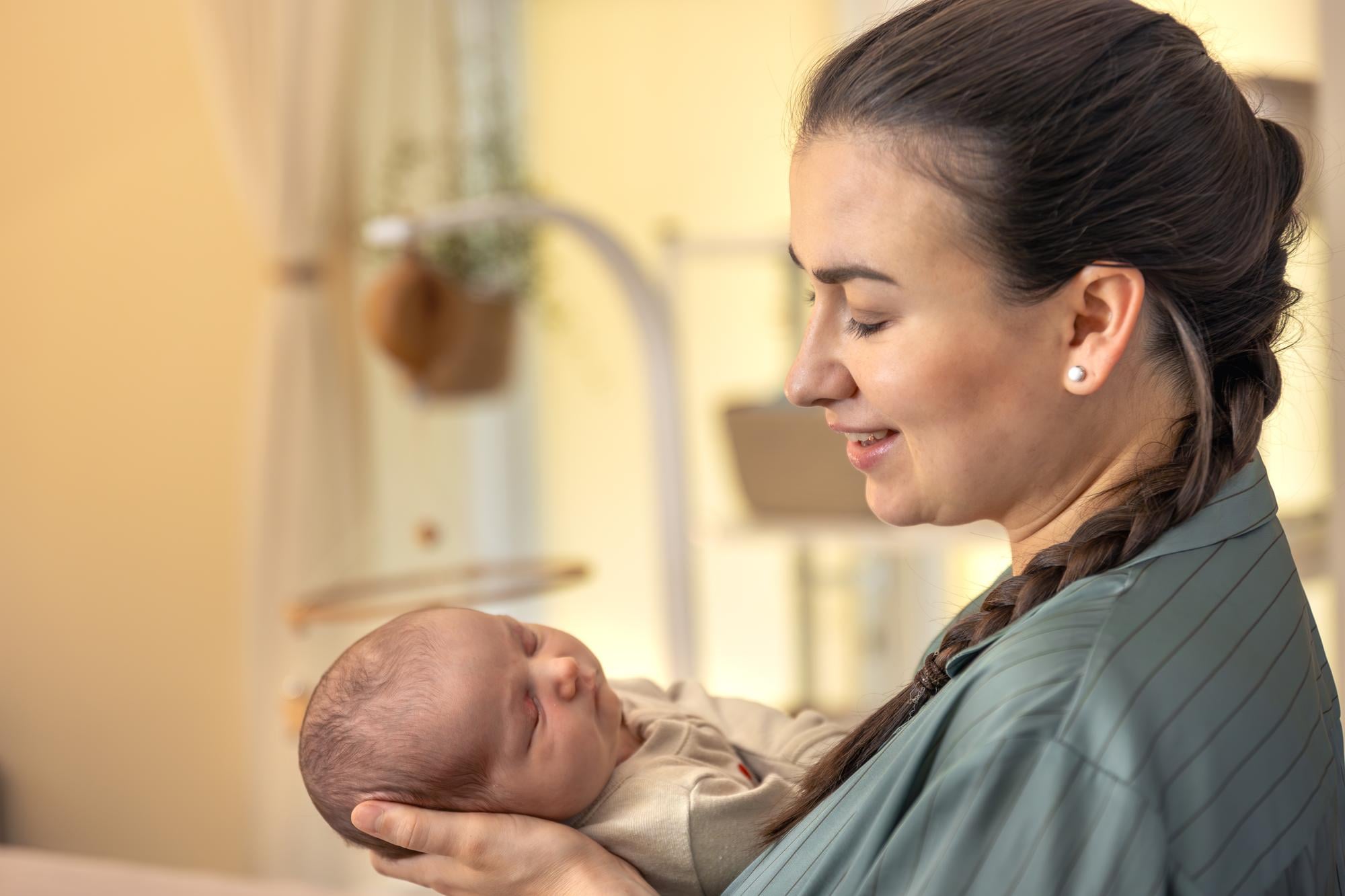
At 9:41 that night, after sixteen hours, the doctor announced that we’d welcomed a perfectly healthy baby boy. Seven pounds, eleven ounces. Twenty and a half inches long. A full head of black hair.
He came out crying, loud and angry, his little fists balled up, his face bright red.
I’ve never seen Aaron look so happy. He was practically glowing. He’d been holding my hand through the whole delivery, and when the doctor held up the baby, Aaron let go of my hand and put both of his over his mouth. His eyes filled. He laughed and cried at the same time.
“A boy,” he said. “Mer. Look at him. Look at him.”
The nurse wiped the baby down and checked him over quickly, and his Apgar scores were good, an eight and a nine. She wrapped him in a striped hospital blanket and put a little blue knit hat on his head. Then she turned around and carefully placed our newborn son in Aaron’s arms.
I watched them together. Aaron, six-foot-one, in his wrinkled flannel shirt with his reading glasses pushed up on his head. Our son, tiny and red-faced, swaddled in the striped blanket, his little mouth working as he settled down and stopped crying.
I expected Aaron to cry or laugh or say something about finally getting his wish. I expected him to say, Hi, buddy. I’m your dad. I expected him to say the name we’d picked out. I even expected him to turn toward the door and shout down the hall to his father in the waiting room.
But he didn’t.
Part Nine: The Words
Instead, he stared at our baby’s tiny face, and his smile slowly faded.
I saw it happen. One moment he was glowing. The next, something passed over his face like a shadow crossing a field. His eyes narrowed. He leaned closer. He tilted the baby toward the light from the window.
He went very still. His jaw tightened. His hands, holding our son, started to shake.
He didn’t look happy at all.
Then he looked at me. His face was white, completely white.
He opened his mouth, and the words that came out made my stomach drop.
“Meredith,” he said. “He looks like Danny.”
For one horrible second, I didn’t understand. I thought he meant the black hair, the Bowman nose. I thought it was sentimental, a man seeing his lost brother in his new son. I started to say something soft, something like Oh, honey.
Then Aaron said the rest.
“His lips,” he said. His voice was cracking. “Mer, look at his lips. They’re blue.”
Part Ten: Blue
I pushed myself up on the hospital bed, sixteen hours of labor and every muscle screaming, and I looked.
At first I didn’t see it. The room was bright, and the baby was red from crying, and he was wearing that little blue knit hat that made everything look bluish around his face. I almost said Aaron, it’s just the hat.
Then the baby yawned. His mouth opened and closed, and I saw it.
His lips weren’t pink. They were a dusky, grayish color, faintly blue at the edges. The skin around his mouth was pale. And his little fingernails, peeking out of the striped blanket, had a faint purplish tinge.
I’m a hospital pharmacist. I’ve been one for eleven years. I’ve worked in the NICU. I’ve mixed medications for babies the size of my hand. I know what that color means.
It’s called cyanosis. It means the baby isn’t getting enough oxygen in his blood.
“Nurse,” I said. My voice came out strange and flat. “Can you check his oxygen saturation, please? Now?”
The nurse was a young woman named Kayla, maybe twenty-five, and she’d been cleaning up the delivery tray. She looked up, surprised. Then she looked at the baby’s face, and I watched her expression change.
She didn’t argue. She took the baby out of Aaron’s arms and laid him on the warmer. She clipped a tiny pulse oximeter sensor around his right hand and another around his foot.
The number came up on the monitor.
SpO2: 79%.
A healthy newborn should be in the high nineties. Kayla pressed the call button on the wall, and her voice was calm and fast at the same time.
“I need a NICU team to Delivery Four,” she said. “Newborn, cyanotic, sats seventy-nine on room air.”
Aaron was standing in the middle of the room with his empty arms still curved the way they’d been when he was holding his son. He was staring at the warmer. He was shaking. I reached out from the bed and grabbed his hand.
“Aaron,” I said. “Look at me. This isn’t Danny. We’re in a hospital. You noticed. You noticed right away.”
He didn’t answer. He just held on to my hand like it was the only thing keeping him from falling through the floor.
Part Eleven: The NICU
The NICU team was there in under two minutes: a neonatologist, two nurses, and a respiratory therapist. They surrounded the warmer, and I couldn’t see our son anymore, just their backs and their hands moving fast.
They put him on oxygen. His numbers barely moved. The neonatologist listened to his chest with a tiny stethoscope for a long time. Then she said something to one of the nurses that I couldn’t hear, and the nurse left the room at a run.
Two minutes later, a technician wheeled in a portable ultrasound machine.
The neonatologist was a woman in her fifties named Dr. Anjali Rao. I knew her a little from work. She sat down beside the warmer with the ultrasound wand and pressed it gently against our son’s chest, and she studied the screen for a long time.
Then she turned around and looked at us.
“Mr. and Mrs. Bowman,” she said gently. “Your son has a congenital heart defect. It’s called transposition of the great arteries.”
She explained it slowly, the way you explain things to parents who are in shock.
The two main arteries coming out of our son’s heart were connected backward. The blood that should go to his lungs to pick up oxygen was going to his body instead, and the blood that should go to his body was going back to his lungs. Two separate loops that barely mixed.
“Before birth,” Dr. Rao said, “it doesn’t matter, because the mother’s blood provides the oxygen. After birth, babies with this condition can look completely normal for a few hours or even a day or two, while a small natural opening in the heart stays open and lets a little blood mix.” She looked at Aaron. “Then that opening starts to close. And the baby turns blue.”
Aaron made a sound. A small, broken sound.
“Can you fix it?” I asked.
Dr. Rao nodded. “Yes,” she said. “It’s very serious, but it’s very fixable. We’ll start medicine right away to keep that opening from closing. Tonight, the cardiology team will probably do a procedure to make a bigger opening, to buy him time. And in the next week or two, he’ll have surgery, an arterial switch. The surgeons will put the arteries where they belong.”
“What are the odds?” I asked. I’m a pharmacist. I need numbers.
“With surgery,” Dr. Rao said, “most babies with this condition grow up and live completely normal lives. They run, they play sports, they grow up.” She paused. “Without it, most don’t survive the first month.”
Part Twelve: “You Saw It”
They took our son to the NICU at 10:23 that night, forty-two minutes after he was born. He went in a clear plastic incubator, with tubes and wires and a nurse squeezing a little oxygen bag, down the hallway toward the elevators.
Aaron walked beside the incubator the whole way, with his hand pressed flat against the plastic.
I couldn’t go. They wouldn’t let me out of bed yet. I lay there in the delivery room with my body empty and aching, staring at the door.
Then Dr. Rao came back. She’d gone with the baby and come back alone. She pulled up a chair beside my bed and sat down.
“I wanted to tell you something,” she said. “Your son’s oxygen saturation was seventy-nine percent when the nurse checked it. If he’d been born four hours earlier, he probably would have been in the high eighties or low nineties, still looking pink. If he’d been born at home, or discharged in a day or two, there’s a real chance nobody would have noticed until it was very late.”
She looked at me. “Who noticed?”
“My husband,” I said. My voice broke. “He was holding him for the first time. He saw his lips.”
Dr. Rao nodded slowly. “Most fathers,” she said, “are looking at their baby’s eyes or nose or hair in that first moment. They’re looking for themselves.” She paused. “Your husband was looking at his lips. That’s not luck. Do you know why he’d do that?”
I put my hand over my mouth. “He had a little brother,” I said. “Who died when Aaron was seven. The same way, I think. A heart defect. Nobody caught it.” I could barely get the words out. “Aaron saw his lips turn blue on the couch at the cabin. He told his mother. She said it was the cold.”
Dr. Rao didn’t say anything for a long time. Then she said, very gently, “Then your husband has been waiting twenty-nine years to see that again and be believed.”
Part Thirteen: Gerald
I found out later what happened in the waiting room.
Gerald had been sitting there for sixteen hours with his cup of coffee and his unopened newspaper. When the NICU team ran past the waiting room door, he looked up. When the incubator came down the hallway with tubes and wires and a nurse squeezing an oxygen bag, he stood up. When he saw his son walking beside it with his hand pressed against the plastic and tears running down his face, Gerald Bowman, sixty-eight years old, dropped his coffee cup on the waiting room floor.
Aaron stopped in the hallway outside the NICU doors. He turned and looked at his father. They stood there for a long moment, two big Bowman men, the old one gray and the young one shaking.
“Dad,” Aaron said. “It’s his heart.”
Gerald’s face went gray.
“His lips were blue, Dad,” Aaron said. His voice cracked open. “Like Danny’s. I saw it. I saw it the second they gave him to me.”
Gerald didn’t say anything for a long time. Then he did something that Aaron told me later he hadn’t done since February of 1997, the night Danny died. He put his arms around his son. Right there in the hallway outside the NICU, with nurses walking past and the elevator dinging, Gerald held Aaron while they both cried.
“I’m sorry,” Gerald kept saying. “I’m sorry, son. I’m so sorry.”
“For what, Dad?”
Gerald couldn’t answer right away. Then he said the thing he’d been carrying for twenty-nine years.
“You told your mother,” he said. “About Danny’s lips. On the fifth day. You were seven, and you told her, and she said it was the cold. And I didn’t listen either.” He held on to Aaron harder. “You saw it first, son. You were seven years old, and you saw it first, and none of us listened to you.”
Part Fourteen: The First Night
They did the procedure that night, a balloon atrial septostomy. A pediatric cardiologist threaded a thin catheter through a vein in our son’s belly button up into his heart, inflated a tiny balloon, and pulled it back through the wall between the upper chambers to make the opening bigger. I wasn’t there. I was still in recovery. Aaron was, standing outside the cath lab with his face pressed to the window in the door.
When it was over, our son’s oxygen level came up to eighty-eight percent. Not perfect, but enough. Enough to buy time.
At two in the morning, they let me go see him. Aaron pushed me down the hallway to the NICU in a wheelchair. I was still in my hospital gown with an IV pole rolling beside me.
The NICU at Butterworth is a long, dim room with rows of incubators and the soft, constant beeping of monitors. I’d worked there for a year when I first started at the hospital. I’d mixed a thousand medications for the babies in that room. I’d never once imagined my own baby would be one of them.
Our son was in an incubator near the far wall. Tiny. Pink now, mostly. With a feeding tube in his nose and an IV in his foot and wires taped to his chest, and a little white bandage on his belly where the catheter had gone in. He was asleep.
Aaron put his hand through the porthole of the incubator and touched his son’s tiny fist with one finger. The baby’s fingers uncurled and closed around it.
Aaron sat there for a long time without saying anything. Then he said, very quietly, “Mer, I need to tell you something.”
“Okay.”
“When I was holding him,” Aaron said. “When the nurse first gave him to me. Do you know what I was thinking about?”
I shook my head.
“The watch,” Aaron said. “Grandpa’s watch. The empty line under my name. I was standing there holding him, and I was thinking, I finally get to fill in the line. Dad’s finally going to look at me like I’m enough.” He stared at the tiny hand wrapped around his finger. “And then I looked at his face, and I saw Danny. And I thought, Oh God. I’m going to lose him too. I’m going to lose him just like Dad lost Danny, and it’s going to be my fault because I wanted it so badly.”
Part Fifteen: The Tries
I didn’t answer him right away. I looked at our son in the incubator, and I thought about four little girls asleep at their grandmother’s house across town. And then I told him about Hazel.
About the couch and the laundry. Didn’t he want us? About the top of the stairs at eleven o’clock at night. About Four tries. That’s us. We’re the tries.
Aaron took his hand out of the incubator. He put both hands over his face. He didn’t make a sound, but his shoulders shook for a long time.
“She said that?” he whispered finally. “Hazel?”
“She’s seven, Aaron,” I said. “She’s seven and she’s smart, and she listens to everything you say. All four of them do.”
“I never,” he said. “I never meant…” He stopped. “I love them, Mer. I love them more than anything. You know that.”
“I know you do,” I said. “And so does Hazel, somewhere. But she also heard you tell your dad, Finally. After four tries.” I took his hand. “She thinks she was a mistake you had to make before you got the thing you really wanted.”
He sat in the plastic NICU chair beside our son’s incubator for a long time, staring at the floor.
“That’s what Dad did to me,” he said finally. “After Danny. I spent my whole life feeling like the one he got stuck with. Like I was the try.” He looked up at me with red eyes. “And I did it to them. To all four of them. Without even knowing.”
Part Sixteen: Surgery Day
The surgery was eight days later.
The arterial switch. The surgeons would open our son’s chest, cut the two great arteries just above the heart, switch them to the correct sides, and move the tiny coronary arteries too, each one thinner than a strand of spaghetti. It would take about six hours.
He was eight days old and seven pounds, nine ounces.
Aaron’s mother brought the girls to the hospital that morning. Hazel, Iris, Clara, and Maisie, in matching pink coats, holding hands in a little chain down the hallway. They hadn’t been allowed to see their brother yet. NICU rules. But the nurses made an exception and let them stand at the window and look through the glass.
Four little faces pressed against the window. Four little noses making four little smudges.
“He’s so small,” Iris whispered. She’s five.
“He has a lot of wires,” Clara said. She’s three.
Maisie, who’s eighteen months, just put her hand flat on the glass and said, “Baby.”
Hazel didn’t say anything. She stood a little apart from her sisters, looking through the window at her brother with that serious, guarded face of hers. Then she said, without looking at anyone, “Is Daddy happy now? He got his boy.”
Aaron was standing right behind her. He’d been talking to the surgeon in the hallway, and he heard every word.
He knelt down beside her. He turned her around gently by the shoulders so she was facing him instead of the window, and I watched him look at his oldest daughter, really look at her, maybe for the first time in a long time.
“Hazel,” he said. “Can I tell you a secret?”
She shrugged.
“When I was seven,” Aaron said, “exactly as old as you, I had a little brother too.”
He told her. He told her about Danny, all of it. The cabin, the snowstorm, the blue lips on the couch. I told my mom and she said it was the cold. Iris and Clara came over and stood close, listening. Maisie sat down on the floor and played with her shoelaces.
“And after he died,” Aaron said, “my dad was so sad that he forgot how to be happy about the son he still had. He forgot about me. Not on purpose. He just looked at me every day and saw that Danny was missing.”
Hazel’s eyes went very wide.
“And I grew up,” Aaron said, “thinking I wasn’t enough. Thinking I was the wrong kid. The leftover.” He swallowed hard. “And then I grew up and had four beautiful girls. And I think I made you feel the exact same way, didn’t I?”
Hazel didn’t answer. Her chin was trembling.
“I’m so sorry, baby,” Aaron said. His voice broke. “You were never a try. None of you. You’re not practice for anything. You’re the whole thing.”
He pulled her into his arms, there on the hospital floor. Then he reached out and pulled Iris and Clara in too, and Maisie crawled over on her own and climbed into his lap.
Four little girls in pink coats, tangled up in their father’s arms on the floor outside the NICU window, while on the other side of the glass their brother slept in his incubator, waiting for surgery.
Part Seventeen: Six Hours
The surgery took six hours and twelve minutes.
We sat in the surgical waiting room on the third floor: Aaron and me, his mother Carol, the four girls coloring at a little kids’ table in the corner, and Gerald. Gerald sat by the window the whole time, in the same chair, not moving, holding something in his hands.
At the two-hour mark, I went over and sat beside him. He was holding the watch, the gold Hamilton with the engraved B on the case. Aaron must have brought it from home. Gerald had the case open and was looking at the names inside: Thomas. Walter. Gerald. Aaron. And the empty space underneath.
“I gave him this when he turned twenty-one,” Gerald said, without looking up. “Told him it was for his first son. First son of the first son.” He ran his thumb over the empty line. “I said it like it was a tradition. It wasn’t. My father started it to make me feel important, and I kept it going because I didn’t know how to tell Aaron I loved him any other way.”
He closed the watch.
“There’s a name missing,” he said quietly. “There’s always been a name missing. My father’s watch has five names on it, not four. Danny should’ve been under mine. I never had it engraved. I couldn’t.”
He turned and looked at me with his hard gray eyes, and they were wet.
“I painted and Sons on every truck for thirty years,” he said. “Like if I kept it up there, he’d still be with us somehow. And I let Aaron grow up thinking it was a promise he had to keep.” He shook his head slowly. “I made him think he had to give me a son to make up for the one I lost.”
He looked across the room at his four granddaughters coloring at the little table. Hazel was drawing a picture of a hospital. Iris was drawing a heart.
“I never once held those girls the way I should have,” Gerald said. “Because they weren’t him.”
Part Eighteen: The Surgeon
At 4:47 in the afternoon, the surgeon came through the double doors. She was a small woman in blue scrubs named Dr. Emily Hart, one of the best pediatric heart surgeons in the Midwest. She pulled down her surgical mask.
She was smiling.
“He did beautifully,” she said. “The switch went perfectly. The coronary arteries transferred without any problems. His heart is working the way it’s supposed to now.” She looked at Aaron and me. “He’s going to be a very normal little boy.”
Aaron put his face in his hands. I grabbed his arm. Behind me, Carol started sobbing. And Gerald stood up from his chair by the window, holding the watch, and walked across the waiting room. He put one big hand on Aaron’s shoulder. He didn’t say anything. He just held on.
Then Dr. Hart said something else.
“I want to tell you something,” she said. “I read his chart before surgery. The nurse documented that his father noticed the cyanosis at forty-one seconds of life. Before any screening test.”
She looked at Aaron.
“Mr. Bowman,” she said. “I’ve done a lot of these surgeries. Most of these babies are caught by the pulse oximetry screen at twenty-four hours, or by a nurse, or sometimes too late. Your son was caught by his father, in the first minute, looking at his lips.” She paused. “Whatever taught you to look there, it saved his life.”
Part Nineteen: The Name
We named him Daniel.
Not right away. We’d picked out a name months earlier: Gerald Thomas Bowman, after his grandfather and his great-great-grandfather. Aaron had wanted it more than anything. Gerald Thomas. Bowman and Sons.
The night after the surgery, sitting beside our son’s incubator in the cardiac ICU, Aaron changed his mind.
“Danny,” he said quietly, his hand through the porthole, his finger in his son’s fist. “His name’s Danny.”
Gerald cried when we told him. He cried so hard that a nurse came over to check on him.
Then he went home and did two things.
The first thing he did was take a can of paint and a brush out to the Bowman & Sons truck parked in his driveway, the oldest one, a 1994 Ford F-350 he still drove on weekends. He painted over the word Sons. Then he called a sign shop in Grand Rapids and had every truck in the fleet repainted.
The new name is on all twelve trucks now: BOWMAN FAMILY ROOFING. SINCE 1961.
The second thing he did was take the watch to a jeweler in Grand Rapids, an old man named Marty who’d been engraving watches on Division Avenue since 1974. He asked Marty to add two lines inside the case.
The first line, under Gerald, was a name that had been missing for twenty-nine years: Daniel.
The second line was at the bottom, under Aaron.
Part Twenty: The Watch
Gerald gave the watch back to Aaron at our son’s homecoming three weeks later. We had a small party at our house in Kentwood with streamers and balloons and a cake from Meijer that said WELCOME HOME DANNY in blue frosting. The girls had made a banner out of construction paper and taped it over the front door: four sets of handprints in four colors, and a fifth tiny set in blue that the nurses had helped us make at the hospital.
Gerald stood in our living room in his best flannel shirt and held out the velvet box.
“Open it,” he said.
Aaron opened the watch. He read the names inside, and his face changed.
Thomas.
Walter.
Gerald.
Daniel.
Aaron.
And below his name, where there had always been an empty space waiting for a first son, there was new engraving. Not one name. Five.
Hazel. Iris. Clara. Maisie. Danny.
Aaron looked up at his father. He couldn’t speak.
“First children of the first son,” Gerald said gruffly. “All of them.” He cleared his throat. “Took me too long to figure out that’s what the line was for.”
Then he did something none of us had ever seen him do. He walked over to the couch where Hazel was sitting with her sisters, and he lowered himself, slowly, with his bad knees, onto the cushion beside her. He put his big arm around her shoulders.
“Hazel,” he said. “I’m sorry I never asked you to go fishing at the cabin.”
Hazel looked up at him, startled. “I’ve never been fishing,” she said.
“I know,” Gerald said. “That’s what I’m sorry about.”
Part Twenty-One: The Cabin
Six months later, in the spring, we all went up to the cabin on Lake Michigan for Memorial Day weekend: Aaron and me, all four girls, Danny in his car seat, Carol, and Gerald.
Danny’s scar is a thin pink line down the middle of his chest now. He’s eight months old and twenty pounds and laughs at everything. His cardiologist says his heart is perfect.
On Saturday morning, Gerald woke the girls up at five-thirty. He’d bought four little life jackets in four different colors and four little fishing rods from the Meijer in Ludington. He took them down to the dock in the gray morning mist, all four of them, and he taught them to bait a hook.
I watched from the kitchen window with a cup of coffee. Aaron came and stood beside me with Danny on his hip.
Down on the dock, Gerald was crouched beside Maisie, holding her tiny hands on the rod, showing her how to cast. Hazel was sitting on the end of the dock with her feet dangling, already fishing, serious as a surgeon. Iris and Clara were arguing about whose turn it was with the worm container.
“He never took me fishing after Danny,” Aaron said quietly. “Not once. I used to stand at this window and watch the other dads on their docks with their kids.”
Danny grabbed his nose. Aaron laughed and let him.
“Look at him now,” Aaron said.
Down on the dock, Hazel’s rod suddenly bent. She shrieked. She stood up so fast she almost fell in, and Gerald was there in a second, his big hands over hers on the rod, not taking it from her, just steadying. “Reel,” he said. “Slow. That’s it. You’ve got it, Hazel. You’ve got it.”
She reeled in a perch, a little yellow one, maybe six inches long. She held it up in the gray morning light with both hands, her face blazing with pride.
Gerald looked at her and said, loud enough that we heard it all the way up at the kitchen window, “That’s my granddaughter.”
Hazel looked up at him. She didn’t say anything. She just grinned.
Part Twenty-Two: What He Said
People ask me sometimes what Aaron said when he first held our son. They’ve heard the story. They expect it to be something terrible. He’s not mine. He’s not what I wanted. Something to make their stomachs drop the way mine did.
And it did make my stomach drop. He looks like Danny. His lips are blue.
But I’ve thought about it a lot since then, and I’ve come to believe that those were the most loving words my husband has ever said.
Because a man who only wanted a son for the name, or for his father, or for a line engraved inside a gold watch, would have been looking for himself in that tiny face. He’d have been looking at the nose and the hair and the chin. He’d have been looking for proof that he finally got what he was owed.
Aaron looked at our son and saw that something was wrong. He saw it because he’d spent twenty-nine years carrying a seven-year-old’s guilt about a brother nobody believed him about. And this time, when he said it out loud, somebody listened.
Last night, Aaron was putting the kids to bed. All five of them now share the two bedrooms upstairs: the four girls in bunk beds in one, Danny in his crib in the other. I stood in the hallway listening, the way I always do.
He went into the girls’ room first. I heard him read them a chapter of Charlotte’s Web in four different voices. I heard Clara ask if Wilbur dies, and Aaron say, “Nope, Charlotte saves him.” I heard Hazel say, “Daddy, you’re doing the spider’s voice wrong,” and Aaron say, “Then you do it,” and Hazel read the next page herself in a perfect, quiet, serious Charlotte voice.
Then he went into Danny’s room. I heard him lift Danny out of his crib, and the rocking chair creaking.
And I heard him sing, off-key, an old Bob Seger song. The same one he sang to Hazel at three in the morning eight years ago.
When he came out, he found me in the hallway. He leaned against the wall beside me in the dark.
“Mer,” he said. “Can I tell you something?”
“Always.”
“I used to think I needed a son,” he said, “to be enough for my dad.”
He looked at the girls’ door, with the construction-paper sign Hazel made taped to it: NO BOYS ALOWED (EXCEPT DANNY AND DADDY).
“And it turns out,” he said, “I just needed my kids to know they were enough for me.”
He went into our bedroom, opened the top drawer of the dresser, and took out the velvet box. He opened the watch and looked at the names inside. Hazel. Iris. Clara. Maisie. Danny.
Then he closed it, put it back in the drawer, and came to bed.
He doesn’t sit up at night running his thumb over the empty space anymore. There isn’t one.

Adrian Hawthorne is a celebrated author and dedicated archivist who finds inspiration in the hidden stories of the past. Educated at Oxford, he now works at the National Archives, where preserving history fuels his evocative writing. Balancing archival precision with creative storytelling, Adrian founded the Hawthorne Institute of Literary Arts to mentor emerging writers and honor the timeless art of narrative.