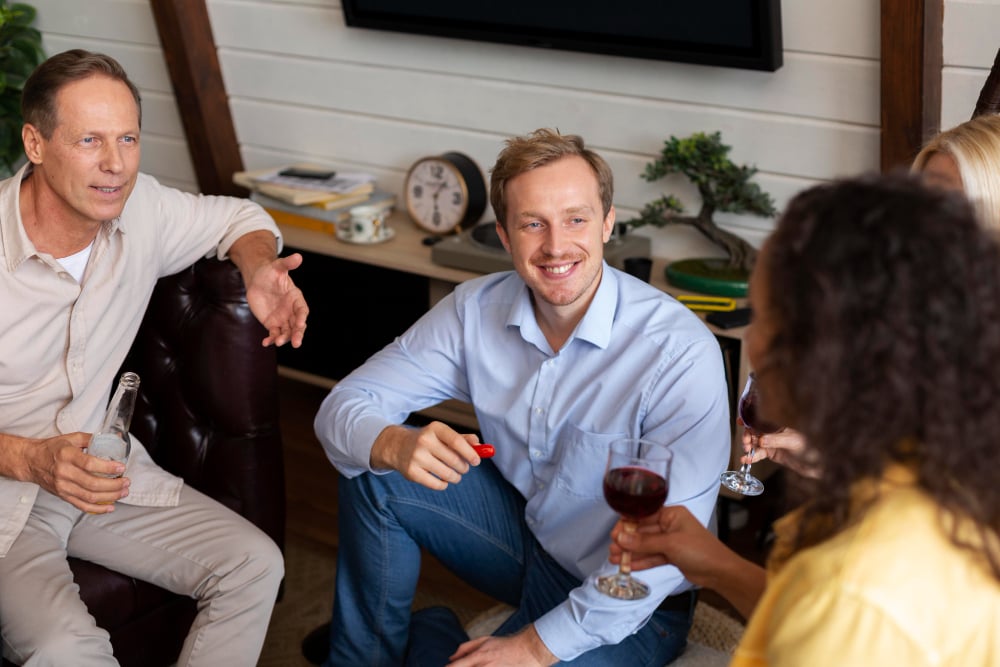
My brother-in-law was wearing my father’s bathrobe.
That was the first thing I really saw. Before the mud on the floor. Before the dog hair on the recliner. Before my father sitting on a kitchen chair in the corner of his own living room, staring at his shoes.
Marcus was leaning against the kitchen counter in a thick white cotton robe. I knew that robe. I’d bought it six weeks earlier at a department store in Providence. I’d stood in the aisle for ten minutes feeling different fabrics, because my father gets cold in the mornings and I wanted him to have something warm.
Marcus had the sleeves pushed up. He was on his phone.
“Right on the water, man,” he was saying. “The whole summer, rent-free. I’m telling you, we are set.”
Then he turned around and saw me standing in the doorway with a chocolate cake in my hands.
He didn’t look guilty. He looked annoyed, like I was a delivery that had come on the wrong day.
He ended the call. He looked at my father. Then he pointed at him.
“This is a family home,” Marcus said. “He needs to accept that.”
Behind me, on the couch, my sister laughed.
My name is Mara. I’m thirty-seven years old.
I’m a nurse practitioner. I’ve been one for eleven years. I work long shifts on a cardiac unit in Providence. I own a small condo. I drive a four-year-old Subaru. I have a savings account that doesn’t make my chest tighten when I look at it.
None of that was always true.
The house was a blue cape on the Maine coast. I paid $425,000 for it, in cash, and put it in my parents’ names. It wasn’t about me. It was about a promise I made when I was fifteen, standing in the hallway of our apartment, listening to my mother go silent over a heating bill.
It took me twenty-two years to keep that promise.
It took my sister about four days to try to take it apart.
I grew up on the third floor of a six-story building in Providence. Three bedrooms. Thin walls. One bathroom with a shower that went cold after eight minutes. A kitchen where the linoleum curled up at the corners.
My mother patched those corners with duct tape. Then she painted the tape white so it would blend in.
It didn’t blend in. But she tried. That was my mother. She always tried.
My parents weren’t careless people. I need you to understand that. My father worked facilities maintenance at a hospital for twenty-three years. Steady, union, honest work. My mother worked part-time in medical records and picked up more hours as we got older.
They were careful. They paid things on time when they could. They clipped coupons. They never bought anything on credit they couldn’t pay off.
They just lived right at the edge. One bad month meant something had to wait. And sometimes waiting meant it never happened at all.
When I was nine, the hospital changed management and cut the maintenance contract.
I remember the night my father came home and told my mother. I was supposed to be asleep. I was lying on the floor of my bedroom with my ear near the gap under the door.
“They’re bringing in an outside company,” he said.
“Can you apply with them?”
“I did. They said they’d call.”
They didn’t call.
He found other work after four months. It paid less. The benefits were worse. And by then his back had started to go. He never complained about it. He just walked slower. He sat down differently, one hand on the arm of the chair, lowering himself in stages.
The pill bottles in the medicine cabinet multiplied. Two. Then four. Then six.
I knew what they cost, because on the fifteenth of every month I heard my mother whisper the number to him at the kitchen table.
That was the year she started cutting the pills in half.
I saw her do it once. She was standing at the counter with a butter knife, pressing it down on a small white tablet, very carefully, so it would split clean. She put one half back in the bottle and swallowed nothing. She was making the bottle last twice as long.
She saw me watching.
She didn’t explain. I didn’t ask.
I was ten. I already understood.
My sister Dana was two years younger than me.
At seven, Dana was loud. She felt everything all the way to the bottom, and she let everyone know it. She could cry with so much conviction that adults felt personally responsible for whatever had happened, even when nothing had happened at all.
She wasn’t scheming. Not at seven. She was just a kid who felt big feelings in a small apartment.
But my parents were so tired. They were holding the whole household together with duct tape and butter knives. When Dana pushed, they didn’t always have the strength to push back.
So she pushed. And they gave in. And she pushed again.
I remember one Saturday when we went to the grocery store. Dana wanted a box of cereal with a cartoon tiger on it. It cost almost twice what the store brand cost.
“No, sweetheart,” my mother said.
Dana sat down in the middle of the aisle and screamed.
People stared. A man with a cart had to go around her. My mother’s face turned red.
She put the cereal in the cart.
On the way home, she quietly took the cereal out of her own budget. I know because she didn’t buy herself the little jar of hand cream she’d been picking up and putting back for three weeks.
I watched all of it. I never sat down in an aisle and screamed.
I was the quiet one. The responsible one.
My parents called me their rock.
That sounds like a compliment. It isn’t, completely. What it meant in practice was this: we know Mara will be fine, so we’ll spend our energy on the one who won’t be.
And I was fine.
I was fine the way kids are fine when they’ve learned that needing something is a burden. So they stop showing that they need anything at all.
I was fifteen when I made the promise.
It was February. A bad month. The kind of month when the heating bill comes and the savings account is at its thinnest.
I was at the kitchen table doing chemistry homework. My mother was at the counter with the accordion file where she kept all the bills. She thought I had my headphones on.
I didn’t. The batteries had died.
She took out the heating bill. She opened it. She looked at the number on the paper.
Then she set it down on the counter, very carefully. She put both hands flat on the counter and just stood there.
She wasn’t crying. She was past crying by then. She just stood there, pressing down on that counter with both hands, like she was trying to keep it from floating away.
It lasted maybe thirty seconds.
Then she put the bill back in the folder. She closed the file. She opened the refrigerator and started making dinner.
“Spaghetti okay, honey?” she said, without turning around.
“Sure, Mom.”
I didn’t say anything else.
But something hardened in me in those thirty seconds. It wasn’t anger. It was a decision.
I was going to fix this.
Not someday, vaguely, when I grew up. I meant it like a real goal. Specific. Urgent. I already knew that doing nothing was also a choice.
The next morning I went to school and knocked on my guidance counselor’s door.
“What do I need to do,” I asked her, “to become a nurse?”
I did everything she told me to do.
I took every science class the school offered. I worked at a pharmacy after school and saved my paychecks in a coffee can under my bed. I got a scholarship to a state university. I worked nights as a nursing assistant all through college, changing sheets and taking vital signs on a cardiac floor at three in the morning.
That’s where I fell in love with hearts. Not the romantic kind. The real kind. The muscle that keeps going whether or not anyone thanks it.
I got my nursing license at twenty-two. I went back to school for my nurse practitioner degree at twenty-four. I paid off my loans at thirty. I bought my condo at thirty-one.
And every month, without telling anybody, I put money into a separate account.
I labeled it in my banking app with one word.
Promise.
But to understand what happened at that blue house, you have to understand Dana.
Not Dana at seven. Dana at thirty-five, which is how old she was when she showed up at my parents’ new house with a mattress strapped to her husband’s truck.
There’s a version of Dana that lives in our family’s memory. In that version, she’s sensitive. Artistic. Someone who feels things deeply and has had a hard time getting on her feet, because the world is hard and some people just struggle more than others.
My mother believes in that version. So does my Aunt Teresa. So did I, for a long time.
The version I know is different. The version I know is a grown woman who never had to change, because someone was always there to catch her.
Usually that someone was me.
Her husband is Marcus.
In nine years of marriage, Marcus has been a landscaper, a gym manager, a “consultant” for a company nobody in our family could ever explain, a part-time contractor, and most recently, nothing.
He doesn’t find this embarrassing. He finds it reasonable.
“I’m not going to work somewhere that doesn’t respect me,” he told me once at Thanksgiving, chewing a dinner roll. “Life’s too short.”
“Life’s also expensive,” I said.
He laughed like I’d made a joke.
Before Marcus, Dana had a part-time job at a frame shop, a tiny studio apartment, and a credit card she was slowly paying down. It wasn’t much. But it was hers.
Within two years of meeting Marcus, she’d quit the job, moved into his place, maxed out the card, and called me three times about three separate emergencies.
They turned out to be one emergency. One they’d been slowly creating the whole time.
I remember one of those calls very clearly.
It was a Tuesday night. I’d just finished a fourteen-hour shift. A man in his fifties had coded twice on my unit that afternoon. We got him back both times. My hands were still shaking a little when my phone rang.
“Mara?” Dana was crying. “Mara, I’m so sorry to call, I didn’t know who else to call.”
“What happened? Are you okay? Is Leo okay?”
Leo was a baby then.
“We’re getting evicted,” she said. “They gave us a notice. We have ten days. Marcus’s job fell through and the landlord won’t listen and I don’t know where we’re going to go with a baby.”
“How much do you need?”
“For the new place, the deposit and first month…” She sniffed. “Twenty-four hundred.”
I sat down on the floor of my condo, still in my scrubs.
“Okay,” I said. “Send me the information. I’ll wire it tomorrow.”
“Thank you. Thank you so much. I’ll pay you back, I swear. As soon as Marcus finds something.”
“Don’t worry about it,” I said.
She didn’t pay me back. I didn’t really expect her to.
That was the problem. Nobody expected anything from Dana. Including Dana.
After that, it was a pattern.
I paid for dental work when Dana called crying about Leo’s teeth. I co-signed a car loan so Marcus could get to a job he didn’t end up getting. I covered a month of rent when he quit a contracting job because of, in his words, “a disagreement with the foreman about respect.”
Every time, I told myself the same things.
This is temporary. She’ll stabilize. This is what family does.
That’s the thing about enabling someone. It doesn’t feel like enabling when you’re inside it. It feels like love. It feels like being responsible. You don’t see it until you step back and look at the whole picture, instead of just one payment at a time.
Three years ago, I finally stepped back.
It was a rainy Sunday. I had the day off. I made a pot of coffee, opened my laptop, and went through nine years of bank statements and Venmo history, line by line.
I put every payment to Dana or Marcus in a spreadsheet.
Deposit. Dental. Rent. Car payment. Groceries. “Just till Friday.” Becca’s daycare. Marcus’s truck repair. Christmas presents for the kids, from Dana, that I’d paid for.
At the bottom of the column, I typed in the formula and pressed enter.
$47,000.
I sat there looking at that number for a long time. Long enough that my coffee went cold.
Forty-seven thousand dollars isn’t a bunch of kindnesses. It’s a funding arrangement. One I’d agreed to without ever saying yes, and never once tried to change.
Dana relied on it the way you rely on electricity. You don’t think about it until it’s gone.
And when it’s gone, you’re furious.
I tried pulling back twice.
The first time, I told Dana I couldn’t cover their rent that month. I said it gently. I said I loved her.
She didn’t speak to me for six weeks.
She called my mother instead. My mother called me.
“She’s so upset, Mara,” my mother said. “She says you’re punishing her. Is everything okay with you? Is there something going on?”
“Nothing’s going on, Mom. I just can’t keep doing this.”
“I know, honey. I know. But the kids…”
I paid the rent.
I could feel the whole machine clicking back into place.
The second time, Dana texted me things I’m not going to repeat. Then, two days later, she apologized. I accepted. Nothing changed.
What finally changed was me.
It wasn’t one big dramatic moment. It was slow. Like fog lifting. I started to see Dana’s emergencies not as bad luck, but as a system.
Marcus created the crisis. Dana called me crying. I fixed it. Everything reset.
And every time I fixed it, I made the machine run a little smoother.
So when I finally had enough money in the Promise account, I didn’t tell anybody right away.
I called an estate attorney first.
Her name was Linda Ferreira. Her office was on the second floor of an old brick building on Westminster Street. She had reading glasses on a beaded chain and a very calm voice.
I sat across from her and told her what I was planning. A house, for my parents, for their fiftieth anniversary. Paid in cash.
Then I told her about Dana.
I told her about the deposits, and the dental work, and the car loan, and the forty-seven thousand dollars. I told her about Marcus and the foreman and the respect.
She didn’t look surprised. She just nodded and wrote something on a legal pad.
“You want your parents to have the house,” she said. “Fully. With their names on it. But you want someone with the authority to protect it, in case somebody decides to treat it as available.”
“Yes,” I said. “Exactly that.”
“Who would that someone be?”
“Me,” I said.
She smiled a little.
“I see a lot of families,” she said. “The ones who plan for this are usually the ones who’ve already been burned.”
We drafted the trust in ninety minutes. My parents’ names on the deed. Me as trustee. A clear list of who was allowed to live there: my mother and my father. Anyone else was a guest, there by their invitation, and if a guest overstayed or misused the property, the trustee had the authority to require them to leave.
I signed the papers the same day I closed on the house.
I’ve always been a planner.
I just hadn’t always known who I was planning against.
I found the house on a Thursday night in July, at eleven-thirty, sitting at my kitchen table with a bowl of cereal going soggy in front of me.
I’d been looking for eight months. I had a spreadsheet. I had saved searches on four real estate websites. I had a folder in my email with a hundred and forty starred listings.
I knew exactly what I wanted.
Coastal. Within a couple of hours of Providence. Small. Two bedrooms. Nothing that would give my parents a whole new list of things to worry about. A real kitchen. A deck or a porch. Water you could see from at least one window. Structurally sound.
No projects. No fixer-uppers. My parents had spent fifty years fixing things that should have been replaced. I wasn’t going to hand them another one.
The listing for the blue cape came up on a site I didn’t check very often. It had been on the market for sixty-one days. In that market, that meant something was wrong with it, or it was overpriced.
I almost scrolled past it.
Then I looked at the photos.
About a thousand square feet. Two bedrooms, a bath and a half. The outside was painted a blue that had faded in a nice way, like it was meant to look like that. There was a deck off the back, wide enough for a table and chairs and a row of potted plants. The kitchen window faced east, toward the water.
You couldn’t actually see the ocean from inside. Trees blocked it. But in one photo, taken early in the morning, you could see the light coming off the water through the branches. That silvery, gold light you only get on the coast.
I put down my spoon.
I looked at that picture for a long time.
I drove up the next Saturday.
The listing agent was a woman named Patricia. She’d clearly sold a lot of houses, and she wasn’t going to oversell this one.
“Previous owners bought it in 1987,” she told me, unlocking the front door. “Lived here till last year. Then they moved into assisted living. Their kids didn’t want it.”
“Why’s it been sitting so long?”
She shrugged. “People want a view. You can’t see the water from the couch. And it’s small.”
“I don’t need big,” I said.
I went through the whole house in twenty minutes. I checked the roof from the yard. I looked under every sink. I opened the circuit breaker panel. I knocked on the basement walls like I knew what I was listening for. Honestly, I sort of did. My father taught me.
Then I stood at the kitchen window for three minutes, not saying anything.
Patricia waited. She didn’t push.
“It’s a good house,” she said quietly. “It’s not fancy. But it’s a good house.”
“I’ll offer four-fifteen,” I said. “Cash. Close in thirty days.”
She raised her eyebrows. Just a little.
The sellers came back. We met in the middle. We closed six weeks later, in early September, at $425,000.
I wired the money from the Promise account. I’d expected to feel scared. To second-guess myself. To lie awake.
I didn’t.
It felt like setting down something heavy that I’d been carrying since I was fifteen.
I spent the next three weekends getting the house ready.
I hired a painter. I hired a crew to clean the floors. I bought a sofa, oatmeal-colored, soft enough to fall asleep on. I bought a kitchen table that sat four.
I bought a recliner for my father.
I sat in eleven different recliners at two different stores before I found one with the right lumbar support for a man with a bad back. The salesman at the second store watched me test the last one for five full minutes.
“It’s for my dad,” I said. “He’s got a bad back. Forty years of hospital maintenance.”
“Then this is your chair,” the salesman said. “This one’s built for guys like that.”
I bought it.
I bought lamps. A coffee maker. A kettle. Plain, heavy dishes that wouldn’t chip. Towels. Sheets. A thick white cotton bathrobe, because my father is always cold in the mornings.
Then I went to the grocery store. Three of them.
A regular store for the basics. A nicer one for the things my parents considered luxuries. The expensive orange juice my mother always picked up and then put back. The good coffee my father liked but never bought for himself. A bottle of wine. And a farm stand on the way into town for fruit and vegetables that would last the first week.
I filled the pantry with pasta and soup and flour.
Then I filled the medicine cabinet.
I paid out of pocket for a three-month supply of my father’s blood pressure medication. I put the bottle on the middle shelf, right at eye level.
I wanted him to open that cabinet and see a full bottle. Not half empty. Not a refill to remember. Not a pill cut in half with a butter knife.
Full.
At an antique shop in town, I found a small wooden recipe box. Old pine, worn smooth on the corners.
I put one index card inside it. I wrote on it in my neatest handwriting:
For late mornings, slow coffee, and the sound of water. Fifty years of figuring it out. You’re done figuring. Happy anniversary. Love, M.
I put the box in the silverware drawer.
The plan was simple. Pick them up Friday. Tell them I was taking them to a nice dinner for their anniversary. Drive them up the coast. Let the house do the rest.
I should have known that any plan involving my family needed a backup plan.
I picked my parents up at eleven o’clock on a Friday morning in early October.
My mother had made sandwiches. Turkey and cheese, wrapped in wax paper, in a brown paper bag. She handed it to me as soon as she got in the car.
“I don’t know if this restaurant’s any good,” she said. “And I don’t want you spending too much.”
I took the bag. I put it in the back seat.
“Thank you, Mom,” I said. That was all.
My father got into the passenger seat slowly, the way he always does. One hand on the door frame. Careful with his back.
He was wearing a button-down shirt. He’d combed his hair. He smelled like the aftershave he’s worn since before I was born. Cedar and soap. If you asked me what the word “father” smells like, that’s what I’d tell you.
Once he was settled, he looked over at me.
“You don’t have to do all this,” he said.
“I know.”
“We’re happy where we are.”
“I know that too, Dad,” I said.
I put the car in drive.
My mother asked questions the whole way.
“Where is this place?”
“North.”
“How far north?”
“A little farther.”
“Mara, is this one of those places where they don’t put prices on the menu?”
“Mom. Relax.”
My father didn’t ask anything. He watched the window and hummed something without a tune under his breath. He does that when he’s content. I hadn’t heard him do it in years.
Somewhere around the New Hampshire border, the world started to change. The strip malls thinned out. The trees got taller. The light got lower and paler, like it had been washed in salt.
Forty minutes into Maine, it was a different world.
We turned off Route 1. The road narrowed. Then narrowed again. We drove through a little town. A post office, a hardware store, a diner with a hand-painted sign.
“That diner looks nice,” my mother said.
“We should come back sometime,” I said.
On the other side of town, the trees opened up for a second, and there was the water. A small cove, silver-gray in the October light.
My mother made a small sound. Like a breath that caught.
“We’re close,” I said.
We turned onto the gravel lane.
The blue cape sat at the end of it, facing the trees. I’d left one lamp on inside that morning, on a timer. You could see it through the front window. Warm and yellow.
I put the car in park. I turned off the engine.
My mother looked at the house. Then at me.
“Is this the restaurant?” she said.
“No,” I said. “This is yours.”
There’s a silence before someone understands something, and a different silence after.
I heard both of them.
My father turned his head slowly and looked at me.
“I bought it,” I said. My voice came out steadier than I felt. “Cash. It’s in your names. There’s no mortgage. No bills. The property taxes are paid five years ahead. The utilities are set up. The fridge is full. The medicine cabinet is stocked. You don’t have to do anything except walk in.”
My mother put her hand over her mouth.
My father didn’t say a word. He opened his car door and got out, one hand on the frame, slow. He walked up to the front door and just stood there, looking at it.
I followed him. I took the key out of my pocket and put it in his hand.
He held it in his palm.
His hands were shaking.
“Open it, Dad,” I said.
He tried. The key kept missing the lock. So I put my hand over his, the way he’d done with me when I was little and learning to use a screwdriver, and I guided it in.
The door swung open.
My mother went in first.
She moved slowly through the living room. She trailed one hand along the back of the sofa as she passed it. Then into the kitchen.
She stopped at the window over the sink. She looked out at the trees and the light coming through them.
She opened the refrigerator. She stood there looking at the full shelves. The orange juice. The wine. The vegetables from the farm stand. She didn’t take anything out. She just looked.
Then she closed it.
She opened a drawer. Then another one. She found the recipe box in the silverware drawer.
She opened it. She read the card.
She sat down at the kitchen table and pressed the card against her chest and cried.
It wasn’t the tight, quiet crying I’d heard through walls my whole childhood. It was something deep and ragged. She didn’t try to hide it. She didn’t try to stop.
It was the crying of someone who’d been carrying something for fifty years, and had finally found the place to put it down.
My father walked the whole house.
He touched everything. The door frames. The walls. The banister. He opened the circuit breaker panel and looked inside and closed it again, nodding to himself.
He opened the medicine cabinet in the bathroom. He stood there for a long moment. He didn’t say anything about the full bottle. He just closed the cabinet very gently.
Then he went and stood at the back window, where you could see a slice of the water between the trees.
“It’s solid,” he said quietly. Not to me. Not to anybody.
He wasn’t only talking about the house.
That night we ate my mother’s turkey sandwiches on the deck and drank the wine out of the plain heavy glasses I’d bought. We watched the sky go from silver to pink to black.
Gulls called somewhere far off. You could hear the water moving, even though you couldn’t quite see it.
My parents held hands. I don’t think I’d seen them hold hands since I was a kid.
“I keep waiting for someone to knock on the door,” my mother whispered. Her head was on my father’s shoulder.
“Nobody’s coming, Mom,” I said. “It’s yours.”
My father was quiet for a long time.
“I haven’t slept through the night in thirty years,” he said finally. Not really to us. Just out into the dark. “I think I might tonight.”
That feeling lasted forty-eight hours.
My mother called me on Sunday evening. I was at the hospital, finishing chart notes after a long shift.
“Hi, honey.”
Then a pause. The kind of pause where someone’s deciding how to start.
“Everything’s wonderful here,” she said. “I made soup. Your father found a little path down to the water. He walked it twice.”
“That’s great, Mom.”
“I wanted to mention that Dana called.”
I didn’t say anything.
“She heard about the house,” my mother said. “She’s just so excited for us. She wants to come see it. Just lunch. Just to celebrate.”
My mother’s voice had changed. It had that rhythm she uses when she’s asking for something she knows I might not want to give.
“I thought it would be nice,” she said.
“Mom, you just got there. You’re still unpacking.”
“It’s your sister, Mara. What’s the harm? It’s one afternoon.”
I closed my eyes.
I thought about the trust. About Linda Ferreira and her reading glasses. About the forty-seven thousand dollars.
And I thought about my mother at that kitchen table, crying into an index card.
“Fine,” I said. “A day visit. Lunch. And they leave before dinner. Okay? And if anything feels wrong, Mom, anything at all, you call me.”
“You worry too much,” she said.
Dana and Marcus drove up that Saturday with the kids.
I texted my mother at noon. How’s lunch?
She sent back a heart.
At three, I texted again. Everything ok?
No answer.
At five, I called her. It went to voicemail.
I called my father.
He picked up on the second ring.
“Hey, Mara.” His voice sounded normal. Too normal. Like a man reading lines.
“Dad. Are they gone?”
“They decided to stay for dinner,” he said. “Dana thought it would be nice to watch the sunset from the deck.”
“Are they still there right now?”
“Marcus is.” He stopped. Started again. “Yes. They’re still here.”
“Dad. Call me when they leave. Okay? Whatever time it is.”
“Okay,” he said.
He didn’t call.
I sat on my couch with my phone on my knee until almost midnight.
The next morning, I called my mother at nine.
She answered on the fourth ring. She was whispering.
“I can’t really talk,” she said. “Marcus is asleep on the couch.”
The new couch. The oatmeal one I’d picked out.
“The kids are in the guest room,” she went on. “Dana’s in there with them.”
“Mom. When are they leaving?”
“Maybe Tuesday. Marcus wants to take the kids to see the lighthouse.”
“Mom…”
I stopped myself. I took a breath. In the cardiac unit, when a patient’s family is panicking, you lower your voice instead of raising it. I lowered mine.
“Tell me what’s been happening.”
There was a long silence.
“He’s been loud,” she said finally.
In my mother’s language, “loud” covered a lot of territory. None of it good.
“Your father’s been spending most of his time on the deck,” she added.
I was already doing the math on the drive. Two hours and forty minutes, depending on traffic through Portsmouth.
“I’m coming Wednesday,” I said. “Don’t tell them.”
“Mara, please don’t make a…”
“I’m not going to make anything, Mom. I’m coming to see you. That’s all.”
I spent Monday on my lunch break in my car in the hospital parking garage, on the phone with Linda Ferreira.
“I need to confirm something,” I said. “Under the trust. As trustee. If people are staying at the house without my parents’ permission, how much authority do I have to make them leave?”
“Are your parents asking them to leave?”
“My mother agreed to lunch. It’s been three days. My father’s hiding on the deck. They’re too worn out to ask.”
Linda was quiet for a moment.
“Under the terms we drafted,” she said, “anyone other than your parents is a guest. If a guest overstays or misuses the property, you can require them to vacate. You don’t need to go to court for that, as long as you give them verbal and written notice and a reasonable window to comply. I’d keep it calm. I’d keep it short. And I’d write down everything.”
“Can you put that on letterhead for me? One page?”
“I’ll email it in an hour.”
She did. I printed it at the nurses’ station and folded it into my bag.
Then I looked up locksmiths near the house. I found one called Mid Coast Lock. A man named Victor answered.
“I might need all the exterior locks changed on Wednesday,” I told him. “Front, back, garage, the deck slider. I’m not sure yet what time. Can you be on standby?”
“For a whole house? Sure. You want to put down a deposit?”
I gave him my card number.
“Can I ask what the situation is?” he said. “Just so I know what I’m walking into.”
“Family,” I said.
“Ah,” Victor said. He didn’t ask anything else.
On Tuesday morning, I stopped at a bakery near my condo and ordered a chocolate cake for pickup Wednesday.
I told myself the cake was because I was visiting my parents.
That was true. It was also true that I wanted to walk into that house holding something sweet. Something that said I came here because I love you. Not to start a fight.
Even if a fight was what I was going to get.
Wednesday morning, I picked up the cake. I put it carefully on the back seat. I texted Victor from the bakery parking lot.
ETA around noon. Please head toward the address. I’ll text you when I’m fifteen minutes out.
The drive north did what it always does. The trees got taller. The light got better. The world got quieter.
But I wasn’t quiet inside.
I went through it in my head, step by step, the way I go through a difficult procedure before I walk into the room. What I had. What it meant. What I was going to do, and in what order.
Stay calm. Get the kids out of the room. Show her the paper. Give her a window. Call Victor.
Don’t yell. Don’t cry. Don’t let Dana make it about how you said it instead of what she did.
Fifteen miles out, I texted Victor. Fifteen minutes.
He wrote back. On my way.
I turned onto the gravel lane.
Marcus’s truck was parked sideways on the lawn. Right on the grass. There was a mattress strapped to the roof with bungee cords. It was half unloaded, one end sagging over the side. The front door of the house was wide open.
A mattress.
For a lunch visit.
I sat in my car for a few seconds with my hands on the wheel.
Then I got the cake off the back seat and walked inside.
The smell hit me first.
Stale beer. Wet dog. The warm, sour smell of fast food that’s been sitting in its wrappers too long.
It wasn’t the house I’d left. That house had smelled like fresh paint and cedar and salt air. This smelled like a place where nobody felt responsible for anything.
The entryway rug was dark with tracked-in mud. Shoes were piled against the wall. A duffel bag lay dropped in the living room doorway like nobody had bothered to move it in days. Open chip bags on the coffee table. A dried ring of juice on the side table. The throw blanket balled up on the floor.
And my father’s recliner.
The one I’d tested eleven times. The one built for a man with a bad back.
It was matted with dog hair. Across the seat. Down one arm.
They’d brought their dog. Nobody had mentioned a dog.
Leo and Becca were on the sofa.
Leo was seven. He was sitting very straight, holding the TV remote, staring at the screen with the careful attention of a little boy who’s pretending not to notice that an adult just walked in.
Becca was four. She looked right at me. Then away. Then right back.
“Hi, Auntie Mara,” she whispered.
“Hi, sweetheart,” I said.
And then I heard Marcus.
That’s how I ended up standing in the doorway with a cake, looking at my brother-in-law in my father’s bathrobe. Listening to him tell someone on the phone that he had a house on the water, all summer, rent-free.
That’s how I ended up watching him point at my father and say, “This is a family home. He needs to accept that.”
And my sister laughed.
I turned my head.
Dana was on the couch, at the far end, past the kids. Her feet were up on the coffee table. Her phone was in her hand. She didn’t even look up properly.
It was the laugh of someone who thinks the whole thing is already settled.
My mother was at the kitchen sink. Her back was to the room. She was holding the edge of the counter with both hands.
I knew that posture. I’d seen it once before, when I was fifteen.
She was holding the counter down so it wouldn’t float away.
I set the cake on the counter, next to her. I touched her shoulder once. She didn’t turn around.
Then I looked at my father.
He was in the corner of his own living room, on a dining chair someone had dragged away from the kitchen table. His hands were on his knees. He was staring at the floor.
He looked smaller than I’d ever seen him.
He was wearing a different shirt from the one I’d last seen him in, and it wasn’t one I recognized. It was too big. Someone had pushed him out of his own closet along with everything else.
He looked up and met my eyes for one second.
Then he looked back at the floor.
In that one second, I saw everything. The shame. The helplessness. The tiredness of a man who’d spent his whole life holding things together with his bare hands, and didn’t have it in him to hold this one.
He wasn’t weak. He was worn down.
There’s a difference. It matters.
I looked back at Marcus.
He held my gaze. Comfortable. Settled. Standing in my parents’ kitchen like the room belonged to him.
“Marcus,” I said. My voice was very even. “Can you take the kids outside for a few minutes?”
He looked at Dana.
Dana gave him a small nod.
He shrugged. “Hey, guys. Let’s go look at the water.”
The kids slid off the couch. Becca grabbed her shoes. Leo looked at me over his shoulder as he went. He had the face of a kid who knows something’s wrong and has decided it’s probably his fault.
The sliding door closed behind them.
The room went quiet.
I sat down in the armchair across from my sister.
Not the recliner. I couldn’t sit in the recliner.
Dana and I looked at each other. The way sisters look at each other when there’s nothing left to pretend about.
“You came to make a scene,” she said.
“I came because Mom was whispering in her own kitchen.”
“She was being considerate. Marcus was sleeping.”
“At nine in the morning.”
Dana looked out the window.
“You always do this,” she said. “You make everything into a problem.”
“I found your Airbnb listing,” I said.
The room went very still.
Even my mother, at the sink, stopped moving.
I’d found it Monday night. I hadn’t been looking for it, exactly. I’d been looking at the town’s website, checking trash pickup days for my parents. A sidebar ad for vacation rentals popped up. The first photo was a deck. A wide wooden deck, with two Adirondack chairs facing a line of trees.
My deck. My parents’ deck. The deck where we’d eaten turkey sandwiches and watched the sky go black.
I took out my phone. I turned it around so Dana could see the screenshot.
Coastal Gem on a Quiet Cove. Summer rentals available. $325/night.
“You posted it two days after they moved in,” I said.
Dana’s face did the thing it does when she’s caught.
She doesn’t crumble. She doesn’t say sorry. She goes very still. Like she’s saving her energy. Like she’s already working out her next move before this one is over.
“That was Marcus’s idea,” she said. “Your name isn’t even on it. He set it up. I just…”
“There were three bookings,” I said. “Someone named Amy in June. Rachel in July. Someone called Rook in August. You had the whole summer sold.”
Her jaw tightened.
“We were going to use that money for upkeep,” she said. “Old houses need…”
“I prepaid the taxes for five years, Dana.”
“For other things, then.”
“Where were Mom and Dad going to sleep,” I said, “when Amy was here?”
Dana didn’t answer.
That pause said everything.
“There’s the guest room,” she said finally.
“The one your children are in right now,” I said. “So the plan was to put our parents in the back bedroom of their own house. And rent out the rest to strangers. And keep the money.”
“You make everything sound so…”
“I’m just describing what the booking calendar shows.”
I kept my voice level. Not angry. Precise. The voice I use to tell families what’s actually happening when everyone else in the room is too scared to say it.
At the sink, my mother made a small sound. I didn’t look at her. I didn’t want Dana to see her crying and use it.
“Dana,” I said. “Since you and Marcus got together, I’ve given you forty-seven thousand dollars.”
She stared at me.
“I added it up. Every transfer. Every Venmo. The car loan. The deposits. The rent. The dental work. Forty-seven thousand dollars.”
Her mouth was slightly open.
The number surprised her. Not because she didn’t believe it. Because she’d never once counted.
You don’t count when someone else is always covering the cost.
“I’m not asking for it back,” I said. “I’m telling you because I want you to understand what I’ve been doing. And why I’m not doing it anymore. Not with this house. Not with anything else.”
She looked away.
“I was the one who always caught you,” I said quietly. “So you never had to learn how to stand up.”
Outside, through the window, I could hear the kids. Becca laughing. Leo calling something about a crab. Their voices were bright against the sound of the water.
“So you’re kicking us out?” Dana said. Her voice was flat.
“You were never supposed to be here past lunch on Saturday.”
I reached into my bag. I set two things on the coffee table between us, next to the open chip bags.
First, a copy of the deed. My parents’ names. Nobody else’s.
Second, one page on Linda Ferreira’s letterhead.
Dana picked up the letter.
I watched her read it. The trust language. The part about the trustee. The part about guests, and the authority to require them to leave.
She read it twice.
The soft, wounded look she’d been holding dissolved completely.
“You set this up before you even told them about the house,” she said.
“Three weeks before.”
“You were already planning.”
“I was planning for you,” I said.
She set the page down on the coffee table.
The look she gave me wasn’t all anger. It wasn’t all grief either. It was the look of somebody who’s just realized she’s been seen doing what she was doing. And seen for a lot longer than she knew.
I picked up my phone.
“I’m calling the locksmith now,” I said. “He’s already nearby. I need you packed and gone before he gets here.”
“Are you serious?”
“I’m not calling the police. I’m not reporting the listing. I’m not posting anything. I’m asking you to cancel those bookings and leave. Now. Cleanly.”
“Where are we supposed to go?”
I looked at my sister. My little sister, who used to crawl into my bed during thunderstorms, who used to make me braid her hair before school because Mom didn’t have time.
“That’s not something I can solve for you,” I said.
I called Victor. He picked up on the first ring.
“Hey,” he said. “Ready for me?”
“Yes. Come on over.”
Dana stood up. The soft voice was gone now. Completely.
“You think you’re so much better than us,” she said. “You always have.”
“I think I’m more prepared,” I said. “That’s all.”
She looked at me a second longer. Then she turned and went to the sliding door. She pulled it open.
“Marcus,” she said. “We’re leaving.”
I heard his voice go up. “What? Says who?”
Her voice went down, low and fast. I couldn’t hear the words.
A silence.
Then boots on the deck stairs. Heavy ones. Coming back toward the house.
I went to the sink first.
My mother was still holding the counter. I put my hands over hers. Her knuckles were white.
“Mom,” I said quietly. “Come outside with Dad. Okay? Let them pack.”
She let go of the counter. One finger at a time.
My father was already standing. He’d heard everything. He walked past me toward the deck without a word. But on his way, he touched my arm. Just for a second.
My parents sat on the deck. My father in the Adirondack chair I’d set facing the tree line. My mother next to him.
They didn’t talk. They just sat close together, the way they always have in hard moments. Letting being near each other do the work that words couldn’t.
I pulled a chair over and sat down at their level. I didn’t want to stand over them.
“They’re packing,” I said.
My mother turned to me. “Mara…”
“It’s handled.”
“You didn’t have to…”
“Mom.”
She stopped.
“I know this is going to feel like I broke something,” I said. “Between you and Dana. So I want you to hear me say exactly what I did. I asked people who were staying in your home without your permission to leave. That’s it. That’s all I did.”
My mother looked at the trees.
“Whatever she says about it later,” I went on. “Whatever Aunt Teresa says. Whatever story gets told at Christmas. None of that changes what actually happened in this house.”
“She’s going to say things,” my mother said.
“She already is,” I said. “And then someday she’ll need something. And she’ll call you. And you’ll have to decide what to do. But that’s later. Right now, you’re in your house, and they’re leaving it. That’s the only thing that matters right now.”
From inside came the sounds of packing. Bags hitting the floor. Zippers. Becca crying about something. A stuffed rabbit, I found out later, that had gone under the guest bed. Marcus’s voice, low and simmering.
My mother flinched at every sound.
My father didn’t move at all.
Marcus came out first. A duffel bag over one shoulder. His jaw set hard.
He’d taken off the bathrobe. It was lying in a heap just inside the slider. I could see it through the glass.
He stopped when he saw us. He didn’t look at me. He looked at my father.
“This is messed up,” he said. “Your own daughter. Doing this to family.”
My father looked back at him.
He didn’t say anything. He just held Marcus’s eyes, without any expression at all. The way a man holds something still when he’s decided to be completely still.
Marcus waited. Five seconds. For an answer that wasn’t coming.
His jaw tightened. He hitched the bag up on his shoulder and went around the side of the house to the truck.
Dana came out a few minutes later. Becca on her hip, holding the rescued rabbit. Leo behind her with a backpack.
She stopped when she saw me.
The look she gave me wasn’t quite hatred. There was still some love mixed into it. But it was about as close as family gets.
“I want you to know,” she said, “I will not forget this.”
“I know.”
“You humiliated us.”
“I asked you to leave your parents’ home,” I said.
She shifted Becca higher on her hip. She walked down the deck stairs without looking at our parents.
Leo stopped at the top of the stairs.
He looked at the deck boards. Then at my father. Then at me.
“Bye, Grandpa,” he said quietly.
“Bye, Leo,” my father said. His voice cracked on the name.
Leo went down the stairs after his mother.
My mother’s hand lifted from her lap. Just a little. The start of reaching out.
She didn’t finish it.
My father put his hand over hers.
We listened to the truck start. It backed out too fast, the way Marcus does everything. The tires spat gravel. It went down the lane, onto the road, and away.
Then nothing.
Just wind in the trees. And the far-off sound of water.
My mother let out a long, slow breath. It wasn’t a sigh. It was something letting go.
Victor showed up fifteen minutes later.
He was a compact man in his fifties with a canvas tool bag and a gray beard. He shook my hand. He nodded at my parents on the deck. He didn’t ask a single question.
“All the exterior locks,” he said. “Front, back, garage, and the slider here.”
“Yes.”
“Forty-five minutes.”
He went to work.
My parents and I stayed on the deck. We could hear him moving through the house. The whir of the drill. The click of hardware. The solid thunk of a new deadbolt sliding into place.
My father listened to every single one.
He didn’t say anything. But something in the way he sat began to change while Victor worked. Slowly. His shoulders came down. His hands loosened on the arms of the chair. Like a rope going slack after holding something heavy for a long time.
When Victor was done, he brought me four keys on a plain metal ring.
“Two for you,” he said. “Two for them.”
I paid him. I added a tip. He accepted both without comment.
At the bottom of the deck stairs, he turned around.
“My wife’s brother,” he said, “lived in our basement for two years. Said it’d be two weeks.”
He looked at my father.
“You’ve got a good daughter,” he said.
Then he got into his van and drove away.
I stood at the front door for a minute.
I turned the new deadbolt. Then turned it back. The clean, solid click of it. Nothing loose. Nothing that would give.
Then I went inside, got a garbage bag from under the sink, and got to work.
My mother tried to help. She came in from the deck and picked up a chip bag.
“Mom,” I said. “Go sit with Dad.”
“I can help, Mara.”
“I know you can. Go sit with Dad.”
She argued a little more. I poured her a glass of water, put it in her hand, and pointed at the slider.
She went.
I stripped the guest room. I washed the sheets in hot water and remade the bed.
I found the white bathrobe on the floor by the slider. I put it in the wash on its own.
I scrubbed the muddy entryway floor on my hands and knees. I washed every glass and plate in water as hot as I could stand. I vacuumed the dog hair off my father’s recliner. It took three passes and a lint roller.
I rolled up the ruined entryway rug and dragged it down to the curb.
I worked for three hours.
When I was done, the house was clean. It smelled like itself again. The lamp in the living room was on. Through the window, the last of the daylight was coming off the water through the trees.
I folded the clean bathrobe and laid it over the arm of my father’s recliner.
Then I sat down on the oatmeal sofa.
I thought I might cry. I didn’t.
I just sat in the quiet house and let it settle around me.
My mother went to bed at nine.
My father stayed up in his recliner, under the lamp, reading Steinbeck. He’d put on the bathrobe. He didn’t say anything about it. He just put it on.
It was the good kind of quiet. A man in his own chair in his own house.
I was at the kitchen table with a cup of tea I’d stopped drinking an hour before.
Around midnight, he put down his book. He looked at the ceiling for a while. Then he got up, slowly, one hand on the arm of the chair, and went out through the slider to the deck.
I followed him.
He was standing at the railing looking out at the dark. The trees were black shapes against a sky that still held a little faint light from the town down the coast. Where you could see the water between the branches, it had a dull pewter shine.
It was cold. That sharp coastal cold that gets down inside your collar and stays there.
I went back inside and got two blankets from the linen closet. I handed him one.
He took it without turning around.
We stood there.
My father and I have always been able to do that. Be quiet together without it meaning something’s wrong. My mother feels silence. My father lives in it. I learned it from him.
After a long time, he spoke.
“I should have handled it.”
“You did handle it, Dad.”
“I let them walk in,” he said. “I let him sit in my chair. I let him wear…” He stopped. “I didn’t say a word.”
“You called me.”
“That’s not the same thing.”
“It’s exactly the same thing,” I said.
I turned toward him.
“When have you ever, in my whole life, called someone and said, I can’t manage this, I need help? Thirty years of we’ll figure it out. Even when you couldn’t. Even when it cost you everything. Even when Mom was cutting your pills in half with a butter knife.”
He turned his head and looked at me.
“I saw,” I said. “I was ten.”
He didn’t say anything. His eyes were wet.
“You called me this time,” I said. “Or you let Mom call me. And you answered when I called. That’s not weakness, Dad. That’s the first time I’ve ever seen you trust somebody else to carry something you couldn’t. For a man like you, that’s the hardest thing there is.”
He was quiet.
Down below, the water moved in the dark.
“She’s my daughter,” he said finally. “I kept thinking, it’s family. You don’t…” He stopped. “I kept waiting for it to fix itself.”
“It doesn’t fix itself,” I said. “That’s the thing about this kind of problem. It just moves in. And then it spreads out. And one day you look up and you’re spending all day on the deck of your own house so you don’t have to be inside it.”
I kept my voice gentle.
“She wasn’t going to leave on her own, Dad.”
He was quiet for a long time.
“Was she really going to rent it out?” he asked.
“Three bookings. The whole summer.”
He took that in. His jaw moved once. Then his face went still, the way it does when he’s choosing not to say what he’s thinking.
“I’m glad you came,” he said.
“I know.”
“I’m glad you set up the trust.” A pause. “I’m embarrassed.”
“Don’t be. It was necessary. It wasn’t embarrassing. It was practical.”
“She’s my daughter,” he said again. He wasn’t making an excuse for her. He was just stating it. The weight of it. “I’m going to have to figure out what that means now. Going forward.”
“You don’t have to figure that out tonight.”
“No,” he said. He pulled the blanket tighter around his shoulders. “No. I suppose not.”
We stayed at the railing until the cold got unreasonable.
Then my father reached over and put his hand on my shoulder.
He doesn’t hug much. He never has. But his hand stayed there for a long moment.
It said everything he couldn’t say out loud. It said, I see what you did today. I know what it cost you. I’m grateful in a way that doesn’t fit into words, and I’m not going to try to make it fit.
“Go to bed,” he said.
“You first.”
He made a sound that was almost a laugh.
He went inside. I heard the floor creak under him. The third board from the hallway. I’d noticed it my first weekend there and decided not to fix it. I liked that you could tell where people were in the house by sound.
I stayed out on the deck a little longer. Just long enough to really feel the cold.
Then I went inside and locked the door.
The noise started before seven the next morning.
Fourteen missed calls. Eleven texts.
My Aunt Teresa. My mother’s cousin Barbara. A number I didn’t recognize, which turned out to be Marcus’s mother. Three from Dana.
I lay in bed in the guest room and read through them the way I read a patient’s chart before I walk into the room. So I’d know what I was walking into.
Aunt Teresa: Mara, I cannot believe what I’m hearing. Dana is in pieces. Those children spent the night in a PARKING LOT.
Dana: You are a controlling monster. I hope you know what you’ve done to this family.
Dana, forty minutes later: Mom won’t return my calls. What did you say to her?
Dana, at 2:04 a.m.: I’m sorry. I know things got out of hand. Can we talk, please?
I put the phone face down on the blanket.
I lay there looking at the ceiling. The off-white I’d had painted. The east-facing window. Morning light coming in flat and clean.
I wasn’t spiraling. I was doing what I do when something outside me tries to knock me over.
Find the facts. Hold onto them.
The facts were these. Dana and Marcus had come uninvited past one lunch, and stayed four days past what my mother had agreed to. They’d pushed my parents out of their own rooms in their own home. They’d listed the house on Airbnb and taken three bookings without anyone’s permission. I’d asked them to leave. I’d shown them documents that gave me the right to ask. I’d called a locksmith. They’d left.
And my parents had slept in their own bed.
Everything in my phone was just noise around those facts.
I got up. I made coffee. I took it out to the deck.
I spent twenty minutes doing what I should have done the night before. I took screenshots of the listing, the booking calendar, the dates. I saved everything with the date and time.
Later that morning, I checked again. The listing was gone. Dana or Marcus had taken it down sometime in the night. I was glad I had the screenshots.
I wrote a short summary of what had happened, just facts, and emailed it to Linda Ferreira for her records.
Not because I expected a lawsuit. Dana and Marcus didn’t have any ground to stand on.
But writing things down is the difference between being believed and being just one more voice in a family fight.
The Facebook post showed up while I was eating breakfast.
Dana had posted a picture of herself and the kids in what looked like a rest stop parking lot. Becca asleep in the back seat with her mouth open, holding her rabbit. Leo looking out the window with the blank face kids get when they’re exhausted and being used as evidence.
The caption said:
Spent last night in a parking lot because my sister decided legal documents matter more than family. My babies are tired and confused and asking me why Auntie Mara doesn’t love us anymore. This is what happens when money becomes more important than people.
It had been shared forty-seven times.
I noticed that number. Forty-seven.
I almost laughed. I didn’t.
I read the post once. Then I put my phone down on the table.
I finished my coffee. I went inside and washed the mug.
I didn’t respond to the post. I didn’t explain anything to Aunt Teresa, or Barbara, or Marcus’s mother.
That was a choice. It wasn’t easy.
There’s a part of me that’s been saying I’m not the problem to an audience that wasn’t listening for thirty years. That part of me wanted to write out the whole timeline. Attach the screenshots. Post the booking calendar. Let everybody see.
But my parents were in the kitchen behind me.
My mother was making oatmeal. My father was reading the local paper, which he’d walked to the end of the lane to get. The kitchen was warm and quiet. It smelled like coffee and oats and brown sugar.
I wasn’t going to drag that kitchen into a public fight just so I could be right on the internet.
Being right online has never once given anybody anything worth what it costs.
I stayed one more night.
On Friday morning, my phone rang while I was loading my bag into the Subaru. It was Aunt Teresa. I’d been ignoring her for two days. This time I answered.
“Mara.” She didn’t say hello. “What on earth is going on with you?”
“Hi, Aunt Teresa.”
“Dana says you showed up with lawyers. With papers. And threw her and those babies out with nowhere to go.”
“I showed up with a cake,” I said. “And one piece of paper.”
“Don’t be smart with me.”
“I’m not being smart. Have you talked to Mom?”
“Your mother isn’t answering her phone.”
“Then maybe,” I said gently, “that tells you something too.”
There was a silence on the line.
“Dana says you’ve been jealous of her your whole life,” Aunt Teresa said.
I closed the trunk of my car. I looked at the blue house. At the new pot of orange mums my father had put on the front step that morning, the first thing he’d planted there.
“I love Dana,” I said. “I’m not going to fight with her through you. If you want to know what happened, ask Mom. When she’s ready. And Aunt Teresa? Ask her what it felt like to stand in her own kitchen for four days and whisper.”
I said goodbye. I hung up.
She didn’t call back.
My mother called me that afternoon, when I was halfway home.
“I saw it,” she said right away. “The post. Are you okay?”
“I’m fine, Mom.”
“Your father hasn’t looked at his phone. He doesn’t want to.” A pause. “Dana called me. I let it go to voicemail.”
“That’s okay.”
“I know what happened in this house, Mara.”
Her voice sounded different. There was something in it I didn’t quite recognize. Firm. Steady. My mother is almost never firm.
“I was here,” she said. “I know what I saw. I know what it felt like to stand in my own kitchen and feel like a visitor. I’m not going to argue with her post. I’m not going to call Teresa. I’m just going to be here. In my house.”
I didn’t say anything for a moment. I had to pull into the right lane because I couldn’t see the road very well.
“That’s the right call, Mom,” I said.
“I know,” she said. “I’m learning.”
The calls and texts slowed down over the next week. The post got a lot of comments for a few days. Then it stopped getting any.
Dana texted me twice more. Once angry. Once asking to talk.
I sent one reply, to the second one.
I love you. I’m not available to discuss this right now.
She didn’t answer.
I went back to Providence. Back to the cardiac unit. My condo. My Subaru.
I worked long shifts. I cooked dinner. I slept. I did it all again.
A man came in one night with chest pain, scared out of his mind, convinced he was dying. He wasn’t. It was a panic attack. I sat with him for twenty minutes after the tests came back clean and just let him breathe.
“You’re very calm,” he said to me. “How do you stay so calm?”
“Practice,” I said.
I didn’t tell him I’d been practicing since I was ten.
My parents called every two or three days.
They weren’t long calls. My father’s calls are never long. But they called from somewhere real. Somewhere that was theirs.
My mother told me she’d started baking from scratch again. A honey cake she hadn’t made since I was little. She’d made it twice. It had come out right both times.
“I used the good honey,” she said. “From the farm stand. Six dollars a jar. I didn’t even look at the price until I got home.”
My father told me he’d walked down the path to the little dock four mornings in a row.
“How’s your back?” I asked.
There was a pause. The careful pause of a man who doesn’t want to make too big a deal of something good, in case it gets taken away.
“It didn’t bother me,” he said.
“Good.”
“The water’s cold,” he said. “But I like looking at it.”
Six weeks after the locksmith, I drove up on a Saturday without calling first.
I turned onto the gravel lane, and the house was just a house again.
The lawn was clear. No tire tracks. The deck furniture was out.
My father had moved the Adirondack chairs. He’d turned them a few degrees more toward the water. I would never have thought to do that. It was better.
The pot of mums on the front step had faded, and he’d swapped it for winterberry. Bright red berries on bare branches, still holding their color in the late November cold.
My father was on the deck with a mug and a piece of paper. He was writing something.
He looked up when he heard my car door close.
“Hey,” he said. Like I’d just been there yesterday.
“What are you writing?”
“Letter to my brother,” he said. “He moved to Arizona in 1987. We still write letters. Never switched to email.” He said it without any apology. “Your mother’s inside.”
“Is she baking?”
“Since eight this morning.”
I could already smell it from the deck. Cinnamon and butter and something with apples.
My mother was at the counter with flour up to her elbows.
She had a look on her face I’d been trying to remember without quite admitting I was trying. Focused. Content. The face of a woman who wasn’t bracing for anything. Who was just standing in a room doing one thing, and the doing of it was enough.
I tried to count back to the last time I’d seen that look. I couldn’t find it.
“You didn’t call,” she said.
“I wanted to surprise you.”
She made the little sound that means she’s pleased and isn’t going to make a fuss about it.
“Sit down,” she said. “There’s coffee.”
I sat at the kitchen table and looked out the window over the sink.
The light was doing what it does on November mornings on the Maine coast. Coming in low through the bare trees. Catching the water between the branches in flat silver panels.
It isn’t a dramatic view. It isn’t a postcard. It’s the kind you could look at every morning for the rest of your life without getting tired of it. Which is a different thing, and a better one.
My mother rolled out pie dough. She didn’t look up.
“How is she?” she asked.
“I don’t know,” I said. “I haven’t talked to her.”
“I have.” She pressed the rolling pin down, rolled it forward, rolled it back. “She called last week. She said she was sorry things had gotten to this point.”
I waited.
“Which is different,” my mother said, “from being sorry for what she did.”
“Yes,” I said. “It is.”
My mother put down the rolling pin. She wiped her hands on her apron.
“I told her I knew the difference,” she said. “She didn’t like that.”
She was quiet for a second.
“She asked if she could come visit. I told her I needed to talk to you first.”
I held my coffee mug in both hands.
“What do you want to do, Mom?”
“I want my daughter back,” she said simply.
She picked up the measuring spoon. Put it down again.
“I also know what she did wasn’t all right. And I know that if she comes here and nothing’s changed, I don’t have what it takes to handle it.”
“You don’t have to handle it,” I said. “That’s what the trust is for.”
“I know. But I don’t want every visit to be a legal situation, Mara. I don’t want to be afraid of my own daughter coming to my door.”
“That’s fair,” I said.
“So what do I do?”
I thought about it.
I thought about Leo standing at the top of the deck stairs. Looking at the boards. Bye, Grandpa.
I thought about the forty-seven thousand dollars. What it had bought, and what it hadn’t.
“Tell her she can come,” I said. “A day visit. Just her. Not Marcus. Not yet. Not until she’s done more than make one phone call. Tell her that’s the condition. And tell her you want to see her, and you hope she comes.”
My mother listened.
“And if it goes sideways,” I said, “you call me. Not after. While it’s happening.”
She nodded slowly.
She picked up the rolling pin and went back to the dough.
After a while, she said, “Your grandmother would have liked you. She was practical the same way. Not cold. Just clear.”
“I’ll take that,” I said.
“You should,” my mother said. “She was the best person I ever knew.”
I stayed through dinner.
My father made soup. Butternut squash, from a cookbook my mother had found at the farm stand’s little book swap shelf. He’d been working through it all fall, one recipe at a time. He made each one twice. The second time, he’d change something.
There was something in the soup I couldn’t figure out. A little warmth at the back of it.
“What’s in this?” I asked.
“Secret,” my father said.
“Dad.”
“A man’s allowed one secret in his own kitchen.”
My mother laughed. A real laugh. She put her hand on his arm.
After dinner, the three of us sat out on the deck under blankets until the cold got unreasonable.
Then we went inside and talked about nothing important.
The book my father was reading. A bird my mother had seen from the kitchen window, red with a black face. A town meeting they’d gone to about a proposed stop sign at the end of Harbor Road, which had apparently gotten very heated.
“A man stood up,” my mother said, “and said if they put in that stop sign, he’d move to New Hampshire.”
“Did they put it in?” I asked.
“They tabled it,” my father said gravely. “Till spring.”
Ordinary things.
The texture of a life being lived.
I drove home at ten o’clock.
The highway was empty. The sky was full of stars, the thick kind you only get far away from city lights. I drove with the radio off.
I felt light. The kind of light you feel after you’ve set down something very heavy.
It wasn’t fixed. Dana wasn’t fixed. Marcus wasn’t fixed. I didn’t know yet what my family would look like going forward. None of that was finished.
But my parents were in their house. The locks were good. The deed was in their names.
Dana came up in January.
My mother called me the night before.
“She said yes,” my mother said. “Just her. She’s driving up tomorrow. For lunch.”
“How do you feel about it?”
“Scared,” my mother said. “And happy. Both.”
“That sounds about right.”
“Your father’s going to be here,” she said. “He says he’s going to make the soup. The secret one.”
“Call me after,” I said. “Or during. Whatever you need.”
She called me at four the next afternoon.
“She left,” my mother said. “Just now. Before dinner. Like we said.”
I let out a breath I hadn’t known I was holding.
“How was it?”
My mother was quiet for a moment.
“Hard,” she said. “And good. She cried a lot. I cried a little. Your father didn’t say very much. But he made her a bowl of soup and he sat across from her while she ate it.”
“Did she say anything?”
“She said Marcus is working,” my mother said. “At a warehouse, nights. She said she’s got a job too. At a frame shop. Like the one she had before.” A pause. “She said they’re in a small apartment. That it’s not great. But it’s theirs.”
I didn’t say anything.
“And she asked about you,” my mother said. “She asked if you were still mad. I told her she’d have to ask you herself.”
“What did she say?”
“She said, I know.”
My mother told me one more thing before she hung up.
“Before she left, she stood in the kitchen and looked out the window for a long time. The one over the sink. And then she said, It’s really nice here, Mom. And I said, Yes. It is.”
My mother’s voice wavered.
“And she said, I’m glad Mara did it. Very quietly. Like she didn’t want anybody to hear.”
Dana texted me that night.
It was the first text in three months that wasn’t angry or asking for something.
I saw the house today. For real this time. Mom made honey cake. Dad made soup. I don’t know how to say the rest of it yet. But I’m going to try.
I read it four times.
Then I wrote back.
Okay. I’ll be here when you do.
It’s been almost a year now.
Dana and I talk sometimes. Not often. It’s careful. We’re like two people relearning how to walk on an injured leg. Some days go fine. Some days she says something sharp, and I hang up, and we try again a week later.
She hasn’t asked me for money once.
I notice that. I don’t say anything about it. I just notice.
Leo sends my parents drawings in the mail. Crabs, mostly. And lighthouses. My father sticks every one of them on the refrigerator with magnets from the hardware store in town.
Marcus has not been back to the house. Maybe someday. That’s up to my parents now. Not me.
It’s their house.
Last month was their fifty-first anniversary.
I drove up on a Friday. I didn’t bring a cake this time. My mother made one. Honey cake, with the good honey.
That night, after dinner, I opened the silverware drawer to get forks. The little wooden recipe box was still in there.
But it was fuller now.
I opened it.
My card was still in the front. You’re done figuring. Behind it there were others now. In my mother’s handwriting. Honey cake. Apple pie with the farm stand apples. And one in my father’s careful block letters.
BUTTERNUT SQUASH SOUP (SECOND VERSION).
I read down the ingredients.
At the bottom, he’d written: 1 pinch cayenne. Don’t tell Mara.
I laughed out loud, standing alone in the kitchen. I put the card back exactly where I found it.
I’ve never told him I know.
Before I went to bed that night, I stood at the kitchen window over the sink.
It was dark. You couldn’t see the water. But you could hear it, faintly, through the glass.
My father had gone to bed. The third board from the hallway creaked under him. Then the bedroom door. Then nothing.
He sleeps through the night now. Most nights. My mother told me.
I used to think I was going to fix my family.
That was the promise I made at fifteen, at that kitchen table, with my chemistry homework and my dead headphones. I’m going to fix this.
I couldn’t, though. Not all of it. Nobody can do that.
I couldn’t fix the years my mother spent cutting pills in half. I couldn’t fix my father’s back. I couldn’t fix Dana, and I finally stopped trying, and I think that was the most loving thing I’ve ever done for her.
Some things you fix.
Some things you can only make room for.
The room my parents needed turned out to be a blue cape on the Maine coast. A window over the sink. A deck facing the trees. A full bottle on the middle shelf of the medicine cabinet.
And a lock on the door that only opens for the right people.
I made that room.
I turned off the kitchen light, checked the deadbolt once, and went to bed.

Laura Bennett writes about complicated family dynamics, difficult conversations, and the quiet moments that change everything. Her stories focus on real-life tensions — inheritance disputes, strained marriages, loyalty tests — and the strength people find when they finally speak up. She believes the smallest decisions often carry the biggest consequences.