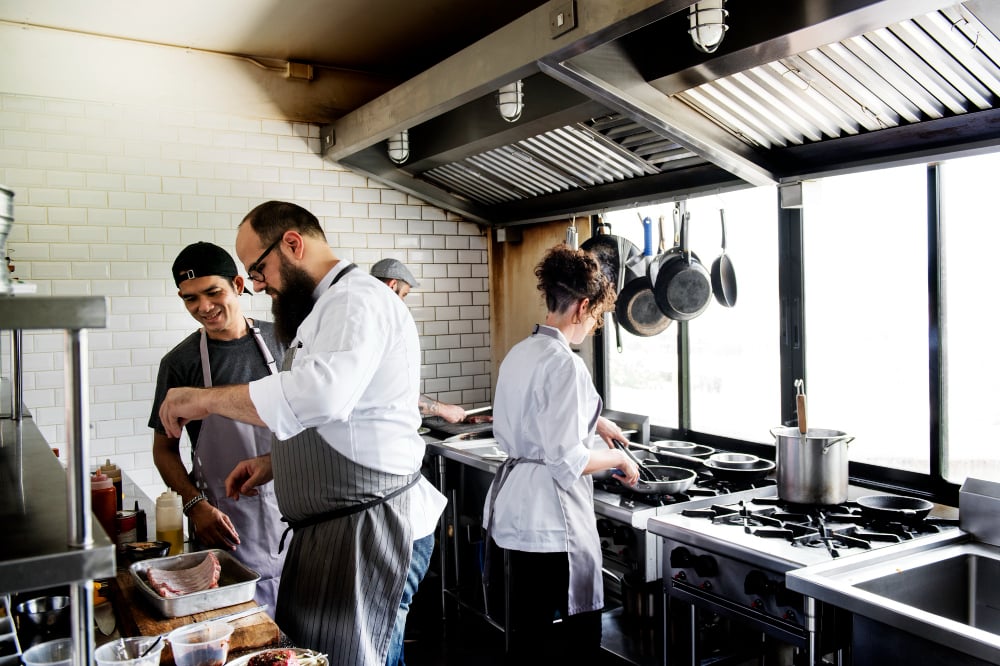
The man in the black coat stopped in the doorway of the dining hall and looked around the room.
He was tall. Maybe fifty. Dark suit, long black wool coat, gray at the temples. He didn’t look like anybody else in that room. Everybody else was wearing whatever they had. Hoodies. Work boots. A woman near the window had three sweaters on, one over the other.
He scanned the tables, slowly, like he was looking for one face out of three hundred.
Then he found it.
My son’s.
Noah was sitting next to me at the end of a long folding table, holding a paper cup of water. He’d been rubbing the zipper of his backpack with his thumb all afternoon. Back and forth. Back and forth.
When he saw the man, his thumb stopped.
His face went white. Whiter than the chemo had already made it.
He grabbed his backpack with both arms and pulled it into his lap.
The man walked straight across the dining hall toward us. Past the dessert table. Past the woman in three sweaters. Past a little boy eating chocolate cake with his hands.
He stopped in front of our table.
“Clarice?” he said.
I stood up.
“Yes?”
“I’m Daniel.”
I’d heard that name once before. Through a bedroom door. Hi, Daniel. Followed by a sentence that had been sitting in my chest like a stone for two weeks.
Please don’t tell my mom yet.
I looked down at Noah. He was holding his backpack like it was a life jacket.
“Is everything okay?” I said.
The man raised both hands. Palms out. Gentle.
“Yes,” he said. “Noah isn’t in trouble. I promise.”
I stayed standing.
He glanced down at my son. Something soft passed over his face. Then he looked back at me.
“He hasn’t told you the truth,” he said. “Has he?”
My husband, Mark, died four years ago.
It was a Thursday in October. He was driving home from his shift at the warehouse. A truck ran a red light on Route 9. The police officer who came to my door kept his hat in his hands the whole time. I remember that. I remember staring at that hat.
Noah was eight. He was in the living room building a tower out of couch cushions. He heard me make a sound I’d never made before, and he came running into the hallway, and he saw my face, and he knew.
I thought nothing in the world could ever hurt worse than that night.
I was wrong.
Eleven months ago, my son was diagnosed with cancer.
It started with bruises. Big purple ones on his shins that he couldn’t explain. Then he got tired. Not normal tired. He fell asleep at the dinner table one night with his fork in his hand.
Then a fever that wouldn’t go away.
Then a blood test.
Then a doctor in a small room with a box of tissues on the table, saying a word I had to ask her to spell.
Leukemia.
Noah was eleven when treatment began.
He turned twelve in a hospital room.
I bought cupcakes from the hospital cafeteria for his birthday. Chocolate, with blue frosting. That was all they had.
He took one bite and made a face.
“This frosting tastes like toothpaste,” he said.
“It does not.”
“It does. Minty toothpaste. Taste it.”
I tasted it. It tasted a little bit like toothpaste.
He ate two.
That was Noah. Even scared, even sick, even with a tube in his arm, he could find something ridiculous to say.
That night, after the nurses came through for the last check, he looked up at me from his pillow.
“Mom,” he said. “I have to get better.”
“Why’s that?”
“Because who else is gonna leave dirty socks all over the house?”
I laughed.
Then I said I was going to get some ice. I stepped out into the hallway, and I pressed my back against the wall next to the hand sanitizer dispenser, and I cried into my sleeve until a nurse named Tasha came and put her hand on my shoulder and didn’t say anything.
He never saw that part.
At least, I hoped he didn’t.
For weeks, I barely left his room.
I slept in the fold-out chair by the window. It was too short for me. My feet hung off the end. I learned to sleep curled up on my side like a shrimp.
There were tests. Then more tests. Then waiting for the results of the tests. Then more waiting.
Some mornings, Noah barely touched breakfast. He’d push the eggs around with his spoon and say he wasn’t hungry and turn toward the wall.
Other mornings, he demanded pancakes.
“Not the hospital ones,” he’d say. “The real ones. From the place downstairs. With the whipped cream.”
I learned to love the pancake mornings. I’d run down four flights of stairs in my socks to get them before he changed his mind.
He kept a drawing of the ocean taped to the wall beside his bed.
He’d drawn it himself, with markers, the first week. Big blue waves with white tops. A yellow sun. A seagull that looked more like a capital M.
He’d never seen the ocean. Not once in his whole life. We live in Ohio. Mark always said we’d go someday. Myrtle Beach. He’d even looked up hotels.
Someday never came.
Sometimes, late at night, when Noah couldn’t sleep, he’d look at the drawing.
“Mom,” he’d say. “Are waves really that loud? Like on TV?”
“I think so.”
“Louder than the hospital?”
“I think so, baby.”
“Nothing’s louder than the hospital.”
“We’ll find out,” I said. “Someday. I promise.”
Then, one afternoon in March, a volunteer from a children’s charity came to his room.
Her name was Beth. She had red curly hair and a cheerful smile and a purple folder pressed against her chest.
“Noah,” she said, “I have a question for you.”
Noah looked at her folder suspiciously.
“Does it involve another needle?”
She laughed. “Not this time.”
She sat down on the edge of the chair and explained. Her organization granted special wishes. For kids who were going through serious illnesses. They could choose something meaningful. An experience. A trip. Something to look forward to.
Noah sat up straighter in bed.
“Like anything?”
“We’ll talk about what’s possible,” Beth said.
He looked over at his ocean drawing.
I knew what he was going to say. I was already planning it in my head. A beach. A hotel with a pool. His feet in the sand. The first wave.
Instead, he asked something completely different.
“Could I buy dinner for people?”
Beth tilted her head.
“What kind of dinner?”
“For people who don’t have enough food.”
He pulled his blanket up over his knees.
“Not sandwiches in bags,” he said quickly. “I mean a real dinner. A proper one.”
His fingers traced the blue seam along the edge of the hospital blanket.
“With tables. And chairs. And real plates.”
He thought for a second. Then his mouth curved up into a grin.
“And dessert,” he said.
I stared at him.
“Noah, sweetheart,” I said. “This is your wish.”
“I know, Mom.”
“You could choose something just for you. The ocean. You could see the ocean.”
He shrugged one thin shoulder.
“People do stuff for me every day,” he said.
He looked over at the IV pole beside his bed. At the bags of medicine dripping down the tube into his arm.
“Every single day,” he said. “Nurses. Doctors. You. Everybody does stuff for me.”
He looked back at Beth.
“I want to do something for somebody else.”
Beth didn’t say anything for a moment. She looked down at her folder. When she looked up again, her eyes were wet.
“How many people were you thinking?” she asked.
Noah considered it very seriously.
“As many as we can,” he said.
Beth made some phone calls.
A week later, she came back with news. She’d contacted an outreach program on the east side of the city. The Harbor Street Community Center. They served meals four nights a week and ran a food pantry on weekends.
Their building had a big dining hall. Their kitchen could cook for several sittings in one afternoon. With enough volunteers, they could serve three hundred people.
Noah’s eyes went huge.
“Three hundred?”
The coordinator at Harbor Street, a woman named Rosa, came to the hospital herself the next day to meet him. She was short and solid, maybe sixty, with silver hair in a long braid and reading glasses pushed up on her head.
“Three hundred dinners,” she said, standing at the foot of his bed. “That’s our workable target. That’s the most we can do in one day.”
“Then we need really good food,” Noah said.
Rosa laughed. “What did you have in mind?”
He’d already made a list. On the back of a hospital menu.
Macaroni and cheese. The real kind, baked, with the crunchy top.
Roast chicken.
Green beans. “Because you’re supposed to have a vegetable,” he said, looking at me.
Warm bread with butter.
And chocolate cake.
“Lots of chocolate cake,” he said. “Like, a lot. Way more than you think.”
Rosa wrote it all down.
For the first time in months, our conversations weren’t about treatment.
They weren’t about blood counts or platelets or whether he could keep his breakfast down. They were about napkins. Tablecloths. Whether people would want lemonade or iced tea.
“Both,” Noah decided. “People should get to choose.”
I watched my son come back to life a little. Planning. Deciding. Being in charge of something. After eleven months of everybody else deciding everything for him.
But something else caught my attention too.
Noah kept checking his backpack.
It was his old school backpack. Green, with a broken zipper pull that he’d replaced with a paperclip. He kept it on the chair beside his bed. He never let it out of his sight.
Inside, there was a small box. A keepsake box. Wooden, with a little brass latch. I’d seen it once when he was digging for his phone charger.
Whenever I came near, he zipped the bag shut.
“What are you hiding in there?” I asked him one evening.
“Nothing.”
“Then why the big secret?”
He grinned.
“Maybe I’m planning your birthday.”
“My birthday’s six months away.”
“Exactly,” Noah said. “I’m organized.”
I laughed.
But he didn’t open the bag.
To understand why that box mattered, you have to understand what happened after Mark died.
We didn’t have much. We never had. Mark worked at a distribution warehouse. I cleaned offices at night. We had a small two-bedroom apartment over a laundromat on Wade Street. We were fine. Just barely, but fine.
Then he was gone.
His life insurance through work was ten thousand dollars. The funeral cost eight. The warehouse sent a sympathy card signed by forty people and a gift basket of fruit.
Without his paycheck, everything fell apart in about six weeks.
I picked up extra shifts. Then I picked up a second job at a grocery store. I still couldn’t make the rent. I sold Mark’s truck. I sold his guitar. I sold my grandmother’s ring.
By January, I was choosing between the electric bill and food.
I chose the electric bill. Noah needed the heat.
There was one afternoon I’ve never forgotten. I thought Noah had.
It was a cold Saturday in late January. Gray sky. The kind of cold that gets in your teeth.
I’d taken Noah to the park on Euclid Avenue because the library was closed and the apartment was too sad to sit in. He wanted to play on the swings. I sat on a bench and watched him.
I’d packed him a sandwich. Peanut butter and grape jelly on white bread.
It was the last of the bread. The last of the peanut butter, too. I’d scraped the jar with a spoon to get enough.
There wasn’t enough for two.
When he came over to the bench, out of breath, cheeks pink from the cold, I handed it to him.
“Aren’t you having one?” he asked.
“I already ate,” I said. “Before we left. You were in the bathroom.”
He looked at me for a second.
Then he sat down next to me on the bench and started eating.
He was eight.
I thought he believed me.
A man came walking down the path.
He wore a worn brown jacket with a torn pocket. Jeans with a hole in one knee. A knit cap. He was maybe forty-five, thin, with a scruffy beard. He was carrying a paper bag.
He sat down on the other end of our bench.
He took a sandwich out of the bag. Turkey and cheese, on wheat bread, wrapped in a paper napkin.
He looked over at Noah, eating his peanut butter and jelly.
Then he looked at me. At my empty hands. At my hands that kept twisting the strap of my purse.
He didn’t say anything for a long time.
Then he tore his sandwich in half.
He held one half out to me. Still wrapped in the napkin.
“Oh, no,” I said. “No, thank you. I’m fine. I already ate.”
He didn’t take it back.
He just set it down on the bench between us.
“My name’s Michael,” he said.
He pointed toward the road on the far side of the park.
“I volunteer at the outreach center across town,” he said. “Harbor Street. Over on the east side.”
He nodded down at my hands. At the purse strap.
“I know what hunger looks like,” he said quietly.
I didn’t say anything. I couldn’t.
He pushed the half sandwich a little closer to me on the bench.
“There’s enough,” he said.
I sat there for a long time.
Noah stopped eating. He was watching me.
Eventually, I picked up the sandwich.
I ate it.
It was the best thing I’ve ever eaten in my entire life. Turkey and cheese on wheat bread, a little dry. No mustard.
When I looked up to thank him, Michael was already walking away down the path, with his hands in his jacket pockets and the paper bag folded under his arm.
I called after him. “Thank you!”
He lifted one hand without turning around.
That was it. That was the whole thing. Maybe ten minutes.
I went back the next day.
I made two sandwiches that morning with bread I’d bought with the last four dollars in my wallet. Turkey and cheese. No mustard. I wrapped one in a paper napkin.
I went to the park. I sat on the same bench. I waited.
He didn’t come.
I went back the day after that. I waited for two hours, until Noah got cold and wanted to go home.
The bench stayed empty.
I never saw Michael again.
A few months later, things got better. Slowly. I got a full-time job as a receptionist at a dental office. Benefits. Steady hours. We moved to a slightly bigger apartment on Lake Street.
We were okay.
And I never told Noah about going back to the park. I didn’t want him to remember that winter. I wanted him to forget we’d ever been hungry.
I thought he had.
Noah came home between appointments in April. His counts were good enough for a few weeks at home.
The dinner was set for the second Saturday in May.
Planning took weeks.
The adults handled the kitchen. Rosa and the kitchen manager, a big laughing woman named Darlene, worked out the menu and the food safety and the timing. A church across the street lent us forty extra folding chairs. A grocery store donated the chicken. A bakery downtown heard about it on the local news and said they’d make the cakes. All of them.
Noah got to choose the napkins.
He wanted yellow ones.
“Why yellow?” Rosa asked.
“Because white looks like hospital paper,” Noah said.
I understood that completely.
During one planning visit at the Harbor Street Center, Darlene waved me over to the kitchen.
“Clarice! I need some signatures on these allergy forms!”
I followed her over to the big steel serving counter. Noah stayed behind with Rosa at a table in the dining hall. His backpack was sitting on the floor between his sneakers.
Darlene walked me through the food restrictions. Nut allergies. Gluten. Dairy. Which pans would be used for what.
I glanced back over my shoulder.
Noah had the backpack in his lap. He’d opened it. He’d taken out the little wooden box. He was showing Rosa something inside it.
She was listening very carefully. Leaning toward him. She said something. He nodded.
Then she opened her folder and wrote something down.
I couldn’t hear them. The dining hall was too big, and Darlene was talking about cross-contamination.
Darlene tapped the last signature line with her pen.
“Right here, hon.”
I signed it. I walked back across the dining hall.
By the time I got there, Noah had zipped the backpack shut. It was on the floor again.
Rosa was sliding a piece of paper under the clip of her clipboard.
“What did I miss?” I asked.
Noah adjusted the strap of his backpack.
“Napkin business,” he said.
Rosa smiled at me.
“Highly confidential napkin business,” she said.
I looked from one of them to the other.
Neither one of them said anything else.
I figured they were planning some kind of surprise for the dinner. A cake with my name on it, maybe. Something like that.
On the drive home, Noah was quiet.
Unusually quiet. He held his backpack in his lap with both arms around it. He looked out the window and didn’t say anything.
When we pulled into our parking spot behind the building, I reached over and put my hand on his shoulder.
“You seem quiet, honey.”
“Just tired.”
His arms got tighter around the backpack.
For a second, I thought he was about to tell me something. He opened his mouth. He looked at me.
Then he looked away, toward our building.
“Can we get pizza?” he said.
I wanted to push him. I wanted to say, What’s in the box, Noah? What did you show Rosa? What’s going on?
But treatment had taken so many choices away from him. What he ate. When he slept. Who touched him. What went into his arm. I didn’t want to take one more thing.
“Only if you order something besides plain cheese,” I said.
He managed a tired smile.
“Absolutely not.”
I ordered his favorite. Plain cheese, extra cheese.
He ate two slices on the couch with a blanket over his legs. We put on a movie, the one with the robot who falls in love.
He fell asleep before it was over.
His backpack stayed tucked under his arm the whole time. Even asleep, he held onto it.
At his next hospital appointment, the doctors talked through the dinner.
They approved it, carefully.
Noah would have to stay away from the crowded serving lines. He couldn’t handle hot food or hot pans. He had to wear a mask. He had to sit down every half hour. We’d leave the minute he got tired.
Noah listened to the whole list without interrupting once. That had never happened before.
Then he raised his hand. Like he was in school.
“Can I still hand out napkins?”
The nurse, Tasha, smiled.
“With the precautions we talked about,” she said. “From your own table. With your mask on.”
“Excellent,” Noah said.
He turned and looked at me.
“Official napkin manager,” he said.
I laughed.
But later that night, back at home, I found him on his bed looking at something.
A folded scrap of paper was lying on his blanket. He was smoothing it out with his fingers.
It looked old. Yellowed. Soft, like it had been folded and unfolded many times. One corner had a faint brown stain on it.
When he saw me in the doorway, he folded it up fast and slipped it into a clear plastic sleeve and put it back in the wooden box.
“What’s that?” I asked.
“Just something I kept.”
“Kept from where?”
He hesitated.
“A long time ago,” he said.
Before I could ask anything else, his phone rang on the nightstand.
He grabbed it right away.
“Hi, Daniel,” he said.
I stopped in the doorway.
I’d never heard that name before. Not once. Not from Noah, not from Rosa, not from Beth, not from any of the doctors.
Noah lowered his voice. He turned slightly away from me, toward the wall.
I stepped back into the kitchen. He was twelve. He deserved some privacy.
But our apartment is small. The walls are thin.
I heard one sentence.
“Please don’t tell my mom yet.”
My hand stopped on the kitchen counter.
I stood very still.
Noah’s voice again, softer.
“I want to do it myself.”
A pause. Then he laughed. A nervous little laugh.
“Yeah,” he said. “I know. I know.”
Then he hung up.
I waited a minute. Then I went back into his room.
“Who’s Daniel?” I asked.
“A guy from the outreach program.”
“Why haven’t I met him?”
Noah rubbed his forehead with the heel of his hand.
“You might,” he said.
I sat down on the edge of his bed. I picked up his hand.
His hand was so thin. His knuckles stuck out like little marbles.
“Honey,” I said. “If this is too much. If you’re too tired. We can change things. We can push it back. Nobody would mind.”
He shook his head hard.
“Don’t cancel it, Mom.”
“I wasn’t going to cancel it.”
“Promise?”
“I promise.”
His shoulders relaxed back against the pillow.
But he still wouldn’t tell me who Daniel was.
I didn’t sleep much that night.
I lay in bed and stared at the ceiling and thought about every awful thing it could be.
A stranger calling my twelve-year-old son. Asking him to keep secrets from me.
I thought about calling Rosa first thing in the morning. I thought about calling the police. I thought about taking Noah’s phone and reading every message.
At three in the morning, I got up and went to his room.
He was asleep. His mouth was open. One arm was flung over the backpack.
I stood in the doorway and watched him breathe.
And I decided to trust him.
He’d never given me one reason not to. Not in twelve years. Not once.
I went back to bed.
The morning of the dinner, Noah woke up at five-thirty.
He’d barely slept. Neither had I.
He put on his favorite blue sweatshirt. The one with the hole in the cuff that he chews on when he’s nervous. It hung off him now. Two sizes too big. It used to fit.
Then he checked his backpack. Three times.
“Do you have everything?” I asked.
“Probably.”
“Water bottle?”
“Yes.”
“Mask?”
“Yes, Mom.”
“Hand sanitizer?”
“Yes.”
“Your secret collection of stolen hospital socks?”
He grinned.
“That’s in a different bag.”
I kissed his forehead.
He tolerated it.
We drove to the Harbor Street Center at nine in the morning. The dinner didn’t start until noon, but Noah wanted to see everything get set up.
Volunteers were already putting out tables. Somebody had hung yellow streamers from the ceiling. Somebody else had put little vases of daisies on every table.
The kitchen smelled like roasted chicken and warm bread. Big steel trays were lined up behind the serving counter. Darlene was yelling cheerfully at somebody about the macaroni.
Noah stopped inside the doorway.
He counted the tables. Out loud. Under his breath.
“Thirty,” he said. “Thirty tables.”
He turned to Rosa, who’d come over to meet us.
“All this?” he said.
Rosa smiled.
“All this,” she said. “For you, kiddo.”
“Not for me,” Noah said. “For them.”
Then he looked toward the entrance. He took out his phone. He checked it.
I noticed.
But I didn’t ask.
Not yet.
The first guests started arriving around eleven-thirty.
Some came alone. Some came in pairs. A mother came with four little kids, all holding hands in a line like ducklings. An old man came on a walker with a tennis ball on each foot. A teenage boy came in by himself, hood up, and sat in the corner and didn’t look at anybody.
One of the first men through the door was big and bearded, in a Carhartt jacket with paint on it. He stopped at the dessert table. He stared.
“Chocolate cake?” he said.
Noah was sitting at his little napkin table right next to it. He nodded proudly.
“That was my idea.”
The man looked down at him. At the mask. At the blue sweatshirt hanging off his shoulders.
“Good decision, kid,” he said.
Noah laughed.
Noah had his own table. Off to one side, away from the serving lines, near an open window for fresh air. Rosa had set it up for him with a big stack of yellow napkins and a hand-lettered sign that said OFFICIAL NAPKIN MANAGER.
Every person who walked past got a yellow napkin.
Some of them laughed. Some of them said thank you. A few didn’t say anything at all, just took the napkin and kept walking. Noah handed them one anyway.
I stayed nearby. Rosa kept an eye on his breaks with a timer on her phone. Every half hour, it beeped, and Noah groaned and sat back in his chair for ten minutes.
“I’m fine,” he said every single time.
“Sit,” Rosa said every single time.
He sat.
Around two o’clock, between sittings, Darlene brought him a piece of chocolate cake on a paper plate.
“Quality control,” Noah explained to me, picking up his fork.
I rolled my eyes.
“Very important work,” I said.
He ate half of it. That was more than he’d eaten in one sitting in three weeks.
Then he put down his fork and asked when the next group was coming.
All afternoon, Noah kept watching the entrance.
Not constantly. Just often enough for me to notice. Every time the door opened, his head turned.
Around three, I leaned down next to him.
“Expecting somebody?”
He shook his head.
“Maybe,” he said.
“That’s not an answer, Noah.”
“It’s the best one I’ve got, Mom.”
I let it go.
The guests kept coming.
The mother with the four kids came back through the line a second time and asked if it was okay. Rosa said it was more than okay. The littlest one, a girl about three, got macaroni and cheese all over her face and her dress and the table and laughed like it was the best day of her life.
The teenage boy in the corner never took his hood off. But he ate two full plates. And when he left, he stopped at Noah’s table.
“Thanks, man,” he said quietly.
“You want a napkin?” Noah said.
The boy looked at him for a second. Then he took one. He folded it carefully and put it in his pocket.
An older woman came up to Noah’s table late in the afternoon. She was maybe seventy, small and stooped, with a plastic rain bonnet on her head even though it wasn’t raining.
She thanked him for the napkins.
Noah shrugged. He was straightening his stack of napkins again, making the edges perfect.
“They’re just napkins,” he said.
The woman smiled at him. She had very few teeth. It was a beautiful smile.
“They’re useful, son,” she said. “You’d be surprised how long it’s been since somebody handed me something useful.”
Noah looked up at her.
Then he picked up a second napkin. He held it out.
“Then take two,” he said.
By five o’clock, he was exhausted.
He was sitting next to me with his head on my shoulder. His backpack was on the floor, propped against his knees.
I watched him rub the zipper with his thumb. Back and forth. Back and forth.
Something was still bothering him.
Rosa came over with her clipboard. She was smiling so wide her eyes almost disappeared.
“We’ve served three hundred guests,” she said.
Noah lifted his head.
“Exactly?”
Rosa checked the clipboard. She turned it around so he could see. Tally marks. Rows and rows of them.
“Three hundred served,” she said. “Exactly.”
He smiled. So wide that I almost started crying right there.
Then he leaned his head back against my shoulder.
“Did we do good, Mom?” he asked.
“We did wonderful, sweetheart.”
He yawned.
“Can I have more cake?”
“After some water.”
He groaned.
“You’re impossible.”
I handed him his water bottle. He drank.
Then he looked toward the entrance again.
And his thumb stopped moving on the zipper.
That’s when the man in the black coat walked in.
That’s when Noah went pale and pulled his backpack into his lap.
That’s when the man walked across the room and said my name and told me he was Daniel.
And that’s when he said, He hasn’t told you the truth, has he?
I pulled out the chair next to Noah and put my hand on his back. I could feel his spine through the sweatshirt. Every bone.
“What truth?” I said.
“Noah asked the coordinator not to tell you,” Daniel said.
I turned to my son.
“When did you talk to Rosa?”
Noah kept rubbing the zipper.
“During that planning visit,” he said. He wouldn’t look at me. He kept his eyes on his hands. “When you were with Darlene. Signing the allergy stuff.”
Daniel glanced at Noah. Then back at me.
“I’m sorry,” he said. “That came out sounding a lot worse than I meant it.”
He gestured to the empty folding chair across from us.
“May I sit?”
I nodded.
Daniel sat down across from us. He unbuttoned his coat. Underneath, his suit was nice, but his tie was crooked, like he’d tied it in a car.
He folded his hands on the table.
Then he asked me a question.
“Do you remember a man who shared his sandwich with you?”
The metal edge of the folding chair pressed into my palm.
A park bench came back to me.
A cold afternoon in January. A gray sky. Peanut butter scraped out of the bottom of a jar with a spoon.
A hungry eight-year-old boy, eating the last sandwich.
And a stranger in a worn brown jacket, tearing his own sandwich in half.
“Michael?” I whispered.
Daniel nodded slowly.
“He was my brother,” he said.
Noah unzipped his backpack.
The zipper caught twice under his fingers. He had to work it loose.
He took out the little wooden keepsake box.
Then he looked at me.
“Mom,” he said. “There’s something I never told you.”
He opened the brass latch.
Inside, there was a folded paper napkin.
He’d kept it in a clear plastic sleeve. The kind you put baseball cards in. The edges of the napkin had gone yellow. There was a faint brown stain on one corner.
I knew it before he even unfolded it.
“Remember the park, Mom?” he said.
I looked at Daniel.
Then I looked at my son.
“Of course I remember,” I said.
Noah lifted the plastic sleeve out of the box. Very carefully. Like it was made of glass.
“Michael wrapped the sandwich in this,” he said. “The half he gave you. When you weren’t looking, after you ate it, I took the napkin off the bench and put it in my coat pocket.”
“You kept it?” I said. “For four years?”
He nodded.
“I knew you hadn’t eaten, Mom,” he said.
I took the plastic sleeve from him. I held it between my fingers.
“Why didn’t you say anything?” I whispered.
Noah looked down at the table.
“Because you looked sad enough already,” he said.
I pulled him against me.
He leaned into me. His head fit right under my chin. Just like it did when he was little.
Then he whispered something else. Right against my collarbone. So quietly I almost didn’t hear it.
“That’s why I picked the dinner,” he said.
I closed my eyes.
He’d remembered that afternoon for four years. He’d carried that napkin through a move, and a new school, and eleven months of hospitals. He’d kept it in a box and taken it out at night and looked at it.
And I’d never known.
Daniel was quiet for a long time. He let us have that.
Then he folded his hands on the table again.
“Michael was my older brother,” he said. “Eight years older. He practically raised me after our dad left.”
He looked out at the crowded dining hall. At the long tables. At the yellow streamers.
“He lost his apartment about six years ago,” Daniel said. He rubbed one thumb slowly across his knuckles. “He’d been a line cook for twenty years. The restaurant closed. Then his knee went bad. Then he couldn’t stand on it for a full shift. Then the rent went up.”
He was quiet for a moment.
“I didn’t know how bad it was,” he said. “Not for a long time. He didn’t tell me. Michael never told anybody when he needed something. Only when somebody else did.”
“For a while, he stayed in temporary housing,” Daniel said. “Shelters. A room at the Y.”
I thought about the worn brown jacket. The torn pocket. The hole in the knee of his jeans.
“He’d volunteered here, at Harbor Street, for years before that. Back when he was working. Every Sunday. Cooking.”
Daniel nodded toward the big steel serving counter. Toward Darlene, laughing behind it.
“And after he lost his place, he kept coming back,” Daniel said. “Even when he was staying at the shelter. He’d come in and help in the kitchen. Then he’d eat with everybody else after.”
Noah looked up.
“That’s how they remembered him,” Noah said. “Here.”
Daniel nodded.
“Eventually he found somewhere permanent,” Daniel said. “A little studio over on Forest Avenue. Through a housing program. He was so proud of it. He sent me a picture of his own front door key.”
He smiled a little. Then the smile went away.
“When Noah told Rosa about the sandwich,” he said, “she knew right away who it was. Michael used to make sandwiches here every Saturday to hand out at the park on Euclid. In paper bags. Turkey and cheese, on wheat. Always wrapped in a napkin.”
“No mustard,” I said.
Daniel looked at me. He laughed. It came out wet.
“No mustard,” he said. “He hated mustard.”
“Rosa called me,” Daniel said. “After Noah showed her the napkin. She set up a video call. Between Noah and me.”
He looked at my son.
“Noah told me about his wish,” Daniel said. “About the three hundred dinners. About why.”
Noah rubbed his eyes with the back of his wrist.
“I asked Rosa to find you,” Daniel said to me. “I wanted to meet you. Both of you. I wanted to come today.”
He pressed his fingers against something inside his coat pocket.
“Michael died last year,” he said. “In August. His heart. In his sleep. In his own apartment. With his own key on the hook by the door.”
I lowered my eyes.
“I’m so sorry,” I said.
Daniel nodded.
“I never knew about that sandwich,” he said. “He never told me. He never told anybody about things like that. I found out about half the things he did for people at his funeral. Strangers kept coming up to me. Telling me stories.”
He looked at the yellowed napkin in the plastic sleeve.
“I never heard this one,” he said.
And then I remembered something I’d never told Noah. Or anybody.
“I went back,” I said.
Noah frowned at me.
“Where?”
“To the park,” I said. “The next day.”
I smoothed the plastic sleeve flat against the folding table with my fingertips.
“I made Michael a lunch. With the last four dollars I had. Turkey and cheese. On wheat. No mustard. I wrapped it in a napkin, just like he did.”
Daniel leaned closer across the table.
“I waited by that same bench,” I said. My finger followed the yellow edge of the napkin. “For two hours. Until you got cold, Noah.”
I looked at my son.
“But he never came.”
“I tried again the next afternoon,” I said. “And the one after that.”
I shook my head.
“The bench stayed empty,” I said.
Noah was staring at me.
“You remembered him too?” he said.
“Every single time I packed your school lunch,” I said. “Every time. For four years.”
Noah wiped his cheek against the sleeve of his blue sweatshirt.
“I thought you forgot,” he said. “I thought you wanted to forget. You never talked about that winter. Not ever.”
I shook my head.
“Not for a single day, baby,” I said. “I just didn’t want you to remember it. I wanted you to have forgotten we were ever that hungry.”
“I didn’t forget,” Noah said.
“I know that now.”
Daniel looked down at his hands for a long moment.
Then he reached into the inside pocket of his coat.
He brought out an index card. Old. Bent at one corner. Stained with something that might have been coffee or might have been grease.
“Michael used this,” he said. “When he volunteered here. It was taped to the wall above his station in the kitchen. Darlene saved it for me after he died.”
He held it out to Noah.
“He liked making sandwiches for people,” Daniel said.
Noah took the card. He held it in both hands.
The handwriting was in pencil. Dark and uneven, like it had been pressed hard into the paper.
MICHAEL’S SANDWICHES
Wheat bread (toast it if it’s stale — nobody will know)
Turkey. Not too thin.
Swiss or provolone. Never American. American is not cheese.
Lettuce if we got it.
Tomato if it’s summer.
Wrap in napkin. Paper bag. Hand it to them. Look them in the eye.
Noah read it twice.
Then he looked up.
“Does this have mustard?” he asked seriously.
Daniel laughed out loud.
“Michael hated mustard,” he said. “He said mustard was a crime against turkey.”
“Good,” Noah said. “He had excellent taste.”
Daniel laughed again. Then he looked out at the dining hall one more time.
The last sitting was finishing up. The mother with the four kids was wrapping cake in napkins to take home. The old man with the walker was asleep in his chair with his hands folded over his stomach. The man in the paint-stained Carhartt jacket was helping Darlene stack chairs.
“I think he would’ve loved today’s dinner,” Daniel said.
Noah looked down at his empty cake plate.
“Even the dessert?” he said.
Daniel smiled at him.
“Especially that.”
We stayed until almost everyone was gone.
Daniel helped fold tables. He took off his black coat and his suit jacket and rolled up his sleeves and folded tables with the rest of the volunteers. Darlene put him to work drying pans.
Before we left, Rosa came over with a small brass plaque. It was new. Still in the plastic.
“We had this made last week,” she said. “Daniel paid for it. We’re putting it on the wall above the station where Michael used to work.”
She held it up so Noah could see.
MICHAEL’S KITCHEN
“There’s enough.”
Noah read it.
“That’s what he said,” Noah said. “On the bench. That’s exactly what he said to Mom.”
“I know,” Rosa said. “You told me. That’s how we knew what to put on it.”
Daniel walked us out to the car.
It was dark by then. The parking lot lights were buzzing.
Noah was so tired he could barely walk. I had my arm around him. He was holding his backpack against his chest.
At the car door, Noah stopped. He turned to Daniel.
“Can I ask you something?”
“Of course.”
“Was Michael happy? At the end? In his apartment?”
Daniel crouched down so he was eye level with Noah. In the parking lot. In his nice suit pants.
“Yes,” he said. “He was happy. He had his own key. He had his own kitchen. He made sandwiches every Saturday right up until the week he died.”
Noah nodded slowly.
“Good,” he said.
Then he did something I didn’t expect. He opened his backpack. He took out the little wooden box. He held it out to Daniel.
“Do you want this?” he said. “It was your brother’s napkin.”
Daniel looked at the box for a long time.
Then he gently closed Noah’s fingers around it.
“No,” he said. “He gave it to you. Keep it. You’ve taken better care of it than anybody else ever could.”
A few weeks later, Noah had another hospital appointment.
A long one. Blood work and a scan and a meeting with his doctor in the small room with the box of tissues.
His counts were better. Not done. Not finished. But better. The doctor used the word “responding.” She said it twice. I made her say it a third time.
We drove home tired. Both of us.
That afternoon, Noah asked for sandwiches.
We tried Michael’s recipe.
Wheat bread. Turkey, not too thin. Provolone, because Swiss gives Noah a stomachache. Lettuce, because we had it. No tomato, because it was May and the tomatoes at the store looked sad.
No mustard.
Noah took one bite and made a face.
“The bread’s too chewy,” he said.
“Then stop eating it.”
“I’m evaluating it, Mom.”
He took another bite. Then another one.
While he was evaluating, I made one more sandwich.
I wrapped it in a paper napkin. A yellow one, left over from the dinner. I put it in a plastic container.
Noah watched me close the lid.
“Who’s that for?” he asked.
“The outreach program,” I said. “If they’ll take it.”
I slid the container into the refrigerator.
“We’ll have to check their donation rules first,” I said. “Rosa will know.”
He nodded.
“Can we make more next time?”
“We can ask what they need.”
Noah looked at the refrigerator for a long time.
“Michael only gave us half,” he said quietly.
I sat down across from him at the table.
“It was enough that day, sweetheart,” I said.
He thought about that. Really thought about it. I could see him turning it over.
Then he pushed his empty plate across the table toward me.
“Speaking of enough,” he said. “Can I have another one?”
I reached for the bread.
“Of course,” I said.
Rosa said they’d take sandwiches every Saturday. As many as we could make.
So every Saturday morning, we make them. At our kitchen table on Lake Street.
The first week, we made six. The second week, ten. Then Daniel heard about it and started coming over on Saturdays with bags of groceries. Then Tasha the nurse came, on her day off. Then Beth from the wish charity. Then two of Noah’s friends from school, once their parents said it was okay.
Last Saturday, there were nine of us crowded around my little kitchen table and the counter and the top of the washing machine, making a hundred and twelve sandwiches.
No mustard.
Wrapped in napkins. Yellow ones.
Noah is still the official napkin manager.
We drive them over to Harbor Street at noon. Darlene meets us at the back door. She hands them out at the park on Euclid Avenue on Saturday afternoons. The same park. The same bench, sometimes.
Noah can’t go into the park yet. Too many people. Too many germs. The doctors say not yet.
So he sits in the car with the window down and watches.
Last Saturday, a girl about eight years old took a sandwich from Darlene. She sat down on the bench. She unwrapped it.
Then she looked over at the woman next to her. Her mother, maybe. A thin, tired woman, holding her purse strap with both hands.
The little girl tore her sandwich in half.
She held one half out to her mother.
The woman shook her head. The little girl didn’t take it back. She set it down on the bench between them.
Noah watched the whole thing through the car window.
He didn’t say anything.
He just reached over and took my hand.
In September, Noah’s doctor said a word I’d been waiting almost a year to hear.
Remission.
She said it carefully. She said it with a lot of other words around it. Early. Monitoring. Maintenance therapy. Every three months.
But she said it.
I didn’t cry in the little room with the tissues. I waited until we got to the parking garage. Then I sat in the car with my forehead against the steering wheel and cried so hard Noah had to pat my back.
“Mom,” he said. “Mom. You’re supposed to be happy.”
“I am happy,” I said. “This is what happy looks like.”
“It looks weird,” Noah said.
In October, we went to the ocean.
The charity said Noah could still have a wish. A second one. Beth said she’d never seen anybody use their first wish on somebody else, and the board had voted unanimously.
So we went to Myrtle Beach. The hotel Mark had looked up all those years ago was still there. I booked it.
Daniel drove down to meet us for a day. He brought a cooler full of sandwiches. Turkey and provolone on wheat. Wrapped in yellow napkins.
The first morning, Noah walked down to the water in his blue sweatshirt. It fit him a little better now. He’d gained six pounds.
He stood at the edge of the water. The waves came up over his sneakers. He didn’t even care that they got wet.
He just stood there. Listening.
“Mom,” he said, without turning around.
“Yeah, baby?”
“It’s louder than the hospital.”
I laughed. I stood next to him in the cold water.
“I told you,” I said.
“You said you thought so.”
“Well. Now we know.”
Noah still has the wooden box. It’s on the shelf above his bed, next to his ocean drawing.
He added something to it after the dinner. Michael’s recipe card. Daniel said he could keep it.
So now there are two things in that box. A napkin from a park bench, four years old, with a brown stain on one corner. And an index card with pencil writing on it, pressed hard into the paper.
Hand it to them. Look them in the eye.
Sometimes I think about how close I came to never knowing.
How Noah carried that afternoon by himself for four years. How he watched his mother pretend she’d already eaten, and decided not to say anything because I looked sad enough. How he was eight years old, and he knew.
How he took a paper napkin off a park bench and kept it.
And how, when somebody offered him anything in the world, the ocean, a trip, a pool, anything, he thought about a man in a brown jacket tearing a sandwich in half.
And he asked for three hundred dinners.
Michael gave us half a sandwich on a cold day in January.
He said there was enough.
I didn’t believe him then. I believed there was never going to be enough of anything ever again. Not money. Not food. Not time. Not anything.
He was right, though.
There was enough.
There was enough for that afternoon. And it turned into enough for three hundred people in a dining hall with yellow streamers. And a hundred and twelve sandwiches every Saturday. And a little girl on a bench, tearing hers in half for her mother.
It just took four years for me to see how far half a sandwich could go.
Ethan Blake is a skilled Creative Content Specialist with a talent for crafting engaging and thought-provoking narratives. With a strong background in storytelling and digital content creation, Ethan brings a unique perspective to his role at TheArchivists, where he curates and produces captivating content for a global audience.
Ethan holds a degree in Communications from Zurich University, where he developed his expertise in storytelling, media strategy, and audience engagement. Known for his ability to blend creativity with analytical precision, he excels at creating content that not only entertains but also connects deeply with readers.
At TheArchivists, Ethan specializes in uncovering compelling stories that reflect a wide range of human experiences. His work is celebrated for its authenticity, creativity, and ability to spark meaningful conversations, earning him recognition among peers and readers alike.
Passionate about the art of storytelling, Ethan enjoys exploring themes of culture, history, and personal growth, aiming to inspire and inform with every piece he creates. Dedicated to making a lasting impact, Ethan continues to push boundaries in the ever-evolving world of digital content.